Intracranial Pressure Monitoring Devices Market Analysis & Forecast: 2026-2033

Intracranial Pressure Monitoring Devices Market Size and Forecast – 2026 – 2033
The Global Intracranial Pressure Monitoring Devices Market size is estimated to be valued at USD 1.45 billion in 2026 and is expected to reach USD 2.35 billion by 2033, exhibiting a compound annual growth rate (CAGR) of 6.8% from 2026 to 2033.
Global Intracranial Pressure Monitoring Devices Market Overview
The intracranial pressure (ICP) monitoring devices market includes a variety of invasive and non-invasive products used to measure pressure inside the skull in conditions such as traumatic brain injury, stroke, hydrocephalus, and brain hemorrhage. Invasive products include external ventricular drains, intraparenchymal pressure monitors, fiber-optic catheters, and microtransducer-based systems that provide accurate real-time readings. Non-invasive products include transcranial Doppler ultrasound systems, optic nerve sheath diameter ultrasound devices, and imaging-based techniques such as MRI and CT assessments. The market is driven by rising neurological disorders, increasing ICU admissions, and demand for safer monitoring technologies. Continuous innovation is improving accuracy, safety, and clinical outcomes globally.
Key Takeaways
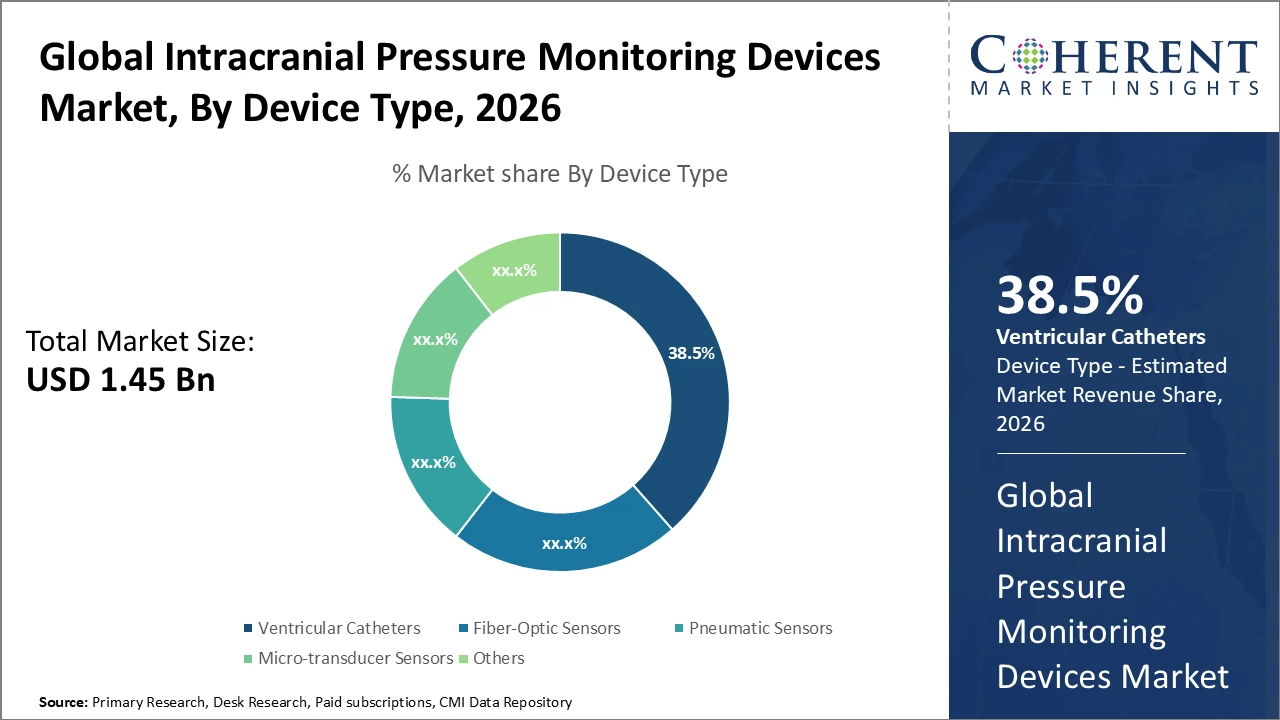
The ventricular catheters segment retains dominance in the intracranial pressure monitoring devices market, accounting for over 38.5% market share, driven by its accuracy and reliability in critical care settings.
Fiber-optic sensors are the fastest-growing segment owing to their minimally invasive nature and integration with digital monitoring systems, catalyzing innovation within device types.
Traumatic brain injury remains the primary application, with neurological surgery and stroke management units emerging as significant subsegments driving market revenue expansion.
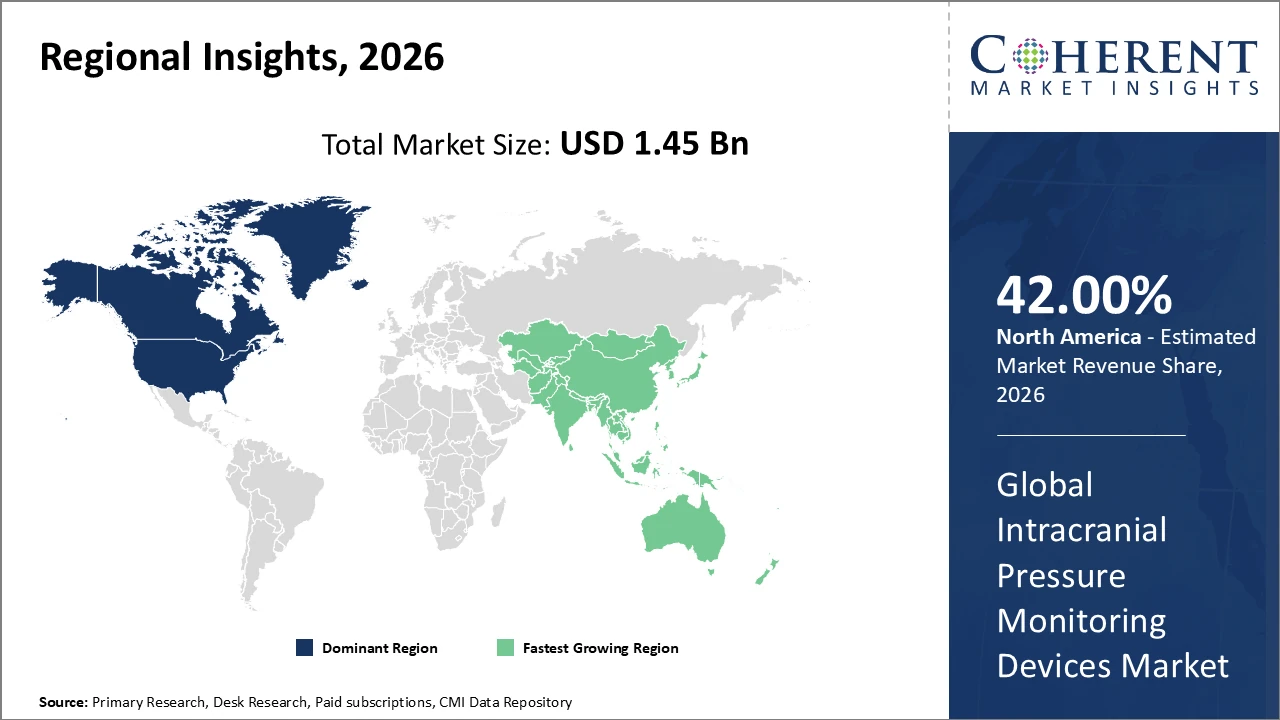
North America holds a commanding industry share of 42%, attributed to its advanced healthcare infrastructure and presence of key manufacturers.
Asia-Pacific is the fastest-growing region due to rising patient populations and governmental healthcare investments.
Europe continues to show steady growth by integrating cutting-edge technology and enhanced patient care protocols.
Intracranial Pressure Monitoring Devices Market Segmentation Analysis
To learn more about this report, Request Free Sample
Intracranial Pressure Monitoring Devices Market Insights, By Device Type
Ventricular catheters dominate the intracranial pressure monitoring devices market due to their high accuracy, reliability, and ability to provide both pressure measurement and cerebrospinal fluid drainage. They are widely used in trauma centers and neurosurgical units, supported by continuous innovations aimed at reducing infection risks and improving ease of insertion. Fiber-optic sensors represent the fastest-growing subsegment because of their minimally invasive nature, portability, and compatibility with advanced digital monitoring systems. Pneumatic and micro-transducer sensors serve niche clinical applications but hold smaller market shares due to higher costs and technical complexity. The others segment includes emerging non-invasive devices that are gradually gaining clinical acceptance.
Intracranial Pressure Monitoring Devices Market Insights, By Application
Traumatic brain injury dominates intracranial pressure monitoring device applications due to the urgent need for continuous ICP assessment to guide treatment and prevent secondary brain injury. Rising global accident rates and military-related injuries further drive demand in this segment. Hydrocephalus is a rapidly growing application, supported by implantable monitoring systems that improve cerebrospinal fluid management and reduce risks of over or under-drainage. Stroke-related monitoring is increasingly adopted in acute care settings due to frequent intracranial hypertension in ischemic and hemorrhagic strokes. Neurosurgery applications require precise ICP measurement during elective and emergency procedures to improve outcomes. The others segment includes pediatric neurocritical care and emerging uses.
Intracranial Pressure Monitoring Devices Market Insights, By End User
Hospitals hold the dominant share in the intracranial pressure monitoring devices market due to high patient volumes, advanced infrastructure, and the capability to use a wide range of monitoring systems such as ventricular and fiber-optic devices. They remain the primary centers for managing traumatic brain injuries, stroke, and other critical neurological conditions. Specialized neurocritical care centers are the fastest-growing subsegment, supported by rising establishment of dedicated neurological ICUs and improved awareness of brain injury management protocols. Ambulatory surgical centers show limited but steady adoption for outpatient neurosurgical procedures. The others segment includes rehabilitation centers and research institutions exploring emerging ICP technologies.
Intracranial Pressure Monitoring Devices Market Trends
The intracranial pressure monitoring devices market is rapidly transitioning towards smart and connected healthcare technologies.
Adoption of wireless ICP monitoring devices has increased significantly, with North American healthcare providers reporting an 18% rise in uptake in 2025 due to improved patient mobility and reduced infection risk.
AI integration in predictive neuromonitoring is improving early detection of intracranial hypertension, enhancing clinical decision-making and patient survival outcomes in 2026 clinical studies.
Growing demand for patient-friendly and minimally invasive devices is driving global R&D investments.
Biodegradable sensor prototypes are entering clinical trials in the Asia-Pacific region, reflecting innovation in next-generation ICP monitoring technologies.
Overall trends indicate a shift toward digital health integration and personalized neurocritical care solutions.
Intracranial Pressure Monitoring Devices Market Insights, By Geography
To learn more about this report, Request Free Sample
North America Intracranial Pressure Monitoring Devices Market Analysis and Trends
In North America, the intracranial pressure monitoring devices market holds a dominant position due to its well-established healthcare infrastructure, high healthcare expenditure, and rapid adoption of advanced monitoring technologies. The strong presence of leading companies such as Medtronic and Integra LifeSciences further strengthens regional leadership. Supportive regulatory frameworks and continuous innovation in neurocritical care solutions also contribute to market expansion. Hospitals and neurocritical care centers in the United States account for a significant share of global revenue, driven by a high incidence of traumatic brain injuries and an aging population requiring advanced neurological monitoring. This combination sustains North America’s market dominance.
Asia Pacific Intracranial Pressure Monitoring Devices Market Analysis and Trends
The Asia Pacific region is experiencing the fastest growth in the intracranial pressure monitoring devices market, with an estimated CAGR exceeding 8% from 2024 to 2030. This expansion is driven by increasing investments in healthcare infrastructure, growing awareness of neurotrauma management, and a rapidly expanding patient population. Government initiatives in countries such as India and China are encouraging the adoption of advanced medical technologies, boosting market penetration. In addition, collaborations between global companies and emerging regional manufacturers, particularly in China, are accelerating the development and availability of cost-effective ICP monitoring devices tailored to local healthcare needs, further supporting regional market growth.
Intracranial Pressure Monitoring Devices Market Outlook for Key Countries
USA Intracranial Pressure Monitoring Devices Market Analysis and Trends
The USA remains the largest intracranial pressure monitoring devices market, driven by continuous innovation and high procedural volumes in neurocritical care. In 2025, over 350,000 neurosurgical cases required ICP monitoring annually, supporting strong device adoption across hospitals and trauma centers. Leading companies such as Medtronic and Integra LifeSciences dominate the market with advanced product offerings, including wireless and fiber-optic sensor systems that improve clinical precision and patient outcomes. High healthcare expenditure, strong reimbursement policies, and a well-developed emergency care network further strengthen market growth. These factors collectively reinforce the United States’ leadership position in the global ICP monitoring devices industry.
Germany Intracranial Pressure Monitoring Devices Market Analysis and Trends
The Germany intracranial pressure monitoring devices market is witnessing steady growth, driven by a strong healthcare system and increasing cases of traumatic brain injuries, stroke, and hydrocephalus. Hospitals and neurocritical care units remain the primary end users, supported by advanced neurosurgical infrastructure and skilled medical professionals. Invasive monitoring devices continue to dominate due to high accuracy, while non-invasive technologies are gaining traction with advancements in imaging and digital monitoring systems. Key trends include rising adoption of minimally invasive devices, integration of AI-based diagnostic tools, and increasing demand for wireless monitoring solutions. Strong R&D activities and early technology adoption further support market expansion in Germany.
Analyst Opinion
Monitoring device pricing dynamics significantly influence market share distribution, with ventricular catheters witnessing a 3.1% price reduction in 2025, boosting demand in emerging markets.
Less invasive sensor technologies recorded an average 7.5% price increase in 2026 due to higher production costs and integration of wireless telemetry systems.
These pricing trends strongly affect hospital procurement decisions and overall revenue patterns in the intracranial pressure monitoring devices market.
Demand-supply equilibrium in neurocare facilities is improving due to rising establishment of neurocritical care units, especially in Asia-Pacific hospitals.
Asia-Pacific recorded a 12% increase in neurosurgical procedures requiring ICP monitoring in 2024, leading to a 9% rise in device consumption.
Expansion of healthcare infrastructure in emerging regions is a key driver of sustained market growth.
Use case diversification beyond trauma care is increasing, with ICP monitoring adoption in hydrocephalus and stroke management rising by 15% in 2025.
Pediatric neuro-intensive care units showed a 10% year-over-year increase in sensor implantation rates, supporting segment growth.
Expanding clinical applications are enhancing revenue opportunities beyond traditional traumatic brain injury cases.
Technological integration with real-time wireless monitoring and AI-driven analytics is improving clinical outcomes.
Hospitals adopting these systems reported a 20% improvement in early complication detection in 2026.
This shift is accelerating regulatory approvals and increasing adoption of advanced ICP monitoring solutions.
Market Scope
| Report Coverage | Details | ||
|---|---|---|---|
| Base Year: | 2025 | Market Size in 2026: | USD 1.45 billion |
| Historical Data for: | 2020 To 2024 | Forecast Period: | 2026 To 2033 |
| Forecast Period 2026 to 2033 CAGR: | 6.8% | 2033 Value Projection: | USD 2.35 billion |
| Geographies covered: |
|
||
| Segments covered: |
|
||
| Companies covered: | Medtronic plc, Integra LifeSciences, Raumedic AG, Sophysa, NeuroDx, NeuroLog, Neurolux, SpinalFlow, PressureEasy, NeuroPace | ||
| Growth Drivers: |
|
||
Uncover macros and micros vetted on 75+ parameters: Get instant access to report
Intracranial Pressure Monitoring Devices Market Growth Factors
The surge in traumatic brain injuries (TBIs) worldwide, particularly among aging populations and in regions with rising accident rates, remains a key driver of the intracranial pressure monitoring devices market. The CDC reported a 6% increase in TBI-related hospitalizations in the USA between 2024 and 2025, directly increasing device demand. Technological advancements, including minimally invasive ICP monitoring systems, have improved clinical acceptance and safety, leading to an 11% rise in adoption over the last two years. Expanding use in neurosurgery and stroke management has broadened market scope, with European neuro centers recording a 9% growth in procedures in 2025, supported by favorable healthcare policies in emerging economies.
Intracranial Pressure Monitoring Devices Market Development
In March 2026, Australian regulators granted their first approval for a medical device designed to monitor intracranial pressure in the management of hydrocephalus.
Key Players
Leading Companies of the Market
Medtronic plc
Integra LifeSciences
Raumedic AG
NeuroLog
SpinalFlow
NeuroPace
Neurolux
NeuroDx
ressureEasy
Sophysa
Competition in the intracranial pressure monitoring devices market is intensifying as leading companies focus on developing wireless telemetric ICP devices and biodegradable sensor technologies. Medtronic has strengthened its market position through strategic acquisitions of smaller innovators, which expanded its product portfolio and contributed to a 14% revenue growth in its ICP segment in 2025. This strategy has enabled the company to enhance its technological capabilities and maintain leadership in neurocritical care solutions. Similarly, Integra LifeSciences introduced a next-generation ventricular catheter in 2026 integrated with fiber-optic sensors, improving monitoring accuracy and clinical outcomes. These advancements are increasing competition and accelerating innovation across the market.
Intracranial Pressure Monitoring Devices Market Future Outlook
The intracranial pressure monitoring devices market is projected to experience steady growth, driven by the increasing prevalence of neurological disorders such as traumatic brain injuries, stroke, and hydrocephalus. Rising demand for minimally invasive and non-invasive monitoring solutions is expected to improve patient outcomes and expand clinical adoption. Technological advancements, including wireless ICP monitoring systems, AI-based predictive analytics, and biodegradable sensors, will reshape neurocritical care practices. Growing healthcare infrastructure and investments in emerging economies will further accelerate market expansion. Additionally, expanding applications in neurosurgery, emergency care, and pediatric intensive care units will create new opportunities, while continuous innovation will enhance global competitiveness.
Intracranial Pressure Monitoring Devices Market Historical Analysis
The intracranial pressure monitoring devices market has shown steady historical growth driven by increasing incidence of neurological disorders such as traumatic brain injuries, stroke, and hydrocephalus. Earlier adoption was largely concentrated in developed regions with advanced neurocritical care infrastructure. Over time, improvements in catheter-based monitoring systems and the introduction of fiber-optic and microtransducer technologies enhanced clinical accuracy and safety. The expansion of intensive care units globally and rising surgical procedures contributed to higher device utilization. Additionally, growing awareness of early intracranial hypertension management and gradual adoption of minimally invasive techniques supported market development, laying a strong foundation for current technological advancements and global expansion.
Sources
Primary Research Interviews:
Neurologists, neurosurgeons, and neurocritical care specialists involved in intracranial pressure monitoring and brain injury management
ICU physicians, trauma care specialists, and hospital administrators using invasive and non-invasive ICP monitoring devices
Biomedical engineers, R&D heads, and product managers working on fiber-optic sensors, ventricular catheters, and wireless ICP monitoring systems
Databases:
GlobalData – Neurocritical care device market analysis, ICP monitoring device pipelines, and competitive intelligence
IQVIA – Hospital procurement data, device utilization trends, and neurological disorder treatment statistics
National Institutes of Health (NIH) / ClinicalTrials.gov – Clinical trials on intracranial pressure monitoring technologies and neuromonitoring innovations
Magazines:
Nature Neuroscience – Advances in brain monitoring technologies and neurocritical care innovations
Fierce MedTech – Medical device launches, neuromonitoring innovations, and regulatory approvals
Medical Device & Diagnostic Industry (MD+DI) – ICU monitoring technologies and intracranial pressure device developments
NeuroNews International – Neurosurgery innovations and brain monitoring technology updates
Journals:
Journal of Neurotrauma – Clinical studies on traumatic brain injury and intracranial pressure monitoring outcomes
Neurosurgery – Research on invasive and non-invasive ICP monitoring techniques and clinical efficacy
Critical Care Medicine – ICU monitoring practices and neurocritical patient management research
Newspapers:
The New York Times – Healthcare innovation, brain injury awareness, and medical technology adoption trends
Financial Times – MedTech industry investments, neurodevice market expansion, and regulatory trends
Reuters Health – Medical device approvals, neurocritical care updates, and global health technology developments
Bloomberg – Medical technology company strategies, acquisitions, and market performance in neuromonitoring sector
Associations:
American Association of Neurological Surgeons (AANS) – Neurosurgery guidelines and ICP monitoring standards
Neurocritical Care Society – Clinical protocols and research in brain injury and ICU monitoring
European Society of Intensive Care Medicine (ESICM) – Critical care monitoring standards and neuro ICU advancements
World Federation of Neurosurgical Societies (WFNS) – Global neurosurgery practices and brain monitoring initiatives
Share
Share
Komal Dighe is a Management Consultant with over 8 years of experience in market research and consulting. She excels in managing and delivering high-quality insights and solutions in Health-tech Consulting reports. Her expertise encompasses conducting both primary and secondary research, effectively addressing client requirements, and excelling in market estimation and forecast. Her comprehensive approach ensures that clients receive thorough and accurate analyses, enabling them to make informed decisions and capitalize on market opportunities.

Credibility and Certifications

860519526


9001:2015

27001:2022


Need a Custom Report?
We can customize every report - free of charge - including purchasing stand-alone sections or country-level reports
Customize NowJoining thousands of companies around the world committed to making the Excellent Business Solutions.
View All Our Clients