Machine To Machine Connections Market Analysis & Forecast: 2026-2033

The machine to machine connections market size is anticipated to grow at a CAGR of 5.9% with USD 29.4 Bn in 2026 and is expected to reach USD 43.92 Bn in 2033. The primary drivers are largely defined by rising IoT adoption, industrial automation, smart utilities, connected vehicles, and remote asset monitoring. Expanding 5G networks, low-power connectivity, cloud platforms, and edge analytics are further strengthening real-time device communication across automotive, healthcare, retail, energy, and manufacturing applications. As per Cisco Annual Internet Report, by 2023, Machine to Machine (M2M) connections are expected to account for half of all the global
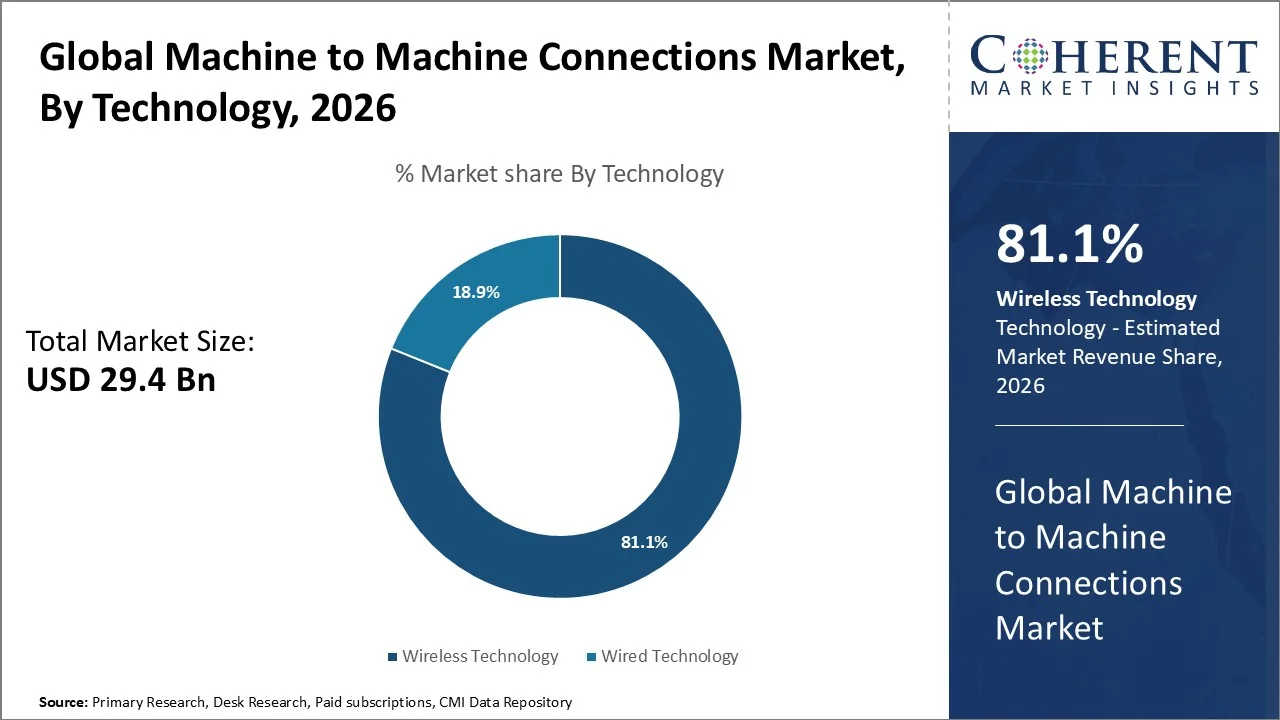
On the basis of technology, the wireless technology is projected to account for the largest machine to machine connections market share of 81.10% in 2026. The segment’s growth is due to the increasing demand for mobile, low-maintenance, and wide-area connectivity in various sectors such as logistics, healthcare, smart infrastructure, industrial assets, and transportation.
The rise in cellular M2M SIM card adoption is a clear indicator of this shift. As per the OECD, M2M SIM cards grew by 14% in just one year, with countries like Sweden and Austria having 267 and 233 M2M SIMs per 100 inhabitants. In addition, the 5G technology plays a major role in propelling this expansion. In 2024, nearly 37% of mobile broadband subscriptions in OECD countries were 5G-based, thereby allowing for low-latency M2M applications.
The International Telecommunication Union (ITU) highlights that 5G allows for the connection of large numbers of devices with minimal delays. Moreover, the regulatory developments like the adoption of the US Cyber Trust Mark for wireless IoT products by FCC in March 2024, are boosting trust as well as adoption. In Europe, 70.9% of people used internet-connected devices in 2024, thus reflecting the widespread adoption of wireless IoT technology across various sectors.
To learn more about this report, Request Free Sample
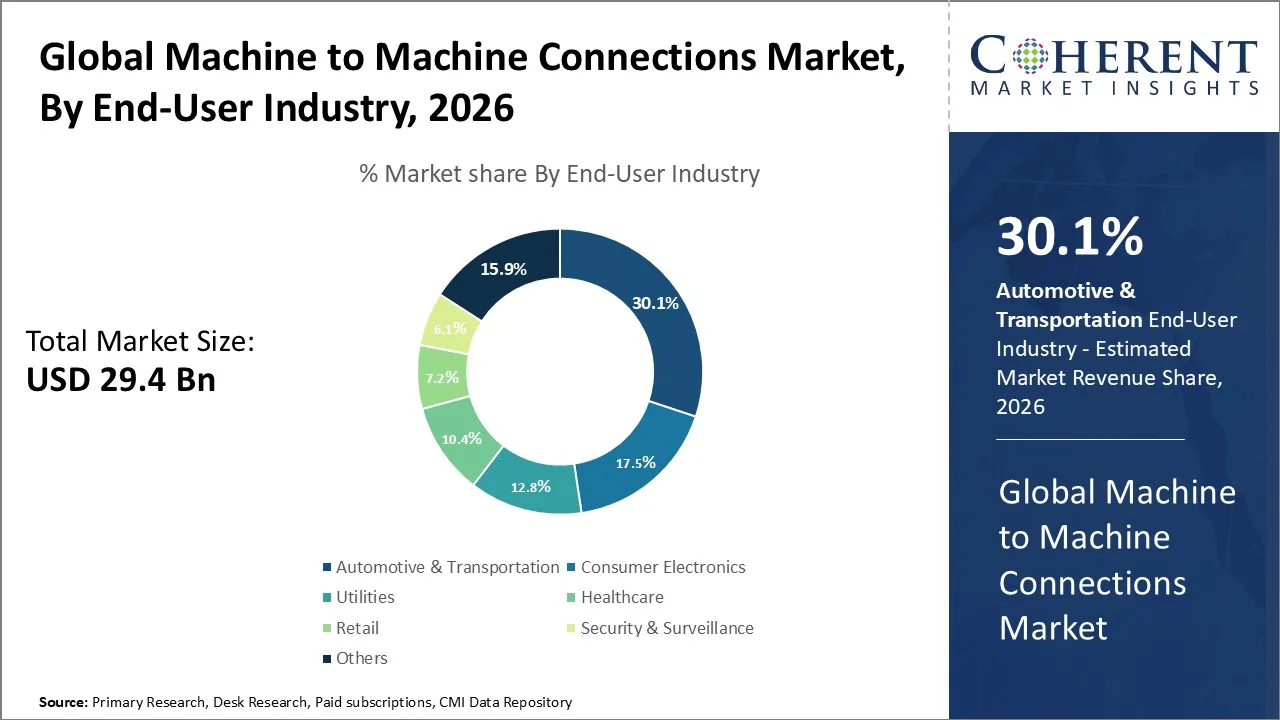
Automotive & transportation lead with a major 30.1% share in 2026. The segment’s growth is due to the increasing reliance on M2M connectivity for vehicle safety, fleet management, compliance, and intelligent transportation systems. The governments are actively developing regulatory frameworks for Vehicle-to-Network (V2N) communication, which is essential for both automotive telematics as well as remote vehicle connectivity solutions. For instance, in April 2026, the Telecom Regulatory Authority of India (TRAI) issued a consultation paper explaining how cellular networks play a vital role in enabling V2N services. They are essential for the development of connected vehicles.
The statistical reports indicate that nearly 90% of new vehicles in Europe are now equipped with embedded connectivity features, thereby demonstrating the widespread incorporation of M2M technology in the automotive industry. The regulatory requirements like India’s AIS-140 telematics standards for public service vehicles and the EU's eCall mandates are also boosting the adoption of connected devices in vehicles, thus propelling the growth of M2M connections in this sector.
The Machine to Machine (M2M) Connections Market in the U.S. is undergoing a major transformation owing to the expansion of wireless networks. The growth is driven by the widespread rollout of 5G technology, federal broadband funding, along with the new IoT security regulations.
According to the Federal Communications Commission's (FCC) Broadband Data Collection results released in May 2025, 96% of homes and small businesses in the US now have access to mobile 5G services with fast speeds. The growth in infrastructure is facilitating the rise of various M2M applications like telemetry, fleet tracking, smart meters, and remote monitoring of industrial equipment.
In addition, the National Telecommunications and Information Administration's (NTIA) Broadband Equity, Access, and Deployment (BEAD) program has allocated USD 42.45 billion in order to enhance broadband access in underserved areas, with all funds fully committed by December 2024. According to the U.S. Census Bureau, 95% of U.S. households owned at least one computer, and 90% subscribed to broadband services in 2021, thereby signaling strong readiness for M2M adoption.
The machine to machine connections market is undergoing a transformation with the integration of 5G, Artificial Intelligence (AI), and eSIM technology. The incorporation of M2M SIM cards has surged, with OECD data revealing an increase from 326 million active cards in 2019 to over 642 million by 2024. This represents 46 subscriptions per 100 inhabitants. This growth is particularly evident in sectors like transportation, energy, logistics, and smart manufacturing.
The International Telecommunication Union (ITU) demonstrates that 5G technology is particularly well-suited for M2M applications. It offers the ability to connect a vast number of devices with minimal delay, which is essential for sensor-heavy systems. In addition, the regulatory updates are shaping the landscape. In December 2025, the Telecom Regulatory Authority of India (TRAI) introduced a new authorization framework for international M2M SIM services, thereby streamlining the process with low entry costs along with a ten-year validity period.
Moreover, the European Union’s Cyber Resilience Act, set to take effect in December 2024, will require improved cybersecurity for connected products, thus underscoring the increasing focus on secure M2M connectivity.
|
Current Event |
Description and its Impact |
|
Introduction of 5G Connectivity for M2M Applications |
|
|
Implementation of Cybersecurity Regulations for IoT Devices |
|
Uncover macros and micros vetted on 75+ parameters: Get instant access to report
To learn more about this report, Request Free Sample
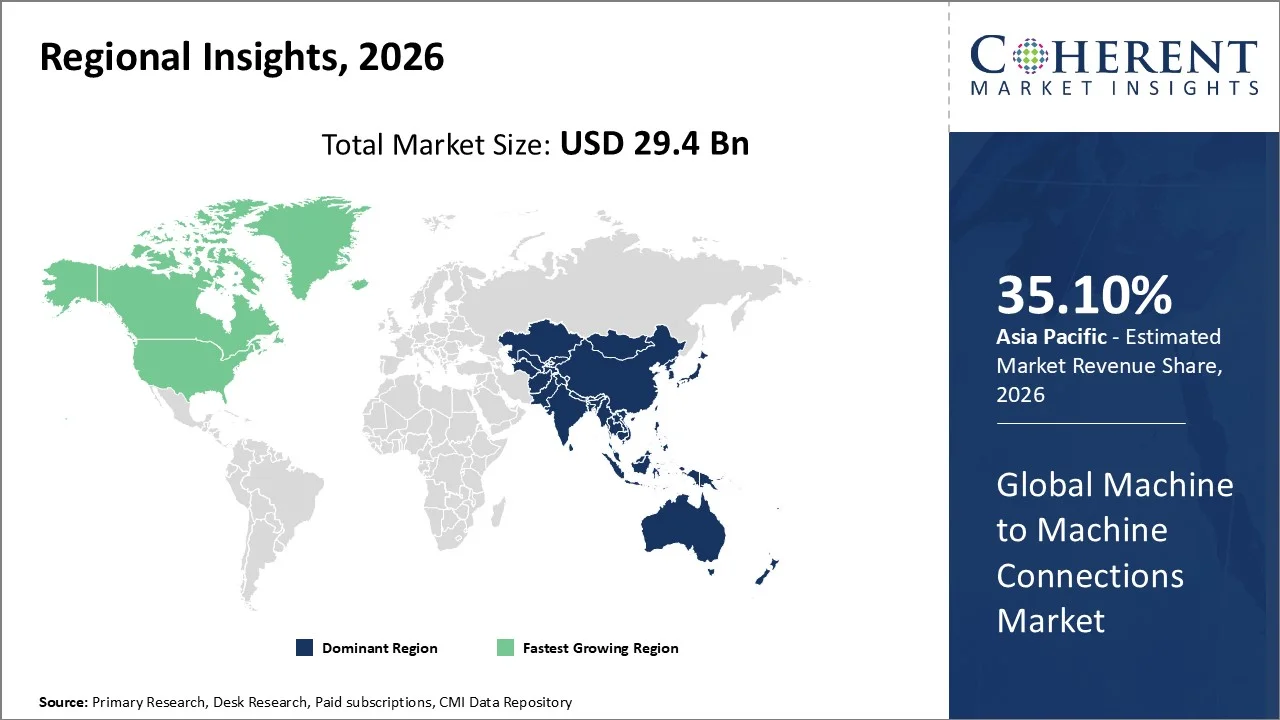
The Asia Pacific region accounts for 35.10% of the market share in 2026. The region’s growth is owing to its extensive cellular IoT base, rapid 5G rollout, and government-led digital infrastructure initiatives. China is one of the major contributors, with its national IoT action plan targeting more than 10 billion IoT terminal connections by 2028 along with a projected core IoT industry scale of 3.5 trillion yuan (USD 505.8 billion). This growth is owing to the incorporation of M2M technologies in smart manufacturing, utilities, transportation, logistics, and urban infrastructure.
In addition, India is witnessing growth in M2M connections. The data from the government indicates that M2M cellular mobile connections witnessed a rise from 103.48 million in November 2025 to 109.19 million in December 2025, thereby reflecting the increasing use of SIM and eSIM-enabled devices. The regional connectivity advancements also assist in enhancing the market's expansion. Asia Pacific is set to reach 101 active mobile-broadband subscriptions per 100 people in 2025, and over 40% of mobile-broadband subscriptions in the region being 5G-enabled.
In March 2026, the Asian Development Bank unveiled a bold USD 70 billion regional investment plan aimed at bolstering electricity connections and digital infrastructure across Asia and the Pacific by 2035, with the goal of enhancing resilience, lowering costs, and expanding access, PTI reported.
North America is expected to witness strong growth in Machine to Machine Connections Market over the forecast period. The region’s growth is owing to government regulations and increased demand for secure and high-capacity connectivity solutions. In the U.S., the Federal Communications Commission (FCC) introduced the Cyber Trust Mark program in March 2024. This voluntary cybersecurity labeling initiative aims to enhance the security of wireless consumer IoT products, such as smart meters, cameras, and industrial devices, helping build trust in M2M connectivity solutions.
In addition, the FCC’s 5G Fund for Rural America is distributing up to USD 9 billion to expand voice and 5G broadband in rural areas. This initiative supports the development of connected infrastructure like remote monitoring as well as smart farming technologies. The Canada government’s broadband expansion program aiming for 98% high-speed internet access by 2026 is also responsible for the growth of market for M2M services. These developments are fostering the growth of M2M applications in various sectors like automotive V2X, smart grids, logistics, and industrial automation.
For instance, in July 2025, Corsha announced an investment from Cybernetix Ventures, a leading early-stage VC firm specializing in robotics, automation, and physical AI. The investment will speed up Corsha's mission to secure every machine connection within robotics and industrial autonomous systems.
China is experiencing strong growth in the machine-to-machine (M2M) connections market mainly due to government-led initiatives. In March 2026, the Ministry of Industry and Information Technology, along with several other national departments, released the Action Plan for Promoting IoT Industry Innovation (2026-2028). It aims to expand IoT device connectivity in the country. The plan targets the establishment of hundreds of billions of terminal connections and seeks to grow the IoT core industry to more than ¥3.5 trillion by 2028. It includes specific goals such as 10 applications achieving more than 100 million connections and 15 applications with more than 10 million connections, thereby underscoring the government's commitment to M2M deployment.
The official statistics reveal that industrial IoT in China is growing quickly, with projections showing over 120 million connected machines by 2028, up from more than 100 million today. This increase in M2M connectivity is crucial for industries like smart manufacturing, urban infrastructure, logistics, and utilities. These regulations and developments demonstrate China’s strong commitment to promoting widespread IoT as well as M2M adoption.
In the United States, federal efforts are fueling the expansion of connectivity infrastructure that supports M2M (machine-to-machine) and broader IoT applications. The Federal Communications Commission (FCC) is modernizing its broadband data collection processes to track the availability of fixed as well as mobile broadband services in the country. This also includes the launch of 5G-NR mobile services, which are important for supporting M2M applications like industrial sensors and connected utilities.
In addition, the National Telecommunications and Information Administration (NTIA) is working to improve internet access through the Internet for All initiative.
These efforts are expected to boost the adoption of M2M technology in industries like manufacturing, transportation, and utilities in the U.S.
Some of the major key players in Machine to Machine Connections Market are AT&T Inc., Cisco Systems Inc., Texas Instruments Incorporated, Huawei Technologies Co., Ltd., NXP Semiconductors N.V., Intel Corporation, Murata Manufacturing Co., Ltd., Gemalto N.V., Vodafone Group PLC, U-Blox Holding AG, Commsolid GmbH, and Fanstel Corporation.
| Report Coverage | Details | ||
|---|---|---|---|
| Base Year: | 2025 | Market Size in 2026: | USD 29.4 Bn |
| Historical Data for: | 2020 To 2024 | Forecast Period: | 2026 To 2033 |
| Forecast Period 2026 to 2033 CAGR: | 5.9% | 2033 Value Projection: | USD 43.92 Bn |
| Geographies covered: |
|
||
| Segments covered: |
|
||
| Companies covered: |
AT&T Inc., Cisco Systems Inc., Texas Instruments Incorporated, Huawei Technologies Co., Ltd., NXP Semiconductors N.V., Intel Corporation, Murata Manufacturing Co., Ltd., Gemalto N.V., Vodafone Group PLC, U-Blox Holding AG, Commsolid GmbH, and Fanstel Corporation. |
||
| Growth Drivers: |
|
||
| Restraints & Challenges: |
|
||
Uncover macros and micros vetted on 75+ parameters: Get instant access to report
Share
Share
Ankur Rai is a Research Consultant with over 5 years of experience in handling consulting and syndicated reports across diverse sectors. He manages consulting and market research projects centered on go-to-market strategy, opportunity analysis, competitive landscape, and market size estimation and forecasting. He also advises clients on identifying and targeting absolute opportunities to penetrate untapped markets.
Joining thousands of companies around the world committed to making the Excellent Business Solutions.
View All Our Clients