Metal Injection Molding Powders Market Analysis & Forecast: 2026-2033

Metal Injection Molding Powders Market Size and Forecast – 2026 – 2033
The Global Metal Injection Molding Powders Market size is estimated to be valued at USD 1.30 billion in 2026 and is expected to reach USD 2.34 billion by 2033, exhibiting a compound annual growth rate (CAGR) of 8.7% from 2026 to 2033.
Global Metal Injection Molding Powders Market Overview
MIM powders are fine, spherical or irregular metal powders specifically formulated for metal injection molding feedstocks; they include stainless steels, tool steels, cobalt-chrome, titanium, nickel alloys, and copper/brass powders with narrow particle size distributions and controlled flow characteristics. These powders are blended with polymeric binders and additives to create feedstock compounds suitable for injection molding; the characteristics of the powders (apparent density, tap density, oxygen content, particle morphology) are critical for achieving high green density, minimal shrinkage, and defect-free sintered parts.
Key Takeaways
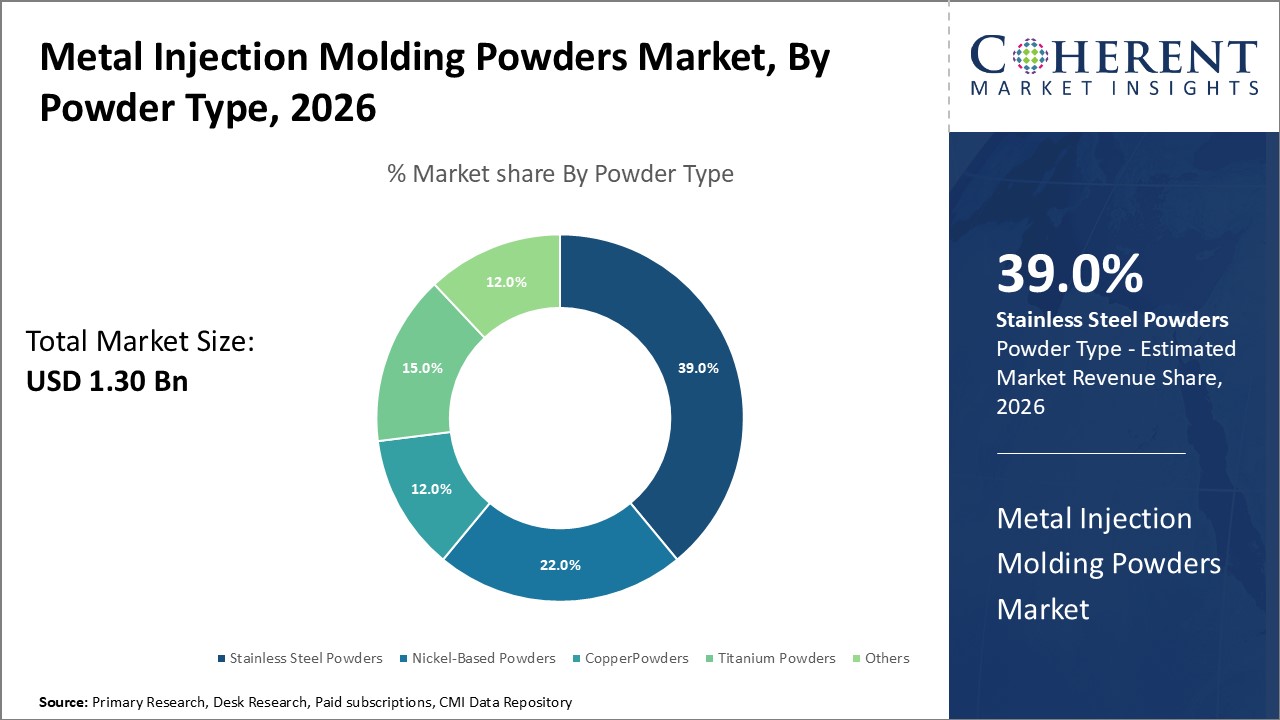
The Stainless Steel Powders segment dominates with a 39% market share, driven by its broad applicability and cost-effectiveness.
The Titanium Powders subsegment, however, exhibits the fastest growth rate owing to its expanding use in aerospace and medical implants due to superior biocompatibility and strength.
The Automotive application segment commands 43% market share, reflecting the industry's accelerated shift to metal injection molds for lightweight components, while Medical Devices represent the most rapidly expanding application due to advancements in precision medical manufacturing.
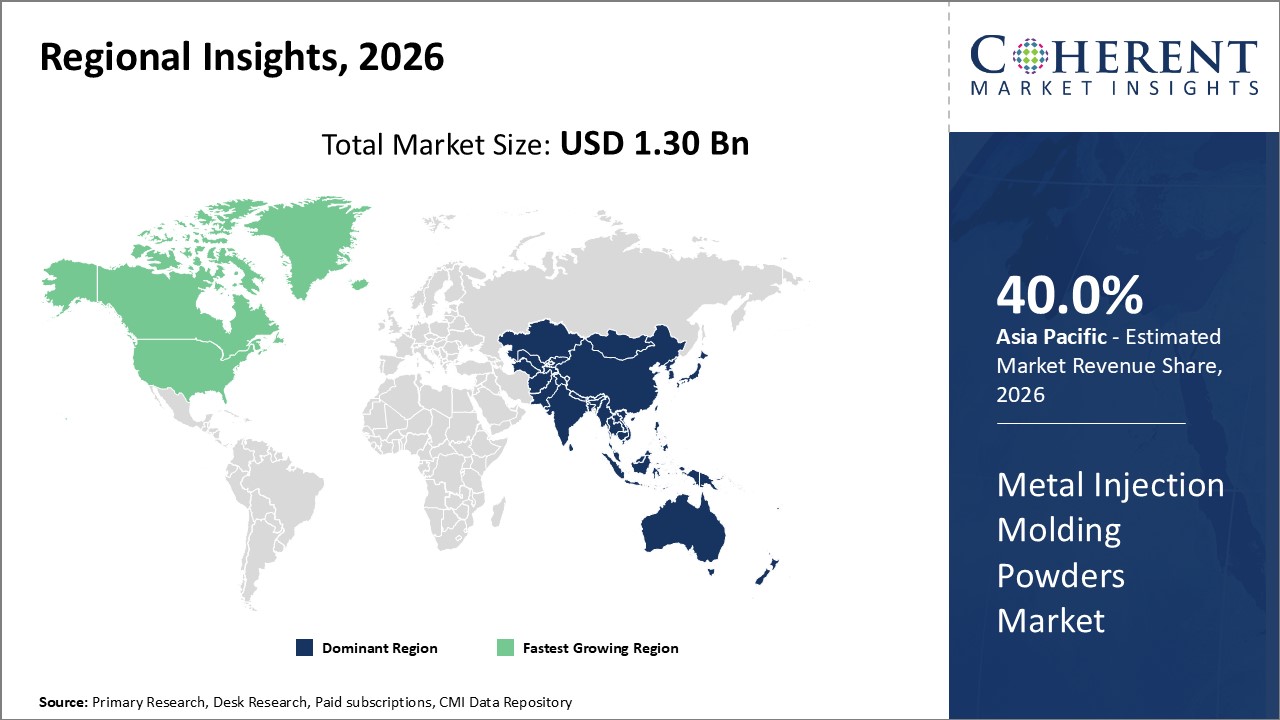
Regionally, Asia Pacific leads the Metal Injection Molding Powders market with over 40% market share, significantly driven by China’s booming manufacturing base and government incentives in advanced manufacturing sectors.
Meanwhile, North America is the fastest-growing region with a CAGR exceeding 9%, fueled by aerospace innovations and increasing imports of premium alloy powders.
Metal Injection Molding Powders Market Segmentation Analysis
To learn more about this report, Request Free Sample
Metal Injection Molding Powders Market Insights, By Powder Type
Stainless Steel Powders dominate the market share with 39%, largely due to their versatility, cost-efficiency, and extensive adoption across automotive and consumer electronics sectors. Their corrosion resistance and mechanical properties make them ideal for mass production applications requiring durability. Titanium Powders are the fastest-growing subsegment, propelled by rising aerospace and medical device demand for lightweight, high-strength solutions. Copper Powders, with moderate corrosion resistance and excellent thermal properties, find niche applications in electronics and heat exchangers. Nickel-based powders are favored for high-temperature applications but hold a smaller market share due to higher costs.
Metal Injection Molding Powders Market Insights, By Application
Automotive leads with a commanding 42% market share, driven by the industry’s push towards lightweighting and component miniaturization to improve fuel efficiency and reduce emissions. The aerospace application, while smaller in share, shows accelerated growth fueled by stringent safety standards and the increasing usage of MIM powders in engine and structural components. Medical Devices represent one of the fastest-growing application areas, leveraging MIM powders for producing complex surgical tools and implants with superior biocompatibility. Consumer Electronics utilizes metal injection molding powders for miniaturized, high-precision parts, driven by continued evolution in device design.
Metal Injection Molding Powders Market Insights, By End-User Industry
Manufacturing is the largest segment owing to the broad usage of metal powders in tooling, precision parts, and mass-produced components, addressing diverse industry needs. Healthcare stands out as the fastest-growing subsegment, reflecting rapid adoption of MIM powders in implants, prosthetics, and surgical instruments designed to meet stringent regulatory standards and patient-specific demands. Defense applications utilize high-performance powders for reliable, durable parts under extreme conditions, but have limited volume compared to other industries. The Energy segment is gaining traction with the increasing deployment of powder metallurgy components in renewable energy technologies like wind turbines and fuel cells.
Metal Injection Molding Powders Market Trends
The evolving landscape of the Metal Injection Molding Powders market is driven by advanced manufacturing protocols and material innovations.
Increasing adoption of additive manufacturing and hybrid molding techniques exemplifies the market’s pivot towards enhanced customization and precision.
For example, in 2026, several aerospace manufacturers integrated MIM powders with 3D printing, resulting in a 26% reduction in part lead times.
Another notable trend is the growing environmental regulation prompting manufacturers to invest in cleaner powder production technologies, a move steadily gaining momentum particularly in Europe and North America.
Metal Injection Molding Powders Market Insights, By Geography
To learn more about this report, Request Free Sample
Asia Pacific Metal Injection Molding Powders Market Analysis and Trends
In the Asia Pacific region, the dominance in the Metal Injection Molding Powders market is attributed to robust manufacturing ecosystems in China, Japan, and South Korea. China alone accounts for over 25% of the global market share, leveraging low-cost powder production and high application demand from the automotive and electronics sectors. Government policies supportive of advanced manufacturing and R&D funding have further fueled market growth in this region.
North America Metal Injection Molding Powders Market Analysis and Trends
Meanwhile, North America exhibits the fastest growth with a CAGR exceeding 9%. This is propelled by aerospace industry innovations and increased imports of specialty powders. The presence of top market players such as Sandvik AB and Carpenter Technology Corporation helps maintain technological leadership. Additionally, regulatory incentives promoting clean energy vehicles boost usage in automotive applications.
Metal Injection Molding Powders Market Outlook for Key Countries
USA Metal Injection Molding Powders Market Analysis and Trends
The USA’s market is characterized by advanced research initiatives and strong aerospace and medical device industries. Major corporations focusing on high-grade powder manufacturing contribute significantly to market revenue. Recent data from 2025 reveals a 10% increase in demand for titanium powders used in aerospace turbine components, underscoring the country’s focus on lightweight and high-performance materials. Government grants supporting additive manufacturing developments have also accelerated technological advances and adoption rates.
China Metal Injection Molding Powders Market Analysis and Trends
China’s market is notable for its rapid capacity expansions and broad industry applications, particularly automotive and consumer electronics. In 2026, the country reported a 15% growth in MIM powder output, driven by domestic powder producers upgrading production lines with the latest atomization technologies. Government incentives targeting innovative manufacturing practices and infrastructural enhancements provide a supportive environment for sustained business growth.
Analyst Opinion
Production capacity enhancements remain a primary supply-side driver, with several manufacturers expanding output to meet rising industry share demands. For instance, recent capacity expansions by powder producers in Asia Pacific increased output by over 15% in 2025, supporting the global scale-up of metal injection molding (MIM) components.
Pricing dynamics reflect an upward trend due to increased raw material costs, yet end-user sectors are willing to absorb these premium prices given the superior performance benefits. Data from 2026 shows that pricing adjustments corresponded with a 13% increase in metal powder costs, influencing overall market revenue.
Demand is robust across automotive lightweighting applications and medical device manufacturing, which grew by approximately 11% and 15% respectively in 2025. This highlights a diversification in use cases catalyzing market growth strategies.
Imports of specialized alloy powders have surged particularly in North America and Europe, with import volumes increasing by 18% in 2026, driven by stringent quality requirements in aerospace sectors aiming for reduced emissions and enhanced performance.
Market Scope
| Report Coverage | Details | ||
|---|---|---|---|
| Base Year: | 2025 | Market Size in 2026: | USD 1.30 billion |
| Historical Data for: | 2020 To 2024 | Forecast Period: | 2026 To 2033 |
| Forecast Period 2026 to 2033 CAGR: | 8.7% | 2033 Value Projection: | USD 2.34 billion |
| Geographies covered: |
|
||
| Segments covered: |
|
||
| Companies covered: | Carpenter Additive, MIM Manufacturing Company, Hitachi Chemical Company, Advanced Powder Technology, Element Materials Technology, Oerlikon Group, Sumitomo Electric Industries, Indutherm GmbH, Alcon Group, Praxair Surface Technologies | ||
| Growth Drivers: |
|
||
Uncover macros and micros vetted on 75+ parameters: Get instant access to report
Metal Injection Molding Powders Market Growth Factors
The surge in automotive lightweighting initiatives has emerged as a principal growth driver, with manufacturers emphasizing reduced vehicle weight for fuel efficiency and emission control. OEMs reported a 15% increase in MIM powder consumption for such applications in 2025. Growth in the aerospace sector is propelled by stringent safety and performance standards requiring high-quality powders that enable complex part geometries; aerospace demand grew by 13% last year alone. Furthermore, the healthcare industry's adoption of MIM powders for minimally invasive surgical instruments and implants expanded the market revenue by over 14% in recent times. Additionally, ongoing technological advancements in powder synthesis, such as gas atomization and plasma rotating electrode process, enhance powder uniformity and yield, significantly improving cost efficiencies and industrial scalability.
Metal Injection Molding Powders Market Development
In November 2026, Xact Metal launched the XM200G µHD metal 3D printer, introduced new metal powders, and confirmed continued development progress on the larger-format XM300G system. The updates strengthened Xact Metal’s additive manufacturing portfolio by enhancing print resolution, material compatibility, and scalability for industrial metal AM applications.
In August 2026, Sandvik introduced Osprey® MAR 55, a high-performance tool steel powder developed specifically for additive manufacturing. The launch expanded Sandvik’s metal powder offerings, enabling improved wear resistance, toughness, and process reliability for demanding AM tooling and component production.
Key Players
Leading Companies of the Market
Carpenter Additive
MIM Manufacturing Company
Hitachi Chemical Company
Advanced Powder Technology
Element Materials Technology
Oerlikon Group
Sumitomo Electric Industries
Indutherm GmbH
Alcon Group
Praxair Surface Technologies
Several market players have adopted strategic collaborations to enhance R&D capabilities, such as the 2025 partnership between Mitsubishi Materials Corporation and BASF SE, resulting in a patented high-performance stainless-steel powder that boosted automotive component durability by 21%. Additionally, Sandvik AB implemented an aggressive market penetration strategy in the medical sector in 2026, increasing its share by 9% through customized powder formulations for implant manufacturing.
Metal Injection Molding Powders Market Future Outlook
Future growth will be shaped by increasing demand for precision engineering parts, especially in electric vehicles, medical implants, and wearables. Advanced alloy development, ultra-fine powder technologies, and hybrid processes combining MIM with additive manufacturing are expected to expand design possibilities. Manufacturers will also shift toward cleaner, high-purity powders with tighter particle-size ranges to meet stringent performance and sustainability requirements. Geographic expansion—particularly in Asia—will remain strong as manufacturing outsourcing grows.
Metal Injection Molding Powders Market Historical Analysis
The market for MIM powders has grown consistently with the expansion of metal injection molding as a preferred manufacturing process for small, complex, high-precision components. Historically, adoption was driven by aerospace, medical, and electronics industries that required miniaturized parts with strong mechanical properties. Over the past decade, improvements in powder metallurgy, sintering technologies, and binder systems have increased part reliability and broadened applications to include consumer electronics, automotive sensors, orthodontic brackets, and firearm components.
Sources
Primary Research Interviews:
Powder Metallurgy Engineers
MIM Manufacturers
Automotive Component OEMs
Databases:
ASTM Materials Database
Magazines:
Metal Powder Report
Modern Casting Magazine
Materials Today
Journals:
Powder Metallurgy
Materials Science & Engineering A
Metallurgical and Materials Transactions
Newspapers:
Financial Times Metals
Reuters Manufacturing
Nikkei Industry News
Associations:
Metal Powder Industries Federation (MPIF)
European Powder Metallurgy Association (EPMA)
Share
Share
Vidyesh Swar is a seasoned Consultant with a diverse background in market research and business consulting. With over 6 years of experience, Vidyesh has established a strong reputation for his proficiency in market estimations, supplier landscape analysis, and market share assessments for tailored research solution. Using his deep industry knowledge and analytical skills, he provides valuable insights and strategic recommendations, enabling clients to make informed decisions and navigate complex business landscapes.

Credibility and Certifications

860519526

9001:2015
27001:2022


Need a Custom Report?
We can customize every report - free of charge - including purchasing stand-alone sections or country-level reports
Customize NowJoining thousands of companies around the world committed to making the Excellent Business Solutions.
View All Our Clients