

Injection Molding Materials Market Size and Share Analysis- 2026 To 2033
The Injection Molding Materials Market size is anticipated to grow at a CAGR of 5.8%, with a market value of USD 338.0 Bn in 2026, and is expected to reach USD 500.5 Bn by 2033.
The major factors fueling the growth of market include the rising demand of lightweight and high-performance materials in automotive, packaging, consumer goods, electronics and healthcare sectors, increasing substitution of metals with engineering plastics and increasing adoption of injection molding for high volume manufacturing of precision components. OICA’s April 23, 2026 report stated global vehicle production rose 3.9% to 96.4 million units in 2025 from 92.7 million units in 2024, which will support demand for injection-molded automotive components and engineering polymers.
Key Takeaways
- The plastics segment is likely to dominate the market with 84.6% in 2026. The segment’s growth is owing to the extensive use of polypropylene, ABS, polyethylene, polycarbonate, nylon, and other engineering thermoplastics in high-volume molded components, along with their lightweight characteristics, design flexibility, relatively low processing costs, and suitability for automotive, packaging, electronics, consumer goods, and medical applications. The European Commission’s Joint Research Center (JRC) said in August 2025 that the EU consumed 62.8 million tons of plastics, or around 140 kg per person. It said global plastics consumption is set to double by 2060, indicating long-term demand for polymer processing technologies will remain strong.
- The hydraulic injection molding machines segment is set to lead with 53.2% in 2026. The segment’s dominance is owing to its high clamping-force capabilities, broad mold-size compatibility, ability to process large and complex components, comparatively attractive capital costs, and extensive installed base across automotive, consumer goods, construction, and industrial molding operations. In March 2026, Haitian International reported that all its major injection-molding machine platforms recorded growth during 2025, while its Mars servo-hydraulic platform maintained stable demand.
- The packaging segment is expected to dominate the end-user category with 33.0% in 2026. The segment’s growth is owing to high-volume production of caps and closures, containers, tubs, thin-wall food packaging, household packaging, and other rigid molded products, together with increasing adoption of lightweight and recyclable polymer packaging. In July 2026, the European Commission’s JRC reported that 5.9 million tonnes of plastic packaging were placed on the market across the countries analyzed in 2025.
- Asia Pacific is expected to dominate the Global Injection Molding Materials Market with approximately 40.7% market share in 2026. The region’s dominance is owing to its large polymer-production base, extensive injection-molding manufacturing capacity, and strong demand from automotive, electrical & electronics, packaging, consumer goods, and industrial manufacturing sectors, particularly across China, Japan, India, South Korea, and Southeast Asia. According to PlasticsEurope’s Plastics the Fast Facts 2025, released on 8 October 2025, Asia accounted for 57.2% of global plastics production in 2024, with China alone representing 34.5%, giving the region a large raw-material and downstream plastics-conversion ecosystem.
Market Drivers
Transition Toward Recyclable and Recycled Packaging Materials is Reshaping Injection Molding Material Demand
Sustainability requirements are a major driver for injection molding materials in general, but especially in caps and closures, tubs, containers, food packaging, household packaging and other high-volume rigid packaging applications. Resin makers are developing more polypropylene, polyethylene and PET grades with recycled content and refining their formulations for enhanced recyclability, mechanical performance, food contact compliance and repeated high-speed molding.
In June 2026, the European Commission published implementation guidance for Regulation (EU) 2025/40 on Packaging and Packaging Waste (PPWR), confirming that the regulation applies from August 12, 2026. The framework introduces design-for-recycling requirements and mandatory recycled-content provisions for plastic packaging. The regulation also requires Member States to establish systems capable of supporting a 90% separate collection rate by weight for single-use plastic beverage bottles and metal beverage containers by 2029.
Expanding Medical Technology Manufacturing is Supporting Medical-Grade Polymers and Liquid Silicone Rubber
Healthcare is becoming an increasingly attractive application area for injection molding materials as production of diagnostic consumables, drug-delivery components, syringes, inhalation device components, surgical products, laboratory consumables, medical device housings, seals and other precision components ramp up. Medical manufacturing requires materials that provide high purity, biocompatibility, chemical resistance, sterilization compatibility and repeatable dimensional performance.
In September 2025, MedTech Europe reported that Europe was home to more than 38,000 medical technology companies, around 90% of which were SMEs. The European medical technology sector employed more than 930,000 people, while over 15,700 medtech patent applications were filed in 2024.
Current Events and Their Impact on the Injection Molding Materials Market
Current Event | Description and its Impact |
EU Packaging and Packaging Waste Regulation Becomes Applicable, Strengthening Recyclability and Recycled-Content Requirements (August 2026) |
|
India Strengthens Extended Producer Responsibility Enforcement for Plastic Packaging (March 2026) |
|
- Current Industry Events of 2026
- Market Size Estimation
- Regional Breakdown
- Competitive Landscape
- Customer Intelligence
- Segmental Analysis
- Pricing Analysis
- Key Market Drivers, Challenges & Future Trends
- Customized Insights Section
Segmental Insights
Why are Plastics Acquiring the Largest Share?
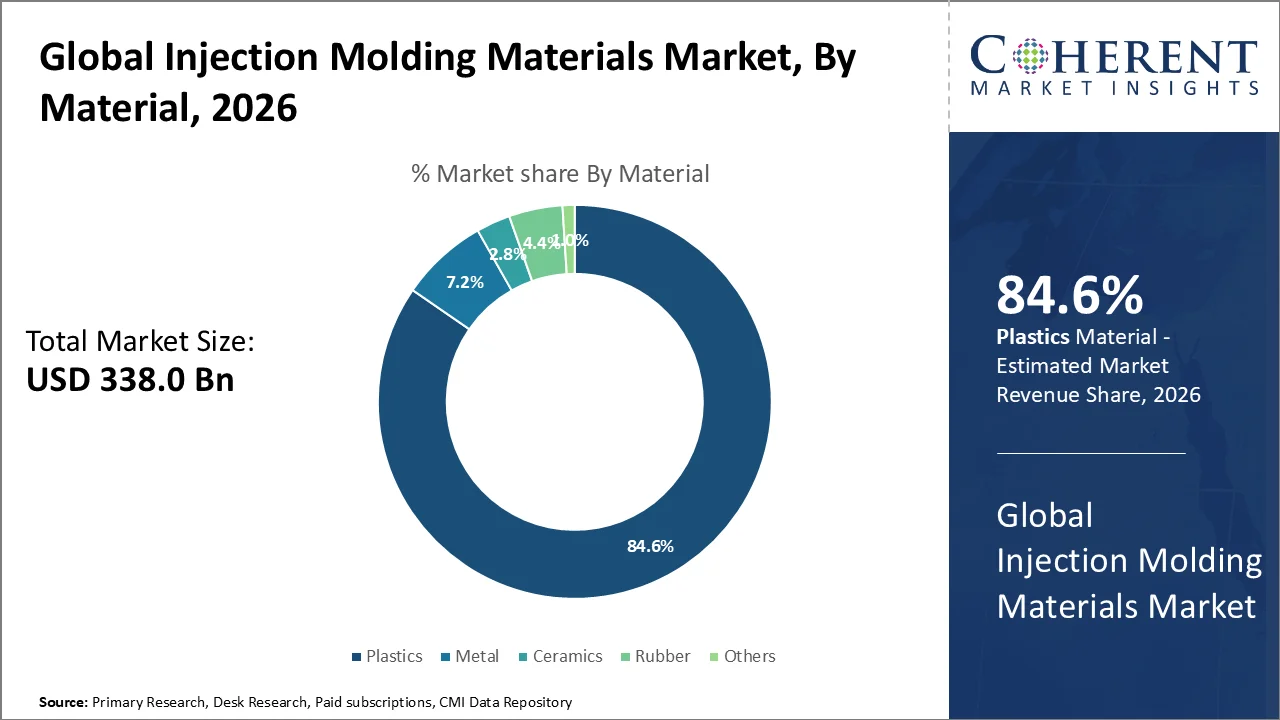
On the basis of material, the plastics segment is projected to account for the largest Injection Molding Materials Market share of 84.6% in 2026. The segment’s dominance is owing to the extensive processing of polypropylene, ABS, polyethylene, polycarbonate, nylon, PBT, PEEK, PPS, and other thermoplastics through injection molding. Plastic has good moldability, low component weight, corrosion resistance, short cycle times and cost-effective mass production for packaging, automotive, electrical & electronics, consumer goods, construction and healthcare applications.
In July 2026, the American Chemistry Council reported that U.S. production of major plastic resins reached 8.8 billion pounds in June 2026, increasing 1.2% year-over-year. Cumulative production during the first six months of 2026 reached 53.3 billion pounds, up 6.6% compared with the same period in 2025.
Why are Hydraulic Injection Molding Machines Holding the Largest Share?
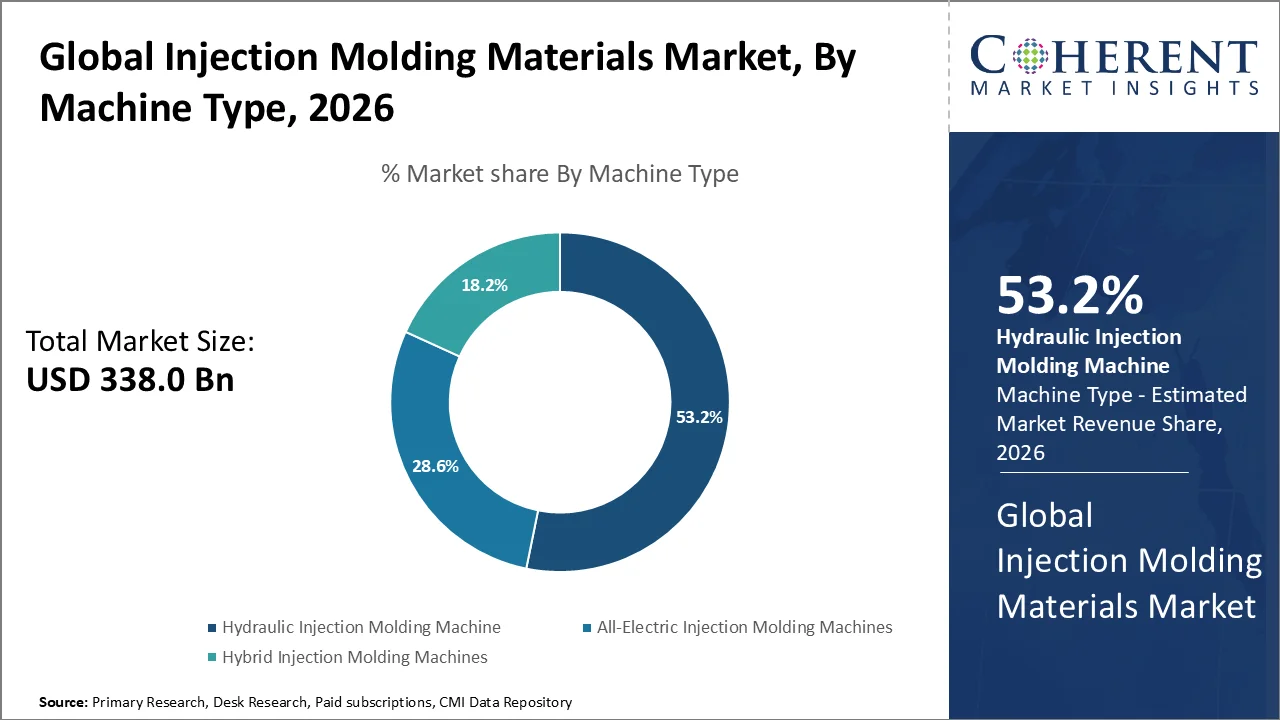
Based on machine type, hydraulic injection molding machines are projected to have the largest market share of 53.2% in 2026. Their dominance is attributable to their high clamping-force capabilities, applicability to large molds and heavy components, processing flexibility, relatively economical equipment configurations and extensive installed base in automotive, packaging, construction, consumer goods and general industrial molding.
In February 2026, Milacron selected its 170-ton Q-Series servo-hydraulic injection molding machine for demonstration at PT XPO 2026. The system is intended for use in automotive, construction, packaging, electrical and custom molding applications, showing the wide end-market reach of modern hydraulic technology.
Why is Packaging Acquiring the Largest End-User Share?
On the basis of end user, the packaging segment is projected to account for the largest Injection Molding Materials Market share of 33.0% in 2026. The segment’s dominance is owing to the high-volume production of caps and closures, containers, tubs, thin-wall packaging, dispensing components, food packaging, household-product containers, and other rigid packaging products. Injection molding enables extremely high production speeds, multi-cavity manufacturing, lightweighting, dimensional consistency, and efficient processing of polypropylene, HDPE, PET, and recycled polymers.
In April 2025, the Plastics Industry Association, U.S. plastics reclaimers more than doubled their capacity to supply post-consumer recycled (PCR) resin to the packaging market between its 2021 and 2025 assessments. The increase in PCR capacity is bolstering the packaging converters’ supply base of materials as brand owners are demanding increased use of recycled resin in molded packaging.
In May 2026, ENGEL demonstrated the production of 24 LLDPE closure caps every 5.5 seconds with a 24-cavity injection mold. It also demonstrated thin-wall polypropylene ice-cream containers with a 3 second molding cycle, illustrating the very high throughput achievable in injection molded packaging.
Injection Molding Materials Market Trends
- Automotive and consumer applications are changing their material selection due to the increased use of recycled and circular engineering plastics. Manufacturers are increasingly offering grades of recycled-content polycarbonate, PC/ABS, polypropylene and engineering polymers that retain dimensional stability and processability. In June 2026, Covestro announced that it had adopted Bayblend T85X R35 CQ containing 35% post-consumer recycled material for selected interior components of the Lexus ES.
- The growing substitution of metal components with lightweight engineering thermoplastics is strengthening demand for polyamide and fiber-reinforced injection molding materials. High-performance plastics are increasingly replacing aluminum and steel in automotive components where weight reduction, corrosion resistance, component integration, and manufacturing efficiency are important. In March 2025, BASF and WAL introduced an injection-molded Ultramid polyamide commercial-vehicle air tank that is 10–20% lighter than aluminum alternatives and more than 50% lighter than steel versions.
- Growing demand for miniaturization and performance requirements of electrical and electronic components are driving the adoption of high temperature engineering plastics. PESU, PPS, PBT, PEI, liquid crystal polymers and glass fiber reinforced materials are becoming important in switches, sensors, circuit breakers, semiconductor components, connectors and e-mobility systems. In March 2025, BASF introduced an injection-molding PESU grade that enables a 12.5% reduction in melt-processing temperature compared with standard PESU.
Regional Insights
Asia Pacific Dominates Owing to its Large Manufacturing Base and Expanding Electronics and Automotive Production
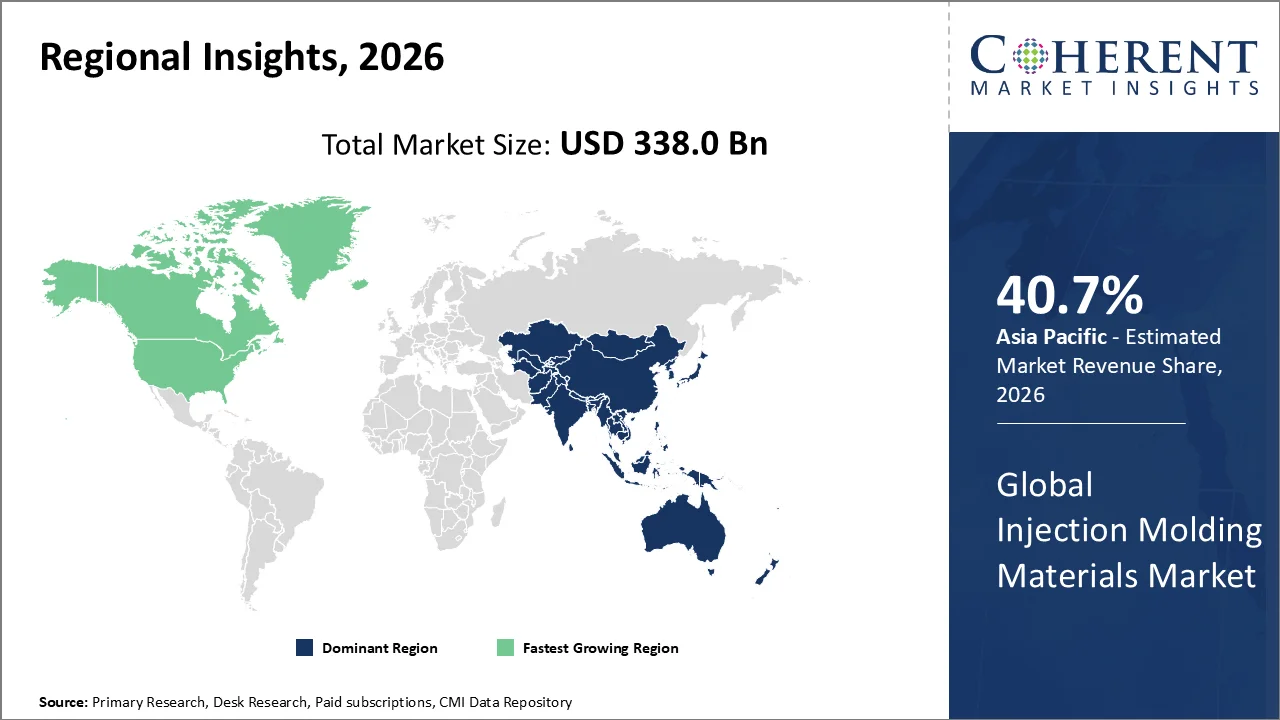
Asia Pacific is expected to dominate the Global Injection Molding Materials Market with approximately 40.7% market share in 2026. The region’s dominance is owing to its extensive plastics-processing ecosystem, large automotive and electronics manufacturing base, strong availability of petrochemical feedstocks, and high-volume production of consumer goods, packaging, electrical components, and industrial products across China, India, Japan, South Korea, and Southeast Asia.
In July 2026, China’s Ministry of Industry and Information Technology reported that the value-added output of the country’s electronic information manufacturing industry increased 14.8% year-over-year during the first half of 2026. During the same period, China produced 7.399 million new-energy vehicles, up 6.0%, while industrial robot production increased 28.0% and integrated-circuit production increased 23.1%.
In July 2026, LG Chem announced continued commercialization of circular plastic materials in South Korea, including Ocean Bound Plastic materials and Bio-Circular Balanced products.
North America is Expected to be the Fastest-Growing Region Owing to Manufacturing Reshoring and High-Value Engineering Material Demand
North America is expected to witness the fastest growth in the Injection Molding Materials Market over the forecast period. Growth is being supported by semiconductor and electronics manufacturing reshoring, increasing automation, expansion of domestic advanced-manufacturing capacity, and rising requirements for high-performance molded components across automotive, medical devices, electrical equipment, aerospace, data centers, and semiconductor infrastructure.
According to Statistics Canada data released on July 15, 2026, Canadian plastics and rubber product manufacturing sales were 11.9% higher year-over-year in May 2026. Electrical equipment, appliance and component manufacturing sales were also 8.1% higher, while motor vehicle manufacturing sales increased 9.0% year-over-year.
In February 2026, Celanese opened its expanded Michigan Technology Center in the U.S. to accelerate North American engineered-material development. The expansion added more than 10,000 square feet of high-bay processing space and includes injection molding equipment, extrusion lines, a Santoprene TPV pilot line, and application-development capabilities.
Strong Domestic Plastics Industry and Manufacturing Investment are Accelerating the Injection Molding Materials Market in the United States
The U.S. Injection Molding Materials Market is witnessing strong growth owing to its established plastics-processing industry, increasing manufacturing investment, and rising consumption of engineering thermoplastics across automotive, packaging, healthcare, electronics, electrical equipment, and consumer applications. Demand is also shifting toward higher-performance and recycled-content polymers as manufacturers focus on lightweighting, automation, domestic sourcing, and material circularity.
In September 2025, the Plastics Industry Association reported that the U.S. plastics industry generated approximately USD 550.7 billion in shipments in 2024.
China Injection Molding Materials Market Trends
China continues to represent one of the most important national markets for injection molding materials owing to its massive plastics-processing ecosystem, expanding high-technology manufacturing base, and large-scale production of electronics, electrical equipment, automobiles, packaging, appliances, and consumer products.
According to China's National Bureau of Statistics, on July 17, 2026, value added in the manufacture of rubber and plastic products increased 6.5% year-over-year during January–June 2026. During the same period, China's overall manufacturing value added increased 5.6%, while high-technology manufacturing expanded 13.3%.
Who are the Major Companies in Injection Molding Materials Industry
Some of the major key players in Injection Molding Materials Market are ExxonMobil, BASF, Dow, Huntsman, Eastman, INEOS, SABIC, Magna International, Newell Rubbermaid, Beckton Dickinson, and IAC group.
Key News
- In May 2026, ExxonMobil showcased Exceed PP7755KNE1 at interpack 2026, a high-flow polypropylene impact copolymer designed for thin-wall injection molding applications such as ice-cream containers, yogurt containers, takeaway packaging, appliances, automotive components, and other rigid products.
- In June 2026, SABIC launched LNP ELCRIN DC0051RC1, its first post-consumer-recycled carbon-fiber-reinforced compound. The polycarbonate-based material contains 75% PCR content and provides UL94 V-0 flame-retardant performance at 0.8 mm, making it suitable for thin-wall electronic housings and structural molded components.
Market Report Scope
Injection Molding Materials Market Report Coverage
| Report Coverage | Details | ||
|---|---|---|---|
| Base Year: | 2025 | Market Size in 2026: | USD 338.0 Bn |
| Historical Data for: | 2020 To 2024 | Forecast Period: | 2026 To 2033 |
| Forecast Period 2026 to 2033 CAGR: | 5.8% | 2033 Value Projection: | USD 500.5 Bn |
| Geographies covered: |
| ||
| Segments covered: |
| ||
| Companies covered: | ExxonMobil, BASF, Dow, Huntsman, Eastman, INEOS, SABIC, Magna International, Newell Rubbermaid, Beckton Dickinson, and IAC group. | ||
| Growth Drivers: |
| ||
| Restraints & Challenges: |
| ||
Analyst Opinion
- The Injection Molding Materials Market is expected to benefit from continued investment in high-volume molding capacity and manufacturing automation. Demand is progressively shifting toward materials that support faster cycle times, thin-wall molding, dimensional accuracy, and automated production. The North American injection molding machinery shipments increased 30.0% quarter-over-quarter and 4.2% year-over-year in the third quarter of 2025.
- Electrical, electronics, AI infrastructure, and data-center expansion are likely to increase the value contribution of engineering thermoplastics within the market. Materials such as PBT, PPS, polycarbonate, PEI, PEEK, and liquid crystal polymers are increasingly relevant for connectors, electrical insulation, switches, equipment housings, cooling components, and other precision-molded parts. In June 2026, Lawrence Berkeley National Laboratory estimated that U.S. data centers could account for 11.8% of total U.S. electricity consumption by 2030, with its modeled range extending from 9.5% to 15.3%.
- Circularity regulations are expected to reshape rather than reduce the long-term injection molding materials opportunity, with future growth increasingly shifting toward recycled-content polymers, recyclable mono-material systems, and higher-performance compounds capable of incorporating secondary feedstocks. In May 2026, California's permanent SB 54 packaging regulations became effective. The framework requires a 25% reduction in single-use plastic, 100% recyclable or compostable packaging, and a 65% recycling rate for single-use plastic packaging by 2032.
Speak to the analyst
Want personalized insights?
Take the findings above to one of our principal consultants, or have the report rebuilt around the segments, geographies and competitors you actually track.
Market Segmentation
- By Material (Revenue, USD Bn, 2021-2033)
- Plastics
- ABS
- Polypropylene
- Polyoxmethylene (POM)
- Polycarbonate
- Polycarbonate / ABS
- PVC
- Nylon
- Nylon 32% Glass Fiber
- Acrylic (PMMA)
- Styrene Butadiene (SB)
- Polyether Imide(PEI)
- Engineering Thermoplastic Polyurethane (EPU)
- HDPE
- LDPE
- Liquid Crystal Polymer
- LLDPE
- Polybutylene Terephthalate (PBT)
- PEEK
- PET
- Polysulfone (PSU)
- Polyphenylene Sulfide
- Others
- Metal
- Iron
- Low Alloys Steels
- Stainless Steel
- Aluminum
- Cobalt
- Copper
- Carbide
- Precious Metals
- Nickel Metals
- Others
- Ceramics
- Rubber
- Liquid Silicone Rubber (LSR)
- LSR Fluorosilicone
- LSR Medical
- LSR Optical
- Thermoplastic Vulcanizate (TPV)
- Thermoplastic Urethane Powder (TPU)
- Others
- Others
- Plastics
- By Machine Type (Revenue, USD Bn, 2021-2033)
- Hydraulic Injection Molding Machine
- All-Electric Injection Molding Machines
- Hybrid Injection Molding Machines
- By End User (Revenue, USD Bn, 2021-2033)
- Automotive
- Consumer Goods
- Packaging
- Healthcare
- Electrical & Electronics
- Building & Construction
- Furniture
- Others
- By Region (Revenue, USD Bn, 2021-2033)
- North America
- U.S.
- Canada
- Latin America
- Brazil
- Mexico
- Argentina
- Rest of Latin America
- Europe
- Germany
- U.K.
- France
- Italy
- Spain
- Russia
- Rest of Europe
- Asia Pacific
- China
- India
- Japan
- Australia
- South Korea
- ASEAN
- Rest of Asia Pacific
- Middle East
- GCC
- Israel
- Rest of Middle East
- Africa
- South Africa
- Central Africa
- North Africa
- North America
Sources
Primary Research Interviews
- Injection molding material manufacturers and compounders
- Polymer resin producers and engineering plastics suppliers
- Injection molding machine manufacturers
- Tooling, mold, and die manufacturers
- Injection molding processors and contract manufacturers
- Automotive, packaging, healthcare, electronics, and consumer-goods procurement managers
- Plastics processing engineers and material-selection specialists
- Distributors and suppliers of thermoplastics, elastomers, metals, and specialty molding materials
Databases
- World Bank
- Organisation for Economic Co-operation and Development (OECD)
- UN Comtrade Database
- U.S. Census Bureau
- U.S. Bureau of Economic Analysis (BEA)
- Eurostat
- National Bureau of Statistics of China
- Statistics Canada
Magazines
- Plastics Technology
- Injection Molding Magazine
- Plastics News
- Modern Plastics
- European Plastics News
- Manufacturing Today
- Packaging Europe
Journals
- Polymer Engineering & Science
- Journal of Applied Polymer Science
- Polymers
- Journal of Materials Processing Technology
- Materials & Design
- International Polymer Processing
- Journal of Manufacturing Processes
Newspapers
- The Wall Street Journal
- Financial Times
- Reuters
- Nikkei Asia
- The Economic Times
- China Daily
Associations
- Plastics Industry Association (PLASTICS)
- PlasticsEurope
- American Chemistry Council (ACC)
- Society of Plastics Engineers (SPE)
- British Plastics Federation (BPF)
- Japan Plastics Industry Federation (JPIF)
- China Plastics Processing Industry Association (CPPIA)
- Association of German Machinery and Equipment Manufacturers (VDMA)
Public Domain Sources
- Company Annual Reports and Investor Presentations
- Polymer Resin and Engineering Plastics Product Databases
- Company Technical Data Sheets and Material Safety Data Sheets
- Government Manufacturing and Industrial Production Statistics
- Automotive, Packaging, Electronics, and Healthcare Industry Production Data
- Environmental Regulations on Plastics, Recycling, and Recycled Content
- Patent Databases such as WIPO, USPTO, and Google Patents
- Regulatory and Standards Publications from ASTM International, ISO, FDA, and European Commission
- Publicly Available Capacity Expansion, Plant Commissioning, and Product Launch Announcements
Proprietary Elements
- CMI Data Analytics Tool
- Proprietary CMI Existing Repository of Information for the Last 10 Years
Get access to 250+ pages report
Every segment, forecast, competitor profile and data table behind the analysis above — available for instant download.
- ESOMAR Member
- ISO 9001:2015 Certified
- D-U-N-S Registered
- GDPR & CCPA Compliant
Missing comfort of reading report in your local language? Find your preferred language:
Transform your Strategy with Exclusive Trending Reports
Frequently Asked Questions
The Injection Molding Materials Market is expected to reach USD 500.5 Bn in 2033, up from USD 338.0 Bn in 2026.
Major players operating in the global Injection Molding Materials Market include ExxonMobil, BASF, Dow, Huntsman, Eastman, INEOS, SABIC, Magna International, Newell Rubbermaid, Beckton Dickinson, and IAC Group.
The high raw material and resin costs and volatility in petrochemical feedstock prices are the key factors hampering growth of the Injection Molding Materials Market.
The increasing adoption of injection-molded plastics in automotive lightweighting and rising demand for high-performance engineering thermoplastics are major factors driving market growth. Growing demand from packaging, electronics, healthcare, and consumer applications is also supporting the market.
The Injection Molding Materials Market is anticipated to grow at a CAGR of 5.8% between 2026 and 2033.
Among regions, Asia Pacific is expected to account for the largest market share of approximately 40.7% in 2026. The region’s dominance is supported by its large plastics-processing base and strong automotive, electronics, packaging, and consumer-goods manufacturing sectors.
North America is expected to witness the fastest growth over the forecast period, supported by manufacturing reshoring, automation, advanced-material development, and growing demand from automotive, medical devices, electronics, aerospace, and data-center infrastructure.