
all report title image

Pressure Bandages Market Analysis & Forecast: 2026-2033

Pressure Bandages Market, By Product Type (Long Stretch or Elastic Bandages, Multi-component Multilayer Bandage System, and Short Stretch or Low-elasticity Bandages), By Compression Pressure (Light Compression Bandages, Moderate Compression Bandages, and High Compression Bandages), By Material (Cotton Fabric, Latex Free, Polymer, and Others), By Application (Leg Ulcers, Deep Vein Thrombosis, Surgery, Trauma Injury, and Others), By End User (Hospitals, Ambulatory Surgical Centers, Research & Academic Institutes, and Home Care Settings), By Geography (North America, Europe, Asia Pacific, Latin America, Middle East, and Africa)

  • Published In : 25 May, 2026
  • Code : CMI228
  • Page number :250
  • Formats :
      Excel and PDF :
  • Industry : Medical Devices
  • Historical Range : 2020 - 2024
  • Forecast Period : 2026 - 2033

Pressure Bandages Market Size and Forecast – 2026 To 2033

The Pressure Bandages Market is anticipated to grow at a CAGR of 7.7% with USD 14.9 Bn share in 2026 and is expected to reach USD 27.3 Bn in 2033. Rising trauma injuries, chronic wounds, and surgical procedures drive the pressure bandages market. Healthcare providers increasingly adopt these products due to growing patient needs, an aging population, and higher awareness of advanced wound care. From 2015 to 2050, the global population over 60 is projected to rise from 12 % to 22 %.

Key Takeaways

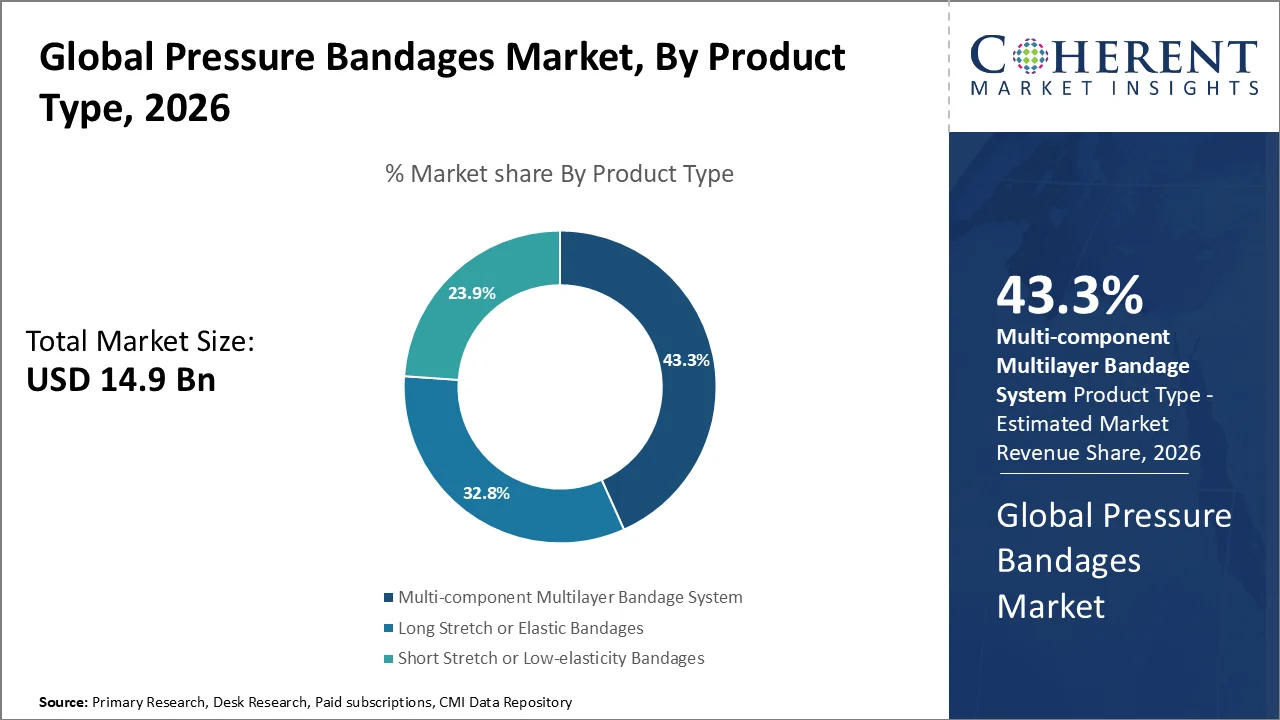
  • Multi-component Multilayer Bandage System hold the largest market share of 43.3% in 2026 owing to its rising prevalence of chronic venous disorders. In the U.S., over 25 million adults have chronic venous insufficiency (CVI), with 6 million in advanced stages.
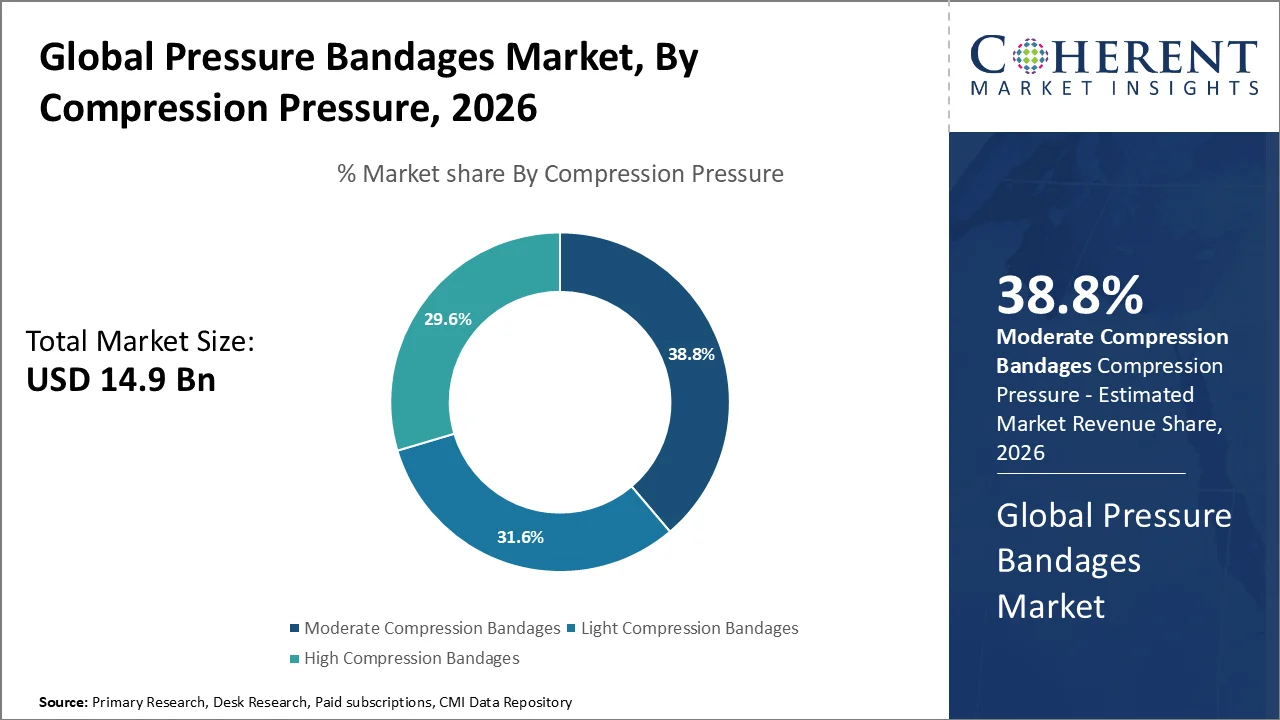
  • Moderate Compression Bandages expected to hold the largest market share of 38.8% in 2026 owing to the high prevalence of venous and edema-related conditions.
  • Cotton Fabric acquired the prominent market share of 37.7% in 2026 owing to its superior skin compatibility and hypoallergenic properties.
  • Leg Ulcers captures the largest market share of 33.3% in 2026 owing to the high prevalence of venous leg ulcer. Venous leg ulcers (VLUs) account for 70–80 % of chronic leg ulcers, affecting 1–3 % of older adults in Western countries. These slow-healing wounds have up to an 80 % recurrence rate, with prevalence rising above 4 % in those over 65.
  • Hospitals hold the largest market share of 43.3% in 2026 owing to its high patient inflow for wound and injury management.
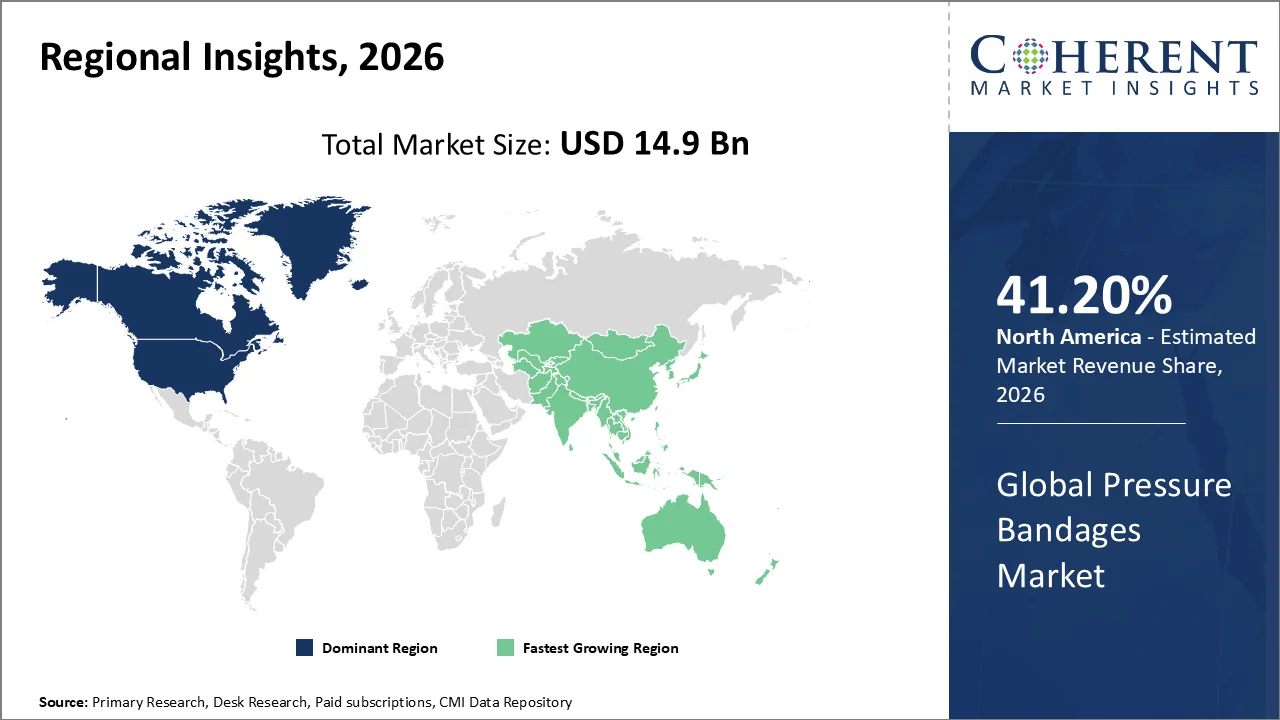
  • North America is expected to acquire the dominant share of 41.2% in 2026 owing to the high prevalence of chronic venous and wound disorders. Chronic wounds affect about 10.5 million in United States.

Current Events and Their Impact

Current Event

Description and its Impact

EU MDR Implementation and Updated MDCG Guidance

  • Description: Ongoing implementation of the EU Medical Device Regulation (MDR) and revised MDCG classification/borderline guidance documents are forcing companies to reassess product classification, clinical evaluation, and conformity assessment pathways for wound care devices, including pressure bandages.
  • Impact: Pressure bandage manufacturers face extended conformity assessment timelines, greater documentation expectations, and higher notified body scrutiny in the EU, potentially increasing time to market and regulatory costs for new and existing products.

U.S. Medicare Reimbursement Policy Changes on High‑Tech Wound Care Products

  • Description: Federal discussions and CMS proposals to cap or reform Medicare payment rates for advanced wound care products (e.g., bioengineered skin substitutes, high‑tech dressings) have dominated U.S. policy debates, with potential reimbursement limits under review.
  • Impact: Proposed reimbursement rate cuts and coverage narrowings can reduce hospital/clinician uptake of premium pressure bandages bundled with advanced materials, affecting pricing strategies and slowing adoption in outpatient and long‑term care settings.

Uncover macros and micros vetted on 75+ parameters: Get instant access to report

Segmental Insights

Pressure Bandages Market By Product Type

To learn more about this report, Request Free Sample

Why is Multi-component Multilayer Bandage System Acquiring the Largest Market Share?

Multi-component Multilayer Bandage System hold the largest market share of 43.3% in 2026. Rising cases of chronic venous disorders and related conditions such as venous leg ulcers drive demand for multi-component multilayer bandage systems in the pressure bandages market. Increasing incidence of diabetes and lymphedema further strengthens the need for effective compression therapy. Healthcare providers increasingly prefer evidence-based wound care that ensures sustained and controlled pressure delivery, which supports wider adoption. A growing elderly population, along with a shift toward outpatient and home healthcare services, promotes the use of multilayer systems due to their clinical effectiveness and reliable performance.
Moderate Compression Bandages expected to hold the largest market share

Pressure Bandages Market By Compression Pressure

To learn more about this report, Request Free Sample

Moderate Compression Bandages expected to hold the largest market share of 38.8% in 2026 owing to the better patient compliance vs high compression systems. Increasing prevalence of venous insufficiency and related edema conditions drives the demand for moderate compression bandages in the pressure bandages market, as these conditions require controlled pressure therapy. Rising cases of lymphedema and post-surgical swelling also support their clinical use. Lymphedema affects an estimated 140–250 million people globally, making it a rapidly growing health concern. Healthcare providers choose moderate compression because it balances comfort and effectiveness, which improves patient compliance. Expanding outpatient and home-based care services, along with an aging population prone to vascular disorders, further increases the adoption of these bandages in routine wound and injury management. For instance, Smart bandages are emerging as a promising innovation that can transform how chronic wounds are treated. These wounds, including diabetic ulcers, surgical wounds, pressure injuries, and related conditions, often lead to serious complications and are more life-threatening than commonly assumed.

Cotton Fabric acquired the prominent market share

Cotton Fabric acquired the prominent market share of 37.7% in 2026 owing to its high breathability and moisture management. High skin compatibility and low allergic risk drive the adoption of cotton fabric in the pressure bandages market, making it suitable for long-term wound care. Its natural breathability and moisture absorption support skin health under compression. Sustainable polyester, cotton blend fabrics were developed as wound dressings for controlled bioactive agent release. Increasing use in chronic wound management and post-surgical care further boosts demand. Healthcare providers prefer cotton because it offers comfort, affordability, and easy application. Growing emphasis on sustainable and biodegradable medical materials, along with expanding home healthcare services, strengthens its use in pressure bandage systems. For instance, in February 2026, Polaroid Therapeutics has received CE Mark approval for POLTX_Fiber, a Class IIb antimicrobial gelling fiber dressing featuring its APT technology. The company introduced this as its first product, marking its entry into the wound care sector with a focus on advancing treatment standards.

Leg Ulcers captures the largest market share

Leg Ulcers captures the largest market share of 33.3% in 2026 owing to the expansion of compression therapy as standard care. Rising venous disorders increase the occurrence of leg ulcers in the pressure bandages market, as these conditions require consistent compression therapy for effective healing. Increasing cases of diabetes and peripheral vascular diseases also contribute to chronic ulcer formation. An aging population with reduced mobility and weaker circulation further raises the risk. Healthcare providers use pressure bandages to enhance healing outcomes and prevent recurrence. Growing awareness of early diagnosis and the expansion of outpatient wound care services further support demand in leg ulcer management. For instance, in April 2026, FeelTect has started a clinical trial in Ireland to test its wearable pressure-sensing device for venous leg ulcers. Researchers at the University of Galway are evaluating the Tight Alright system, which remotely monitors sub-bandage pressure during compression therapy.

Which End User segment dominates the market?

Hospitals hold the largest market share of 43.3% in 2026. Rising patient admissions for trauma, surgical procedures, and chronic wounds drive hospital demand in the pressure bandages market. Hospitals use pressure bandages to manage conditions such as venous leg ulcers, diabetic foot complications, and post-operative edema. Healthcare providers increasingly adopt standardized wound care protocols, which support consistent use of compression therapy. A growing elderly population and a higher incidence of lifestyle-related diseases further increase utilization. Skilled healthcare professionals apply these bandages effectively, while hospitals focus on infection control and faster recovery outcomes, strengthening overall adoption.
Pressure Bandages Market Trends

  • Shift toward outpatient and home healthcare: Home healthcare referrals for wound care have increased by 30 % over the past decade, supporting the use of easy‑to‑apply compression bandages that improve patient compliance and reduce hospital stays.
  • Rising focus on cost‑effective wound management: Pressure bandages are recognized as cost‑effective first‑line therapy, helping reduce overall wound care costs by up to 40 % compared with advanced skin substitutes and prolonged inpatient care.

Regional Insights

Pressure Bandages Market By Regional Insights

To learn more about this report, Request Free Sample

North America dominates owing to strong adoption of advanced wound care technologies

North America is expected to acquire the dominant share of 41.20% in 2026. Strong prevalence of chronic venous disorders drives the pressure bandages market in North America, as conditions like venous leg ulcers require consistent compression therapy. Rising cases of diabetes and related complications further increase demand for effective wound management solutions. In Canada, 8.8–11 % of adults have diabetes, rising about 3.3 % annually. Over 90 % are Type 2, with approximately 549 new cases daily, and projections estimate 5 million Canadians will have diabetes within the next decade. A growing elderly population and a higher incidence of lifestyle-related diseases also raise the need for compression care. Advanced healthcare systems widely adopt evidence-based treatment protocols, while favorable reimbursement policies support market growth. Expanding outpatient services and home healthcare adoption further strengthen regional demand for pressure bandages. For instance, in May 2026, Dimora Medical has launched a Sacrum Silicone Absorbent Soft Dressing to strengthen its home-care product range. The company designed it to improve protection and management of pressure-prone areas.

Asia Pacific Pressure Bandages Market Trends

Increasing surgical procedures, trauma cases, and growing awareness of advanced wound care solutions drive steady growth in the Asia Pacific pressure bandages market. Hospitals and clinics actively adopt innovative bandaging materials that improve comfort and support faster healing. Expanding healthcare infrastructure and a rising geriatric population further boost demand. By 2036, India’s senior population is expected to reach 230 million, representing roughly 15 % of the total population. Manufacturers continuously introduce innovations such as breathable and elastic designs. Developing economies also experience increased market expansion due to rising medical tourism and enhanced emergency care services across the region.

United States Pressure Bandages Market Trends

Rising trauma cases, surgical procedures, and sports injuries are driving steady growth in the United States pressure bandages market. Hospitals, ambulatory centers, and home care settings are increasing their demand as awareness of advanced wound care and emergency preparedness grows. Manufacturers are developing elastic and cohesive bandages with improved comfort and faster healing features. The expanding geriatric population and military applications are also boosting usage, while e-commerce channels are improving accessibility and strengthening distribution across healthcare provider networks nationwide. For instance, in February 2026, Dynarex Corporation launched a new Negative Pressure Wound Therapy (NPWT) pump along with an expanded range of compatible wound care products to support complex wound management across acute, post-acute, and home-care settings.

China Pressure Bandages Market Trends

Hospitals and clinics in China are increasingly adopting advanced elastic and cohesive pressure bandages to improve wound care, patient recovery, and infection control. Rising surgical procedures and an expanding elderly population drive consistent demand across healthcare facilities. By the end of 2024, China had 310 million people aged 60+ (22 % of the population), with those 65+ projected to grow from 172 million in 2020 to 366 million by 2050, highlighting rapid population aging. Domestic manufacturers expand production capacity and introduce cost-effective innovations to strengthen supply. E-commerce platforms and medical distribution networks improve product availability nationwide. Sports injuries and emergency care cases further boost usage across urban and rural healthcare settings, supporting continued market development.

Who are the Major Companies in Pressure Bandages Industry

Some of the major key players in Pressure Bandages are Medtronic Plc, Smith & Nephew, 3M, ConvaTec, Inc., Cardinal Health, Inc., Johnson & Johnson, Nitto Denko Corporation, Persys Medical, Tytek Medical, and BSN Medical.

Key News

  • In March 2026, Smith & Nephew launched its Allevyn Complete Care foam dressing for wound management and pressure injury prevention. The product uses a proprietary five-layer construction and applies a distinct mode-of-action technology designed to support effective wound care while helping prevent pressure injuries.

Market Report Scope

Pressure Bandages Market Report Coverage

Report Coverage Details
Base Year: 2025 Market Size in 2026: USD 14.9 Bn
Historical Data for: 2020 To 2024 Forecast Period: 2026 To 2033
Forecast Period 2026 to 2033 CAGR: 7.7% 2033 Value Projection: USD 27.3 Bn
Geographies covered:
  • North America: U.S. and Canada
  • Latin America: Brazil, Argentina, Mexico, and Rest of Latin America
  • Europe: Germany, U.K., Spain, France, Italy, Russia, and Rest of Europe
  • Asia Pacific: China, India, Japan, Australia, South Korea, ASEAN, and Rest of Asia Pacific
  • Middle East: GCC Countries, Israel, and Rest of Middle East
  • Africa: South Africa, North Africa, and Central Africa
Segments covered:
  • By Product Type: Long Stretch or Elastic Bandages, Multi-component Multilayer Bandage System, and Short Stretch or Low-elasticity Bandages
  • By Compression Pressure: Light Compression Bandages, Moderate Compression Bandages, and High Compression Bandages
  • By Material: Cotton Fabric, Latex Free, Polymer, and Others
  • By Application: Leg Ulcers, Deep Vein Thrombosis, Surgery, Trauma Injury, and Others
  • By End User: Hospitals, Ambulatory Surgical Centers, Research & Academic Institutes, and Home Care Settings
Companies covered:

Medtronic Plc, Smith & Nephew, 3M, ConvaTec, Inc., Cardinal Health, Inc., Johnson & Johnson, Nitto Denko Corporation, Persys Medical, Tytek Medical, and BSN Medical.

Uncover macros and micros vetted on 75+ parameters: Get instant access to report

Analyst Opinion

  • Pressure bandages are not a discretionary medical product but a direct response to a high and persistent injury burden. According to our research, millions of people globally suffer non-fatal injuries annually requiring wound compression, making bandaging a routine necessity rather than a niche intervention.
  • Trauma and emergency cases strongly anchor demand, as road traffic injuries alone cause about 1.19 million deaths each year and leave 20–50 million people with non-fatal injuries, many of whom require immediate compression and post-surgical wound management using pressure bandages.
  • Surgical volume further reinforces structural demand, with more than 300 million major surgeries performed globally each year, where pressure bandages are routinely used for hemostasis, edema control, and post-operative stabilization, particularly in orthopedic and vascular procedures.
  • Sports and occupational injuries add another consistent demand layer, with studies showing that soft tissue injuries account for nearly 30–40% of all sports-related injuries, directly increasing the use of elastic and cohesive pressure bandages in rehabilitation and acute care settings.

Market Segmentation

  • By Product Type: (Revenue, USD Bn, 2021-2033)
    • Long Stretch or Elastic Bandages
    • Multi-component Multilayer Bandage System
    • Short Stretch or Low-elasticity Bandages
  • By Compression Pressure: (Revenue, USD Bn, 2021-2033)
    • Light Compression Bandages
    • Moderate Compression Bandages
    • High Compression Bandages
  • By Material: (Revenue, USD Bn, 2021-2033)
    • Cotton Fabric
    • Latex Free
    • Polymer
    • Others
  • By Application: (Revenue, USD Bn, 2021-2033)
    • Leg Ulcers
    • Deep Vein Thrombosis
    • Surgery
    • Trauma Injury
    • Others
  • By End User: (Revenue, USD Bn, 2021-2033)
    • Hospitals
    • Ambulatory Surgical Centers
    • Research & Academic Institutes
    • Home Care Settings
  • By Region: (Revenue, USD Bn, 2021-2033)
    • North America
      • U.S.
      • Canada
    • Latin America
      • Brazil
      • Mexico
      • Argentina
      • Rest of Latin America
    • Europe
      • Germany
      • U.K.
      • France
      • Italy
      • Spain
      • Russia
      • Rest of Europe
    • Asia Pacific
      • China
      • India
      • Japan
      • Australia
      • South Korea
      • ASEAN
      • Rest of Asia Pacific
    • Middle East
      • GCC
      • Israel
      • Rest of Middle East
    • Africa
      • South Africa
      • Central Africa
      • North Africa
  • Key Players
    • Medtronic Plc
    • Smith & Nephew
    • 3M
    • ConvaTec, Inc.
    • Cardinal Health, Inc.
    • Johnson & Johnson
    • Nitto Denko Corporation
    • Persys Medical
    • Tytek Medical
    • BSN Medical

Sources

Primary Research interviews

  • Orthopedic surgeons, emergency medicine physicians, and wound care specialists across tertiary hospitals and trauma centers
  • Procurement managers from hospital networks and surgical care units
  • Medical device distributors and pharmacy chain stakeholders

Databases

  • WHO Global Health Observatory (GHO)
  • OECD Health Statistics
  • World Bank Health Nutrition and Population Data
  • National health ministry databases and hospital discharge datasets

Magazines

  • Medical Device and Diagnostic Industry (MD+DI)
  • Wound Care Today
  • Journal of Wound Care Industry features
  • Healthcare Asia / India Medical Times

Journals’

  • The Lancet (orthopedics, trauma, and surgical care studies)
  • BMJ (British Medical Journal) wound management research
  • Journal of Vascular Surgery
  • International Wound Journal
  • Burns & Trauma Journal

Newspapers

  • The Guardian (global healthcare coverage)
  • The New York Times (health and surgery reporting)
  • The Hindu (India healthcare system coverage)
  • South China Morning Post (China healthcare developments)

Associations

  • World Health Organization (WHO)
  • International Wound Infection Institute (IWII)
  • American College of Surgeons (ACS)
  • International Society of Orthopaedic Surgery and Traumatology (SICOT)
  • Chinese Medical Association (CMA)

Public Domain sources

  • Government health ministry publications and surgical procedure reports
  • WHO injury and trauma datasets
  • Open-access hospital and clinical trial repositories
  • National road safety and accident statistics reports

Proprietary Elements

  • CMI Data Analytics Tool, and Proprietary CMI Existing Repository of information for last 10 years

Share

Share

About Author

Manisha Vibhute is a consultant with over 5 years of experience in market research and consulting. With a strong understanding of market dynamics, Manisha assists clients in developing effective market access strategies. She helps medical device companies navigate pricing, reimbursement, and regulatory pathways to ensure successful product launches.

Missing comfort of reading report in your local language? Find your preferred language :

Frequently Asked Questions

The global pressure bandages market is estimated to surpass USD 14.9 Bn by 2026.

Among product type, multi component multilayer bandage system segment holds a dominant position in the pressure bandage market, owing to the higher convenience offered and the vast presence of the product in the product portfolio of the manufacturers.

Increasing incidence of chronic leg ulcers is one of the major factors that is expected to propel growth of the market over the forecast period.

The global pressure bandages market is estimated to exhibit a CAGR of 7.7% over the forecast period

Among regions, North America is expected to hold dominant position in the global pressure bandages market over the forecast period.

Major players operating in the global pressure bandages market include Medtronic Plc, Smith & Nephew, 3M, ConvaTec, Inc., Cardinal Health, Inc., Johnson & Johnson, Nitto Denko Corporation, Persys Medical, Tytek Medical, and BSN Medical.

Select a License Type

EXISTING CLIENTELE

Joining thousands of companies around the world committed to making the Excellent Business Solutions.

View All Our Clients
trusted clients logo

© 2026 Coherent Market Insights Pvt Ltd. All Rights Reserved.
