Reinforcement Material Market Analysis & Forecast: 2026-2033

Reinforcement Material Market Size and Forecast – 2026 – 2033
The Global Reinforcement Material Market size is estimated to be valued at USD 14.6 billion in 2026 and is expected to reach USD 26.3 billion by 2033, exhibiting a compound annual growth rate (CAGR) of 9.3% from 2026 to 2033.
Global Reinforcement Material Market Overview
The Reinforcement Material comprises products designed to enhance the strength, durability, and performance of construction and industrial materials. Key offerings include steel reinforcements, glass fibers, carbon fibers, synthetic fibers, and composite materials. Steel reinforcements, widely used in concrete structures, provide tensile strength, while fibers improve crack resistance and flexibility. Carbon and glass fibers are preferred in advanced applications like aerospace, automotive, and sports equipment due to their high strength-to-weight ratio. Additionally, synthetic and polymer-based reinforcements offer corrosion resistance and lightweight solutions. These products cater to diverse industries, driving demand through infrastructure development, industrial applications, and evolving material technologies.
Key Takeaways
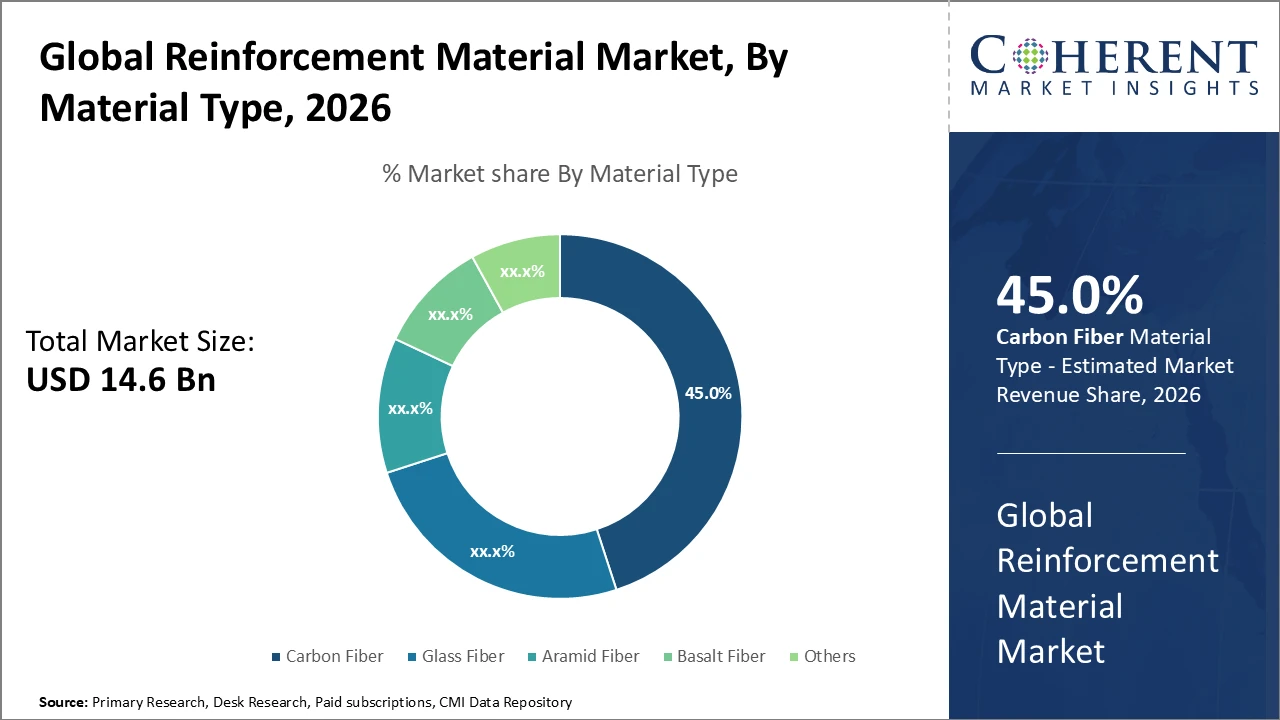
The Carbon Fiber segment dominates the Material Type category with a 45% industry share, driven by its superior strength-to-weight ratio and expanding applications in automotive and aerospace.
Construction remains the leading application segment, accounting for over 35% of the market revenue, supported by accelerating urban development projects in Asia Pacific.
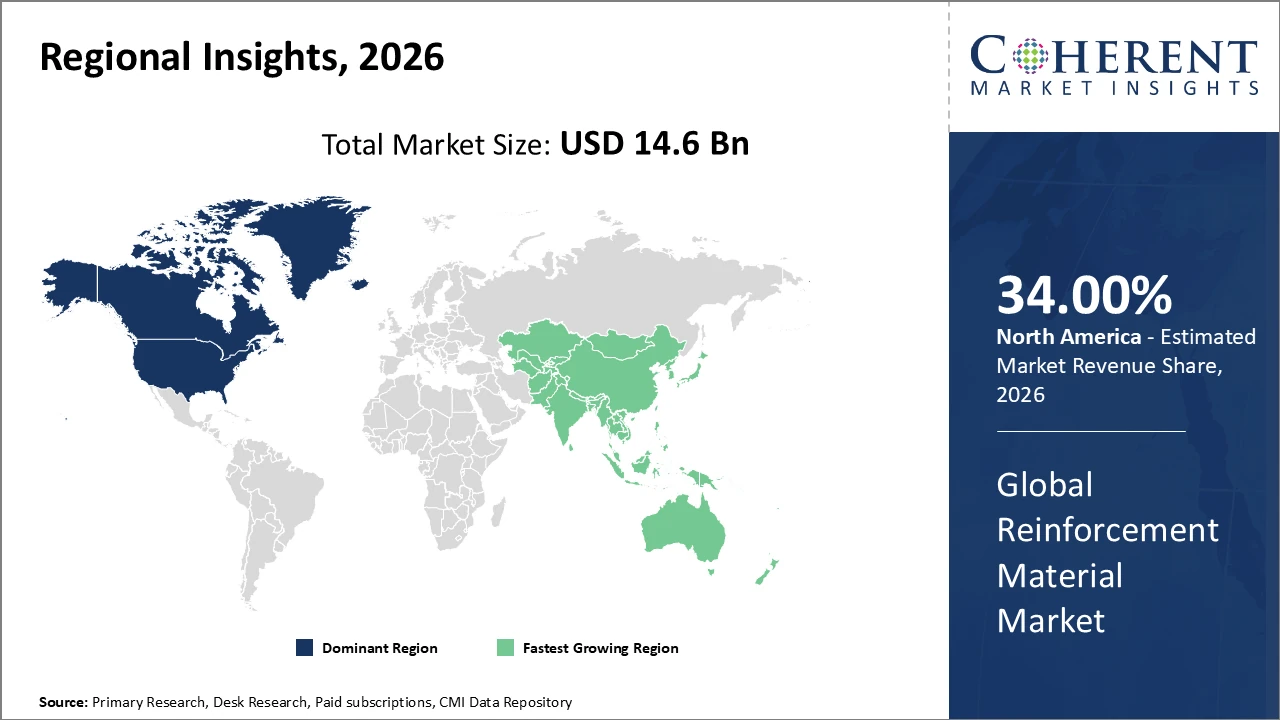
North America holds the largest market share due to mature aerospace and automotive industries, while Asia Pacific shows the fastest CAGR fueled by infrastructure investments and policy support.
In Europe, stringent environmental regulations are shaping the demand for recyclability and sustainability within reinforcement materials, opening growth avenues for eco-friendly solutions.
Reinforcement Material Market Segmentation Analysis
To learn more about this report, Request Free Sample
Reinforcement Material Market Insights, By Material Type
Carbon Fiber dominates the market share at 45%. Its prominence stems from exceptional mechanical strength and lightweight characteristics, driving widespread adoption in automotive and aerospace sectors. Demand for carbon fiber composites grew sharply in 2025, particularly boosted by electric vehicle development and aircraft modernization programs. Glass Fiber remains a reliable subsegment, valued for cost efficiency and corrosion resistance, sustaining steady demand in construction and marine applications. Aramid Fiber, recognized for impact resistance, is increasingly preferred in safety equipment and defense sectors. Basalt Fiber, though still emerging, is gaining attention due to environmental benefits and thermal stability, while other specialty hybrid composites are gradually entering niche applications.
Reinforcement Material Market Insights, By Application
Construction dominates the market, driven by rapid urbanization and large-scale infrastructure projects, contributing over 35% of market revenue. Reinforcement materials are widely adopted for enhancing concrete durability and seismic resistance, especially in emerging economies. The automotive subsegment is the fastest-growing, fueled by rising demand for lightweight vehicles to meet stringent fuel economy and emission regulations. Aerospace applications require continuous innovation in reinforcements, focusing on materials that balance weight reduction with strength and thermal stability. Electronics use smaller volumes for circuit boards and thermal management, showing moderate yet steady growth. Marine applications benefit from the corrosion resistance of reinforcements, particularly in developing regions, while other areas such as sports equipment and consumer goods are gradually expanding as reinforcement innovations gain traction.
Reinforcement Material Market Insights, By Form
Woven Fabrics dominate the market due to their versatility and superior mechanical performance in composite structures. Their preference increased markedly in 2026 across aerospace and automotive sectors, driven by adaptability to complex shapes and excellent load distribution. Mats and Roving are primarily used in construction and marine industries because of their cost advantages and ease of application. Chopped Fibers are rapidly gaining traction in injection molding and automotive components, enabling the economical production of complex lightweight parts, making them the fastest-growing subsegment. Other forms include specialty preforms and hybrid combinations designed for niche applications in electronics and defense.
Reinforcement Material Market Trends
Accelerated adoption of sustainable reinforcement alternatives is a key trend, with 2026 seeing a 9% increase in bio-composite reinforcements driven by regulatory pressures in Europe and North America.
Expansion of digital manufacturing methods, including digital twin technology, is streamlining composite product development, enhancing precision, and reducing material wastage, led by companies like Hexcel.
The shift toward circular economy practices and advanced recycling technologies is influencing product innovation and shaping downstream applications across the reinforcement material market.
Reinforcement Material Market Insights, By Geography
To learn more about this report, Request Free Sample
North America Reinforcement Material Market Analysis and Trends
In North America, the Reinforcement Material Market is dominated by a well-established automotive and aerospace industry, supported by strong R&D infrastructure and favorable regulatory frameworks for advanced material adoption. The region holds over 34% of the market share, driven by growing demand for lightweight composites in electric vehicles and aircraft modernization programs. Leading companies such as Owens Corning and Toray have played a pivotal role in sustaining North America’s market leadership through innovation and strategic investments. The combination of technological expertise, industry maturity, and regulatory support continues to reinforce the region’s position as a key hub for reinforcement material development and application.
Asia Pacific Reinforcement Material Market Analysis and Trends
Asia Pacific exhibits the fastest growth in the Reinforcement Material Market, with a CAGR exceeding 11%, driven by rapid urbanization and extensive infrastructure development in countries like China and India. Government initiatives promoting green buildings and expanded automotive manufacturing capacity have significantly boosted reinforcement material demand. Domestic companies such as Jushi Group and Formosa Plastics, along with international entrants, are leveraging the region’s growing opportunities, supported by low-cost manufacturing and a skilled workforce. These factors collectively position Asia Pacific as a key growth hub, attracting investment and innovation while accelerating adoption of advanced reinforcement materials across multiple industries.
Reinforcement Material Market Outlook for Key Countries
USA Reinforcement Material Market Analysis and Trends
The USA’s reinforcement material market is strengthened by its advanced aerospace and automotive sectors, with growing adoption of carbon and aramid fibers for lightweighting initiatives. In 2025, aerospace consumption of carbon fiber composites increased by nearly 13%, highlighting the country’s innovation edge and diverse applications. Government incentives promoting sustainable materials further support market growth. Leading companies like Hexcel and Johns Manville maintain substantial production capacity and invest heavily in research and development, enabling the USA to sustain its global competitive advantage in reinforcement materials while driving technological advancements across multiple high-performance industries.
Germany Disability Devices Market Analysis and Trends
Germany’s disability devices market is expanding steadily, driven by advanced healthcare technologies, strong reimbursement policies, and an aging population demanding greater independence and mobility support. The market features high adoption of AI???enhanced hearing aids, precision orthotics, and mobility aids like wheelchairs and walkers, supported by statutory health insurance coverage and rehabilitation infrastructure. Innovation in assistive technologies—including smart and connected devices—and government incentives further bolster growth, while robust domestic manufacturers such as Ottobock lead in production and product development. Regulatory frameworks and integrated care models also promote accessibility and sustained market expansion across disability segments.
Analyst Opinion
Supply chain optimization is a key driver of market growth, with several large-scale reinforcement producers increasing production capacity by 15% in 2025, significantly boosting overall market revenue. Pricing strategies in 2026 stabilized despite raw material volatility, supporting steady market share growth.
Demand-side dynamics show diversification across application industries. In 2024, automotive sector consumption grew by 12% due to stricter emission norms and the push for lightweight materials, while construction saw a 9% year-on-year increase driven by urban infrastructure development.
Emerging use cases, including 3D-printed composite reinforcements and nano-enhanced fibers, are entering the market. Early-stage aerospace adoption in 2025 raised revenue by 7%, indicating a shift toward high-performance materials with novel properties.
Microeconomic factors such as localized raw material sourcing led to a 10% reduction in import dependency in major producing countries through 2026, enabling competitive pricing and strengthening domestic players, supporting steady market growth and expanding opportunities in regions with favorable trade policies.
Market Scope
| Report Coverage | Details | ||
|---|---|---|---|
| Base Year: | 2025 | Market Size in 2026: | USD 14.6 billion |
| Historical Data for: | 2020 To 2024 | Forecast Period: | 2026 To 2033 |
| Forecast Period 2026 to 2033 CAGR: | 9.3% | 2033 Value Projection: | USD 26.3 billion |
| Geographies covered: |
|
||
| Segments covered: |
|
||
| Companies covered: | SGL Carbon, Toray Industries, Mitsubishi Chemicals, Teijin Limited, Hexcel Corporation, BASF SE, Jushi Group, Solvay SA, Owens Corning, Johns Manville | ||
| Growth Drivers: |
|
||
Uncover macros and micros vetted on 75+ parameters: Get instant access to report
Reinforcement Material Market Growth Factors
Several key growth drivers are fueling the expansion of the Reinforcement Material Market. The rising demand for lightweight composites in automotive and aerospace sectors is a major contributor, as manufacturers focus on fuel efficiency and emission reduction, evidenced by a 14% increase in automotive sector consumption in 2025. Rapid urbanization and infrastructure investments, particularly in Asia Pacific, are boosting demand for construction-related reinforcement materials. Technological advancements, including automated weaving and resin infusion, have enhanced material properties and cost-efficiency, supporting market revenue in 2026. Additionally, stricter environmental regulations are promoting sustainable and recyclable materials, driving innovation and expanding market opportunities.
Reinforcement Material Market Development
In February 2026, Circular Structures USA Inc., based in Roanoke, Virginia, announced the opening of its first U.S. distribution and development center for high-performance flax fiber composite reinforcements. The company operates as the newly formed American subsidiary of Circular Structures GmbH, headquartered in Bremen, Germany.
Key Players
Leading Companies of the Market
SGL Carbon
Toray Industries
Mitsubishi Chemicals
Teijin Limited
Jushi Group
BASF SE
Solvay SA
Hexcel Corporation
Owens Corning
Johns Manville
Companies such as Toray Industries made strategic R&D investments, resulting in a 10% increase in advanced carbon fiber production capacity in 2025. Owens Corning strengthened its market position through collaborations with automotive OEMs, delivering customized reinforcements with enhanced mechanical properties. Hexcel’s emphasis on sustainable reinforcement solutions expanded its product portfolio for aerospace applications, contributing to a 12% growth in aerospace-related revenue. These initiatives highlight how targeted innovation, strategic partnerships, and sustainability-focused developments are driving market share gains and supporting the overall growth of the global reinforcement material industry.
Reinforcement Material Market Future Outlook
The Reinforcement Material Market is poised for robust growth, driven by rising demand for lightweight, high-strength materials across automotive, aerospace, and construction sectors. Advances in composite technologies, including nano-enhanced fibers, 3D-printed reinforcements, and eco-friendly alternatives, will expand application opportunities. Emerging markets in Asia Pacific are expected to lead growth due to infrastructure development and supportive government policies, while mature regions like North America and Europe will focus on innovation and sustainability. Additionally, increasing environmental regulations and circular economy initiatives will accelerate adoption of recyclable and bio-based materials. Overall, the market is set to witness steady revenue expansion and technological evolution.
Reinforcement Material Market Historical Analysis
The Reinforcement Material Market has experienced steady growth over the past decade, driven by expanding applications in construction, automotive, and aerospace industries. Historically, steel reinforcements dominated early demand due to widespread use in concrete structures, while glass fibers gained traction for cost-effective and corrosion-resistant solutions. The 2015–2022 period saw increasing adoption of carbon and aramid fibers, propelled by lightweighting trends in vehicles and aircraft. Technological advancements, including improved manufacturing processes and composite innovations, enhanced material performance and broadened applications. Regional markets such as North America and Europe led early adoption, while Asia Pacific emerged as a key growth region due to urbanization and infrastructure expansion.
Sources
Primary Research Interviews:
Composite Material Manufacturers
Automotive and Aerospace Engineers
Construction and Civil Engineers
Research & Development Experts in Advanced Materials
Databases:
OECD Industrial Statistics
World Bank Infrastructure & Industry Data
Magazines:
CompositesWorld
Reinforced Plastics Magazine
Material Today
Advanced Materials & Processes
Automotive Manufacturing & Design
Journals:
Journal of Composite Materials
Materials & Design Journal
Journal of Reinforced Plastics and Composites
Composites Part B: Engineering
Materials Science and Engineering A
Newspapers:
The Wall Street Journal (Industrials & Materials)
Financial Times (Manufacturing & Materials)
The Economic Times (Industry & Infrastructure)
The Guardian (Business & Technology)
Reuters (Composites & Manufacturing News)
Associations:
American Composites Manufacturers Association (ACMA)
European Composites Industry Association (EuCIA)
Society for the Advancement of Material and Process Engineering (SAMPE)
International Institute for Fiber-Reinforced Plastics (ECP)
World Reinforced Plastics Association
Share
Share
Vidyesh Swar is a seasoned Consultant with a diverse background in market research and business consulting. With over 6 years of experience, Vidyesh has established a strong reputation for his proficiency in market estimations, supplier landscape analysis, and market share assessments for tailored research solution. Using his deep industry knowledge and analytical skills, he provides valuable insights and strategic recommendations, enabling clients to make informed decisions and navigate complex business landscapes.

Credibility and Certifications

860519526


9001:2015

27001:2022


Need a Custom Report?
We can customize every report - free of charge - including purchasing stand-alone sections or country-level reports
Customize NowJoining thousands of companies around the world committed to making the Excellent Business Solutions.
View All Our Clients