Specialty Polymers Market Analysis & Forecast: 2026-2033

Specialty Polymers Market Size and Forecast – 2026 – 2033
The Global Specialty Polymers Market size is estimated to be valued at USD 43.2 billion in 2026 and is expected to reach USD 62.5 billion by 2033, exhibiting a compound annual growth rate (CAGR) of 5.7% from 2026 to 2033.
Global Specialty Polymers Market Overview
The specialty polymers market comprises high-performance materials engineered for specific applications requiring superior properties such as heat resistance, chemical stability, durability, and flexibility. Key products include fluoropolymers, silicone polymers, liquid crystal polymers, polyamides, polyimides, and thermoplastic elastomers. These polymers are widely used in automotive, electronics, medical devices, aerospace, construction, and packaging industries. Unlike commodity plastics, specialty polymers offer enhanced functionality, lightweight characteristics, and longer service life. Growing demand for advanced materials in electric vehicles, renewable energy, healthcare, and miniaturized electronics continues to drive innovation and adoption across global markets.
Key Takeaways
The thermoplastics segment holds the dominant industry share within polymer type, supported by versatile performance characteristics and recyclability, while fluoropolymers are the fastest growing due to rising demand for specialized industrial applications.
Electronics and electrical applications lead the market, driven by ongoing miniaturization and increasing complexity of circuitry, while the healthcare sector is witnessing accelerated growth fueled by continuous medical device innovations.
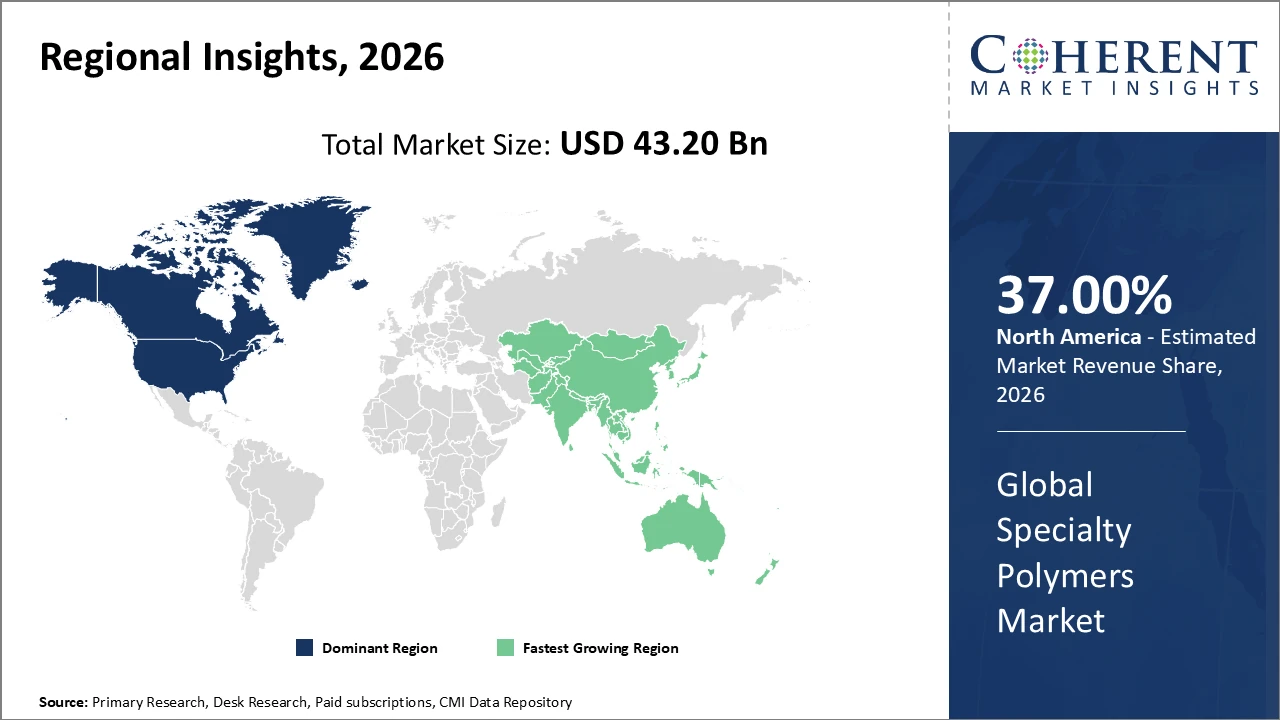
North America dominates overall market share, benefiting from advanced industrial infrastructure and high adoption across aerospace and electronics sectors, whereas Asia Pacific records the fastest CAGR due to expanding manufacturing capacities and supportive government policies.
Europe shows steady market growth, driven by sustainability-focused product development and the presence of stringent regulatory and environmental standards.
Specialty Polymers Market Segmentation Analysis
To learn more about this report, Request Free Sample
Specialty Polymers Market Insights, By Polymer Type
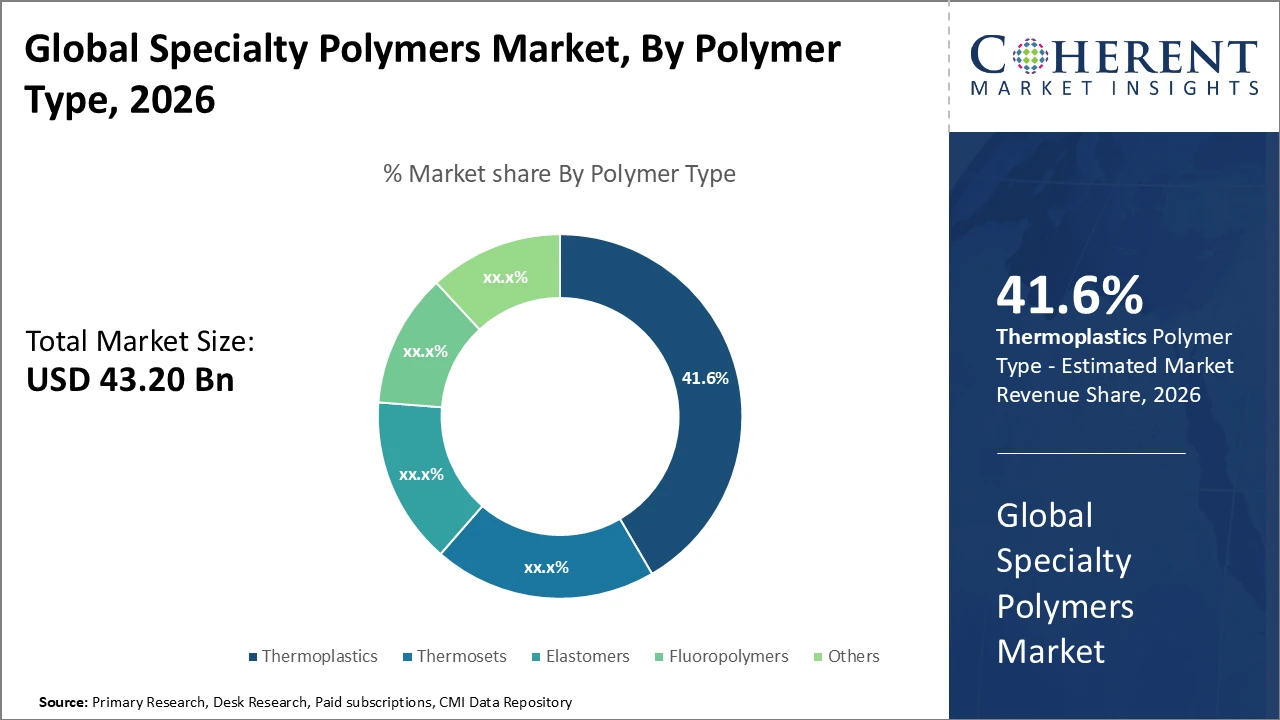
Thermoplastics dominate the specialty polymers market with a 41.6% share, driven by their recyclability, ease of processing, and wide application across automotive, electronics, and consumer goods industries. Their ability to maintain performance at elevated temperatures makes them a core material segment. Fluoropolymers represent the fastest growing subsegment, supported by superior chemical resistance and thermal stability, particularly in demanding industrial and electronics environments. Thermosets are widely used in high-strength and durable components, while elastomers are favored for flexibility and resilience. The “others” category includes emerging polymer types offering specialized properties for niche and advanced applications.
Specialty Polymers Market Insights, By Application
Electronics and electrical applications dominate the specialty polymers market, driven by continuous miniaturization, higher circuit complexity, and increasing thermal management requirements in modern devices. This segment holds a significant share and continues to expand steadily. Healthcare represents the fastest growing segment, supported by rising demand for biocompatible, sterilizable, and high-performance polymers used in medical devices and implants, particularly across developed markets with faster regulatory approvals. Automotive applications benefit from lightweight, high-strength polymer solutions that enhance efficiency and performance, while aerospace relies on advanced specialty polymers with superior thermal and mechanical properties. Packaging remains a smaller segment but is increasingly adopting specialty polymers to improve barrier protection and mechanical durability.
Specialty Polymers Market Insights, By End-User Industry
Consumer electronics dominate this segment, holding a significant market share due to continuous product innovation and strong demand for flexible, lightweight, and high-performance material solutions. Transportation is the fastest-growing subsegment, driven by the automotive industry’s increasing use of lightweight polymers to enhance fuel efficiency and reduce emissions, further accelerated by stringent regulatory requirements. Medical devices show steady growth, supported by rising adoption of advanced polymers offering biocompatibility and sterilization capability. Industrial manufacturing relies on specialty polymers designed for durability and chemical resistance in harsh environments. The “others” category addresses niche applications such as sports equipment and technical textiles that require specialized material properties.
Specialty Polymers Market Trends
Recent years have seen a strong shift toward the development of specialty polymers with improved sustainability profiles, driven by environmental regulations and corporate responsibility goals.
In 2026, bio-based thermoplastics represented approximately 18% of new polymer launches, highlighting industry efforts to reduce environmental impact and reliance on fossil-based materials.
The integration of nanotechnology into polymer composites has delivered significant gains in mechanical strength and thermal conductivity, particularly benefiting aerospace applications where high strength-to-weight ratios are critical.
Demand for fluoropolymers in chemical processing industries has increased due to their superior corrosion resistance, supported by a 7% revenue growth recorded in 2025.
Digital transformation in manufacturing, including additive manufacturing and polymer 3D printing, is enabling new applications, greater customization, and reshaping market segment dynamics.
Specialty Polymers Market Insights, By Geography
To learn more about this report, Request Free Sample
North America Specialty Polymers Market Analysis and Trends
In North America, the specialty polymers market holds a dominant position due to well-established R&D infrastructure, strong aerospace, automotive, and electronics industries, and supportive government initiatives that encourage innovation and advanced manufacturing. The United States leads the regional market, accounting for approximately 35% of North America’s market value in 2026. This leadership is reinforced by the presence of major industry players investing heavily in high-performance and sustainable polymer solutions. Additionally, growing demand for lightweight materials, advanced medical devices, and next-generation electronics continues to stimulate market growth, positioning North America as a key hub for technological advancement and specialty polymer development.
Asia Pacific Specialty Polymers Market Analysis and Trends
Meanwhile, Asia Pacific is projected to register the fastest growth in the specialty polymers market, with a CAGR exceeding 7% from 2026 to 2033. This rapid expansion is driven by increasing production capacities, robust growth across key end-use industries, and rising export activities. Countries such as China and India play a pivotal role, supported by favorable government incentives, infrastructure investments, and cost-efficient manufacturing ecosystems. The expansion of automotive, electronics, and consumer goods manufacturing hubs further accelerates demand for high-performance specialty polymers, contributing significantly to regional market revenues and strengthening Asia Pacific’s position as a global growth engine.
Specialty Polymers Outlook for Key Countries
USA Specialty Polymers Market Analysis and Trends
The U.S. specialty polymers market benefits from a mature industrial ecosystem, robust manufacturing capabilities, and high levels of industrial R&D investment. Home to several leading global players, the country accounts for a substantial share of worldwide market revenue. In 2025, investments exceeding USD 500 million in biopolymer development underscored a strong strategic focus on sustainability and innovation. Demand is further strengthened by the aerospace sector’s reliance on high-strength, lightweight specialty polymers, supported by government initiatives promoting advanced materials. Major companies such as DuPont and Eastman Chemical have continued to drive innovation through new product launches, contributing to steady market expansion.
Germany Specialty Polymers Market Analysis and Trends
Germany’s specialty polymers market is driven by its robust automotive and industrial manufacturing sectors, which rely on advanced polymers for lightweight design and enhanced performance. In 2024, government policies promoting sustainable polymer production led to a 10% year-over-year increase in adoption within automotive manufacturing. Leading companies have invested in local production facilities, streamlining supply chains and accelerating innovation in high-performance materials. Supported by well-integrated value chains, strong export potential, and a focus on sustainability, Germany remains a key contributor to Europe’s specialty polymers market, reinforcing the region’s position in global high-performance polymer production and technology development.
Analyst Opinion
Highly specialized applications in electronics have significantly boosted demand for high-performance specialty polymers, with a 7% year-on-year increase in consumption during 2025. Growth is driven by rising adoption in printed circuit boards and flexible electronics, supporting market share expansion and overall revenue growth.
Production capacity expansions in Asia Pacific, particularly in China and India, have been pivotal in meeting global demand. In 2024, specialty polymer production volumes in these regions increased by 9%, enabling manufacturers to optimize supply chains, reduce costs, and positively impact regional market size.
Market pricing has remained moderately stable despite raw material volatility. In 2026, monomer cost fluctuations influenced pricing strategies, but strategic supplier partnerships helped maintain profitability. Demand-side drivers, such as automotive lightweighting trends, supported steady price elasticity.
Imports of specialty polymers into North America rose by 6.5% in 2025, reflecting increased industrial demand in aerospace and healthcare sectors. This trend highlights a shift toward technologically advanced polymers and reinforces market forecasts based on growing application complexity.
Market Scope
| Report Coverage | Details | ||
|---|---|---|---|
| Base Year: | 2025 | Market Size in 2026: | USD 43.20 billion |
| Historical Data for: | 2020 To 2024 | Forecast Period: | 2026 To 2033 |
| Forecast Period 2026 to 2033 CAGR: | 5.7% | 2033 Value Projection: | USD 62.50 billion |
| Geographies covered: |
|
||
| Segments covered: |
|
||
| Companies covered: | SABIC, Arkema, Solvay, Eastman Chemical Company, DuPont, BASF SE, LG Chem, Celanese Corporation, Evonik Industries, Mitsubishi Chemical Holdings | ||
| Growth Drivers: |
|
||
Uncover macros and micros vetted on 75+ parameters: Get instant access to report
Specialty Polymers Market Growth Factors
The specialty polymers market is being driven by increasing demand for lightweight yet durable materials, particularly in the automotive and aerospace sectors, where they help reduce vehicle weight and enhance fuel efficiency. For instance, Tesla’s expanded use of specialty polymers in battery casings improved energy density and design flexibility by 9% in 2025. In electronics, the shift toward miniaturization and high-performance devices has accelerated adoption, with advanced polymers providing superior electrical insulation and thermal resistance. Sustainability regulations are spurring the development of biodegradable polymers, while growing healthcare investments, such as implantable devices, boost demand for biocompatible and sterilizable materials. Together, these factors are fueling market growth across multiple industries.
Specialty Polymers Market Development
In October 2025, Syensqo announced the launch of certified circular-content portfolio of high-performance elastomers and lubricant fluids, produced at its Spinetta Marengo facility in Piedmont, Italy. The new products use up to 29% post-industrial recycled hydrofluoric acid through a mass-balance certification system, while delivering the same heat resistance, chemical durability, and long-term lubrication performance as conventional materials.
Key Players
Leading Companies of the Market
SABIC
Arkema
Solvay
Eastman Chemical Company
DuPont
BASF SE
LG Chem
Celanese Corporation
Evonik Industries
Mitsubishi Chemical Holdings
Competitive strategies in the specialty polymers market emphasize sustainability and innovation in high-performance polymer grades. In 2025, Arkema introduced bio-based specialty polymers, which led to a 12% increase in market share within the automotive segment, highlighting the effectiveness of eco-conscious product strategies. Similarly, LyondellBasell expanded its polymer production facilities in Asia in 2024, resulting in a 15% improvement in supply chain efficiency and a 10% growth in market revenue. These examples demonstrate how combining sustainable initiatives with strategic capacity expansion and innovation can strengthen market positioning and drive revenue growth in the specialty polymers industry.
Specialty Polymers Market Future Outlook
The specialty polymers market is poised for robust growth driven by increasing demand for lightweight, high-performance, and sustainable materials across automotive, aerospace, electronics, healthcare, and packaging sectors. Advancements in bio-based polymers, nanocomposites, and 3D-printable materials will expand application possibilities, while regulatory emphasis on environmental sustainability will accelerate the adoption of eco-friendly polymers. Emerging markets in Asia Pacific are expected to drive production and consumption, supported by government incentives and expanding manufacturing hubs. Ongoing innovations in polymer performance, coupled with digital manufacturing and supply chain optimization, will continue to reshape the market, offering significant opportunities for manufacturers and investors through 2033.
Specialty Polymers Market Historical Analysis
The specialty polymers market has experienced steady growth over the past decade, driven by rising demand for high-performance materials across automotive, electronics, aerospace, healthcare, and industrial sectors. Historically, thermoplastics dominated the market due to their versatility and recyclability, while fluoropolymers and advanced composites saw rapid adoption in niche, high-performance applications. Regional growth was led by North America and Europe, supported by strong industrial infrastructure and R&D investment, while Asia Pacific emerged as a manufacturing hub with increasing production capacities. Market expansion was also fueled by trends toward lightweighting, miniaturization, and sustainability, laying the foundation for innovation-driven growth in subsequent years.
Sources
Primary Research Interviews:
Polymer manufacturers and suppliers
R&D engineers and material scientists
Automotive, aerospace, and electronics industry specialists
Packaging and medical device developers
Databases:
ICIS Chemicals
Magazines:
Plastics Today
Materials Today
Chemical & Engineering News
CompositesWorld
Journals:
Journal of Applied Polymer Science
Polymer Engineering and Science
Progress in Polymer Science
Macromolecular Materials and Engineering
Journal of Materials Science
Newspapers:
The Financial Times (Materials & Industry)
The Wall Street Journal (Manufacturing & Chemicals)
The Economist (Materials & Technology)
Reuters (Chemicals & Materials)
Associations:
American Chemistry Council (ACC)
Plastics Europe
Society of Plastics Engineers (SPE)
European Chemical Industry Council (Cefic)
International Association of Plastics Distribution (IAPD)
Share
Share
Vidyesh Swar is a seasoned Consultant with a diverse background in market research and business consulting. With over 6 years of experience, Vidyesh has established a strong reputation for his proficiency in market estimations, supplier landscape analysis, and market share assessments for tailored research solution. Using his deep industry knowledge and analytical skills, he provides valuable insights and strategic recommendations, enabling clients to make informed decisions and navigate complex business landscapes.

Credibility and Certifications

860519526


9001:2015

27001:2022


Need a Custom Report?
We can customize every report - free of charge - including purchasing stand-alone sections or country-level reports
Customize NowJoining thousands of companies around the world committed to making the Excellent Business Solutions.
View All Our Clients