Thyroid Eye Disease Treatment Market Analysis & Forecast: 2026-2033
Thyroid Eye Disease Treatment Market Size and Forecast – 2026 – 2033
The Global Thyroid Eye Disease Treatment Market size is estimated to be valued at USD 1.30 billion in 2026 and is expected to reach USD 2.27 billion by 2033, exhibiting a compound annual growth rate (CAGR) of 8.3% from 2026 to 2033.
Global Thyroid Eye Disease Treatment Market Overview
Thyroid eye disease treatment products address inflammation, tissue expansion, and visual impairment associated with autoimmune thyroid disorders. These include corticosteroids, immunomodulatory drugs, biologic therapies, radiation therapy solutions, and surgical interventions such as orbital decompression tools. Recently developed biologics specifically target disease pathways to reduce proptosis and inflammation. Product differentiation centers on efficacy in reducing symptoms, safety profile, treatment duration, and improvement in patient quality of life.
Key Takeaways
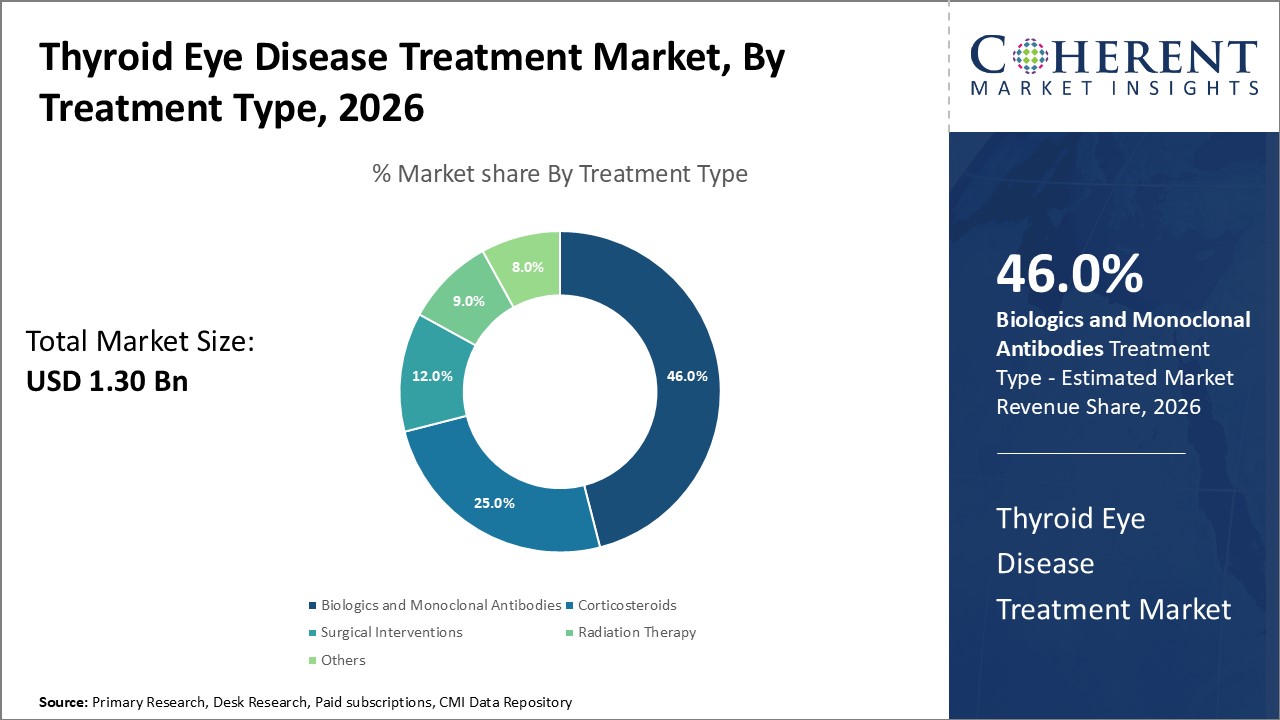
Market segments show clear dominance: The biologics and monoclonal antibodies segment holds a commanding 46% market share, indicating a shift toward sophisticated immunotherapies as the leading treatment modality.
The hospital setting remains the largest end user, corroborating the preference for specialized, inpatient management of complicated TED cases.
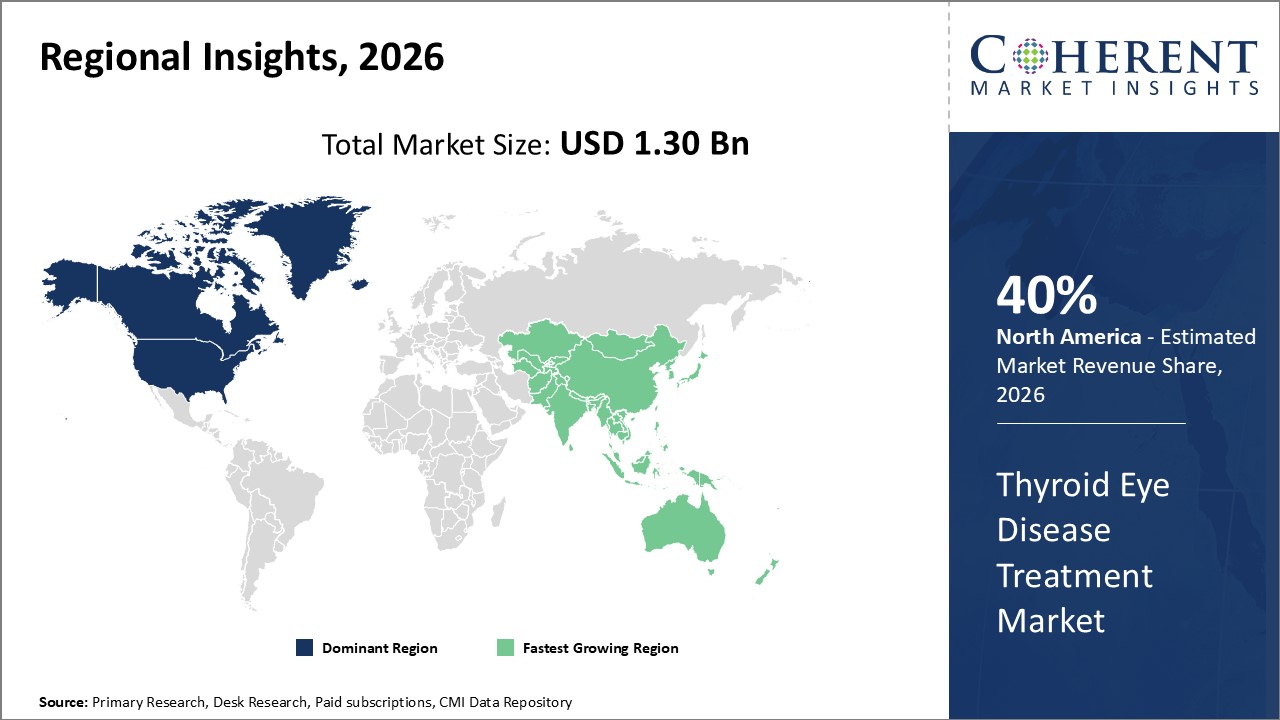
From a regional perspective, North America maintains its leadership due to significant healthcare spending and robust R&D pipelines, accounting for approximately 40% of the global share in 2026.
Meanwhile, the Asia Pacific region emerges as the fastest-growing region with a CAGR exceeding 10% because of rising disease incidence and improved healthcare accessibility.
Thyroid Eye Disease Treatment Market Segmentation Analysis
To learn more about this report, Request Free Sample
Thyroid Eye Disease Treatment Market Insights, By Treatment Type
Biologics and Monoclonal Antibodies dominate the market share with 46%. Biologics and monoclonal antibodies have become the cornerstone of treatment due to their targeted mechanism of action and improved safety profile, significantly reducing disease progression rates. This segment is the fastest growing, supported by rising approvals and expanded indications. Corticosteroids remain integral for symptomatic management but face challenges due to side effects and relapse risk. Surgical interventions cater primarily to severe, refractory cases, while radiation therapy is limited due to emerging safer alternatives.
Thyroid Eye Disease Treatment Market Insights, By Therapeutic Approach
Immunomodulatory Therapy is the dominant segment, accounting for over 50% market share, driven by advanced biologic therapies modulating immune response directly related to TED pathology. It is also the fastest growing subsegment due to ongoing research yielding novel agents. Symptomatic Management continues as a support pillar for managing manifestations such as eyelid retraction and inflammation, but lacks curative potential. Surgical Procedures, while crucial for optic neuropathy or severe proptosis, have limited frequency due to invasiveness. Radiotherapy is less preferred but remains relevant in specific clinical scenarios. Supplementary treatments like lubricants and antioxidants serve as adjuncts rather than isolated therapies.
Thyroid Eye Disease Treatment Market Insights, By End-User
Hospitals dominate with the largest market share of close to 60%, primarily due to their capacity for complex diagnostics, multidimensional treatment delivery, and postoperative care. Hospitals are also central to clinical trials, influencing the market’s research-driven expansion. Specialty Clinics represent the fastest-growing subsegment, benefitting from increasing patient preference for specialized, outpatient management and personalized care pathways. Ambulatory Surgical Centers function mainly for surgical interventions but remain a smaller share. Research Institutes contribute indirectly to market dynamics through clinical studies and the development of treatment protocols.
Thyroid Eye Disease Treatment Market Trends
In recent years, the Thyroid Eye Disease Treatment market trend has notably shifted toward advanced biologics, exemplified by the FDA approval and widespread adoption of teprotumumab, which has revolutionized treatment outcomes.
Real-world data from 2025 indicates an 19% year-over-year growth in telemedicine consultations related to TED management, highlighting the integration of technology in treatment paradigms.
Regionally, North America dominates with a significant market share of approximately 40%, attributed to a well-established healthcare infrastructure, high healthcare expenditure, and research investment.
Asia Pacific exhibits the fastest growth trajectory, showcasing a CAGR of over 10%, fueled by rising disease awareness, expanding hospital infrastructure, and increasing adoption of newer treatment modalities.
Key players such as Horizon Therapeutics and Novartis are strategically expanding their reach in Asia Pacific through partnerships and payload introduction, influencing regional market dynamics.
Thyroid Eye Disease Treatment Market Insights, By Geography
To learn more about this report, Request Free Sample
North America Thyroid Eye Disease Treatment Market Analysis and Trends
In North America, the dominance in the Thyroid Eye Disease Treatment market is driven by advanced medical facilities, high prevalence rates, and favorable reimbursement policies. The U.S., in particular, holds the bulk of this market share, aided by a mature pharmaceutical ecosystem focused on biologics, leading to consistent growth. Companies like Horizon Therapeutics have capitalized on this by launching teprotumumab, ensuring strong market capture.
Asia Pacific Thyroid Eye Disease Treatment Market Analysis and Trends
Meanwhile, Asia Pacific exhibits the fastest growth, supported by rising healthcare investments, increasing patient pool, and government initiatives to improve specialty treatment access. Countries like India and China are witnessing higher diagnosis rates of TED due to heightened awareness campaigns.
Thyroid Eye Disease Treatment Market Outlook for Key Countries
USA Thyroid Eye Disease Treatment Market Analysis and Trends
The USA remains the largest contributor to market revenue owing to the presence of cutting-edge therapeutic options and a highly developed healthcare infrastructure. Approximately 40% of the global thyroid eye disease treatment revenue is generated from the U.S., where Horizon Therapeutics’ teprotumumab has seen over 50% year-over-year prescription growth in 2025. Strong insurance reimbursements and clinical trial activities further underpin market expansion. The U.S. also benefits from growing endocrinology and ophthalmology specialty clinics dedicated to TED, enhancing patient accessibility to innovative treatments.
India Thyroid Eye Disease Treatment Market Analysis and Trends
India’s market is rapidly evolving, propelled by increasing disease awareness and healthcare spending. Growing public and private hospital infrastructure specializing in autoimmune disorders is catalyzing treatment accessibility. The government’s focus on improving healthcare quality and affordability, along with rising medical tourism for ophthalmic treatments, is transforming the competitive landscape. Novartis and other market players have intensified their presence by launching patient assistance programs and expanding drug distribution networks, aiding the acceleration of market revenue in the region.
Analyst Opinion
Robust demand-side indicators reveal an increasing adoption rate of biologics and monoclonal antibody therapies among endocrinologists and ophthalmologists. For instance, global prescriptions of teprotumumab, approved recently, surged by over 36% in 2025, underlining the market’s pivot toward targeted therapies.
On the supply side, manufacturing capabilities for novel immunomodulatory agents have expanded by approximately 23% between 2023 and 2026, driven by increased investment from pharmaceutical companies in active production lines, ensuring steady supply chain resilience.
Market growth is also propelled by emerging treatment protocols incorporating combination therapies, incorporating corticosteroids with emerging biologics. Clinical trial registrations for these protocols increased by 19% globally in 2025, highlighting the shift in therapeutic regimens.
Geographic market dynamics illustrate that North America continues to dominate market share due to high healthcare expenditure and established reimbursement frameworks, registering a 40% market share in 2026, while Asia Pacific markets demonstrate rapid growth attributed to expanding patient awareness and improving healthcare infrastructure.
Market Scope
| Report Coverage | Details | ||
|---|---|---|---|
| Base Year: | 2025 | Market Size in 2026: | USD 1.30 billion |
| Historical Data for: | 2020 To 2024 | Forecast Period: | 2026 To 2033 |
| Forecast Period 2026 to 2033 CAGR: | 8.3% | 2033 Value Projection: | USD 2.27 billion |
| Geographies covered: |
|
||
| Segments covered: |
|
||
| Companies covered: | Santen Pharmaceutical Co., Ltd., Sanofi S.A., AbbVie Inc., Regeneron Pharmaceuticals, Inc., Alexion Pharmaceuticals, Inc., Eisai Co., Ltd., Amgen Inc., Mylan N.V., Ipsen S.A., Ipsen Bioscience, Inc. | ||
| Growth Drivers: |
|
||
Uncover macros and micros vetted on 75+ parameters: Get instant access to report
Thyroid Eye Disease Treatment Market Growth Factors
The growing prevalence of autoimmune thyroid conditions, with an estimated 12 million Americans affected by Graves’ disease alone as of 2025, is a critical growth driver. Increasing patient awareness regarding TED and related complications is pushing demand for early diagnostic and therapeutic interventions. Advances in biologics and targeted molecular therapies are transforming the treatment landscape, improving efficacy and reducing relapse rates. Additionally, improved healthcare reimbursement policies in developed countries are facilitating wider accessibility and affordability of costly novel treatments. The rise in specialized ophthalmic care facilities, particularly in regions like North America and Europe, complements market growth dynamics.
Thyroid Eye Disease Treatment Market Development
In 2025, Viridian Therapeutics announced the submission of a Biologics License Application (BLA) for Veligrotug for the treatment of Thyroid Eye Disease (TED). The submission marked a key regulatory milestone for the company’s lead antibody candidate, supporting its strategy to address significant unmet needs in TED with differentiated efficacy and dosing potential.
In 2025, DRI Healthcare Trust announced the acquisition of a synthetic royalty interest in U.S. sales of Veligrotug and VRDN-003 for the treatment of Thyroid Eye Disease. The transaction strengthened DRI Healthcare’s royalty portfolio while providing long-term exposure to the commercial success of Viridian’s TED therapies in the U.S. market.
Key Players
Leading Companies of the Market
Santen Pharmaceutical Co., Ltd.
Sanofi S.A.
AbbVie Inc.
Regeneron Pharmaceuticals, Inc.
Alexion Pharmaceuticals, Inc.
Eisai Co., Ltd.
Amgen Inc.
Mylan N.V.
Ipsen S.A.
Ipsen Bioscience, Inc.
Market leaders are increasingly investing in expanding their biologics portfolio. Horizon Therapeutics’ aggressive market penetration strategy, supported by successful commercialization of teprotumumab, augmented its revenue by 30% in 2025. Meanwhile, Novartis enhanced its competitive positioning through strategic collaborations and licensing agreements in 2023, accelerating access to innovative therapies in emerging markets.
Thyroid Eye Disease Treatment Market Future Outlook
The TED treatment market is expected to grow as awareness increases and early diagnosis becomes more common. Continued innovation in biologic therapies and immune-modulating drugs will enhance treatment efficacy. Expanding access to specialized care and integration of multidisciplinary treatment approaches will further support market growth. Emerging markets are expected to see increased adoption as healthcare infrastructure improves.
Thyroid Eye Disease Treatment Market Historical Analysis
Historically, treatment for thyroid eye disease focused on symptom management through corticosteroids and surgical interventions. Limited disease-specific therapies restricted long-term outcomes. Over time, improved understanding of the autoimmune mechanisms underlying TED led to the development of targeted biologic therapies. These advances transformed the treatment landscape and significantly improved disease management.
Sources
Primary Research Interviews:
Endocrinologists
Ophthalmologists
Immunologists
Hospital Specialists
Biopharma Researchers
Databases:
FDA Biologics Data
WHO Health Statistics
NIH Databases
Magazines:
Ophthalmology Times
Endocrine Today
BioPharma Dive
MedTech Insight
PharmaVOICE
Journals:
Ophthalmology Journal
Journal of Endocrinology
Thyroid Journal
Clinical Immunology
The Lancet Diabetes & Endocrinology
Associations:
American Thyroid Association
Endocrine Society
American Academy of Ophthalmology
WHO
Rare Disease International
Share
Share
Ghanshyam Shrivastava - With over 20 years of experience in the management consulting and research, Ghanshyam Shrivastava serves as a Principal Consultant, bringing extensive expertise in biologics and biosimilars. His primary expertise lies in areas such as market entry and expansion strategy, competitive intelligence, and strategic transformation across diversified portfolio of various drugs used for different therapeutic category and APIs. He excels at identifying key challenges faced by clients and providing robust solutions to enhance their strategic decision-making capabilities. His comprehensive understanding of the market ensures valuable contributions to research reports and business decisions.
Ghanshyam is a sought-after speaker at industry conferences and contributes to various publications on pharma industry.

Credibility and Certifications

860519526

9001:2015
27001:2022


Need a Custom Report?
We can customize every report - free of charge - including purchasing stand-alone sections or country-level reports
Customize NowJoining thousands of companies around the world committed to making the Excellent Business Solutions.
View All Our Clients