
all report title image

Virtual Rehabilitation And Telerehabilitation Systems Market Analysis & Forecast: 2026-2033

Virtual Rehabilitation and Telerehabilitation Systems Market, By Product Types (Physical Rehabilitation, Neuro Rehabilitation, Cognitive Rehabilitation, and Others), By End User  (Hospitals & Clinics, Rehabilitation Centers, and Home Care Settings), By Geography (North America, Latin America, Europe, Asia Pacific, Middle East, and Africa)

  • Published In : 27 Jan, 2026
  • Code : CMI2304
  • Pages :152
  • Formats :
      Excel and PDF :
  • Industry : Healthcare IT
  • Historical Range : 2020 - 2024
  • Forecast Period : 2026 - 2033

Virtual Rehabilitation and Telerehabilitation Systems Market Size and Forecast: 2026 - 2033

The virtual rehabilitation and telerehabilitation systems market is estimated to be valued at USD 381.91 Mn in 2026 and is expected to reach USD 1,712 Mn by 2033, exhibiting a compound annual growth rate (CAGR) of 21.56% from 2026 to 2033.

Key Takeaways

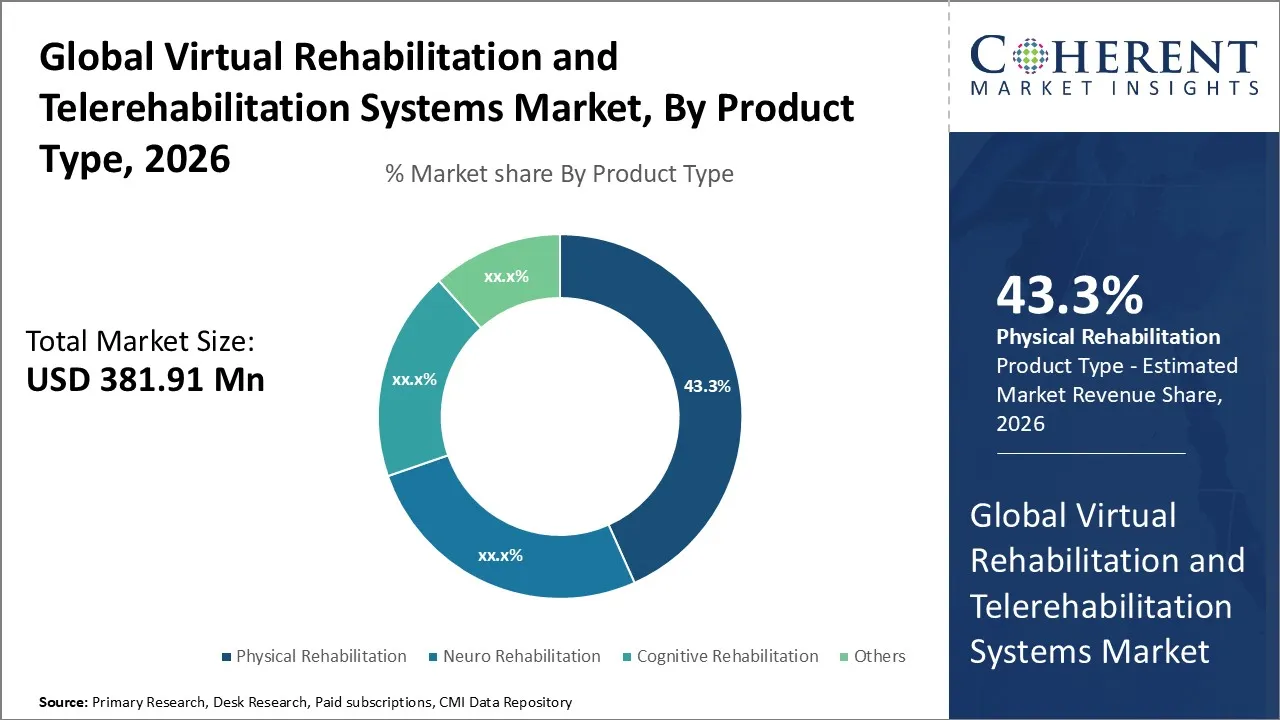
  • By Product Types, Physical Rehabilitation hold the largest market share of 43.3% in 2026 owing to its rising prevalence of physical conditions requiring rehab.
  • By End User, Hospitals & Clinics acquired the prominent market share of 36.6% in 2026 owing to the improving patient care continuity.
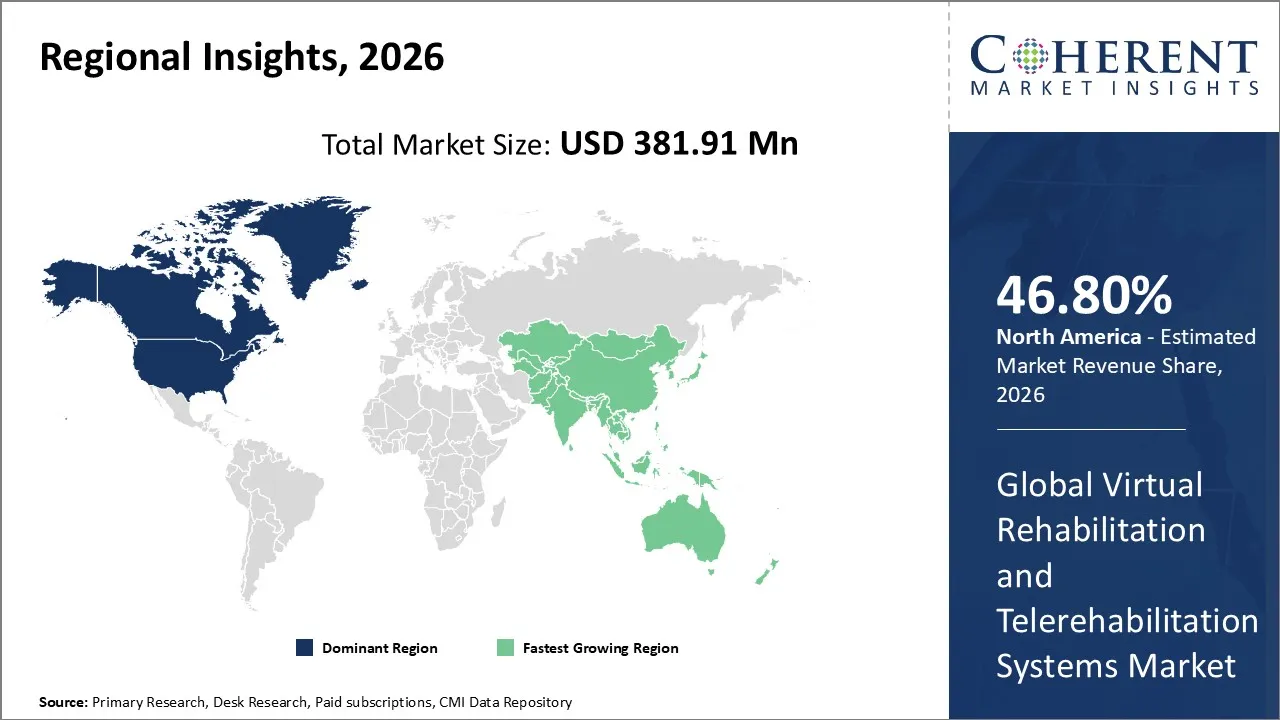
  • By Region, North America dominates the virtual rehabilitation and telerehabilitation systems market with an estimated share of 46.8% in 2026 owing to the high adoption of digital health and telemedicine.

Market Overview

The Virtual Rehabilitation and Telerehabilitation Systems market is growing quickly due to healthcare providers are quickly moving to digital solutions. These systems use the latest technologies, such as AI, VR/AR, wearable sensors, and telecommunication platforms, to help people recover physically, neurologically, and cognitively, regardless of traditional clinical settings. The rising demand reveals that people with long-term health problems, people who need help recovering from surgery, or people who have trouble moving need care that is easy to get, affordable, and ongoing. It also makes it easier for hospitals, clinics, and home-based programs to provide therapy.

Current Events and Its Impact on the Virtual Rehabilitation and Telerehabilitation Systems Market

Current Events

Description and its impact

Geopolitical Tensions Affecting Supply Chains

  • Description: Technological Advancements in AI and AR/VR Integration
  • Impact: Enhances personalization and effectiveness of virtual rehabilitation, increasing adoption rates.
  • Description: Emergence of wearable sensor technologies
  • Impact: Enables continuous remote monitoring, providing granular data that can optimize therapy protocols.

Healthcare Policy and Regulatory Changes

  • Description: Increasing government support for telehealth reimbursement
  • Impact: Facilitates wider insurance coverage, boosting market penetration.
  • Description: Regional variations in telemedicine licensing
  • Impact: May limit or complicate market expansion across jurisdictions.

Geopolitical and Economic Factors

  • Description: Supply chain disruptions affecting hardware components
  • Impact: Impedes production and delivery of telerehabilitation devices, causing delays and cost increases.
  • Description: Trade tensions influencing technology transfer restrictions
  • Impact: Limits collaboration and availability of advanced tech components, potentially slowing innovation.

Uncover macros and micros vetted on 75+ parameters: Get instant access to report

Segmental Insights

Virtual Rehabilitation and Telerehabilitation Systems Market By Product Type

To learn more about this report, Download Free Sample

Which product type holds the largest share in the virtual rehabilitation and telerehabilitation systems market due to cost effectiveness?

Physical Rehabilitation hold the largest market share of 43.3% in 2026. The virtual rehabilitation and telerehabilitation systems market is expanding because a growing number of patients have musculoskeletal, neurological, and age-related conditions that need ongoing therapy. Advanced technologies, like motion sensors, AI-guided exercises, and immersive VR, make remote rehabilitation more effective and interesting. Patients benefit from home-based programs that save time and money on travel, and clinicians track progress in real time. Increasing numbers of individuals are using these solutions due to growing awareness on rehabilitation, which can help with recovery and quality of life.

For example, in December 2025, BKT worked with King Edward Memorial Hospital in Mumbai through the BKT Foundation to build a state-of-the-art Sports Injury and Rehabilitation Center on the hospital campus. This was part of BKT's efforts to improve public health and sports recovery in India.

Virtual Rehabilitation and Telerehabilitation Systems Market Insights, By End User - Hospitals & Clinics contribute the highest share of the market owing to its cost efficiency and resource optimization

Hospitals & Clinics acquired the prominent market share of 36.6% in 2026. Hospitals and clinics are using Virtual Rehabilitation and Telerehabilitation Systems to make patient care improved and to make clinical workflows more efficient. These systems help healthcare providers to monitor on patients from a distance, coordinate rehabilitation programs with multiple disciplines, and provide therapy smoothly in both inpatient and outpatient settings. They reduce costs, make better use of staff, and get patients to stick to their treatment plans by using interactive digital tools. The growing need for ongoing, easy-to-access care and the use of cutting-edge technologies are speeding up the adoption of these technologies in hospitals and other medical facilities.

In September 2025, Boston-based XRHealth announced the launch of XR CareCart, a virtual reality rehabilitation station that can do many things and is meant to bring advanced therapy to clinics, hospitals, and community health settings.
Regional Insights

Virtual Rehabilitation and Telerehabilitation Systems Market By Regional Insights

To learn more about this report, Download Free Sample

North America Virtual Rehabilitation and Telerehabilitation Systems Market Trends

North America dominates the overall market with an estimated share of 46.80% in 2026. Healthcare providers in North America rapidly embrace Virtual Rehabilitation and Telerehabilitation Systems as the region has considerable amounts of advanced infrastructure and people are open to using digital health solutions. Hospitals and clinics use AI, VR/AR, and wearable technology to make personalized rehab plans and track on patients progress remotely.

Supportive telehealth policies, increasing chronic disease cases, and patient demand for convenient home-based care are driving this growth. Providers also employ these systems to boost operational efficiency, improve treatment outcomes, and broaden access to rehabilitation services in both urban and rural areas. For instance, in October 2025, Bioness Medical, Inc. announced the launch of Bioness Integrated Therapy System (BITS) Functional Reality, an immersive virtual reality platform designed to support neuro-rehabilitation.

What are the key trends shaping the Asia Pacific Virtual Rehabilitation and Telerehabilitation Systems Market?

Healthcare providers in the Asia Pacific region swiftly adopted Virtual Rehabilitation and Telerehabilitation Systems to meet the needs of more patients and get around the fact that traditional rehabilitation services are hard to get to. Hospitals and clinics are using AI-driven platforms, wearable sensors, and telecommunications technologies to provide personalized therapy remotely. Government programs that promote telehealth, make the internet more accessible, and raise awareness of the benefits of rehabilitation are speeding up the process.

Providers use these systems to enhance patient outcomes, lower costs, and expand access to care in both urban and rural communities. For instance, in October 2025, HCAH SuVitas Rehabilitation Centre in Hyderabad inaugurated the Centre for Advanced Robotics and Recovery, advancing stroke and neuro rehabilitation services.

United States Virtual Rehabilitation and Telerehabilitation Systems Market Trends

Healthcare providers in the United States are actively implementing Virtual Rehabilitation and Telerehabilitation Systems to deliver efficient, patient-focused care. Hospitals and outpatient centers use AI, VR/AR, and wearable technologies to design personalized rehabilitation programs and track patient progress remotely. Supportive telehealth policies, widespread digital literacy, and growing demand for convenient home-based therapy are driving adoption. Providers also employ these systems to streamline clinical workflows, lower operational costs, and improve treatment outcomes, expanding access to rehabilitation services in both urban and rural areas. For instance, Penumbra, Inc. announced the launch of the first full-body, non-tethered immersive healthcare solution designed for rehabilitation.

How are the China Virtual Rehabilitation and Telerehabilitation Systems Market evolving in terms of key trends?

In China, healthcare providers are quickly adopting Virtual Rehabilitation and Telerehabilitation Systems to meet the growing need for rehabilitation services among a large number of patients. AI, wearable devices, and mobile platforms help hospitals and clinics provide personalized therapy remotely and track patient progress. Government programs that support digital health, more people having access to the internet and smartphones, and more people knowing about the benefits of rehabilitation are all making it happen faster. Providers use these systems to make patients' lives better, make their operations more efficient, and make therapy more available in both cities and rural areas.

End-user Feedback and Unmet Needs in the Virtual Rehabilitation and Telerehabilitation Systems Market

  • Patient Experience and Engagement: End-users appreciate the convenience of home-based rehabilitation but often report challenges in maintaining motivation and adherence over long therapy periods. Many patients seek more interactive, gamified exercises and real-time feedback to stay engaged, highlighting the need for systems that balance clinical effectiveness with enjoyable user experiences.
  • Accessibility and Connectivity: Patients in rural or underserved areas value remote rehabilitation but face barriers such as limited internet connectivity, device availability, or technological literacy. There is a growing demand for low-bandwidth, user-friendly platforms that can deliver therapy effectively without complex setup or constant technical support, ensuring equitable access to rehabilitation services.
  • Clinical Customization and Flexibility: Clinicians report that some systems lack sufficient flexibility to tailor rehabilitation programs to individual patient needs. End-users desire platforms that allow real-time adjustments, personalized exercise intensity, and progress tracking, enabling providers to deliver therapy that adapts to recovery speed and specific functional limitations.

Virtual Rehabilitation and Telerehabilitation Systems Market Trend

Integration of AI and Machine Learning

Healthcare providers increasingly adopt AI-driven platforms in virtual rehabilitation to deliver personalized therapy plans and predict patient recovery trajectories. Machine learning algorithms analyze patient performance data in real time, allowing dynamic adjustment of exercises, intensity, and duration. This trend enhances treatment efficacy, enables early detection of complications, and supports clinicians in decision-making, making remote rehabilitation more responsive, adaptive, and patient-centric compared to traditional one-size-fits-all approaches.

Expansion of VR/AR-Based Rehabilitation

Virtual and augmented reality technologies are transforming rehabilitation experiences by creating immersive, gamified environments. Patients engage in interactive exercises that simulate real-world scenarios, improving motivation and adherence. Hospitals and clinics leverage VR/AR to enhance neurological, cognitive, and physical therapy outcomes. This trend reflects a shift toward experiential rehabilitation, where therapy is not only effective but also engaging, helping patients maintain long-term participation while allowing clinicians to monitor progress in real time.

Virtual Rehabilitation and Telerehabilitation Systems Market Opportunity

Integration with Wearable and IoT Devices

There is an opportunity to enhance virtual rehabilitation systems by integrating wearable sensors and IoT-enabled devices. These tools provide real-time monitoring of motion, posture, and physiological parameters, enabling personalized therapy and early detection of complications. Developers can create systems that analyze data for actionable insights, improving outcomes and patient engagement. Leveraging IoT and wearables can differentiate solutions in a competitive market by combining clinical accuracy with convenience and remote accessibility.

Market Report Scope

Virtual Rehabilitation and Telerehabilitation Systems Market Report Coverage

Report Coverage Details
Base Year: 2025 Market Size in 2026: USD 381.91 Mn
Historical Data for: 2020 To 2024 Forecast Period: 2026 To 2033
Forecast Period 2026 to 2033 CAGR: 21.56% 2033 Value Projection: USD 1,712 Mn
Geographies covered:
  • North America: U.S. and Canada
  • Latin America: Brazil, Argentina, Mexico, and Rest of Latin America
  • Europe: Germany, U.K., Spain, France, Italy, Russia, and Rest of Europe
  • Asia Pacific: China, India, Japan, Australia, South Korea, ASEAN, and Rest of Asia Pacific
  • Middle East: GCC Countries, Israel, and Rest of Middle East
  • Africa: South Africa, North Africa, and Central Africa
Segments covered:
  • By Product Types: Physical Rehabilitation, Neuro Rehabilitation, Cognitive Rehabilitation, and Others
  • By End User: Hospitals & Clinics, Rehabilitation Centers, and Home Care Settings
Companies covered:

Reflexion Health, Inc., 270 Vision Ltd., CoRehab srl, Hinge Health, Inc., SWORD Health, S.A., MIRA Rehab Limited, Bridgeway Senior Healthcare, Motekforce Link, GestureTek Inc., Virtualware Group, Motorika Medical Ltd., LiteGait, Doctor Kinetic, and Mindmaze.

Growth Drivers:
  • Rising Demand for Remote and Home-Based Care
  • Growing Prevalence of Chronic and Mobility-Related Conditions
Restraints & Challenges:
  • Connectivity and Infrastructure Barriers
  • Clinical Validation and Standardization

Uncover macros and micros vetted on 75+ parameters: Get instant access to report

Virtual Rehabilitation and Telerehabilitation Systems Market News

  • In February 2025, Osso VR announced early access to Osso Nurse Training, a VR platform designed to help health systems onboard new graduate nurses faster while maintaining high standards of patient care.

Analyst Opinion (Expert Opinion)

  • The Virtual Rehabilitation and Telerehabilitation Systems market is transitioning from niche telehealth applications to becoming integral in mainstream therapeutic care, driven by measurable clinical and operational outcomes. Adoption metrics indicate more than 64% of healthcare institutions have implemented telerehabilitation platforms to expand accessibility and continuity of care beyond traditional settings. Real‑world examples show hospitals are integrating VR and motion‑tracking tools to enhance rehabilitation precision, with over 57% of clinicians acknowledging that such technologies improve real‑time feedback and outcome monitoring.
  • Telehealth utilization trends further reinforce this transition; remote patient monitoring usage surged from about 20% to 81% among clinicians within a few years, underscoring the rapid normalization of digital rehabilitation workflows across specialties. The clinical justification for these systems is supported by meta‑analyses demonstrating significant improvements in key functional outcomes for conditions like shoulder mobility and stroke recovery when compared to conventional therapy approaches.
  • Nevertheless, the path to universal adoption is nuanced by persistent barriers. Regulatory compliance and data privacy concerns remain salient, with a notable share of providers citing these as impediments to full implementation. Technological literacy gaps, especially among older patients—who constitute a significant rehabilitation user base—further complicate engagement and adherence strategies. Despite these challenges, strategic collaborations between technology innovators and healthcare providers—exemplified by partnerships expanding robotic therapy services into hundreds of centers—illustrate the market’s maturation and future integration into comprehensive care models.

Market Segmentation

  • By Product Types
    • Physical Rehabilitation
    • Neuro Rehabilitation
    • Cognitive Rehabilitation
    • Others
  • By End User
    • Hospitals & Clinics
    • Rehabilitation Centers
    • Home Care Settings
  • By Regional Insights
    • North America
      • U.S.
      • Canada
    • Latin America
      • Brazil
      • Argentina
      • Mexico
      • Rest of Latin America
    • Europe
      • Germany
      • U.K.
      • Spain
      • France
      • Italy
      • Russia
      • Rest of Europe
    • Asia Pacific
      • China
      • India
      • Japan
      • Australia
      • South Korea
      • ASEAN
      • Rest of Asia Pacific
    • Middle East
      • GCC Countries
      • Israel
      • Rest of Middle East
    • Africa
      • South Africa
      • North Africa
      • Central Africa
  • Key Players Insights
    • Reflexion Health, Inc.
    • 270 Vision Ltd.
    • CoRehab srl
    • Hinge Health, Inc.
    • SWORD Health, S.A.
    • MIRA Rehab Limited
    • Bridgeway Senior Healthcare
    • Motekforce Link
    • GestureTek Inc.
    • Virtualware Group
    • Motorika Medical Ltd.
    • LiteGait, Doctor Kinetic
    • Mindmaze

Sources

Primary Research interviews

  • Healthcare professionals specializing in rehabilitation
  • Telerehabilitation technology developers and solution providers
  • Hospital administrators and rehabilitation clinic managers
  • Patients using virtual rehabilitation platforms

Databases

  • PubMed
  • ClinicalTrials.gov
  • IEEE Xplore Digital Library
  • Scopus
  • Web of Science

Magazines

  • Rehabilitation & Therapy Magazine
  • Telemedicine and e-Health Magazine
  • HealthTech Magazine
  • Physiotherapy Practice

Journals

  • Journal of Telemedicine and Telecare
  • Archives of Physical Medicine and Rehabilitation
  • Disability and Rehabilitation: Assistive Technology
  • Journal of Medical Internet Research (JMIR)
  • Frontiers in Digital Health

Newspapers

  • The New York Times – Health Section
  • The Guardian – Health & Technology
  • The Washington Post – Health Section
  • The Times of India – Health & Technology

Associations

  • American Physical Therapy Association (APTA)
  • World Federation of Occupational Therapists (WFOT)
  • International Society for Telemedicine & eHealth (ISfTeH)
  • Rehabilitation Engineering and Assistive Technology Society of North America (RESNA)

Public Domain sources

  • World Health Organization (WHO) reports
  • Centers for Disease Control and Prevention (CDC) resources
  • National Institutes of Health (NIH) publications
  • U.S. Food and Drug Administration (FDA) databases
  • Open-access clinical guidelines

Proprietary Elements

  • CMI Data Analytics Tool
  • Proprietary CMI Existing Repository of information for last 8 years

Share

Share

About Author

Manisha Vibhute is a consultant with over 5 years of experience in market research and consulting. With a strong understanding of market dynamics, Manisha assists clients in developing effective market access strategies. She helps medical device companies navigate pricing, reimbursement, and regulatory pathways to ensure successful product launches.

Missing comfort of reading report in your local language? Find your preferred language :

Frequently Asked Questions

The global virtual rehabilitation and telerehabilitation systems market is estimated to surpass USD 1,712 Mn in 2033.

Major players operating in the global virtual rehabilitation and telerehabilitation systems market include Reflexion Health, Inc., 270 Vision Ltd., CoRehab srl, Hinge Health, Inc., SWORD Health, S.A., MIRA Rehab Limited, Bridgeway Senior Healthcare, Motekforce Link, GestureTek Inc., Virtualware Group, Motorika Medical Ltd., LiteGait, Doctor Kinetic, and Mindmaze.

Lack of awareness among healthcare professionals about novel technologies and advanced therapies is one of the major factors that is expected to hamper growth of the market over the forecast period.

Increasing initiatives by research institutes and major key players to develop technologically advanced virtual reality rehabilitation devices is one of the major factors that is expected to propel growth of the market over the forecast period.

The global virtual rehabilitation and telerehabilitation systems market is estimated to exhibit a CAGR of 21.56% over the forecast period

Among regions, North America is expected to hold dominant position in the market over the forecast period.

Select a License Type

EXISTING CLIENTELE

Joining thousands of companies around the world committed to making the Excellent Business Solutions.

View All Our Clients

trusted clients logo
© 2026 Coherent Market Insights Pvt Ltd. All Rights Reserved.
