

Automotive Differential Market Size and Forecast – 2026-2033
The global automotive differential market is estimated to be valued at USD 27.74 Bn in 2026 and is expected to reach USD 52.03 Bn by 2033, exhibiting a compound annual growth rate (CAGR) of 9.4% from 2026 to 2033.
Key Takeaways of the Global Automotive Differential Market
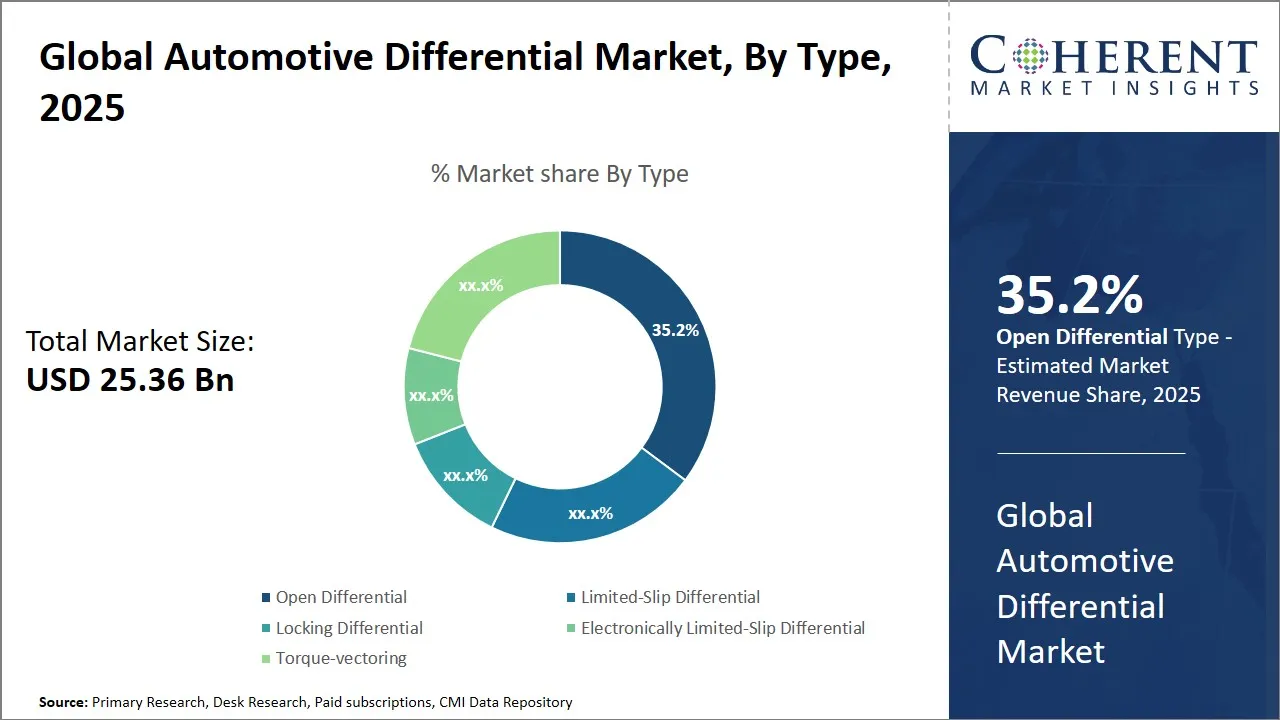
- The open differential segment is expected to lead the market holding a share of 36.2% in 2026.
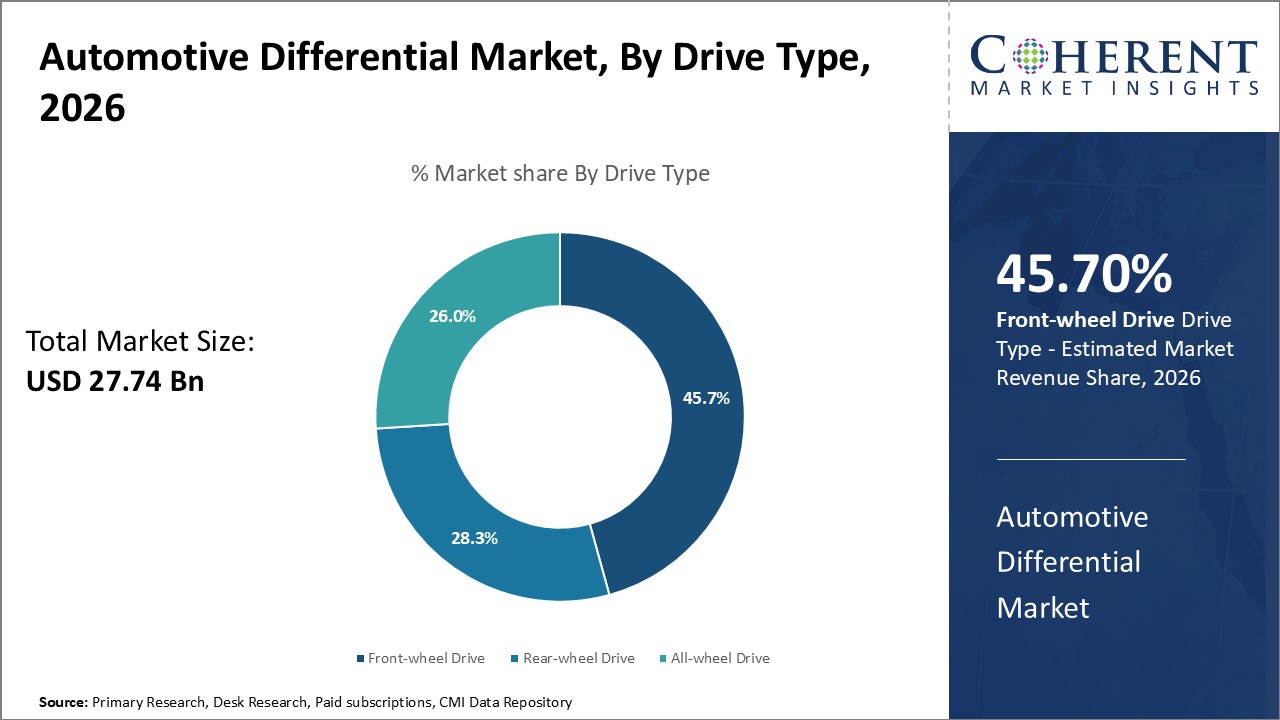
- The front-wheel drive segment is estimated to dominate with a share of 45.7% in 2026.
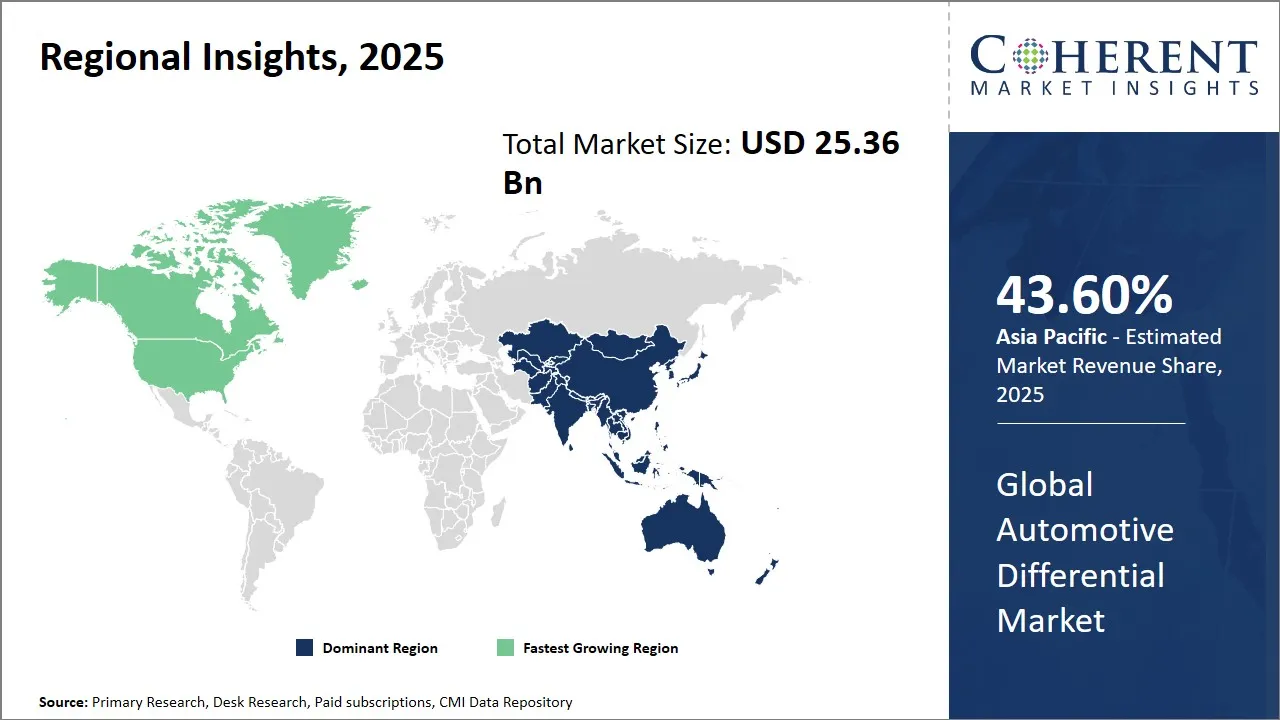
- Asia Pacific, holding an estimated share of 43.6% in 2026, and projected to dominate the market.
- North America, holding a projected share of 19.3% in 2026, and shows the fastest growth in the market.
Market Overview
The market is seeing a big move towards smart and electronically controlled differentials that enhance vehicle stability, traction, and fuel efficiency. The rise in electric vehicle production is adding to innovation in differential designs to accommodate electric drivetrains. Additionally, stringent environmental regulations and consumer preference for safer and more reliable vehicles are accelerating the development of next-generation differentials, including limited-slip and torque vectoring types, which are gaining traction across passenger cars, commercial vehicles, and SUVs.
Current Events and their Impacts
Current Events | Description and its Impact |
U.S. Inflation Reduction Act (IRA) — EV tax credits & sourcing rules |
|
EU CO₂/zero-emission car targets (2025–2035 regulatory pathway) |
|
China policy shift: local chip push & evolving EV subsidy stance |
|
Segmental Insights
- Current Industry Events of 2026
- Market Size Estimation
- Regional Breakdown
- Competitive Landscape
- Customer Intelligence
- Segmental Analysis
- Pricing Analysis
- Key Market Drivers, Challenges & Future Trends
- Customized Insights Section
Global Automotive Differential Market Insights, By Type – Open Differential Segment Leads Because of its Cost-Effectiveness and Reliability
The open differential segment is expected to hold the largest share of 36.2% in 2026 due to its low cost, mechanical simplicity, and widespread use in mass-market passenger cars. Its minimal component count makes it durable, inexpensive to manufacture, and easy to integrate—especially into FWD architectures, which dominate global vehicle production. Open differentials also reduce frictional losses, supporting better fuel economy compared to limited-slip or electronic systems, making them the practical choice for economy-focused OEMs.
Toyota Corolla and Honda Civic platforms continue using open front differentials in their global FWD models, demonstrating automakers’ reliance on cost-effective, long-proven differential designs for high-volume passenger cars.
Global Automotive Differential Market Insights, By Drive Type – Front-Wheel Drive Leads Because of its Efficiency and Dominance in Passenger Vehicles
The front-wheel drive segment, holding a share of 45.7% in 2026, is set to lead the market because it consolidates the engine, transmission, and differential into one compact transaxle unit, reducing cost, weight, and complexity. Front-Wheel Drive (FWD) gives excellent packaging efficiency, better traction in everyday conditions, and superior fuel economy. Its prevalence in global passenger vehicle production, and compatibility with many hybrid/EV front-motor platforms, also adds to its dominance.
Hyundai’s i20, Elantra, and Tucson (base variants) use FWD transaxle systems with integrated differentials, contributing significantly to global FWD vehicle output—especially in Asia Pacific and Europe.
Pricing Analysis of the Automotive Differential Market
Differential Type | Indicative Price per Unit (USD) |
Open Differential (basic mechanical) | ~ USD 200–400 |
Limited-Slip Differential (mechanical LSD) | ~ USD 250–400 |
Electronic Limited-Slip Differential (eLSD/ELSD) | ~ USD 700–1,000+ |
Torque-Vectoring Differential (incl. e-differential/e-axle) | ~ USD 2,000–4,000+ (estimate) |
Locking Differential | ~ USD 500–1,500 (estimate) |
Cost Structure & Profitability
Cost element | Mechanical differential — typical share of unit manufacturing cost (%) | E-differential/e-axle — typical share of unit manufacturing cost (%) | Notes/impact on profitability |
Raw materials (gears, housings — steel/alloy/castings) | 26.00% | 22.00% | Large single cost item for mechanical diffs (gear steel, nodular iron/aluminum housings). Price volatility (steel/aluminum) directly squeezes margins unless hedged or pass-through contract exists. |
Precision machining (gear cutting, turning, milling, broaching) | 18.00% | 16.00% | High-cost CAPEX & cycle time. Volume and process efficiency (hobbing vs shaving, multi-axis CNC) strongly affect per-unit cost. Lower labor but higher machine depreciation. |
Heat-treating & surface hardening (carburizing, induction hardening, nitriding) | 12.00% | 9.00% | Critical for gear life and warranty costs. Outsourcing vs in-house heat treat affects control & cost — in-house raises fixed cost but lowers per-unit at scale. |
Bearings, seals, fasteners, small parts | 6.00% | 5.00% | Commodity items but important for reliability; quality influences warranty claims. |
Electronics & controls (ECU, sensors, actuators) — only relevant for e-differentials | 0.00% | 18.00% | For e-differentials this is a major cost driver (power electronics, control units, sensors, wiring). Semiconductor pricing and sourcing strategies heavily affect costs. |
Actuators/clutch packs/hydraulic/mechatronic units | 6.00% | 9.00% | Mechanical LSDs/locking mechanisms for mechanical diffs; for e-diffs includes actuators & integrated clutch/electromechanical devices — higher complexity = higher cost. |
Assembly & integration (incl. testing fixtures & calibration) | 10.00% | 10.00% | Labor + test time. E-differentials require additional calibration and ECU flashing (increasing test time & test-equipment cost). |
Quality assurance & end-of-line testing | 3.00% | 4.00% | Leak tests, NVH testing, dynamometer tests; e-diffs require functional electrical checks. Affects warranty exposure. |
Coatings, finishes & packaging | 2.00% | 1.50% | Paint, anti-corrosion, packaging for shipment. Small but non-negligible. |
Warranty provisioning & field support (allocated per unit) | 4.00% | 3.50% | Function of historical failure rates; complex e-diffs can have higher early failure risk (warranty reserves may be higher until mature). |
Indirect overhead (factory G&A, utilities, tooling amortization) | 6.00% | 6.00% | Fixed costs — scale dependent. Tooling amortization is material for low-volume programs. |
R&D & product development (allocated/per unit) | 2.00% | 5.00% | E-diffs require more electronics & software R&D; allocation depends on expected program volumes and how OEM/Tier-1 contracts allocate development costs. |
Logistics/duties/inbound parts freight | 1.50% | 1.00% | Varies with supply chain localization. Higher when components are imported. |
EV-Specific Differential Adoption
- E-Axles
An e-axle includes the electric motor, power electronics, transmission, and differential into a compact unit. It is increasingly the standard drivetrain architecture for modern battery electric vehicles (BEVs).
Adoption Characteristics in EVs
- Widely adopted in Front-wheel Drive (FWD), Rear-wheel Drive (RWD), and All-Wheel Drive (AWD) electric cars, especially in mid- to high-end models.
- Reduces complexity vs. conventional axle + differential systems.
- Gives high efficiency, reduced weight, and precision torque delivery.
- Popular among OEMs such as Bosch, ZF, GKN, Dana, Magna, etc.
Reasons for Strong Adoption
- Helps increase range by improving drivetrain efficiency (up to 5–10%).
- Better packaging and reduced mechanical losses.
- Ideal integration platform for software-based torque control.
- Torque Vectoring Differentials
Torque vectoring in EVs is often software-driven rather than dependent on mechanical limited-slip or locking differentials. EV torque vectoring can be achieved through:
- Dual-motor setup on one axle.
- Independent wheel motors.
- Electrically controlled multi-plate clutch packs.
Adoption Characteristics
- Common in high-performance EVs like Tesla Plaid, Audi e-tron S, and Porsche Taycan.
- Increasingly adopted in premium SUVs for stability and traction.
- Allows near-instantaneous torque adjustments because of EV motor response.
Reasons for Adoption
- Improved cornering, traction, and vehicle stability control.
- Removes the need for heavy mechanical limited slip diffs.
- Enhances performance (0–100 km/h acceleration, torque delivery).
- Open vs. Locking Differentials in EVs
- Open Differentials
Traditional open differentials are still used in many EVs but are almost always paired with brake-based traction control or software torque management.
Adoption Characteristics
- Standard in budget EVs and compact crossovers.
- Simpler, lighter, and cheaper than mechanical locking or limited-slip differentials.
- Software compensates for traction imbalance.
Reasons for Adoption
- Cost efficiency.
- Simplicity and fewer mechanical points of failure.
- Sufficient for everyday road use.
- Locking Differentials
Mechanical locking differentials have limited adoption in EVs because of the availability of software-based alternatives. However, they still appear in off-road EVs and performance SUVs.
Adoption Characteristics
- Found in models like Rivian R1T/R1S, Hummer EV, and some off-road prototypes.
- Digital or electronically actuated lockers may be used for rock-climbing or deep-terrain control.
Reasons for Lower Adoption
- Added weight reduces range.
- Complexity compared to software-based torque control.
- Many EVs achieve similar traction outcomes using dual-motor setups.
Summary
EV Differential Type | Adoption Level | Typical Applications | Key Reasons |
E-Axles | Very High | Mass-market EVs, premium EVs, SUVs | Efficiency, integration, compact design |
Torque Vectoring Systems | Moderate to High (fast growing) | High-performance EVs, premium SUVs | Stability, cornering performance |
Open Differentials | High in low- to mid-range EVs | Budget EVs, compact EVs | Low cost, simple architecture |
Locking Differentials | Low (niche) | Off-road EVs, adventure pickups | Mechanical traction in rough terrain |
Regional Insights
Asia Pacific Automotive Differential Market Analysis and Trends
Asia Pacific, holding an estimated share of 43.6% in 2026, dominates the global automotive differential market because of the region's strong automotive manufacturing ecosystem, especially in countries like China, Japan, South Korea, and India. The strong presence of major automotive OEMs and tier-1 suppliers in this region makes strong demand for automotive differentials in passenger cars, commercial vehicles, and increasingly electric vehicles. Governments in this region have also put in place supportive policies promoting local manufacturing and exports as part of their broader industrial development strategies.
Also, Asia Pacific sees a vast and cost-competitive supply chain network, enabling competitive production of automotive components. Notable companies such as JTEKT Corporation (Japan), GKN Automotive (with significant operations in Asia), and Hyundai Mobis (South Korea) have a substantial presence here, contributing to advanced differential technologies and after-sales services. Trade dynamics seeing intra-regional free trade agreements and the region's role as a major export hub further add to its market leadership.
North America Automotive Differential Market Analysis and Trends
North America, holding an estimated share of 19.3% in 2026, exhibits the fastest growth in the global automotive differential market. This growth is because of strong demand in the U.S. and Canada for light trucks, SUVs, and commercial vehicles with advanced differential systems to improve performance, safety, and fuel efficiency. The region’s focus on innovation, especially in electric and hybrid drivetrains, adds to the automotive differential market growth.
Government policies emphasizing cleaner transportation and incentives for electric vehicles encourage OEMs to use sophisticated differential systems made for new propulsion technologies. The presence of big automotive hubs in Michigan and Ontario, combined with the influence of leading companies such as Dana Incorporated, American Axle & Manufacturing (AAM), and Meritor, supports robust R&D and production activities focused on differentials. Trade policies and agreements like USMCA encourage regional manufacturing and supply chain integration, adding to the market expansion.
Global Automotive Differential Market Outlook for Key Countries
China Automotive Differential Market Analysis and Trends
China automotive differential market grows because of its position as the world’s largest automotive producer and consumer. The growing use of SUVs and electric vehicles makes demand for sophisticated differential systems, including limited-slip and electronic differentials. Chinese government initiatives aimed at boosting new energy vehicles (NEVs) stimulate innovation among local manufacturers such as Wanxiang Group and Huayu Automotive Systems. Collaborations and joint ventures with international companies further add to the technological capabilities in China’s differential component manufacturing.
Germany Automotive Differential Market Analysis and Trends
Germany continues to lead Europe’s automotive differential market, because of its reputation for engineering excellence and presence of premium automotive manufacturers like BMW, Mercedes-Benz, and Volkswagen Group. These manufacturers focus on using advanced differential technologies like torque vectoring and active differentials to enhance vehicle dynamics. Suppliers such as ZF Friedrichshafen and Schaeffler Group play big roles in advancing differential designs that align with Germany’s focus on performance and environmental standards. Strong government support for automotive innovation and a big supplier network solidify Germany’s market prominence.
U.S. Automotive Differential Market Analysis and Trends
The U.S. automotive differential market sees a mix of high-volume passenger vehicles and commercial trucks needing various differential systems. With a growing push towards electrification, companies like Dana Incorporated, American Axle & Manufacturing, and Meritor are increasingly making electric drivetrain-compatible differentials. Policy incentives aimed at reducing emissions and modernizing transport infrastructure fuel ongoing investments. Additionally, the competitive aftermarket segment for differentials supports maintenance and upgrades, making steady aftermarket demand alongside OEM production.
India Automotive Differential Market Analysis and Trends
India automotive differential market is growing as the country becomes a big hub for both two-wheeler and four-wheeler manufacturing. Domestic demand for passenger and commercial vehicles with improved traction and fuel efficiency makes interest in advanced differential solutions. Indian manufacturers such as Suprajit Engineering and Endurance Technologies work with global players for technology transfer and localization of differential components. Government initiatives pushing Make in India and infrastructure development encourage increased vehicle production and component manufacturing, further energizing the market.
Market Players, Key Development, and Competitive Intelligence
Key Developments
- In December 2024, Dana Incorporated (NYSE: DAN), announced the new AdvanTEK 40 Pro axle system, the next evolution of its distinguished 40,000-pound 6x4 tandem axle system.
- In July 2024, BorgWarner secured multiple contracts to supply its electric cross differential (eXD) to three major OEMs, including GAC Motor, an East Asian OEM, and a Major Global OEM based in Europe. The companies will incorporate BorgWarner’s eXD technology onto both rear- and front-wheel-drive battery electric vehicle (BEV) applications ranging from super sports cars to premium sedans to hot hatchbacks.
- In May 2024, BorgWarner became first-to-market with its electric Torque Vectoring and Disconnect (eTVD) system for battery electric vehicles (BEVs) with launches for Polestar and an additional major European OEM. The eTVD is part of BorgWarner’s electric torque management system (eTMS) solutions portfolio.
- In January 2024, At CES 2024, AAM showcased its award-winning, next-generation 3-in-1 electric drive units (eDUs), fully integrated e-Beam axles, and innovative component technologies that are helping define the future of mobility around the globe.
Top Strategies Followed by Automotive Differential Market Players
- Established market leaders invest a lot in research and development (R&D) to make high-performance differential products that meet the evolving demands of the automotive industry.
- ZF launched its next-generation eBeam electric axle drive for pickup trucks, combining the differential, motor, and inverter into a high-performance integrated system.
- Mid-level companies in the automotive differential market typically adopt strategies that emphasize cost-effectiveness while maintaining acceptable quality standards.
- Linamar’s lightweight, cost-optimized axle assemblies for SUVs and light trucks focus on reducing manufacturing cost through modular design.
- Small-scale players in the global automotive differential market distinguish themselves by focusing on niche applications and innovative product features that larger competitors may overlook.
- Eaton’s “Detroit Locker” line specializes in locking differentials for off-road racing, rock crawling, and performance trucks.
Market Report Scope
Automotive Differential Market Report Coverage
| Report Coverage | Details | ||
|---|---|---|---|
| Base Year: | 2025 | Market Size in 2026: | USD 27.74 Bn |
| Historical Data for: | 2020 To 2024 | Forecast Period: | 2026 To 2033 |
| Forecast Period 2026 to 2033 CAGR: | 9.4% | 2033 Value Projection: | USD 52.03 Bn |
| Geographies covered: |
| ||
| Segments covered: |
| ||
| Companies covered: | Dana Incorporated, ZF Friedrichshafen AG, GKN Automotive, American Axle & Manufacturing, BorgWarner Inc., Eaton Corporation, JTEKT Corporation, Linamar Corporation, Magna International, Schaeffler AG, Aisin, Nexteer Automotive, Neapco, Mubea, and Hyundai WIA | ||
| Growth Drivers: |
| ||
| Restraints & Challenges: |
| ||
Market Dynamics
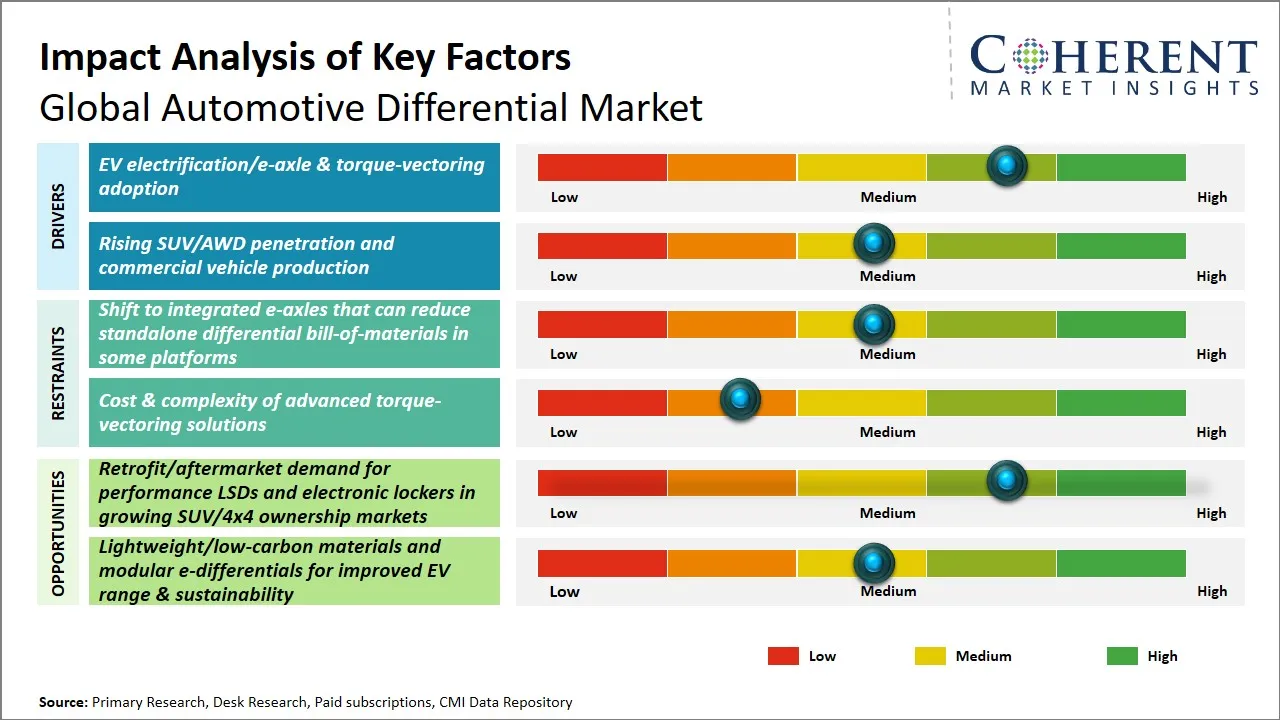
Global Automotive Differential Market Driver – EV Electrification/E-Axle & Torque-Vectoring Adoption
The shift toward EVs is reshaping the automotive differential market as automakers increasingly adopt e-axles and electronic torque-vectoring systems that integrate motors, gears, and control electronics into compact units. These systems add to packaging efficiency, improve energy use, and deliver precise torque management—essential for EV performance and safety. As traditional mechanical differentials lose relevance in pure EV platforms, electronically controlled solutions are being chosen for next-generation drivetrains.
Audi e-tron S uses a dual-motor rear setup with active torque vectoring, replacing traditional LSDs and showing how EVs are adding to adoption of advanced electronic differential systems.
Global Automotive Differential Market Opportunity – Retrofit/Aftermarket Demand for Performance LSDs and Electronic Lockers in Growing SUV/4x4 Ownership Markets
Rising ownership of SUVs and 4x4 vehicles is making strong aftermarket demand for performance LSDs and electronic lockers, as customers seek better traction and off-road capability. Growing disposable incomes in markets like Asia Pacific and Latin America are boosting retrofit upgrades, while improved, cost-friendly differential technologies make installations easier. This trend extends the lifecycle of existing vehicles and creates profitable avenues for aftermarket-focused manufacturers.
Eaton’s aftermarket Detroit Truetrac LSD has seen a lot of adoption among Jeep Wrangler and Toyota Hilux owners, reflecting the surge in retrofit traction-enhancing differential upgrades.
Analyst Opinion (Expert Opinion)
- EV drivetrains are increasingly removing or minimizing the need for mechanical differentials, putting long-term pressure on suppliers who still rely a lot on ICE and AWD mechanical systems. Many incumbent players have been slow to pivot, and the gap between EV-ready and legacy suppliers is widening.
- Steel, precision gear metals, and machining costs have climbed sharply, while automakers are simultaneously demanding lower component prices. This dual squeeze is eroding profitability, and many mid-tier suppliers simply don’t have the scale or automation capacity to absorb the shock—forcing them into aggressive cost trimming that risks compromising innovation.
- Tier-1 giants are swallowing high-value segments with vertically integrated e-axle platforms, leaving smaller players to fight over shrinking niches like aftermarket differentials and off-road lockers. This polarization is creating a structural imbalance where only suppliers with deep R&D pockets can compete in the electrified future, while others face strategic irrelevance.
Speak to the analyst
Want personalized insights?
Take the findings above to one of our principal consultants, or have the report rebuilt around the segments, geographies and competitors you actually track.
Market Segmentation
- Type Insights (Revenue, USD Bn, 2021 - 2033)
- Open Differential
- Limited-Slip Differential
- Locking Differential
- Electronically Limited-Slip Differential
- Torque-vectoring
- Drive Type Insights (Revenue, USD Bn, 2021 - 2033)
- Front-wheel Drive
- Rear-wheel Drive
- All-wheel Drive
- Regional Insights (Revenue, USD Bn, 2021 - 2033)
- North America
- U.S.
- Canada
- Latin America
- Brazil
- Argentina
- Mexico
- Rest of Latin America
- Europe
- Germany
- U.K.
- Spain
- France
- Italy
- Russia
- Rest of Europe
- Asia Pacific
- China
- India
- Japan
- Australia
- South Korea
- ASEAN
- Rest of Asia Pacific
- Middle East
- GCC Countries
- Israel
- Rest of Middle East
- Africa
- South Africa
- North Africa
- Central Africa
- North America
- Key Players Insights
- Dana Incorporated
- ZF Friedrichshafen AG
- GKN Automotive
- American Axle & Manufacturing
- BorgWarner Inc.
- Eaton Corporation
- JTEKT Corporation
- Linamar Corporation
- Magna International
- Schaeffler AG
- Aisin
- Nexteer Automotive
- Neapco
- Mubea
- Hyundai WIA
Sources
Primary Research Interviews
Stakeholders
- Automotive OEMs
- Differential & Axle Manufacturers
- Electric Drivetrain Integrators
- EV Manufacturers (Powertrain Architects & System Integration Engineers)
- Commercial Vehicle Fleet Operators
- Automotive Component Distributors & Aftermarket Retailers
- Tier-2 Gear & Forging Suppliers (Heat-Treatment Specialists)
- Performance & Off-Road Vehicle Tuners (for locking/LSD differentials)
- Automotive Testing & Validation Experts
- Sustainability and Lightweighting Consultants (focused on drivetrain efficiency)
Databases
- Eurostat
- U.S. Census Automotive & Transportation Data
- Automotive Components Global Database (ACGD – fictional)
- OECD Mobility and Transport Data
- EV-Drivetrain Open Statistics Consortium (EDOSC – fictional)
Magazines
- Automotive Engineering Today
- Drivetrain Technology Review (DTR – fictional)
- Powertrain International Magazine
- Electric Vehicle Systems Digest
- Global Auto Components Weekly
Journals
- Journal of Automotive Engineering and Management
- SAE International Journals – Powertrain, Fuel & Lubricants
- International Journal of Vehicle Systems & Mechanics
- Electric Powertrain Engineering Journal
- Journal of Mobility Technology
Newspapers
- Automotive News (Global Edition)
- The Detroit News – Auto Section
- The Guardian – Automotive Industry Section
- Nikkei Asia – Mobility & Manufacturing Section
- The Economic Times (India) – Auto Industry
Associations
- Society of Automotive Engineers (SAE International)
- Automotive Component Manufacturers Association (ACMA)
- European Association of Automotive Suppliers (CLEPA)
- Japan Automobile Manufacturers Association (JAMA)
- North American Drivetrain Association (NADA – fictional)
- Global Electric Drivetrain Consortium (GEDC – fictional)
Public Domain Sources
- U.S. Census Bureau
- EUROSTAT
- United Nations Economic Commission for Europe (UNECE)
- World Bank Mobility & Industrial Data
- ResearchGate
- International Energy Agency (IEA) Mobility Data
- Open Vehicle Powertrain Research Archive
Proprietary Elements
- CMI Data Analytics Tool
- Proprietary CMI Existing Repository of Information for Last 8 Years
Get access to 250+ pages report
Every segment, forecast, competitor profile and data table behind the analysis above — available for instant download.
- ESOMAR Member
- ISO 9001:2015 Certified
- D-U-N-S Registered
- GDPR & CCPA Compliant
Missing comfort of reading report in your local language? Find your preferred language:
Transform your Strategy with Exclusive Trending Reports
Frequently Asked Questions
The global automotive differential market is estimated to be valued at USD 27.74 billion in 2026 and is expected to reach USD 52.03 billion by 2033.
The CAGR of the global automotive differential market is projected to be 9.4% from 2026 to 2033.
EV electrification/e-axle & torque-vectoring adoption and rising SUV/AWD penetration and commercial vehicle production are the major factors driving the growth of the global automotive differential market.
Shift to integrated e-axles that can reduce standalone differential bill-of-materials in some platforms and cost & complexity of advanced torque-vectoring solutions are the major factors hampering the growth of the global automotive differential market.
In terms of type, the open differential is estimated to dominate the market revenue share in 2026.
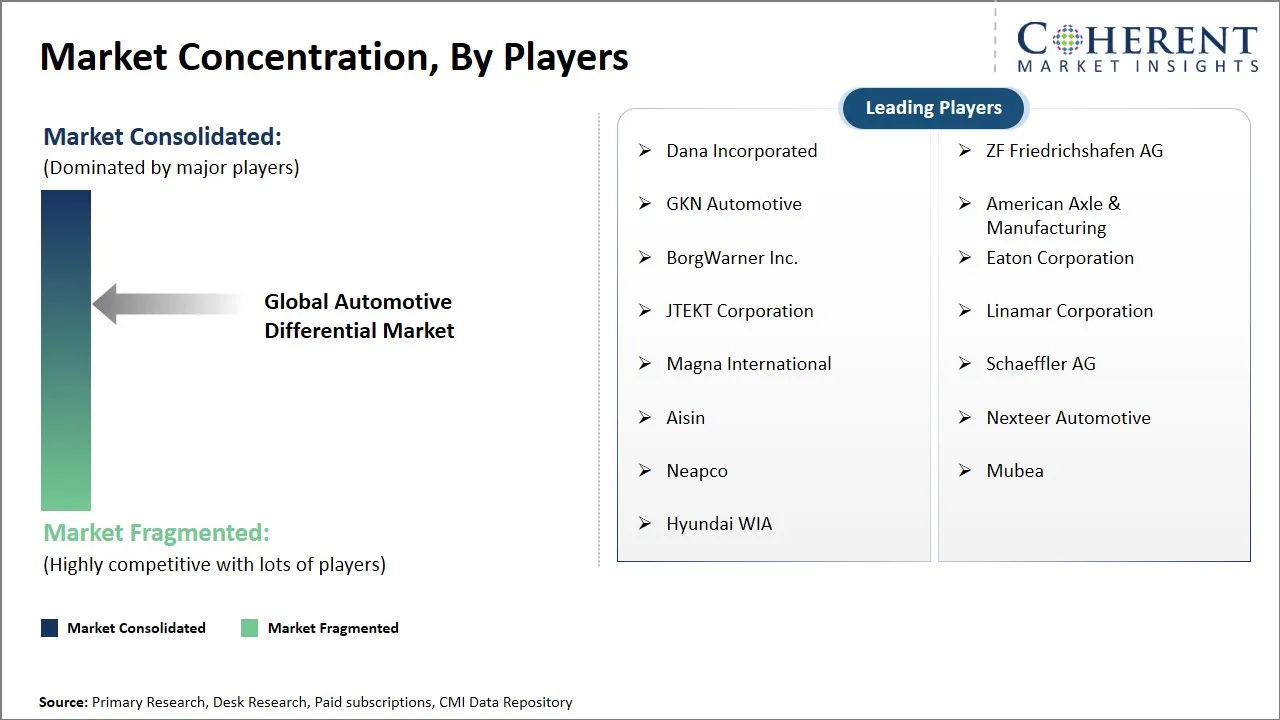
Dana Incorporated, ZF Friedrichshafen AG, GKN Automotive, American Axle & Manufacturing, BorgWarner Inc., Eaton Corporation, JTEKT Corporation, Linamar Corporation, Magna International, Schaeffler AG, Aisin, Nexteer Automotive, Neapco, Mubea, and Hyundai WIA are the major players.
Asia Pacific is expected to lead the global automotive differential market in 2026.