

Global Canned Fruits Market Size and Forecast – (2026-2033)
According to Coherent Market Insights, the global canned fruits market is estimated to be valued at USD 12.54 Bn in 2026 and is expected to reach USD 17.07 Bn by 2033, expanding at a compound annual growth rate (CAGR) of 4.5% from 2026 to 2033.
Key Takeaways of the Canned Fruits Market
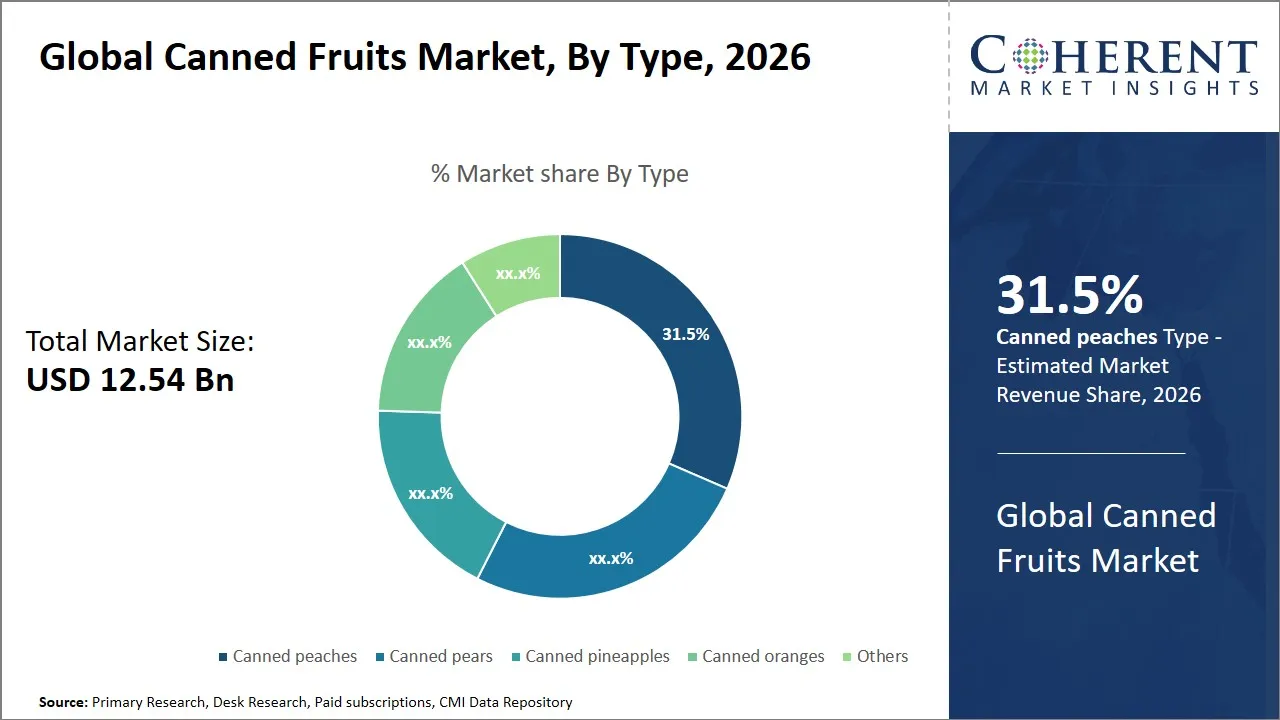
- Canned peaches segment is expected to account for 31.5 % of the market share in 2026.
- The whole fruits segment is estimated to command a 59.7 % of the canned fruits market share in 2026.
- Supermarkets and hypermarkets segment is projected to hold 32.7 % of the global canned fruits market share in 2026.
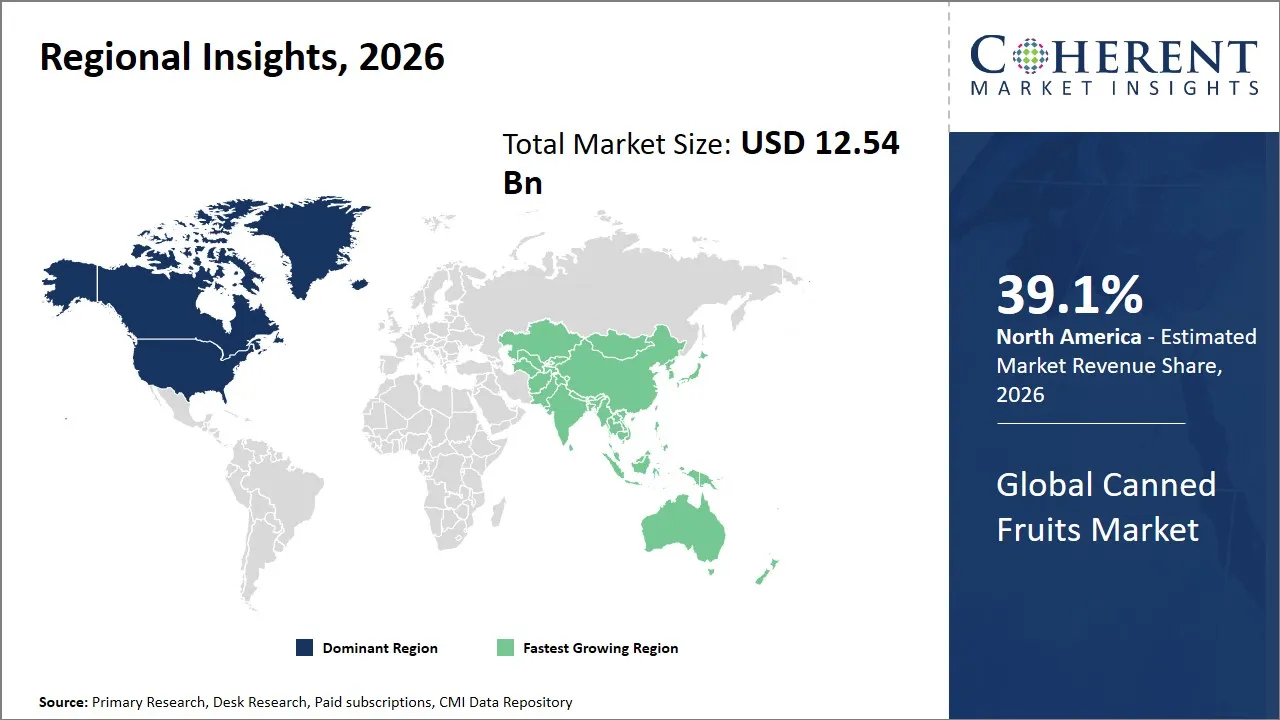
- North America is expected to lead the market with a 39.1 % share in 2026.
- Asia Pacific is projected to be the fastest-growing region, accounting for 15.3% share in 2026, driven by rapid urbanization, rising disposable incomes, and increasing demand for ready-to-eat convenience foods.
Market Overview
- A significant market trend driving the canned fruits industry is the growing preference for organic and preservative-free options, as consumers increasingly seek healthier and vegan food natural food alternatives.
- Additionally, innovations in packaging technologies that enhance product freshness and sustainability are gaining traction.
- The rise in ready-to-eat and on-the-go fruit products also contributes to market growth, alongside expanding urbanization and busy lifestyles, which stimulate demand for convenient food solutions.
Currents Events and Its Impact
Current Events | Description and its Impact |
U.S. FDA proposes mandatory front-of-pack “Nutrition Info box” labeling (January 2025) |
|
India: FSSAI proposes amendments to prohibit PFAS and BPA in food-contact packaging (October 2025 consultation) |
|
Segmental Insights
- Current Industry Events of 2026
- Market Size Estimation
- Regional Breakdown
- Competitive Landscape
- Customer Intelligence
- Segmental Analysis
- Pricing Analysis
- Key Market Drivers, Challenges & Future Trends
- Customized Insights Section
Why Does the Canned Peaches Segment Dominate the Global Canned Fruits Market in 2026?
Canned peaches contribute the 31.5% of the market share in 2026, owning to its widespread consumer appeal and versatile usage in various culinary applications. Peaches have a natural sweet taste and a soft texture, which provide an appealing canned fruit product profile. Their popularity is partly explained by the fact that notwithstanding processing and canning, they preserve their flavor and nutritional value to be popular with customers who want to consume conveniently and yet healthy fruits. Also, the canned peaches also occupy the leading positions in home kitchens and professional food preparation, often being used in desserts, salads, and breakfast food, which further contributes to their appropriateness.
For instance, canned peaches are a staple in breakfast food, often used in fruit salads or paired with yogurt, making them a key ingredient in quick and healthy breakfast options. Additionally, they occupy leading positions in both home kitchens and professional food preparation, where they are frequently used in desserts, salads, and as toppings, further contributing to their versatility and appropriateness across various meal types.
Whole Fruits Dominate the Global Canned Fruits Market
Whole Fruits segment hold 59.7% of the global canned fruits market share in 2026, driven by their convenience, visual appeal, and versatility in use. Canned whole fruits have the advantage of providing the consumer with the ability to have fruit in the almost natural form, which is very appealing to those who value a small amount of processing and an experience of eating food. The intactness of whole fruit keeps the original texture and form of the fruit and therefore forms a very attractive snack or in the cases where the visual appearance of the fruit is a factor of culinary use like fruit salads and the ornamental culinary masterpieces.
The other reason that can justify the superiority of whole fruits is the preference of the consumers towards simplicity and purity of food products. Canned whole fruits are seen less processed compared to pureed or cut products, which appeal to buyers of clean label products. This is in line with the general trends in favor of health-conscious dieting, as more consumers are becoming more skeptical of ingredient documentaries and prefer to eat food that seems to be more natural.
Supermarkets and Hypermarkets Dominates the Global Canned Fruits Market
Supermarkets and hypermarkets hold 32.7% of the canned fruits market share in 2026, due to their wide scope of penetration, diversification, and purchasing habits among consumers. These retail formats are an effective one stop shopping place of consumers who are inclined to a wide range of canned fruits as one roof, where the consumers easily compare and choose. The availability of canned fruits in supermarkets and hypermarkets in various types and forms takes advantage of the high foot traffic and regular visits of consumers to the supermarkets, which automatically translate to increased sales volumes.
Another advantage that supermarkets and hypermarkets have is that they can take advantage of bulk buying capacity and shelf space management that has led to competitive pricing and advertising of products to price sensitive customers. This is an added goal of pricing and in-store display and sampling which contributes to creating more visibility of the product and stimulates impulse buying. Canned fruits usually have added value by retailers, who usually work with manufacturers on special packages or limited flavors, which adds more value to the products in these venues.
Regional Insights
North America Canned Fruits Market Analysis and Trends
The North America region is projected to lead the market with a 39.1% share in 2026, due to the developed food processing sector, high consumer knowledge on the convenience foods and an established cold chain and distribution system. The area enjoys strict food safety policies that are being imposed by the FDA and USDA agencies, thus increasing consumer trust in the canned items of fruit.
Additionally, government efforts to create healthy eating habits have caused the advancement of tinned fruit products with lower sugar and organic products and services. The major competitors like Del Monte Foods, Dole Food Company, and Seneca Foods Corporation have high manufacturing and distribution presence with large supply chains linked to the local fruit production centers in California and Florida. Large-scale penetration of the product is made possible by the established retail environment comprising supermarkets and the big-box stores.
Asia Pacific Canned Fruits Market Analysis and Trends
The Asia Pacific region is expected to exhibit the fastest growth in the market contributing 15.3% share in 2026, due to the increasing urbanization, growing disposable incomes and the changing consumer lifestyles to ready-to-eat convenience foods. The provision of retail facilities, especially supermarkets and online shopping, is boosting the availability of products in the emerging economies such as India, China, and southeast Asia.
The domestic and foreign manufacturers are expanding operations encouraged by government support of modernizing the food processing industry towards the use of subsidies, relaxed policies on foreign direct investment. Local firms like Tasty Bite Eatables (India), China-based Guangdong Haimen Group, and Thailand-based Malee Group are coming up with products that are regional in their tastes such as tropical fruit combinations and high-end tinned fruits. The trade dynamics are also conducive to growth with more and more canned fruits being exported both in the region and to the world.
Global Canned Fruits Market Outlook for Key Countries
Why Is India Emerging as a Competitive Producer of Barium Carbonate?
The U.S. canned fruits market benefits from a robust agricultural base producing fruits like peaches, pineapples, and cherries, which feed directly into the canned fruits segment. Del Monte and Dole are large-scale companies that innovate their products and are known, with wide product variants, both organic and no-sugar-added. The demand is influenced by consumer behavior in healthy snacking and convenient meal preparation, which is underpinned by extensive retail chains and excellent cold chains. Quality and food safety are upheld through regulatory control, and the consumer confidence in canned fruits is high.
China Canned Fruits Market Trends
China's canned fruits market expansion is supported by rapid urbanization and an expanding middle class with growing demand for convenient, nutritious food options. Local domestic players such as Guangdong Haimen Group are taking advantage of the high local supplies of fruits, and their products are oriented at the local population, such as tropical and native fruit products. The government policies focus on the process of modernizing the food processing technology, and enhancing food safety, which enhances reliability and attractiveness of the products. The increased presence of e-commerce has also facilitated the expansion of distribution and a wide variety of product lines in urban and semi-urban regions.
Why is India Emerging as a Competitive Producer of Canned Fruits?
The market in India canned fruit is expanding with the rise in population in urban areas, the changes in the income’s levels, and the changing food habits of the people in the area that are inclined towards shelf-stable and ready foods. Other companies like Tasty Bite Eatables and Priya Foods target the mass market with low cost products, but are also looking at niche products of organic and exotic canned products of fruits. The government policies to facilitate food processing facilities and export subsidies increase the production capacity. Nevertheless, fragmented supply chains and cold storage warehouse issues are also areas of focus to be developed in the market further.
Germany Canned Fruits Market Trends
Germany continues to lead the European canned fruits market with strong consumer preference for high-quality and organic products, supported by stringent food safety and labeling regulations. Established companies like such as Bonduelle Group and Zuegg, focus on the innovation and introduce varieties that have natural preservatives and fruits produced in a sustainable manner. The retail Industry is well established, and the consumer preference towards healthy convenience foods is growing, which helps to maintain a stable demand. Germany is also an important exporter in the region, as it has strategic position and logistic infrastructure.
Brazil Canned Fruits Market Trends
The advantage of canned fruits market is the vast production of fruits, especially those of tropical fruits like mangoes, papayas, and guavas in Brazil. Local firms such as Fruta de Ouro and Gomes da Costa play an important role in processing and distributing tinned fruits in the country and other countries. The growing level of urbanization and the changing lifestyle makes consumers more interested in ready-to-eat fruit products. Market vitality is achieved through supportive government policies that are geared towards agricultural modernization and marketing of agricultural produce.
Retail Channel Profit & Return Dynamics (Profit Margin, Return Rate, and Velocity by Channel)
Retail Channel | Avg. Gross Margin (%) | Return/Damage Rate (%) | Sales Velocity (Units/SKU/Month) |
Modern Grocery (Supermarkets & Hypermarkets) | 18–22% | 1.5–2.5% | 420–520 |
Traditional Trade (Kirana/Independent Stores) | 12–16% | 0.8–1.5% | 160–240 |
E-commerce (Marketplaces & D2C) | 28–35% | 4.5–7.0% | 90–140 |
Market Players, Key Development, and Competitive Intelligence
Key Developments
- In November 2024, Amazon expanded its private-label grocery lineup with the launch of a new value-focused brand called Amazon Saver. The Seattle-based retail giant called Amazon Saver a “new no-frills brand that will help grocery budgets go further.” Most Amazon Saver products are priced at less than USD 5.
- In June 2024, SPC announced it cut back on its canned fruit production as cost-conscious customers opted for cheaper imported alternatives. It is cutting its peach and pear intake by 40% due to waning demand for products grown in Australia.
- In March 2024, Trüfrü, an award-winning frozen snack brand, launched in the U.K. market with the listing secured by Tesco and the announcement of the opening of more outlets in the coming period.
Top Strategies Followed by Global Canned Fruits Market Players
Player Type | Strategic Focus | Example |
Established Market Leaders | Heavy investment in R&D and innovation | For instance, Del Monte Foods constantly improving canning and aseptic technology to enhance shelf life and preserve nutrition due to the increasing standards of food safety. Dole Food Company enjoys the benefits of long term sourcing agreements with farmers of fruits and also invests in sustainable agricultural practices to ensure that raw materials supply and prices remain stable. |
Mid-Level Players | Cost-effective solutions with balanced quality | Princes Group produce efficiently by opening regional production centers and by making contracts with retailers where they produce their own label products, and these costs mean they save overheads. |
Small-Scale Players | Niche specialization & innovative variants | An example includes the Companies such as Oregon Fruit Products which specializes in high-end, organic and specialty fruits to be used in bakery and foodservice. Local and regional brands are also testing the waters of exotic fruits, clean-label formulations and sustainable packaging to attract health-conscious customers. |
Market Report Scope
Global Canned Fruits Market Report Coverage
| Report Coverage | Details | ||
|---|---|---|---|
| Base Year: | 2025 | Market Size in 2026: | USD 12.54 Bn |
| Historical Data for: | 2020 To 2024 | Forecast Period: | 2026 To 2033 |
| Forecast Period 2026 to 2033 CAGR: | 4.5% | 2033 Value Projection: | USD 17.07 Bn |
| Geographies covered: |
| ||
| Segments covered: |
| ||
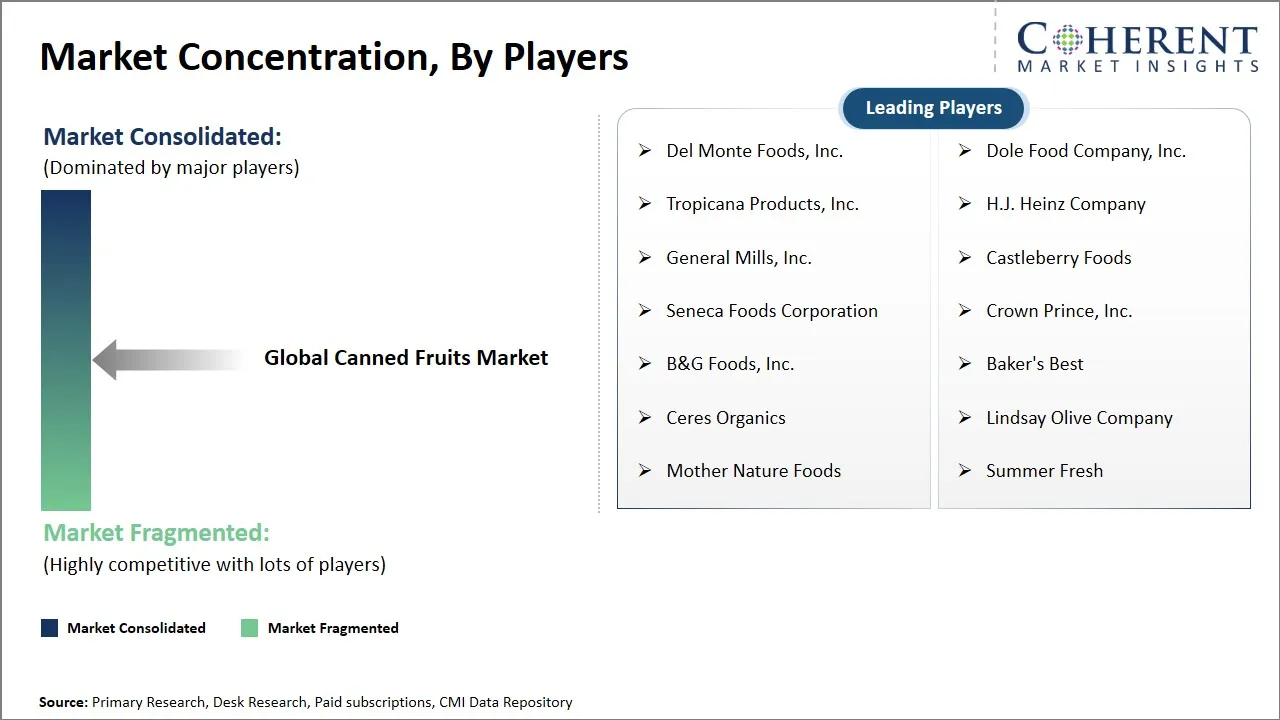
| Companies covered: | Del Monte Foods, Inc., Dole Food Company, Inc., Tropicana Products, Inc., H.J. Heinz Company, General Mills, Inc., Castleberry Foods, Seneca Foods Corporation, Crown Prince, Inc., B&G Foods, Inc., Baker's Best, Ceres Organics, Lindsay Olive Company, Mother Nature Foods, and Summer Fresh | ||
| Growth Drivers: |
| ||
| Restraints & Challenges: |
| ||
Canned Fruits Market Dynamics
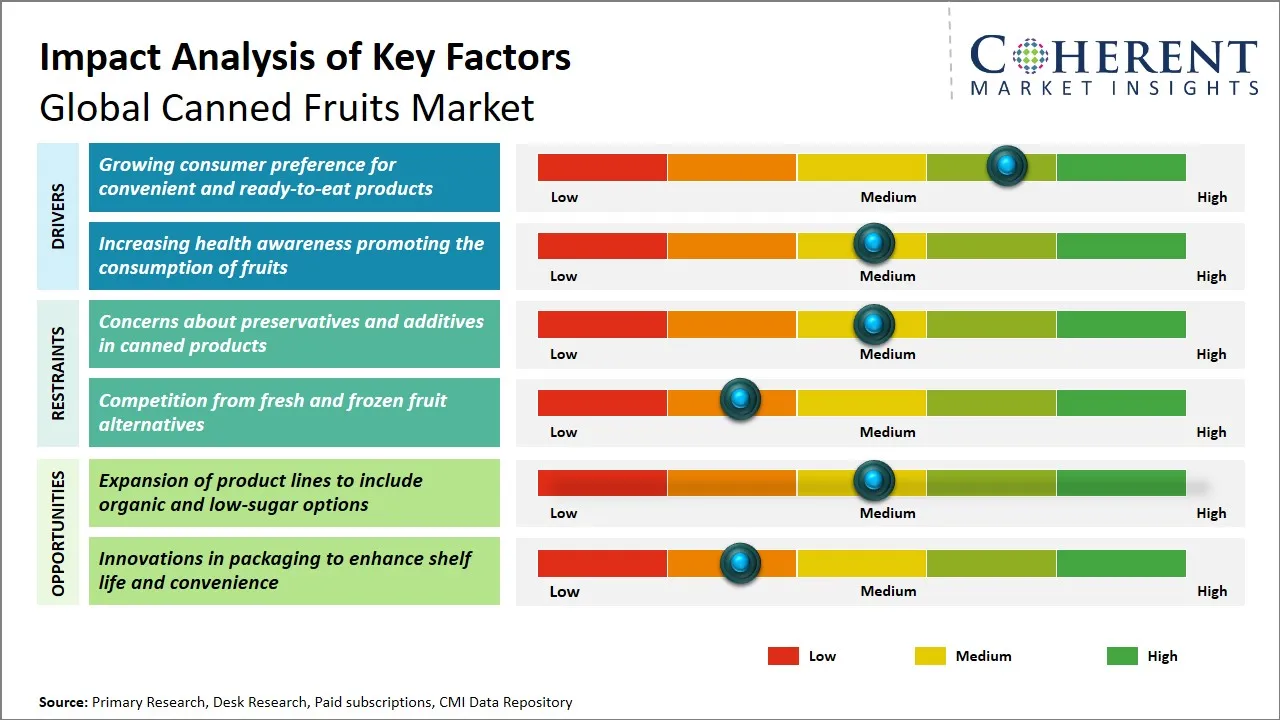
Canned Fruits Market Driver - Growing Consumer Preference for Convenient and Ready-to-Eat Products
The increased demand of convenience in the modern lifestyle characterized by the pace of life is indeed a major pressure that stimulates more market in the canned fruits sector across the globe. Consumers are demanding products with minimum form of preparation and at the same time offer nutritional value and taste. Canned fruits are a perfect fit in this requirement since they provide a ready to eat food product that can be stored and consumed at any time without having to undergo washing, peeling, and slicing of fresh fruits. Also, the long shelf life of canned fruits will solve the issue of wastage of food items and hence the canned fruits will be appealing to busy families and institutions like schools and offices.
As an example, large FMCG players like Del Monte and Dole Food Company have always had the presence of canned fruit SKUs targeted at quick desserts, breakfast bowls and baking, due to the demand of urban and time-squewed consumers.
(Source: https://www.delmontepacific.com/hubfs/pdf/DMPL%20AR2018_Final%2026JulyNEW.pdf)
Canned Fruits Market Opportunity - Expansion of Product Lines to Include Organic and Low-Sugar Options
The global canned fruits market is experiencing a big opportunity with the growth of the products to cover organic and low-sugar varieties. Growing consumer health and wellness awareness, combined with the increasing demand of clean-label products, is pushing manufacturers to be more creative and offer a variety of products. Organic tinned fruits, which are grown without the use of synthetic pesticides and fertilizers are a welcome development to the fast-growing market of health-conscious customers who consider natural and sustainable food options. Besides, the demand of low-sugared products in canned fruit products is driven by health concerns about sugar overconsumption and associated health conditions like obesity and diabetes. The addition of low-sugar canned fruit products will agree with the trend to low-calorie diets and will help the target consumers who want to snack and cook with healthy food products.
For example, Brands like Libbys or Native Forest are selling fruit in juice or water rather than heavy syrup directly responding to the challenge of sugar reduction.
Analyst Opinion (Expert Opinion)
- The market of canned fruits is in the process of re-emerging due to the growing demand of consumers on convenience and long shelf life without the loss of nutritional value. According to the Global Canning Industry Conference (2023) and the Food and Beverage Innovation Summit (2022), important developments are made, with such companies as Del Monte and Dole leading innovations that center on the idea of organic and no-added-sugar to appeal to health-conscious buyers.
- The fact that Del Montes has just introduced a new set of organic canned fruits adds credence to the fact that the industry is reacting to the need to have clean-label products. Conversations during these events highlighted the increasing demand to use sustainable packaging solutions and this is an extension of a wider investment on the responsibility of the environment.
- The threat of canned fruits substitutes by fresh and frozen or frozen versions, or some perceptions of the nutritional content of canned goods. Firms that are able to put across the advantages of canned fruits in nutritional and convenient terms and invest in sustainable activities will have high chances of attracting huge market share. Finally, the success of the canned fruits market will be based on its capability to keep on innovating and keeping up with the changing consumer demands in terms of quality and sustainability.
Speak to the analyst
Want personalized insights?
Take the findings above to one of our principal consultants, or have the report rebuilt around the segments, geographies and competitors you actually track.
Market Segmentation
- Type Insights (Revenue, USD Bn, 2021 - 2033)
- Canned peaches
- Canned pears
- Canned pineapples
- Canned oranges
- Others
- Form Insights (Revenue, USD Bn, 2021 - 2033)
- Whole Fruits
- Cut Fruits
- Distribution Channel Insights (Revenue, USD Bn, 2021 - 2033)
- Supermarkets and hypermarkets
- Specialty Stores
- Online Retail
- Others
- Regional Insights (Revenue, USD Bn, 2021 - 2033)
- North America
- U.S.
- Canada
- Latin America
- Brazil
- Argentina
- Mexico
- Rest of Latin America
- Europe
- Germany
- U.K.
- Spain
- France
- Italy
- Russia
- Rest of Europe
- Asia Pacific
- China
- India
- Japan
- Australia
- South Korea
- ASEAN
- Rest of Asia Pacific
- Middle East
- GCC Countries
- Israel
- Rest of Middle East
- Africa
- South Africa
- North Africa
- Central Africa
- North America
- Key Players Insights
- Del Monte Foods, Inc.
- Dole Food Company, Inc.
- Tropicana Products, Inc.
- J. Heinz Company
- General Mills, Inc.
- Castleberry Foods
- Seneca Foods Corporation
- Crown Prince, Inc.
- B&G Foods, Inc.
- Baker's Best
- Ceres Organics
- Lindsay Olive Company
- Mother Nature Foods
- Summer Fresh
Sources
Primary Research Interviews
- CEO – Leading Canned Fruits Producer (e.g., Del Monte Pacific Limited or Dole Packaged Foods, LLC)
- Supply Chain Director – Major Canned Fruits Distributor
- Production Lead – Specialty Fruit Canning Manufacturer
- Sustainability Officer – Canned Fruits Certification Authority
Stakeholders
- Manufacturers
- Del Monte Foods, Dole Food Company, The Kraft Heinz Company, Rhodes Food Group, Roland Foods LLC
- End-use Sectors
- Retail and Grocery Stores (Supermarkets, Hypermarkets, Convenience Stores)
- Foodservice (Restaurants, Hotels, Bakeries)
- Institutions (Schools, Hospitals, Military)
- Food Processing (Ready Meals, Baby Food, Ingredients)
- Regulatory & Certification Bodies
- EPA (Effluent Guidelines for Canned Fruits)
- European Commission (REACH, Contaminant Regulations)
- Global Food Safety Initiative (GFSI) Certifications (e.g., BRCGS, IFS)
- Fairtrade and Rainforest Alliance (Sustainability)
- E-commerce Platforms and Retailers
- Advanced packaging and processing firms adopting sustainable canning tech
Databases
- UN Comtrade Database (HS Code 2008: Fruit, nuts prepared/preserved)
- India Import Export (EXIM) Database
- USDA Fruit and Tree Nut Trade Data
- Eurostat Trade Statistics for Processed Fruits
- CBI Market Information (Processed Fruit & Vegetables)
Magazines
- Prepared Foods Magazine – Trends in canned fruits processing
- Food Processing Magazine – Canned fruits innovations
- Fruit Processing – Global canning industry dynamics
- Supermarket News – Retail trends for canned produce
Journals
- Journal of Food Science – Canned fruits quality and nutrition
- Food Control – Safety in fruit canning
- Journal of Cleaner Production – Sustainability in canned fruits
- Trends in Food Science & Technology – Processing techniques
Newspapers
- The Wall Street Journal – Global demand for preserved fruits
- Financial Times – Canned fruits trade and pricing
- Business Standard (India) – Asia canned fruits market growth
- Reuters – Supply chain disruptions in fruit canning
Associations
- Canning Fruit Producers' Association (CFPA, South Africa)
- ANICAV (National Association of Canned Vegetable Industries, Italy – includes fruits)
- Glass Packaging Institute (adapted for canning)
- International Fruit and Vegetable Juice Association
- Can Manufacturers Institute
- Global Food Safety Initiative (GFSI)
Public Domain Sources
- EPA – Guidelines for canned fruits processing and effluents
- European Commission – Food contaminant regulations for canned products
- World Health Organization – Safety standards for preserved fruits
- USDA – Canned fruits statistics and trade
- FAO – Sustainable fruit processing reports
Proprietary Elements
- CMI Data Analytics Tool
- Proprietary CMI Existing Repository of information for last 8 years
Get access to 250+ pages report
Every segment, forecast, competitor profile and data table behind the analysis above — available for instant download.
- ESOMAR Member
- ISO 9001:2015 Certified
- D-U-N-S Registered
- GDPR & CCPA Compliant
Missing comfort of reading report in your local language? Find your preferred language:
Transform your Strategy with Exclusive Trending Reports
Frequently Asked Questions
The global canned fruits market is estimated to be valued at USD 12.54 Bn in 2026 and is expected to reach USD 17.07 Bn by 2033.
The CAGR of global canned fruits market is projected to be 4.5% from 2026 to 2033.
Growing consumer preference for convenient and ready-to-eat products and increasing health awareness promoting the consumption of fruits are the major factors driving the growth of the global canned fruits market.
Concerns about preservatives and additives in canned products and competition from fresh and frozen fruit alternatives are the major factors hampering the growth of the global canned fruits market.
In terms of type, canned peaches are estimated to dominate the market revenue share in 2026.
Del Monte Foods, Inc., Dole Food Company, Inc., Tropicana Products, Inc., H.J. Heinz Company, General Mills, Inc., Castleberry Foods, Seneca Foods Corporation, Crown Prince, Inc., B&G Foods, Inc., Baker's Best, Ceres Organics, Lindsay Olive Company, Mother Nature Foods, and Summer Fresh are the major players.
North America is expected to lead the global canned fruits market in 2026.