

Global Carrier Rocket Market Size and Forecast – 2026 - 2033
The Global Carrier Rocket Market is estimated to be valued at USD 18.73 Bn in 2026 and is expected to reach USD 35.58 Bn by 2033, exhibiting a compound annual growth rate (CAGR) of 9.6% from 2026 to 2033.
Key Takeaways of the Carrier Rocket Market
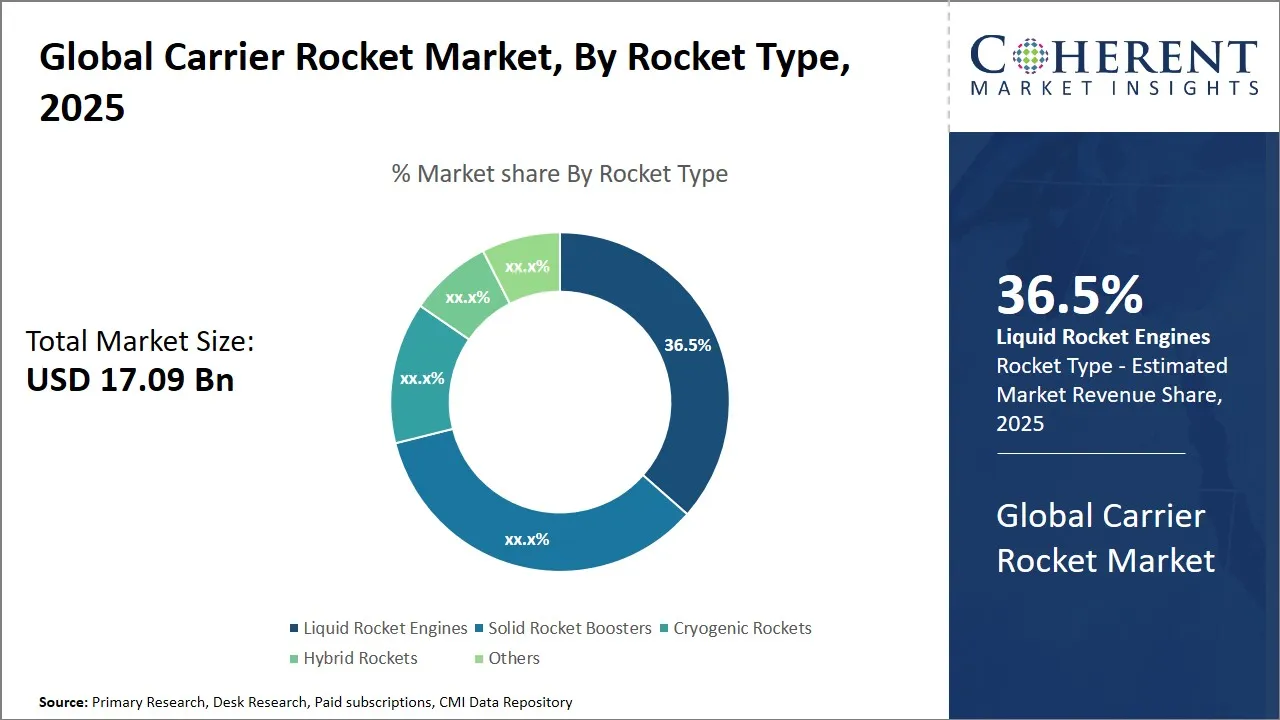
- The Liquid Rocket Engines segment leads the market, holding an estimated share of 37.5% in 2026.
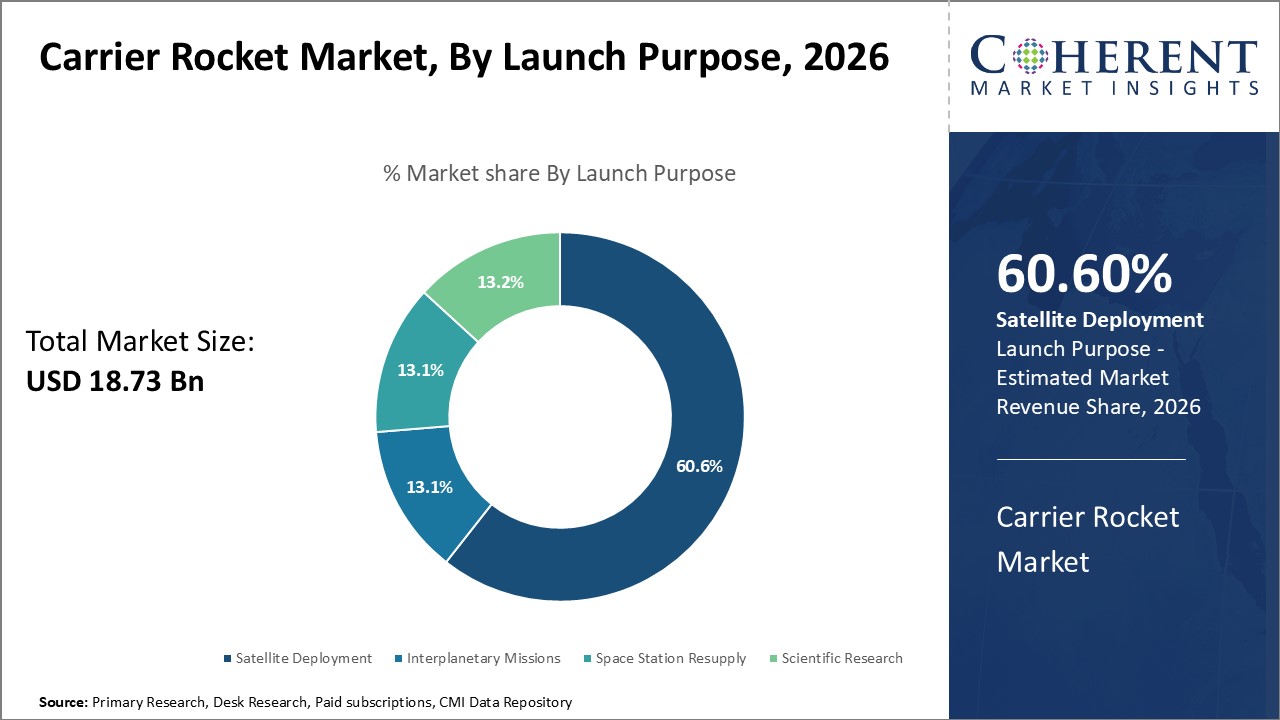
- The Satellite Deployment segment is projected to dominate with a share of 60.6 % in 2026.
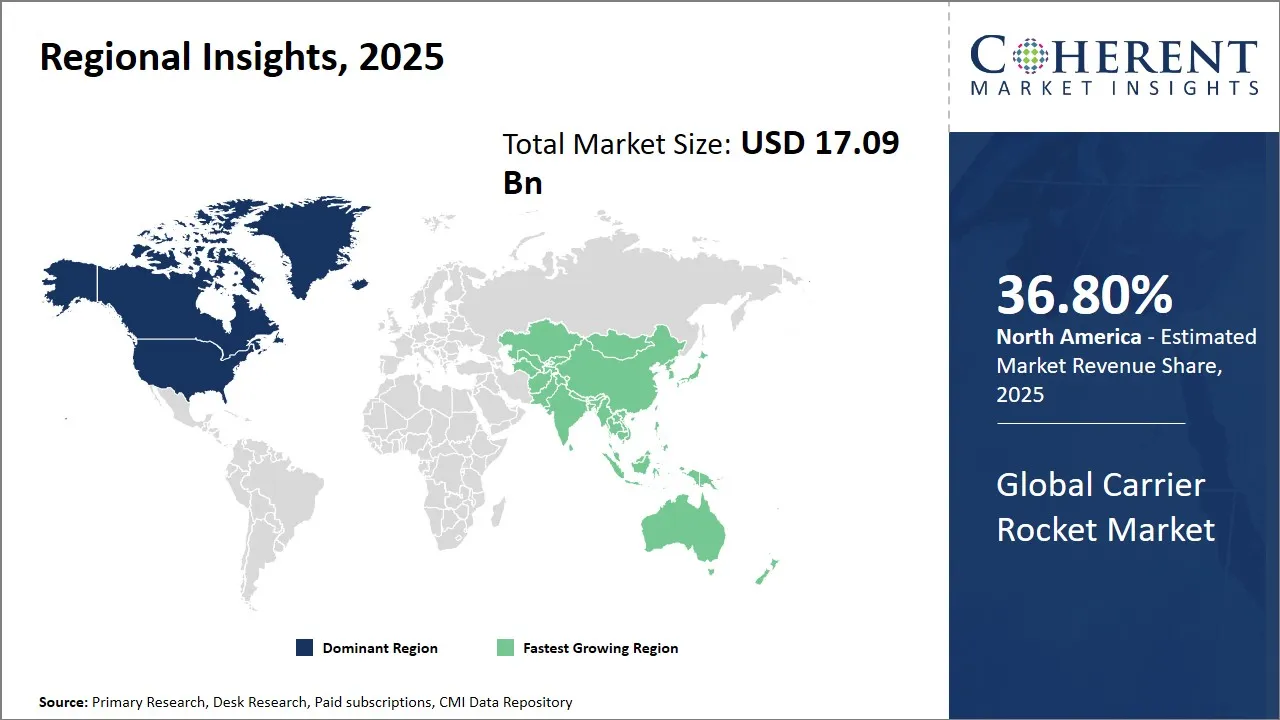
- North America is estimated to lead the market with a share of 36.8 % in 2026.
- Asia Pacific, holding a share of 18.1 % in 2026, is projected to be the fastest growing region.
Market Overview
The market trend indicates a strong shift towards reusable carrier rockets, significantly reducing launch costs and turnaround time. Furthermore, collaborations between government space agencies and private aerospace companies are adding to innovation and expanding service offerings. The growing deployment of small satellites for communication, earth observation, and navigation is also fueling demand, making this market highly dynamic and competitive with numerous new players entering the ecosystem.
Current Events and Its Impact
Current Events | Description and its impact |
Geopolitical and Trade Developments |
|
Environmental & Policy Changes |
|
Segmental Insights
- Current Industry Events of 2026
- Market Size Estimation
- Regional Breakdown
- Competitive Landscape
- Customer Intelligence
- Segmental Analysis
- Pricing Analysis
- Key Market Drivers, Challenges & Future Trends
- Customized Insights Section
Global Carrier Rocket Market Insights, by Rocket Type - Liquid Rocket Engines Lead Owing to Their Superior Performance and Versatility
Liquid rocket engines dominate the market, holding an estimated share of 37.5% in 2026. Liquid rocket engines use liquid propellants, usually a combination of a fuel and an oxidizer, which makes possible accurate throttling and shutdown capabilities. This controllability makes liquid engines particularly suitable for complex orbital insertions and precise payload delivery, which are essential for modern satellite deployment and interplanetary missions.
Also, advancements in materials, cooling systems, and engine designs have added to the reliability and performance of liquid rockets over time. Moreover, the ability of liquid engines to be restarted multiple times during a mission adds flexibility for adjusting orbits or conducting multiple payload deployments.
Liquid rocket engines also support a bigger range of mission requirements compared to other rocket types. While solid rocket boosters provide high thrust, their lack of control post-ignition limits their usage to initial boost phases rather than main propulsion stages. While cryogenic rockets offer efficiency, they need complex storage solutions because of the extremely low temperatures of their propellants, adding to operational challenges. Hybrid rockets, while promising, do not yet offer the performance reliability that liquid engines do, which is limiting their adoption in carrier rocket applications.
Global Carrier Rocket Market Insights, by Launch Purpose, Satellite Deployment Dominates Fueled by Exponential Demand for Communication and Earth Observation Satellites
The satellite deployment segment is expected to capture the highest market share of 60.6% in the global carrier rocket market in 2026. Both private companies and governments are spending a lot on launching vast networks of small to medium-sized satellites in low Earth orbit (LEO) to bridge connectivity gaps. This has encouraged rocket manufacturers and launch service providers to focus on improving payload integration capabilities and developing reusable rockets tailored to multiple satellite launches in a single mission, thus optimizing costs and deployment efficiency.
The rise of earth observation satellites for climate monitoring, disaster management, agriculture, and urban planning has also added a lot to satellite deployment demand. These satellites offer real-time data critical for governments and scientific bodies, adding to the need for reliable and frequent launches. The continuous technological upgrades and miniaturization of satellite components have made it possible for more satellites to be launched at once, encouraging a higher cadence of launches supported by specialized carrier rockets.
Additionally, the rise of private enterprises and public-private partnerships in the satellite industry has opened new markets and fueled investment in launch services infrastructure.
Impact of AI on the Carrier Rocket Market
AI algorithms are used to simulate and analyze complex rocket designs, reducing development time and improving performance precision. In mission planning, AI aids trajectory optimization and fuel consumption modeling, increasing launch efficiency and safety. Real-time diagnostics powered by AI also allow for early detection of potential failures in engines, avionics, and propulsion systems, minimizing the risk of in-flight anomalies.
A notable example is SpaceX's use of AI and machine learning in its Falcon 9 and Starship launch systems. The company integrates AI for real-time decision-making during vertical landings, ensuring precise booster recovery even under challenging conditions.
Regional Insights
North America Carrier Rocket Market Analysis and Trends
North America, holding an estimated share of 36.8% in 2026, dominates the global carrier rocket market, because of a well-established aerospace ecosystem, significant government investments, and the presence of leading aerospace companies. U.S.-based Relativity Space is using additive manufacturing (3D printing) in its fully reusable launch vehicle, Terran R. Over 85% of the rocket’s components are 3D-printed, which cuts production time and cost while allowing fast iteration and customization.
Robust partnerships between private sector giants like SpaceX, Boeing, and Lockheed Martin contribute significantly to innovation and market leadership. The region has from a mature infrastructure, advanced launch facilities, and a highly skilled workforce. Also, North America's trade policies and international collaborations facilitate export and technology exchange, adding to its commanding position in the market.
Asia Pacific Carrier Rocket Market Analysis and Trends
The Asia Pacific, holding a share of 18.1% in 2026, is expected to exhibit the fastest growth in the global carrier rocket market, propelled by an expanding space program and increased government spending particularly in China and India. The region's fast-paced industrialization and drive toward technological self-reliance have spurred national space agencies like China National Space Administration (CNSA) and Indian Space Research Organisation (ISRO) to ramp up launch capabilities. For instance, ISRO is working on developing a semi-cryogenic engine powered by refined kerosene (RP-1) and liquid oxygen (LOX), known as the SE2000.
Supportive government policies fostering public-private partnerships have further accelerated growth. Several emerging private companies in China and Japan are entering the market, complementing governmental efforts. The region also benefits from growing regional cooperation and increased demand for satellite deployment to support telecommunications, earth observation, and defense sectors.
Global Carrier Rocket Market Outlook for Key Countries
U.S. Carrier Rocket Market Analysis and Trends
The U.S. continues to lead with a combination of government-backed initiatives and vibrant private sector participation. SpaceX's reusable Falcon series and ULA’s Atlas and Delta launch vehicles exemplify cutting-edge technology shaping global market trends. NASA's Artemis program and increased military satellite deployments underscore sustained government commitment. The country’s regulatory environment encourages innovation while ensuring safety and competitiveness.
China Carrier Rocket Market Analysis and Trends
China carrier rocket market is expanding fast because of significant investment from the CNSA and an ambitious national space roadmap. The Long March rocket series has established a reliable launch record, supporting China’s satellite constellations, lunar missions, and Mars exploration. State-backed companies like China Aerospace Science and Technology Corporation (CASC) play a very important role, supported by growing industrial clusters focused on launch vehicle manufacturing.
India Carrier Rocket Market Analysis and Trends
India is characterized by the indigenous development of carrier rockets such as the Polar Satellite Launch Vehicle (PSLV) and the GSLV series by ISRO. Government initiatives emphasizing self-sufficiency and cost-effective launch services add to India’s expanding role in the commercial satellite launch business. The country aims to leverage its affordable launch competitiveness to attract international customers, supported by a robust policy framework and expanding infrastructure.
Japan Carrier Rocket Market Analysis and Trends
Japan maintains a decent presence in the market through JAXA and private companies like Mitsubishi Heavy Industries, which develop and operate the H-IIA rocket family. The government's clear focus on advancing space technology with international cooperation through bilateral partnerships supports ongoing innovation. The country’s stable regulatory environment and strong technological base makes it a key player in the Asia Pacific carrier rocket landscape.
Russia Carrier Rocket Market Analysis and Trends
Russia has a longstanding presence in the carrier rocket market becasue of its legacy aerospace industry and extensive launch facilities such as Baikonur and Plesetsk cosmodromes. Roscosmos continues to operate the Soyuz and Proton launch vehicles. Despite seeing some challenges related to modernization and competition, Russia has established expertise and international launch service agreements, adding to its strategic relevance.
Market Players, Key Development, and Competitive Intelligence
Key Developments
- On July 10, 2025, Mitsui O.S.K. Lines, Ltd. announced the company's move toward commercializing an offshore rocket launch and recovery vessel through a partnership agreement with Innovative Space Carrier, Inc. and TSUNEISHI SOLUTIONS TOKYOBAY Co., Ltd. This project originated from the MOL Group's new business proposal program, the 'MOL Incubation Bridge', designed to encourage employees to foster ideas for new businesses.
- In May 2025, Rocket Lab USA, Inc. announced the completion of a significant corporate reorganization, which involved a merger under a new holding company structure, with Rocket Lab becoming a wholly owned subsidiary of Rocket Lab Corporation.
- In March 2025, Rocket Lab USA, Inc., a global leader in launch services and space systems, entered into a non-binding term sheet with certain lenders to acquire a controlling equity position in Mynaric AG. Mynaric is a leading provider of laser optical communications terminals for air, space, and mobile applications.
- In December 2024, Boeing and Lockheed Martin's joint rocket venture, United Launch Alliance (ULA), announced plans to upgrade a version of its Vulcan rocket to challenge SpaceX's Starship in the low Earth orbit satellite launch market. ULA wants to develop a Vulcan model tailored to the increasingly lucrative low Earth orbit (LEO) market, mainly due to SpaceX launching thousands of satellites there for its Starlink Internet service.
Top Strategies Followed by Carrier Rocket Market Players
- Established players dominate the landscape through substantial investments in research and development (R&D), continuously pushing the boundaries of rocket technology to create high-performance and reliable launch vehicles.
- SpaceX continues to invest heavily in R&D, especially in the development of Starship, a fully reusable heavy-lift rocket designed for interplanetary missions.
- Mid-level players adopt a different, yet equally strategic approach by concentrating on delivering cost-effective solutions that balance quality with affordability.
- Japanese private firm iSpace targets price-sensitive customers by developing low-cost lunar lander and small rocket launch solutions. Their Hakuto-R mission and planned lightweight rockets focus on delivering compact payloads for scientific and commercial clients, offering a more economical alternative to large-scale launches.
- Small-scale players carve out their position in the global carrier rocket market by concentrating on specialized features or cutting-edge innovations that differentiate their offerings.
- Gilmour Space is a startup focusing on hybrid rocket propulsion technology, which combines solid and liquid fuels for safety and performance. It aims to serve the small satellite market with its upcoming Eris launch vehicle.
Market Report Scope
Carrier Rocket Market Report Coverage
| Report Coverage | Details | ||
|---|---|---|---|
| Base Year: | 2025 | Market Size in 2026: | USD 18.73 Bn |
| Historical Data for: | 2020 To 2024 | Forecast Period: | 2026 To 2033 |
| Forecast Period 2026 to 2033 CAGR: | 9.6% | 2033 Value Projection: | USD 35.58 Bn |
| Geographies covered: |
| ||
| Segments covered: |
| ||
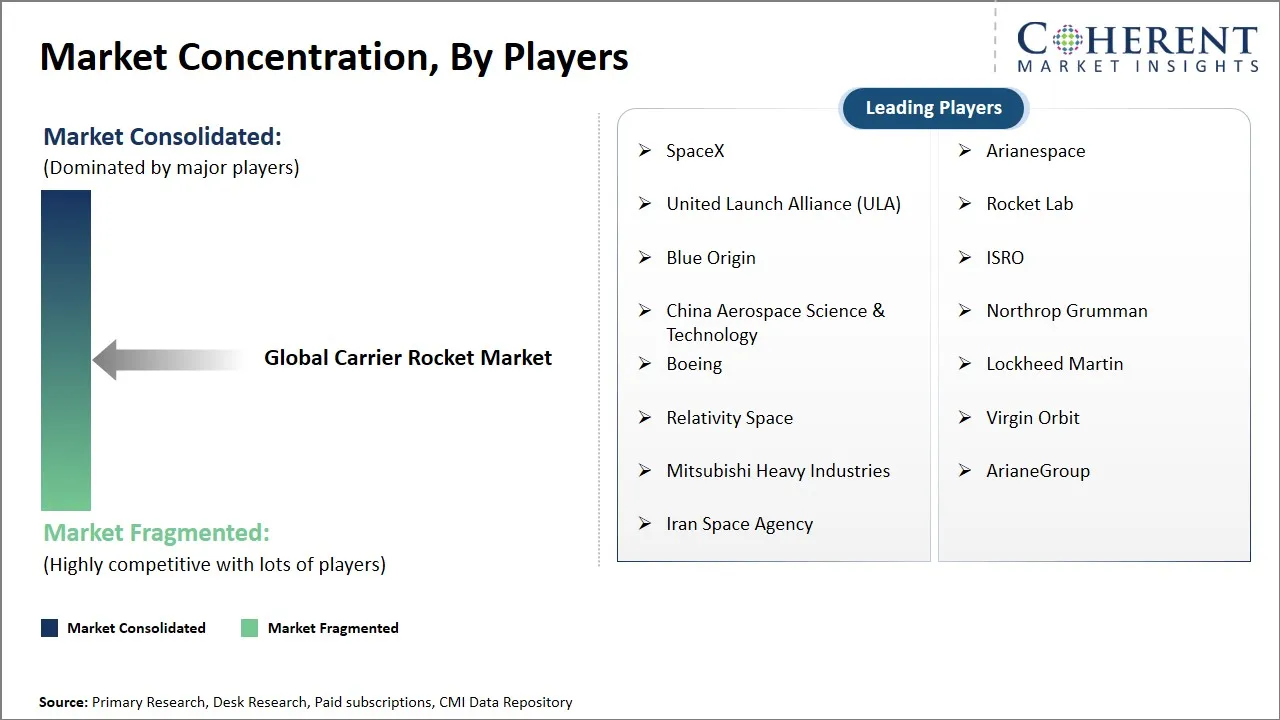
| Companies covered: | SpaceX, Arianespace, United Launch Alliance (ULA), Rocket Lab, Blue Origin, ISRO, China Aerospace Science & Technology, Northrop Grumman, Boeing, Lockheed Martin, Relativity Space, Virgin Orbit, Mitsubishi Heavy Industries, ArianeGroup, and Iran Space Agency | ||
| Growth Drivers: |
| ||
| Restraints & Challenges: |
| ||
Market Dynamics
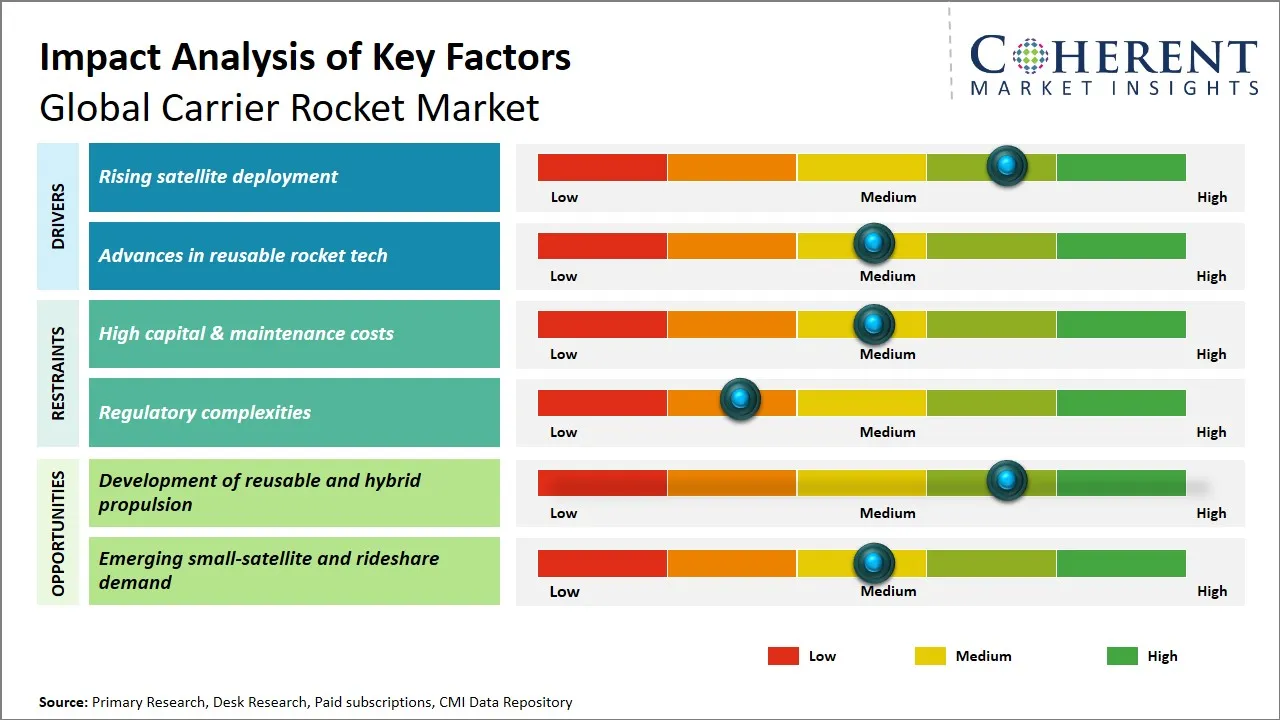
Global Carrier Rocket Market Driver – Rising Satellite Deployment
With advancements in communication, earth observation, and navigation technologies, governments and private enterprises are launching a growing number of satellites to enhance connectivity, surveillance, and data collection capabilities. The popularity of mega-constellations for providing global broadband coverage is adding to the need for reliable and cost-effective rocket launches. For example, Amazon’s Project Kuiper aims to deploy over 3,200 satellites to provide global broadband coverage, joining SpaceX’s ongoing Starlink constellation, which has already launched 6,000+ satellites.
Also, the rise of small satellites or CubeSats, which support different types of applications such as scientific research and disaster management, has added to more frequent and diversified launch requirements.
Global Carrier Rocket Market Opportunity – Development of Reusable and Hybrid Propulsion
Traditional expendable rockets incur high operational costs as each launch requires new hardware, prompting industry stakeholders to explore reusable technologies that enable multiple launches with the same vehicle components. Companies spending on the advancement of reusable propulsion highly reduce per-launch expenses, thus increasing access to space and attracting new customers, including small satellite operators and emerging spacefaring nations. For instance, ISRO is actively developing a Reusable Launch Vehicle (RLV) with successful demonstration landings, targeting cost-effective access to space and aligning with the global shift toward sustainable launch systems.
Also, hybrid propulsion, combining solid and liquid rocket fuels, provides improved flexibility and improved thrust performance. This diversification allows the development of adaptable launch vehicles that can meet different mission profiles, such as low Earth orbit payload deployment and interplanetary missions. Reusable and hybrid propulsion also makes the development cycle faster, making possible faster turnaround times and increased launch cadence.
Analyst Opinion (Expert Opinion)
- The global surge in demand for broadband connectivity and low-latency internet is positioning telecommunications as the most dominant industry segment in the carrier rocket market. Major satellite constellation programs like SpaceX’s Starlink, OneWeb, and Amazon’s Project Kuiper are deploying thousands of satellites into low Earth orbit, creating a consistent and high-volume need for carrier rockets—particularly in the small and medium payload categories. These large-scale deployments have turned telecom into a recurring launch customer, accelerating launch frequency and innovation in reusable systems.
- Meanwhile, government and defense sectors remain reliable and high-value demand drivers. Organizations such as NASA, ESA, CNSA, and ISRO, along with national defense departments, rely on carrier rockets for launching classified payloads, Earth observation satellites, scientific instruments, and interplanetary missions. This segment typically prefers dedicated heavy-lift launches and offers long-term contractual stability to established launch providers.
- Simultaneously, commercial imaging and IoT-based services are rising sharply, driven by applications in agriculture, weather monitoring, and smart infrastructure. As a result, there’s growing demand for low-cost rideshare launches, enabling newer players and startups to enter the space economy and disrupt traditional launch models.
Speak to the analyst
Want personalized insights?
Take the findings above to one of our principal consultants, or have the report rebuilt around the segments, geographies and competitors you actually track.
Market Segmentation
- Rocket Type Insights (Revenue, USD Bn, 2021 - 2033)
- Liquid Rocket Engines
- Solid Rocket Boosters
- Cryogenic Rockets
- Hybrid Rockets
- Others
- Launch Purpose Insights (Revenue, USD Bn, 2021 - 2033)
- Satellite Deployment
- Interplanetary Missions
- Space Station Resupply
- Scientific Research
- Regional Insights (Revenue, USD Bn, 2021 - 2033)
- North America
- U.S.
- Canada
- Latin America
- Brazil
- Argentina
- Mexico
- Rest of Latin America
- Europe
- Germany
- U.K.
- Spain
- France
- Italy
- Russia
- Rest of Europe
- Asia Pacific
- China
- India
- Japan
- Australia
- South Korea
- ASEAN
- Rest of Asia Pacific
- Middle East
- GCC Countries
- Israel
- Rest of Middle East
- Africa
- South Africa
- North Africa
- Central Africa
- North America
- Key Players Insights
- SpaceX
- Arianespace
- United Launch Alliance (ULA)
- Rocket Lab
- Blue Origin
- ISRO
- China Aerospace Science & Technology
- Northrop Grumman
- Boeing
- Lockheed Martin
- Relativity Space
- Virgin Orbit
- Mitsubishi Heavy Industries
- ArianeGroup
- Iran Space Agency
Sources
Primary Research Interviews
Stakeholders
- Space Launch Providers (e.g., Launch Coordinators, Vehicle Systems Engineers)
- Satellite Manufacturing Companies (e.g., Payload Engineers, Integration Managers)
- Space Agencies (e.g., Mission Planners from NASA, ISRO, CNSA)
- Private Aerospace Startups (e.g., Founders, CTOs from smallsat launch firms)
- Government Procurement Officials for Defense and Scientific Missions
- Aerospace Propulsion System Developers (e.g., R&D heads, test engineers)
Databases
- U.S. Commercial Spaceflight Reports Archive
- China National Space Science Data Center
- European Launcher Program Archive (ELPA)
- Japan Space Industry Database (JSID)
- Global Orbital Launch Registry
- Rocketry Systems & Propulsion Inventory (RSPI)
Magazines
- Launch Vehicle Today
- Orbital Mechanics & Space Systems Review
- Aerospace Engineering Monthly
- NextGen Propulsion Quarterly
- Payload & Launch Industry Digest
Journals
- Journal of Propulsion Science and Launch Technology
- Spaceflight Systems and Structures Review
- Journal of Advanced Aerospace Research
- Orbital Systems Engineering Journal
- Reusable Rocket Technology Journal
Newspapers
- Global Aerospace News
- The Launch Observer
- The Spaceflight Times
- Asia-Pacific Rocketry Herald
- New York Aerospace Daily
Associations
- International Association for Launch Vehicle Engineers (IALVE)
- American Institute of Space Propulsion (AISP)
- Global Federation for Orbital Transport (GFOT)
- Asia-Pacific Launch Technology Consortium (APLTC)
- Reusable Launch Alliance (RLA)
Public Domain Sources
- NASA Open Data Portal
- ESA Launch Statistics Archive
- United Nations Office for Outer Space Affairs (UNOOSA)
- World Bank - Space Economy Indicators
- OECD Space Forum Publications
- ResearchGate
Proprietary Elements
- CMI Data Analytics Tool, Proprietary CMI Existing Repository of information for the last 8 years
Get access to 250+ pages report
Every segment, forecast, competitor profile and data table behind the analysis above — available for instant download.
- ESOMAR Member
- ISO 9001:2015 Certified
- D-U-N-S Registered
- GDPR & CCPA Compliant
Missing comfort of reading report in your local language? Find your preferred language:
Transform your Strategy with Exclusive Trending Reports
Frequently Asked Questions
The global carrier rocket market is estimated to be valued at USD 18.73 billion in 2026 and is expected to reach USD 35.58 billion by 2033.
The CAGR of global carrier rocket market is projected to be 9.6% from 2026 to 2033.
Rising satellite deployment and advances in reusable rocket tech are the major factors driving the growth of global carrier rocket market.
High capital & maintenance costs and regulatory complexities are the major factors hampering the growth of global carrier rocket market.
In terms of Rocket Type, Liquid Rocket Engines are estimated to dominate the market revenue share in 2026.
SpaceX, Arianespace, United Launch Alliance (ULA), Rocket Lab, Blue Origin, ISRO, China Aerospace Science & Technology, Northrop Grumman, Boeing, Lockheed Martin, Relativity Space, Virgin Orbit, Mitsubishi Heavy Industries, ArianeGroup, and Iran Space Agency are the major players operating in the global carrier rocket market.
Carrier rockets use liquid fuels (like RP-1 kerosene, liquid hydrogen, or liquid methane), solid propellants, or hybrid fuels (a mix of solid and liquid components), depending on the stage and mission requirements.