

Global Container Ship Market and Forecast – 2026-2033
The global container ship market is estimated to be valued at USD 16.10 Bn in 2026 and is expected to reach USD 22.51 Bn by 2033, exhibiting a compound annual growth rate (CAGR) of 4.9% from 2026 to 2033.
Key Takeaways of the Container Ship Market
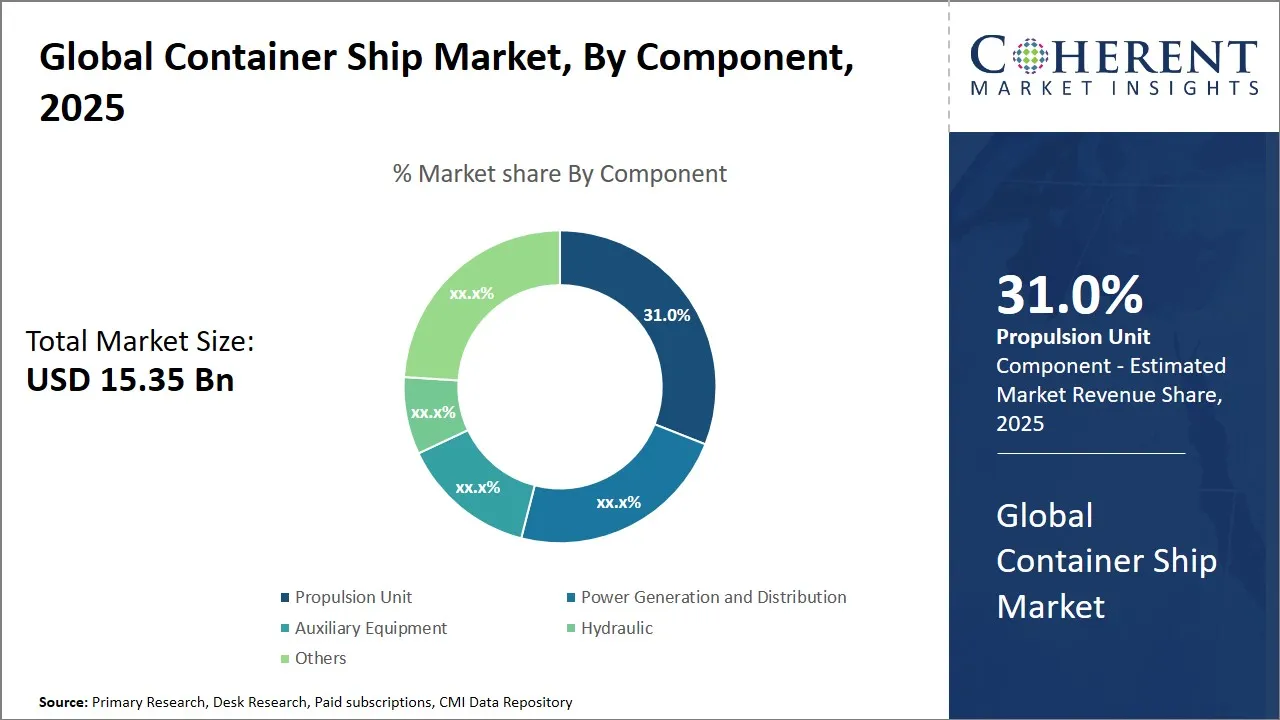
- The propulsion unit segment is expected to account for 32% of the container ship market share in 2026.
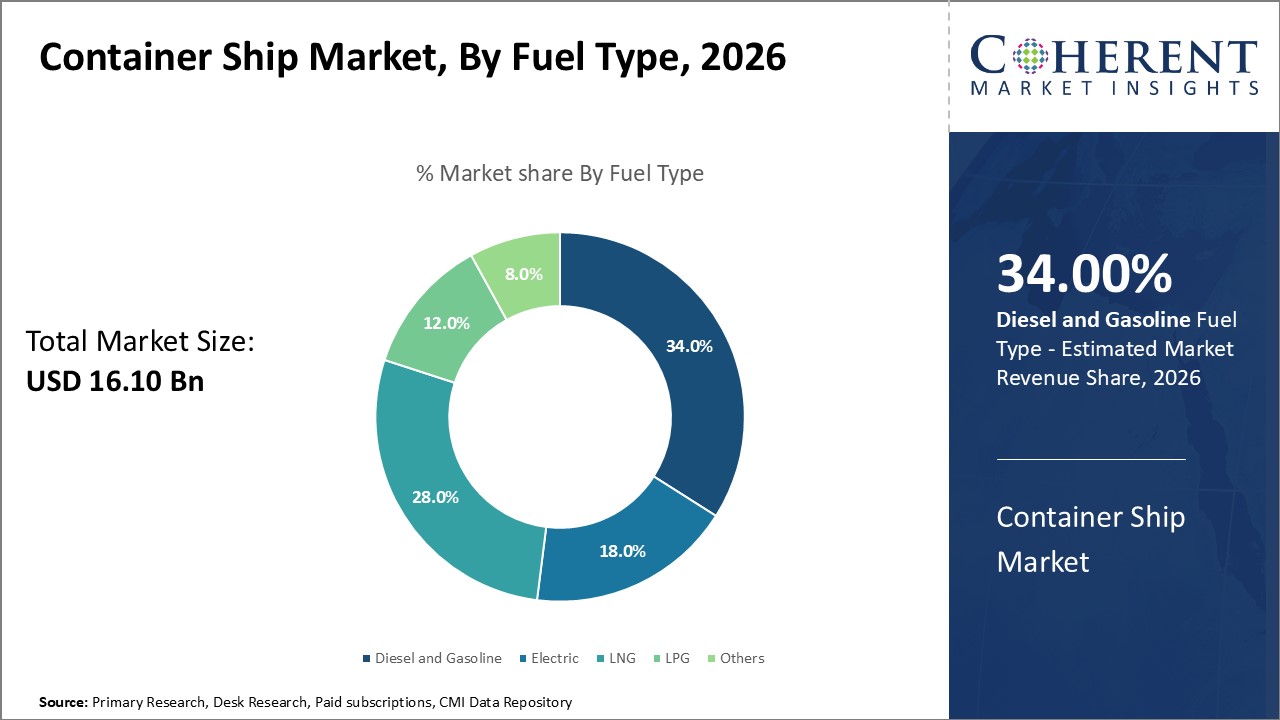
- The diesel and gasoline segment is projected to capture 34% of the market share in 2026.
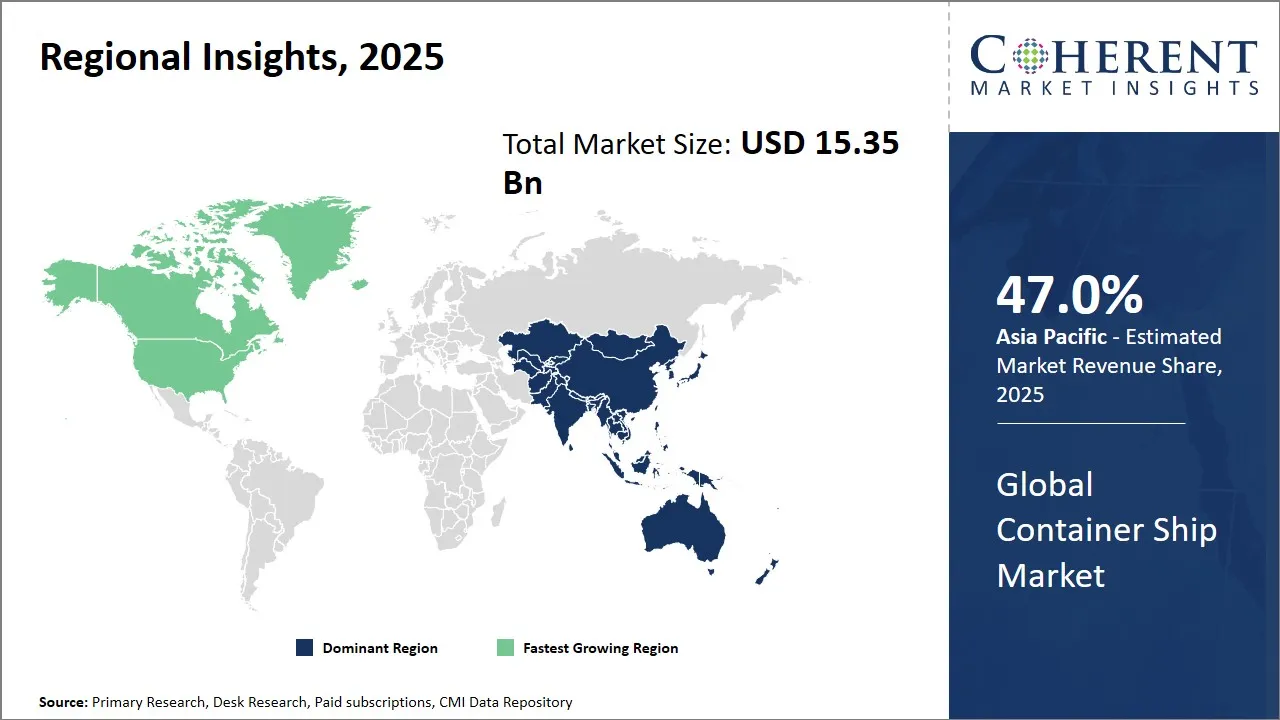
- Asia Pacific will dominate the container ship market in 2026 with an estimated 47%
- North America will hold 29% share in 2026 and record the fastest growth.
Current Events and Its Impact
Current Events | Description and its Impact |
CMA CGM Plan Announcement |
|
Segmental Insights
- Current Industry Events of 2026
- Market Size Estimation
- Regional Breakdown
- Competitive Landscape
- Customer Intelligence
- Segmental Analysis
- Pricing Analysis
- Key Market Drivers, Challenges & Future Trends
- Customized Insights Section
Why Does Propulsion Unit Dominate the Global Container Ship Market in 2026?
The propulsion unit segment is expected to hold 32.0% of the global container ship market share in 2026. This dominance comes mainly from the importance of propulsion units in steering ships and delivering power across long sea paths. As shipping firms must follow tough global environmental rules, they need better fuel use and fewer emissions, driving the demand for modern drive systems. Modern engines use smart electronics, mix energy types, or improve blade shapes to cut fuel needs and running expenses.
For instance, in November 2026, Finnish technology group, Wärtsilä, signed an agreement to supply a combined hybrid drive setup for a cargo ship being built at Royal Bodewes yard in the Netherlands. This vessel is intended for Norway’s Aasen Shipping. Instead of traditional methods, this solution integrates advanced components to improve efficiency during operation.
Diesel and Gasoline Segment Dominates the Container Ship Market
The diesel and gasoline segment is predicted to dominate the market with a 34% share in 2026. The continued dominance of diesel and gasoline stems from years of dependable performance at sea. As they have powered ships for so long, support systems like fuel stations and repair knowledge are already in place. Since these resources exist nearly everywhere, international fleets benefit from steady access during complex routes. That broad reach makes uninterrupted operations possible across distant ports.
The choice of diesel or petrol often comes down to strong energy output along with ease of use in current engines, leading to reliable power without excessive running expenses. Even though pollution remains an issue, better engine setups, including precise fuel delivery combined with cleaner exhaust methods have lowered harmful outputs so modern diesel runs cleaner compared to earlier versions.
Orderbook vs Scrapping Gap Analysis
Metric | Approx. Value |
Orderbook (end-2024) | 8.3 million TEU |
Fleet Capacity | 31 million TEU |
Orderbook as % of Fleet | 27-30 % |
Scrapping Potential | 1.8 million TEU |
Regional Insights
Asia Pacific Container Ship Market Analysis and Trends
The Asia Pacific region is projected to lead the market with a 47% share in 2026. The rise comes from smart geography, strong production networks, or active trade flows. This area hosts top container hubs - Shanghai, Singapore, Busan - that boost handling speed while improving freight movement.
A tight network of builders, carriers, or service firms across China, Japan, and South Korea pushes new tech use alongside vessel upgrades. At the same time, supportive state actions like funding port facilities, maritime zones, or incentives for newer fleets help keep Asia Pacific ahead. Key players such as China COSCO Shipping Corporation, Mitsubishi Corporation, or Hyundai Merchant Marine lead updates in ships plus wider route coverage, helping confirm this region’s central role in worldwide shipping.
North America Container Ship Market Analysis and Trends
North America is expected to exhibit the fastest growth in the market contributing 29% share in 2026. The container ship sector in North America is going through changes, as operators revise routes due to new trade trends and uneven demand. Imports have declined slightly, leading firms to shift available space and alter timetables; meanwhile, terminals and land transport face strain from delays and inconsistent gear availability.
Key ocean carriers aim to fine-tune network layouts and partnerships for better performance, whereas hubs are revising workflows to handle irregular cargo movements by targeting busier lanes instead. In summary, the industry shows constant motion, with vessels, docks, and freight movers adapting step-by-step to fresh market shifts.
Global Container Ship Market Outlook for Key Countries
Why is China Emerging as a Major Producer of Container Ships?
China plays a key role in global shipping due to its position as top exporter and importer of factory-made products. Its strong ship production sector, mainly based in Jiangsu and Zhejiang, supplies many cargo vessels internationally. Firms like China COSCO Shipping keep growing their vessel numbers while using modern freight systems for better route handling across continents. State projects including the Belt and Road Initiative boost sea links, opening up port access around the globe while lifting need for more container ships.
South Korea Container Ship Market Analysis and Trends
South Korea remains at the forefront of building cargo ships and managing sea transport. Thanks to firms such as Hyundai Heavy Industries and Samsung Heavy Industries, it delivers modern freighters featuring smart design and lower fuel use. Companies including Hanjin Shipping and HMM help shape international shipping routes. With public backing like construction subsidies and funding for new ideas, South Korea keeps its edge in producing large containerships.
U.A.E Container Ship Market Analysis and Trends
The U.A.E’s economy is expanding quickly because it sits on major sea lanes - this helps boost advanced harbors such as Jebel Ali. Based in Dubai, DP World runs cargo terminals while enhancing supply chain solutions, linking international markets more closely. Officials are shifting focus away from oil by supporting shipping industries through targeted regulations. Upgrades in digital port systems along with smoother customs procedures reduce delays, positioning the country as a central hub for freight movement.
Is U.S. the Next Growth Engine for the Container Ship Market?
The U.S. trade network relies heavily on large shipments moving through hubs such as Los Angeles, Long Beach, and Savannah. Instead of just expanding space, authorities are upgrading technology systems at these terminals to streamline cargo flow. Companies like Matson, Inc. along with Crowley Maritime Corporation run domestic freight services plus carry goods across the Pacific. Rather than ignoring impact, new rules require cleaner ships and smarter loading methods to meet emissions targets.
Germany Container Ship Market Analysis and Trends
Germany's container ship market reflects its role as a key European trade center. While Hamburg and Bremerhaven rank among Europe’s most active ports, they manage large cargo flows. Although firms like Hapag-Lloyd operate worldwide, their growth stems from fleet upgrades and partnerships. As environmental goals gain priority, cleaner ships and greener terminals become more common. Because digital tools are encouraged through policy, operations improve, helping Germany stay ahead in regional freight transport.
Idle Fleet & Slow Steaming Impact
Metric | Approx. Value |
Global idle container ship fleet | 0.5 %–0.8 % |
Idle capacity | 200,000–275,000 TEU |
Number of idle ships | 65–90 vessels |
Vessels under repair/maintenance | 730,000–860,000 TEU |
Slow steaming effective capacity absorption | Up to ~2.3 % |
Market Players, Key Development, and Competitive Intelligence
Key Developments
- On November 13, 2025, the Taiwan-based carrier, Evergreen announced that it had 42 new vessels on order, with a combined capacity exceeding 660,000 TEU which is equivalent to 34% of its existing fleet. The company has now expanded its order book further, placing an additional order for fourteen 14,000 TEU ships.
- On February 21, 2025, shipping powerhouse, Mediterranean Shipping Company, placed an order for as many as eight 22,000 TEU liquefied natural gas dual fuel container vessels in China
Top Strategies Followed by Global Container Ship Market Players
Player Type | Strategic Focus | Example |
Established Market Leaders | Product Reflag | French liner, CMA CGM, announced the reflagging of its 9,300-TEU container ship, Phoenix, under the U.S. flag. |
Mid-Level Players | Major Collaboration | In September 2024, Ocean Network Express, along with HMM and Yang Ming Marine Transportation, announced a collaboration for a period of five years. Owing to this ongoing collaboration, ONE can still offer steady, adaptable shipping solutions, supported by broader worldwide reach, which means better results and smoother processes for clients. |
Small-Scale Players | New Product Launch | In April 2024, Wan Hai Lines introduced its new Southeast Asia - India Service VIII, known as SI8. The route aims to strengthen connections across Southeast Asia plus western parts of India. Operation will be handled together with Korea Marine Transport Co., Ltd., alongside Interasia Lines. Four ships will run the service, each able to carry around 3,000 TEUs. |
Market Report Scope
Container Ship Market Report Coverage
| Report Coverage | Details | ||
|---|---|---|---|
| Base Year: | 2025 | Market Size in 2026: | USD 16.10 Bn |
| Historical Data for: | 2020 To 2024 | Forecast Period: | 2026 To 2033 |
| Forecast Period 2026 to 2033 CAGR: | 4.9% | 2033 Value Projection: | USD 22.51 Bn |
| Geographies covered: |
| ||
| Segments covered: |
| ||
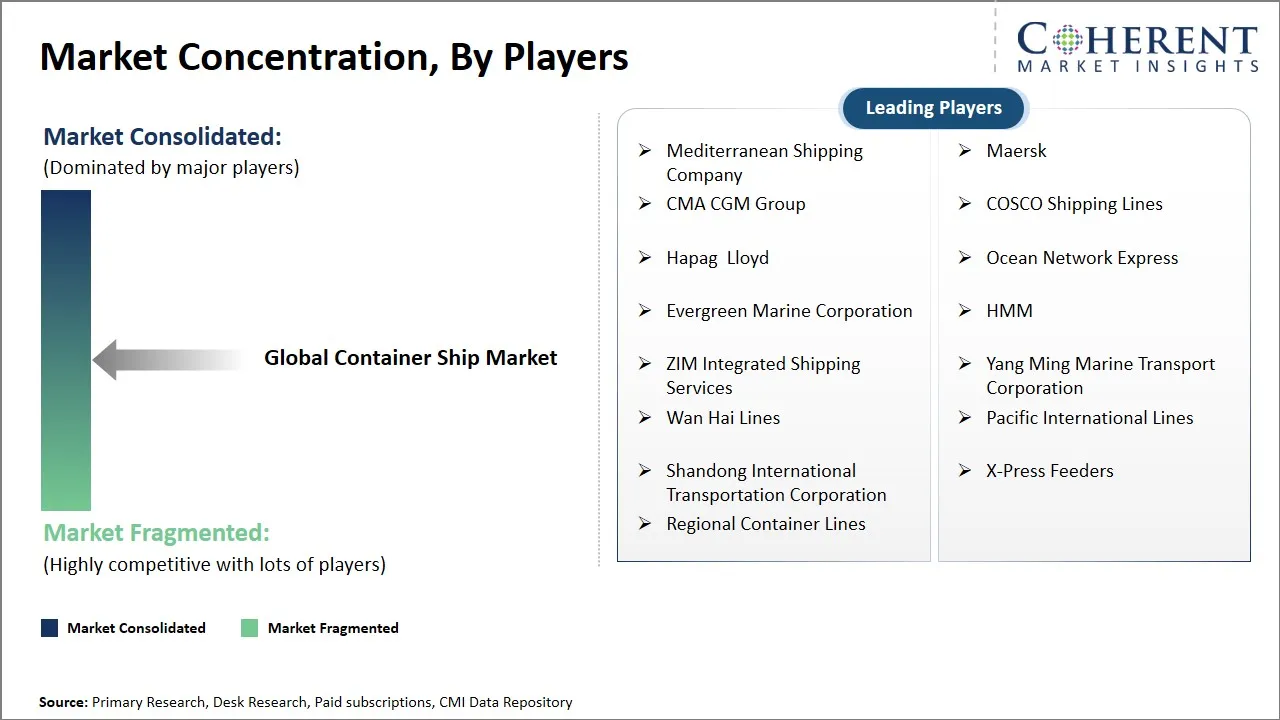
| Companies covered: | Mediterranean Shipping Company, Maersk, CMA CGM Group, COSCO Shipping Lines, Hapag Lloyd, Ocean Network Express, Evergreen Marine Corporation, HMM, ZIM Integrated Shipping Services, Yang Ming Marine Transport Corporation, Wan Hai Lines, Pacific International Lines, Shandong International Transportation Corporation, X-Press Feeders, and Regional Container Lines | ||
| Growth Drivers: |
| ||
| Restraints & Challenges: |
| ||
Global Container Ship Market Dynamics
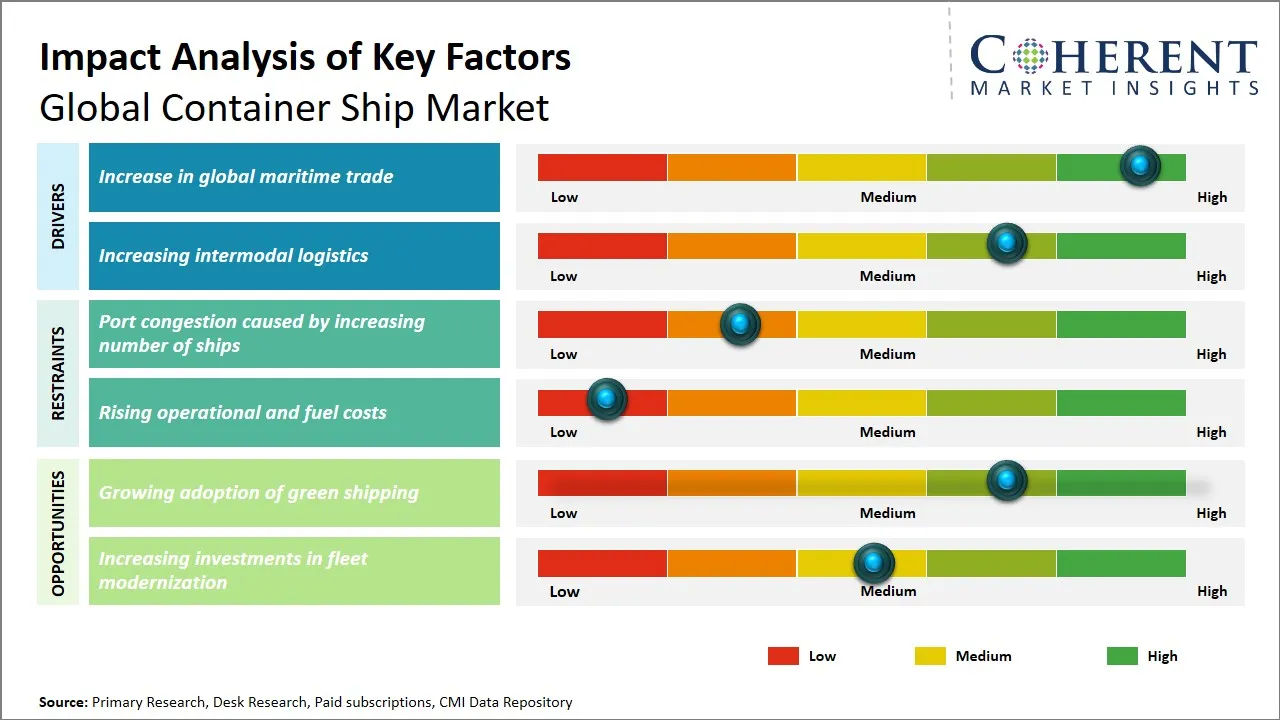
Global Container Ship Market Driver - Increase in Global Maritime Trade
The growth of worldwide sea trade is pushing the container ship market ahead. Because countries rely on each other more, cross-ocean freight volumes have risen sharply, leading to a need for bigger container fleets. Globalization has stretched supply networks wider, boosting imports and exports among key regions like Asia, Europe, and the Americas.
More trading means stronger demand for containerships that carry more goods, travel faster, while using less fuel. The surge in online shopping, along with shifting buyer habits, has increased the demand for dependable sea transport, prompting carriers to boost spending on updated cargo vessels. As a result, stronger global shipping activity supports steady advancement and renewal in the container vessel sector.
For instance, on December 14, 2025, Acting Texas Comptroller, Kelly Hancock released a study showing that the Port of Beaumont generated USD 23 billion in trade during 2024, marking a 182% growth from 2015. The study found trade through the port affected 157,000 net jobs and contributed USD 23.4 billion to Texas' gross domestic product in 2024.
Global Container Ship Market Opportunity - Growing Adoption of Green Shipping
The increasing focus on environmental protection and port infrastructure along with strict global rules targeting lower carbon output, opens major prospects for the worldwide container ship industry via wider use of clean maritime technology. Since groups like the International Maritime Organization (IMO) have introduced tighter pollution limits, carriers and builders now prioritize low-impact options to meet requirements while improving ecological performance. New developments, such as using cleaner fuels including LNG, ammonia, or hydrogen, alongside better engine efficiency and improved ship shapes are reshaping operations across the field.
In parallel, smart tools like navigation optimizers and live tracking help cut fuel waste and exhaust levels, boosting overall sustainability efforts. Embracing eco-conscious methods does more than reduce harm - it also responds to stronger public and investor expectations for responsible logistics networks. On top of that, public authorities and global organizations provide financial support to promote eco-friendly vessel upgrades or constructions, thus boosting sector engagement.
For instance, in September 2025, BIMCO published that 534 container ships are on order which will be able to use alternative fuels upon delivery. These represent 53% of ships on order and 77% of the Twenty-Foot Equivalent Unit (TEU).
(Source:https://www.bimco.org/news-insights/market-analysis/shipping-number-of-the-week/2025/0918-snow/)
Analyst Opinion (Expert Opinion)
- The global container ship sector is shifting away from extreme pandemic-era conditions, moving into steadier trade flows, though uncertainty remains high. While sea-based commerce grows slowly, experts point out that freight prices have dropped from recent highs; instead, firms now deal with steeper running costs and thinner profits due to added vessel supply and changing international trade rules affecting demand. As a result, earnings expectations for shipping lines in 2025 are somewhat below those of 2024, driven by firmer cargo levels meeting increasing expenditures.
- Going forward, structural shifts are influencing the market. Container orders stay high as fleets grow, which could lead to excess supply and unstable rates. Still, steady trade demand driven by economic trends and broader transport networks supports ongoing need for shipping. Rules on emissions are pushing companies to adopt cleaner fuels and tech, making these factors key in decision-making. Firms that manage growth carefully while investing wisely might gain advantage in an evolving sector central to world trade.
Speak to the analyst
Want personalized insights?
Take the findings above to one of our principal consultants, or have the report rebuilt around the segments, geographies and competitors you actually track.
Market Segmentation
- Component Insights (Revenue, USD Billion, 2021 - 2033)
- Propulsion Unit
- Power Generation and Distribution
- Auxiliary Equipment
- Hydraulic
- Others
- Fuel Type Insights (Revenue, USD Billion, 2021 - 2033)
- Diesel and Gasoline
- Electric
- LNG
- LPG
- Others
- Regional Insights (Revenue, USD Billion, 2021 - 2033)
- North America
- U.S.
- Canada
- Latin America
- Brazil
- Argentina
- Mexico
- Rest of Latin America
- Europe
- Germany
- U.K.
- Spain
- France
- Italy
- Russia
- Rest of Europe
- Asia Pacific
- China
- India
- Japan
- Australia
- South Korea
- ASEAN
- Rest of Asia Pacific
- Middle East
- GCC Countries
- Israel
- Rest of Middle East
- Africa
- South Africa
- North Africa
- Central Africa
- North America
- Key Players Insights
- Mediterranean Shipping Company
- Maersk
- CMA CGM Group
- COSCO Shipping Lines
- Hapag Lloyd
- Ocean Network Express
- Evergreen Marine Corporation
- HMM
- ZIM Integrated Shipping Services
- Yang Ming Marine Transport Corporation
- Wan Hai Lines
- Pacific International Lines
- Shandong International Transportation Corporation
- X-Press Feeders
- Regional Container Lines
Sources
Primary Research interviews
- Container Shipping Line Executives
- Port Terminal Operators
- Shipbuilding Industry Representatives
- Maritime Logistics Service Providers
Databases
- Lloyd's List Intelligence
- Clarksons Research Services
- IHS Markit Maritime & Trade
- Alphaliner Database
Magazines
- Maritime Executive
- Container Management Magazine
- Port Technology International
- Fairplay Magazine
Journals
- Maritime Policy & Management
- Journal of Transport Geography
- Transportation Research Part E: Logistics and Transportation Review
Newspapers
- Lloyd's List
- TradeWinds
- American Shipper
- The Maritime Standard
Associations
- International Chamber of Shipping (ICS)
- World Shipping Council (WSC)
- International Association of Ports and Harbors (IAPH)
- Baltic and International Maritime Council (BIMCO)
Public Domain sources
- International Maritime Organization (IMO)
- UNCTAD Maritime Transport Reports
- World Trade Organization (WTO) Trade Statistics
- Port Authority Publications
Proprietary Elements
- CMI Data Analytics Tool
- Proprietary CMI Existing Repository of information for last 8 years
Get access to 250+ pages report
Every segment, forecast, competitor profile and data table behind the analysis above — available for instant download.
- ESOMAR Member
- ISO 9001:2015 Certified
- D-U-N-S Registered
- GDPR & CCPA Compliant
Missing comfort of reading report in your local language? Find your preferred language:
Transform your Strategy with Exclusive Trending Reports
Frequently Asked Questions
The global container ship market is estimated to be valued at USD 16.10 Bn in 2026 and is expected to reach USD 22.51 Bn by 2033.
The CAGR of global container ship market is projected to be 4.9% from 2026 to 2033.
Increase in global maritime trade and increasing intermodal logistics are the major factors driving the growth of the global container ship market.
Port congestion caused by increasing number of ships and rising operational and fuel costs are the major factors hampering the growth of the global container ship market.
In terms of component, propulsion unit is estimated to dominate the market revenue share in 2026.
Alliances allow carriers to share vessels and networks, optimizing schedules and reducing operational costs.
It offers a shorter route during ice-free months, reducing transit time and fuel costs.