

Global Corrosion Inhibitors Market Size and Forecast – 2026-2033
The Global Corrosion Inhibitors Market is estimated to be valued at USD 10,075.0 Mn in 2026 and is expected to reach USD 15,049.3 Mn by 2033, exhibiting a compound annual growth rate (CAGR) of 5.9% from 2026 to 2033.
Key Takeaways of the Corrosion Inhibitors Market
- The organic segment is expected to account for 73.3 % of the global corrosion inhibitors market in 2026, driven by the inherent benefits of organic inhibitors over their inorganic alternatives.
- The water-based segment is projected to capture 75.90 % of the market share in 2026, driven by their environmental advantages, ease of application, and compatibility with a wide range of industrial systems.
- The power generation segment is expected to account for 32.30 % of the corrosion inhibitors market in 2026, primarily driven by the crucial need to preserve the integrity and efficiency of power plant infrastructure.
- Asia Pacific is expected to lead the global corrosion inhibitors market in 2026 with a 37.1 % share, driven by the increasing industrialization, stringent regulatory standards, and growing demand for corrosion protection across various sectors. North America, with an estimated 26.5% share in 2026, will be the fastest-growing region, fueled by rapid industrial growth, infrastructure development, and heightened focus on environmental sustainability and asset protection.
Market Overview
The main market trend that can be identified is the increasing use of eco-friendly and sustainable corrosion inhibitors as industries transition into greener options due to environmental regulations. Additionally, technological advancements in multifunctional and high-performance inhibitors contribute to the significant growth of the market. Nanotechnology and smart coatings integration has significantly improved the effectiveness of corrosion protection, while the new demands from end-use industries like infrastructure development and renewable energy are driving innovation and demand for corrosion inhibitors.
Current Events and Its Impact
Current Events | Description and its impact |
Surge in infrastructure investment in Asia Pacific (APAC) |
|
Rise of eco‑friendly/bio‑based corrosion inhibitors |
|
Segmental Insights

- Current Industry Events of 2026
- Market Size Estimation
- Regional Breakdown
- Competitive Landscape
- Customer Intelligence
- Segmental Analysis
- Pricing Analysis
- Key Market Drivers, Challenges & Future Trends
- Customized Insights Section
Corrosion Inhibitors Market Insights, By Type – Organic Segment Dominates the Market due to its Superior Efficiency and Environmental Compatibility
The organic segment is expected to hold 73.3% share of the global corrosion inhibitors market in 2026, primarily due to the inherent advantages offered by organic inhibitors over their inorganic counterparts. Organic corrosion inhibitors mainly work by forming a protective film on the metal surface, which acts as an effective barrier between corrosive agents such as water, oxygen, and salts and the metal beneath. This translates into improved corrosion resistance, particularly in aggressive environments.
Among the major drivers are an increase in the scope of applications for organic corrosion inhibitors in various industries. Most commercial organic corrosion inhibitors are based on amino acids, amines, phosphonates, and other carbon-based compounds and, hence, can be formulated to meet very specific corrosion problems. The most important reason for the preference of organic inhibitors, especially in protecting valuable equipment and infrastructure from corrosion, is that they offer efficient long-term protection without metal degradation.
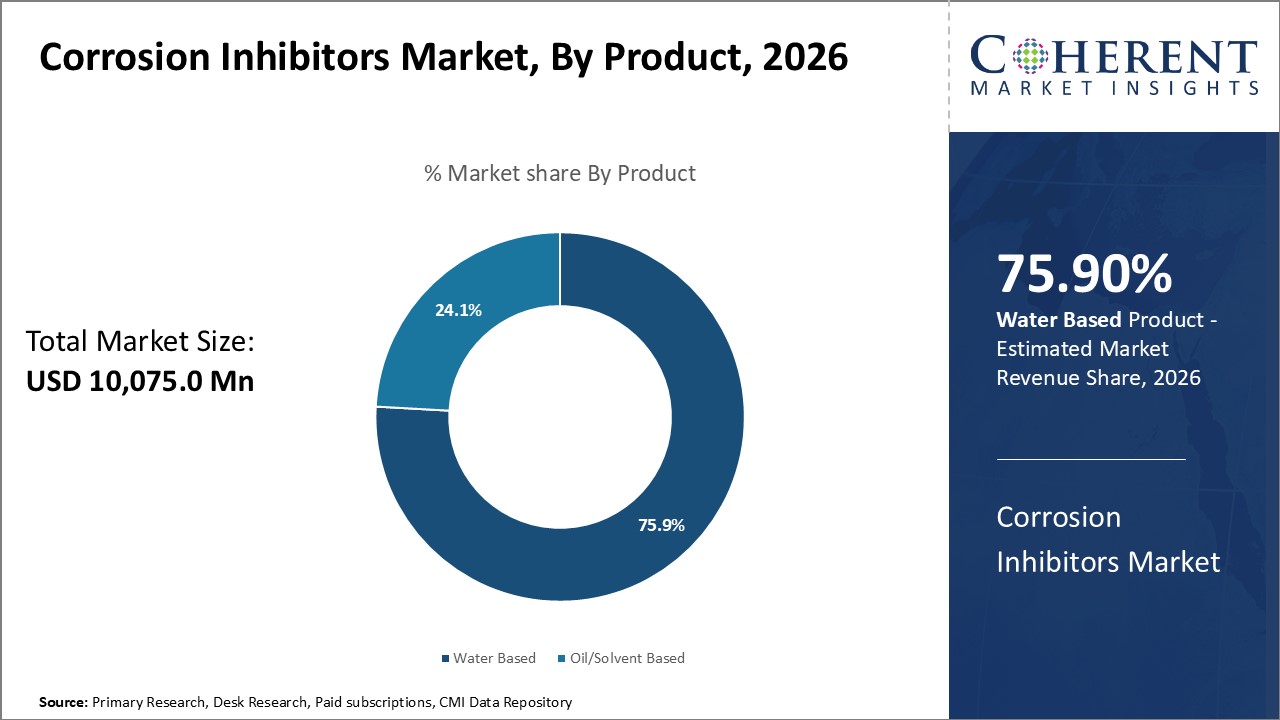
Corrosion Inhibitors Market Insights, By Product - Water Based Segment Dominates the Market Driven by Increasing Demand for Eco-Friendly and Compatible Corrosion Control Solutions
Water based segment is expected to hold 75.90% share of the market in 2026, due to its inherent environmental advantages, ease of application, and compatibility with a wide range of industrial systems. Its action is mostly related to aqueous media; whereby effective corrosion protection can be achieved without resorting to the use of harsh solvents or volatile organic compounds (VOC) that have become a regulatory concern in recent years.
These factors have led to an expansion of the water-based segment, predominantly because of the increasing emphasis on sustainable industrial practice, as well as adherence to regulations aimed at reducing emissions. Since water-based products emit fewer harmful solvents to the atmosphere, they align smoothly with worldwide movements towards cleaner production. Most regulatory bodies in major economies have also been promoting the use of chemical solutions that are less toxic and safer; thus, water-based inhibitors have seen widespread substitution for their solvent-based variants.
Corrosion Inhibitors Market Insights, By Application - Power Generation Segment Dominates the Market Driven by Critical Need for Infrastructure Longevity and Operational Reliability
The power generation segment is projected to hold 32.30% share of the corrosion inhibitors market in 2026, largely due to the need for maintaining the integrity and efficiency of power plants. Most power plants-whether thermal, nuclear, or renewable-based-use substantial amounts of metal components that are subjected to high temperatures, extreme pressure, and often corrosive steam or water environments.
A major driver in corrosion inhibitors for this segment is the need to avoid cases of downtime and ensure continuous power supply. Corrosion-induced failures lead to very expensive repairs or replacement of sensitive and costly equipment like boilers, turbines, condensers, and cooling systems. Such operational risk drives the power generation facilities to invest considerably in reliable corrosion prevention mechanisms, including state-of-the-art inhibitors.
Regional Insights
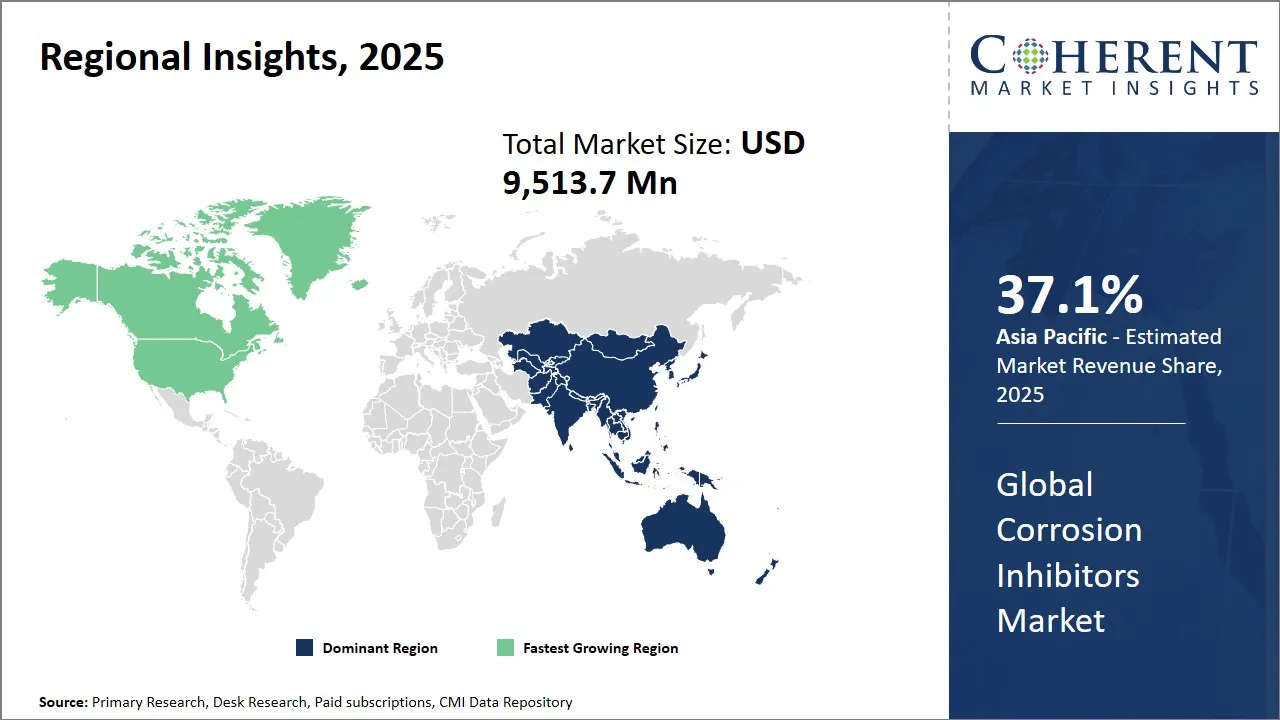
Asia Pacific Corrosion Inhibitors Market Analysis and Trends
The Asia Pacific region is expected to take over the market, with a share of 37.1% in 2026, mainly attributed to growing industrialization and expansion of industry in China, India, Japan and South Korea. The market features large chemical manufacturing areas, large infrastructure development programs, and a considerable user base covering oil & gas, automotive, construction and marine industries, which create the ecosystem in the region. Initiatives concerning infrastructure development and ensuring energy security by various governments of different economies in the region have also encouraged the usage of corrosion inhibitors for assets to extend their life and reduce cost related to maintenance.
The existence of large multinational chemical companies such as BASF and Dow Chemical Company and local giants such as Sinochem and Tata Chemicals enables advanced product development and availability. Furthermore, trade dynamics favor the region due to relatively lower raw material costs and greater focus on exports, particularly with specialty chemicals. All of these create the opportunity for the Asia Pacific region to become the leading region in the corrosion inhibitors market.
North America Corrosion Inhibitors Market Analysis and Trends
The North America region is expected to exhibit the fastest growth in the market contributing 26.5% share in 2026, driven by strong demand from key industries such as oil and gas, automotive, and manufacturing, with the U.S. and Canada being the major contributors. Infrastructure related to the oil and gas industry in this region includes refineries, pipelines, and offshore platforms-all of which cannot function without corrosion inhibitors that help maintain the integrity and performance of critical assets. Consequently, huge investments are being made either in the maintenance or expansion of infrastructure, thereby propelling the growth of the corrosion inhibitors market.
Corrosion inhibitors play a significant role in the automotive industry to prevent rust and prolong the vehicle life, especially in harsh weather conditions of snow and ice prevalent in northern parts of the U.S. and Canada.
Global Corrosion Inhibitors Market Outlook for Key Countries
China Corrosion Inhibitors Market Trends
The market for corrosion inhibitors in China is shaped by huge demand emanating from significant oil & gas processing and heavy manufacturing. Ongoing efforts within the country to upgrade industrial assets and infrastructure continue to drive the demand for sophisticated corrosion inhibitors that can help reduce downtime and maintenance costs.
Important organizations like BASF, Sinopec, and Wanhua Chemical have made significant investments in manufacturing localized products to meet market demand for specific industry needs, such as environmentally friendly inhibitors and water-based inhibitors. Government regulations have also played a role in creating greater emphasis on environmental compliance, driving the market toward sustainability, innovation, and growth.
India Corrosion Inhibitors Market Trends
The domestic market of India is rapidly growing, reflecting the increase in industrial and infrastructural projects on power generation, oil refining, and water treatment. The presence of domestic participants like Tata Chemicals, coupled with global players like Dow and Clariant, depicts a competitive landscape that is conducive to developing a wide range of inhibitors for various applications. The strong government support via initiatives like "Make in India" encourages local production and technological advances in corrosion inhibitor technologies. The urgency to decrease losses from corrosion, especially with oil pipelines and petrochemical plants, shows just how important corrosion inhibitors are becoming in the country.
U.S. Corrosion Inhibitors Market Trends
The U.S. is at the forefront of a well-established corrosion inhibitors ecosystem and better research and development infrastructure. The strong presence of oil & gas, automotive, aerospace, and construction industry activities, along with the necessity of performance for corrosion control markets continues to be met by industry leaders such as Dow Chemical, Honeywell, and 3M. High levels of environmental and industrial standards also press the market towards specialty and green inhibitors. In addition, established supply chains and trade networks in the U.S. further contribute to steady demand for these products over geographic distribution.
Saudi Arabia Corrosion Inhibitors Market Trends
The corrosion inhibitors market in Saudi Arabia has seen high levels of investment into oil and gas sector infrastructure. Corrosion inhibitors are an essential part of protecting pipelines, refining, and other petrochemical activities. Domestic giants like SABIC, along with multinational companies such as AkzoNobel and Clariant, are actively contributing to product innovation for extreme climatic conditions and corrosive environments that are typical in the region.
The government's push to diversify its industrial sectors through initiatives like Vision 2030 further propels the demand for corrosion prevention solutions in emergent sectors such as water treatment and renewable energy. Strategic partnerships, along with local manufacturing capacity increases, are improving the market momentum even further.
Germany Corrosion Inhibitors Market Trends
The growth of Germany's corrosion inhibitors is influenced by its strong automotive, chemical, and manufacturing industries. With a reputation for precision engineering and sustainability, German companies focus on environment-friendly corrosion inhibitors that meet the strict EU environmental standards. Major players like BASF, Lanxess, and Evonik Industries take advantage of advanced R&D facilities in the country to develop high-performance, specialty chemicals applied in automotive coating, preservation of metals, and industrial applications. Government policies promoting circular economy principles and strict industrial safety drive the demand for corrosion inhibitors directed toward asset longevity and environmental compliance.
Raw-material Supply Chain & Price-shock Sensitivity in the Corrosion Inhibitors Market
- The corrosion inhibitors market faces significant supply chain disruptions due to geopolitical events such as the Russia-Ukraine war, impacting raw material availability and transportation routes, causing delays and increased logistic costs in regions like Europe and Asia-Pacific. This affects the steady supply of key raw materials such as amines, phosphates, ceramic sands, and resins used in corrosion inhibitors.
- Price volatility is a major challenge, with raw material costs linked to petroleum derivatives fluctuating significantly. This price instability impacts production costs and margins for manufacturers globally.
- Dependency on imported raw materials increases vulnerability in the supply chain, particularly for high-strength corrosion inhibitors requiring specialized raw materials. Smaller producers struggle more to secure reliable contracts due to supply uncertainties and cost pressures.
- Market participants are adopting strategies such as diversifying supply chains, increasing local sourcing efforts, and strategic hedging to mitigate risks associated with price shocks and availability disruptions.
- Tariffs and international trade barriers further complicate raw material sourcing, especially in key markets like North America, Europe, and Asia, leading to fluctuating prices and supply challenges.
Market Players, Key Development, and Competitive Intelligence
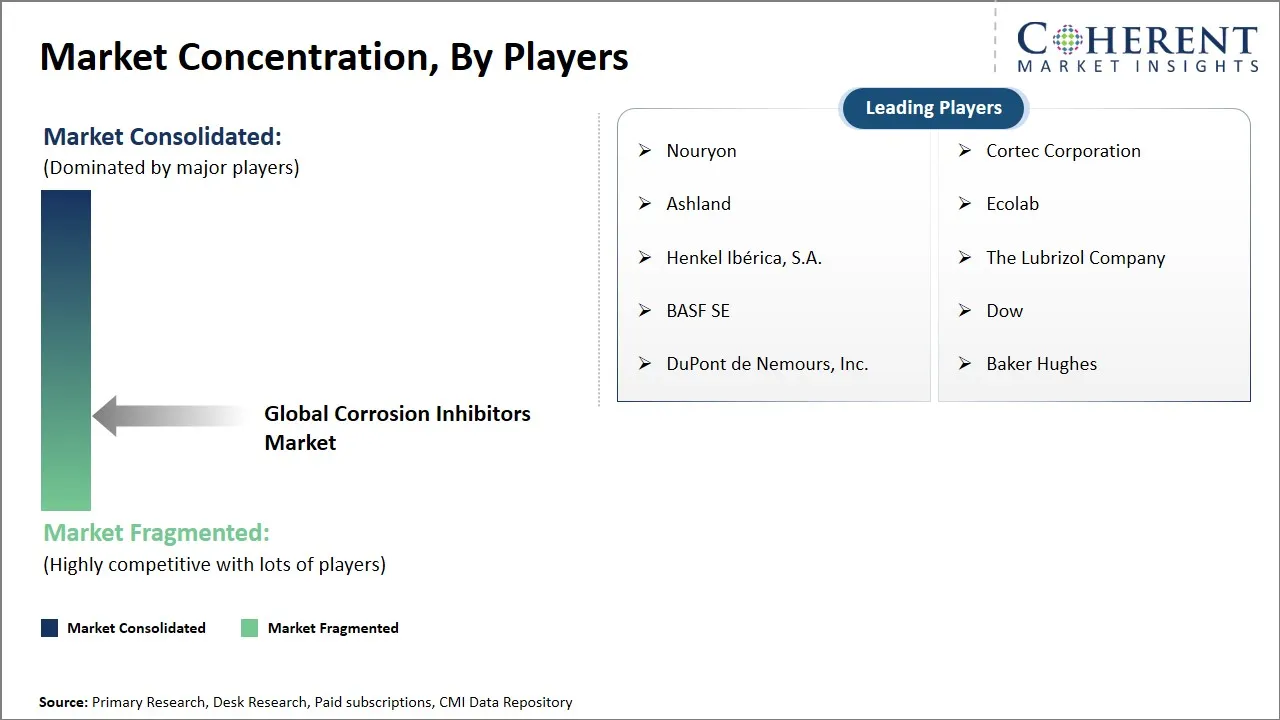
Key Developments
- In August 2024, PPG introduced its newest product, PPG PRIMERON Optimal, a powdered primer with optimized zinc for corrosion protection. This new primer has enhancements for adhesion and durability for various industrial applications. In addition, PPG PRIMERON Optimal will extend the life of coated surfaces by including effective corrosion inhibitors for all climate and conditions. This introduction indicates PPG's capacity to create products of high quality to support customers' growing demands for protective coatings.
- In March 2023, Cortec Corporation introduced a breakthrough in corrosion inhibitors with VpCI-649 HP, certified to ANSI/NSF Standard 61 for hydro-testing drinking water systems. VpCI-649 HP brings corrosion protection during hydrostatic testing, which is essential in testing vessels and piping. VpCI-649 HP reduces the dosage needed with little chloride sensitization, which protects metal surfaces and creates additional opportunities for safe applications in drinking water, thus raising the standard in the industry for corrosion prevention.
Top Strategies Followed by Global Corrosion Inhibitors Market Players
- Established companies in the industry thrive with significant investments in research and development (R&D), with the objective of bringing new products that provide high-level performance derived from user needs and the requirements of the industry. Established players use ongoing product improvements to maintain their reputation for quality and reliability over time by satisfying industry standards relating to performance and environmental compliance.
- For instance, two of the leaders in this marketplace, BASF and AkzoNobel, have shown that they consistently enhance and expand their product offerings to satisfy ongoing stricter regulations on the environment. BASF's Corrosion Inhibitors Portfolio develops high-performance products in the automotive sector, oil & gas, and construction industries that demonstrate enhancements that reduce the impact to the environment. AkzoNobel is guaranteed to spend money on sustainability and develop products that decrease the harmful impact to the environment while maintaining corrosion protection properties in aggressive environments.
- Mid-level companies in the corrosion inhibitors market have a more niche works approach relating to their products, paying more attention to price-sensitive products with a quality-to-price ratio. Mid-level players recognize that a high volume of consumers are price-sensitive and develop specific products that are easy on consumers' wallets. The middle players are in the industry feel they must develop and continue to enhance their products, and also turn to technology, product designers, and producers to optimize their own methods of manufacture improve their formulation of products.
- For example, Cortec Corporation, which plays a major role in the mid-tier company market segment, has created a line of corrosion inhibitors specific to certain industrial uses of packaging, coatings, and metalworking. They advertise their product as a comparable and lower-cost alternative to high-end branded product offerings, providing value to small- and mid-sized businesses.
- Small businesses have created their niche within the global corrosion inhibitors market by focusing on specialized attributes or unique product variations to address specific operational challenges for their customers. Small businesses have also developed or adopted better advanced, cutting-edge technologies that help create innovative product differentiation propelling them in the marketplace, such as bio-based or environment-friendly inhibitors designed solely for use in specific industries.
- For example, GreenChem specializes in bio-based environment-friendly corrosive inhibitors specifically designed to support their environmental focus for customers in agriculture, construction, and marine industries.
Market Report Scope
Corrosion Inhibitors Market Report Coverage
| Report Coverage | Details | ||
|---|---|---|---|
| Base Year: | 2025 | Market Size in 2026: | USD 10,075.0 Mn |
| Historical Data for: | 2020 To 2024 | Forecast Period: | 2026 To 2033 |
| Forecast Period 2026 to 2033 CAGR: | 5.9% | 2033 Value Projection: | USD 15,049.3 Mn |
| Geographies covered: |
| ||
| Segments covered: |
| ||
| Companies covered: | Nouryon, Cortec Corporation, Ashland, Ecolab, Henkel Ibérica, S.A., The Lubrizol Company, BASF SE, Dow, DuPont de Nemours, Inc., and Baker Hughes | ||
| Growth Drivers: |
| ||
| Restraints & Challenges: |
| ||
Corrosion Inhibitors Market Dynamics
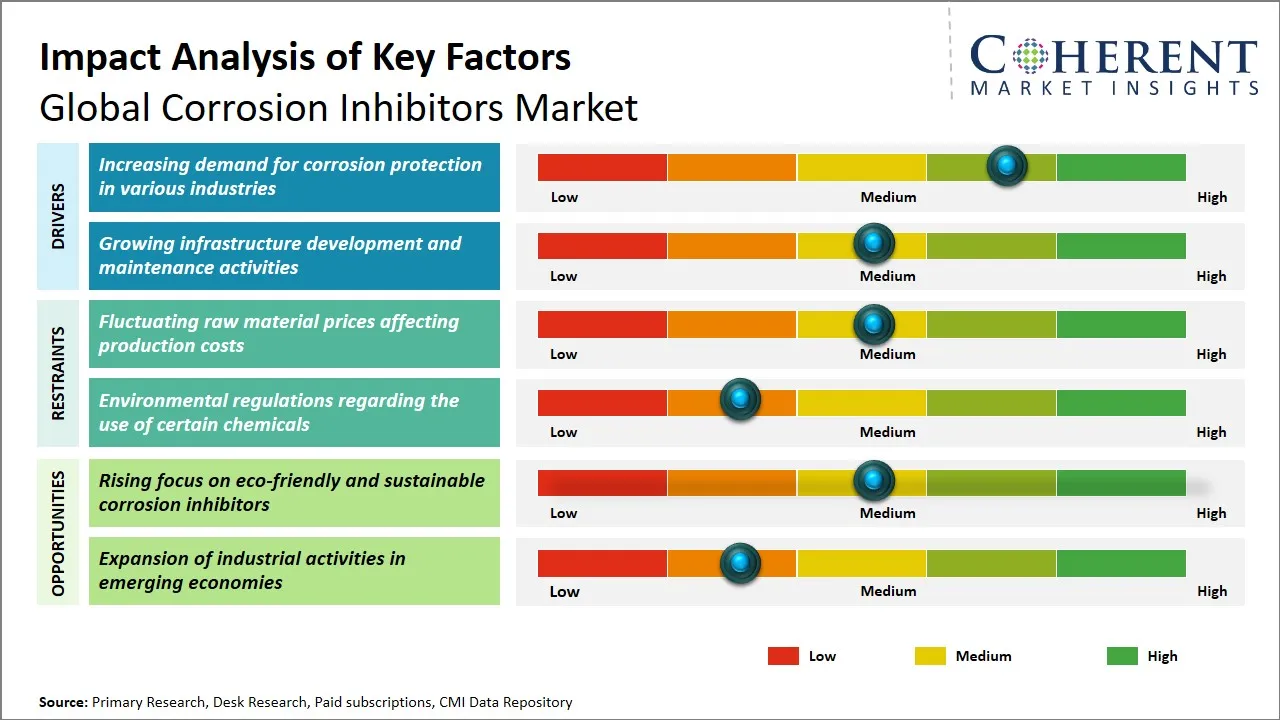
Corrosion Inhibitors Market Driver - Increasing Demand for Corrosion Protection in Various Industries
The rising focus on asset life and operational efficiency across many industries is substantially boosting the demand for corrosion inhibitors worldwide. Various industries - oil and gas, automotive, construction, water treatment chemicals, and manufacturing, are increasingly investing in corrosion-protection solutions to combat the expensive impacts of corrosion due to environmental influences such as moisture, chemicals, and extreme temperature. Corrosion inhibitors play a key role to preserve infrastructure integrity, lower maintenance costs, and prevent unanticipated equipment breakdowns which directly aid uninterrupted production cycles.
For example, ExxonMobil and Chevron have invested large amounts in advanced corrosion protection solutions to extend asset life of pipelines and offshore platforms, as these industries rely heavily on corrosion inhibitors to avoid costly repairs and maintain operational integrity in harsh environments.
Corrosion Inhibitors Market Opportunity - Rising Focus on Eco-Friendly and Sustainable Corrosion Inhibitors
The global corrosion inhibitors market has a significant opportunity as the demand for eco-friendly and sustainable corrosion inhibitor solutions continues to rise. With the growth in environmental regulations globally, industries such as oil & gas, water treatment, automotive, and construction are looking for alternative options to the traditional corrosion inhibitors which often contain hazardous chemicals. Consumers and corporations' growing environmental consciousness, combined with governmental/alleged eyes of regulatory bodies who are imposing restrictive regulations on minimizing ecological footprint, fuels this shift.
For example, companies such as Tesla and General Motors have increasingly focused on developing environment-friendly, resolute materials to protect vehicle components against rust and other forms of degradation, in part because aluminum and dimensional-lightweight materials are increasingly used in vehicles, and are corrosion-prone materials. Employing corrosion inhibitors in coatings increases the durability of a vehicle while protecting against the corrosion process.
Analyst Opinion (Expert Opinion)
- The corrosion inhibitors market is expected to grow considerably, driven by the worldwide uptick in industrial activity along with the need for asset protection in many sectors, including oil, gas, automotive and construction-focused industries. Notes from the Corrosion 2023 Conference and the International Conference on Protect Coatings (2022) noted some central innovations, with companies like BASF and Cortec Corporation leading the pack to develop advanced formulations. BASF’s development of a recently introduced biodegradable corrosion inhibitor linked to the sustainability trend serves as an excellent example of how the market is adapting to regulatory policies and environmental awareness.
- At both conferences, one common theme had to do with footprints considering tenability; nanotechnology’s expanding role in improving corrosion inhibitors’ effectiveness sometimes allowed for longer service intervals while reducing maintenance frequency/costs. While the importance of R&D to develop eco-friendly and performance-effective products, useful collaboration with industry leaders is another reported factor to support market expansion into new areas.
- As always, players willing to invest in R&D into high-performance/development formulations, and engage in quality collaborations will have an advantage. Overall, the corrosion inhibitors market growth includes expansion into other sectors with fabrications and the demands for durability and sustainable management of their assets.
Speak to the analyst
Want personalized insights?
Take the findings above to one of our principal consultants, or have the report rebuilt around the segments, geographies and competitors you actually track.
Market Segmentation
- Type Insights (Revenue, USD Mn, 2021 - 2033)
- Organic
- Inorganic
- Product Insights (Revenue, USD Mn, 2021 - 2033)
- Water Based
- Oil/Solvent Based
- Application Insights (Revenue, USD Mn, 2021 - 2033)
- Power Generation
- Oil & Gas
- Pulp & paper
- Metals processing
- Chemicals
- Other Applications
- Regional Insights (Revenue, USD Mn, 2021 - 2033)
- North America
- U.S.
- Canada
- Latin America
- Brazil
- Argentina
- Mexico
- Rest of Latin America
- Europe
- Germany
- U.K.
- Spain
- France
- Italy
- Russia
- Rest of Europe
- Asia Pacific
- China
- India
- Japan
- Australia
- South Korea
- ASEAN
- Rest of Asia Pacific
- Middle East
- GCC Countries
- Israel
- Rest of Middle East
- Africa
- South Africa
- North Africa
- Central Africa
- North America
- Key Players Insights
- Nouryon
- Cortec Corporation
- Ashland
- Ecolab
- Henkel Ibérica, S.A.
- The Lubrizol Company
- BASF SE
- Dow
- DuPont de Nemours, Inc.
- Baker Hughes
Sources
Primary Research Interviews
- R&D Directors and Product Development Heads from leading corrosion inhibitor manufacturers (e.g., BASF, Nouryon, Baker Hughes)
- Procurement Managers from major industrial chemical distributors and end-use sectors
- Sustainability and Regulatory Affairs Managers from certification bodies focused on chemical safety and environmental compliance
- Technology and Innovation Heads specializing in eco-friendly and green corrosion inhibitor formulations
Stakeholders
- Corrosion inhibitor manufacturers and raw material suppliers
- End-use sectors
- Oil & Gas (pipeline protection, drilling equipment)
- Power Generation (cooling systems, turbines)
- Chemical Processing
- Metal & Mining
- Water Treatment and Municipalities
- Automotive and Aerospace sectors focusing on corrosion prevention
- Regulatory, Environmental, and Certification Bodies (EPA, ECHA, EPA equivalents in Asia and Middle East)
- E-commerce Platforms and Industrial Retailers
- Technology Integrators working on AI-based personalized corrosion prevention and monitoring solutions
Databases
- UN Comtrade Database
- India Import Export (EXIM) Database
Magazines
- Chemical & Engineering News
- Corrosion Magazine (NACE International)
- Industrial WaterWorld (focus on water treatment chemicals)
- Coatings World (focus on protective coatings and inhibitors)
Journals
- Corrosion Science (focus on research progress and testing)
- Journal of Applied Electrochemistry (innovations in inhibitor chemistry)
- International Journal of Corrosion and Scale Inhibition
- Journal of Cleaner Production (sustainable corrosion inhibitor research)
Newspapers
- The Financial Times (market growth and investment news)
- The Wall Street Journal (industrial chemical market trends)
- The Guardian (environment and regulation related to chemicals)
- Asia Health Journal (regional market developments in Asia-Pacific)
- European Nutrition News (regulations affecting chemical industries)
Associations
- NACE International (The Corrosion Society)
- The Association for Materials Protection and Performance (AMPP)
- International Corrosion Council (ICC)
- Environmental Protection Agencies (EPA, ECHA, regional equivalents)
Public Domain Sources
- US Environmental Protection Agency (EPA) guidelines and regulations on chemical use
- European Chemicals Agency (ECHA) regulations on chemical safety and environmental impact
- World Health Organization (WHO) safety standards related to chemicals
- OECD assessments on chemical and environmental safety in industrial applications
Proprietary Elements
- CMI Data Analytics Tool, Proprietary CMI Existing Repository of information for last 8 years.
Get access to 250+ pages report
Every segment, forecast, competitor profile and data table behind the analysis above — available for instant download.
- ESOMAR Member
- ISO 9001:2015 Certified
- D-U-N-S Registered
- GDPR & CCPA Compliant
Missing comfort of reading report in your local language? Find your preferred language:
Transform your Strategy with Exclusive Trending Reports
Frequently Asked Questions
The global corrosion inhibitors market is estimated to be valued at USD 10,075.0 Mn in 2026 and is expected to reach USD 15,049.3 Mn by 2033.
The CAGR of global corrosion inhibitors market is projected to be 5.9% from 2026 to 2033.
Increasing demand for corrosion protection in various industries and growing infrastructure development and maintenance activities are the major factors driving the growth of the global corrosion inhibitors market.
Fluctuating raw material prices affecting production costs and environmental regulations regarding the use of certain chemicals are the major factors hampering the growth of the global corrosion inhibitors market.
In terms of type, organic is estimated to dominate the market revenue share in 2026.
Nouryon, Cortec Corporation, Ashland, Ecolab, Henkel Ibérica, S.A., The Lubrizol Company, BASF SE, Dow, DuPont de Nemours, Inc., and Baker Hughes are the major players.
Asia Pacific is expected to lead the global corrosion inhibitors market in 2026.