

Global CPU Heatsink Market Size and Forecast – 2026-2033
Coherent Market Insights estimates that the global CPU heatsink market is expected to reach USD 5 Bn in 2026 and will expand to USD 8 Bn by 2033, registering a CAGR of 6% between 2026 and 2033.
Key Takeaways of the CPU Heatsink Market
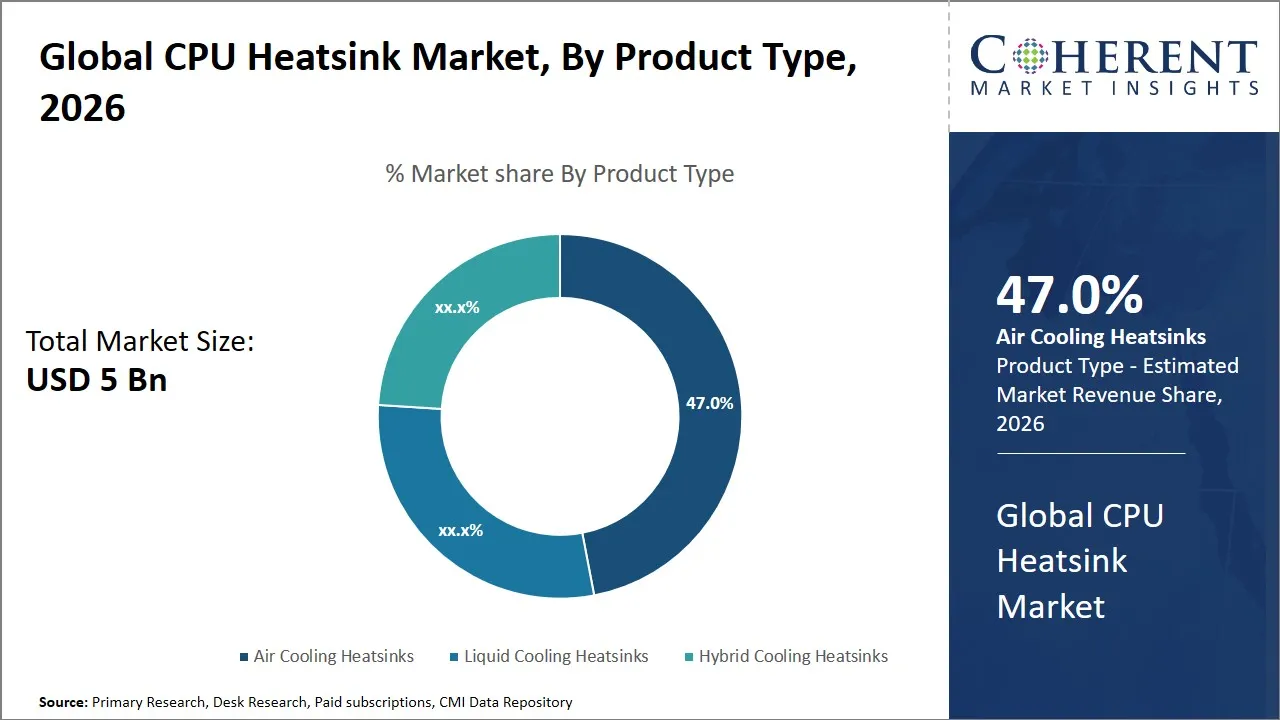
- The air cooling heatsinks segment is expected to account for 47% of the CPU heatsink market share in 2026.
- The aluminum segment is estimated to capture 45% of the market share in 2026.
- The desktop computers segment is projected to hold 36% of the global CPU heatsink market share in 2026.
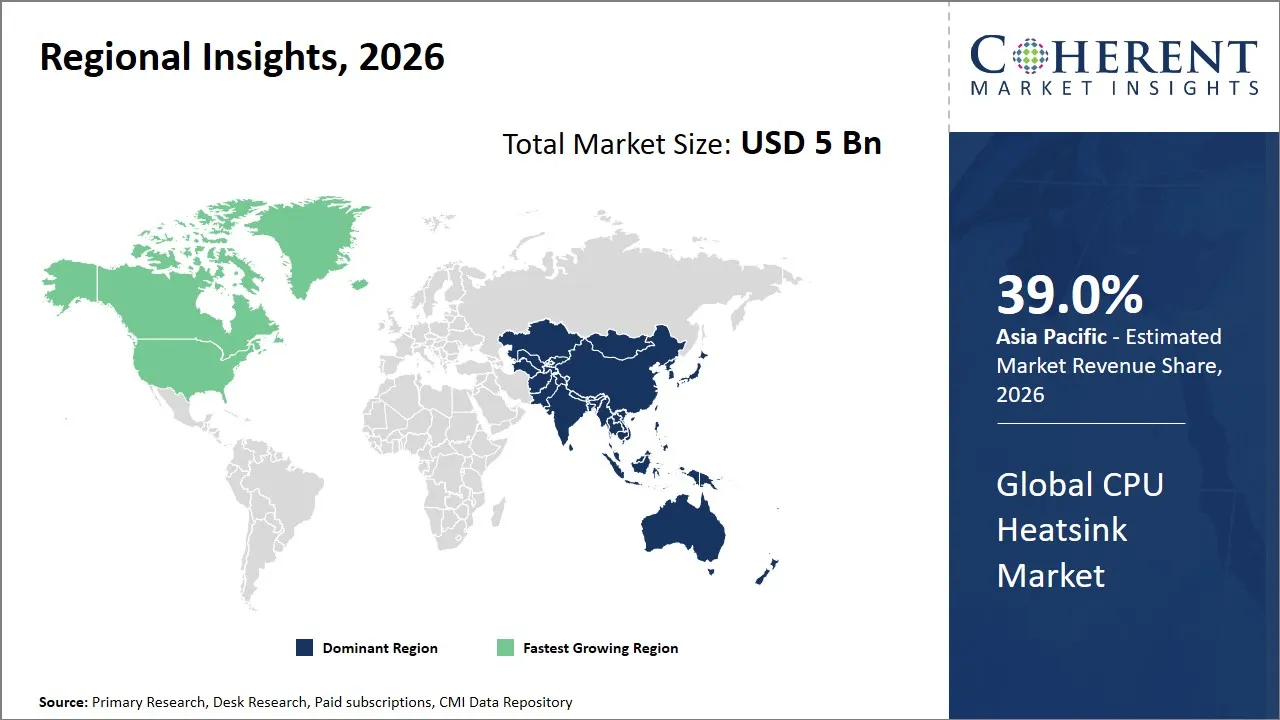
- Asia Pacific will dominate the CPU heatsink market in 2026 with an estimated 39% share.
- North America will hold 33% share in 2026 and is expected to record the fastest growth over the forecast period.
Current Events and Its Impact
Current Events | Description and its Impact |
Noctua at Computex Taipei 2025 |
|
Segmental Insights
- Current Industry Events of 2026
- Market Size Estimation
- Regional Breakdown
- Competitive Landscape
- Customer Intelligence
- Segmental Analysis
- Pricing Analysis
- Key Market Drivers, Challenges & Future Trends
- Customized Insights Section
Why Does the Air Cooling Heatsinks Segment Dominate the Global CPU Heatsink Market in 2026?
The air cooling heatsinks segment is expected to account for 47.0% of the global CPU heatsink market share in 2026. Growth stems mainly from low cost, consistent performance, stability during setup. Heat disperses when airflow moves over metal fins linked to the CPU - this reduces chip temperature efficiently. A major influence behind rising use of air-cooled heatsinks lies in adaptability across many system types, whether basic office machines or moderately powered gaming units, opening access for diverse users.
For instance, on January 5, 2026, SUDOKOO, debuted at the CES 2026, unveiling a new lineup of high-performance CPU air coolers and liquid cooling solutions designed for workstations, PC enthusiasts, creators, and professional users. The showcased products span workstation-class air cooling, low-profile vapor-chamber air coolers, enthusiast-grade tower coolers, and LCD-equipped liquid CPU coolers, reflecting SUDOKOO's engineering-first approach to modern thermal design.
(Source: prnewswire.com)
Aluminum Segment Dominates the Global CPU Heatsink Market
The aluminum segment is projected to account for 45.0% of the CPU heatsink market share in 2026. Primarily, advancement stems from a favorable mix of heat transfer ability, expense, and structural traits. Although copper conducts heat better than aluminum, the latter weighs much less, which favors usage when minimizing mass matters most. What stands out occurs during heatsink fabrication - spreading across broad zones happens without adding excessive volume or load to the system responsible for temperature control.
Why are Desktop Computers the Most Widespread Application in the CPU Heatsink Market?
The desktop computers segment is expected to account for 36.0% of the market share in 2026. Driven by what these users expect in speed and personal setup, higher demand emerges. Noticeable heat often emerges inside desktop setups using high-output chips, particularly during intense tasks like video processing or running complex simulations. As warmth increases past acceptable limits, function stability risks decline, system response may weaken, and component lifespan can shorten. For this reason, managing internal temperature stands key to consistent long-term operation. Consequently, strategies aimed at reducing excess warmth become essential elements of design integrity. The degree of cooling success shapes how reliably the unit operates across extended periods.
Thermal Performance vs TDP Class Mapping
TDP Class (Watts) | Representative CPUs / Use | Heatsink Type / Example | Measured Thermal Performance (ΔT Above Ambient) |
≤ 65 W (Low TDP) | Entry / office desktops | Compact low-profile air heatsink | ~24–30 °C @ 65 W heat load |
~85 W (Mainstream) | Mid-range desktops | Mid-range air heatsink (e.g., Hyper 612 “stock class”) | 9.2 °C @ 85 W (full fan) |
~95–105 W (Performance) | High-end desktop CPUs | Mid-to-high range heatsinks or AIO liquid | ~8.3 – 15 °C over ambient @ 85–150 W |
~130 W (High TDP) | High-end gaming CPUs | High-performance air with heatpipes or vapor chamber | ~12–15 °C @ 150 W |
~130 W (Rated Cooler) | Heatsinks rated up to 125–130 W | Example: Dynatron T06 (125 W rated) | Performance geared to 125 W dissipation (no exact ΔT published) |
150 W (Very High TDP) | Enthusiast desktop / entry-level workstation | Premium air or hybrid (heatpipe/vapor chamber) | ~10–15 °C @ 150 W (best cases) |
>150 W (Extreme/Server) | Workstation / servers | Server-class heatsinks (1U/2U with heatpipes) | Performance dependent on system design; data guides target ~0.18–0.24 °C/W |
Regional Insights
Asia Pacific CPU Heatsink Market Analysis and Trends
The Asia Pacific region is projected to lead the market with a 39% share in 2026. As industry runs wide here, growth takes shape slowly at first, built on long-held skills with chips and circuitry. From decisions made far above boardrooms, rules emerge that quietly boost technical work across labs and factories. Where countries stand firm - China, Taiwan, South Korea, Japan - a shift gains speed: more processors mean heat must move faster too. That demand pulls in parts such as cooling fins, needed wherever machines run nonstop. Vast production lines stay steady thanks to networks already in place, shaped by years of shipping patterns. Added advantages appear through agreements cutting import costs, making movement smoother without fanfare.
Firms including Cooler Master from Taiwan, Deepcool out of China, even Noctua, an European name but active across APAC channels, use local research labs to shape new forms of small, effective heat dissipators. Dominance continues as innovation blends with scale, placing the Asia Pacific zone ahead without reliance on fleeting trends or exaggerated claims.
For instance, on December 9, 2025, DeepCool launched the SPARTACUS 360, a flagship AIO liquid cooler engineered to deliver high-end thermal performance. Built around a new 6th-generation pump and semi-integral blade fans, it incorporates a 3.4" IPS LCD screen on the pump, offering 750-nit brightness, a crisp 480×480 resolution, and support for 16.7 million colors.
(Source: deepcool.com)
North America CPU Heatsink Market Analysis and Trends
The North America region is expected to exhibit the fastest growth in the market contributing 33% share in 2026. Growth unfolds because the area prioritizes advanced tech uptake, sees elevated interest in gaming and powerful computing systems, while hosting numerous influential OEMs active within semiconductors and computer hardware.
With invention as a force, the economy grows stronger when funds flow into trials - especially those testing liquid and hybrid cooling together with traditional heat spreaders. As public initiatives push to widen homegrown manufacturing while reducing imports, growth moves faster still. Firms like Corsair and Cooler Master, though headquartered elsewhere but active across markets, stay highly engaged; so does Arctic, all focusing on high-performance thermal parts built for specialists facing intense demands.
Global CPU Heatsink Market Outlook for Key Countries
Why is China Emerging as a Major Hub in the CPU Heatsink Market?
Manufacturing on a massive scale defines China's economic landscape, especially within consumer electronics. A dense network of OEMs and ODMs populates the region, turning out numerous PC parts - CPU heatsinks included - with consistent output feeding strong domestic appetite. Firms such as Deepcool stand out, delivering solutions across pricing tiers without sacrificing inventive design. Instead of relying solely on cost advantages, progress emerges through structured national goals like "Made in China 2025," which prioritize precision engineering. As methods evolve under these frameworks, performance standards rise, influencing supply chains well beyond borders. Products now reach global shelves bearing marks of upgraded craftsmanship rooted in localized development.
Is U.S. the Next Growth Engine for the CPU Heatsink Market?
Innovation drives the U.S. marketplace, where premium products meet needs in gaming, enterprise computing, and high-end workstations demanding effective heat control. Firms like Corsair and Noctua concentrate heavily on these areas, offering powerful coolers that emphasize visual design alongside function. Support for domestic chip production, shaped by federal initiatives, fosters growth opportunities within hardware and associated thermal systems. Awareness among buyers about temperature regulation and quiet operation fuels interest in higher-grade cooling technology.
Germany CPU Heatsink Market Analysis and Trends
In Germany, industry weighs heavily within Europe, hosting many makers of machinery and computer parts who value long-lasting build. From nearby Austria, firms such as Noctua shape influence throughout German-speaking areas by applying fine craftsmanship that matches tough European norms. Because rules around emissions are firm, progress often leans toward cooler-running components that save power. Positioned at the heart of the continent, movement of goods flows easier through this hub, linking partners across borders without delay. Though rooted locally, outcomes stretch far due to connectivity woven into trade routes.
Taiwan CPU Heatsink Market Analysis and Trends
From its central location in the global semiconductor network, Taiwan influences how CPU heatsinks develop over time. Close links to key chip designers like TSMC and MediaTek help local manufacturers adjust quickly to new processor requirements. Production lines respond rapidly because insights from product testing feed directly back into engineering plans. Notably, improvements first seen in Cooler Master designs eventually appear in many mainstream coolers. While based on a small island, these operations affect hardware standards worldwide. Where rules back honest inquiry and clear ownership, fresh ideas grow more easily. Because of this shift, work from regional labs begins shaping how heat is managed across the globe.
India CPU Heatsink Market Analysis and Trends
A shift unfolds in India, where usage of personal computers and gaming gear gains momentum alongside stronger domestic production efforts like those promoted through "Make in India." A shift begins among young consumers turning toward efficient, economical CPU cooling solutions. While international brands remain present, domestic producers refine their range for cost-aware audiences, altering distribution paths simultaneously. Beyond market activity, changes gain physical form and government-supported initiatives push local electronic manufacturing to reduce reliance abroad. With production moving closer to home, a consequence forms gradually: advancement in parts designed for thermal control.
Market Players, Key Development, and Competitive Intelligence
Key Developments
- On January 6, 2026, TRYX announced three groundbreaking products at CES 2026, the TURRIS 620 CPU air cooler, the FLOVA F50 mid-tower ATX case, and the STAGE 360 AIO liquid cooler. Building on the success of the PANORAMA series, these new offerings combine cutting-edge display technology, exceptional thermal efficiency, and user-centric features to empower PC enthusiasts, gamers, and creators.
- On September 17, 2025, Cooler Master launched its latest coolers featuring its "3D heat-pipe" technology. First unveiled in May during Computex 2025, the company's new Hyper 212 3DHP greatly improves heatsink efficiency by routing additional heat-pipes through the center of the fin stack instead of just the edges.
Top Strategies Followed by Global CPU Heatsink Market Players
Player Type | Strategic Focus | Example |
Established Market Leaders | Business Collaboration | On May 20, 2025, at Computex 2025, Noctua showcased its latest innovation, an all-in-one (AIO) cooling solution powered by Calyos’ two-phase loop technology. |
Mid-Level Players | Acquisition of ASETEK | On November 25, 2025, Asetek entered into a binding agreement with CQXA Holdings Pte. Ltd, pursuant to which the Offeror will make a voluntary recommended public takeover offer to the shareholders of Asetek to acquire all shares in Asetek. |
Small-Scale Players | FAULHABER Product Launch | On July 28, 2025, Zalman Technologies released the jet-engine inspired Zet5 CPU cooler for retail availability. |
Market Report Scope
CPU Heatsink Market Report Coverage
| Report Coverage | Details | ||
|---|---|---|---|
| Base Year: | 2025 | Market Size in 2026: | USD 5 Bn |
| Historical Data for: | 2020 To 2024 | Forecast Period: | 2026 To 2033 |
| Forecast Period 2026 to 2033 CAGR: | 6% | 2033 Value Projection: | USD 8 Bn |
| Geographies covered: |
| ||
| Segments covered: |
| ||
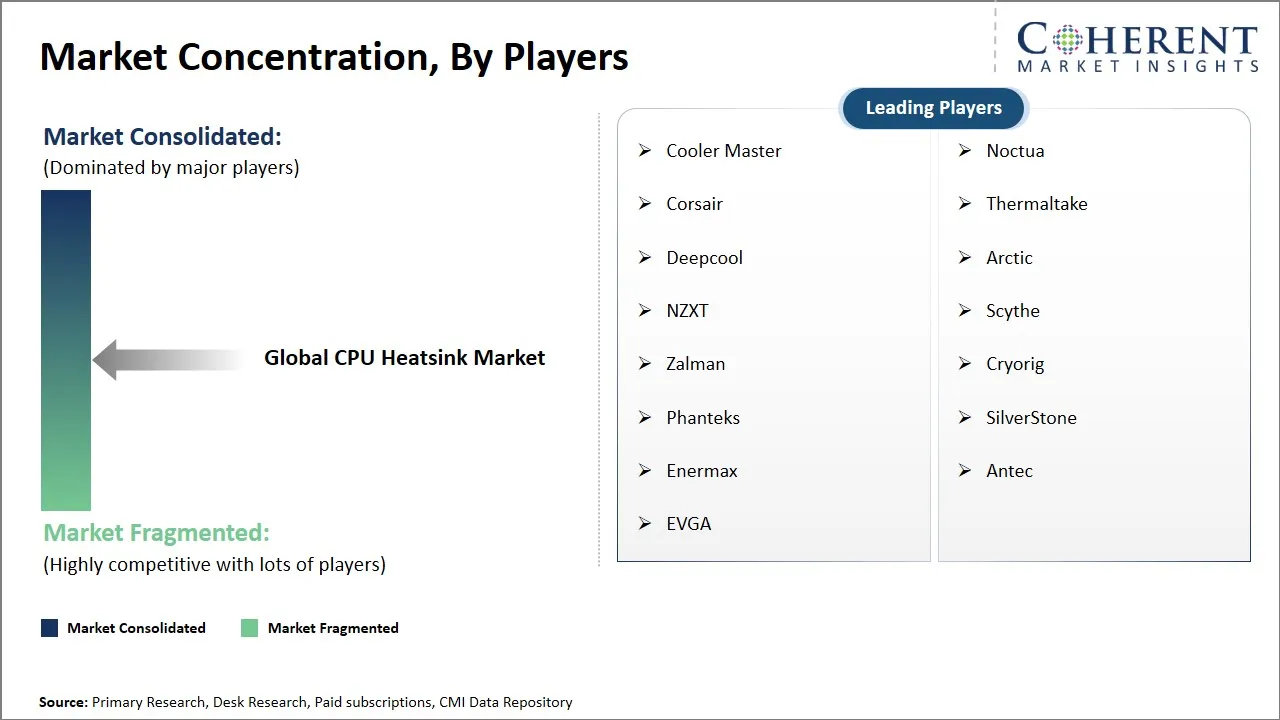
| Companies covered: | Cooler Master, Noctua, Corsair, Thermaltake, Deepcool, Arctic, NZXT, Scythe, Zalman, Cryorig, Phanteks, SilverStone, Enermax, Antec, and EVGA | ||
| Growth Drivers: |
| ||
| Restraints & Challenges: |
| ||
Global CPU Heatsink Market Dynamics
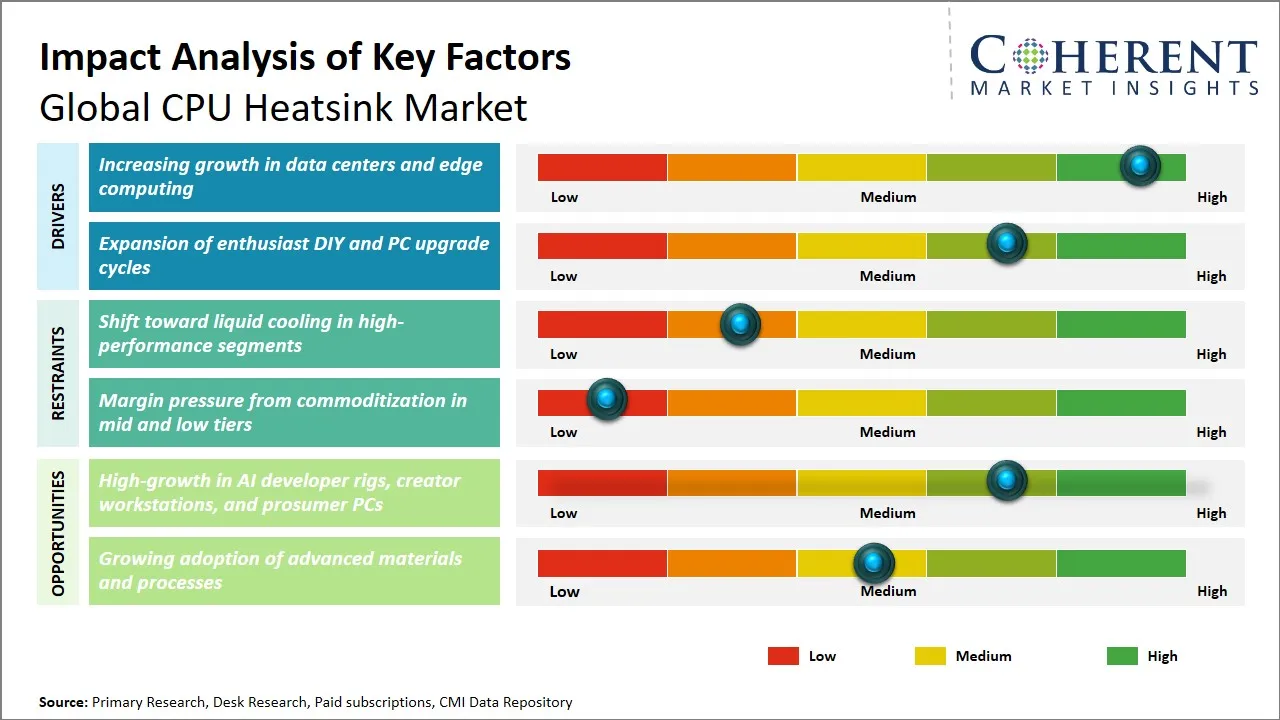
Global CPU Heatsink Market Driver - Increasing Growth in Data Centers and Edge Computing
The rapid expansion of data centers and the proliferation of edge computing infrastructure are significantly driving the demand for advanced CPU heatsinks. As organizations increasingly rely on powerful servers and distributed computing resources to handle vast volumes of data and real-time analytics, the need for efficient thermal management solutions becomes critical. CPUs in these environments operate under high performance and continuous workloads, generating substantial heat that, if not properly dissipated, can lead to system instability, reduced lifespan, and performance throttling.
For instance, on November 24, 2025, Amazon announced plans to invest an estimated USD 15 billion in Northern Indiana to build new data center campuses to support artificial intelligence (AI) and cloud computing technologies. Generative AI is driving increased demand for advanced cloud infrastructure and compute power, and Amazon’s investment will support the future of AI innovation from new data center campuses in the Hoosier State.
(Source: aboutamazon.com)
Global CPU Heatsink Market Opportunity - High-Growth in AI Developer Rigs, Creator Workstations, and Prosumer PCs
Growth within the global CPU heatsink sector appears closely tied to rising numbers of AI development systems. As machine learning tasks grow more intricate, specialists need computing power strong enough to manage heavy calculations over long intervals. High activity levels create significant warmth inside these machines, making efficient cooling essential. Equipment tasked with managing processor temperatures must keep up, ensuring stability while protecting internal components from degradation. In parallel, professionals who generate digital media now adopt advanced setups built around fast multi-threaded chips and graphics accelerators. These configurations emit large amounts of heat during operation, increasing reliance on effective dissipation methods. Enhanced thermal control emerges not as a luxury but as an operational requirement across such environments.
For instance, on January 6, 2025, NVIDIA announced foundation models running locally on NVIDIA RTX AI PCs that supercharge digital humans, content creation, productivity and development. These models, offered as NVIDIA NIM microservices, are accelerated by new GeForce RTX 50 Series GPUs, which feature up to 3,352 trillion operations per second of AI performance and 32GB of VRAM.
(Source: nvidianews.nvidia.com)
Analyst Opinion (Expert Opinion)
- Growth continues within the worldwide CPU heatsink sector, supported by stronger needs for powerful computing in areas like artificial intelligence, gaming hardware, and large-scale data operations. With chips now packing more cores and generating greater heat, managing temperature effectively enters central focus during development phases. Because of this, movement gains speed away from simple fan-based methods, favoring instead components that integrate vapor chambers, heat pipes, or refined fin layouts. Another influence emerges through smaller system builds and decentralized computing units, these require new approaches where minimal size does not reduce performance output.
- Performance gaps now shape much of marketplace rivalry, alongside advances in materials science. Instead of relying solely on traditional methods, newer models integrate features suited for upcoming processor generations. Even so, many manufacturers stick with airflow-driven cooling units because they remain economical and proven over time. Yet a shift appears at the higher end - hybrid systems gain ground where near-liquid efficiency matters most. Looking ahead, ecological factors begin nudging design choices into new directions. Recyclability plays a growing role, just as low-energy heat management gains attention across large-scale computing environments. Enterprise buyers show particular sensitivity to these trends when selecting components.
Speak to the analyst
Want personalized insights?
Take the findings above to one of our principal consultants, or have the report rebuilt around the segments, geographies and competitors you actually track.
Market Segmentation
- Product Type Insights (Revenue, USD Billion, 2021 - 2033)
- Air Cooling Heatsinks
- Liquid Cooling Heatsinks
- Hybrid Cooling Heatsinks
- Material Type Insights (Revenue, USD Billion, 2021 - 2033)
- Aluminum
- Copper
- Others
- Application Insights (Revenue, USD Billion, 2021 - 2033)
- Desktop Computers
- Laptops
- Servers
- Others
- Cooling Type Insights (Revenue, USD Billion, 2021 - 2033)
- Low TDP (under 100W)
- Medium TDP (100W-200W)
- High TDP (above 200W)
- Regional Insights (Revenue, USD Billion, 2021 - 2033)
- North America
- U.S.
- Canada
- Latin America
- Brazil
- Argentina
- Mexico
- Rest of Latin America
- Europe
- Germany
- U.K.
- Spain
- France
- Italy
- Russia
- Rest of Europe
- Asia Pacific
- China
- India
- Japan
- Australia
- South Korea
- ASEAN
- Rest of Asia Pacific
- Middle East
- GCC Countries
- Israel
- Rest of Middle East
- Africa
- South Africa
- North Africa
- Central Africa
- North America
- Key Players Insights
- Cooler Master
- Noctua
- Corsair
- Thermaltake
- Deepcool
- Arctic
- NZXT
- Scythe
- Zalman
- Cryorig
- Phanteks
- SilverStone
- Enermax
- Antec
- EVGA
Sources
Primary Research Interviews
- CPU Heatsink Manufacturers and OEMs
- Computer Hardware Distributors and Retailers
- PC Assembly Companies and System Integrators
- Data Center Infrastructure Managers
Databases
- Semiconductor Industry Association (SIA) Database
- Global Trade Information Services (GTIS)
Magazines
- PC Magazine
- Computer Power User (CPU) Magazine
- Maximum PC
- Tom's Hardware Magazine
Journals
- IEEE Transactions on Components, Packaging and Manufacturing Technology
- Journal of Electronic Packaging
- International Journal of Heat and Mass Transfer
Newspapers
- The Wall Street Journal
- Financial Times
- Nikkei Asia Technology Section
- Electronic News
Associations
- Semiconductor Industry Association (SIA)
- Electronic Components Industry Association (ECIA)
- Computer Technology Industry Association (CompTIA)
- International Electronics Manufacturing Initiative (iNEMI)
Public Domain Sources
- U.S. Patent and Trademark Office (USPTO) Database
- World Trade Organization (WTO) Trade Statistics
- International Trade Centre (ITC) Market Analysis
- Government Technology Transfer Offices
Proprietary Elements
- CMI Data Analytics Tool
- Proprietary CMI Existing Repository of Information for Last 8 Years
Get access to 250+ pages report
Every segment, forecast, competitor profile and data table behind the analysis above — available for instant download.
- ESOMAR Member
- ISO 9001:2015 Certified
- D-U-N-S Registered
- GDPR & CCPA Compliant
Missing comfort of reading report in your local language? Find your preferred language:
Transform your Strategy with Exclusive Trending Reports
Frequently Asked Questions
The global CPU heatsink market is expected to stand at USD 5 Bn in 2026 and is expected to reach USD 8 Bn by 2033.
The CAGR of global CPU heatsink market is projected to be 6% from 2026 to 2033.
Increasing growth in data centers and edge computing and expansion of enthusiast DIY and PC upgrade cycles are the major factors driving the growth of the global CPU heatsink market.
Shift toward liquid cooling in high-performance segments and margin pressure from commoditization in mid and low tiers are the major factors hampering the growth of the global CPU heatsink market.
In terms of product type, air cooling heatsinks are estimated to dominate the market revenue share in 2026.
No, heatsinks are designed to fit specific CPU sockets and form factors.
AI workloads increase processor heat output, boosting the demand for advanced thermal solutions.