

Global Electric Park Brake Market Size and Forecast – 2026 To 2033
The global electric park brake market is expected to grow from USD 7 Bn in 2026 to USD 12 Bn by 2033, registering a compound annual growth rate (CAGR) of 9% from 2026 to 2033. The global electric park brake market is driven by the growing introduction of stringent vehicle safety regulations globally. On January 3, 2025, the U.S. National Highway Traffic Safety Administration finalized updates to Federal Motor Vehicle Safety Standard (FMVSS) No. 208, requiring enhanced seat belt warning systems including rear-seat occupancy alerts. The rule extends enforcement deadlines into 2026-2027 for full compliance across passenger vehicles. (Source: Federal Register)
Key Takeaways of the Global Electric Park Brake Market
- The caliper integrated EPB segment is expected to account for 51.0% of the global electric park brake market share in 2026. Growing consumer preference for convenience features such as auto-hold and hill-start assist are driving the growth of the segment. On May 29, 2024, BMW expanded the standardization of Auto Hold, Hill Start Assist, and adaptive brake assist features across more trim levels rather than limiting them to premium packages. (Source: BMW)
- The passenger vehicles segment is estimated to capture 59.0 % of the market share in 2026. High penetration rate of premium and luxury vehicles is a major factor driving the segmental growth. On January 14, 2026, Mercedes-Benz Group India reported record revenue growth driven by a 12% rise in top-end luxury vehicle sales and a 34% surge in AMG performance models. (Source: Times of India)
- North America is expected to dominate the electric park brake market in 2026 with a market share of 33.0 %. Growing OEM focus on vehicle electrification in the region is driving the growth of the electric park brake market in North America. On October 14, 2025, Stellantis announced a USD 13 billion investment in North America focused on expanding EV, hybrid, and range-extended vehicle production across Jeep, Dodge, and Ram brands, including retooling multiple U.S. plants. (Source: Stellantis)
- Asia Pacific is expected to account for 29.0 % share in 2026 and is projected to record the fastest growth over the forecast period. Increasing integration of park brakes smart diagnostics and predictive maintenance features are driving the growth of the Asia Pacific electric park brake market. On July 30, 2025, ZF, a global leader in driveline and chassis technology announced the Start of Production of its Electric Park Brake (EPB) system in India. This debut comes through its integration into a recently launched all-electric vehicle, for a leading Indian OEM, marking a significant milestone for ZF’s e-mobility and innovation strategy in the Indian passenger car segment. (Source: ZF Group)
- Rapid shift toward full electronic brake integration in vehicles: As a part of the total vehicle electrification, automakers are replacing conventional handbrakes with EPB systems. EPBs are being securely linked with electronic stability control (ESC), anti-lock braking systems (ABS) and advanced driver assistance systems (ADAS), which allows for smoother automation and increased safety performance in modern automobiles.
- Strong demand growth driven by electric and hybrid vehicle: Electric vehicle (EV)/hybrid electric vehicle (HEV) growth is a key growth driver. EPBs minimize mechanical complexity and weight and improve energy efficiency, all consistent with EV design aims. EPB is often a standard feature, rather than an optional upgrade, on many modern EV systems.
Segmental Insights
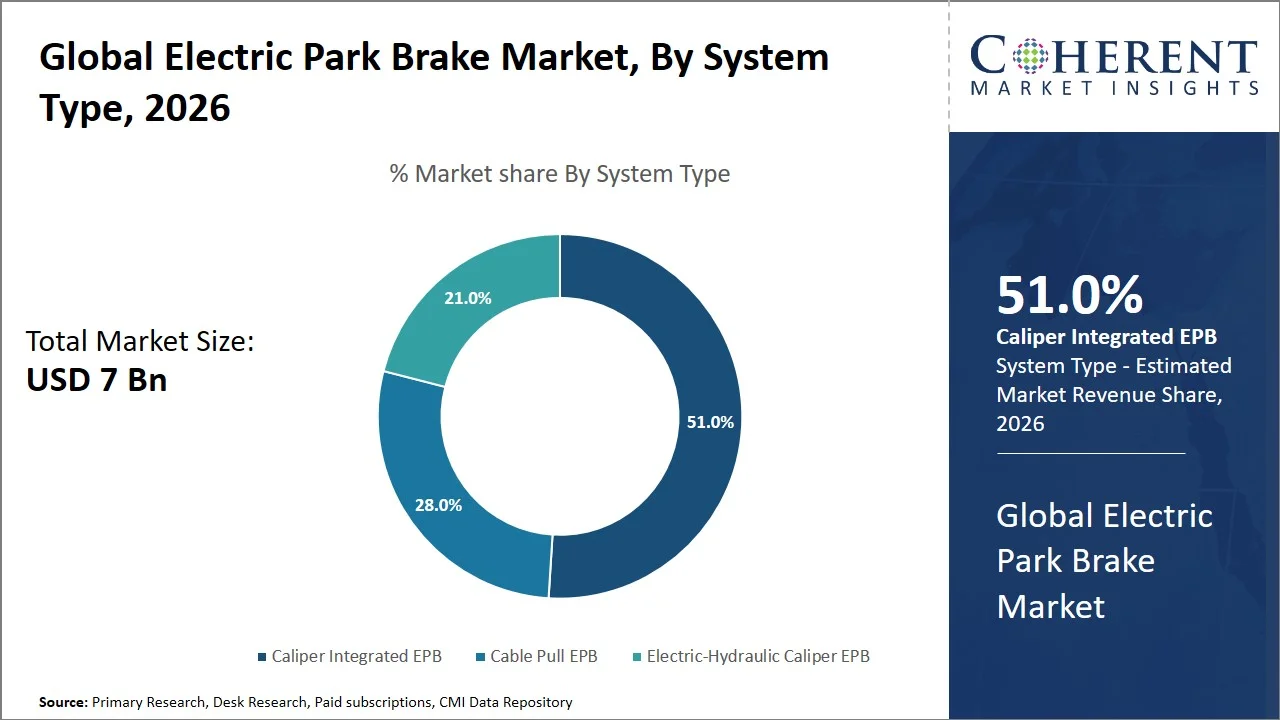
Why Does Caliper Integrated EPB Dominate the Global Electric Park Brake Market?
The caliper integrated EPB segment is expected to account for 51.0% of the global electric park brake market share in 2026. One of the main reasons for the global domination of caliper-integrated EPB systems is higher acceptance due to faster vehicle integration and reduced system complexity. This design incorporates the electric motor directly into the brake caliper, removing the need for extra wires, actuators and individual control modules as utilized in cable-pull systems. Automakers will find it easier to install, and the design will cut overall car assembly time and reduce maintenance requirements. This makes it attractive to manufacturers for mass-market passenger vehicles where cost economy and compact packaging are the key. For example, AUMOVIO designs products like EPB-Ci for modern vehicle platforms, which delivers premium performance with reduced power consumption and simplified operation. With its robust durability, flexible application across vehicle types, and innovative downsizing potential, the EPB-Ci offers manufacturers and drivers alike a future-ready solution that improves both comfort and safety. (Source: AUMOVIO)
- Current Industry Events of 2026
- Market Size Estimation
- Regional Breakdown
- Competitive Landscape
- Customer Intelligence
- Segmental Analysis
- Pricing Analysis
- Key Market Drivers, Challenges & Future Trends
- Customized Insights Section
Why are Passenger Vehicles the Most Widespread Vehicle Type?
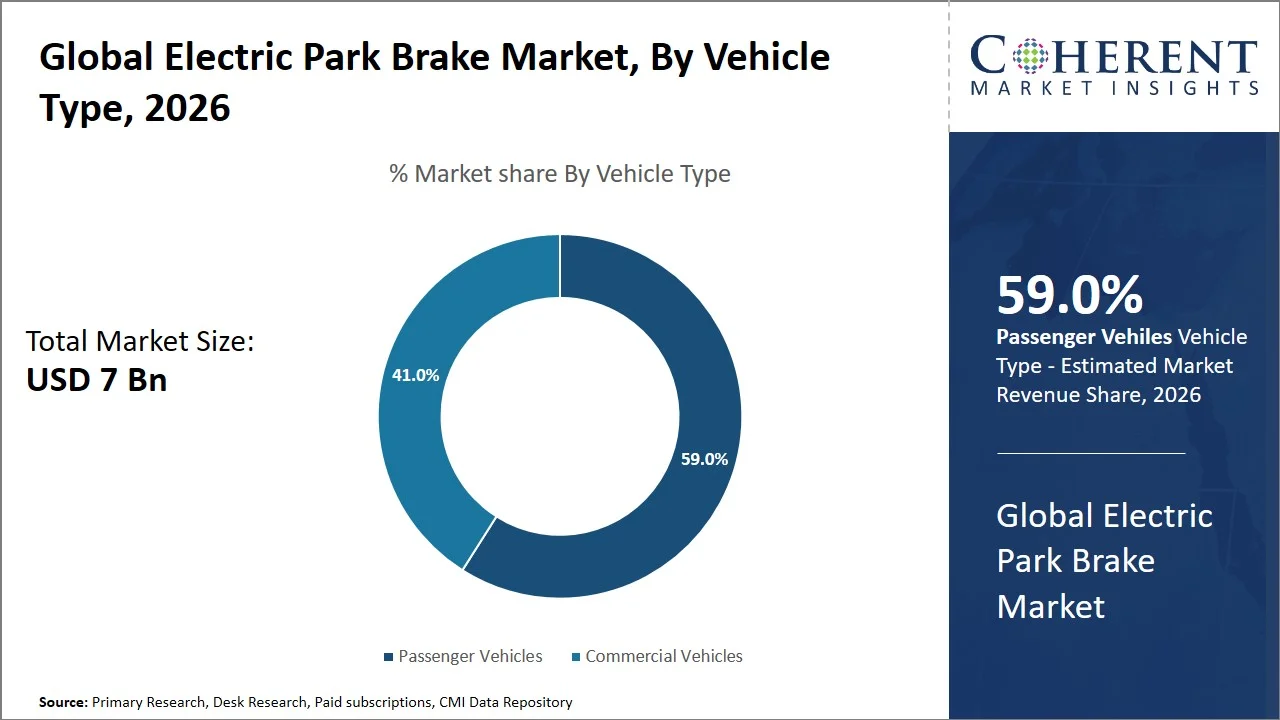
The passenger vehicles segment is expected to account for 59.0% of the global electric park brake market share in 2026. The major factor driving the electric parking brake market is the high global production and sales volume of passenger cars. Passenger vehicles outweigh commercial vehicles by a large margin in terms of annual manufacture and road population notably in the fast urbanizing regions. The sheer size of passenger vehicle manufacturing is driving the largest demand for EPB systems compared to buses or trucks, as electric parking brakes become an increasingly standard safety and convenience feature in mid-range and luxury cars. In 2025, BMW outsold every other luxury brand to become best-seller in the U.S. The German automaker sold 388,897 vehicles last year, a 4.7 percent increase. Lexus was the country’s second-best-selling luxury brand, with 370,260 cars sold.
Currents Events and their Impact
Current Events | Description and its Impact |
EU General Safety Regulation (GSR) - Regulation (EU) 2019/2144 |
|
UNECE WP.29 Cybersecurity & Software Update Regulations |
|
(Source: European Union, UNECE)
Electric Park Brake Market Dynamics
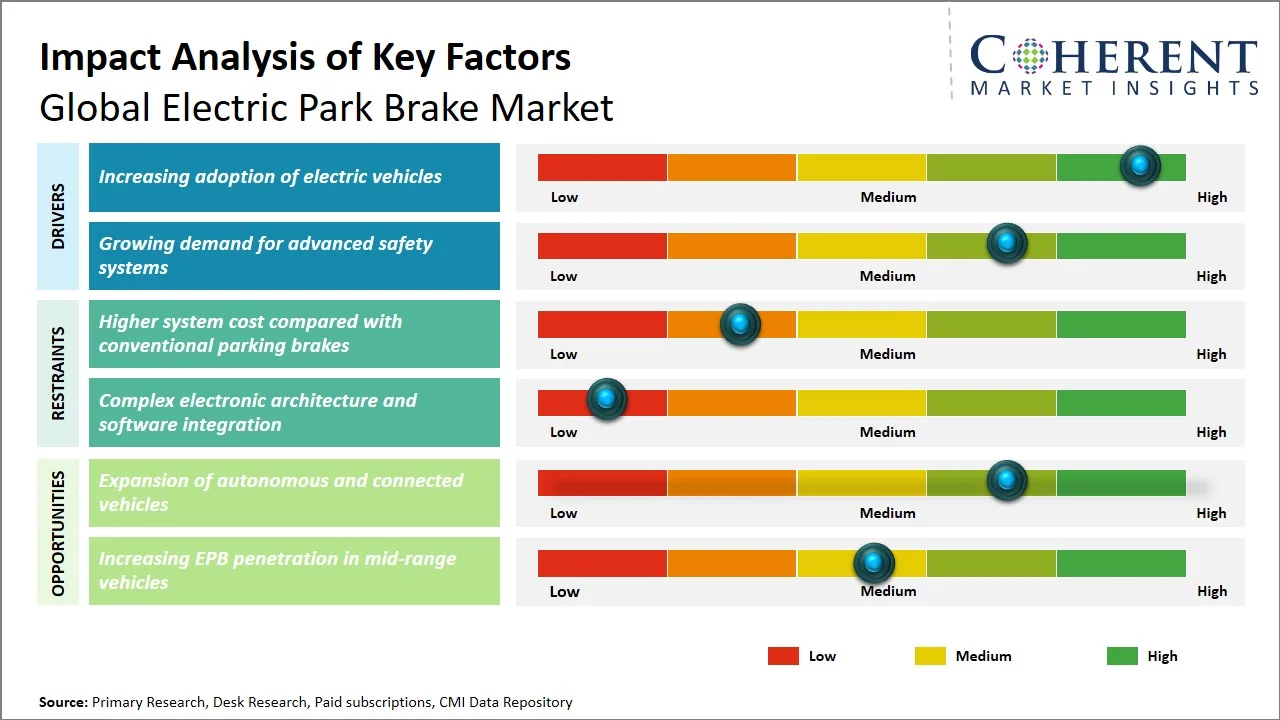
Market Drivers
- Increasing adoption of electric vehicles: The worldwide shift towards electric vehicles is a major driver of the market for electric parking brakes, as EV architectures are intrinsically more suited for electronically controlled braking systems. EPBs save weight, free up cabin space, and can be used on battery electric platforms where most car operations are controlled by digital control systems, unlike conventional mechanical systems. As governments drive decarbonization and OEMs increase EV lines, EPB is becoming increasingly standard in new electric cars rather than an optional upgrade. In 2025, the International Energy Agency reported that global electric car sales exceeded 20 million units, accounting for about one in every four new cars sold worldwide, marking a major milestone in mass EV adoption. This confirms EVs are no longer niche and are entering mainstream passenger vehicle demand across major markets. (Source: International Energy Agency)
- Growing demand for advanced safety systems: The increasing consumer awareness and stringent safety requirements across the globe are driving the adoption of advanced safety systems, which directly impacts the integration of EPB. All modern cars have things like automatic emergency braking, hill-start assist and electronic stability control, all of which operate in conjunction with EPB systems. As auto manufacturers look to increase crash avoidance and driver assistance capabilities, EPB is being used as a building block of the broader intelligent vehicle safety technology ecosystem. On November 26, 2025, Euro NCAP announced updates that vehicle safety ratings are being revised to emphasize driver attention monitoring, crash prevention performance, and real-world ADAS effectiveness rather than just feature presence. (Source: Euro NCAP)
Emerging Trends
- Increasing adoption of “Auto Hold” and driver convenience features: Consumers are demanding a greater number of convenience-oriented features such as Auto Hold, hill-start assist and one-touch parking. EPB systems are progressing from simple parking duties to intelligent braking subsystems that improve urban driving comfort, especially in traffic congestion situations.
- Technological advancement toward smart and predictive braking systems: The manufacturers are focusing on next-generation EPB technologies with sensors, electronic control units, and software-driven diagnostics. These technologies will now be able to self-monitor wear, detect issues early and interact with onboard vehicle networks, which might lead to predictive maintenance and semi-autonomous driving support.
Regional Insights
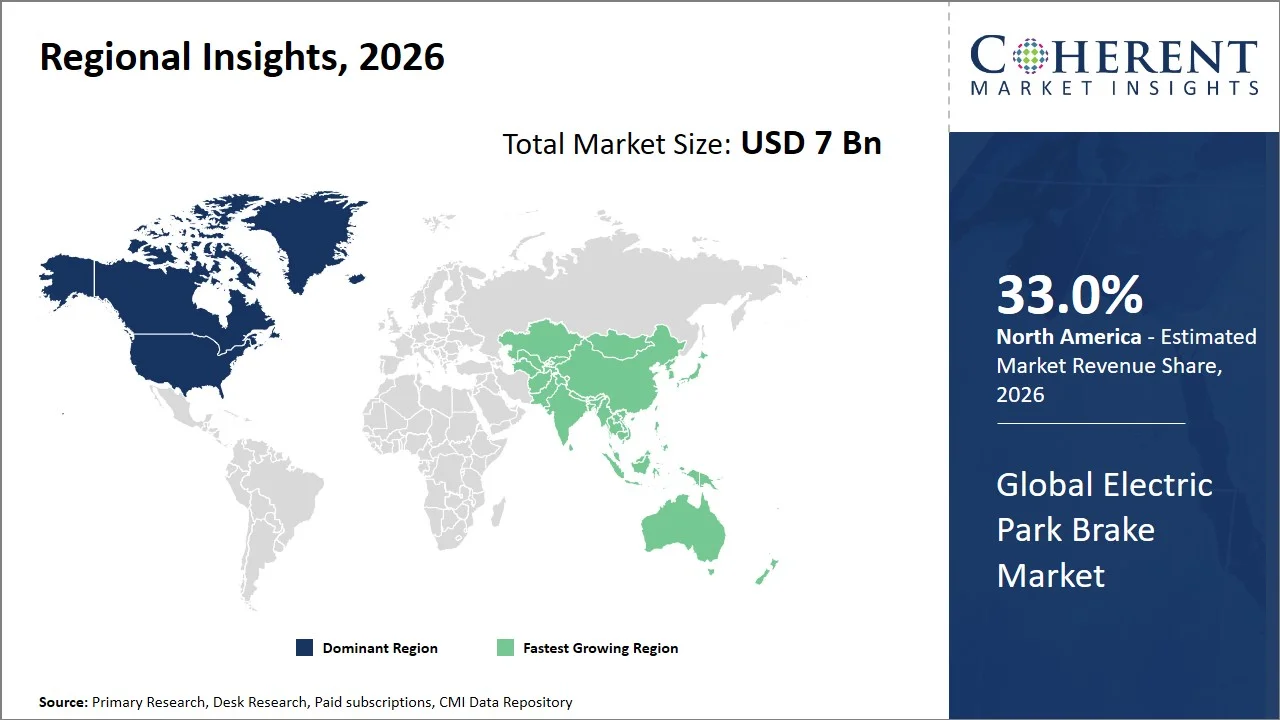
Why is North America a Strong Market for Electric Park Brakes?
North America is expected to account for a market share of 33.0% in 2026. n North America, the adoption of electric park brake is closely tied to the high penetration of pickup trucks and SUVs from manufacturers like Ford Motor Company and General Motors. Models such as the Ford F-150 (higher trims) and Chevrolet Silverado increasingly incorporate EPB, along with auto-hold features. Canadian and U.S. assembly plants have quickly adopted modular brake-by-wire-ready platforms to accommodate ADAS packages in vehicles such as the Jeep Grand Cherokee and Ram 1500. Fleet electrification trends are also impacting the industry, with electric SUVs such as the Ford Mustang Mach-E incorporating EPB as standard to reduce mechanical complexity. On November 18, 2024, the U.S. National Highway Traffic Safety Administration expanded its NCAP roadmap to include ADAS features like blind spot warning, lane-keeping assist, and pedestrian automatic emergency braking, with implementation phased through 2026–2027. (Source: NHTSA)
Why Does the Asia Pacific Electric Park Brake Market Exhibit High Growth?
Asia Pacific is projected to account for 29.0% of the global electric park brake market and is expected to register the fastest growth. Asia Pacific is the major production hub for EPB systems, with mass manufacturing happening in China, Japan, South Korea, and India, with high-volume vehicles including the Toyota Corolla, Hyundai Creta, and Honda City offering EPB in higher trims. Regional supplier ecosystems driven by such as Continental and local Tier-1 suppliers enable cost-efficient EPB manufacture integrated in the caliper for compact automobiles. Fast urbanization and traffic-congested cities such as Bangkok, Shanghai and Jakarta are forcing OEMs to standardize EPB and auto-hold combinations on mid-range passenger vehicles. On December 9, 2025, Brakes India, part of the T S Santhanam Group (a faction of the larger TVS Group of Companies), and Japan-based TBK Co. Ltd. signed a capital and business alliance agreement under which Brakes India will acquire a 10% shareholding in TBK through a primary capital infusion for an undisclosed sum. (Source: Times of India)
Global Electric Park Brake Market Outlook for Key Countries
Why is the U.S. Emerging as a Major Hub in the Electric Park Brake Market?
In the U.S., electric park brake has seen very high penetration in premium sedans and EVs from Tesla and other legacy OEMs with Tesla Model 3 and Tesla Model Y being completely dependent on electronic braking design. The BMW 3 Series and Mercedes-Benz C-Class are luxury cars that have adopted the EPB standard, substituting conventional handbrakes to provide functions like auto-hold during stop-and-go driving. The regulatory alignment to NHTSA safety objectives and the broad deployment of ADAS packages in the mid-range vehicles is speeding up EPB uniformity across new model launches.
Is China the Next Growth Engine for the Electric Park Brake Market?
China is the fastest growing electric park brake market, because to the enormous EV penetration spearheaded by businesses like BYD Company, NIO Inc., and XPeng Inc., where models like BYD Seal and NIO ES6 often incorporate EPB as a baseline requirement. Electronic braking system has become a necessity for new EV platforms to meet government-supported New Energy Vehicle policies and intelligent driving needs. Local suppliers like Bethel Automotive and ZF China operations are ramping up their manufacture of integrated EPB actuators to satisfy OEMs’ requirements.
Germany Electric Park Brake Market Analysis and Trends
Germany represents a lucrative electric park brake industry, dominated by premium automakers such as BMW Group, Mercedes-Benz Group and Volkswagen Group. These manufacturers have made EPB standard across their vehicles, including the BMW 5 Series, Mercedes E-Class and Volkswagen Golf. German engineering means integrating the EPB with regenerative braking systems on plug-in hybrids and EVs such as the Volkswagen ID.4 and Audi Q4 e-tron. Suppliers such as Bosch and Continental are prominent, and assist the further development of brake control units in accordance with EU safety and automation regulations.
Japan Electric Park Brake Market Analysis and Trends
Toyota, Honda and Nissan lead the way in Japan for the adoption of electric park brakes, with vehicles such as the Toyota Camry, Honda Accord and Nissan X-Trail including EPB to assist small packaging and hybrid economy. Japanese OEMs are focusing on EPB integration in hybrid systems such as Toyota Prius where electronic control synergy increases braking coordination with regenerative systems. We work closely with our major domestic suppliers Denso and Advics to develop extremely dependable and compact EPB designs suitable for large-scale production for the home and export markets.
South Korea Electric Park Brake Market Analysis and Trends
Kia and Hyundai Motor Group are the leaders of the electric park brake market in South Korea. Models like the Hyundai Tucson, the Kia Sportage and the Hyundai Ioniq 5 have EPB as part of its SmartSense ADAS ecosystem. The rapid EV growth in the country has set EPB as a norm in electric platforms to accommodate features such as auto-hold and hill-start assist in the urban driving environment. HL Mando (Mando) is one of the local Tier-1 suppliers and a significant supplier of integrated caliper EPB systems for export cars for the global market.
Global Electric Park Brake Market - Regional Automotive Safety Legislation Updates
Region/Country | Regulation / Legislative Update | Key Requirements |
European Union | EU Roadworthiness Package Update | Introduces periodic inspections for EVs, ADAS systems, electronic safety systems, software integrity checks, and digital vehicle documentation. |
Council Position on Revised Vehicle Inspection Rules | Modernizes vehicle testing rules to account for EVs, advanced safety technologies, and electronic vehicle data management. | |
U.S. | NHTSA Expanded NCAP ADAS Testing Program | Adds evaluations for pedestrian AEB, lane-keeping assist, blind-spot warning, and blind-spot intervention. |
NHTSA Automated Vehicle Framework Modernization | Launches rulemaking to update Federal Motor Vehicle Safety Standards (FMVSS) for automated driving systems. | |
China | Automated Driving Safety Regulations & ADAS Oversight | Restricts marketing claims around autonomous driving and requires stricter testing and approval for driving-related software updates. |
New Automated Driving, Brake Assistance & Vehicle Control Standards | Draft regulations introduce enhanced safety requirements for automated driving systems, brake assistance technologies, and vehicle controls. | |
New EV Battery Safety Standard (Effective July 2026) | Requires stricter thermal runaway prevention, crash-impact testing, and fast-charging safety validation. | |
Global (UNECE) | Growing Regulatory Focus on Software Integrity & ADAS Validation | Vehicle software, electronic safety systems, and ADAS functions are increasingly subject to validation and compliance requirements. |
Global (EV & Connected Vehicles) | Increased Safety Testing for Intelligent and Electrified Vehicles | New testing facilities and safety validation programs emphasize ADAS, intelligent vehicle systems, and electrified vehicle safety. |
How is the Expansion of Autonomous and Connected Vehicles Creating New Growth Opportunities in the Electric Park Brake Market?
The growing penetration of connected & autonomous vehicles is providing significant potential prospects for the Electric Parking Brake (EPB) industry as the vehicles are highly dependent on totally electronic, software-controlled braking systems instead of mechanical links. EPB is a crucial actuator used in autonomous driving systems by firms including Tesla, Inc. and Waymo LLC for automated parking, remote car immobilization, and smooth integration with vehicle control units. Connected vehicle designs also allow centralized software to monitor and regulate EPB systems, supporting features like predictive maintenance, remote diagnostics, and over-the-air updates. Thus, EPB is evolving from a mere parking function into an integral part of intelligent vehicle control ecosystems and directly benefits from the global transition to autonomous mobility. On June 4, 2026, Tesla announced it is expanding the service area for unsupervised robotaxis in Austin, Texas, U.S., as it continues to play catch-up with competitors. (Source: Business Insider)
Global Electric Park Brake Market - Global EV Platform Launches with EPB
EV Platform / Vehicle Launch | EPB-Related Feature |
Hyundai IONIQ 9 | Electronic parking brake integrated with Auto Hold and ADAS-oriented vehicle controls |
Kia EV3 | Standard Electronic Parking Brake (EPB) with Auto Hold functionality |
Volvo EX90 | Automatic parking brake engagement, Auto Hold, assisted parking integration |
Suzuki e VITARA | Electronic brake control architecture with regenerative braking integration |
Tesla Model Y | Electronic Parking Brake integrated into software-controlled braking architecture |
Volvo EX90 2026 | Enhanced connected safety, Emergency Stop Assist, and automated vehicle control functions linked with electronic braking systems |
Kia EV6 | Electronic Parking Brake integrated into advanced driver assistance ecosystem |
Market Players, Key Development, and Competitive Intelligence
Key Developments
- On April 15, 2025, Nexteer Automotive launched its Electro-Mechanical Brake (EMB) system, an advanced Brake-by-Wire (BbW) solution that enhances safety, comfort, serviceability and supports software-defined chassis integration. The company leveraged its technology building blocks to create a modular, high-precision braking system and strategically expand into “Motion-by-Wire” chassis control.
- On January 30, 2025, a Bosch development team announced that it has successfully tested the new hydraulic brake-by-wire system from Bosch for the first time on public roads. This solution completely eliminates the mechanical connection between the brake pedal and the brake system. The driver’s brake request is transmitted to the brake-by-wire system purely as an electrical signal via redundant signal lines.
Competitive Landscape
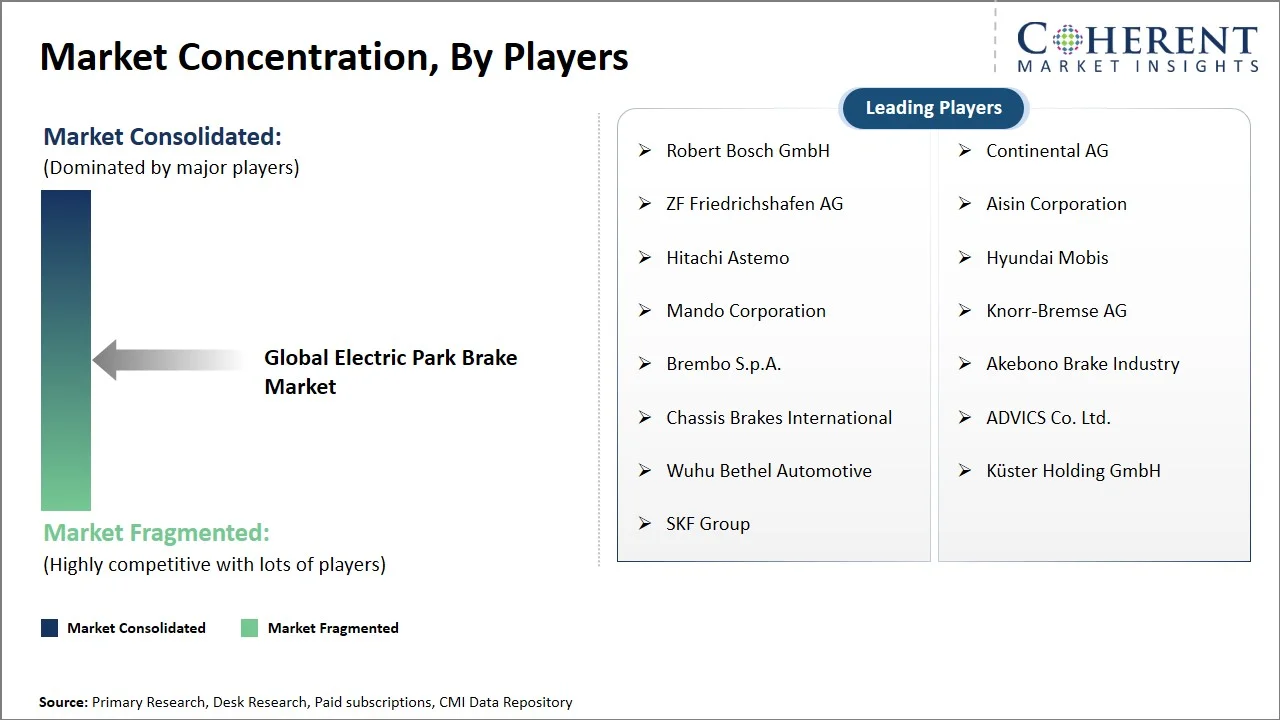
The global electric park brake market is highly consolidated with a few major Tier-1 automotive suppliers such as Continental AG, Robert Bosch GmbH, and ZF Friedrichshafen AG dominating the market owing to their integrated brake-by-wire and actuator technologies. Competition is expected to be intensified by regional manufacturers in China and South Korea, providing cost-optimized caliper-integrated EPB systems to large scale OEM platforms. Increasingly, automakers and suppliers are working together to co-develop EPB systems for EVs and ADAS-enabled vehicles, creating a fast track to product standardization across global vehicle segments.
Market Report Scope
Electric Park Brake Market Report Coverage
| Report Coverage | Details | ||
|---|---|---|---|
| Base Year: | 2025 | Market Size in 2026: | USD 7 Bn |
| Historical Data for: | 2020 To 2024 | Forecast Period: | 2026 To 2033 |
| Forecast Period 2026 to 2033 CAGR: | 9% | 2033 Value Projection: | USD 12 Bn |
| Geographies covered: |
| ||
| Segments covered: |
| ||
| Companies covered: | Robert Bosch GmbH, Continental AG, ZF Friedrichshafen AG, Aisin Corporation, Hitachi Astemo, Hyundai Mobis, Mando Corporation, Knorr-Bremse AG, Brembo S.p.A., Akebono Brake Industry, Chassis Brakes International, ADVICS Co. Ltd., Wuhu Bethel Automotive, Küster Holding GmbH, SKF Group | ||
| Growth Drivers: |
| ||
| Restraints & Challenges: |
| ||
Analyst Opinion (Expert Opinion)
- The electric park brake market is widely being driven by the increasing car electrification and integration of modern driver support systems. Strong growth momentum is driven by regulatory mandates and consumer demand for improved safety and convenience features. The importance of continuous innovation in brake-by-wire technology is now being recognized by key suppliers as an important component for retaining competitiveness as cost optimization takes precedence in emerging markets. “Broadly, the market is viewed as shifting from mechanical-electronic hybrid systems to fully electronic braking architectures that are compatible with autonomous driving requirements.
- Future of the electric park brake industry is predicted to be shaped by deeper integration with autonomous driving systems and fully software-defined vehicle architectures. EPB systems are expected to evolve into intelligent self-diagnosing components enabling remote control, predictive maintenance and seamless interfacing with vehicle motion control systems. As urban mobility transitions to connected and autonomous transport solutions, the need is anticipated to further grow with rapid adoption in electric and shared mobility fleets. Moving ahead, EPB will probably be a common baseline feature on almost all passenger vehicles around the world, thanks to safety standards and electrification.
Speak to the analyst
Want personalized insights?
Take the findings above to one of our principal consultants, or have the report rebuilt around the segments, geographies and competitors you actually track.
Market Segmentation
- System Type Insights (Revenue, USD Billion, 2021 - 2033)
- Caliper Integrated EPB
- Cable Pull EPB
- Electric-Hydraulic Caliper EPB
- Vehicle Type Insights (Revenue, USD Billion, 2021 - 2033)
- Passenger Vehicles
- Commercial Vehicles
- Regional Insights (Revenue, USD Billion, 2021 - 2033)
- North America
- U.S.
- Canada
- Latin America
- Brazil
- Argentina
- Mexico
- Rest of Latin America
- Europe
- Germany
- U.K.
- Spain
- France
- Italy
- Russia
- Rest of Europe
- Asia Pacific
- China
- India
- Japan
- Australia
- South Korea
- ASEAN
- Rest of Asia Pacific
- Middle East
- GCC Countries
- Israel
- Rest of Middle East
- Africa
- South Africa
- North Africa
- Central Africa
- North America
- Key Players Insights
- Robert Bosch GmbH
- Continental AG
- ZF Friedrichshafen AG
- Aisin Corporation
- Hitachi Astemo
- Hyundai Mobis
- Mando Corporation
- Knorr-Bremse AG
- Brembo S.p.A.
- Akebono Brake Industry
- Chassis Brakes International
- ADVICS Co. Ltd.
- Wuhu Bethel Automotive
- Küster Holding GmbH
- SKF Group
Sources
Primary Research Interviews
- Automotive OEMs and Tier-1 Suppliers
- Electric Park Brake System Manufacturers
- Automotive Component Distributors and Dealers
- Automotive Industry Consultants and Experts
Magazines
- Automotive News
- SAE International Magazine
- Auto Components India Magazine
- Automotive Electronics Magazine
Journals
- International Journal of Automotive Technology
- SAE International Journal of Passenger Cars
- IEEE Transactions on Vehicular Technology
Associations
- Society of Automotive Engineers (SAE International)
- Automotive Component Manufacturers Association (ACMA)
- European Association of Automotive Suppliers (CLEPA)
- Japan Auto Parts Industries Association (JAPIA)
Public Domain Sources
- International Organization of Motor Vehicle Manufacturers (OICA)
- U.S. National Highway Traffic Safety Administration (NHTSA)
- European Automobile Manufacturers Association (ACEA)
- China Association of Automobile Manufacturers (CAAM)
Proprietary Elements
- CMI Data Analytics Tool
- Proprietary CMI Existing Repository of information for last 10 years
Get access to 250+ pages report
Every segment, forecast, competitor profile and data table behind the analysis above — available for instant download.
- ESOMAR Member
- ISO 9001:2015 Certified
- D-U-N-S Registered
- GDPR & CCPA Compliant
Missing comfort of reading report in your local language? Find your preferred language:
Transform your Strategy with Exclusive Trending Reports
Frequently Asked Questions
The global electric park brake market is expected to stand at USD 7 Bn in 2026 and is expected to reach USD 12 Bn by 2033.
The CAGR of the global electric park brake market is projected to be 9% from 2026 to 2033.
Increasing adoption of electric vehicles and growing demand for advanced safety systems are the major factors driving the growth of the global electric park brake market.
Higher system cost compared with conventional parking brakes and complex electronic architecture and software integration are the major factors hampering the growth of the global electric park brake market.
In terms of system type, the caliper integrated EPB segment is estimated to dominate the market revenue share in 2026.
EPB supports ADAS by enabling automated braking functions and better vehicle control integration.
Yes, EPB improves safety by integrating with systems like auto-hold, hill-start assist, and stability control.