

Europe Paclitaxel Market Size and Forecast - 2026-2033
According to Coherent Market Insights, the Europe paclitaxel market is estimated to be valued at USD 332.9 Mn in 2026 and is expected to reach USD 545.1 Mn by 2033, exhibiting a compound annual growth rate (CAGR) of 7.3% from 2026 to 2033. This growth is driven by increasing cancer prevalence, advancements in chemotherapy treatments, and rising adoption of paclitaxel-based therapies across Europe. Expanding healthcare infrastructure and government initiatives supporting cancer care are further contributing to the market expansion during the forecast period.
Key Takeaways of the Europe Paclitaxel Market
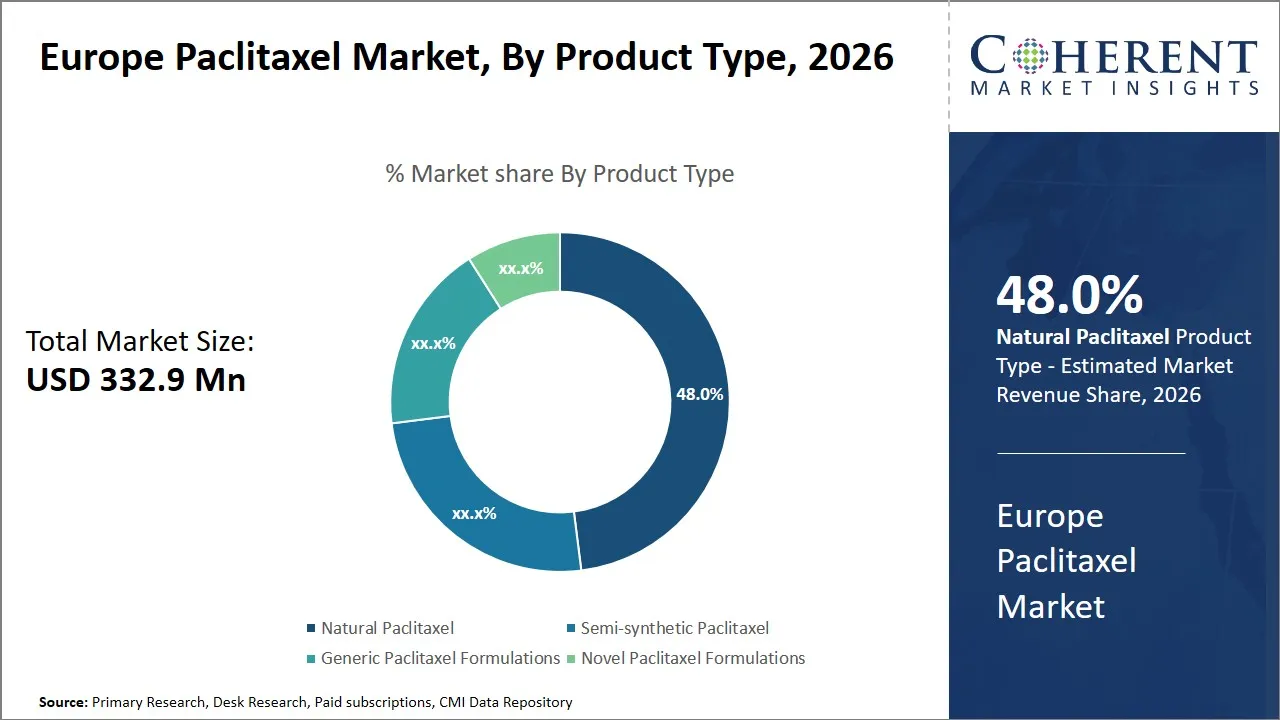
- Natural paclitaxel segment is expected to lead the Europe paclitaxel market, capturing 48% share in 2026.
- The solvent-based paclitaxel injection segment is estimated to represent 43% of the market share in 2026.
- The breast cancer treatment segment is projected to dominate with 51% of the Europe paclitaxel market share in 2026.
Market Overview
- Rising incidence of breast, ovarian, lung, and other solid tumors across Europe continues to increase demand for chemotherapy treatments, sustaining the clinical relevance of paclitaxel across oncology centers.
- Paclitaxel remains widely used in first-line and combination chemotherapy regimens due to its proven clinical efficacy, making it a core drug in treatment protocols for multiple cancer types.
- Adoption of advanced formulations such as albumin-bound paclitaxel and solvent-free variants improves drug delivery, reduces hypersensitivity reactions, and enhances patient tolerability.
- Expansion of generic paclitaxel manufacturing across Europe has improved affordability and accessibility, allowing broader patient access to chemotherapy treatments in both public and private healthcare systems.
Current Events and Its Impact
Current Events | Description and its Impact |
Expansion of Long-Acting Injectable (LAI) Antipsychotics Adoption |
|
Patent Expirations and Generic Market Expansion |
|
Segmental Insights
- Current Industry Events of 2026
- Market Size Estimation
- Regional Breakdown
- Competitive Landscape
- Customer Intelligence
- Segmental Analysis
- Pricing Analysis
- Key Market Drivers, Challenges & Future Trends
- Customized Insights Section
Why Does the Natural Paclitaxel Segment Dominate the Europe Paclitaxel Market in 2026?
The natural paclitaxel segment is expected to hold the largest share of 48% in 2026, largely from the long-standing clinical trust and robust therapeutic performance it offers. Natural Paclitaxel, a directly extracted product of Pacific yew tree (Taxus brevifolia) or European yew species, is still used in most clinical practice as it has a well-known pharmacological profile. It is biocompatible and its inherent biocompatibility factors hold to offer a good tumor suppressive activity with a controlled toxicity profile, making the compound a useful chemotherapeutic agent over the decades.
For instance, in June 2025, the European Commission announced updates to its environmental frameworks governing cultivation and sustainable use of medicinal tree species including Taxus baccata, supporting responsible raw material supply chains used for natural paclitaxel precursor production.
(Source-https://finance.ec.europa.eu/publications/commission-cut-eu-taxonomy-red-tape-companies_en)
Why Does the Solvent-Based Paclitaxel Injection Segment Dominate the Europe Paclitaxel Market in 2026?
The solvent-based paclitaxel injection segment is projected to capture 43% share in 2026, due to its widespread usage and established administration protocols. The Europe paclitaxel formulations market is dominated by the solvent-based transmission segment of the paclitaxel injection due to its historical precedence and widespread clinical use. This conventional preparation uses solvents like Cremophor EL and ethanol which increase the solubility of paclitaxel and allow it to be effectively delivered intravenously. The formulation has been the clinical practice of numerous oncological therapies over many years and has become entrenched in clinical practice.
Breast Cancer Treatment Segment Dominates the Europe Paclitaxel Market
Breast cancer treatment segment is expected to capture the highest share of 51% in 2026, owing to the prevalence and clinical efficacy of paclitaxel. Among the most prevalently diagnosed cancer on women in Europe, breast cancer continues to pose the challenge of leaving a large number of patients with a need to have an efficient method of chemotherapy. The established mechanism of action of paclitaxel, which interferes with the functioning of microtubules to prevent cell division, predisposes it to exhibit greater efficiency with regard to treating early-stage breast cancers as well as metastatic cancer.
For instance, in 2022, there were approximately 2.3 million new cases of breast cancer diagnosed globally, resulting in around 670,000 deaths. Breast cancer is the most common cancer among women worldwide, affecting individuals in every country. It represents one in four of all cancers in women and is the leading cause of cancer-related mortality among females, the World Health Organization (WHO) and Breast Cancer Research Foundation | BCRF confirm.
(Source - https://www.who.int/news-room/fact-sheets/detail/breast-cancer#:~:text)
European Medicines Agency (EMA) Approval Timelines and Regulatory Review Challenges for Paclitaxel Variants in Europe
- Paclitaxel variants (including albumin-bound formulations and generics) have their structures evaluated by the European Medicines Agency (EMA) under a centralized approval process which normally takes approximately 210 active days between validation and Committee for Medicinal Products for Human Use (CHMP) opinion, not including clock stops due to further data requirement. New delivery format or combination signals variants may undergo more comprehensive review, since supplementary quality, safety, and clinical data may be required, and may require longer schedules than traditional generic paclitaxel uses.
- Request of additional clinical data, manufacturing compliance issues, or revised bioequivalence, especially of nanoparticle albumin-bound preparations, can cause delays in the timelines of EMA approval of paclitaxel products. Such extraneous influences like the regulatory burden and the changing guidelines requirements of complex oncology treatments might also lead to the prolonged process of evaluation and affect the pace at which new or improved paclitaxel treatments can be introduced to European markets.
Market Players, Key Developments, and Competitive Intelligence
Key Developments
- On January 30, 2026, the European Medicine Agency’s (EMA) CHMP issued a positive opinion recommending approval of Zynyz (retifanlimab) in combination with carboplatin and paclitaxel for the first-line treatment of adult patients with metastatic or inoperable locally recurrent squamous cell carcinoma of the anal canal (SCAC) in Europe. This immunotherapy-based regimen, based on the Phase 3 POD1UM-303/InterAACT2 trial, showed a 37% reduction in the risk of progression or death compared to chemotherapy alone.
- In May 2025, Meitheal Pharmaceuticals announced the launch of its generic paclitaxel injectable, broadening its oncology portfolio and adding on-market paclitaxel therapy as part of expanded generic chemotherapy offerings.
- In July 2024, the European Commission approved Apexelsin, a generic of nab-paclitaxel (albumin-bound paclitaxel) for marketing in the EU, expanding access to generic chemotherapy options in European cancer care.
Country-wise Reimbursement & HTA Outcomes for Europe Paclitaxel Market
Country | Reimbursement & HTA Outcomes |
U.K. |
|
Germany |
|
France |
|
Italy |
|
Spain |
|
Top Strategies Followed by Europe Paclitaxel Market Players
Player Type | Strategic Focus | Examples |
Established Market Leaders | Multinational pharmaceutical companies invest heavily in R&D to enhance paclitaxel formulations and drug delivery systems, aiming to improve efficacy and reduce side effects. They form strategic partnerships with OEMs to streamline production and expand their global distribution networks, especially in emerging European markets, driven by rising cancer rates. | Bristol Myers Squibb has partnered with various healthcare providers to advance paclitaxel-based combination therapies and expand access to cancer treatments in both developed and emerging markets. |
Mid-Level Players | Mid-level companies in the Europe paclitaxel market focus on offering affordable, high-quality solutions targeting price-sensitive segments, such as smaller healthcare providers and public health sectors. They often form joint ventures and partnerships to scale production and access broader distribution channels, improving their competitiveness. | Sandoz, a mid-tier player, collaborates with hospitals and public healthcare systems to supply cost-effective paclitaxel generics while enhancing production capacity through partnerships with local manufacturers in Europe. |
Small-Scale Players | Small-scale players in the Europe paclitaxel market succeed by focusing on niche products or innovative formulations, often using advanced technologies like nanotechnology or biosimilars. They form local partnerships to enhance market entry and visibility, targeting specific clinical needs unmet by larger competitors. | Siegfried Holding AG, a smaller player in the European paclitaxel market, collaborates with regional research institutions to develop specialized, nanotechnology-based paclitaxel formulations, improving delivery and efficacy for targeted cancer treatments. |
Market Report Scope
Europe Paclitaxel Market Report Coverage
| Report Coverage | Details | ||
|---|---|---|---|
| Base Year: | 2025 | Market Size in 2026: | USD 332.9 Mn |
| Historical Data for: | 2020 To 2024 | Forecast Period: | 2026 To 2033 |
| Forecast Period 2026 to 2033 CAGR: | 7.3% | 2033 Value Projection: | USD 545.1 Mn |
| Segments covered: |
| ||
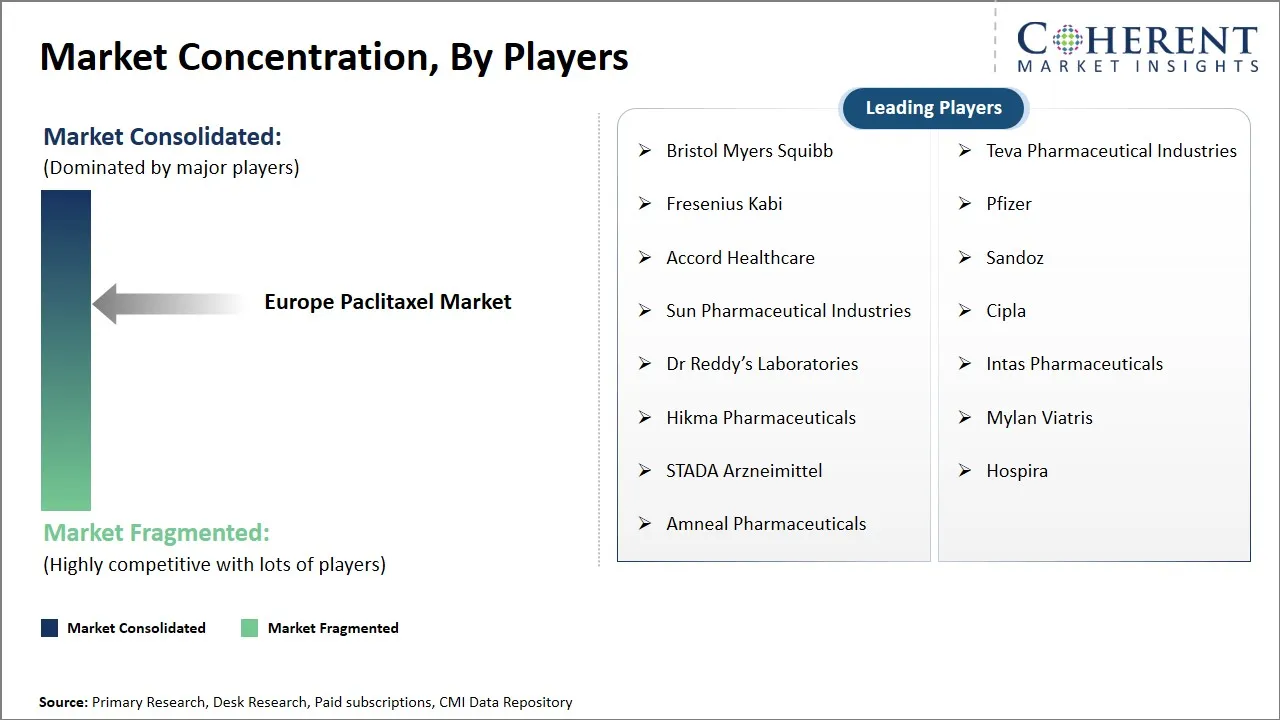
| Companies covered: | Bristol Myers Squibb, Teva Pharmaceutical Industries, Fresenius Kabi, Pfizer, Accord Healthcare, Sandoz, Sun Pharmaceutical Industries, Cipla, Dr Reddy’s Laboratories, Intas Pharmaceuticals, Hikma Pharmaceuticals, Mylan Viatris, STADA Arzneimittel, Hospira, and Amneal Pharmaceuticals | ||
| Growth Drivers: |
| ||
| Restraints & Challenges: |
| ||
Market Dynamics
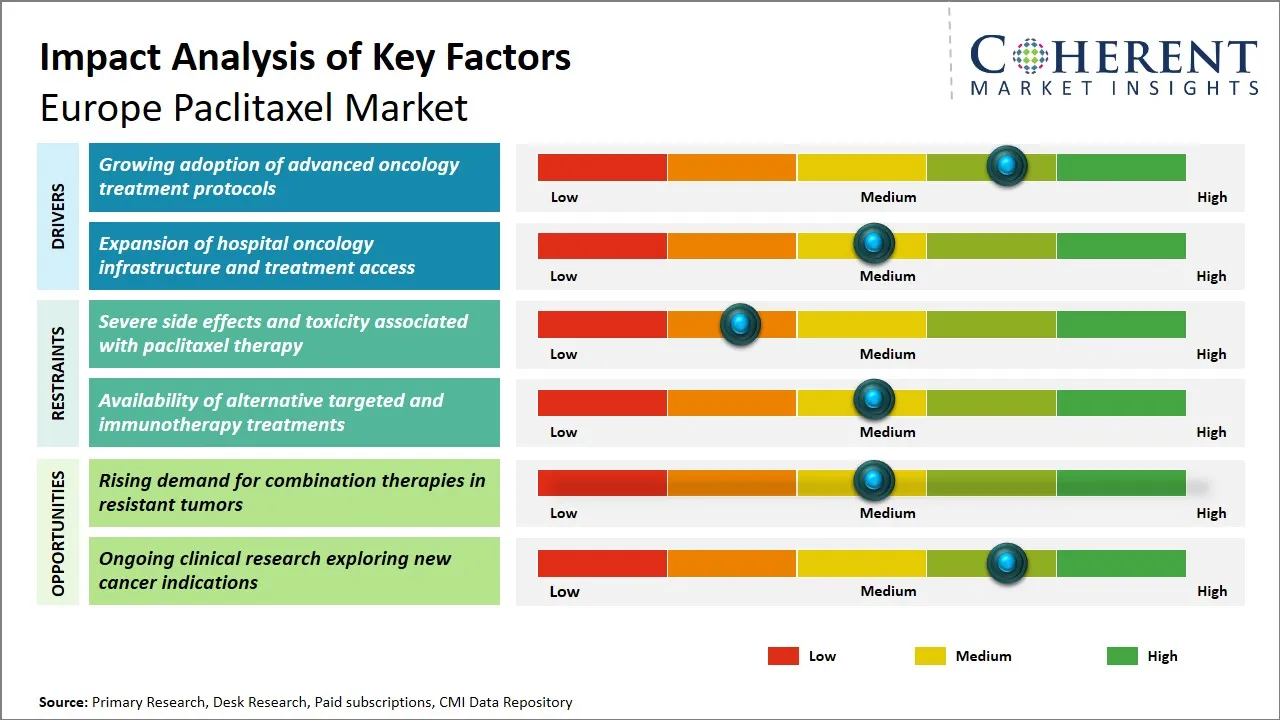
Europe Paclitaxel Market Driver - Growing Adoption of Advanced Oncology Treatment Protocols
The growing adoption of advanced oncology treatment regimens in healthcare institutions is a major driver of the Europe paclitaxel market. With the advances in the field of cancer treatment according to personalized medicine and more targeted treatment strategies, paclitaxel continues to be one of the bedrock chemotherapy agents that are extensively utilized in combination therapy against different types of cancers, including breast, ovarian, and lung cancers. New treatment regimens based on greater precision in oncology with neoadjuvant and adjuvant therapies have increased the use of paclitaxel because it is efficacious and has been shown to have synergy with new targeted therapies and immunotherapies. In addition, the improved body of drug delivery technologies like nanoparticle albuminbound paclitaxel formulations have increased the tolerability of treatment and patient compliance to the treatment and thus promoting its use.
For instance, in July 2025, CuraTeQ Biologics, a wholly owned step-down subsidiary of Aurobindo Pharma, obtained marketing authorisation from the European Commission for Dazublys, a trastuzumab biosimilar used in breast and gastric cancer treatment that expands the company’s oncology portfolio in the European Union.
Europe Paclitaxel Market Opportunity - Rising Demand for Combination Therapies in Resistant Tumors
The market in Europe paclitaxel is experiencing a great opportunity due to the growing demand of combination therapies that are targeting to treat resistant tumors. With the changing paradigms of cancer treatment, mono-therapy is frequently ineffective in the management of cancerous tumors that have developed resistance towards the traditional methods of chemotherapy treatment. Paclitaxel is an established chemotherapeutic drug, which is becoming a standard component of combination-based therapy with targeted therapies, immunotherapies, and new agents to overcome drug resistance and positively impact patient outcomes. The trend has been more pronounced in oncology centers in Western Europe whereby their healthcare infrastructure is well developed to support personalized medicine and new treatment regimes. Furthermore, the continuing clinical trials and research programs highlight the possibility of paclitaxel-based combination therapy in order to increase effectiveness and reduce the number of adverse effects to increase its therapeutic use.
For instance, the Phase 3 ROSELLA trial demonstrated that combining relacorilant with nab‑paclitaxel significantly improved overall survival and progression‑free survival in patients with platinum‑resistant ovarian cancer, indicating strong clinical value for novel combination regimens involving paclitaxel in resistant tumors.
Analyst Opinion (Expert Opinion)
- Europe paclitaxel market is experiencing stable growth because the market demand of oncology treatment is growing with the incidence of cancer in the region, especially breast, ovarian, and lung cancers. The use of better paclitaxel formulations such as albumin bound and better combination treatments is reinforcing outcome of treatment as regulatory approvals continue to grow usage to more cancer indications. The new strategies are creating opportunities in penetrating with generic drugs in Central and Eastern Europe and continued clinical trials on new combinations of treatments, but the challenges are presented by price pressure, competition with targeted therapies and supply chain risks which are present with oncology injectable product production. Players in the market are reacting to this by enhancing the manufacturing resilience and investing in safer and more effective drug delivery format to remain competitive.
- Industry discussion and innovation of treatments Industry dialogue and innovation in the area of cancer treatment is frequently influenced by events like the European Society For Medical Oncology Congress, European Cancer Organisation Summit and BIO Europe conferences that have been held over the last few years, allowing discussions on oncology drug development, access strategy, and new digital and patient support services/mental health counseling of cancer patients to be discussed, and thereby influence policy thinking and acceptance of technology in cancer care. Some of the recent efforts that have impacted the market prospects include the expansion programs on oncology access in Eastern Europe, the partnership between oncology pharmaceutical companies and hospitals in an attempt to test the paclitaxel combinations regimens, and the national cancer plans in the EU nations that support the expansion of diagnostics and treatment in the initial stages, which still continue to bolster the long term demand of established chemotherapy agents such as paclitaxel throughout Europe.
Speak to the analyst
Want personalized insights?
Take the findings above to one of our principal consultants, or have the report rebuilt around the segments, geographies and competitors you actually track.
Market Segmentation
- Product Type Insights (Revenue, USD Mn, 2021 - 2033)
- Natural Paclitaxel
- Semi-synthetic Paclitaxel
- Generic Paclitaxel Formulations
- Novel Paclitaxel Formulations
- Formulation Type Insights (Revenue, USD Mn, 2021 - 2033)
- Solvent-based Paclitaxel Injection
- Albumin-bound Paclitaxel Injection
- Liposomal Paclitaxel
- Polymer-based Paclitaxel Formulations
- Application (indication) Insights (Revenue, USD Mn, 2021 - 2033)
- Breast Cancer Treatment
- Ovarian Cancer Treatment
- Non-Small Cell Lung Cancer Treatment
- Pancreatic Cancer Treatment
- Cervical Cancer Treatment
- Gastric Cancer Treatment
- Head and Neck Cancer Treatment
- Other Solid Tumor Treatments
- Route of Administration Insights (Revenue, USD Mn, 2021 - 2033)
- Intravenous Administration
- Localized Delivery Systems
- End User Insights (Revenue, USD Mn, 2021 - 2033)
- Hospitals
- Specialty Cancer Treatment Centers
- Oncology Clinics
- Research Institutes
- Distribution Channel Insights (Revenue, USD Mn, 2021 - 2033)
- Online
- Offline
- Key Players Insights
- Bristol Myers Squibb
- Teva Pharmaceutical Industries
- Fresenius Kabi
- Pfizer
- Accord Healthcare
- Sandoz
- Sun Pharmaceutical Industries
- Cipla
- Dr Reddy’s Laboratories
- Intas Pharmaceuticals
- Hikma Pharmaceuticals
- Mylan Viatris
- STADA Arzneimittel
- Hospira
- Amneal Pharmaceuticals
Sources
Primary Research Interviews
Industry Stakeholders
- European Medicines Agency (EMA)
- National Health Service (NHS) oncology departments
- Oncology drug formulary decision-makers in EU hospitals
- Pharmaceutical regulatory bodies in European Union member states
- Oncology department heads at major European cancer centers
- Oncology clinical trial coordinators in Europe
End Users
- Healthcare professionals in public hospitals
- Private oncology clinics in Europe
- Patient advocacy groups in oncology
- European cancer patient networks
- Oncology pharmacists in European health systems
- Nurses specializing in oncology care
Government and International Databases
- European Medicines Agency (EMA) database
- European Commission Health and Food Safety Directorate
- World Health Organization (WHO) Global Health Observatory
- European Cancer Organisation (ECO)
- Eurostat Health Statistics
- European Association for Cancer Research (EACR)
Trade Publications
- Oncology Times
- European Journal of Cancer
- Cancer Research UK Journal
- The Lancet Oncology
- Nature Reviews Clinical Oncology
- Medical News Today – Oncology Section
Academic Journals
- Journal of Clinical Oncology
- European Journal of Clinical Pharmacology
- The British Journal of Cancer
- Cancer Chemotherapy and Pharmacology
- Journal of Cancer Research and Clinical Oncology
- Cancer Treatment Reviews
Reputable Newspapers
- The Guardian - Health Section
- The Financial Times - Healthcare News
- The New York Times - Science Section
- The Times (UK)
- Le Monde - Health Coverage
- El País - Science and Medicine
Industry Associations
- European Federation of Pharmaceutical Industries and Associations (EFPIA)
- European Cancer Organisation (ECO)
- European Society for Medical Oncology (ESMO)
- International Agency for Research on Cancer (IARC)
- European Society of Clinical Oncology (ESMO)
- European Association for Cancer Research (EACR)
Public Domain Resources
- European Commission Digital Single Market
- Global Health Data Exchange (GHDx)
- National Cancer Institute (NCI)
- ClinicalTrials.gov
- Open Government Data (OGD) EU
Proprietary Elements
- CMI Data Analytics Tool: Proprietary analytics tool to analyze real-time market trends, consumer behavior, and technology adoption in market
- Proprietary CMI Existing Repository of Information for Last 8 Years
Get access to 250+ pages report
Every segment, forecast, competitor profile and data table behind the analysis above — available for instant download.
- ESOMAR Member
- ISO 9001:2015 Certified
- D-U-N-S Registered
- GDPR & CCPA Compliant
Missing comfort of reading report in your local language? Find your preferred language:
Transform your Strategy with Exclusive Trending Reports
Frequently Asked Questions
The Japan patient care monitoring equipment market is estimated to be valued at USD 332.9 million in 2026 and is expected to reach USD 545.1 million by 2033.
The CAGR of Europe paclitaxel market is projected to be 7.3% from 2026 to 2033.
Growing adoption of advanced oncology treatment protocols and expansion of hospital oncology infrastructure and treatment access are the major factors driving the growth of Europe paclitaxel market.
Paclitaxel is increasingly integrated into personalized medicine through targeted combination therapies, where it is used alongside genetic profiling or biomarkers to tailor treatment regimens for cancer patients. This approach enhances efficacy, reduces adverse effects, and optimizes patient outcomes in cancers like breast and ovarian.
The rise of biosimilars in the Europe Paclitaxel market is driving down prices, increasing accessibility, and intensifying competition. This shift challenges brand-name paclitaxel products, especially in the oncology market, by offering cost-effective alternatives while maintaining therapeutic equivalence.
Severe side effects and toxicity associated with paclitaxel therapy and availability of alternative targeted and immunotherapy treatments are the major factors hampering the growth of Europe paclitaxel market.
In terms of product type, natural paclitaxel is estimated to dominate the market revenue share in 2026.