

Global Faux Leather Market Size and Forecast – 2026 To 2033
The Global Faux Leather Market is estimated to be valued at USD 43.80 Bn in 2026 and is expected to reach USD 68.96 Bn by 2033, exhibiting a compound annual growth rate (CAGR) of 6.70% from 2026 to 2033. Market growth is supported by the wider use of durable, cost-efficient, and animal-free materials across automotive interiors, footwear, fashion accessories, furniture, and upholstery.
Manufacturers are also introducing recycled and lower-impact materials that meet buyer requirements for appearance, abrasion resistance, cleanability, and consistent quality. In December 2025, MINI reported that its latest vehicle family uses interior knitted surfaces containing 92% recycled polyester, while the components are abrasion-resistant and completely leather-free. This development illustrates how major automotive manufacturers are incorporating sustainable alternatives into commercial vehicle interiors, strengthening long-term demand for advanced faux leather and related coated materials.
Key Takeaways of the Global Faux Leather Market
- Polyurethane leather is expected to hold 57.8% of the global faux leather market in 2026 because it balances soft hand-feel, abrasion resistance, flexible processing, and design versatility across footwear, automotive interiors, and upholstery. In July 2024, BASF launched Haptex 4.0, a recyclable, solvent-free polyurethane solution designed for synthetic leather using PET fabric.
- Polyester is projected to capture 43.7% of the market share in 2026, supported by dimensional stability, tensile strength, uniform coating performance, low moisture absorption, and scalable availability. These properties help converters maintain consistent grain, color, and thickness while controlling production costs. In November 2024, Kuraray showcased recycled polyester-based microfibers alongside its sustainable CLARINO man-made leather portfolio at ISPO Munich.
- Footwear is expected to represent 30.8% of the market share in 2026 because faux leather enables high-volume production of uppers, linings, overlays, and trims with repeatable color, texture, abrasion resistance, and material yield. In February 2025, India’s government announced a Focus Product Scheme supporting design, component manufacturing, and non-leather footwear production, strengthening a major downstream consumption channel.
- Asia Pacific is expected to account for 47.8% of market share in 2026, reflecting its concentrated footwear, accessories, automotive, textile-coating, and contract-manufacturing ecosystems. Regional suppliers benefit from integrated polymer, fabric, converting, and export infrastructure. In September 2024, Covestro began developing a Guangzhou TPU application center positioned near Chinese footwear and other industrial clusters, reinforcing local technical support and product development capacity.
- Europe is expected to hold 22.6% of the global faux leather market share in 2026 and expand fastest as buyers prioritize durable, traceable, lower-impact materials and suppliers redesign products for circularity compliance. In September 2025, the European Union adopted Directive 2025/1892, establishing extended producer responsibility provisions and eco-modulated fee mechanisms for textile-related and footwear products.
Segmental Insights
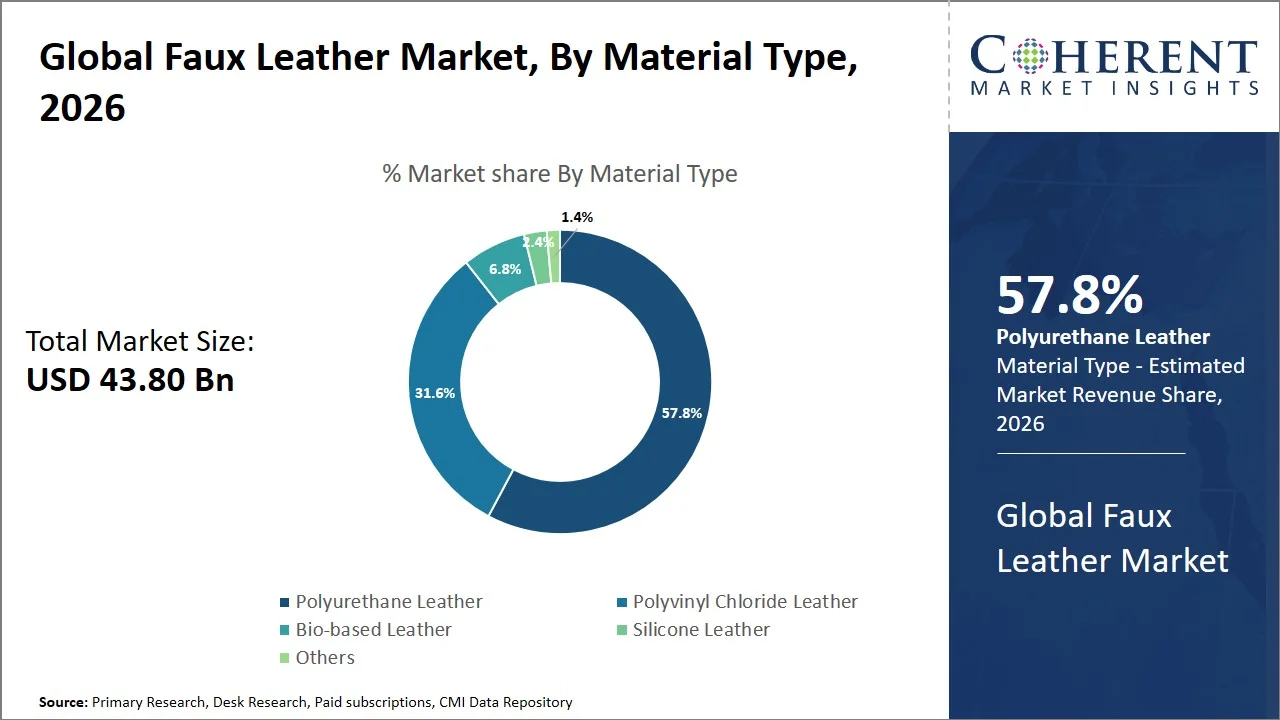
Why Does Polyurethane Leather Dominate the Global Faux Leather Market?
Polyurethane leather is expected to account for 57.8% of the global faux leather market in 2026 because formulators can tune coating thickness, elasticity, gloss, grain retention, hydrolysis performance, and weldability for different buyer specifications. Its compatibility with roll-to-roll coating, lamination, and embossing equipment also lets converters serve fashion, seating, and interior programs without rebuilding production lines. This formulation flexibility supports broader price tiers and shorter product-development cycles than less adaptable material systems. Manufacturers can therefore protect utilization rates while offering differentiated textures and performance grades to footwear, apparel, furnishing, and mobility customers. In October 2025, Stahl introduced PermaQure EPU, a 100%-solids polyurethane resin for synthetic leather that enables post-embossing, durable grain definition, and use on existing PVC embossing lines, highlighting PU’s process adaptability and converter economics.
- Current Industry Events of 2026
- Market Size Estimation
- Regional Breakdown
- Competitive Landscape
- Customer Intelligence
- Segmental Analysis
- Pricing Analysis
- Key Market Drivers, Challenges & Future Trends
- Customized Insights Section
Why Does Polyester Represent the Largest Base Material in the Global Faux Leather Market?
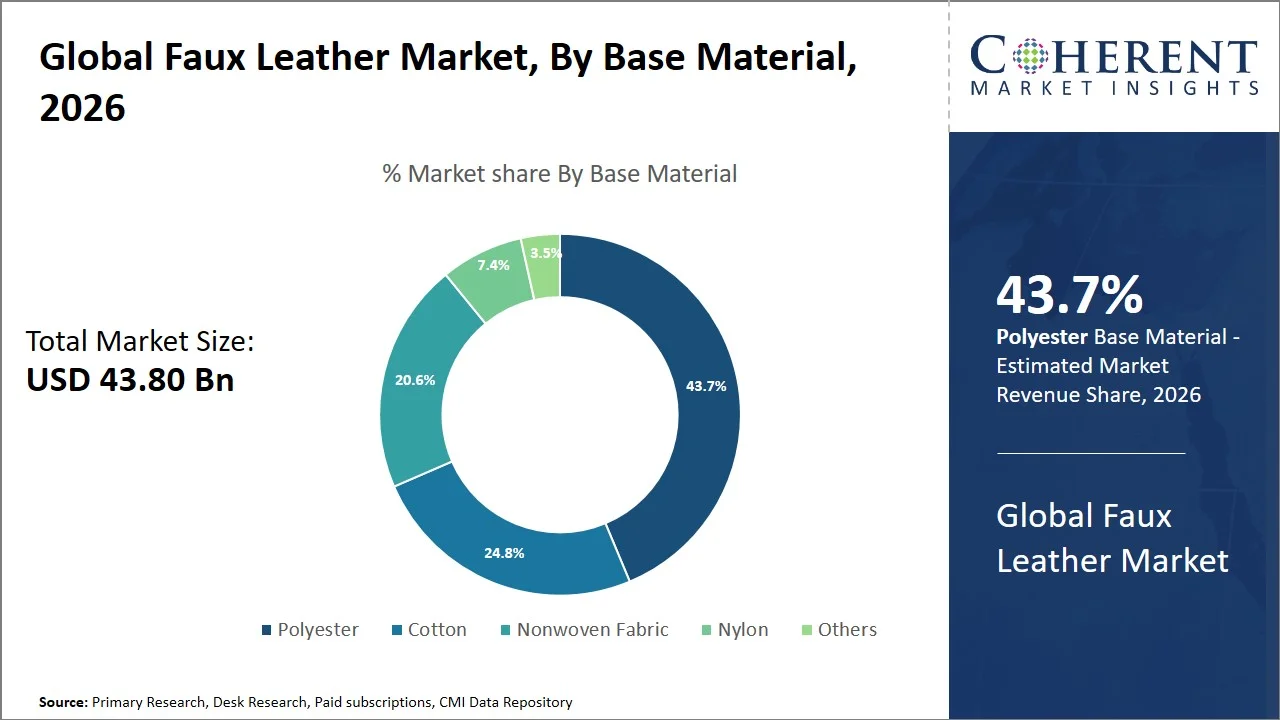
Polyester is expected to account for 43.7% of the base-material segment in the Global Faux Leather Market in 2026, supported by its suitability as a stable and versatile backing for coated, laminated, and microfiber-based faux leather products. The fiber can be engineered into woven, knitted, or nonwoven backings, allowing producers to adjust drape, bulk, tear behaviour, and surface density without changing the outer finish. Its thermal tolerance during drying and embossing also supports stable processing at industrial line speeds. Recycled PET availability is additionally giving brands a practical route to improve material claims while retaining established converting infrastructure. This makes polyester commercially relevant across automotive seating, fashion accessories, upholstery, and premium suede-like surfaces. In October 2024, Alcantara reported that the Renault Rafale E-Tech Hybrid used a special Alcantara interior material containing 61% recycled polyester, demonstrating polyester’s suitability for customized, high-value automotive surfaces.
Why Does Footwear Dominate the End-use Industry Segment of the Global Faux Leather Market?
Footwear is expected to hold 30.8% of the global faux leather market in 2026 because shoe producers require materials that can move quickly from design approval to repeatable factory output across large seasonal SKU portfolios. Faux leather supports precision cutting, stitching, bonding, printing, perforation, and branded surface effects, helping manufacturers standardize uppers across multiple factories and price points. Its sheet consistency also simplifies nesting and component planning, which is important for controlling waste and lead times in contract footwear production. Suppliers that provide coordinated upper materials, adhesives, and processing guidance can secure longer programs with athletic, casual, school, safety, and fashion brands. In November 2024, Dow launched lower-carbon footwear materials, including polyolefin elastomers for recyclable artificial-leather shoe uppers with reduced weight, low odor, and no plasticizers, solvents, or heavy metals.
Current Events and their Impact
Current Event | Description and Its Impact |
July 2024 – EU Ecodesign for Sustainable Products Regulation entered into force |
|
January 2025 – California PFAS restrictions for textile articles became effective |
|
March 2024 – EU rules against misleading environmental claims entered into force |
|
Global Faux Leather Market Dynamics
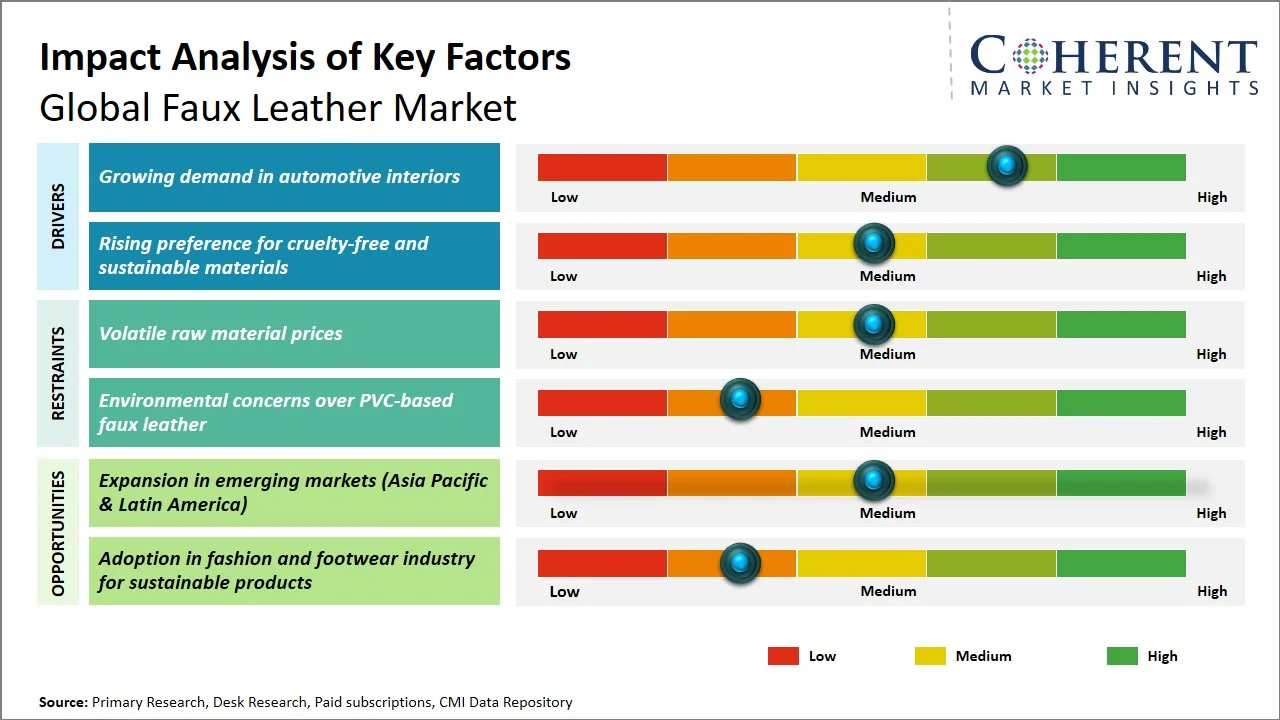
Key Market Drivers
Growing preference for affordable animal free materials supporting faux leather adoption
Affordable animal-free materials are broadening faux leather adoption by allowing brands to offer a leather-like appearance without the cost variability, hide grading, cutting losses, and animal-origin concerns associated with natural leather. Uniform rolls also support predictable color matching, automated cutting, and repeatable specifications across large product ranges. This benefits coated-fabric manufacturers, backing suppliers, converters, private-label producers, and brands serving value and mid-priced consumers. Commercially, the driver rewards suppliers that can combine accessible pricing with credible composition disclosure, durability testing, and attractive tactile finishes; weak-performing substitutes risk damaging buyer confidence. In July 2025, PETA reported that Renault had confirmed plans to remove animal leather from its vehicle range by the end of 2025 and use recycled and environmentally oriented alternatives in new models, demonstrating mainstream interest in scalable animal-free interior materials.
Automotive and footwear production increasing demand for durable coated
Automotive and footwear manufacturing supports faux leather demand because both industries consume repeatable coated surfaces in high-volume, specification-led production. Vehicle interiors require controlled grain, low odor, abrasion resistance, cleanability, and stable color across seats, steering components, door trims, and consoles. Footwear factories value materials that tolerate cutting, stitching, bonding, flexing, and seasonal design changes while maintaining consistent yield. These requirements create recurring opportunities for polyurethane formulators, polyester and nonwoven backing producers, embossing specialists, adhesive suppliers, and OEM-qualified converters. Commercial success depends on passing application tests and delivering identical performance across plants, not merely offering low-cost sheet material. In April 2026, Hyundai Motor introduced the IONIQ 3 with polyurethane synthetic leather containing corn-derived bio-PE on the steering wheel, showing how durable coated materials are being integrated into newly launched mass-production vehicle platforms.
Emerging Market Trends
Traceability Becomes a Product Attribute
Faux leather procurement is shifting toward verified product-level information, including polymer origin, recycled or bio-based content, chemical compliance, backing composition, and manufacturing location. Materials supported by reliable documentation are easier for brands to approve, export, and retain through compliance reviews. This benefits suppliers with strong testing, certification, and data-management capabilities, while producers relying on unsupported sustainability claims may lose preferred-supplier status.
Regional Finishing Networks Compress Development Cycles
Regional finishing networks allow suppliers to manufacture standardized coated substrates centrally and complete embossing, printing, coloration, lamination, and inspection closer to footwear, furniture, and automotive customers. This model reduces inventory, supports smaller orders, and accelerates sampling and customization. Regional converters and technically capable distributors will gain importance, while suppliers with long replenishment cycles may face pressure. Competitive advantage will increasingly depend on flexible finishing capacity, quality consistency, and rapid customer response.
Regional Insights
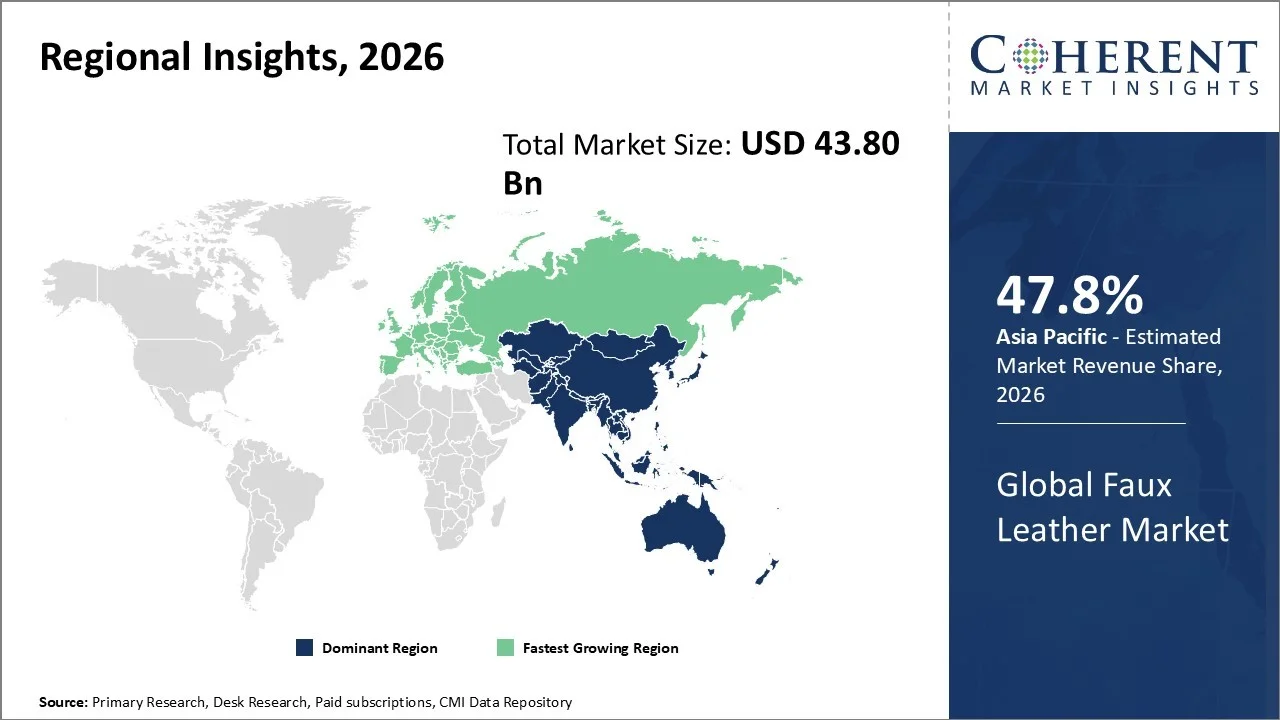
Why Does Asia Pacific Dominate the Global Faux Leather Market?
Asia Pacific is expected to account for 47.8% of the global faux leather market share in 2026 because the region combines substantial coating capacity with dense footwear, automotive, furniture, apparel, and accessories supply chains. Producers can source polyurethane systems, PVC compounds, polyester backings, release paper, pigments, and finishing services from established industrial clusters, reducing lead times and supporting high-volume customization. China, India, Japan, South Korea, and Southeast Asia also offer varied manufacturing economics, enabling suppliers to serve both cost-sensitive and premium programs. This scale strengthens export competitiveness while supporting domestic consumption. In September 2025, the All-China Leather Exhibition in Shanghai brought together synthetic materials, components, functional materials, and low-carbon solutions for footwear, automotive, furniture, fashion accessories, and sportswear, illustrating the region’s integrated commercialization platform.
Why is Europe Emerging as the Fastest-Growing Region in the Global Faux Leather Market?
Europe is expected to hold 22.6% of the global faux leather market in 2026 and emerge as the fastest-growing region as brands place greater weight on traceable inputs, leather-free interiors, recycled content, low-emission coatings, and material durability. European automotive, furniture, footwear, and fashion buyers frequently require detailed chemical-compliance and lifecycle documentation, encouraging suppliers to move beyond commodity coated fabrics toward higher-value engineered surfaces. Premium design programs also create opportunities for bio-attributed polymers, recycled textile carriers, and advanced tactile finishes. Regional converters able to validate environmental and functional performance can consequently secure more specialized programs. In April 2025, Volvo Cars highlighted Nordico leather-free upholstery in the EX90, combining recycled and bio-attributed materials within a premium vehicle interior and demonstrating commercial acceptance of alternative surface materials in Europe.
Global Faux Leather Market Outlook for Key Countries
Why is the U.S. a Key Market for the Global Faux Leather Market?
The U.S. is a key country in the global faux leather market because it concentrates premium automotive programs, contract-furniture specification, hospitality refurbishment, footwear brands, accessories companies, and material-technology developers. Buyers typically require consistent appearance, abrasion resistance, cleanability, flame performance, and dependable supply across nationwide production and distribution networks. This encourages suppliers to offer application testing, customized grains, color matching, and technical documentation rather than compete only on price. The country’s innovation ecosystem also supports collaboration among automotive designers, biotechnology companies, polymer specialists, and converters, accelerating the evaluation of next-generation leather alternatives. In June 2024, Cadillac and MycoWorks announced a collaboration on a Fine Mycelium-based material intended for high-performance automotive interior applications, showing how U.S. original-equipment manufacturers are testing renewable substitutes for conventional leather surfaces.
Why is India Important in the Global Faux Leather Market?
India is important in the global faux leather market because its footwear, automotive seating, two-wheeler accessories, luggage, furniture, and value-fashion industries create demand across multiple price and performance levels. Domestic converters benefit from competitive manufacturing costs, expanding coating expertise, established textile-backing supply, and proximity to major downstream production clusters. Buyers increasingly require improved softness, hydrolysis resistance, embossing quality, and color consistency, encouraging investment in polyurethane-coated fabrics alongside established PVC capacity. Export-oriented manufacturers can also use India as a production base for customized materials serving international brands. Capacity additions strengthen domestic availability and can reduce dependence on imported specialty constructions. In May 2026, Jasch Industries approved an increase in installed capacity for PU-coated fabrics, indicating that Indian producers are expanding output to address customer requirements and diversify the domestic synthetic-leather product mix.
Why Does China Support Growth in the Global Faux Leather Market?
China supports growth in the global faux leather market through its extensive polyurethane, PVC, polyester, textile, coating, footwear, automotive, furniture, and consumer-goods manufacturing networks. Close proximity among resin suppliers, base-fabric producers, release-paper specialists, finishers, component manufacturers, and exporters enables rapid sampling and large-volume commercialization. The country is also shifting product development toward waterborne, solvent-free, bio-based, antibacterial, breathable, and recyclable constructions as domestic brands and overseas customers tighten material specifications. This combination of scale and formulation capability helps Chinese suppliers compete across commodity and technical grades while accelerating market entry for new designs. In July 2025, WIPO Green published a Zhejiang Meisheng New Material technology covering renewable antibacterial waterborne polyurethane synthetic leather with high peel strength, illustrating China’s movement toward differentiated, lower-impact performance materials.
Why is Germany a Strategic Country in the Global Faux Leather Market?
Germany is a strategic country in the global faux leather market because its automotive, public-transport, healthcare, hospitality, office-furniture, and contract-interior sectors impose demanding specifications for abrasion, flame resistance, disinfectant compatibility, tear strength, and long-term appearance. German material suppliers and converters therefore compete through engineering support, validated testing, precision finishing, and close collaboration with designers and original-equipment manufacturers. Sustainability requirements further encourage phthalate-free plasticizers, solvent-free finishes, stronger textile backings, and products designed for extended service life. These capabilities position Germany as a development center for premium and technical faux leather rather than a purely volume-based market. In February 2026, Continental upgraded its skai Parotega NF artificial leather with staynu technology, stronger tear-resistant backing, a phthalate-free plasticizer, solvent-free finishing, and additional colors for contract applications.
Why is Brazil an Important Growth Market for the Global Faux Leather Market?
Brazil is an important growth market for the global faux leather market because it combines sizable footwear, furniture, automotive-aftermarket, marine-upholstery, accessories, and interior-decoration demand with strong distribution links across Latin America. Local buyers need materials suited to varied climates, frequent cleaning, color-led design cycles, and price-sensitive manufacturing, creating space for both standard coated fabrics and specialized performance laminates. Domestic production also shortens replenishment times for furniture and footwear clusters while reducing dependence on long-distance sourcing. Suppliers that tailor textures, flexibility, weather resistance, and color palettes to Brazilian applications can strengthen customer and distributor relationships. In June 2024, Cipatex presented new vegan and synthetic coverings for furniture, outdoor environments, and marine upholstery at ForMóbile in São Paulo, demonstrating locally developed products targeting several Brazilian end-use markets.
Technology Adoption Landscape in the Global Faux Leather Market
Technology | Adoption Level | Key Application Area | Business Impact |
Release-paper casting and transfer coating | High | PU and PVC surfaces for footwear, upholstery, bags, and automotive interiors | Delivers repeatable grain, gloss, color, and coating thickness at commercial line speeds, supporting large production runs and design consistency. |
Solvent-free and 100%-solids polyurethane coating | Medium | Footwear uppers, automotive trim, furniture coverings, and fashion accessories | Reduces solvent handling and recovery requirements while supporting controlled film formation, embossing, and lower-emission manufacturing. |
Waterborne polyurethane dispersion coating | Medium | Apparel, footwear, upholstery, and interior surfaces | Helps suppliers address restricted-substance and emission requirements, although drying energy, cure control, and production speed remain operational considerations. |
Microfiber nonwoven impregnation and surface finishing | Medium | Premium suede-like footwear, automotive interiors, apparel, and accessories | Produces fine structure, softness, drape, and tear performance that support premium pricing, but requires specialized equipment and process knowledge. |
Bio-attributed and biomass-derived polyurethane feedstocks | Medium | Premium automotive, footwear, fashion, and interior applications | Allows suppliers to reduce dependence on wholly fossil-derived inputs while retaining compatibility with established coating and conversion systems. |
Inline machine-vision inspection and digital color control | Medium | Coating, embossing, printing, lamination, and final roll inspection | Identifies surface defects and shade variation earlier, improving yield, specification consistency, claim prevention, and customer approval rates. |
How are Repairable and Replaceable Surface Systems Creating New Growth Opportunities in the Global Faux Leather Market?
Repairable and replaceable faux-leather surface systems could create a commercially attractive opportunity beyond one-time material sales. Contract furniture, hospitality seating, public transport, shared mobility, marine interiors, and fleet vehicles often replace entire assemblies when only the exposed covering is damaged, stained, or outdated. Suppliers can address this inefficiency through modular skins, removable upholstery panels, compatible repair compounds, standardized color libraries, and take-back arrangements for recovered material. The opportunity is strategically important because it converts faux leather from a consumable roll good into a lifecycle solution with recurring service, replacement, and refurbishment revenue. Market capture will require validated adhesion and seam performance, field-repair protocols, installer training, digital records for material matching, and distribution partners capable of supplying small replacement quantities. Specialist converters and vertically integrated suppliers are likely to benefit most because they can coordinate material design, fabrication, installation, and recovery. New entrants can participate through repair chemistry or service platforms, but qualification requirements and fragmented installed assets will make partnerships essential.
Market Players, Key Development, and Competitive Intelligence
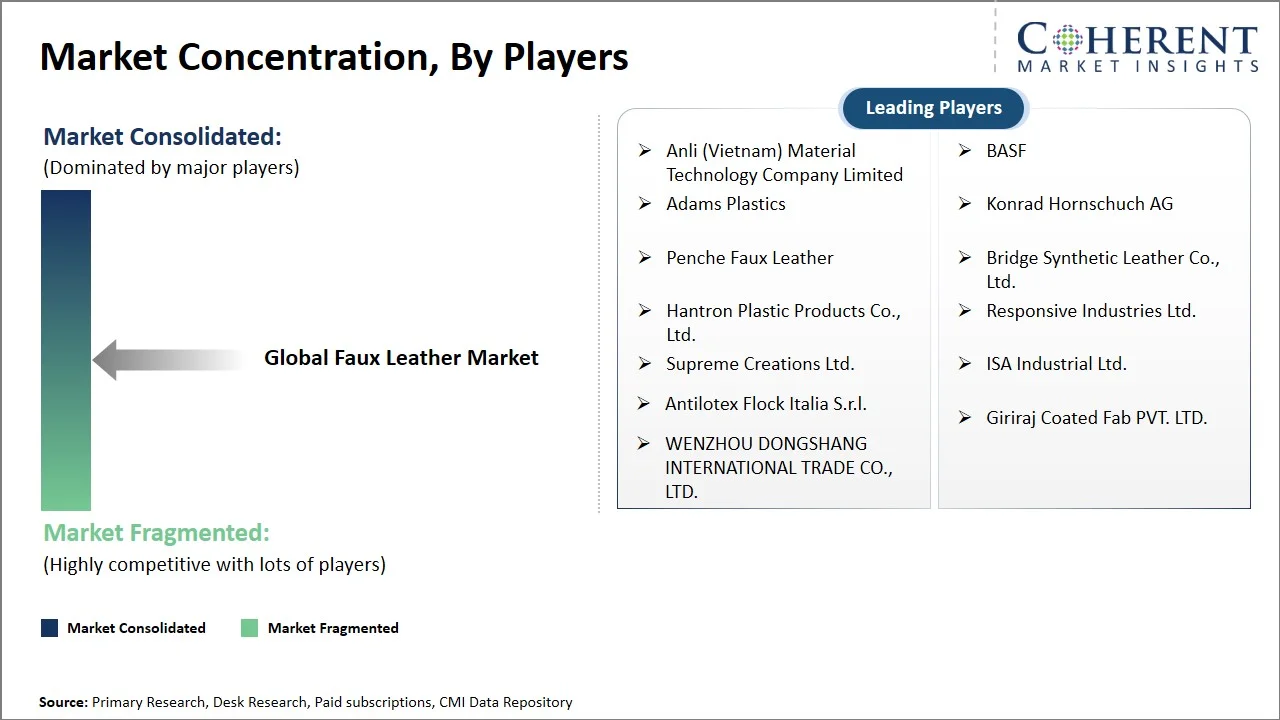
Key Developments
- In November 2025, innovera and Melina Bucher presented handbags produced using ISA Core powered by innovera. The launch is important for the global faux leather market because it moved an engineered leather alternative into a finished consumer-accessories application where appearance, folding behavior, edge finishing, stitching, tactility, and product durability must be validated together. Such commercialization can help material developers move beyond laboratory samples and build converter, designer, and brand confidence.
- In July 2025, Uncaged Innovations announced a collaboration with JLR to develop a proof-of-concept automotive interior using its ELEVATE plant-protein-based leather alternative. The project was designed around compatibility with existing manufacturing workflows, which is important because material suppliers must demonstrate that new surfaces can be cut, formed, bonded, and assembled without extensive production-line redesign. The collaboration strengthens the commercial pathway for next-generation animal-free materials in premium vehicle interiors.
- In October 2024, Mitsubishi Chemical Group launched higher-biomass-content grades of BENEBiOL, a biomass-based polycarbonatediol used as a raw material for polyurethane resins. The material is relevant to artificial leather because it can support flexibility, tactile performance, stain resistance, and chemical durability while allowing formulators to reduce reliance on conventional fossil-derived inputs. The development gives coating and resin producers another feedstock option for differentiated footwear, automotive, furniture, and fashion surfaces.
Competitive Landscape
The global faux leather market is moderately fragmented, particularly at the coated-fabric and converting levels. Participants include multinational polymer and coating-chemistry suppliers, integrated artificial-leather manufacturers, microfiber specialists, regional coaters, textile-backing producers, finishers, and emerging biomaterial developers. Competition varies by application: commodity products are influenced heavily by price and capacity, while automotive, technical upholstery, and premium footwear grades depend on qualification records, consistent performance, regulatory documentation, design support, and supply reliability. Regional producers remain important because they can provide smaller order quantities, local color development, faster sampling, and responsive delivery.
Key focus areas include
- Application qualification: Automotive and technical-interior suppliers compete through validated abrasion, hydrolysis, odor, flammability, cleanability, and colorfastness performance.
- Manufacturing economics: Coating yield, line speed, energy use, solvent management, backing utilization, and defect rates directly affect pricing flexibility and margins.
- Design responsiveness: Extensive grain libraries, rapid color matching, embossing flexibility, and low-volume sampling help suppliers secure seasonal footwear, accessories, and furniture programs.
- Supply reliability: Buyers favor producers with secure polymer and textile-backing procurement, consistent batch quality, regional inventories, and dependable delivery schedules.
- Compliance capability: Restricted-substance control, chemical declarations, product traceability, test documentation, and claim substantiation are becoming procurement differentiators.
- Customer integration: Technical teams that support material selection, cutting, bonding, sewing, forming, and troubleshooting can build stronger OEM and brand relationships.
- Sustainability credibility: Suppliers must connect recycled, bio-attributed, animal-free, or lower-emission positioning with verifiable composition and commercially acceptable durability.
Market Report Scope
Faux Leather Market Report Coverage
| Report Coverage | Details | ||
|---|---|---|---|
| Base Year: | 2025 | Market Size in 2026: | USD 43.80 Bn |
| Historical Data for: | 2020 To 2024 | Forecast Period: | 2026 To 2033 |
| Forecast Period 2026 to 2033 CAGR: | 6.70% | 2033 Value Projection: | USD 68.96 Bn |
| Geographies covered: |
| ||
| Segments covered: |
| ||
| Companies covered: | Kuraray, Toray Industries, Teijin, San Fang Chemical Industry, Mayur Uniquoters, Continental, Kolon Industries, Achilles Corporation, Anhui Anli Material Technology, H R Polycoats, FILWEL, Alfatex Italia, Fujian Polytech Technology, Winner Nippon Leatherette, and Xiefu Group | ||
| Growth Drivers: |
| ||
| Restraints & Challenges: |
| ||
Analyst Opinion (Expert Opinion)
- The global faux leather market leadership is likely to move from suppliers that merely sell coated rolls toward material-platform providers that combine surface chemistry, textile engineering, design libraries, conversion guidance, qualification data, and lifecycle documentation. Buyers will increasingly evaluate how quickly a supplier can take a concept from digital specification through sampling and industrial approval. Companies embedded in customers’ development processes should gain stronger pricing power and longer program visibility than volume-focused producers offering interchangeable grades.
- Faux leather may gradually stop being purchased primarily as an imitation of animal leather and instead become part of a wider engineered-surface category competing with technical textiles, thermoplastic skins, coated composites, and modular interior systems. This would pressure producers whose portfolios depend mainly on visual resemblance and low price. Formulation flexibility, multifunctional surfaces, digital material data, process compatibility, and cross-application engineering would become essential capabilities, benefiting suppliers able to solve functional surface requirements rather than reproduce traditional leather aesthetics.
- Participants should prioritize low-emission coating capability, field-performance databases, chemical-compliance systems, diversified polymer and backing supply, and regional finishing partnerships. Fleet interiors, public seating, hospitality refurbishment, durable accessories, and replaceable upholstery components deserve greater attention because they can support specification-led and recurring business. Companies should protect margins through application-specific grades and technical services rather than unqualified sustainability premiums. Excessive investment in novel feedstocks should be avoided until production throughput, durability, converter compatibility, claim substantiation, and committed customer demand are demonstrated.
Speak to the analyst
Want personalized insights?
Take the findings above to one of our principal consultants, or have the report rebuilt around the segments, geographies and competitors you actually track.
Market Segmentation
- Material Type Insights (Revenue, USD Bn, 2021 - 2033)
- Polyurethane Leather
- Polyvinyl Chloride Leather
- Bio based Leather
- Silicone Leather
- Others
- Base Material Insights (Revenue, USD Bn, 2021 - 2033)
- Polyester
- Cotton
- Nonwoven Fabric
- Nylon
- Others
- End-use Industry Insights (Revenue, USD Bn, 2021 - 2033)
- Footwear
- Automotive
- Furnishing and Upholstery
- Bags Wallets and Accessories
- Apparel
- Sports Goods
- Others
- Distribution Channel Insights (Revenue, USD Bn, 2021 - 2033)
- Direct B2B Sales
- Distributors and Wholesalers
- Online B2B Platforms
- Retail and Specialty Stores
- Others
- Regional Insights (Revenue, USD Bn, 2021 - 2033)
- North America
- U.S.
- Canada
- Latin America
- Brazil
- Argentina
- Mexico
- Rest of Latin America
- Europe
- Germany
- U.K.
- Spain
- France
- Italy
- Russia
- Rest of Europe
- Asia Pacific
- China
- India
- Japan
- Australia
- South Korea
- ASEAN
- Rest of Asia Pacific
- Middle East
- GCC Countries
- Israel
- Rest of Middle East
- Africa
- South Africa
- North Africa
- Central Africa
- North America
Sources
Primary Research Interviews
- Polyurethane, PVC, bio-based, silicone, microfiber, and coated-fabric manufacturers
- Resin, plasticizer, pigment, additive, adhesive, coating chemical, textile-backing, and release-paper suppliers
- Footwear, automotive interior, furniture, upholstery, fashion, accessories, apparel, and sports-goods manufacturers
- Distributors, wholesalers, importers, exporters, retailers, testing laboratories, and certification providers
- Product development, procurement, production, quality, compliance, sustainability, logistics, marketing, and sales executives
Stakeholders
- Faux leather manufacturers, coated-fabric converters, microfiber specialists, and contract manufacturers
- Polymer, coating chemical, polyester, cotton, nylon, nonwoven fabric, and reinforcement-material suppliers
- Coating, calendaring, lamination, embossing, printing, drying, curing, and inspection-equipment providers
- Automotive OEMs, footwear brands, furniture producers, fashion companies, upholstery contractors, and accessory manufacturers
- Distributors, sourcing agents, private-label suppliers, e-commerce platforms, importers, exporters, laboratories, and logistics providers
End-use Sectors
- Footwear uppers, linings, trims, sports shoes, safety footwear, sandals, and fashion footwear
- Automotive seats, steering wheels, door panels, dashboards, consoles, and interior trims
- Residential, office, contract, hospitality, healthcare, marine, and public-transport upholstery
- Bags, wallets, luggage, belts, watch straps, phone covers, and fashion accessories
- Apparel, sports equipment, gym products, protective pads, bicycle saddles, and recreational products
Regulatory and Government Bodies
- U.S. EPA, CPSC, FTC, NHTSA, U.S. Census Bureau, and USITC
- Health Canada, Environment and Climate Change Canada, Statistics Canada, and CBSA
- European Commission, ECHA, Eurostat, CEN, and national market-surveillance authorities
- UK OPSS, HSE, DEFRA, BSI, and ONS
- China SAMR, Ministry of Ecology and Environment, China Customs, NBS, and SAC
- Japan METI, Consumer Affairs Agency, Japan Customs, and JISC
- Bureau of Indian Standards, CPCB, Ministry of Textiles, DGFT, and Ministry of Environment
- Brazil INMETRO, ABNT, IBAMA, MDIC, Receita Federal, and IBGE
- ISO, ASTM International, AATCC, SATRA, and accredited testing laboratories
Databases
- UN Comtrade, ITC Trade Map, WTO Statistics, Eurostat, USITC DataWeb, World Bank, OECD, and UNIDO
- U.S. Census Bureau, Statistics Canada, Destatis, China NBS, Japan Statistics Bureau, India MOSPI, and Brazil IBGE
- China Customs, Japan Trade Statistics, India Export Import Data Bank, and Brazil Comex Stat
- ECHA chemical database, OECD eChemPortal, U.S. EPA CompTox, and restricted-substance databases
- U.S. CPSC recalls, EU Safety Gate, Health Canada recalls, and UK product-safety databases
- WIPO PATENTSCOPE, Espacenet, company filings, product catalogues, pricing records, shipment data, and material certificates
Magazines and Journals
- Coatings World, European Coatings Journal, Textile World, Technical Textiles International, and Sustainable Plastics
- Footwear News, World Footwear, SATRA Bulletin, Automotive Interiors World, Furniture Today, and Apparel Resources
- Progress in Organic Coatings, Polymer Testing, Journal of Applied Polymer Science, and Textile Research Journal
- Materials & Design, Journal of Industrial Textiles, Journal of Cleaner Production, and Resources, Conservation and Recycling
Associations
- Coated Fabrics and Film Association
- American Association of Textile Chemists and Colorists
- SATRA Technology Centre
- ZDHC Foundation
- Textile Exchange
- Cascale
- AFIRM Group
- American Coatings Association
- PlasticsEurope
- Footwear Distributors and Retailers of America
- European Furniture Industries Confederation
- European Automobile Manufacturers’ Association
Public Domain Sources
- Product catalogues, technical data sheets, safety data sheets, formulation guides, and composition declarations
- Data on coating weight, thickness, tensile strength, tear strength, abrasion, flexing, hydrolysis, ageing, and adhesion
- Automotive, footwear, furniture, textile, accessories, and sports-goods production and consumption data
- Import-export records, tariffs, customs classifications, shipment data, and anti-dumping decisions
- Restricted-substance lists, recalls, safety notices, certifications, environmental declarations, and lifecycle assessments
- Annual reports, press releases, capacity expansions, product launches, patents, trade-fair announcements, and retail listings
Key Standards and Regulations
- ISO 2411 for coating-adhesion strength in rubber- or plastics-coated fabrics
- ISO 1421 for tensile strength and elongation testing
- ISO 7854 for resistance to repeated flexing
- ISO 5470 series for abrasion resistance
- ISO 1419 for accelerated-ageing evaluation
- ASTM D751 for physical and performance testing of coated fabrics
- ISO 105 and AATCC standards for colorfastness
- ISO 3795 and FMVSS No. 302 for vehicle-interior flammability
- EN 1021, BS 5852, and California TB 117-2013 for upholstered-furniture flammability
- EU REACH, POPs Regulation, General Product Safety Regulation, and Ecodesign for Sustainable Products Regulation
- U.S. TSCA, CPSIA, FTC environmental-marketing guidance, California Proposition 65, and applicable PFAS restrictions
- Canadian, Chinese, Japanese, Indian, and Brazilian requirements covering chemicals, consumer safety, labeling, and imports
- ZDHC MRSL, Global Recycled Standard, Recycled Claim Standard, OEKO-TEX Standard 100, and bluesign criteria
- ISO 9001, ISO 14001, ISO 45001, ISO/IEC 17025, ISO 14040, and ISO 14044
Proprietary Elements
- CMI Data Analytics Tool
- Proprietary CMI Existing Repository of information for last 10 years.
Get access to 250+ pages report
Every segment, forecast, competitor profile and data table behind the analysis above — available for instant download.
- ESOMAR Member
- ISO 9001:2015 Certified
- D-U-N-S Registered
- GDPR & CCPA Compliant
Missing comfort of reading report in your local language? Find your preferred language:
Transform your Strategy with Exclusive Trending Reports
Frequently Asked Questions
The CAGR of the global faux leather market is projected to be 6.70% from 2026 to 2033.
The global faux leather market is estimated to be valued at USD 43.80 Bn in 2026 and is expected to reach USD 68.96 Bn by 2033.
Faux leather is widely used in footwear, automotive interiors, furniture and upholstery, bags, wallets, apparel, and sports goods.
Faux leather is primarily manufactured using polyurethane and polyvinyl chloride coatings applied over polyester, cotton, nonwoven fabric, or nylon backing materials.
The market is being shaped by bio-based materials, solvent-free coatings, recycled textile backings, improved product traceability, customized surface finishes, and growing preference for animal-free products.
Growing preference for affordable animal free materials supporting faux leather adoption and automotive and footwear production increasing demand for durable coated fabrics are the major factors driving the growth of the global faux leather market.
Environmental concerns surrounding PVC and petroleum-based polyurethane materials and lower breathability and durability limiting replacement of premium natural leather are the major factors hampering the growth of the global faux leather market.