

Global Fragment Analysis Market Size and Forecast – 2026 to 2033
The global fragment analysis market is estimated to be valued at USD 309.4 Mn in 2026 and is expected to reach USD 603.0 Mn by 2033, exhibiting a compound annual growth rate (CAGR) of 10.0% from 2026 to 2033. This substantial growth trajectory reflects the increasing adoption of fragment analysis techniques across biotechnology, pharmaceutical research, and clinical diagnostics, driven by advancements in analytical technologies and rising demand for precise biomolecular characterization.
Key Takeaways of the Global Fragment Analysis Market
- The Polymerase Chain Reaction (PCR)-based fragment analysis segment is expected to account for 32.3% share in 2026.
- Within product and service, the instruments segment estimated to dominate the market, capturing 53.4% share in 2026.
- The DNA fragments segment is projected to hold 55.3% of the fragment analysis market share in 2026.
- North America is expected to lead the market, holding a share of 38.3% in 2026. Asia Pacific is anticipated to be the fastest-growing region, with an estimated market share of 24.5% in 2026.
Market Overview
The market trend is characterized by the integration of fragment analysis with automated and high-throughput platforms, enhancing efficiency and accuracy in genetic and protein analysis. Additionally, the expanding application scope in personalized medicine, especially for genetic disorder diagnosis and drug development, is fueling market expansion. Innovations such as coupling fragment analysis with next-generation protein sequencing and microfluidic technologies are further propelling the market forward, making these techniques indispensable in cutting-edge research and clinical settings.
Currents Events and Its Impacts
Current Events | Description and its Impact |
Rapid Integration of AI/ML for Capillary Electrophoresis (CE) Data Analysis |
|
Heightened U.S.-China Trade Tensions Affecting Biotech Supply Chains |
|
Segmental Insights

- Current Industry Events of 2026
- Market Size Estimation
- Regional Breakdown
- Competitive Landscape
- Customer Intelligence
- Segmental Analysis
- Pricing Analysis
- Key Market Drivers, Challenges & Future Trends
- Customized Insights Section
Fragment Analysis Market Insights, By Technology – Polymerase Chain Reaction (PCR)-Based Fragment Analysis Dominates due to High Accuracy and Routine Clinical Use
The Polymerase Chain Reaction (PCR)-based holds an estimated market share of 32.3% share in 2026. This great preeminence has been largely blamed on the unmatched sensitivity, specificity and versatility of PCR making it precise in amplification and detection of nucleic acid fragments in a broad spectrum of application.
Sizing of fragments can be done using PCR-based techniques and the results are fast and accurate, a key requirement in genetic studies, clinical testing and forensic studies. The technology is also very flexible in that it supports multiplexing as several fragments can be analyzed at the same time, which significantly enhances the throughput of a laboratory setup and also operational efficiency.
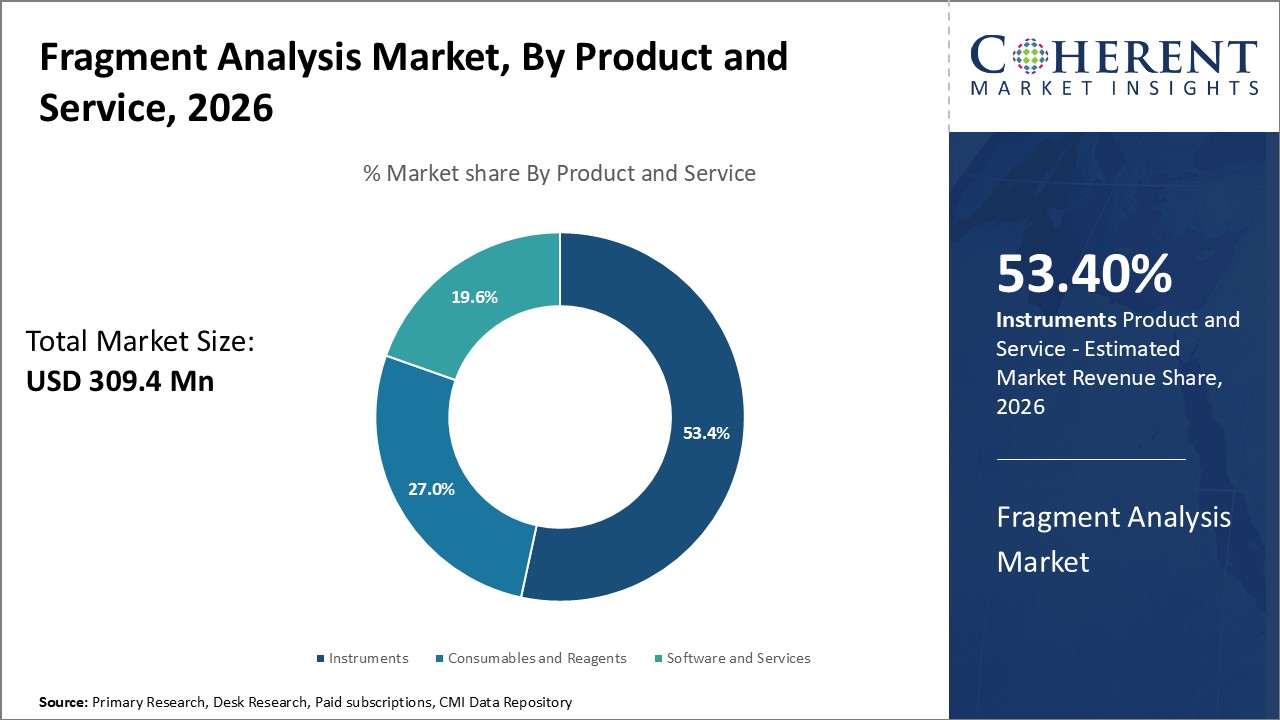
Fragment Analysis Market Insights, By Product and Service – Instruments Lead due to Essential Role in CE, PCR, and NGS Workflows
The instruments segment is projected to account for 53.4% share in 2026, as they are the most significant in providing effective and trustworthy fragment analysis processes. Genetic analyzers, PCR systems, and microarray scanners are the key hardware in developing the products used in the detection and sizing of nucleic acid and protein fragments with high accuracy.
In September 2022, Promega Corporation, a global life-science tools maker, announced its Spectrum Compact CE System to bring flexible Sanger sequencing and fragment analysis directly to labs. Promega noted that the compact design lets researchers run four to thirty-two samples on-demand, cutting outsourcing needs and lowering costs while keeping sequencing and fragment workflows simple and accessible.
Fragment Analysis Market Insights, By Fragment Type – DNA Fragments Dominate due to Broad Applicability Across Diagnostics and Research
The DNA fragments segment is expected to capture 55.3% of the market share in 2026. This popularity can be greatly explained by the widespread application of the DNA fragment analysis to various areas of genetic studies, clinical diagnostics, forensics, and agricultural biotechnology.
For example, QIAGEN, a global molecular diagnostics and sample-processing company, highlighted its QIAxcel DNA Kits for advanced fragment analysis. QIAGEN noted that the automated system delivers high-resolution DNA fragment separation using reusable gel cartridges and capillary electrophoresis.
Technology Penetration & Performance Comparison - Fragment Analysis Market
- PCR-based fragment analysis maintains the highest penetration due to its speed, accuracy, and compatibility with existing lab workflows. Its dominance is reinforced by broad adoption in clinical genetics, forensics, and molecular diagnostics, where high throughput and reliability remain non-negotiable.
- Capillary Electrophoresis (CE) continues to outperform newer alternatives on resolution, sensitivity, and multi-fragment detection. Though NGS-linked fragment tools are rising, CE and PCR combinations still deliver superior cost-efficiency, consistency, and validated performance, making them the operational backbone for most laboratories.
Regional Insights

North America Fragment Analysis Market Analysis and Trends
The North America region is projected to lead the market with a 38.3% share in 2026, because of the market ecosystem with a developed infrastructural health care, robust research and development, and the presence of major players in the industry. The region has favorable government efforts that encourage creativity in analytic technologies and fragmentation analysis that is applicable in pharmaceuticals, polymers and environmental research.
The integration of fragment analysis with other molecular and genetic tools further strengthens market adoption. Notable companies such as Thermo Fisher Scientific, Agilent Technologies, and Bio-Rad Laboratories have significant operations here, contributing cutting-edge instruments and reagents that cater to the growing demands of clinical diagnostics, forensic analysis, and life science research.
Asia Pacific Fragment Analysis Market Analysis and Trends
The Asia Pacific region is expected to exhibit the fastest growth in the market contributing 24.5% share in 2026, because of the swift industrialization, growing investment in biotechnological research, and rising healthcare accessibility. Countries like China, India, and Japan have initiated initiatives of innovation, regulatory approvals and infrastructural developments which have resulted in growing the markets.
Another stimulus to the market expansion is the increasing pharmaceutical sector and the increasing attention to personalized medicine and clinical genomics. The most prominent of them, such as Shimadzu Corporation, Hitachi High-Technologies, and Wako Pure Chemical Industries, are actively involved into the market with region-specific fragment analysis solutions and large distribution networks.
Fragment Analysis Market Outlook for Key Countries
U.S. Fragment Analysis Market Trends
The market of fragment analysis in the U.S. is the main support of the entire fragment analysis ecosystem in the world that is facilitated by the advanced system of R&D and the utilization of the latest technologies in the biotechnological and pharmaceutical industries. Thermo Fisher scientific and Agilent Technologies are the leading competitors with local manufacturing and innovation hubs. High regulatory framework and investment in research in the field of genomics, proteomics, and forensic sciences within the country is the constant source of demand on the highly developed fragment analysis solutions.
Several U.S. labs such as the Broad Institute and MD Anderson Cancer Center deploy high-throughput CE-based instruments for oncology genomics and forensic workflows. Companies including Bio-Rad Laboratories and Illumina support the market with advanced consumables and workflow automation tools tailored for fragment length analysis in clinical and research environments.
China Fragment Analysis Market Trends
China fragment analysis market continues to show a strong growth due to high investments by both the government and the general population in the area of biotechnology and modernization of healthcare. The interest of government in the development of precision medicine projects and enhancement of diagnostic measures is stimulating the usage of fragment analysis devices. Firms such as Shimadzu and home based firms are increasing their presence at a rapid pace by creating low cost scalable instruments that are applicable to significant research and clinical infrastructures already in existence.
Organizations such as Berry Genomics and BGI Genomics are integrating fragment analysis into large-scale genetic testing programs. Emerging manufacturers like Tianlong Science and Leading Optoelectronic are supplying domestic CE systems and reagent kits that align with China’s push for technology self-reliance in molecular diagnostics.
Germany Fragment Analysis Market Trends
Germany is the market leader in the fragment analysis in Europe because the country has a robust industrial base and well-developed life sciences. The country enjoys technological innovations and variety of applications in pharmaceuticals, environmental science, and food safety with the large investments in bioanalytical research by both the government and other stakeholders. Bruker and Analytik Jena are the leaders of the industry that are also contributing to the market through offering high-precision fragment analysis platforms and custom services.
Institutes such as the Max Planck Society and Fraunhofer Research Centers use fragment analysis for molecular biology, environmental monitoring, and food-quality testing. Companies like Eppendorf SE and Merck KGaA (Life Science Solutions) offer specialized reagents, capillaries, and workflow modules to support advanced fragment separation applications.
Japan Fragment Analysis Market Trends
The market structure of the fragment analysis business in Japan is characterized by a well-developed level of technology use, and the interest in innovation in analytical instruments, supported by the government in the program of health technologies and research. The major users of advanced fragment analysis solutions are the large pharmaceutical and biotechnology sectors of the country. Holistic companies such as the Hitachi High-Technologies are very important in that the companies use superior engineering and vast networks of services to fulfill the demand.
Research institutions including RIKEN and the National Institute of Advanced Industrial Science and Technology (AIST) integrate fragment analysis into genomics and pharmaceutical development pipelines. Firms such as Shim-Pack (Shimadzu’s consumables division) and Tosoh Bioscience enhance domestic availability of CE reagents and analytical components.
Role of Artificial Intelligence (AI) in the Global Fragment Analysis Market
- AI is transforming the global fragment analysis market by automating peak detection, improving accuracy, and reducing manual interpretation across CE and PCR workflows. Companies like Thermo Fisher Scientific and Agilent use AI to optimize run quality and predict assay performance.
- On December 02, 2025, DataSnipper launched AI Extractions to convert unstructured documents into traceable Excel-ready data using Microsoft Azure, with Aprio reporting faster validation and smoother adoption.
- AI also enables predictive analytics, automated reporting, and higher throughput, giving companies strong efficiency and scalability advantages. While challenges such as transparency and regulatory acceptance remain, hybrid human AI workflows and disciplined adoption ensure AI delivers long-term value without compromising scientific reliability.
Market Players, Key Developments, and Competitive Intelligence

Key Developments
- On November 6, 2025, Freshworks Inc, a global customer experience software provider, introduced new AI capabilities in Freshdesk to reduce service fragmentation and speed up support delivery. The company highlighted the Freshdesk Command Center as a unified workspace that brings all customer conversations and AI tools together for faster resolutions. Freshworks also launched Vertical AI Agents for sectors like ecommerce and fintech to cut routine tasks, along with Freddy AI Insights to give leaders real-time visibility into service trends.
- In March 2025, Thermo Fisher Scientific Inc., a global leader in laboratory technologies, introduced the IVDR-compliant SeqStudio Flex Dx Genetic Analyzer for Sanger sequencing and Fragment Analysis. The system serves clinical labs needing fast results, easier workflows, and stronger regulatory alignment. It offers flexible operating modes, better connectivity, improved data quality, and a design focused on efficient training and daily usability.
- In August 2024, Zymo Research, a global innovator in epigenetics and microbiomics, introduced the Zymo-Seq SPLAT DNA Library Kit to advance genomic and Fragment Analysis. The company highlighted that its SPLAT technology directly ligates adapters to single-stranded DNA, preserving genetic integrity and improving the accuracy of fragmentation profiling. Zymo Research stated that the kit supports diverse samples, including cfDNA and FFPE DNA, and enables fast, three-hour library preparation.
- In November 2022, GitHub, a leading software development platform, introduced beta support for Kotlin analysis in its CodeQL engine to strengthen security workflows. The company noted that Kotlin is widely used for Android development and now benefits from native CodeQL scanning, enabling mobile and server projects to detect vulnerabilities more effectively. GitHub added that existing Java queries now extend to Kotlin, including checks for Intent handling, WebView issues and fragment injection.
Top Strategies Followed by Global Fragment Analysis Market Players
- The presence of well-established companies that take advantage of the large investment in research and development allows them to be innovative and introduce high-performance and technologically advanced products. Such businesses are dealing with consistent innovation to support the genomics, proteomics, and forensic markets, and they consolidate their role by aligning with strategic alliances with the major players and OEMs within the industry to enlarge product lines and enhance distribution coverage.
- Thermo Fisher Scientific, Agilent Technologies, and PerkinElmer exemplify this category. These players continuously integrate advanced CE platforms, high-throughput sequencers, and precision analytical software into their ecosystems
- The middle-level market players use moderation approach based on offering cost-efficient fragment analysis solutions without sacrificing on key quality parameters. By specializing in serving price-sensitive customers such as academic labs and small biotech firms with low cost but reliable solutions, and by leveraging active collaborations and strategic partnerships to enhance their technological capabilities and market reach, these players expand their technological strength and market reach.
- Eurofins Genomics, Promega Corporation, and Bio-Techne represent mid-tier participants. They focus on competitively priced fragment analysis kits, CE reagents, and workflow consumables tailored for academic institutions and emerging biotech companies.
- The fragment analysis market has small competitors that dominate a niche market or introduce new product features which are also innovations in the market thereby setting apart their offerings compared to the larger competitors. Such firms use innovative technologies to develop niche solutions to specific applications or customer demands, and small players tend to fortify their presence and prominence by making local partnerships with startups, academic teams, and local production.
- Niche players such as NimaGen, Lumex Instruments, and Helini Biomolecules operate with specialized fragment analysis kits, miniaturized CE systems, or targeted mutation-detection assays. These firms differentiate through agility, rapid customization, and localized partnerships with universities, biotech incubators, and regional diagnostics manufacturers.
Market Report Scope
Fragment Analysis Market Report Coverage
| Report Coverage | Details | ||
|---|---|---|---|
| Base Year: | 2025 | Market Size in 2026: | USD 309.4 Mn |
| Historical Data for: | 2020 To 2024 | Forecast Period: | 2026 To 2033 |
| Forecast Period 2026 to 2033 CAGR: | 10.0% | 2033 Value Projection: | USD 603.0 Mn |
| Geographies covered: |
| ||
| Segments covered: |
| ||
| Companies covered: | Thermo Fisher Scientific Inc., Danaher Corporation, Agilent Technologies Inc., Bio-Rad Laboratories Inc., QIAGEN N.V., Promega Corporation, PerkinElmer Inc. (Revvity), Merck KGaA (MilliporeSigma), F. Hoffmann-La Roche Ltd., Illumina Inc., Abbott Laboratories, New England Biolabs Inc., Takara Bio Inc., SCIEX, and LGC Group | ||
| Growth Drivers: |
| ||
| Restraints & Challenges: |
| ||
Fragment Analysis Market Dynamics

Fragment Analysis Market Driver - Growing Demand for Genotyping and Molecular Diagnostics
One of the main factors driving the global fragment analysis market is the healthcare sector's greater use of genotyping and molecular diagnostics. The state-of-the-art personalized medicine made it a prerequisite that the genetic profiling must be very accurate; thus, it allowed the doctors to give the treatments that are suitable for the patients based on their genetic make-up. Genotyping methods are very important in recognizing Single Nucleotide Polymorphisms (SNPs), mutations, and the less common genetic variants that may lead to a person being more susceptible to a certain disease or making him/her respond to a specific drug differently. Moreover, molecular diagnostics are indispensable in the areas of early disease detection, prognosis, and monitoring treatment effectiveness, particularly in oncology, infectious diseases, and genetic disorders.
In April 2025, ABL Diagnostics, a molecular diagnostics company listed on Euronext, announced an exclusive distribution partnership with Genient, an India-based life sciences distributor, to expand access to its UltraGene qPCR assays and DeepChek sequencing tools used for microbiology and Fragment Analysis. The company said Genient will promote its real-time PCR panels and sequencing workflows across Indian laboratories, supported by software validated for CE and NGS systems.
Fragment Analysis Market Opportunity - Integration of AI-Driven Fragment Interpretation Tools
The global fragment analysis market is rumored to get a considerable push through the incorporation of AI-powered fragment interpretation tools, which would create a revolutionary opportunity for the market players. The traditional methods of manual interpretation use where the analyst's skill determines the accuracy of the result have become overburdened with analysis of data due to the increase in volume and complexity. AI-based interpretation tools use powerful and sophisticated machine learning algorithms along with big data analytics to automatically find and describe molecular fragments with greater accuracy and speed. Moreover, this integration enhances all the processes involved but it also allows deeper insights to be drawn by recognizing patterns and correlations that are too subtle for conventional techniques and hence, might get overlooked.
In September 2025, Cisco, a global cybersecurity and networking company, launched new AI-powered Splunk Enterprise Security editions to cut SOC complexity and improve threat response while reducing operational fragmentation. The company said the updated platform unifies detection, investigation and response in one workspace, supported by AI tools that prioritize alerts and automate routine tasks.
Analyst Opinion (Expert Opinion)
- The fragment analysis market is going to experience a substantial increase, according to the expert opinion. This growth will be driven by the following factors: the improvement of CE systems, the more extensive use of PCR and NGS workflows, and the increasing demand for genetic testing in clinical and forensic areas. There are chances in the oncology and infectious disease surveillance markets. However, the high costs and complexity of workflows are still major factors that slow down the adoption of these technologies. The American Society of Human Genetics Meeting and AGBT Conference are among the key scientific events that have recently facilitated the discussions about assay performance, regulatory needs, and new technologies.
- Thermo Fisher's introduction of the SeqStudio Flex system and Promega's deployment of the Spectrum Compact CE platform are among the recent industry moves that exhibit the exact trend towards quicker and more user-friendly fragment analysis tools. These initiatives, along with National Genome Projects and U.K. and Asia Pacific Population Sequencing Programs, are also boosting testing volumes, which in turn increases the demand for CE, PCR and NGS-based workflows that are reliable across both research and healthcare settings.
Speak to the analyst
Want personalized insights?
Take the findings above to one of our principal consultants, or have the report rebuilt around the segments, geographies and competitors you actually track.
Market Segmentation
- Technology Insights (Revenue, USD Mn, 2021 - 2033)
- Polymerase Chain Reaction (PCR)-Based Fragment Analysis
- Capillary Electrophoresis (CE)
- Next-Generation Sequencing (NGS)-Based Fragment Analysis
- Microfluidics and Lab-on-Chip Fragment Analysis
- Gel Electrophoresis (Agarose/Polyacrylamide)
- Product and Service Insights (Revenue, USD Mn, 2021 - 2033)
- Instruments
- Genetic Analyzers/Sequencers
- PCR Systems
- Microarray Scanners
- Other Instruments
- Consumables and Reagents
- Kits and Assays
- Enzymes and Master Mixes
- Standards and Size Markers
- Other Reagents
- Software and Services
- Instruments
- Fragment Type Insights (Revenue, USD Mn, 2021 - 2033)
- DNA Fragments
- RNA Fragments
- Protein Fragments (Low-use, niche applications)
- Application Insights (Revenue, USD Mn, 2021 - 2033)
- Nucleic Acid Analysis
- Genotyping (SSR, SNP)
- Mutation Detection and Sequencing
- Others (Microsatellite Instability Analysis, etc.)
- Quality Control and Validation
- Next-Generation Sequencing Library QC
- CRISPR Edit Confirmation
- Others (PCR Product Verification, etc.)
- Genetic Fingerprinting and Forensics
- Nucleic Acid Analysis
- End User Insights (Revenue, USD Mn, 2021 - 2033)
- Clinical Diagnostics Laboratories
- Hospitals
- Research and Academic Institutes
- Biopharmaceutical and Biotechnology Companies
- Contract Research Organizations (CROs)
- Regional Insights (Revenue, USD Mn, 2021 - 2033)
- North America
- U.S.
- Canada
- Latin America
- Brazil
- Argentina
- Mexico
- Rest of Latin America
- Europe
- Germany
- U.K.
- Spain
- France
- Italy
- Russia
- Rest of Europe
- Asia Pacific
- China
- India
- Japan
- Australia
- South Korea
- ASEAN
- Rest of Asia Pacific
- Middle East
- GCC Countries
- Israel
- Rest of Middle East
- Africa
- South Africa
- North Africa
- Central Africa
- North America
- Key Players Insights
- Thermo Fisher Scientific Inc.
- Danaher Corporation
- Agilent Technologies Inc.
- Bio-Rad Laboratories Inc.
- QIAGEN N.V.
- Promega Corporation
- PerkinElmer Inc. (Revvity)
- Merck KGaA (MilliporeSigma)
- Hoffmann-La Roche Ltd.
- Illumina Inc.
- Abbott Laboratories
- New England Biolabs Inc.
- Takara Bio Inc.
- SCIEX
- LGC Group
Sources
Primary Research Interviews
Industry Stakeholders
- Genomics Core Laboratories at Universities
- Heads of Research and Development (R&D) in Public Research Institutes
End-Users
- Clinical Diagnostic Laboratories using Fragment Analysis
- Agricultural Research Units for Genetic Diversity Studies
Government and International Databases
- National Center for Biotechnology Information (NCBI) GenBank
- Sequence Read Archive (SRA)
- Reference Sequence (RefSeq) Database
- European Molecular Biology Laboratory (EMBL)
- International Nucleotide Sequence Database Collaboration (INSDC)
- National Institutes of Health (NIH)
Trade Publications
- Macrogen Educational Articles
- Thermo Fisher Scientific Fragment Analysis Guides
- BioTechniques Magazine
- Nature Methods Journal
- Bioinformatics Review
- Advances in Genome Biology and Technology (AGBT)
Academic Journals
- Nucleic Acids Research
- Molecular Biology Reports
- Genome Research
- BMC Genomics
- PLOS ONE Journal
- Nature Communications
Reputable Newspapers
- Science Daily
- Nature News
- The New York Times – Science Section
- The Guardian – Science Section
- Reuters Health
- BBC News – Science & Environment
Industry Associations
- International Society for Computational Biology (ISCB)
- American Society of Human Genetics (ASHG)
- European Society of Human Genetics (ESHG)
- Advances in Genome Biology and Technology (AGBT)
- International Nucleotide Sequence Database Collaboration (INSDC)
- Human Genome Organisation (HUGO)
Public Domain Resources
- GenBank
- Sequence Read Archive (SRA)
- NCBI Tools (National Center for Biotechnology Information)
- GitHub (Open-source Fragment Analysis Scripts)
- Open Bioinformatics Resources
Proprietary Elements
- CMI Data Analytics Tool: Proprietary analytics tool to analyze real-time market trends, consumer behavior, and technology adoption in market
- Proprietary CMI Existing Repository of Information for Last 8 Years
Get access to 250+ pages report
Every segment, forecast, competitor profile and data table behind the analysis above — available for instant download.
- ESOMAR Member
- ISO 9001:2015 Certified
- D-U-N-S Registered
- GDPR & CCPA Compliant
Missing comfort of reading report in your local language? Find your preferred language:
Transform your Strategy with Exclusive Trending Reports
Frequently Asked Questions
The global fragment analysis market is estimated to be valued at USD 309.4 Mn in 2026 and is expected to reach USD 603.0 Mn by 2033.
The CAGR of the global fragment analysis market is projected to be 10.0% from 2026 to 2033.
Growing demand for genotyping and molecular diagnostics and rising adoption of forensic and criminal investigation DNA workflows are the major factors driving the growth of the global fragment analysis market.
High instrument and kit procurement costs and limited skilled workforce for data interpretation are the major factors hampering the growth of the global fragment analysis market.
In terms of technology, the Polymerase Chain Reaction (PCR)-based fragment analysis is estimated to dominate the market revenue share in 2026.
Thermo Fisher Scientific Inc., Danaher Corporation, Agilent Technologies Inc., Bio-Rad Laboratories Inc., QIAGEN N.V., Promega Corporation, PerkinElmer Inc. (Revvity), Merck KGaA (MilliporeSigma), F. Hoffmann-La Roche Ltd., Illumina Inc., Abbott Laboratories, New England Biolabs Inc., Takara Bio Inc., SCIEX, and LGC Group are the major players.
North America is expected to lead the global fragment analysis market in 2026.