

Global Hessian Sacks Market Size and Forecast – 2026-2033
The Global Hessian Sacks Market is estimated to be valued at USD 2.58 Bn in 2026 and is expected to reach USD 3.76 Bn by 2033, exhibiting a compound annual growth rate (CAGR) of 5.5% from 2026 to 2033.
Key Takeaways of the Hessian Sacks Market
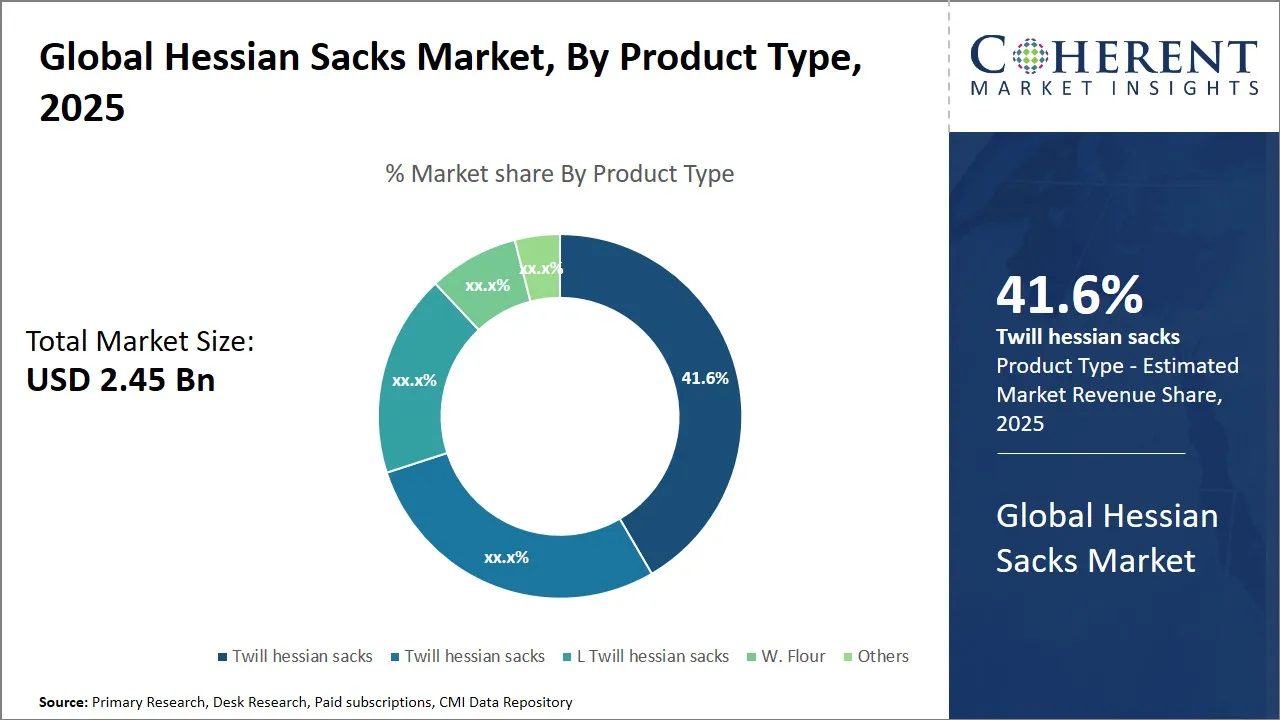
- The Twill hessian sacks segment is expected to account for 42.6 % of the global hessian sacks market in 2026, driven by their outstanding durability and diverse range of applications.
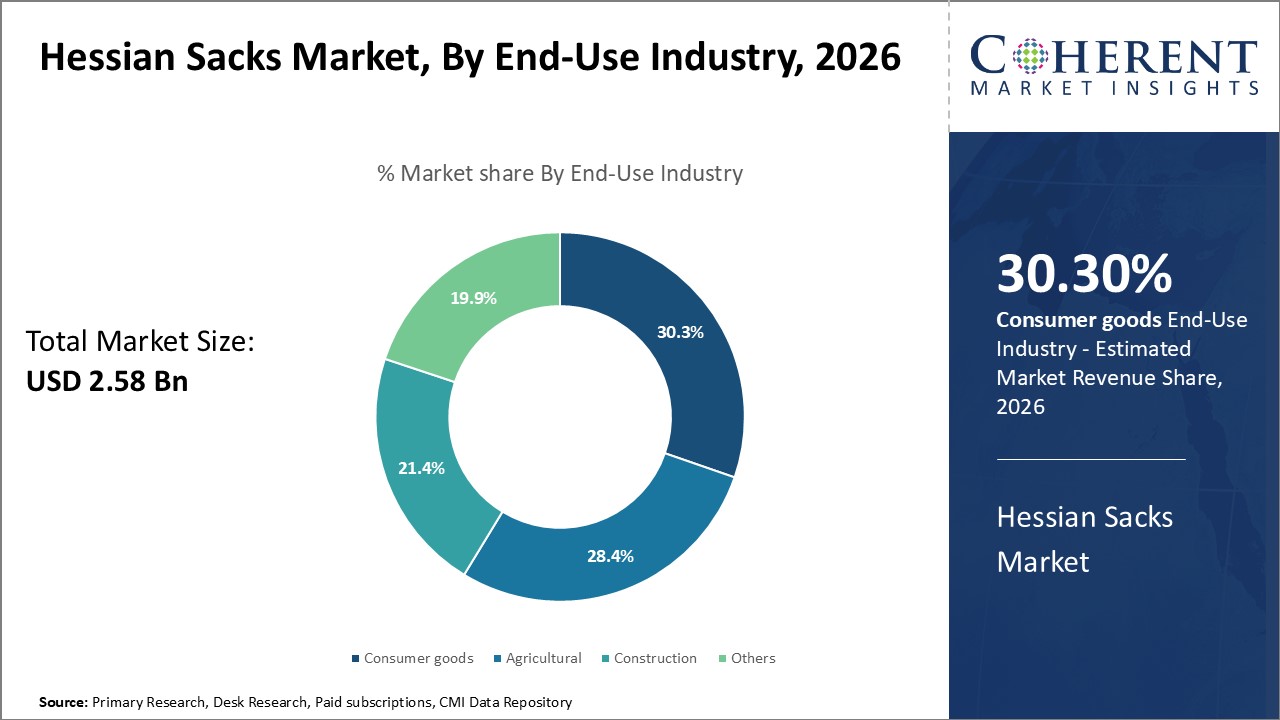
- The consumer goods segment is projected to hold 30.3 % share of the global hessian sacks market in 2026, driven by the growing consumer demand for sustainable and functional packaging solutions.
- The online segment is expected to capture 39.5 % share of the global hessian sacks market in 2026, driven by the rapid expansion of e-commerce and changing consumer purchasing patterns.
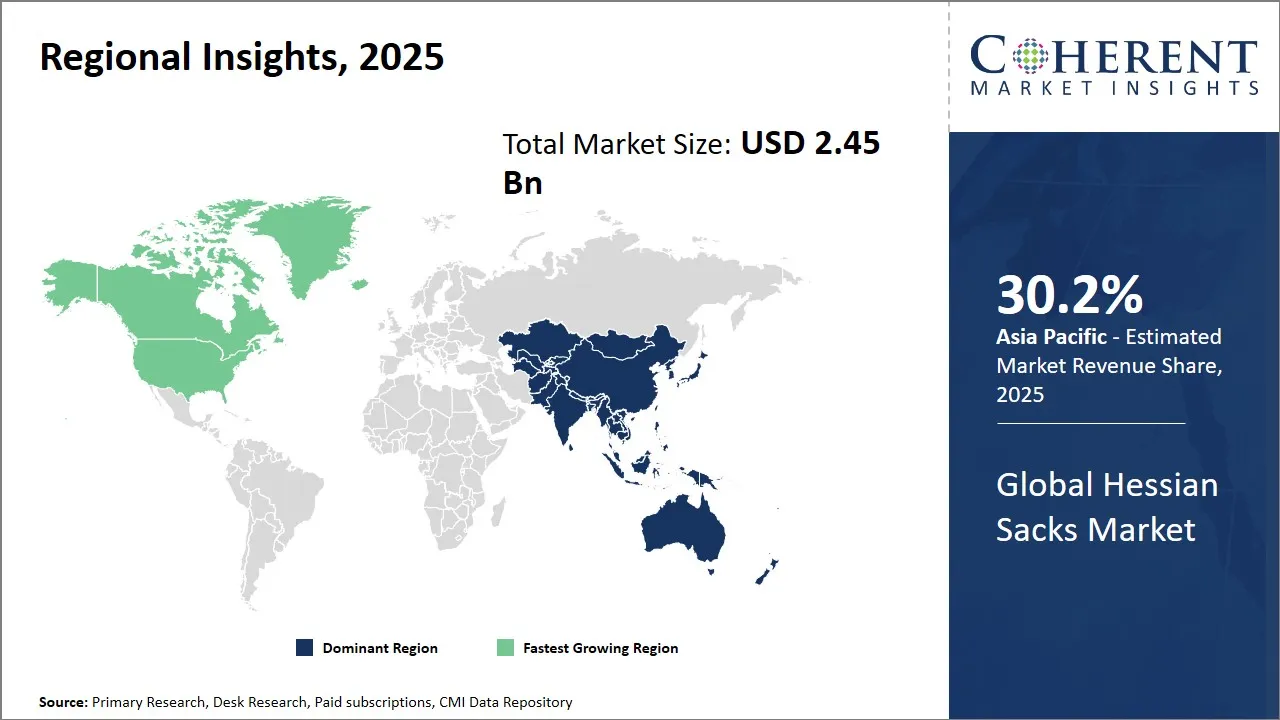
- Asia Pacific is expected to lead the global hessian sacks market in 2026 with a 30.2 % share, driven by the increasing demand for eco-friendly packaging and the region's growing manufacturing sector. North America, with a 21.5% share in 2026, will be the fastest-growing region, fueled by the rise in sustainable packaging solutions, e-commerce growth, and a shift toward environmentally-conscious consumer behavior.
Market Overview
The market trend shows a heightened demand for sustainable and biodegradable packaging materials, which has hastened the adoption of hessian sacks on a global scale. Growing awareness about protecting the environment and government funding to promote the utilization of recyclable materials also contribute to the strong market growth. Changes and research and development in fabric quality and design should enhance the durability and function of hessian sacks as a primary solution for agricultural, industrial, and retail implementing.
Current Events and Its Impact
Current Events | Description and its Impact |
Surge in Eco-Friendly Packaging Demand |
|
Technological Advancements in Production |
|
Segmental Insights
- Current Industry Events of 2026
- Market Size Estimation
- Regional Breakdown
- Competitive Landscape
- Customer Intelligence
- Segmental Analysis
- Pricing Analysis
- Key Market Drivers, Challenges & Future Trends
- Customized Insights Section
Hessian Sacks Market Insights, By Product Type - Twill Hessian Sacks Segment Dominates the Market Driven by Durability and Versatility
Twill hessian sacks segment is expected to hold 42.6% share in the global hessian sacks market in 2026, owing to their superior durability and broad applications. These bags are made from a unique weave structure that gives them enhanced strength and durability against wear and tear than the rest. The strength owes its success to its high durability, which makes Twill hessian bags significantly preferred in operations involving frequent dealing with, moving about, and storing of bulky or heavy items. The natural resilience of twill cloth discourages tear or puncture of the bags themselves, or of the items within, thereby making it a trusted option.
In addition, the multifaceted nature of Twill hessian sacks is essential in their ability to dominate the market. They are utilized in various industries, such as packaging agricultural products, industrial products transportation, and retail packaging options. The ability of hessian material to breathe helps in keeping agricultural products like coffee beans, grains, and nuts fresh, thus making Twill sacks a suitable packaging material in the food supply chain. Besides, manufacturers value how easily Twill hessian sacks can be tailored in the size, weave density, and water-resistant coating treatment to suit particular customer needs.
Hessian Sacks Market Insights, By End-use Industry - Consumer Goods Segment Dominates the Market due to Benefits from Sustainability and Functional Packaging
The consumer goods segment is projected to contribute 30.3% share of the global hessian sacks market in 2026, as a result of mounting consumer demand for eco-friendly and practical packaging. Consumer goods such as apparel, handicrafts, and home goods are highly dependent on visually appealing as well as robust packaging solutions that also resonate with the growing awareness regarding environmental concerns. Hessian sacks, especially those produced from natural materials such as jute, are poised to satisfy this double imperative by presenting both aesthetic appeal and environmental benefit.
The haptic texture and natural aesthetic of hessian fabric empowers an earthy attraction that finds strong appeal among ecological consumers as well as brands seeking to raise their profile as sustainable and responsible. This has resulted in broader use of hessian sacks as gift wrapping, promotional packaging, and retail bags for different consumer goods categories. Hessian sacks are also printable or embroidered easily, enabling brands to add customized logos, patterns, or messages to their packaging, leading to improved brand visibility and loyalty.
Hessian Sacks Market Insights, By Distribution Channel – Online Segment Dominates the Market Driven by E-commerce Expansion and Convenience
The online segment is projected to hold 39.5% share in the global hessian sacks market in 2026, driven mainly by the accelerated growth of e-commerce and changing consumer buying habits. Online shopping has really opened up a world of possibilities for both businesses and consumers, giving them access to a wider variety of hessian sacks with customized features, better prices, and delivery options that traditional retail just can't match. This impulse is vital in the developing world where access to physical retail stores for specialty packaging goods such as hessian sacks may be restricted. Online platforms also facilitate a worldwide reach, allowing consumers to purchase hessian sacks from manufacturers across the globe, thus leveraging competitive international prices and innovative product varieties.
Regional Insights
Asia Pacific Hessian Sacks Market Analysis and Trends
The Asia Pacific region is projected to lead the market with a 30.2% share in 2026, fueled by the strong agricultural sector of the region, widespread cultivation of jute, and established supply chain networks. India and Bangladesh are the biggest producers of raw jute, the major input used in hessian sacks, which lowers the cost of raw material and secures the regional market ecosystem.
Government policies encouraging sustainable packaging and non-plastic, eco-friendly alternatives give further impetus to demand. Further, the region is boosted by a well-established jute industry backed by small and medium-scale businesses as well as large players like Lila Group (India) and Beximco Limited (Bangladesh) that have diversified product lines to meet expanding local and export markets. Trade policy biased towards the export of jute, in addition to investments made in advanced weaving technologies, improves the competitive advantage of the region in the international market.
North America Hessian Sacks Market Analysis and Trends
The North America region is expected to exhibit the fastest growth in the market contributing 21.5% share in 2026, due to rising environmental concerns among the consumers and regulations against plastic packaging. The changing regulatory ecosystem in the form of single-use plastic bans in Canada and some U.S. states has accelerated the adoption of biodegradable, natural fiber-based sacks such as hessian.
The market ecosystem of the region is supported by innovation and sustainability, and high-quality, tailor-made hessian sacks for agriculture, retail, and packaging of artisan products are delivered by companies like Burlap & Barrel and Bagcraft Packaging Supplier. Strong retail industries and increasing demand for natural and organic products enable better adoption.
Global Hessian Sacks Market Outlook for Key Countries
India Hessian Sacks Market Trends
The hessian sacks market in India benefits from established jute harvesting and traditional weaving in West Bengal and Bihar. Programs endorsed by the government such as the National Jute Policy promote sustainable jute materials, and their use, supporting the development of the domestic market for Hessian sacks. Large-scale producers like LNJ Bhilwara Group and Gaurav Jute Products are helping improve jute sack capacities through positive innovation, offering a variety of sacks that are used for agriculture, food storage, and industry.
Bangladesh Hessian Sacks Market Trends
Bangladesh remains an important player in the hessian sacks market. Support from the government in the form of subsidies and export incentives support competitive pricing and quality standards.
Leading businesses like Beximco Limited and Akij Jute Mills are helping improve jute sacks production, and exporting to regions such as Europe, North America and neighboring countries. An increasing focus on sustainability and mechanization in jute processing has also contributed to Bangladesh's strengthening jute capabilities and export base in the global hessian sack supply chain.
U.S. Hessian Sacks Market Trends
The U.S. hessian sacks market is at the forefront of embracing green packaging alternatives, stimulated by increased consumer demand for sustainable products and regulatory constraints on synthetic packaging materials. American businesses like Burlap & Barrel and Pony Pak Bags led the way to introduce specialized, high-quality hessian sacks utilized mostly for specialty food packaging, gardening, and artisanal goods markets.
Germany Hessian Sacks Market Trends
Germany's hessian sacks market prospers due to stringent environmental policies and an overall dedication to sustainability in the nation's packaging industry. The green policies promoted by the government, focusing on minimized carbon footprints and recyclable products, fuel higher usage of hessian sacks for farming, gardening, and retail packaging. Industry leaders like Hessian Europe GmbH and Gardigo GmbH have launched technologically enhanced goods with increased durability and biodegradability. Germany's status as a European market leader fosters cross-border exchange and undertakings intended to substitute plastic sack use, strengthening the regional market ecosystem.
Brazil Hessian Sacks Market Trends
Brazil's market conditions are influenced by the expanding agricultural sector, where hessian sacks are being increasingly used for packaging and transportation of produce. Growing concern for sustainable packaging and government initiatives favoring renewable agricultural produce drive market growth. Domestic players, such as Ecotex Packaging, emphasize product design innovation, improving sack strength and moisture resistance to meet tropical conditions. Trade dynamics with the encouragement of more exports of coffee and grains also trigger dependence on hessian sacks locally as well as for export purposes, supporting Brazil's growing position in the global market.
Macro and Micro Economic Factors Impacting the Hessian Sacks Market Growth
Macroeconomic Factors Impacting Growth
- Agricultural Sector Expansion: Growth in global agricultural production—particularly in Asia Pacific countries such as India, Bangladesh, and China—is contributing to a strong demand for hessian sacks (used to transport grains, coffee, and produce).
- Economic Growth and Industrialization in Emerging Markets: Rapid industrialization in developing markets is supporting the demand for sustainable industrial packaging and construction applications.
- Trade Dynamics and Export Growth: Jute exports from South Asia remain vital. Favorable trade policies and lower production costs in jute-producing countries contribute to competitiveness in global markets.
- Inflation and Commodity Price Variability: Volatility in raw jute prices affects production costs globally. Inflationary pressures across textile and transport sectors can restrain market margins, especially in export-oriented economies.
- Urbanization and Construction Growth: Expansion of urban infrastructure raises hessian usage in the construction industry, particularly as geotextiles and scaffolding covers that align with green building policies.
Microeconomic Factors Impacting Growth
- Rising Demand for Eco-Friendly and Biodegradable Packaging: Consumer awareness about sustainability and brand positioning drives businesses to adopt hessian packaging, especially in food, beverage, and retail applications.
- Cost Competitiveness vs. Synthetic Alternatives: Despite being natural and eco-friendly, hessian sacks face competition from polypropylene and plastic materials due to cost and durability differences, forcing continuous innovation in coating and lamination technology.
- Technological Advancements and Product Innovation: Manufacturers are developing burlap variants that have coatings that improve moisture and UV resistance, making burlap products more useful for various perishable and industrial products.
- Dependence on End-use Sector: Agriculture continues to dominate the demand segment, followed by construction, chemicals, and cosmetics. The steady demand from the agricultural sector provides a stable market even in cyclical industry fluctuations.
Market Players, Company Insights, and Competitive Intelligence
Company Insights
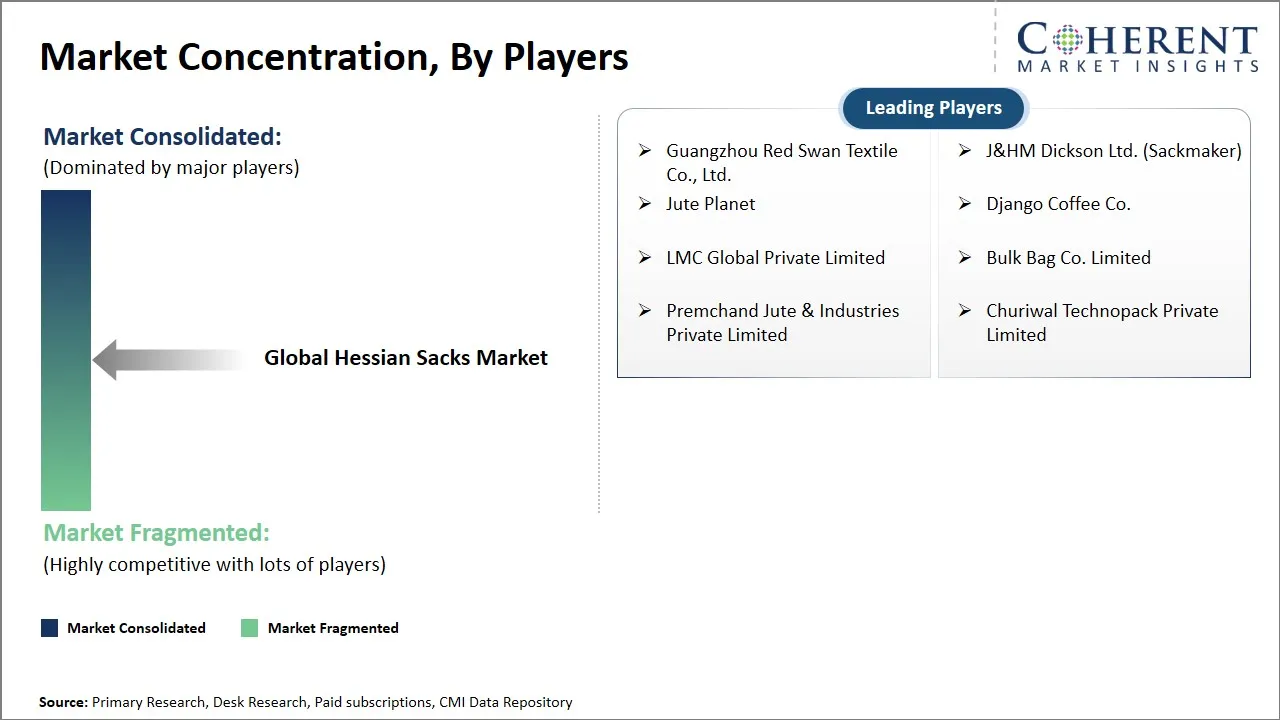
Guangzhou Red Swan Textile Co., Ltd. is a well-known Chinese producer of hessian sacks, also referred to as jute sacks or burlap bags. The company produces a wide variety of these sacks with diverse industrial and agricultural uses. They have high-quality jute gunny bags for use in packaging coffee beans, cocoa, rice, sugar, and other cereals.
Top Strategies Followed by Global Hessian Sacks Market Players
- Established market players invest significantly in research and development to fuel innovation, with a focus on manufacturing high-performing Hessian sacks that are responsive to changing customer needs like higher durability, biodegradability, and customizability. Established players also implement aggressive expansion plans globally by expanding their distribution networks and taking advantage of extensive supply chain capabilities that enable them to enter new markets in Asia Pacific, Latin America, and Africa.
- For example, Emmvee has launched a new range of sacks that are environment-friendly, comprising a jute-biodegradable polymer combination, which are gaining traction with the worldwide trend towards sustainable packaging options.
- Mid-tier companies in the hessian sacks market focus on offering affordable yet reliable solutions, particularly targeting cost-conscious consumers in emerging economies, where price remains a key factor in purchasing decisions..
- For example, JutePack Ltd. has partnered with technology company, SmartPack, to incorporate RFID tracking into its sacks, enabling small businesses to enhance logistics and traceability without increasing costs substantially.
- Small-scale operators traverse the competitive landscape by creating niche segments in the Hessian sacks industry, often highlighting specialized product attributes or innovative design features that distinguish them from mass-market products. The operators use state-of-the-art technologies, like environment-friendly treatments, distinctive weaving styles, or embedded smart tags, to maintain their edge within a competitive market.
- For example, Australia's EcoJute Creations incorporates natural plant-based dyes and weaves into the production of uniquely patterned sacks, and sustainability is a concern resonating with the expanding eco-conscious consumer market.
Market Report Scope
Hessian Sacks Market Report Coverage
| Report Coverage | Details | ||
|---|---|---|---|
| Base Year: | 2025 | Market Size in 2026: | USD 2.58 Bn |
| Historical Data for: | 2020 To 2024 | Forecast Period: | 2026 To 2033 |
| Forecast Period 2026 to 2033 CAGR: | 5.5% | 2033 Value Projection: | USD 3.76 Bn |
| Geographies covered: |
| ||
| Segments covered: |
| ||
| Companies covered: | Guangzhou Red Swan Textile Co., Ltd., J&HM Dickson Ltd. (Sackmaker), Jute Planet, Django Coffee Co., LMC Global Private Limited, Bulk Bag Co. Limited, Premchand Jute & Industries Private Limited, and Churiwal Technopack Private Limited | ||
| Growth Drivers: |
| ||
| Restraints & Challenges: |
| ||
Hessian Sacks Market Dynamics
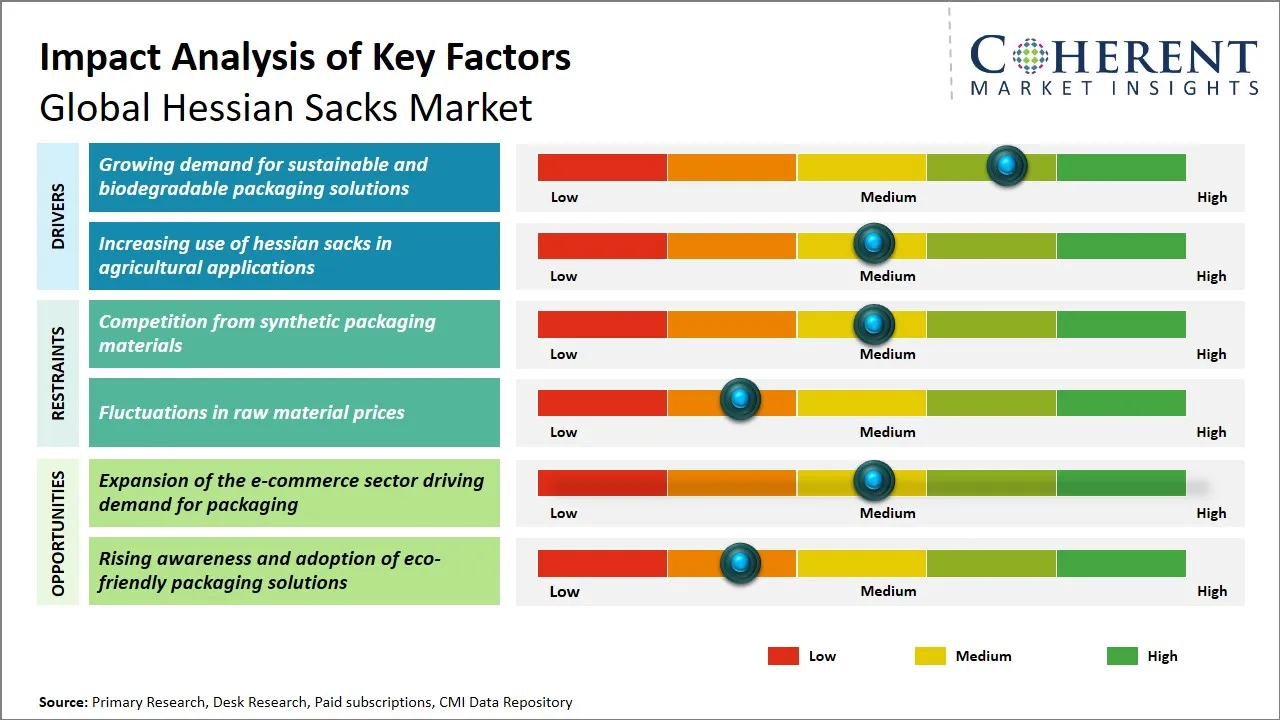
Hessian Sacks Market Driver - Growing demand for sustainable and biodegradable packaging solutions
The global focus on environmental sustainability is increasingly fueling the demand for hessian sacks in various industries. As both companies and consumers become more environmentally conscious, there is a tendency to shift towards natural, biodegradable options instead of synthetic, biodegradable plastics packaging materials. Hessian sacks, made from jute fibers are a greener alternative that fits the trend towards less plastic use and a lower carbon footprint.
Their natural biodegradability, recyclability, and renewability make them an appropriate packaging material for agricultural related produce, textiles and fresh food packaging, when product integrity and environmental footprint is most important. Westfalia Fruit, a global leader in fresh fruit supply, makes use of jute sacks to package their avocados and thus they can reduce their use of plastic while also making sustainability commitments.
Hessian Sacks Market Opportunity - Expansion of the E-Commerce Sector is Driving Demand for Packaging
As consumer consciousness about the environment is on the rise and there is a greater focus on biodegradable products, e-commerce companies are looking for alternatives to traditional plastic packaging. Hessian sacks, which are produced from natural jute fibers, fit perfectly into this trend, as they are biodegradable as well as reusable and also ensure a strong protection for the goods being shipped.
For example, GoJute International has manufactured and supplied jute bags to various sectors, including tourism, retail, and agriculture, promoting eco-friendly packaging solutions.
Analyst Opinion (Expert Opinion)
- The hessian sacks industry is growing owing to increasing consumer interest in sustainable packaging options from a variety of sectors. Insights from the International Petroleum Technology Conference (2023) and the Mining Indaba (2022) highlighted significant innovations, with companies like Schlumberger and Halliburton leading the development of high-performance drill bits designed for extreme conditions.
- Schlumberger’s introduction of its new PDC drill bit technology, which enhances durability and efficiency, exemplifies the trend toward optimizing drilling operations.
- Additionally, investments in sustainable practices, such as eco-friendly materials for drill bit manufacturing, can resonate with environmentally conscious clients. Ultimately, the drill bits market's expansion will hinge on innovation and the ability to meet the evolving needs of diverse industries.
Speak to the analyst
Want personalized insights?
Take the findings above to one of our principal consultants, or have the report rebuilt around the segments, geographies and competitors you actually track.
Market Segmentation
- Product Type Insights (Revenue, USD Bn, 2021 - 2033)
- Twill hessian sacks
- Twill hessian sacks
- L Twill hessian sacks
- W. Flour
- Others
- End-use Industry Insights (Revenue, USD Bn, 2021 - 2033)
- Consumer goods
- Agricultural
- Crops
- Vegetables
- Starchy food
- Others
- Construction
- Others
- Distribution Channel Insights (Revenue, USD Bn, 2021 - 2033)
- Online
- Offline (Retail Stores)
- Distributors
- Others
- Regional Insights (Revenue, USD Bn, 2021 - 2033)
- North America
- U.S.
- Canada
- Latin America
- Brazil
- Argentina
- Mexico
- Rest of Latin America
- Europe
- Germany
- U.K.
- Spain
- France
- Italy
- Russia
- Rest of Europe
- Asia Pacific
- China
- India
- Japan
- Australia
- South Korea
- ASEAN
- Rest of Asia Pacific
- Middle East
- GCC Countries
- Israel
- Rest of Middle East
- Africa
- South Africa
- North Africa
- Central Africa
- North America
- Key Players Insights
- Guangzhou Red Swan Textile Co., Ltd.
- J&HM Dickson Ltd. (Sackmaker)
- Jute Planet
- Django Coffee Co.
- LMC Global Private Limited
- Bulk Bag Co. Limited
- Premchand Jute & Industries Private Limited
- Churiwal Technopack Private Limited
Sources
Primary Research Interviews
- Operations Director – Leading Hessian Sack Manufacturer
- Procurement Manager – Major Global Food Packaging Company
- Sustainability Lead – International Jute Products Consortium
- Raw Materials Manager – Large-Scale Agricultural Cooperative
Stakeholders
- Manufacturers (Jute Mills, Sack Fabricators)
- End-use Sectors
- Agriculture (grain, seeds, produce packaging)
- Food & Beverage (bulk ingredients transport)
- Construction (sand, cement, industrial fills)
- Retail and Specialty Stores
- Trade Associations (exporters/importers, jute boards)
- E-commerce and Logistics Providers
- Technology Players (automation & sack printing solutions)
Databases
- UN Comtrade Database (jute, hessian and sack trade flows)
- India EXIM Database (import/export stats on jute sacks)
- Bangladesh Export Promotion Bureau (jute goods data)
Magazines
- International Packaging News – Updates on eco-friendly packaging and sack markets
- Jute & Natural Fibres Review – Global innovations in jute-based products
- Agri-Packaging Today – Market trends and sustainability in agricultural sacks
- Textile Value Chain – Insights on jute industry dynamics and sack market
Journals
- Journal of Natural Fibers – Research on jute/hessian material properties and advances
- Packaging Technology and Science – Studies on performance and design of hessian sacks
- International Journal of Agricultural Science – Use of hessian sacks in bulk crop logistics
- Journal of Cleaner Production – Life cycle and sustainability studies of natural fiber
Newspapers
- The Financial Times – Coverage on global trade, packaging sector, and commodity shifts
- The Daily Star (Bangladesh) – News on jute industry and sack export trends
- The Economic Times (India) – Agri-supply chain and packaging market policy updates
- The Guardian – Articles on sustainability and plastics replacement in packaging
Associations
- International Jute Study Group (IJSG)
- Indian Jute Mills Association (IJMA)
- Bangladesh Jute Mills Association (BJMA)
- Packaging Industry Associations (global and regional)
- Sustainable Packaging Coalition
Public Domain Sources
- FAO – Guidelines on sustainable agri-packaging, jute sack standards
- Indian Ministry of Textiles – Jute policy and standards
- Bangladesh Jute Board – Quality and certification standards
- World Trade Organization – Trade regulations for jute/hessian goods
Proprietary Elements
- CMI Data Analytics Tool, Proprietary CMI Existing Repository of information for last 8 years.
Get access to 250+ pages report
Every segment, forecast, competitor profile and data table behind the analysis above — available for instant download.
- ESOMAR Member
- ISO 9001:2015 Certified
- D-U-N-S Registered
- GDPR & CCPA Compliant
Missing comfort of reading report in your local language? Find your preferred language:
Transform your Strategy with Exclusive Trending Reports
Frequently Asked Questions
The global hessian sacks market is estimated to be valued at USD 2.58 Bn in 2026 and is expected to reach USD 3.76 Bn by 2033.
Drill bit’s design affects drilling speed and accuracy by optimizing cutting efficiency, reducing friction, and ensuring precise material removal, which enhances both speed and precision.
The CAGR of global hessian sacks market is projected to be 5.5% from 2026 to 2033.
Growing demand for sustainable and biodegradable packaging solutions and increasing use of hessian sacks in agricultural applications are the major factors driving the growth of the global hessian sacks market.
Competition from synthetic packaging materials and fluctuations in raw material prices are the major factors hampering the growth of the global hessian sacks market.
In terms of product type, twill hessian sacks are estimated to dominate the market revenue share in 2026.
Guangzhou Red Swan Textile Co., Ltd., J&HM Dickson Ltd. (Sackmaker), Jute Planet, Django Coffee Co., LMC Global Private Limited, Bulk Bag Co. Limited, Premchand Jute & Industries Private Limited, and Churiwal Technopack Private Limited are the major players.