

Global Intraoral Scanners Market Size and Forecast: 2026 to 2033
The global intraoral scanners market is estimated to be valued at USD 919.9 Mn in 2026 and is expected to reach USD 1,958.6 Mn by 2033, exhibiting a compound annual growth rate (CAGR) of 11.4% from 2026 to 2033. This robust growth reflects increasing adoption of digital dentistry technologies and rising demand for accurate, efficient dental imaging solutions worldwide. The market expansion is driven by technological advancements and growing awareness about oral care diagnostics.
Key Takeaways of the Global Intraoral Scanners Market:
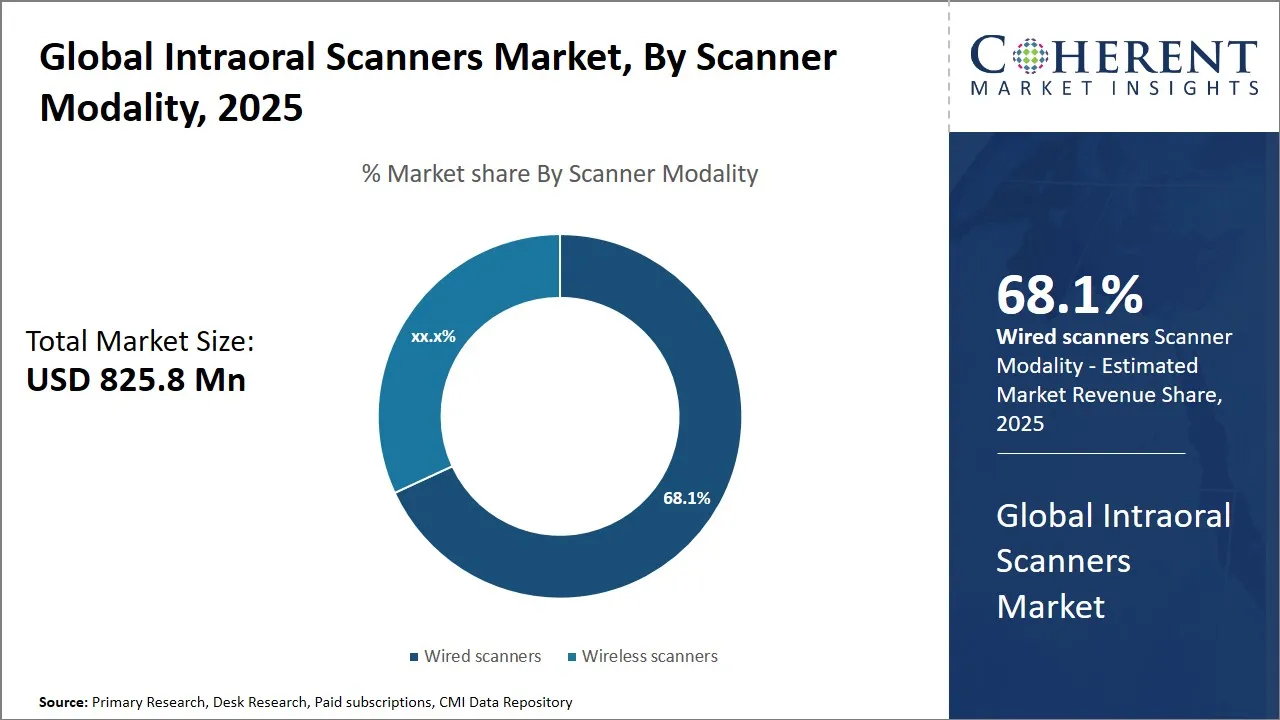
- By scanner modality, the wired scanners segment is expected to lead the global intraoral scanners market with a 69.1% share in 2026.
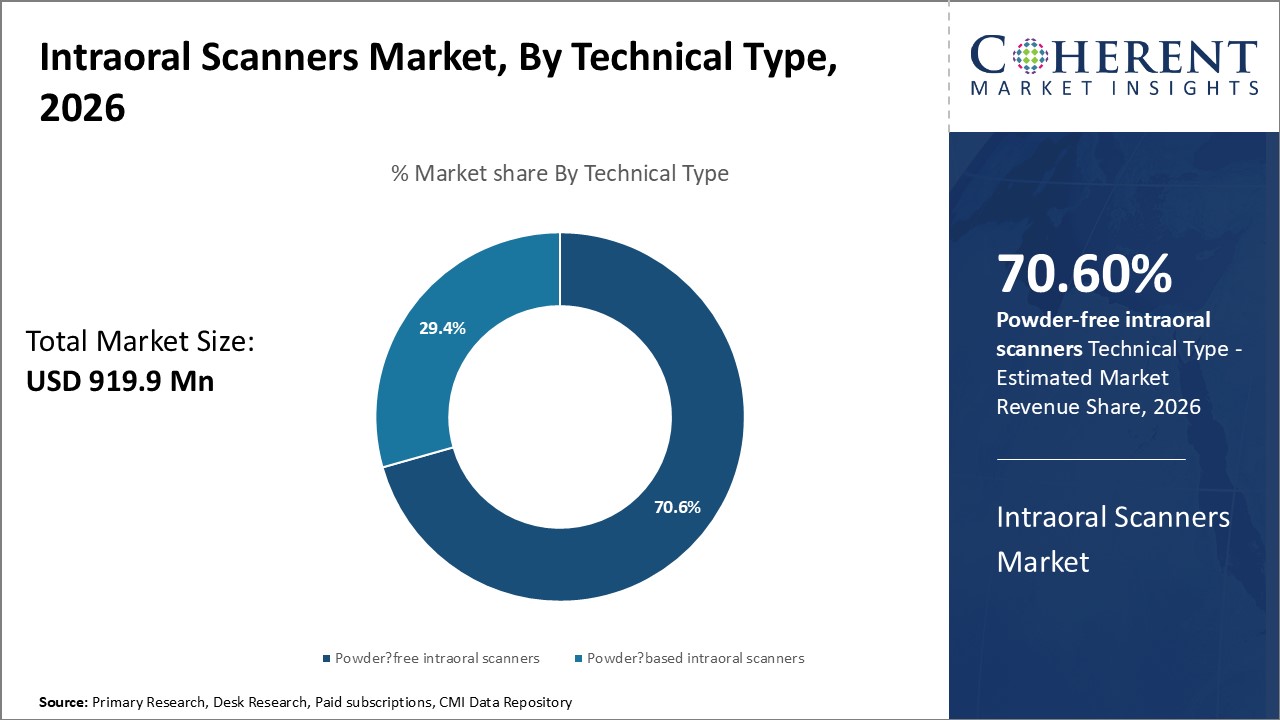
- By technical type, the powder-free scanners segment is estimated to dominate the market with a 70.6% share in 2026.
- By modality, the standalone segment is projected to hold 61.1% of the market share in 2026.
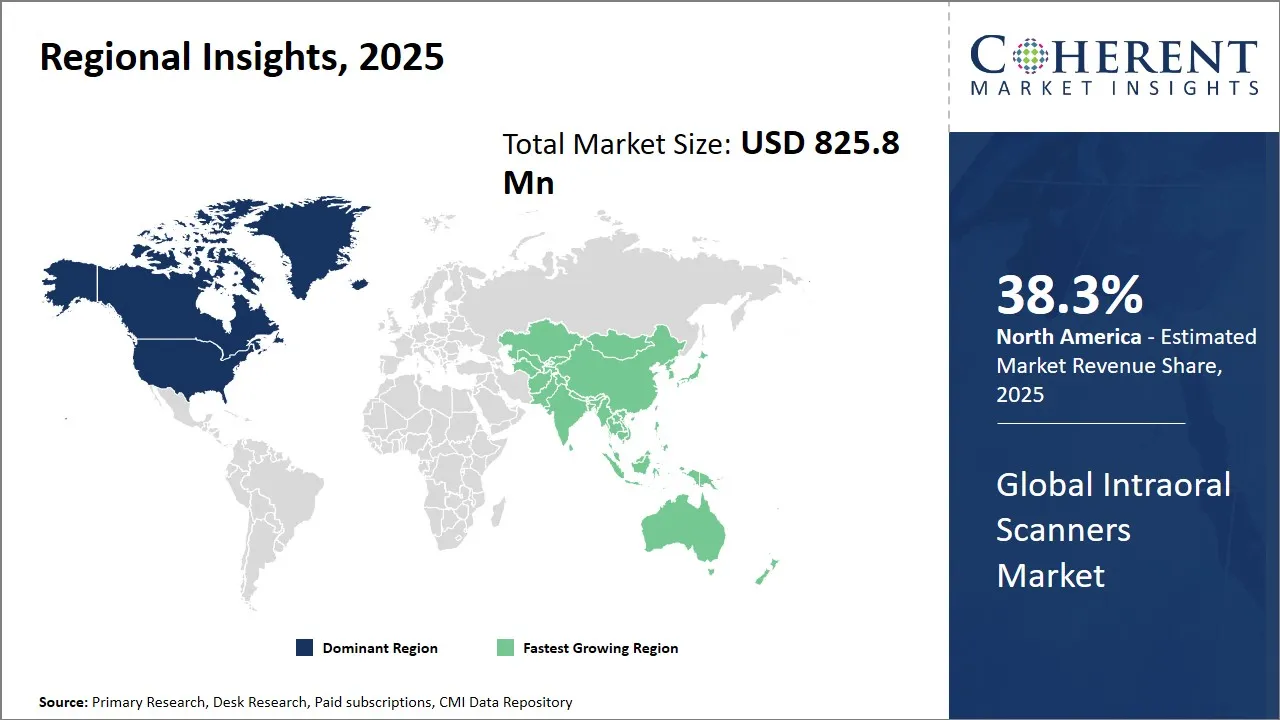
- North America is expected to lead the market, holding a share of 38.3% in 2026. Asia Pacific is anticipated to be the fastest-growing region, with an estimated market share of 24.4% in 2026.
Market Overview
A key trend shaping the intraoral scanners market is the integration of artificial intelligence (AI) and enhanced imaging capabilities, enabling more precise diagnostics and treatment planning. Additionally, the rise of minimally invasive dental procedures and increasing demand for chairside CAD/CAM workflows are accelerating the adoption of these scanners in dental clinics. Furthermore, the growing preference for digital impressions over traditional methods due to improved patient comfort and time efficiency continues to boost the market growth globally.
Currents Events and Its Impact
Current Events | Description and its Impact |
Government-led digital health modernization programs |
|
Surge in Demand for Portable and Wireless Scanners |
|
Segmental Insights
- Current Industry Events of 2026
- Market Size Estimation
- Regional Breakdown
- Competitive Landscape
- Customer Intelligence
- Segmental Analysis
- Pricing Analysis
- Key Market Drivers, Challenges & Future Trends
- Customized Insights Section
Intraoral Scanners Market Insights, By Scanner Modality - Reliability and Consistent Performance Propel Wired Scanners Segment Growth
The wired scanners are projected to account for 69.1% of the market share in 2026, owing to their high levels of reliability and stability in clinical execution. Their constant relationship allows them to have accurate imaging, which is critical to accurate digital impressions.
The wired system also minimizes delays in transmission and eliminates loss in transmission so clinicians can continue working without the hassles. This reliability guarantees quicker processes and reliable scan quality, which makes wired scanners the standard of choice in most of the practices.
Intraoral Scanners Market Insights, By Technical Type - Powder-Free Intraoral Scanners Accelerate Adoption through User Convenience and Enhanced Accuracy
The powder-free intraoral scanners have the highest market share of 70.6% in 2026, due to the rising promotion of the use of technology to enhance ease of use and comfort to the patient. The conventional powder-based scanners involve spraying of the patient with a fine powder of titanium dioxide on the teeth in order to increase the surface reflectivity as well as the level of scanning accuracy.
Nonetheless, this extra measure may be tedious, time-consuming and even uncomfortable to patients. The intraoral scanners that are powder-free do not require this application thus simplifying the scanning process.
Intraoral Scanners Market Insights, By Modality - Standalone Segment Dominates by Offering Dedicated Performance and Robust Clinical Integration
The standalone segment is expected to capture 61.1% of the intraoral scanners market share in 2026, due to the tailored design and conservative clinical use. Standalone scanners are compact devices that are only focused at producing highly detailed digital impressions as opposed to portable scanners which can be focused on mobility or multipurpose.
In April 2024, Medit, a South Korea based digital dentistry company, introduced the Medit i900 intraoral scanner. The device offers faster and smoother scanning with a new control interface and improved ergonomics. It enhances material capture and gives dentists better precision and usability. The launch builds on Medit’s i500, i700, and i600 lineup, which reshaped the market with affordable high-performance options.
Healthcare Expenditure and Reimbursement Dynamics
- Healthcare expenditure for dental technologies is increasing as clinics prioritize efficiency and improved patient outcomes. Many regions allocate higher budgets for digital equipment, supporting faster diagnosis and better treatment planning. Hospitals invest selectively because scanner procurement requires capital approvals and workflow integration. Lower-income regions still face adoption barriers due to limited digital funding.
- Reimbursement for intraoral scanner procedures remains inconsistent across markets. Most countries classify digital impressions as non-reimbursable, pushing costs to patients or providers. Some private insurers offer partial reimbursement when scanners support restorative or orthodontic workflows. Public systems rarely fund scanners directly, slowing adoption in government facilities.
Regional Insights
North America Intraoral Scanners Market Analysis and Trends
Intraoral scanners market position is dominant in North America, with a 38.3% share in 2026, because of its well-developed dental healthcare system, the use of high-technologies, and favorable reimbursement policies. The availability of the strong ecosystem of the major dental equipment manufacturers, research centers, and qualified dentists also contributes to the development of the market.
In October 2026, Align Technology, a global leader in clear aligners and Intraoral Scanners, introduced major upgrades to its iTero Digital Solutions ecosystem. The new features improve chairside diagnostics, enhance patient communication, and support faster CAD/CAM workflows. The update includes advanced visualization tools, improved oral health reporting, expanded 3D printing and milling compatibility, and a new mock-up workflow for single-visit dentistry.
Asia Pacific Intraoral Scanners Market Analysis and Trends
The Asia Pacific region is expected to exhibit the fastest growth in the market contributing 24.4% share in 2026, due to rising healthcare infrastructure, rising disposable income, and rising dental tourism in the nations such as China, India, and Japan. In this region, governments are pumping money into modernization of healthcare as well as making efforts to enhance oral health awareness.
In addition, the emergence of major multinational firms like 3Shape, Medit, and Planmeca which are consolidating their market position by forming regional collaborations and local product propositions are also boosting growth. The dynamics of trade are accepted because of the better supply chains and production facilities that are located in such countries as China and South Korea, which facilitated the penetration of more advanced intraoral scanners at even more affordable prices.
Intraoral Scanners Market Outlook for Key Countries
U.S. Intraoral Scanners Market Trends
The U.S. intraoral scanners market is one that has high technology acceptability and wide coverage of dental insurance which supports the use of digital dentistry equipment such as intraoral scanners. It is one of the major centers of innovation and product development and firms such as Align Technology based in this country have led the way in improving the accuracy and usability of the scanners. Clusters of dental clinics and academic institutions make the adoption wide, and the regulatory agencies like the U.S. FDA offer a flexible channel through which product approvals are made, a guarantee of dynamism in the market.
In September 2022, 3Shape, a global digital dentistry company, introduced the TRIOS 5 Wireless intraoral scanner. The scanner features a compact ergonomic design, intelligent alignment technology, and strong hygiene standards. It delivers faster scanning with ScanAssist, which reduces distortion and guides dentists through LED cues and haptic feedback
Germany Intraoral Scanners Market Trends
Germany is also an important market in Europe that is backed by high level of industrial base and precision engineering tradition, which is helpful in dental equipment industry. The introduction of the intraoral scanner in the clinics is encouraged by government healthcare programs and private dental cover programs, both in urban and rural clinics. The subsidiaries of multinational companies such as Sirona (Dentsply Sirona) and international competitors also invest a lot in research and development plants in this region, which promotes innovation in the world of intraoral scanning technology.
In February 2023, Carestream Dental, a global dental technology company, introduced IO Scanner Link to expand access to intraoral scans. The tool allows CS Imaging 8 software to connect directly with third party intraoral scanners for smoother digital workflows. It lets clinicians launch scans with one click and auto import data for implant planning, guide design, and lab sharing.
China Intraoral Scanners Market Trends
The market development of intraoral scanners in China is driven by three factors, namely, the rapid urbanization, the increasing attention to oral health, and the efforts by government to modernize healthcare facilities. The local players like the Shining 3D supplement the work of its international competitors, which leads to the creation of a competitive environment stimulating innovation and cost-effective solutions. The rising count of dental centers moving to digital workflows and the growth of dental training programs also contribute to the growth of the market.
In March 2023, Freqty Technology, a Chinese digital dentistry manufacturer, introduced its PANDA Smart intraoral scanner at IDS Cologne. The device is the smallest and lightest scanner in the PANDA series and offers high-accuracy imaging with a comfortable workflow.
Japan Intraoral Scanners Market Trends
The Japan intraoral scanners market boasts of well-developed healthcare ecosystem and focus on quality and accuracy in dental care. The elderly population has increased the levels of demand in restorative dental procedures that demand scanning technologies with high precision. Other major players such as Planmeca and 3Shape remain in the market but their focus has been on customization of their products to suit local clinical demands. The adoption of intra-oral scanners with digital dental systems is currently becoming popular due to proactive health policies of the government.
In July 2026, Shining 3D, a global 3D digitalization solutions provider, announced a new Japan subsidiary to strengthen its presence in the region. The company aims to improve local support, deepen collaboration with partners, and expand applications in industrial measurement and digital dentistry.
Adoption of Digital Dentistry and CAD/CAM Systems - Intraoral Scanners Market
- Digital dentistry adoption is rising across clinics, hospitals, and academic institutions. Multi-chair clinics lead adoption due to faster workflows and higher patient load. Hospitals adopt scanners more slowly because integration requirements delay deployment. Academic institutions mainly use scanners for training and research, which keeps daily utilization lower.
- Leading manufacturers directly influence this adoption through strong clinical and academic programs. 3Shape expands TRIOS use in universities and large clinics through education partnerships. Align Technology drives iTero adoption in orthodontic chains and residency programs. Dentsply Sirona promotes Primescan and CEREC systems in teaching hospitals. Planmeca advances Emerald S adoption through collaborations with global dental schools.
Market Players, Key Developments, and Competitive Intelligence
Key Developments
- On November 18, 2025, Dentalkart, a leading dental technology platform in India, launched the Waldent BLZ IntraVue 900 AI intraoral scanner. The device uses optical 3D imaging and real time AI to deliver accurate impressions and smooth scanning. It supports CAD CAM workflows and helps clinics shift to digital dentistry with ease. The scanner features ergonomic design, autoclavable tips, and fast data transfer for daily use.
- In October 2025, Dandy, a digital dental lab, introduced the Dandy Vision intraoral scanner. The scanner uses advanced optics and AI to deliver faster and more precise digital impressions. It is trained on millions of scans and offers clear soft tissue visuals for better treatment planning. The system supports a full digital workflow with real-time technician guidance for dental practices.
- In October 2025, DEXIS, a global dental technology provider, launched the Imprevo intraoral scanner after its Carestream Dental acquisition. The scanner delivers faster performance with a 40 FPS engine and smoother scan processing. It features improved optics, including dual sensors and a wider depth of field for clearer detail. The slimmer autoclavable tip and gesture controls enhance daily clinical use.
- In September 2024, Dentsply Sirona, a global dental technology company, introduced Primescan 2, a cloud native intraoral scanner. The wireless device scans directly to the cloud from any internet connected system and supports fast digital workflows. It captures a full arch in under one minute with strong accuracy and helps practices expand services.
Top Strategies Followed by Global Intraoral Scanners Market Players
- The established market leaders in the industry invest quality time in research and development (R&D) to develop high performance and innovative products to meet the emerging needs of professionals in the dental industry. Their high level of R&D provides higher imaging accuracy, scans at a faster rate and easier interfaces. They also continue to strengthen market dominance by creating strategic alliances and establishing OEMs alliances that increase their technology penetration and present new areas of segments.
- In October 2023, Straumann, a global dental solutions company, acquired AlliedStar, a fast-growing Chinese intraoral scanner maker. The move strengthens Straumann’s digital strategy and expands its scanner offerings in China. AlliedStar’s products will integrate into the upcoming Straumann AXS platform to support unified digital workflows.
- The mid-level competitors in the intraoral scanners market have a different competitive stance, mainly on the provision of affordable solutions that are moderate in terms of quality and cost. These firms are aware of the high demand in the price sensitized segments especially in the developing economies and align their products in a way that will increase their own access without compromise on the necessary performance.
- Mid-tier intraoral scanner companies like Shining 3D (China) and Runyes Medical (China) focus on delivering scanners that are affordable yet reliable for clinics in developing markets. Their devices offer acceptable accuracy, basic AI assistance, and integration with common CAD/CAM platforms, making them strong value-driven choices for cost-sensitive dental practices.
- Small industry competitors in the world of intraoral scanners strategically cut niches within specialized features or product differentiation using innovation. These businesses regularly embrace new innovative technologies like artificial intelligence, cloud connectivity, or ergonomically crafted scanning gadgets to establish unique value propositions that seek to cut specific sub-segments in the dental market.
- Smaller innovators such as AlliedStar (China, now acquired by Straumann) and Dental Wings (Canada, earlier known for niche digital solutions) differentiate through specialized features like compact hardware, simplified cloud workflows, or AI-driven scanning enhancements. These companies compete by targeting focused segments and offering unique technology rather than broad market coverage.
Market Report Scope
Global Intraoral Scanners Market Report Coverage
| Report Coverage | Details | ||
|---|---|---|---|
| Base Year: | 2025 | Market Size in 2026: | USD 919.9 Mn |
| Historical Data for: | 2020 To 2024 | Forecast Period: | 2026 To 2033 |
| Forecast Period 2026 to 2033 CAGR: | 11.4% | 2033 Value Projection: | USD 1,958.6 Mn |
| Geographies covered: |
| ||
| Segments covered: |
| ||
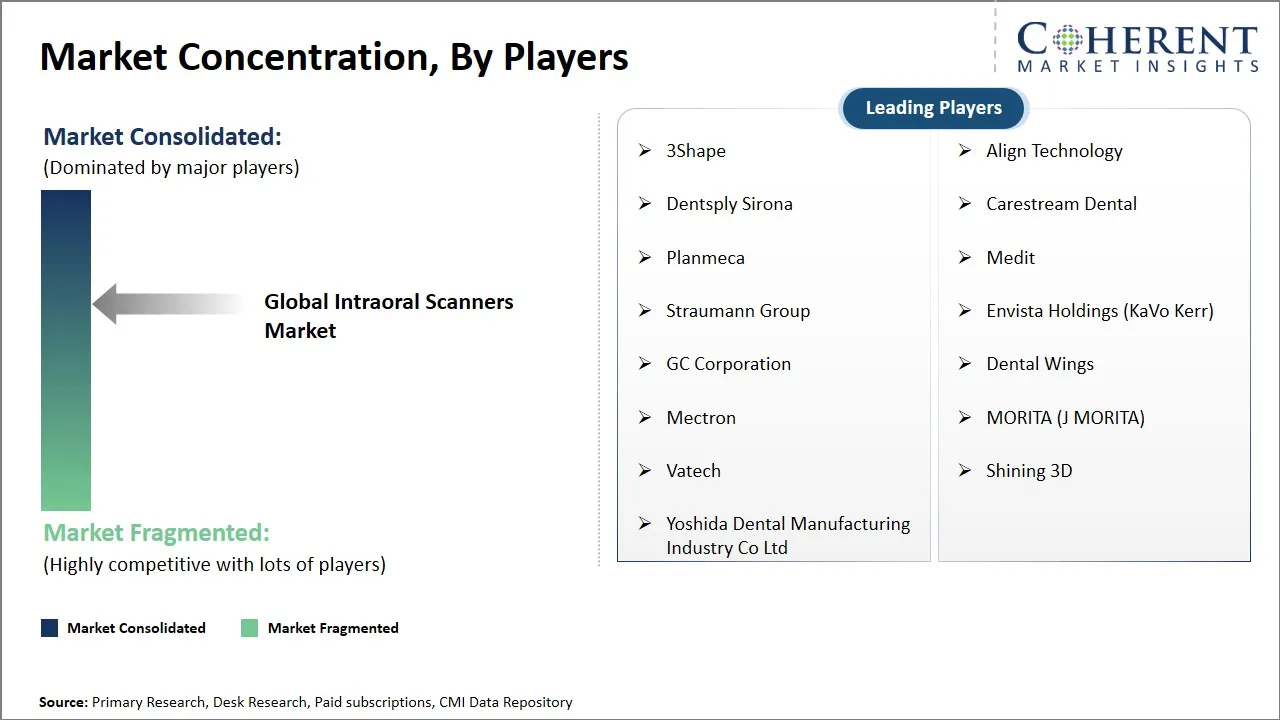
| Companies covered: | 3Shape, Align Technology, Dentsply Sirona, Carestream Dental, Planmeca, Medit, Straumann Group, Envista Holdings (KaVo Kerr), GC Corporation, Dental Wings, Mectron, MORITA (J MORITA), Vatech, Shining 3D, and Yoshida Dental Manufacturing Industry Co Ltd | ||
| Growth Drivers: |
| ||
| Restraints & Challenges: |
| ||
Intraoral Scanners Market Dynamics
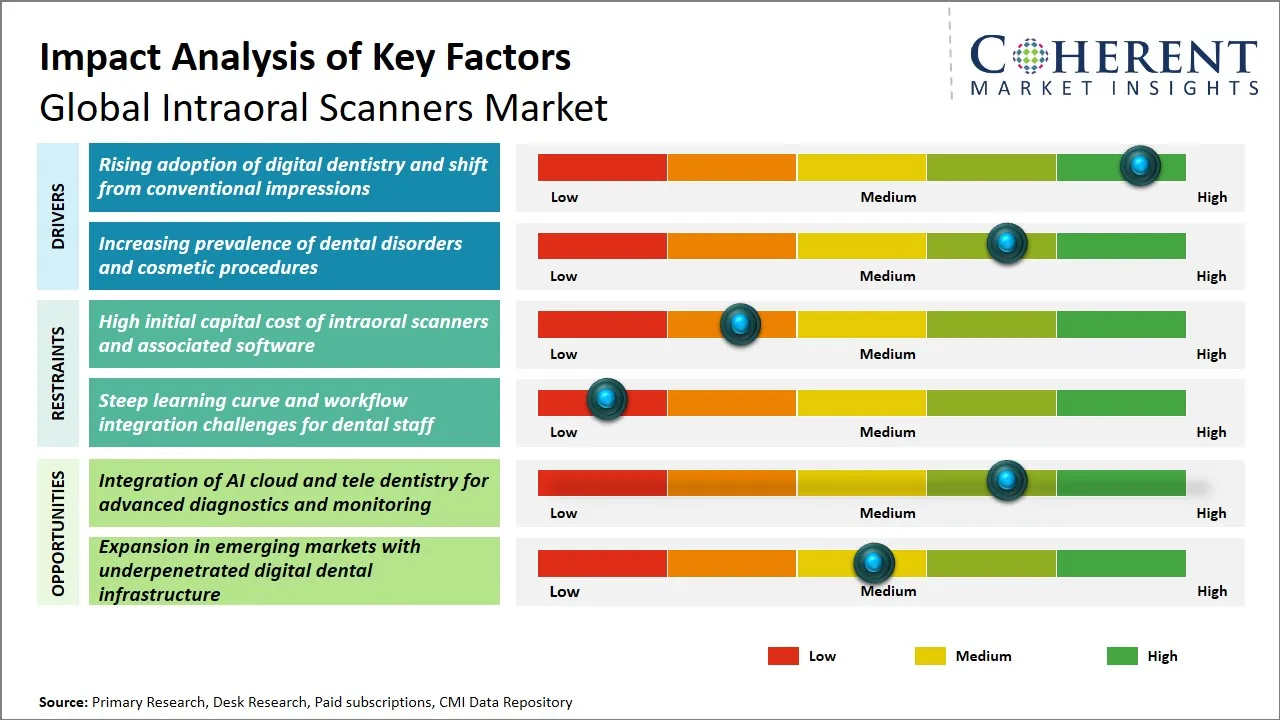
Intraoral Scanners Market Driver - Rising Adoption of Digital Dentistry and Shift from Conventional Impressions
The rising levels of digital dentistry are playing a dominant role in a push towards the demand of intraoral scanners within the dental practices in all parts of the world. The customary dental impressions, which are usually linked to pain, inaccuracy, and time consuming procedures, are slowly being substituted by the digital scanning technologies, which are more precise and comfortable to the patients. With the digital intraoral scanners, practitioners will have a high-level of accuracy in a three dimensional view of the oral cavity of patients and they will be primarily able to diagnose patients faster, develop better treatment plans and simplify the workflow of restorative and orthodontics in their practice.
In October 2025, OSSVIS, a South Korea based dental imaging company, launched the Lilivis SCAN intraoral scanner to expand its Lilivis digital ecosystem. The scanner delivers fast learning, smooth scanning, and accurate full arch capture for everyday use. It integrates seamlessly with Lilivis design, milling, printing, and implant systems to support a complete digital workflow. The device offers competitive pricing, free L CAD software, and a three year warranty for clinics. OSSVIS aims to help dental practices adopt digital dentistry with a unified and efficient platform.
Intraoral Scanners Market Opportunity - Integration of AI, Cloud Technology, and Tele Dentistry for Advanced Diagnostics and Monitoring
The global intraoral scanners market is on the edge of great transformation as it is going to integrate artificial intelligence (AI), cloud computing, and tele dentistry, and it is a great growth opportunity. Intraoral scanners that are powered by AI allow more refined image processing, automatic detection of anomalies in the teeth, and predictive analytics to increase the accuracy of the diagnosis and the treatment plan. These scanners, combined with cloud technology, can store and analyze high amounts of patient data safely to enable the easy access and coordination of dental professionals across the world. Additionally, it is integrated with tele dentistry platforms, which can be remotely monitored and consulted and provide access to dental care in underserved and geographically isolated locations.
In June 2025, Owandy Radiology, a dental imaging systems maker, launched an AI-powered Oral Health Report app for its IOS 3D intraoral scanners. The app uses AI to deliver real-time 3D scans with clearer diagnostics and simple patient visuals. It helps dentists create quick oral health reports with one click and share them securely. The tool aims to improve clinical decisions, patient engagement, and treatment planning within the intraoral scanners market.
Analyst Opinion (Expert Opinion)
- Intraoral scanners market in the field of clinics, the demand for faster digital workflow enabled by AI-based imaging, enhanced 3D precision, and increasing need to make the procedure comfortable and free of impression increase. The regulatory acceptance of digital impressions and the rising number of orthodontic and restorative uses are also supportive factors to growth.
- The main threats are the expensive price of devices and insufficient training in smaller clinics, whereas the possibilities are presented by cloud integration and more intelligent diagnostic functionality. The conferences like IDS Cologne, AEEDC Dubai, the Greater New York Dental Meeting, etc. have contributed to the development of the clinical trends and presentation of new technologies in the sphere of digital dentistry.
- According to the latest market activity, the market has witnessed scanners and software upgrades that are highly automated in terms of analysis and reporting of images and that are powered by AI. Europe and Asia governments are facilitating the advent of digital dentistry by providing modernization grants and pilot schemes and partnerships between manufacturers and universities are enhancing practitioner training.
Speak to the analyst
Want personalized insights?
Take the findings above to one of our principal consultants, or have the report rebuilt around the segments, geographies and competitors you actually track.
Market Segmentation
- Scanner Modality Insights (Revenue, USD Mn, 2021 - 2033)
- Wired scanners
- Wireless scanners
- Technical Type Insights (Revenue, USD Mn, 2021 - 2033)
- Powder‑free intraoral scanners
- Powder‑based intraoral scanners
- Modality Insights (Revenue, USD Mn, 2021 - 2033)
- Standalone
- Portable
- Application Insights (Revenue, USD Mn, 2021 - 2033)
- Orthodontics (clear aligners, braces)
- Prosthodontics/Dental Restoration (crowns, bridges, dentures)
- Implant Dentistry/Implantology
- Endodontics and Periodontics (root canals, gum therapies)
- Other/Miscellaneous dental applications
- Technology Insights (Revenue, USD Mn, 2021 - 2033)
- Confocal Imaging (e.g., 3Shape TRIOS, iTero Element)
- Triangulation-Based Imaging (e.g., CEREC Primescan)
- Other Technologies (e.g., Wavefront Sampling, Accordion Fringe Interferometry)
- End User Insights (Revenue, USD Mn, 2021 - 2033)
- Dental hospitals and clinics
- Dental diagnostic centers
- Dental academic and research institutes
- Other end users (mobile dental services, third‑party dental service providers)
- Regional Insights (Revenue, USD Mn, 2021 - 2033)
- North America
- U.S.
- Canada
- Latin America
- Brazil
- Argentina
- Mexico
- Rest of Latin America
- Europe
- Germany
- U.K.
- Spain
- France
- Italy
- Russia
- Rest of Europe
- Asia Pacific
- China
- India
- Japan
- Australia
- South Korea
- ASEAN
- Rest of Asia Pacific
- Middle East
- GCC Countries
- Israel
- Rest of Middle East
- Africa
- South Africa
- North Africa
- Central Africa
- North America
- Key Players Insights
- 3Shape
- Align Technology
- Dentsply Sirona
- Carestream Dental
- Planmeca
- Medit
- Straumann Group
- Envista Holdings (KaVo Kerr)
- GC Corporation
- Dental Wings
- Mectron
- MORITA (J MORITA)
- Vatech
- Shining 3D
- Yoshida Dental Manufacturing Industry Co Ltd
Sources
Primary Research Interviews
Industry Stakeholders list
- Oral surgeons
- Orthodontists
- Prosthodontists
- Dental clinic owners
- Digital dentistry specialists
- CAD/CAM dental lab technicians
End users list
- General dentists
- Dental hygienists
- Dental assistants
- Public dental hospital staff
- Private clinic practitioners
- Dental school faculty members
Government and International Databases
- World Health Organization
- U.S. Food and Drug Administration
- European Medicines Agency
- Centers for Disease Control and Prevention
- National Institutes of Health
- OECD Health Statistics
Trade Publications
- Dental Economics
- Dental Tribune
- Dentistry Today
- Inside Dentistry
- Dental Products Report
- Journal of Dental Technology
Academic Journals
- Journal of Prosthetic Dentistry
- Journal of Dental Research
- Journal of Clinical Dentistry
- International Journal of Computerized Dentistry
- Journal of Esthetic and Restorative Dentistry
- Journal of Oral Rehabilitation
Reputable Newspapers
- The New York Times
- The Guardian
- The Washington Post
- Financial Times
- The Times of India
- The Wall Street Journal
Industry Associations
- American Dental Association
- FDI World Dental Federation
- International Association for Dental Research
- European Dental Association
- Asian Dental Association
- Canadian Dental Association
Public Domain Resources
- MedlinePlus
- Google Scholar
- NIH National Library of Medicine
- ClinicalTrials.gov
- U.S. Census Bureau
Proprietary Elements
- CMI Data Analytics Tool: Proprietary analytics tool to analyze real-time market trends, consumer behavior, and technology adoption in market
- Proprietary CMI Existing Repository of Information for Last 8 Years
Get access to 250+ pages report
Every segment, forecast, competitor profile and data table behind the analysis above — available for instant download.
- ESOMAR Member
- ISO 9001:2015 Certified
- D-U-N-S Registered
- GDPR & CCPA Compliant
Missing comfort of reading report in your local language? Find your preferred language:
Transform your Strategy with Exclusive Trending Reports
Frequently Asked Questions
The global intraoral scanners market is estimated to be valued at USD 919.9 Mn in 2026 and is expected to reach USD 1,958.6 Mn by 2033.
The CAGR of the global intraoral scanners market is projected to be 11.4% from 2026 to 2033.
Rising adoption of digital dentistry and shift from conventional impressions and increasing prevalence of dental disorders and cosmetic procedures are the major factors driving the growth of the global intraoral scanners market.
High initial capital cost of intraoral scanners and associated software and steep learning curve and workflow integration challenges for dental staff are the major factors hampering the growth of the global intraoral scanners market.
In terms of scanner modality, the wired scanners segment is estimated to dominate the market revenue share in 2026.
3Shape, Align Technology, Dentsply Sirona, Carestream Dental, Planmeca, Medit, Straumann Group, Envista Holdings (KaVo Kerr), GC Corporation, Dental Wings, Mectron, MORITA (J MORITA), Vatech, Shining 3D, and Yoshida Dental Manufacturing Industry Co Ltd are the major players.
North America is expected to lead the global intraoral scanners market in 2026.