

North America and Europe Health Caregiving Market Size and Forecast – 2026 to 2033
The North America and Europe health caregiving market is estimated to be valued at USD 330,414.2 Mn in 2026 and is expected to reach USD 562,522.9 Mn by 2033, exhibiting a compound annual growth rate (CAGR) of 11.1% from 2026 to 2033. This steady growth reflects increasing demand for caregiving services driven by aging populations and rising prevalence of chronic diseases across these regions.
Key Takeaways of the North America and Europe Health Caregiving Market
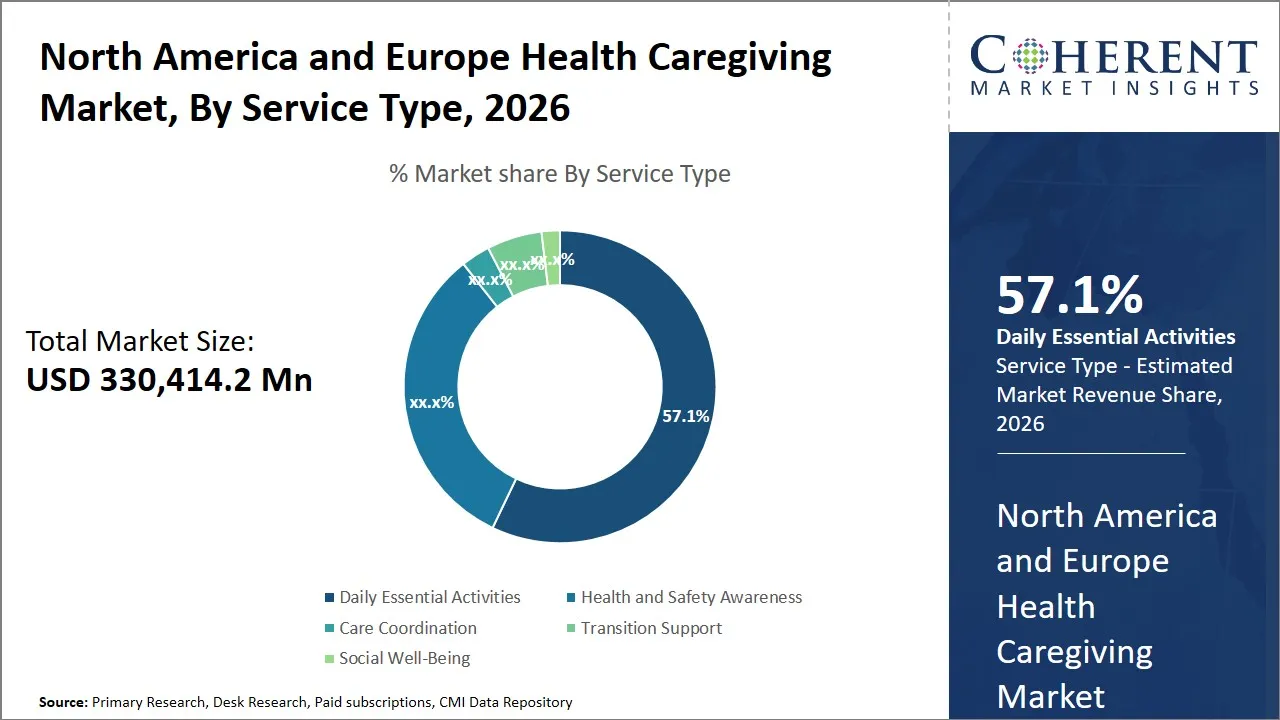
- Daily essential activities segment is expected to lead the North America and Europe health caregiving market, capturing 57.1% share in 2026.
- Geriatric population segment is estimated to represent 61.3% of the North America and Europe health caregiving market share in 2026.
- Neurological segment is projected to dominate with 35.2% of the North America and Europe health caregiving market share in 2026.
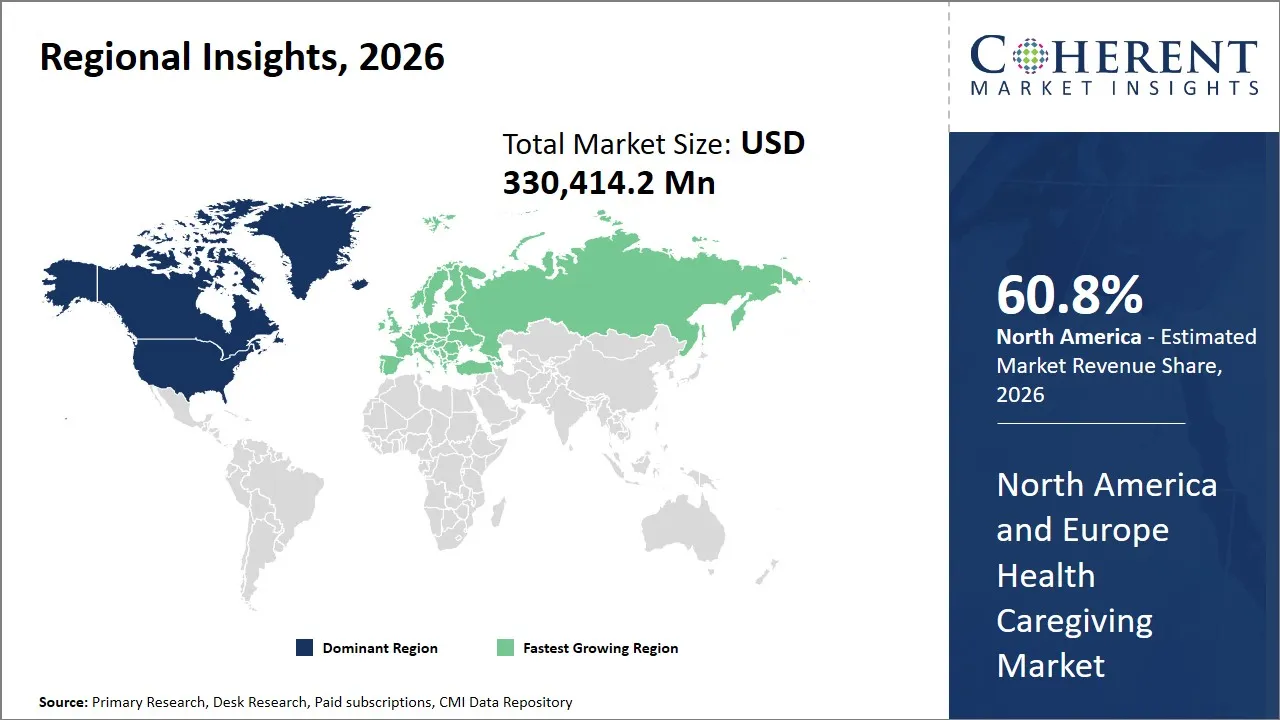
- North America is expected to lead the market, holding a share of 60.8% in 2026. Europe is anticipated to be the fastest-growing region, with 39.2% share in 2026.
Market Overview
- North America and Europe health caregiving market is witnessing steady growth due to the rapid ageing of the population and the rising need for long-term care, home care, and assisted living services.
- North America and Europe health caregiving market is increasingly shifting toward home-based and community-based care models as healthcare systems try to reduce dependence on institutional care and support ageing in place.
- North America and Europe health caregiving market is moving beyond basic support services toward more complex care models that include chronic disease management, dementia care, palliative care, and post-acute recovery support.
- North America and Europe health caregiving market is seeing stronger adoption of digital tools such as remote monitoring, telehealth, and care coordination platforms to improve caregiver productivity and patient outcomes.
Currents Events and their Impact
Current Events | Description and its Impact |
Ageing population is accelerating long-term care demand across North America and Europe |
|
Workforce shortages remain the biggest structural pressure on the caregiving market |
|
Segmental Insights
- Current Industry Events of 2026
- Market Size Estimation
- Regional Breakdown
- Competitive Landscape
- Customer Intelligence
- Segmental Analysis
- Pricing Analysis
- Key Market Drivers, Challenges & Future Trends
- Customized Insights Section
Why Does the Daily Essential Activities Segment Dominate the North America and Europe Health Caregiving Market in 2026?
The daily essential activities segment is expected to hold the largest market share of 57.1% in 2026, owing to the increasing demand for fundamental caregiving support among aging and chronically ill populations. Daily essential activities deals with a variety of fundamental support services needed to sustain the independence and quality of life of the care recipients. The expansion of this segment is also much influenced by the increasing demands of the aging population where a significant portion of the elderly population is faced with physical constraints as well as long-term ailments that limit them in their daily activities of bathing, dressing, grooming, and mobility support. The growing rate of existence of lifestyle related diseases and disabilities further speeds up the need of help in these activities.
For instance, in May 2025, Electronic Caregiver announced the launch of Addison Care, an avatar-driven virtual health assistant designed to support remote patient monitoring and continuous care for seniors and chronic-care patients. The platform integrates daily patient engagement, behavioral-health support, early health-risk detection, and 24/7 telecare services, allowing caregivers and clinicians to track patient conditions remotely and intervene early when needed.
(Source- Electronic Caregiver)
Why Does the Geriatric Population Segment Dominate the North America and Europe Health Caregiving Market in 2026?
The geriatric population segment is expected to hold 61.3% of the market share in 2026, due to demographic shifts and the increasing complexity of elderly care requirements. The geriatric population has been attributed to the long-life span and increasing elderly population in these areas. Improvements in health care have made individuals live longer, and most are likely to have chronic illnesses that need constant care and monitoring. This demographical change has enhanced the need of specialized caregiving services to meet the special physiological and psychological needs of the older adults.
Some of the problems older adults are vulnerable to include mobility loss, cognitive impairment, and dementia or Alzheimer and acute health exacerbations that require comprehensive caregiving. The comorbidity increase also makes care provision more problematic, as the caregivers have to work not only on physical activities but also on medications, nurse coordination, and monitoring vital health alerts. Geriatric care is frequently a multidisciplinary activity, as it includes physical care, mental health assistance, and socialization, which motivates the need to diversify, at the same time, integrated caregiving services.
For instance, in March 2025, an Interreg North Sea project highlighted the launch of a Smart Floor pilot in 2025 focused on fall detection and prevention for elderly care. The solution is part of Europe’s broader push into smart home monitoring, assisted living, and safer independent ageing, making it a useful example for caregiving technology adoption in the region. This is best described as a pilot launch rather than a mass-market product rollout.
(Source- Interreg North Sea)
The Neurological Segment Dominates the North America and Europe Health Caregiving Market
The neurological segment is expected to hold the largest market share of 35.2% in 2026, driven by rising prevalence of neurological disorders and the complexity of care required. The most significant area of therapeutic intervention that makes the caregiving market dominant in North America and Europe is in neurological disorders that include the Alzheimer disease, Parkinson disease, multiple sclerosis, and post-stroke complications. There is an augmented demand of special care giving services to suit these conditions due to the rising occurrence of neurological diseases as a result of ageing populations, environmental influences, and lifestyle modifications.
Healthcare Financing and Reimbursement Landscape for Home Care Services
Aspect | North America | Europe |
Coverage structure | In the U.S., Medicare covers home health only when the patient meets eligibility criteria such as needing part time or intermittent skilled services and being certified by a doctor, while Medicaid is the main payer for long term services and supports delivered at home and in the community through HCBS programs and waivers. In Canada, home and community care is largely publicly funded at the provincial and territorial level, with coverage varying by jurisdiction. | Most European markets rely on national health systems and social insurance models, but coverage is not uniform across countries. The European Commission notes that long term care is financed through a mix of public schemes, social protection systems, and out of pocket spending depending on the country, while some countries such as Germany have a dedicated long term care insurance system. |
What is usually covered | Medicare home health generally covers skilled nursing, home health aide services, physical therapy, occupational therapy, speech language pathology, and medical social services when medically necessary. Medicaid HCBS can cover a broader package tied to long term support needs, including personal care, respite, case management, and other community-based supports. Canada’s publicly funded home care programs also include short term recovery care, long term home support, rehabilitation, and end of life care. | In Europe, coverage often spans home nursing, personal care, long term care support, and in some systems cash or in-kind benefits for dependent older adults. In England, NHS Continuing Healthcare can fund a full package of health and social care for adults with a primary health need, including care provided at home, while NHS funded nursing care covers the nursing component in nursing homes. Germany’s long term care insurance also supports home based and residential care. |
Reimbursement model | Reimbursement in the U.S. is fragmented. Medicare pays under defined home health benefit rules and compliance requirements, while Medicaid reimbursement is state driven and depends on waiver design, benefit authority, and eligibility rules. In Canada, reimbursement is mainly routed through public provincial systems, which makes access more policy driven than purely commercial. | Reimbursement in Europe is more publicly structured but remains country specific. Some countries fund caregiving through tax funded health systems, others through social insurance, and many use mixed models with copayments. EU level data show healthcare spending is mainly financed by compulsory schemes and government schemes, which directly shapes caregiving reimbursement. |
Access limitations | Medicare does not function as open-ended long-term home care coverage. It is limited to eligible patients who need skilled care and does not cover unlimited custodial care. Medicaid offers broader home and community coverage, but access depends on state program design and waiver capacity. In Canada, coverage breadth depends on province and territory, so patient access can vary materially by region. | Europe has broader public involvement, but access is still constrained by country level eligibility rules, local authority budgets, and workforce availability. Even where systems are universal, caregiving access can vary because of waiting times, benefit thresholds, and the divide between health funded care and social care funded support. |
Market impact | Coverage under Medicare, Medicaid, and public Canadian systems is pushing the North America caregiving market toward home based, post-acute, and community care models, but reimbursement complexity and uneven state or provincial policies create fragmentation. This favors operators that can manage compliance, documentation, and multi payer delivery. | In Europe, national health systems and long-term care schemes support a structurally strong caregiving market, but country level policy differences make cross border scaling harder. Providers with models aligned to public reimbursement, ageing at home, and integrated care pathways are in the strongest position. |
Regional Insights
North America Health Caregiving Market Analysis and Trends
The North America region is projected to lead the market with a 60.8% share in 2026, driven by a mature healthcare infrastructure and a well-established ecosystem supporting both formal and informal caregiving services. The existence of major healthcare providers and technology companies in the business of care solutions creates innovativeness and quality service provision. The U.S. has government policies like Medicare and Medicaid that have a huge support to many aspects of the elderly care and management of chronic diseases which encourage those in the provision of home healthcare and care giving services. Moreover, there is an aging population with the growing cases of chronic diseases and the demand of various caregiving solutions such as in-home care to assisted living facilities. The presence of trade relations, such as strong supply chains system and international collaborations, also improves the accessibility to high-quality caregiving solutions and electronic health systems.
For instance, on January 7, 2026, Samsung unveiled a new Family Care – Brain Health monitoring solution at CES 2026 designed to help detect early signs of cognitive decline among older adults. The system analyzes lifestyle patterns using connected devices and wearable technologies to identify potential dementia indicators and automatically alert caregivers, enabling earlier medical intervention and better long-term elderly care management.
(Source- Samsung)
Europe Health Caregiving Market Analysis and Trends
The Europe region is expected to exhibit the fastest growth in the health caregiving market contributing 39.2% share in 2026, spurred by strong government initiatives focused on aging populations and digital transformation in healthcare. The proactive and healthy aging programs targeted by the European Union encourage the member countries to invest in caregiving technologies such as smart homes and telehealth caregiving systems.
The different regulatory systems in various nations foster the quality in care giving and stimulate the participation of a public and a private to increase service coverage. The social welfare systems of such countries as Germany, France, and the U.K. drive the multifaceted caregiving demand, which is that of combining formal professional services with community and family participation. The trade policies that have focused on interoperability and cross-border healthcare services facilitate the growth and standardization of the solutions of caregiving.
For instance, on February 25, 2026, Medtronic announced the EMEA commercial launch of its MiniMed Go smart multiple daily injection system with the Simplera continuous glucose monitoring sensor, with rollout across Europe starting in February 2026. The launch expands connected diabetes management in the region and is relevant to elderly and home-based caregiving as it supports remote monitoring, easier therapy management, and better day-to-day care for patients needing continuous support.
(Source- Medtronic)
North America and Europe Healthcare Caregiving Market Outlook for Key Countries
How is the U.S. Helping in the Growth of the North America and Europe Healthcare Caregiving Market?
The U.S. market of health caregivers is blessed with enormous expenditure on healthcare and the extensive coverage of caregivers offering their services to a high number of elderly people. The home health/hospice segment is dominated by major companies such as Amedisys and Encompass Health, which have embraced the use of technologies in the delivery of care to enhance efficiency. The Affordable Care Act and similar policies promote the preventative care and treatment of a chronic condition, contributing to the development of the integration of the caregiving services with the healthcare delivery as a whole. The interest in caregiving tech startups towards further development of remote caregiving and customized care solutions has also been high in the U.S.
How is Canada Helping in the Growth of the North America and Europe Healthcare Caregiving Market?
The health caregiving market in Canada is successful because of the involvement of the government funds and the provincial healthcare schemes that focus on community-based health care. The aging-in-place policies by the Canadian government facilitate the development of homecare services and this is enhanced by the Revera and Extendicare companies which run large retirement and long-term care facilities. The adoption of digital health, such as telecare, will increase access to caregiving in rural and remote locations. The collaboration between the governmental institutions and the private organizations guarantees constant innovations and quality enhancement in the entire caregiving services.
Key Drivers for the Growth of the Germany Healthcare Caregiving Market
Germany has maintained the top position in the health caregiving market in Europe through its all-inclusive social insurance scheme of long-term care, which takes care of the wide range of care giving needs. Large companies like Korian and Alloheim Senioren-Residenzen have many care facilities and offer new models of outpatient care. To offset the labor supply shortage, government subsidies encourage the use of technology in the caring field such as the use of assistive robotics and e-health programs. Believing in the high quality standards, Germany has a powerful regulatory framework that has positioned it as a model market in the provision of caregiving services in Europe.
U.K. Healthcare Caregiving Market Trends
The market in the U.K. is typified by a growing trend on integrated care systems combining caregiving with primary and social care. The NHS, as well as numerous other bodies and companies in the private sector, such as Bupa and Care UK, are partnering in the provision of person-centered caregiving solutions. The demand for specialized caregiving options is triggered by government policies that are aimed at dementia care and mental health support services. U.K. is also in the forefront to introduce digital health records and telecare technologies that facilitate the delivery and monitoring of care giving.
Technology Enabled Elderly Care and Remote Monitoring Trends
- North America and Europe health caregiving market is experiencing increased technology adoption with providers today involving more remote patient monitoring and telehealth to care of the elderly at home. In North America, the tools are assisting the providers to monitor chronic illnesses, to assist in the recovery after acute care and to make unnecessary hospital visits less frequent, whereas in Europe they are integrated into wider integrated care and hospital-at-home approaches. The change is rendering caregiving to be more sustained, more informational and more ageing-in-place-friendly.
- North America and Europe health caregiving market is also enjoying the rising adoption of wearable, fall-detect, and smart home monitoring to enhance the safety of older adults and assist them to lead an independent life. The technologies will assist the caregivers and family members in identifying the risks at an earlier stage, responding more quickly to emergencies, and tracking changes in daily routines, which is particularly useful in dementia care, fall prevention, and long-term home support. There is an evident trajectory of the market: caregiving is being increasingly technologically facilitated, yet implementation will remain reliant on reimbursement, digital readiness, and support of the public health system.
Market Players, Key Developments, and Competitive Intelligence
Key Developments
- In December 2025, emeis announced that it has finalized sales agreements with Tertianum, a Swiss operator specializing in elderly care and support services, along with two institutional real estate investors. The transaction covers emeis’ nursing home activities in Switzerland and the associated real estate assets. The deal is valued at approximately USD 295 million and forms part of emeis’ strategy to streamline its portfolio while strengthening the European long-term care and caregiving sector.
- In December 2024, AdventHealth entered into a definitive agreement to acquire ShorePoint Health Port Charlotte, certain assets of ShorePoint Health Punta Gorda, and related healthcare facilities in Florida from Community Health Systems subsidiaries. The deal, valued at about USD 265 million in cash, is intended to expand AdventHealth’s care network and strengthen community-based healthcare services in Southwest Florida.
- In November 2023, Gentiva completed the acquisition of ProMedica’s home health, palliative care, and hospice business following regulatory approvals. The deal added more than 4,000 employees to Gentiva and expanded its caregiving and hospice service network across the U.S.
Top Strategies Followed by North America and Europe Health Caregiving Market Players
Player Type | Strategic Focus | Examples |
Established Market Leaders | Established market leaders strengthen their position by investing in R&D to develop advanced caregiving technologies such as smart monitoring devices, remote care platforms, and connected health solutions. They also expand through partnerships, acquisitions, and wider distribution networks to improve product reach, service quality, and market coverage in underserved regions. | Koninklijke Philips has expanded its position in connected care and remote patient monitoring through continuous innovation in health technology and partnerships with healthcare providers, supporting elderly care and home-based monitoring across North America and Europe. |
Mid-Level Players | Mid-level players in the North America and Europe health caregiving market mainly compete by offering affordable and practical solutions for price-sensitive consumers and community care providers. They rely on collaborations with technology firms, manufacturing partners, and regional healthcare networks to improve efficiency, add relevant features, and respond quickly to local demand without carrying the heavy R&D burden of larger players. | Tunstall Healthcare is a strong example, as it focuses on telecare and assisted living solutions that are widely used by local authorities, housing providers, and community care systems across Europe, combining affordability with scalable caregiving technology. |
Small-Scale Players | Small-scale players compete by focusing on niche caregiving solutions such as elderly care devices, remote monitoring tools, and wearable health technologies. They often use agile innovation and local partnerships to enter specific regional markets, improve visibility, and serve targeted patient needs that larger companies may overlook. | Essence Group is a good example, as it has built a niche in remote care and senior monitoring solutions through connected home-based technologies designed for elderly safety and independent living. |
Market Report Scope
North America and Europe Health Caregiving Market Report Coverage
| Report Coverage | Details | ||
|---|---|---|---|
| Base Year: | 2025 | Market Size in 2026: | USD 330,414.2 Mn |
| Historical Data for: | 2020 To 2024 | Forecast Period: | 2026 To 2033 |
| Forecast Period 2026 to 2033 CAGR: | 11.1% | 2033 Value Projection: | USD 562,522.9 Mn |
| Geographies covered: |
| ||
| Segments covered: |
| ||
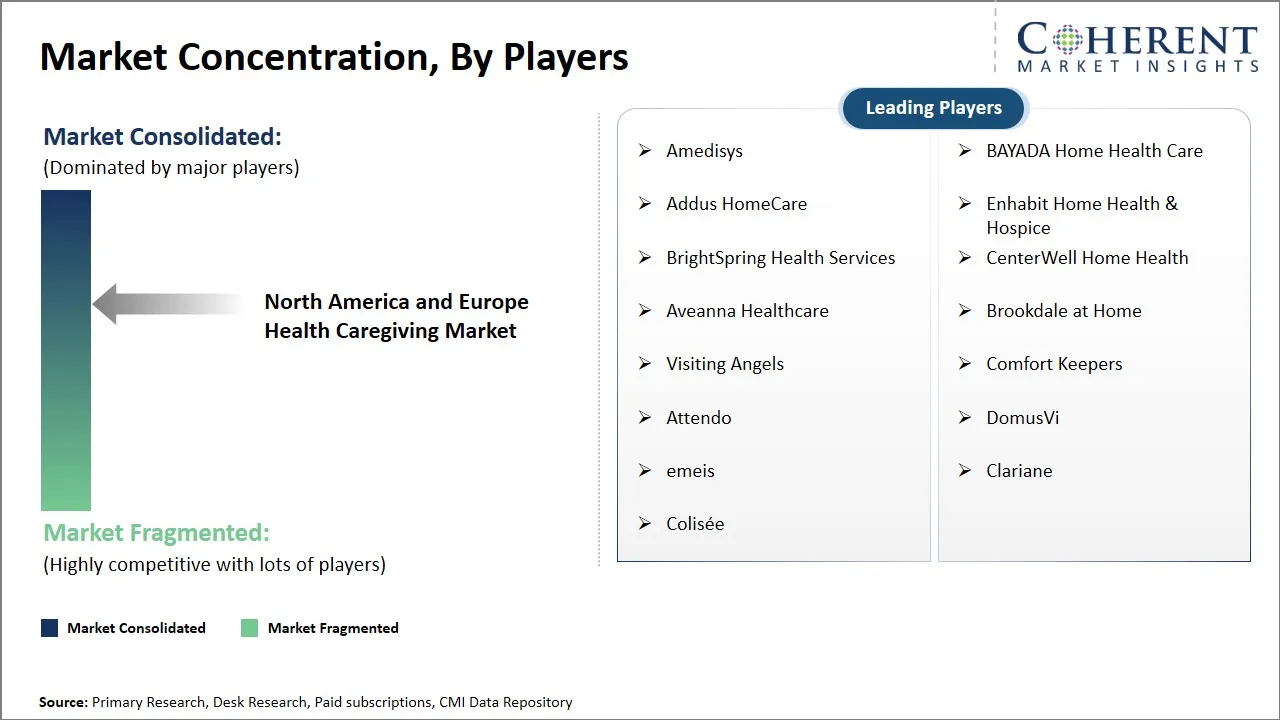
| Companies covered: | Amedisys, BAYADA Home Health Care, Addus HomeCare, Enhabit Home Health & Hospice, BrightSpring Health Services, CenterWell Home Health, Aveanna Healthcare, Brookdale at Home, Visiting Angels, Comfort Keepers, Attendo, DomusVi, emeis, Clariane, and Colisée | ||
| Growth Drivers: |
| ||
| Restraints & Challenges: |
| ||
North America and Europe Health Caregiving Market Dynamics
North America and Europe Health Caregiving Market Driver - Ageing Population and Rising Long-Term Care Demand
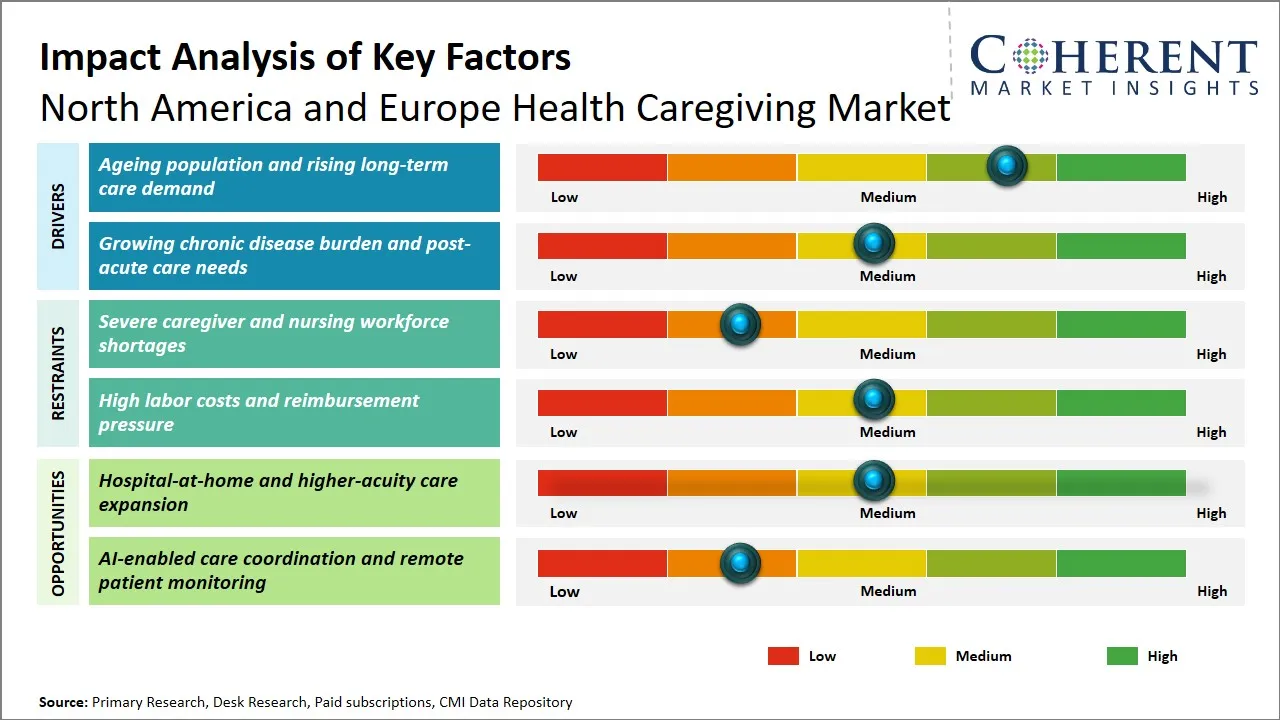
The rising ageing population is greatly driving the markets of North America and Europe health caregiving systems, which have been experiencing a greater demand in provision of the long-term care services. Since life expectancy is steadily increasing with the development of medical technology and healthier lifestyles, an increasing number of people are entering into the older age group that is generally accompanied by chronic diseases and disabilities that demand constant care giver assistance. This population movement is driving the requirements of both in-home based and institutional care provision such as assisted living homes and specialized nursing services. Moreover, the increasing rates of age-related illnesses like the Alzheimer disease and dementia complicate and extend the scope and time of care giving.
For instance, in November 2025, U.K.-based digital home healthcare provider, Cera Care announced the acquisition of GenieConnect, a care-robotics platform, to expand the deployment of AI-enabled home care robots across the U.K. The acquisition followed successful pilot programs conducted with more than 12 local councils and 30 care providers, where the robots supported elderly and vulnerable individuals living at home.
(Source- Cera Care)
North America and Europe Health Caregiving Market Opportunity - Expansion of Hospital-at-Home and Higher-Acuity Care Services
The healthcare markets of North America and Europe have a huge growth potential owing to the increasing number of hospital-at-home and more intensive care offering as a consequence of patient preferences, technological changes, and cost-control measures. The rise of personalized and patient-focused models of care is triggering the implementation of hospital-at-home programs that enable patients to get both acute and post-acute care in the safety of their own homes without a decrease in clinical outcomes relative to the conventional inpatient care environments. The model will minimize congestion in hospitals, decrease the chances of hospital-acquired infections and improve patient satisfaction in general.
For instance, in November 2024, Electronic Caregiver launched Addison Care, a virtual health assistant platform designed to support remote patient monitoring, continuous care engagement, and early risk detection for seniors and chronically ill patients at home. The launch is relevant to the expansion of hospital-at-home and higher-acuity caregiving services because it helps providers monitor patients more closely outside traditional care facilities and intervene earlier when health conditions worsen.
(Source- Electronic Caregiver)
Analyst Opinion (Expert Opinion)
- North America and Europe health caregiving market is expanding due to the fact that demand is no longer discretionary. The market is fast expanding due to ageing populations, increasing long term care utilization and home health payment support is maintaining momentum in the U.S. Another more substantial advantage is higher acuity home care, dementia support, and palliative care, and tech enabled coordination, yet workforce shortage remains a major weakness in the market. That is the greatest limitation of scale, margins, and quality of services in both areas.
- The direction is evident due to the recent events in the sector. The care model redesign, policy debate and operational innovation are the three areas in which the sector is bending, and the LeadingAge Annual Meeting and Global Ageing Network conference in Boston in 2025 presented more than 6,500 ageing services professionals. Simultaneously, Europe is already experimenting with viable solutions like the Barcelona pilot in 2026 that will have 600 support robots in homes and community centers taking care of older adults. That is the market in a nutshell; the demand of care increases, the number of workers reduce, and the pressure to apply technology and integrated delivery models to bridge the gap.
Speak to the analyst
Want personalized insights?
Take the findings above to one of our principal consultants, or have the report rebuilt around the segments, geographies and competitors you actually track.
Market Segmentation
- Service Type Insights (Revenue, USD Mn, 2021 - 2033)
- Daily Essential Activities
- Meals, Home, and Personal Care
- Home Delivery
- Others (Transportation services, etc.)
- Health and Safety Awareness
- Health Vital Alerts
- Diet and Nutrition
- Medication Management
- Personal Safety Monitoring
- Telehealth
- Care Coordination
- Care Planning
- Care Professional Engagement
- Others (Recovery Support, etc.)
- Transition Support
- Long-Term Care Insurance Planning
- Long-Term Care Provider Referral
- Others (Legal Assistance, etc.)
- Social Well-Being
- Daily Essential Activities
- End User Insights (Revenue, USD Mn, 2021 - 2033)
- Geriatric Population
- Disabled Population
- Pediatric Population
- Others (Neonatal, etc.)
- Therapeutic Area Insights (Revenue, USD Mn, 2021 - 2033)
- Neurological
- Oncology
- Cardiovascular
- Metabolic and Endocrine
- Genetic Disorders
- Others (Infectious Diseases, etc.)
- Regional Insights (Revenue, USD Mn, 2021 - 2033)
- North America
- U.S.
- Canada
- Europe
- Germany
- U.K.
- Spain
- France
- Italy
- Russia
- Rest of Europe
- North America
- Key Players Insights
- Amedisys
- BAYADA Home Health Care
- Addus HomeCare
- Enhabit Home Health & Hospice
- BrightSpring Health Services
- CenterWell Home Health
- Aveanna Healthcare
- Brookdale at Home
- Visiting Angels
- Comfort Keepers
- Attendo
- DomusVi
- emeis
- Clariane
- Colisée
Sources
Primary Research Interviews
Industry Stakeholders list
- Home health agency executives
- Nursing home administrators
- Assisted living facility managers
- Hospice care directors
- Long-term care policy specialists
- Digital care coordination platform executives
End-users list
- Family caregivers
- Elderly patients receiving home care
- Residents of assisted living communities
- Residents of nursing homes
- Patients using post-acute rehabilitation support
- Individuals receiving palliative or hospice care
Government and International Databases
- Centers for Medicare & Medicaid Services
- CMS Care Compare
- CMS Provider Data Catalog
- Eurostat
- OECD Health Statistics
- World Health Organization Europe IRIS
Trade Publications
- McKnight’s Long-Term Care News
- Home Health Care News
- Skilled Nursing News
- Behavioral Health Business
- Modern Healthcare
- Healthcare Finance News
Academic Journals
- Age and Ageing
- The Lancet Healthy Longevity
- The Lancet Public Health
- PLOS One
- Innovation in Aging
- The Journals of Gerontology Series B
Reputable Newspapers
- Financial Times
- The Wall Street Journal
- The New York Times
- The Guardian
- The Washington Post
Industry Associations
- LeadingAge
- Eurocarers
- Carers UK
- National Council on Aging
- European Ageing Network
- Alzheimer Europe
Public Domain Resources
- National Institute on Aging
- Administration for Community Living
- European Commission Long-Term Care Report
- WHO Europe State of Long-Term Care
- OECD Health at a Glance Europe
- EUR-Lex
Proprietary Elements
- CMI Data Analytics Tool: Proprietary analytics tool to analyze real-time market trends, consumer behavior, and technology adoption in market
- Proprietary CMI Existing Repository of Information for Last 8 Years
Get access to 250+ pages report
Every segment, forecast, competitor profile and data table behind the analysis above — available for instant download.
- ESOMAR Member
- ISO 9001:2015 Certified
- D-U-N-S Registered
- GDPR & CCPA Compliant
Missing comfort of reading report in your local language? Find your preferred language:
Transform your Strategy with Exclusive Trending Reports
Frequently Asked Questions
The North America and Europe health caregiving market is estimated to be valued at USD 330,414.2 million in 2026 and is expected to reach USD 562,522.9 million by 2033.
The CAGR of North America and Europe health caregiving market is projected to be 11.1% from 2026 to 2033.
Ageing population and rising long-term care demand and growing chronic disease burden and post-acute care needs are the major factors driving the growth of the North America and Europe health caregiving market.
Severe caregiver and nursing workforce shortages and high labor costs and reimbursement pressure are the major factors hampering the growth of the North America and Europe health caregiving market.
Home-based care is gaining ground because it is more aligned with ageing-in-place preferences, can reduce pressure on hospitals and residential facilities, and is receiving continued reimbursement and policy backing. CMS’s 2025 rule shows that home health remains an active policy priority in North America.
Technology is moving from optional to essential. Europe is pushing interoperability and digitally connected care systems, while AI, remote monitoring, wearables, and assistive tools are increasingly being used to improve caregiver productivity, safety monitoring, and care coordination.
In terms of service type, daily essential activities are estimated to dominate the market revenue share in 2026.