

North America Workplace Conflict Management Solution Market Size and Forecast – 2026 to 2033
The North America workplace conflict management solution market is estimated to be valued at USD 3.96 Bn in 2026 and is expected to reach USD 8.32 Bn by 2033, exhibiting a compound annual growth rate (CAGR) of 11.2% from 2026 to 2033.
Key Takeaways of the North America Workplace Conflict Management Solution Market
- The mediation segment leads the market holding an estimated share of 34.2 % in 2026.
- The services segment is projected to dominate with a share of 60.7 % in 2026.
- The large enterprises segment is estimated to lead the market with a share of 67.1 % in 2026.
Market Overview
The market is seeing a rising adoption of advanced digital tools and AI-driven conflict resolution solutions that make possible real-time dispute monitoring and resolution. Organizations are investing a lot in customized conflict management programs to address remote and hybrid work challenges, focusing on promoting collaboration and reducing workplace stress. Also, there is a lot of focus on integrating conflict management solutions with overall employee wellness and organizational culture strategies to add to long-term business performance.
Current Events and Its Impact
Current Events | Description and its Impact |
Geopolitical and Trade Developments |
|
Economic and Infrastructure Trends |
|
Segmental Insights
- Current Industry Events of 2026
- Market Size Estimation
- Regional Breakdown
- Competitive Landscape
- Customer Intelligence
- Segmental Analysis
- Pricing Analysis
- Key Market Drivers, Challenges & Future Trends
- Customized Insights Section
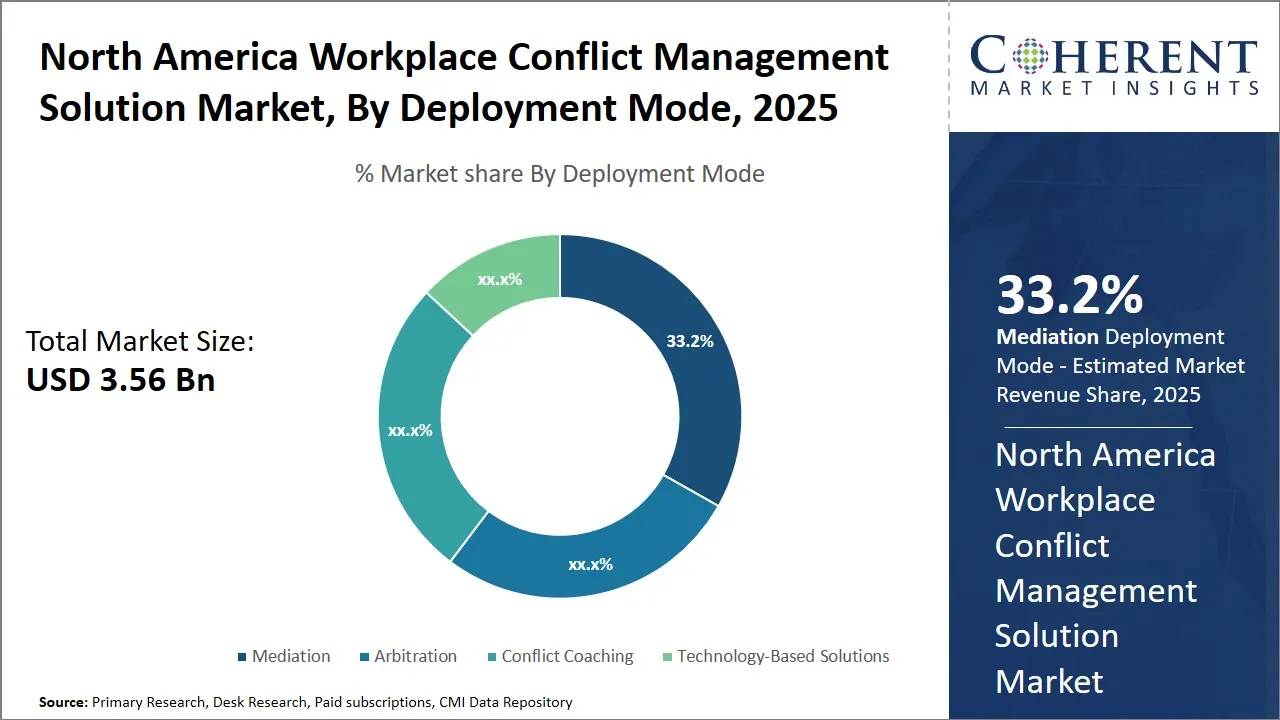
North America Workplace Conflict Management Solution Market Insights, by Deployment Mode – Mediation Segment Dominates Because of Its Effectiveness in Resolving Workplace Conflicts
The mediation segment leads the North America workplace conflict management solution market, holding an estimated share of 34.2% in 2026, because of its ability to facilitate direct communication and mutual understanding between disputing parties. Mediation’s focus on dialogue and collaborative problem-solving appeals to organizations looking for sustainable focus without escalating conflicts into costly or lengthy legal battles. This approach helps maintain workplace relationships, preserves employee morale, and fosters a culture of openness and trust, which are important values in today’s dynamic corporate environments.
Companies increasingly use mediation because it provides a confidential and less adversarial platform for addressing disputes, which is important in sensitive workplace situations. The process is also flexible, helping organizations adjust mediation sessions based on culture, conflict type, and stakeholder involvement, improving the likelihood of compliance with mutually agreed-upon outcomes.
Also, regulatory and compliance pressures push employers to adopt mediation to handle grievances fast and effectively. It is a preventive tool that can reduce the risk of lawsuits and regulatory penalties. For HR teams and corporate leaders, mediation offers a proactive method that aligns with broader organizational goals like employee retention, productivity, and workplace harmony.
The cost-effectiveness of mediation compared to arbitration or litigation is another big factor adding to its market dominance. Mediation typically needs fewer resources and shorter timelines, appealing to enterprises that want to control dispute resolution expenses. Also, mediation supports confidentiality, which is very important for companies’ protective of their reputation and employee privacy.
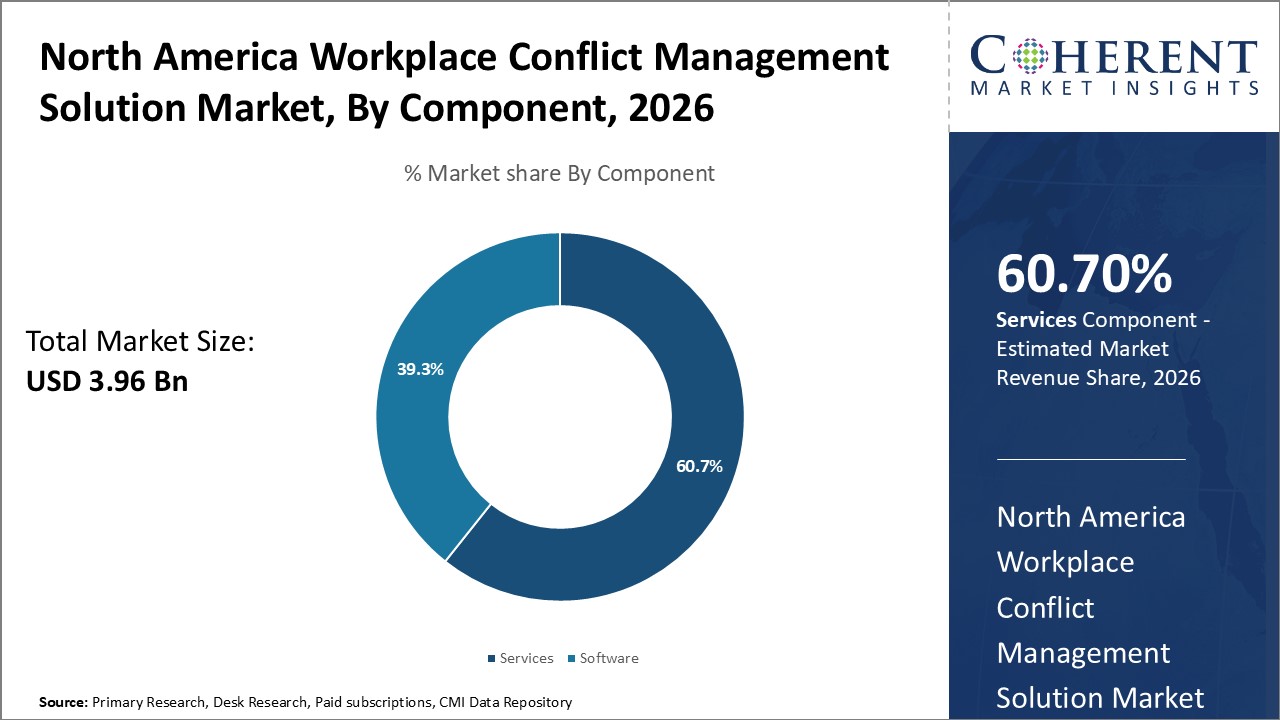
North America Workplace Conflict Management Solution Market Insights, by Component – Services Segment Leads Because of Customized Human Expertise and Support
The services segment is expected to capture 60.7% share in 2026, because of the important role of expert human intervention in conflict resolution. Unlike software solutions, service-oriented offerings bring a personalized, adaptive dimension to managing workplace disputes that technology cannot replicate. Skilled mediators, arbitrators, and conflict coaches play a big role in interpreting complex interpersonal dynamics that need empathy, cultural sensitivity, and real-time judgment.
Organizations rely a lot on conflict management services to provide tailored strategies and implementations suited to their unique internal politics and employee demographics. These services include consultation, training, coaching, and on-demand resolution assistance, which build internal capacities and help companies develop strong conflict management frameworks. Service providers often work closely with HR and leadership teams to understand organizational culture and customize interventions that align with company values and compliance standards.
The complexity of workplace conflicts, especially in diverse and highly regulated industries, need continuous human engagement to navigate nuances like power imbalances, unconscious biases, and emotional undercurrents. Conflict resolution services add value by pushing skill development and providing coaching that helps employees and managers address conflicts constructively before escalation.
Also, service models offer ongoing support through workshops, policy development, and follow-up sessions, ensuring sustainable conflict management rather than one-time fixes. This support improves employee relations and adds to the overall health of organizational culture, a big factor adding to demand for services over standalone software products. The use of human expertise with process-oriented solutions underscores the preference for service components.
For instance, Pollack Peacebuilding Systems, a U.S.-based conflict resolution service provider, has been actively working with Fortune 500 companies and government agencies to deliver customized conflict management services.
North America Workplace Conflict Management Solution Market Insights, by Functionality – Large Enterprises Segment Dominate because of Complexity and Resource Availability
The large enterprises segment is projected to hold 68.1% share in 2026, because of the complexity and scale of their organizational structures. These companies often manage extensive workforces distributed in multiple locations, resulting in a higher potential for interpersonal and interdepartmental conflicts that need advanced conflict management techniques. Large enterprises have greater financial and human resources, allowing them to invest in comprehensive conflict management frameworks that combine different deployment modes and components, like mediation services supported by technology-based tracking systems. The scale of these organizations needs formalized, standardized policies and the engagement of professional conflict resolution experts to ensure consistency, fairness, and compliance with labor laws and regulations.
Also, corporate governance in large enterprises often focus risk management and reputational protection, which adds to the adoption of structured conflict management solutions to mitigate legal exposure and maintain stakeholder confidence. They often use specialized conflict coaching, arbitration, and mediation processes to manage these challenges in a better way, supported by sophisticated software in some cases.
Impact of AI on the North America Workplace Conflict Management Solution Market
Artificial Intelligence (AI) is making possible proactive identification and resolution of disputes. AI tools analyze communication patterns, like emails and chat logs, to detect early signs of tension in team members. For instance, platforms like Personos use sentiment analysis to predict potential conflicts and provide real-time feedback to employees, making a collaborative environment. Tyler Technologies’ AI-powered Modria platform has been widely used in the U.S. for online dispute resolution, including employment-related conflicts.
Market Players, Key Development, and Competitive Intelligence
Key Developments
- On September 16, 2025, Workday, Inc., the enterprise AI platform for managing people, money, and agents, entered into a definitive agreement to acquire Sana, a leading AI company building the next generation of enterprise knowledge tools.
- On September 9, 2025, Global HR research and advisory firm McLean & Company launched its HR Crisis Response Resource Center, a comprehensive hub designed to help HR leaders prepare for, respond to, and recover from organizational crises. The new center offers phase-based resources segmented into Prepare, Protect, Recover, and Learn, along with templates, communication guides, wellbeing tools, and direct analyst support.
- In June 2025, Remote, the leading global HR platform, announced that its purpose-built HRIS, the first Human Resources Information System designed from day one for globally distributed teams, is now available to companies worldwide.
- In August 2024, HR Acuity, the enterprise leader in employee relations case management and investigations software, announced the launch of its next generation employee relations and investigations platform, which informs strategic decision-making, provides proactive insights and helps prevent future issues.
Top Strategies Followed by the North American Workplace Conflict Management Solution Market
- Established players dominate through a lot of investments in research and development (R&D), pushing innovation to create high-performance, scalable conflict management platforms that address different organizational needs.
- JAMS Inc., a leading provider of mediation and arbitration services, has invested in virtual mediation platforms and advanced case management systems.
- Mid-level players in the North American workplace conflict management solution market focus on delivering cost-effective products that offer a balance between quality and affordability.
- Modria focuses on delivering affordable, scalable Online Dispute Resolution (ODR) platforms for HR departments and government agencies. By automating parts of the conflict resolution process, Modria reduces costs greatly, appealing to mid-sized organizations and public institutions that are price-sensitive.
- Small-scale players carve out niches within the North American conflict management solution ecosystem by concentrating on specialized features, innovative product designs, and emerging technological trends.
- The Mediation Group, a smaller provider, has carved out a niche by offering specialized workplace conflict management services tailored for nonprofit organizations and academic institutions.
Market Report Scope
North America Workplace Conflict Management Solution Market Report Coverage
| Report Coverage | Details | ||
|---|---|---|---|
| Base Year: | 2025 | Market Size in 2026: | USD 3.96 Bn |
| Historical Data for: | 2020 To 2024 | Forecast Period: | 2026 To 2033 |
| Forecast Period 2026 to 2033 CAGR: | 11.2% | 2033 Value Projection: | USD 8.32 Bn |
| Segments covered: |
| ||
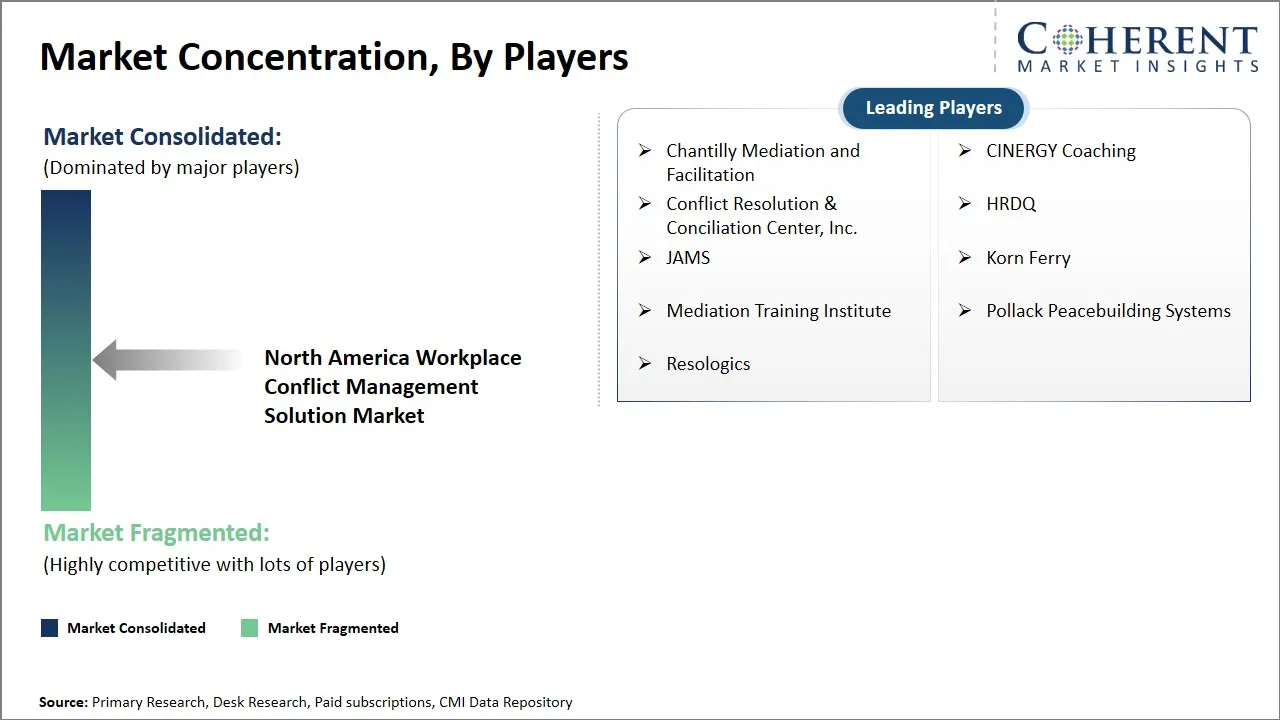
| Companies covered: | Chantilly Mediation and Facilitation, CINERGY Coaching, Conflict Resolution & Conciliation Center, Inc., HRDQ, JAMS, Korn Ferry, Mediation Training Institute, Pollack Peacebuilding Systems, and Resologics | ||
| Growth Drivers: |
| ||
| Restraints & Challenges: |
| ||
Market Dynamics
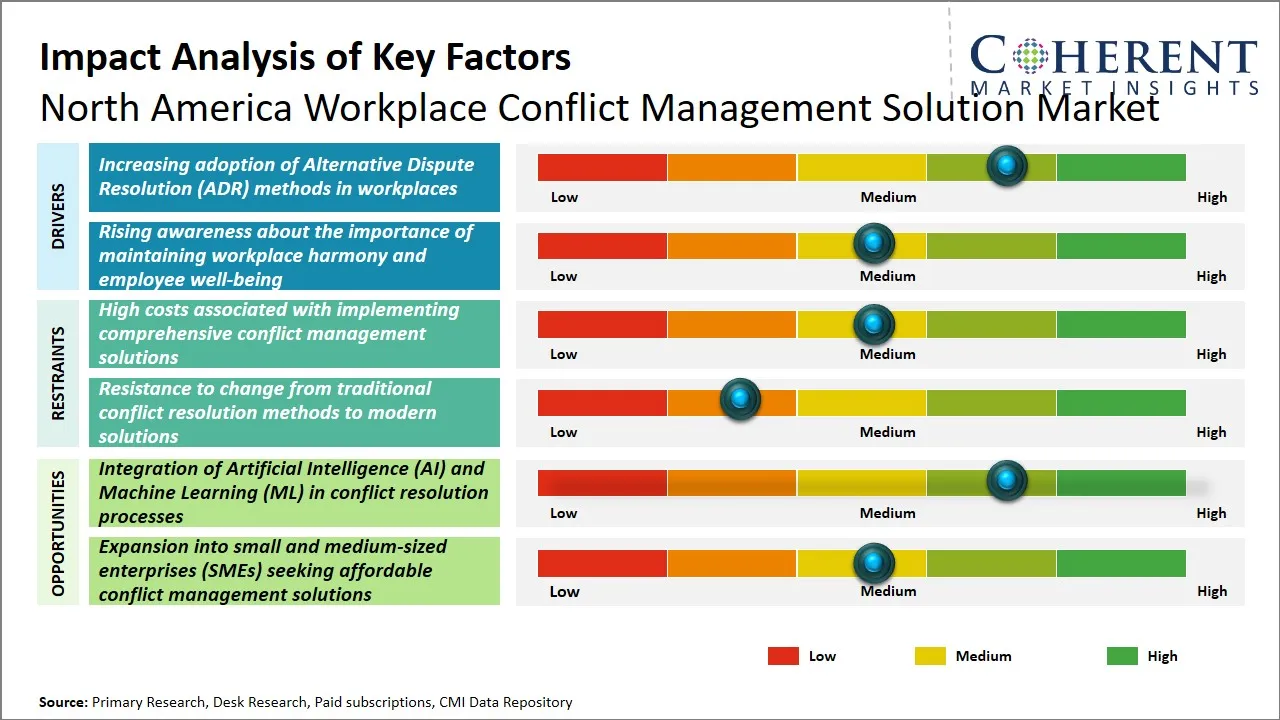
North America Workplace Conflict Management Solution Market Driver – Increasing Adoption of Alternative Dispute Resolution (ADR) Methods in Workplaces
The growing demand for Alternative Dispute Resolution (ADR) methods is making demand for workplace conflict management solutions in North America. Organizations are seeing the value of ADR techniques like mediation, arbitration, and negotiation to resolve disputes efficiently, cost-effectively, and with less disruption to business operations. This shift is because of the need for faster resolution cycles, preserving workplace relationships, and maintaining employee morale.
Also, the rise of complex employment issues, including discrimination claims, harassment complaints, and contractual disagreements, has added to the importance of having structured conflict management frameworks that can handle disputes internally. Employers are investing in digital platforms and training programs that make possible ADR processes, ensuring conflicts are addressed proactively before escalating. The legal and regulatory environment, focusing on fair and prompt dispute resolution, also pushes organizations to use ADR methods.
North America Workplace Conflict Management Solution Market Opportunity – Integration of Artificial Intelligence (AI) and Machine Learning (ML) in Conflict Resolution Processes
The North America workplace conflict management solution market shows a big opportunity through the use of Artificial Intelligence (AI) and Machine Learning (ML) technologies in conflict resolution processes. Organizations are seeing the complexity and sensitivity involved in managing workplace disputes, which has made demand for innovative tools that can provide unbiased, data-driven insights. The predictive analytics powered by ML can forecast conflict trends and help HR managers proactively address underlying issues in organizational culture or team dynamics. To add, AI-driven chatbots and virtual mediators offer scalable conflict management support, ensuring 24/7 availability and reducing dependence on human mediators.
Analyst Opinion (Expert Opinion)
- Platforms increasingly focus on detecting and resolving interpersonal disputes in teams. Using AI-driven sentiment analysis and communication monitoring, they can see friction between employees early and provide mediation guidance before issues grow.
- Many solutions now target hierarchical conflicts, like disagreements between employees and supervisors or conflicts arising from management decisions. These platforms offer structured feedback channels, anonymous reporting, and decision support tools to mediate such disputes in a better way.
- Advanced platforms also handle conflicts outside of the organization, including disputes with suppliers, vendors, and contractors. By tracking contractual obligations, deadlines, and communications, these systems can find potential issues and propose resolution strategies, reducing operational disruptions.
Speak to the analyst
Want personalized insights?
Take the findings above to one of our principal consultants, or have the report rebuilt around the segments, geographies and competitors you actually track.
Market Segmentation
- Deployment Mode Insights (Revenue, USD Bn, 2021 - 2033)
- Mediation
- Arbitration
- Conflict Coaching
- Technology-Based Solutions
- Component Insights (Revenue, USD Bn, 2021 - 2033)
- Services
- Software
- Functionality Insights (Revenue, USD Bn, 2021 - 2033)
- Large Enterprises
- Small and Medium-sized Enterprises (SMEs)
- End User Insights (Revenue, USD Bn, 2021 - 2033)
- Healthcare
- Financial Services
- Information Technology
- Manufacturing
- Government
- Retail
- Others
- Key Players Insights
- Chantilly Mediation and Facilitation
- CINERGY Coaching
- Conflict Resolution & Conciliation Center, Inc.
- HRDQ
- JAMS
- Korn Ferry
- Mediation Training Institute
- Pollack Peacebuilding Systems
- Resologics
Sources
Primary Research Interviews
Stakeholders
- HR Managers and Conflict Resolution Specialists in Large Enterprises
- Workplace Mediation and Arbitration Consultants
- Organizational Psychologists and Employee Engagement Experts
- SME Owners and HR Heads adopting conflict management platforms
- Legal Advisors specializing in labor disputes and employment law
- AI and SaaS Solution Providers for workplace conflict resolution
Databases
- U.S. Bureau of Labor Statistics (BLS)
- North American HR Analytics Database (NAHRAD)
- Employee Engagement Index (EEI)
- OECD Labor and Employment Statistics
Magazines
- HR Today
- Workplace Dynamics Magazine
- Corporate Governance Monthly
- Employee Relations & Management Journal
Journals
- Journal of Organizational Behavior
- International Journal of Conflict Management
- Journal of Human Resource Management
- AI in Management and Workplace Studies
Newspapers
- The Wall Street Journal
- The New York Times (Business & Workplace Section)
- HR Daily News
- The Globe and Mail (Canada)
Associations
- Society for Human Resource Management (SHRM)
- American Arbitration Association (AAA)
- Association for Talent Development (ATD)
- International Association of Workplace Mediation (IAWM)
- National Association of Professional Organizers (NAPO)
Public Domain Sources
- U.S. Census Bureau – Employment and Workplace Data
- EUROSTAT – Labor Market Statistics
- United Nations Global Compact – Human Rights and Labor Practices
- World Bank – Labor & Social Protection Indicators
- ResearchGate – Peer-Reviewed Workplace Conflict Studies
Proprietary Elements
- CMI Data Analytics Tool, Proprietary CMI Existing Repository of information for last 8 years
Get access to 250+ pages report
Every segment, forecast, competitor profile and data table behind the analysis above — available for instant download.
- ESOMAR Member
- ISO 9001:2015 Certified
- D-U-N-S Registered
- GDPR & CCPA Compliant
Missing comfort of reading report in your local language? Find your preferred language:
Transform your Strategy with Exclusive Trending Reports
Frequently Asked Questions
The North America workplace conflict management solution market is estimated to be valued at USD 3.96 billion in 2026 and is expected to reach USD 8.32 billion by 2033.
The CAGR of the North America workplace conflict management solution market is projected to be 11.2% from 2026 to 2033.
Increasing adoption of Alternative Dispute Resolution (ADR) methods in workplaces and rising awareness about the importance of maintaining workplace harmony and employee well-being are the major factors driving the growth of the North America workplace conflict management solution market.
High costs associated with implementing comprehensive conflict management solutions and resistance to change from traditional conflict resolution methods to modern solutions are the major factors hampering the growth of the North America workplace conflict management solution market.
In terms of deployment mode, the mediation segment is estimated to dominate the market revenue share in 2026.
Tools or platforms designed to prevent, manage, and resolve conflicts among employees or between employees and management.
Interpersonal disputes, manager-employee conflicts, team disagreements, and supplier/vendor disputes are addressed.