

Global Orange Juice Market Size and Forecast – 2026-2033
According to Coherent Market Insights, the global orange juice market is estimated to be valued at USD 7.45 Bn in 2026 and is expected to reach USD 12.52 Bn by 2033, exhibiting a compound annual growth rate (CAGR) of 7.7% from 2026 to 2033.
Key Takeaways of the Orange Juice Market
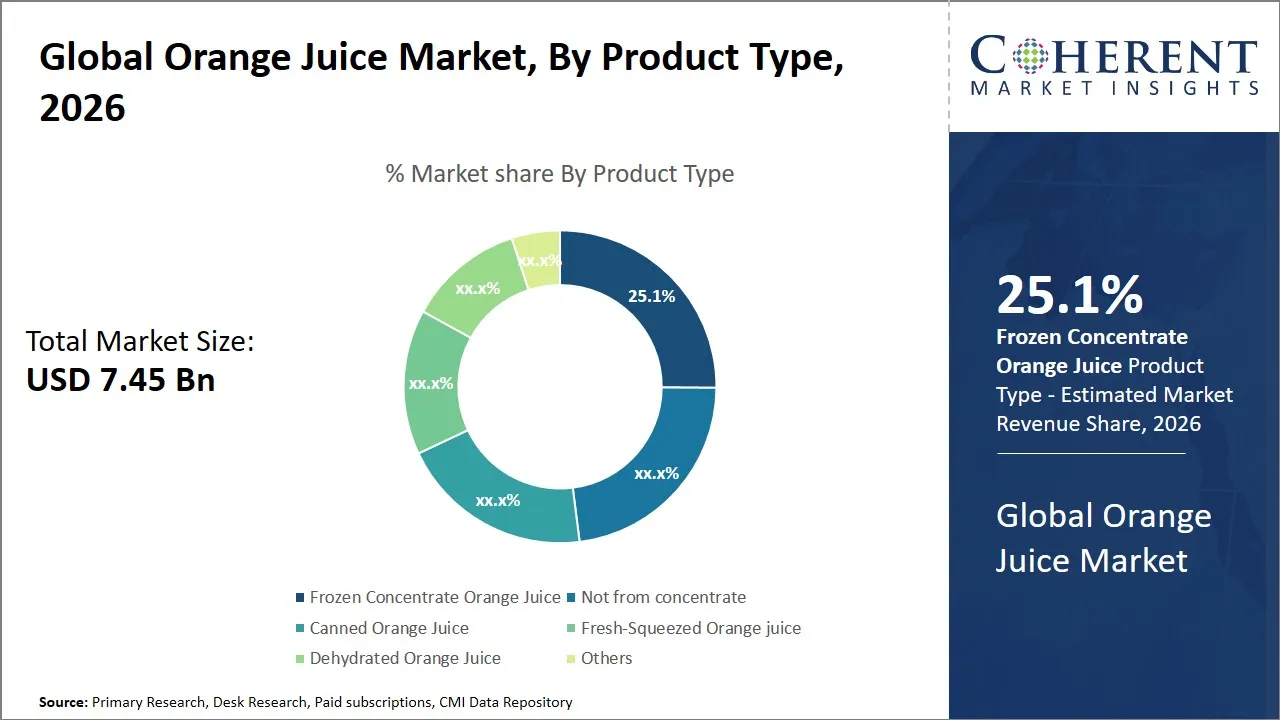
- Frozen concentrate orange juice is expected to capture 25.1 % of the global orange juice market in 2026.
- The bottles segment is projected to account for 38.7 % of the orange juice market in 2026.
- Supermarkets/hypermarkets are expected to hold 34.7 % share of the global orange juice market in 2026.
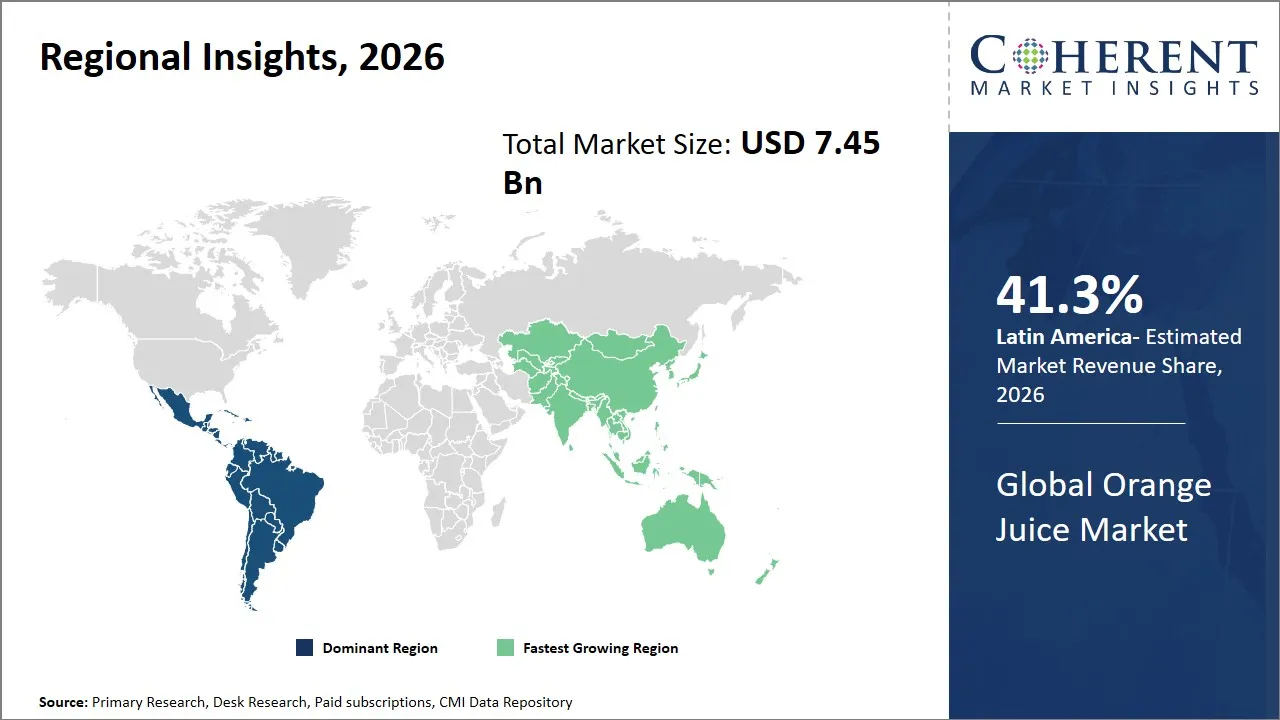
- The Latin America region is expected to dominate the market with a 41.3 % share in 2026, supported by major orange-producing countries like Brazil and Mexico, which form the foundation of the market ecosystem.
- The Asia Pacific region is forecasted to experience the fastest growth in the market, contributing a 19.3 % share in 2026.
Market Overview
- A notable trend in the orange juice market is the growing preference for fresh, cold-pressed, and minimally processed fruit juice, fueled by health-conscious consumers seeking nutrient-rich alternatives to sugary drinks.
- Additionally, innovation in packaging and convenience formats, such as single-serve and on-the-go options, is enhancing market appeal.
- Sustainability practices, including eco-friendly packaging and ethical sourcing, are also shaping consumer choices, pushing manufacturers to adopt more responsible production methods.
Current Events and Its Impact
Current Events | Description and its impact |
U.S. Tariffs on Brazilian Orange Juice Imports |
|
Citrus Greening and Weather‑Driven Supply Constraints |
|
Segmental Insights
- Current Industry Events of 2026
- Market Size Estimation
- Regional Breakdown
- Competitive Landscape
- Customer Intelligence
- Segmental Analysis
- Pricing Analysis
- Key Market Drivers, Challenges & Future Trends
- Customized Insights Section
Why Does the Frozen Concentrate Orange Juice Segment Dominate the Orange Juice Market in 2026?
Frozen concentrate orange juice segment is projected to hold 25.1% share in the global orange juice market in 2026, largely propelled by its convenience and economic benefits. The freshly squeezed juice is made into frozen concentrate orange juice by removing water which makes it considerably lighter and smaller in size, which means it is easy to store and transport. The feature significantly reduces logistics expenses and shelf space demands to retailers, and is thus a desirable choice to both suppliers and vendors in the supply chain.
The concentrated form is also attractive to consumers who look into the product of the juice, which is longer lasting. FCOJ is long-lasting and can be preserved without much loss in flavor or nutritional value, which makes it suitable to the lifestyle of the consumers that require a lot of flexibility and less spoilage. In addition, it serves effectively to both households and foodservice organizations as it allows them to prepare orange juice on-command and in the right amounts, which facilitates a fresh taste with minimal effort.
Bottles Segment Dominates the Orange Juice Market
Bottles segment is projected to hold 38.7% share of the orange juice market in 2026, driven primarily by consumer preference for portability and perceived product quality. Bottled orange juice is usually thought of as a product of freshness and high-end quality particularly when it is produced using the not-from-concentrate or fresh-squeezed juice varieties, which is congruent with the growing health awareness culture of consumers today.
Plastic and glass bottles are transparent and the buyers can physically evaluate the product which increases the level of trust and purchase intentions. In addition, the bottles offer considerable convenience parameters which facilitate their extensive use. They are convenient to use, can be closed and re-opened, in addition to being consumed on the move and this makes them ideal in schedules of the busy person or those who use them as a family.
Why are Supermarkets/Hypermarkets Dominating the Orange Juice Market?
Supermarkets/hypermarkets segment is projected to hold 34.7% share of the global orange juice market in 2026, due to their better accessibility and consumer shopping experiences. These super-sized retail stores have a tremendous variety of orange juice products in a single store that meets the different consumer needs effectively. The ability to have a range of brands, packaging types, and variations of products is an advantage to the shoppers that motivate exploration and return buying behavior.
Supermarkets and hypermarkets have enough shelf space that gives manufacturers a chance to display their entire portfolio of products including high-end and low-end products. The recognition, achieved in such environments, is converted into greater brand awareness and consumer confidence. These stores also tend to have promotions, discounts, and loyalty programs which also contribute to further boosting the sales of orange juice since they attract cost efficient consumers.
Regional Insights
Latin America Orange Juice Market Analysis and Trends
The Latin America region is projected to lead the market with a 41.3% share in 2026. The region boasts some of the world’s largest orange-producing countries, such as Brazil and Mexico, which serve as the backbone of the market ecosystem. The country of Brazil is specifically the leading country in the production and export of orange juice globally, with the help of conducive climatic conditions and huge acreage of land devoted towards the production of oranges.
There are also established supply chains and strong processing industry that contribute to the efficiency of production and quality of products. Other large producers such as Orange Juice Brazil, Citrosuco, and Cutrale have large plantations and factories to process orange juice which is a major contributor to local consumption as well as international trade. Its dominance is also enhanced by the integration of the regions into the global trade networks such as export agreements, and logistical infrastructure.
Asia Pacific Orange Juice Market Analysis and Trends
The Asia Pacific region is expected to exhibit the fastest growth in the market contributing 19.3% share in 2026, driven by rising consumer health awareness, increasing disposable incomes, and expanding retail infrastructure across emerging economies such as China, India, and Southeast Asian countries. The dynamic market ecosystem of the regions is characterized by an increase in urbanization and the changing lifestyle of people in favor of convenient and nutritious drinks.
The governments of major countries are promoting the modernization and facilitation of imports to the agricultural industry, which allows the stable supply of oranges even though not all the areas produce the oranges domestically.
Players in the industry such as Tata Consumer Products, China Huiyuan Juice Group and F&N Holdings are being innovative by product diversification and local taste that is in line with the regional likes. This is also enhanced by increasing the cold chain logistics and broader distribution by way of supermarkets, convenience stores and e-commerce platforms that will assist orange juice to penetrate various consumer segments. The forces of trade such as the high importation of the concentrate and ready-to-drink juices supplement nascent local capacities to produce so as to supply the burgeoning demand.
Global Orange Juice Market Outlook for Key Countries
Why is Brazil Dominating the Global Orange Juice Market?
Brazil is still the giant in the orange juice market, as both production and exports are dominated. The favorable climate in the country and the large size of the plantations allow year-round harvesting, and the technological development of the processing technology provides the constant availability of high-quality concentrated orange juice. Companies such as Citrosuco and Cutrale are not only great exporters but they are sustainability and vertical integration innovators that assist in keeping Brazils ahead of the pack. Their large presence affects the supply of the world hence Brazil is a strategic marketplace to the international markets.
U.S. Orange Juice Market Trends
The U.S. orange juice market can be characterized as having high consumption demand due to health-conscious individuals demanding orange juices. Florida is another key producer center where other companies, such as Floridas Natural and Tropicana, continue to control large market shares. Consumer trust is backed by government regulations that put a high level of value on food safety and quality standards. The established retail and foodservice networks in the country lead to wide product availability, and the trade policies permit imports to complement the supply.
China Orange Juice Market Trends
China’s orange juice market is developing rapidly, as it is affected by the rising number of middle classes and the necessity to consume healthy drinks. Despite limited domestic orange production, the country imports large quantities of concentrated and ready-to-drink orange juice. Large companies like China Huiyuan Juice Group and domestic units of international corporations are increasing their presence through localizing products according to the Chinese taste and spending on advertising campaigns focusing on the health advantage. Government-driven agricultural and food safety standards play a key role in developing local supply chains, despite the reliance on imports.
Why Is India’s Orange Juice Market Gaining Momentum Amid Urbanization and Health Trends?
The India orange juice market demonstrates the emergent demand which is promoted by urbanization and the increasing level of health consciousness. Although there is domestic orange production, these are mainly used in fresh fruit production as opposed to manufacturing of juice hence reliance on imports. Firms such as Dabur and Parle Agro have exploited the market by providing orange juice versions under the well-known brands with localized formulations. The government is slowly promoting the diversification of agriculture and the development of cold chain infrastructure, which along with the enlargement of retail forms, contributing to the growth of the market.
Mexico Orange Juice Market Trends
Mexico is a major producer as well as an emerging consumer of orange juice. It is well located with close access to the U.S. market with support from integrated agriculture and processing industries. Grupo Lala and Jugos del Valle are the companies and these contribute to product innovation and export quality standards. The local market is also strong, as the number of people willing to drink healthy and convenient drinks is growing. The existing trade agreements with North America also allow easy cross-border movements of juice and concentrate, which strengthens the competitive edge of Mexico.
Supply-Side Volatility Exposure of Orange Juice
Factor | Impact | Potential Exposure |
Production Volume Fluctuations | Variability in orange crop yields due to weather patterns, diseases, and pests | High |
Raw Material Costs | Volatility in orange prices due to crop failures or surplus supply | Medium to High |
Climate Change Impact | Increased risk of extreme weather events like hurricanes, droughts, etc. | High |
Market Players, Key Development, and Competitive Intelligence
Key Developments
- Egypt, the world’s second largest exporter of fresh oranges and the leading exporter of affordable oranges, is on the cusp of a transformative shift in its citrus industry. EastFruit’s team with reference to industrial representatives, reports that in 2026, six new factories dedicated to producing orange juice concentrate are set to commence operations, with a combined processing capacity of approximately 2 million tons per year.
- In April 2025, Tropicana launched ‘Fresh & Light’ range in Pure-Pak cartons. Landing on all major British retailer shelves this spring in Pure‑Pak cartons, ‘Fresh & Light’ brings the fresh taste of Tropicana with less sugar for a lighter alternative to standard fruit juice products. Launched at the end of March 2025 and to roll out across all major U.K. supermarkets by the end of April, the new range is a blend of pressed fruits and water to provide a reduced sugar juice drink.
Top Strategies Followed by Global Orange Juice Market Players
Player Type | Strategic Focus | Example |
Established Market Leaders | Heavy investment in R&D and innovation | For example, Tropicana has emphasized on the nutritional content of its juices through the introduction of low-sugar and fortified juices. Such firms make use of modern technologies such as cold-press and pressure high (HPP) to maintain the natural nutrients in the juices and improve the shelf life. |
Mid-Level Players | Balance cost and sustainability by offering affordable alternatives to social plastic products | The Simply Orange Juice Company (Coca Cola Company) or regional brands such as Florida’s Natural target cost-sensitive consumers by offering affordable yet high-quality products. These players tend to focus on creating affordable solutions without sacrificing product quality. |
Small-Scale Players | Niche specialization & innovative variants | For example, Suja Juice has developed a robust brand of organic, non-GMO, and cold-pressed juices, enabling it to stand out of the crowd of its competitors in the mass-market. These mini producers spend a lot of money on state-of-the-art technologies such as high-pressure processing (HPP) and novel packaging that make sure that the juices should not lose their freshness and nutritional value without preservatives. |
Market Report Scope
Report Coverage
| Report Coverage | Details | ||
|---|---|---|---|
| Base Year: | 2025 | Market Size in 2026: | USD 7.45 Bn |
| Historical Data for: | 2020 To 2024 | Forecast Period: | 2026 To 2033 |
| Forecast Period 2026 to 2033 CAGR: | 7.7% | 2033 Value Projection: | USD 12.52 Bn |
| Geographies covered: |
| ||
| Segments covered: |
| ||
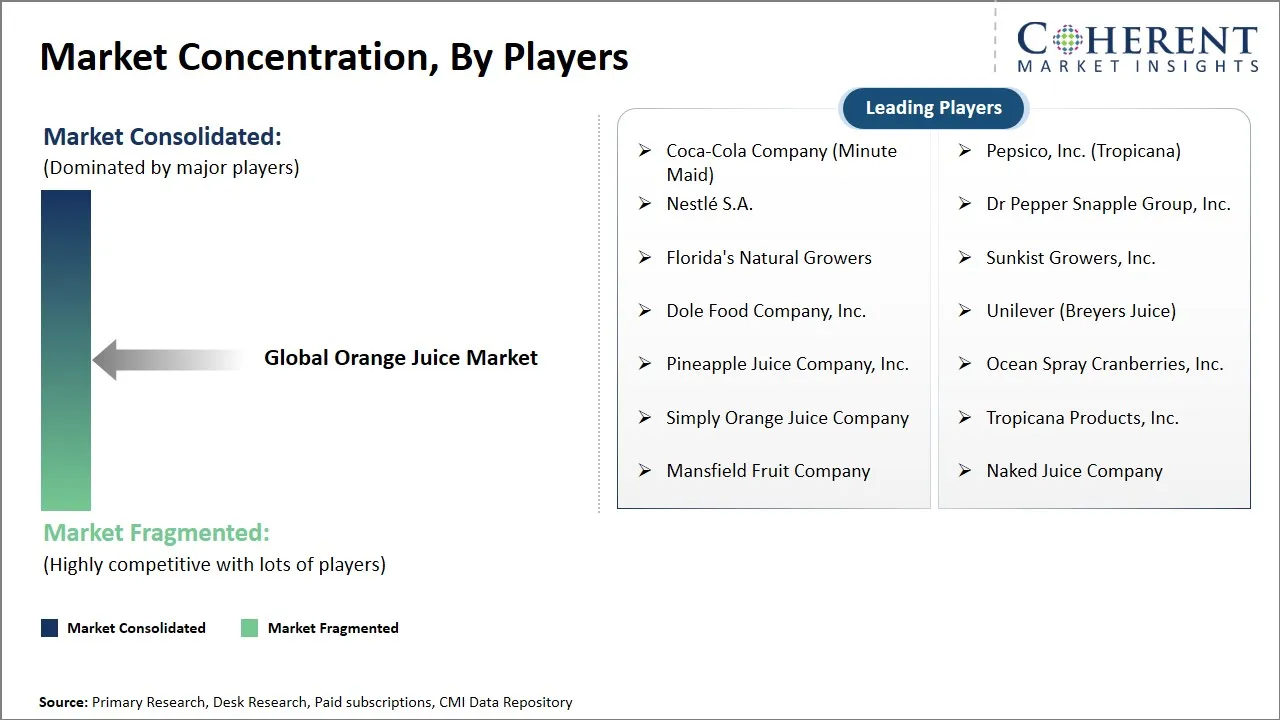
| Companies covered: | Coca-Cola Company (Minute Maid), Pepsico, Inc. (Tropicana), Nestlé S.A., Dr Pepper Snapple Group, Inc., Florida's Natural Growers, Sunkist Growers, Inc., Dole Food Company, Inc., Unilever (Breyers Juice), Pineapple Juice Company, Inc., Ocean Spray Cranberries, Inc., Simply Orange Juice Company, Tropicana Products, Inc., Mansfield Fruit Company, and Naked Juice Company | ||
| Growth Drivers: |
| ||
| Restraints & Challenges: |
| ||
Orange Juice Market Dynamics
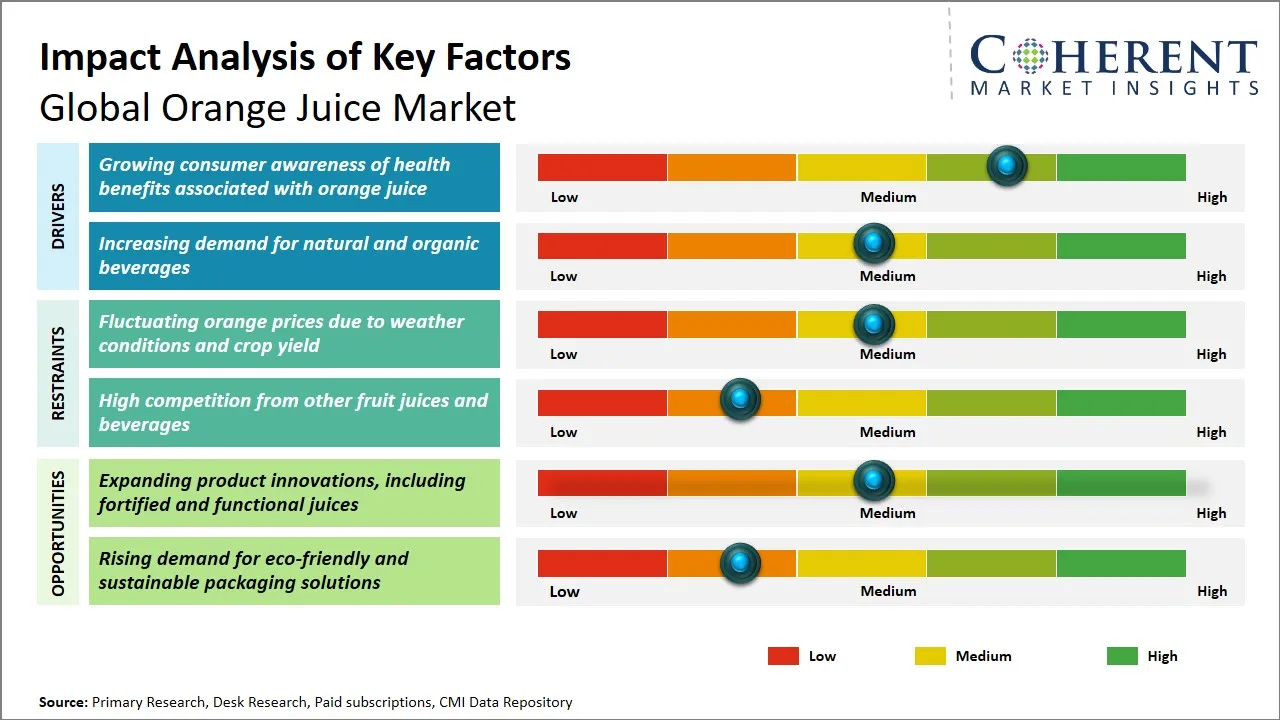
Orange Juice Market Driver - Growing Consumer Awareness of Health Benefits Associated with Orange Juice
The growing consumer concern about health and wellness has been a major factor causing growth in the demand for orange juice in most parts of the world. With more people becoming health-conscious consumers, the awareness about the nutritional value of orange juice like its high concentration of vitamin C. Antioxidants and other important nutrients has turned out to be one of the driving forces in buying behavior. Orange juice is well known to improve the immune system, the health of the heart, and potentially provide natural energy, which is why it is a popular alternative of consumers who are health conscious.
Consumer health consciousness has increased hence sales of orange juice have also increased especially in the regions such as North America and Europe. A study by the European Food Information Council (EUFIC) also found that 45% of European customers said they are more likely to have drinks with high content of vitamin C and antioxidants to strengthen their immune system.
(Source: https://www.eufic.org/en/)
Orange Juice Market Opportunity - Expanding Product Innovations, Including Fortified and Functional Juices
There is a lot of growth potential in the global orange juice market due to the process of product innovation, which has more potential in the field of fortified and functional juices. With a growing trend in consumer preferences to healthier lifestyles, there is a growing demand for functional beverage that provide additional health benefits other than basic nutrition. Vitamins, minerals and antioxidants fortification is becoming an important approach to product differentiation and targeting healthy segments by manufacturers. Orange juices with added functional components like vitamin D, calcium, immune-enhancing substances, probiotics, and vegetable extracts are becoming popular because of the desire by consumers to use natural products that aid immunity, and overall well-being.
The launch of functional and fortified orange juice products, such as those enhanced with probiotics or plant extracts, is gaining traction. In 2023, Nestle launched its Nescafe Functional Orange Juice with the addition of vitamin D and calcium in the drink in light of the increased demands on beverages with more to offer other than simple hydration.
(Source: https://www.nestleprofessional.us/vitality/orange-calcium-frzn-concen-41-3l-3pk)
Analyst Opinion (Expert Opinion)
- The market for orange juice is going through a tricky terrain as they are influenced by the changing consumer demands over health and well-being as well as the issue of stability of the supply chain due to climatic conditions. The conclusions of the International Citrus Conference (2023) and Food and Beverage Trade Show (2022) highlighted important trends and firms such as Tropicana and Minute Maid introduced innovations in fortified and organic orange juice products to serve health-conscious people.
- The recent introduction of a no-added-sugar line by Tropicana shows a strategic change in direction to address the increased demand of transparency and natural ingredients. Conferences at these conferences have emphasized the growing relevancy of sustainability in sourcing and packaging in response to consumer expectations about environmentally-friendly practices. Nevertheless, issues related to changing levels of supply of oranges during the bad weather conditions were also often observed, and this also influenced the prices and supply.
- Businesses that have invested in sustainable agricultural activities and have established strong chains of supply are the ones that have chances of succeeding. Finally, the development of the orange juice market will be based on its capacity to evolve with the trend in consumer preferences and maintain the product quality and sustainability through the current environmental issues.
Speak to the analyst
Want personalized insights?
Take the findings above to one of our principal consultants, or have the report rebuilt around the segments, geographies and competitors you actually track.
Market Segmentation
- Product Type Insights (Revenue, USD Bn, 2021 - 2033)
- Frozen Concentrate Orange Juice
- Not from concentrate
- Canned Orange Juice
- Fresh-Squeezed Orange juice
- Dehydrated Orange Juice
- Others
- Packaging Type Insights (Revenue, USD Bn, 2021 - 2033)
- Bottles
- Cartons
- Cans
- Others (e.g., pouches)
- Distribution Channel Insights (Revenue, USD Bn, 2021 - 2033)
- Supermarkets/Hypermarkets
- Convenience Stores
- Online Retail
- Others (e.g., food service)
- Regional Insights (Revenue, USD Bn, 2021 - 2033)
- North America
- U.S.
- Canada
- Latin America
- Brazil
- Argentina
- Mexico
- Rest of Latin America
- Europe
- Germany
- U.K.
- Spain
- France
- Italy
- Russia
- Rest of Europe
- Asia Pacific
- China
- India
- Japan
- Australia
- South Korea
- ASEAN
- Rest of Asia Pacific
- Middle East
- GCC Countries
- Israel
- Rest of Middle East
- Africa
- South Africa
- North Africa
- Central Africa
- North America
- Key Players Insights
- Coca-Cola Company (Minute Maid)
- Pepsico, Inc. (Tropicana)
- Nestlé S.A.
- Dr Pepper Snapple Group, Inc.
- Florida's Natural Growers
- Sunkist Growers, Inc.
- Dole Food Company, Inc.
- Unilever (Breyers Juice)
- Pineapple Juice Company, Inc.
- Ocean Spray Cranberries, Inc.
- Simply Orange Juice Company
- Tropicana Products, Inc.
- Mansfield Fruit Company
- Naked Juice Company
Sources:
Primary Research Interviews
- CEO – Leading Orange Juice Producer (e.g., Citrosuco or Cutrale equivalent)
- Supply Chain Director – Major Citrus Juice Distributor
- Production Lead – Frozen Concentrate Orange Juice Manufacturer
- Sustainability Officer – Citrus Certification Authority (e.g., Rainforest Alliance)
Stakeholders
- Manufacturers
- End-use Sectors
- Beverage Industry (NFC Juice, Concentrates)
- Food Processing (Blends, Functional Drinks)
- Retail and Export Packers
- Regulatory & Certification Bodies (e.g., FDA for juice safety, EU juice directives, Rainforest Alliance)
- E-commerce Platforms and Retailers (Alibaba, Industrial Suppliers, Tropicana distributors)
- Technology Integration Players: Advanced processing and aseptic packaging firms
Databases
- UN Comtrade Database (HS 200911/200912)
- Brazil EXIM Database (CitrusBR exports)
- USDA Citrus Fruit Reports
- USITC Trade Statistics (Orange Juice)
- Eurostat Agri-Food Trade (Fruit Juices)
Magazines
- Beverage Industry – Trends in fruit juice supply
- Fruit Juice Focus – AIJN industry updates
- Citrus Industry Magazine – Orange production dynamics
- Juice Digest – Processing innovations
Journals
- Journal of Food Science – Orange juice quality and shelf life
- Food Chemistry – Nutritional aspects of orange juice
- Trends in Food Science & Technology – Sustainable juice production
- Journal of Agricultural and Food Chemistry – Citrus processing techniques
Newspapers
- The Wall Street Journal – Global juice demand fluctuations
- Bloomberg – Orange juice price volatility
- Reuters – Citrus greening impacts on supply
- Folha de S.Paulo (Brazil) – Export growth in orange juice
Associations
- International Fruit and Vegetable Juice Association (IFU)
- European Fruit Juice Association (AIJN)
- Juice Products Association (JPA)
- Citrus Growers' Association of Southern Africa (CGA)
- Florida Citrus Mutual
- Juice CSR Platform
Public Domain Sources
- FDA – Guidelines for juice HACCP and safety
- European Commission – Fruit juice regulations
- World Health Organization – Nutritional standards for juices
- USDA – Orange juice statistics and trade
- FAO – Citrus market assessments
Proprietary Elements
- CMI Data Analytics Tool, Proprietary CMI Existing Repository of information for last 8 years.
Get access to 250+ pages report
Every segment, forecast, competitor profile and data table behind the analysis above — available for instant download.
- ESOMAR Member
- ISO 9001:2015 Certified
- D-U-N-S Registered
- GDPR & CCPA Compliant
Missing comfort of reading report in your local language? Find your preferred language:
Transform your Strategy with Exclusive Trending Reports
Frequently Asked Questions
The global orange juice market is estimated to be valued at USD 7.45 Bn in 2026 and is expected to reach USD 12.52 Bn by 2033.
Orange juice is rich in vitamin C, antioxidants, and essential minerals, contributing to immune system support, improved digestion, and skin health. It is also linked to better heart health due to its flavonoid content.
The price of orange juice can fluctuate due to factors such as weather conditions affecting orange crops, supply chain disruptions, and the availability of oranges for juice production.
The CAGR of global orange juice market is projected to be 7.7% from 2026 to 2033.
Growing consumer awareness of health benefits associated with orange juice and increasing demand for natural and organic beverages are the major factors driving the growth of the global orange juice market.
Fluctuating orange prices due to weather conditions and crop yield and high competition from other fruit juices and beverages are the major factors hampering the growth of the global orange juice market.
In terms of product type, frozen concentrate orange juice is estimated to dominate the market revenue share in 2026.