

Global Packed Food Market Size and Forecast – 2026 To 2033
The global packed food market is estimated to be valued at USD 2,845.2 Mn in 2026 and is expected to reach USD 4,392.4 Mn by 2033, exhibiting a compound annual growth rate (CAGR) of 6.4% from 2026 to 2033. This growth is driven by increasing consumer demand for convenience foods, expanding urbanization, and rising disposable incomes across emerging economies, which collectively fuel market expansion.
The market is also gaining momentum from the rising preference for packaged breakfast, snack, and ready-to-consumer products that offer convenience along with functional benefits such as protein enrichment, portion control, and easy preparation. For instance, in August 2025, Kellanova’s Eggo brand launched new protein waffle and pancake flavors across U.S. retailers, strengthening the demand for convenient, packaged breakfast products that combine nutrition, taste, and quick consumption. (Source: Kellanova)
Key Takeaways of the Global Packed Food Market
- Bakery products are expected to account for 28.4 % of the global packed food market share in 2026, supported by their everyday consumption, indulgence-led purchases, and strong acceptance of ready-to-bake formats. In May 2025, General Mills launched Pillsbury BIG COOKIES cookie dough, expanding refrigerated bakery-style products for at-home baking convenience. (Source: General Mills Inc)
- Flexible packaging is expected to hold 39.7 % of the global packed food market share in 2026, owing to its lightweight structure, portion-control suitability, cost efficiency, and strong adoption across snacks, bakery, dairy, and confectionery products. In March 2026, Amcor and Mondelēz developed Cadbury Mini Eggs bags with 65% certified recycled plastic, strengthening flexible sustainable packaging adoption. (Source: Amor)
- Supermarkets or hypermarkets are expected to capture 42.8 % of the global packed food market share in 2026, supported by wide product assortment, private-label expansion, and bundled grocery purchasing. Walmart’s fiscal 2026 filing highlighted strong grocery and health-and-wellness sales, while store-fulfilled pickup and delivery continued supporting comparable sales growth. (Source: Walmart)
- Asia Pacific is expected to dominate with 35.6 % of the global packed food market share in 2026, supported by food processing capacity expansion, urban consumption, and wider organized retail penetration. In March 2025, India’s Press Information Bureau (PIB) reported that 171 food processing companies were approved under the PLI scheme, with USD 12.26 Mn disbursed, reinforcing regional packed food manufacturing. (Source: Government of India)
- North America is expected to account for 27.8 % of the global packed food market share in 2026, supported by premium sauces, prepared meals, snacks, and at-home dining formats. In May 2026, Campbell’s acquired a 49% stake in La Regina, the maker of Rao’s Homemade tomato-based sauces, further strengthening its position in the premium packaged meal solutions segment. (Source: The Campbell's Company)
- Clean-Label Reformulation Gains Momentum: Packed food companies are increasingly reformulating core brands to align with consumer preference for simpler ingredients and transparent labels. This shift is encouraging manufacturers to use natural preservatives, recognizable ingredients, lower sodium, reduced sugar, and protein- or fiber-enriched formulations without compromising taste, texture, or shelf life. Clean-label positioning is becoming a key differentiator across snacks, bakery products, dairy, ready-to-eat meals, and breakfast foods, helping brands strengthen consumer trust and capture premium demand.
- Label Compliance Becomes Strategic Priority: Regulatory scrutiny around health, purity, and ingredient claims is pushing packed food brands to improve substantiation, labeling accuracy, and consumer transparency. In May 2025, Food Safety and Standards Authority of India (FSSAI) issued an advisory directing food businesses to discontinue the term “100%” on food product labels, citing ambiguity and risk of misleading consumers. (Source: FSSAI)
Segmental Insights
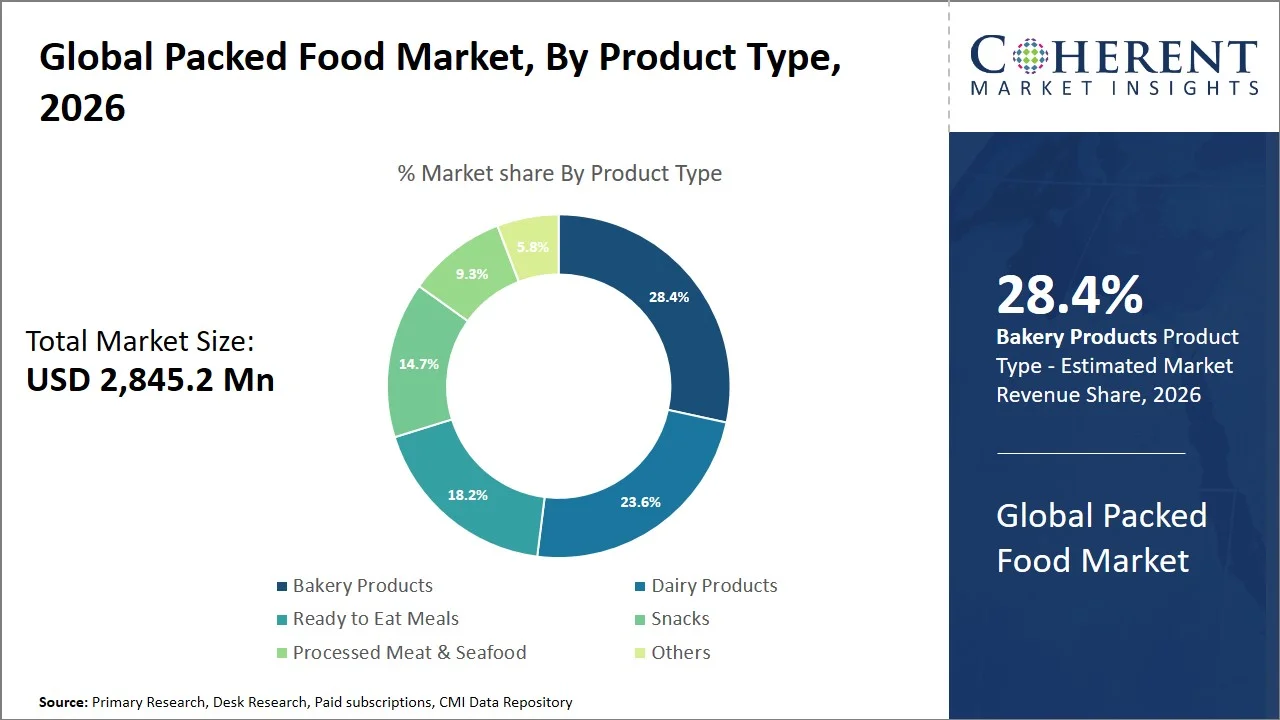
Why Does the Bakery Products Segment Dominate the Global Packed Food Market?
Bakery products are expected to dominate the global packed Food Market with 28.4% of the market share in 2026, supported by their high purchase frequency, broad consumer acceptance, and suitability across breakfast, snacking, and meal-accompaniment occasions. Packaged breads, biscuits, cookies, cakes, buns, and baking mixes benefit from longer shelf life, standardized taste, and strong household penetration across both developed and emerging economies. Demand is also supported by consumers shifting toward portion-packed, premium, high-fiber, gluten-free, and better-for-you bakery formats. On the supply side, large-scale automated baking lines, improved preservatives, modified-atmosphere packaging, and cold-chain-backed distribution improve consistency and reduce wastage. In February 2025, Flowers Foods completed the acquisition of Simple Mills, a premium natural brand offering cracker, cookies, snack bars, and baking mixes, strengthening its better-for-you packaged bakery portfolio. (Source: Flowers Foods)
- Current Industry Events of 2026
- Market Size Estimation
- Regional Breakdown
- Competitive Landscape
- Customer Intelligence
- Segmental Analysis
- Pricing Analysis
- Key Market Drivers, Challenges & Future Trends
- Customized Insights Section
Why Does Flexible Packaging Represent the Largest Packaging Type Segment in the Market?
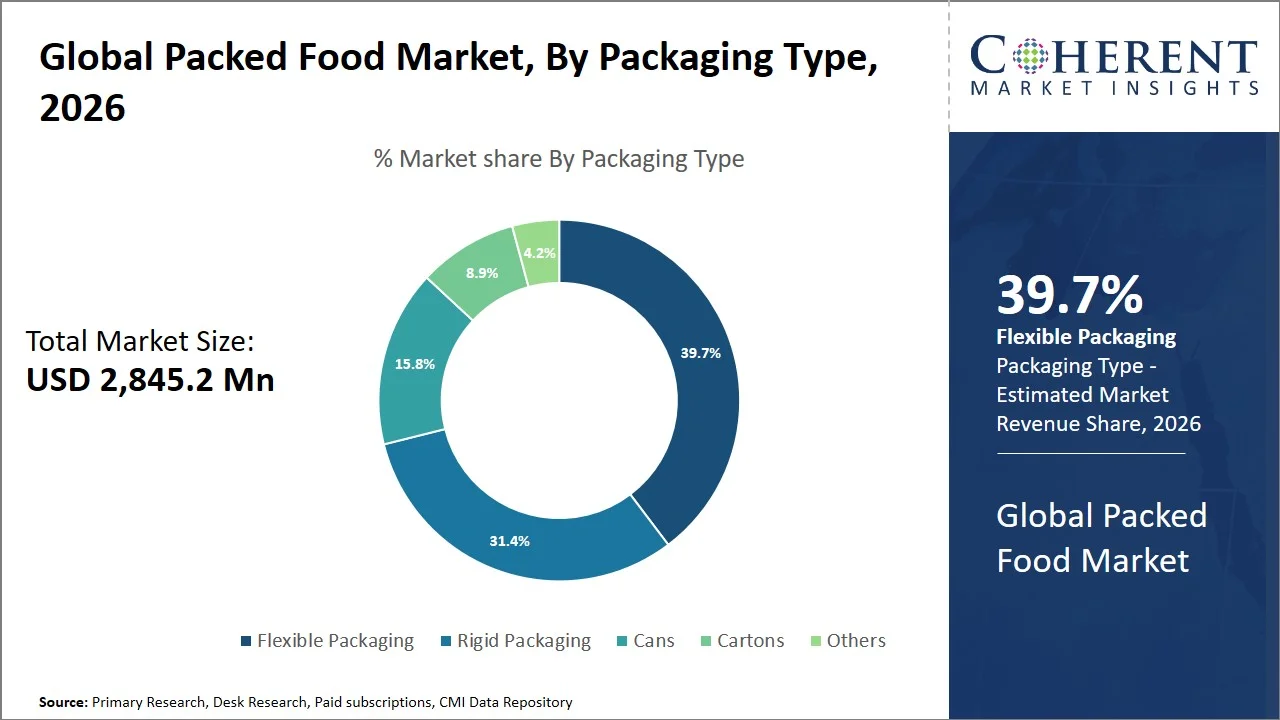
Flexible packaging is expected to represent the largest packaging type segment with 39.7% of the global packed food market share in 2026, as it directly supports the commercial needs of packaged snacks, bakery products, dairy items, ready meals, and processed foods. Pouches, films, wraps, sachets, and flow packs provide lightweight handling, lower transportation cost, high shelf visibility, and strong barrier protection against moisture, oxygen, aroma loss, and contamination. Demand is reinforced by single-serve consumption, resealable formats, and convenience-led food purchasing. From the supply side, mono-material films, recyclable laminates, digital printing, high-speed form-fill-seal systems, and barrier coating technologies are improving sustainability and production efficiency. In September 2025, Borouge, Siegwerk, and TPN Food Packaging launched a fully recyclable mono-material barrier stand-up pouch in Thailand, highlighting innovation in sustainable flexible food packaging. (Source: Siegwerk Druckfarben AG & Co. KGaA)
Why Does the Supermarkets or Hypermarkets Segment Dominate the Global Packed Food Market?
Supermarkets or hypermarkets are expected to dominate the distribution channel segment with 42.8% of the global packed food market share in 2026, as they remain the preferred channel for bulk grocery purchases, branded packed food discovery, private-label buying, and promotional offers. These outlets provide consumers with wide product assortment across bakery, dairy, snacks, ready meals, frozen foods, and processed meat under one roof, enabling comparison-based and impulse purchasing. Their dominance is strengthened by efficient shelf-space management, loyalty programs, cold-chain infrastructure, in-store merchandising, and omnichannel services such as pickup and delivery. For packed food brands, supermarkets provide high-volume visibility and faster product rotation. Costco’s 2025 annual report reported USD 269.9 billion in net sales, with its foods and sundries category covering dry grocery, candy, cooler, freezer, and related products, highlighting the strong scale of warehouse-based packaged food retailing. (Source: Costco)
Currents Events and their Impact
Current Events | Description and its Impact |
European Union Packaging and Packaging Waste Regulation Tightens Packaging Compliance (February 2025 onward) |
|
U.S. FDA Advances Front-of-Package Nutrition Labeling for Packaged Foods (January 2025 onward) |
|
FSSAI Restricts Use of “100%” Claims on Food Labels in India (May 2025 onward) |
|
(Source: European Commission, Food and Drug Administration)
Global Packed Food Market Dynamics
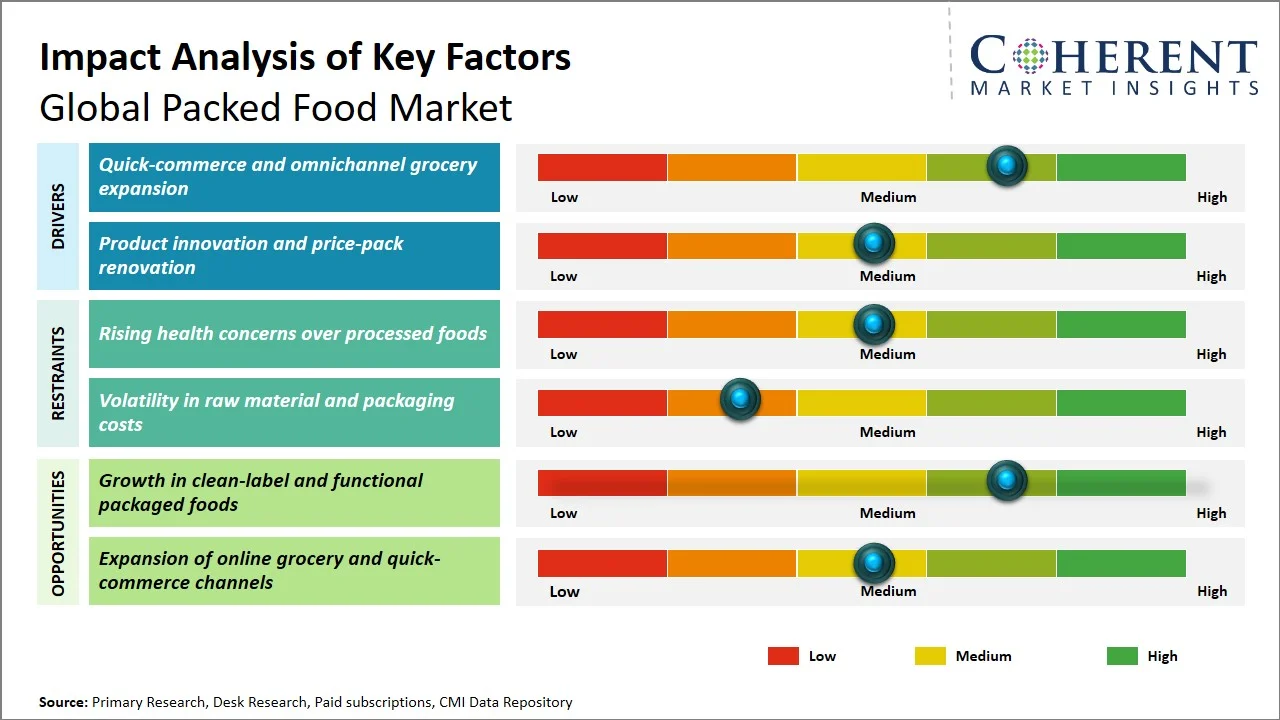
Market Drivers
- Quick-commerce and omnichannel grocery expansion: The global packed food market is gaining strong commercial momentum as grocery retail shifts from planned weekly purchases to fast, app-based replenishment. This supports higher rotation of snacks, bakery items, dairy products, ready meals, and processed foods because consumers increasingly expect smaller baskets, faster delivery, and wider digital availability. For manufacturers, this improves shelf reach beyond physical stores and allows brands to push trial packs, impulse formats, and regional SKUs through store-based fulfillment and online grocery platforms. In May 2026, Walmart launched 30-minute-or-less delivery across 33 U.S. markets, offering faster delivery for immediate and fill-in shopping needs, which strengthens rapid availability of packaged grocery and convenience food products. (Source: Walmart Inc)
- Product innovation and price-pack renovation: Packed food companies are investing in new formats, value packs, flavor extensions, and healthier propositions to defend volume growth in a price-sensitive consumer environment. This driver is important because packed food categories face intense competition from private labels, foodservice options, and fresh alternatives, making innovation essential for repeat purchases and premiumization. Brands are also using packaging redesign, portion control, and affordability-led SKUs to improve household penetration across supermarkets, convenience stores, and online retail. General Mills stated in December 2025 that its fiscal 2026 innovation plans are expected to generate a 25% increase in sales from new products, reflecting how large food companies are using innovation pipelines to restore volume-driven growth (Source: General Mills Inc)
Emerging Market Trends
- Nutrition Transparency and Reformulation Pressure: Packed food brands are increasingly moving toward clearer nutrition communication, reduced sodium, sugar, and saturated fat positioning, and cleaner ingredient profiles. This trend is commercially important because front-of-pack disclosure can influence consumer choice at the shelf and may shift competition from only taste and price toward health credentials. Companies selling bakery products, snacks, ready meals, and processed foods will need stronger formulation discipline, clearer label claims, and better compliance systems to protect brand trust.
- Recyclable and Lower-Impact Packaging Transition: Sustainability is becoming a strategic packaging requirement rather than a brand-support activity in the packed food market. Flexible pouches, cartons, cans, wraps, and rigid containers are being redesigned to reduce virgin material use, improve recyclability, and support circular packaging goals. This trend directly affects procurement cost, supplier selection, packaging machinery compatibility, and retailer listing requirements. Food manufacturers that adopt recyclable mono-material films, recycled-content packaging, and clearer disposal labels can improve compliance readiness and consumer perception.
Regional Insights
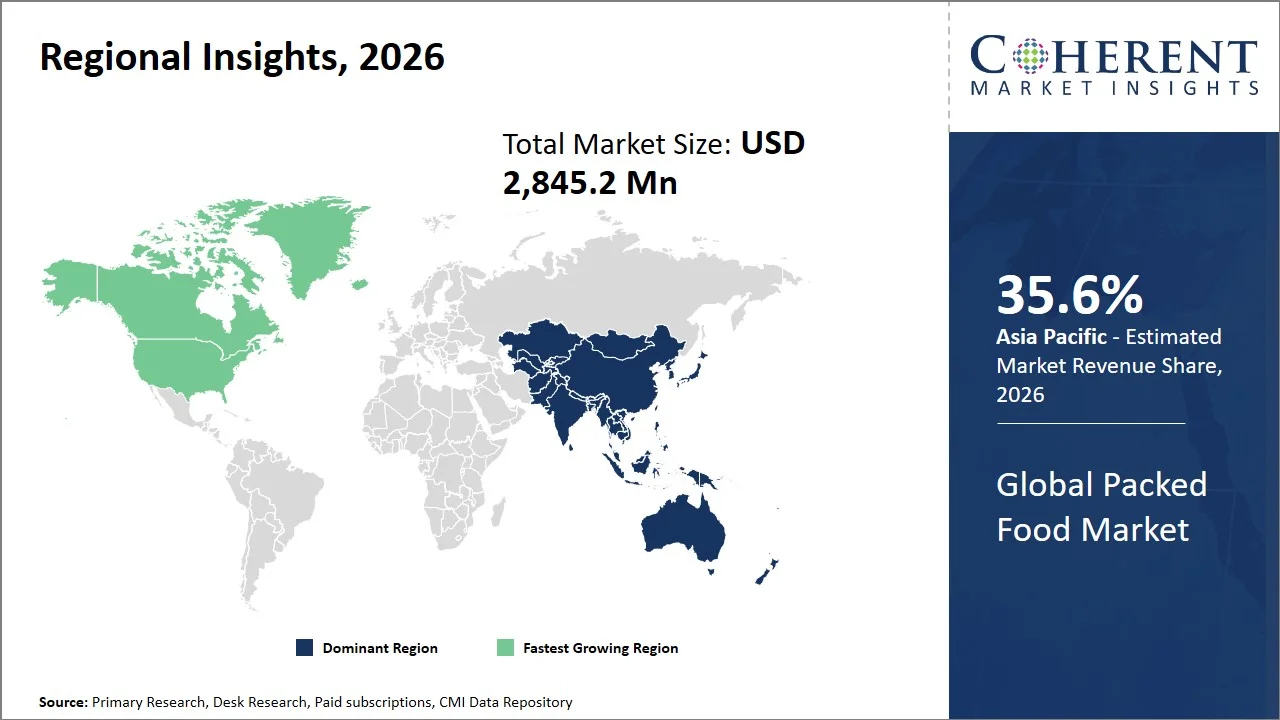
Why Does the Asia Pacific Region Dominate the Global Packed Food Market?
Asia Pacific is expected to dominate the global packed food market with 35.6% share in 2026, supported by large consumer bases, rapid urbanization, expanding food processing capacity, and rising demand for convenient packaged formats across China, India, Japan, South Korea, and Southeast Asia. The region benefits from strong local manufacturing, growing modern retail, quick-commerce penetration, and increasing adoption of snacks, bakery products, dairy products, ready meals, and flexible packaged foods. Local sourcing of agricultural raw materials also strengthens production economics for packed food manufacturers. In May 2026, PepsiCo launched its 2026 APAC Greenhouse Program to scale sustainability solutions across Asia Pacific supply chains, covering logistics efficiency, sustainable agriculture, emissions reduction, and circularity systems. (Source: PepsiCo)
Why is North America Emerging as the Fastest-Growing Region in the Global Packed food Market?
North America is expected to emerge as the fastest-growing region, accounting for 27.8% share in 2026, supported by premium packaged meals, functional snacks, frozen foods, sauces, bakery products, and high-value convenience formats. The region has a mature retail infrastructure, strong private-label competition, advanced food processing technologies, and high consumer willingness to pay for clean-label, protein-rich, portion-controlled, and ready-to-eat products. Growth is also supported by manufacturing modernization and near-market production strategies across the U.S., Canada, and Mexico. In June 2024, Conagra Brands announced the expansion of production capabilities at several North American facilities to support growing demand for frozen meals, snacks, and packed food products, reinforcing regional manufacturing capacity and supply chain efficiency. (Source: Food Dive)
Global Packed Food Market Outlook for Key Countries
Why is China a Core Production and Consumption Hub in the Packed Food Market?
China remains one of the most important countries in the global packed food market due to its large urban consumer base, expanding middle-income population, and strong food processing ecosystem. Demand is supported by packaged snacks, bakery products, dairy products, instant foods, and ready-to-cook meal solutions, particularly across e-commerce and modern retail channels. On the supply side, China has a mature industrial base for food processing, packaging materials, cold-chain logistics, and ingredient manufacturing, allowing companies to scale production efficiently. The country’s industrial statistics also show continued momentum in food-related manufacturing. In 2025, China’s National Bureau of Statistics reported that value added for the processing of food from agricultural and sideline products increased by 5.6% year-on-year, reflecting steady sectoral output growth.
Why is the U.S. Leading Innovation and Manufacturing Modernization in Packaged Food?
The U.S. is a key packed food market due to its strong branded food ecosystem, high supermarket and convenience-store penetration, mature cold-chain infrastructure, and broad consumer acceptance of snacks, sauces, frozen foods, bakery products, dairy products, cereals, and ready meals. The country also leads in automation, portion-controlled packaging, product reformulation, and high-speed retail fulfillment, helping manufacturers improve productivity and respond faster to changing consumer preferences. In July 2025, Mars announced plans to invest USD 2 billion in U.S. manufacturing by the end of 2026, covering its snacking, food, and pet care operations across the country. The investment strengthens domestic production capacity for packed food brands such as M&M’s, SNICKERS, and Ben’s Original, supporting faster supply, local manufacturing resilience, and long-term category growth. (Source: Mars)
Why is India Becoming a High-Growth Packed Food Manufacturing Base?
India is gaining importance in the global packed food market due to its young population, rising urban consumption, expanding quick-commerce channels, and increasing preference for packaged snacks, bakery products, dairy items, ready-to-eat meals, and instant foods. The country also benefits from strong agricultural raw material availability, government support for food processing, and growing investment in packed food manufacturing. Organized retail and digital grocery delivery are improving product availability beyond major cities, helping brands reach semi-urban and rural consumers. In October 2025, Nestlé India signed an MoU with the Ministry of Food Processing Industries to accelerate investments in greenfield and brownfield projects in Odisha and existing manufacturing locations over the next two to three years. (Source: Nestlé India)
Why Does Germany Remain a Strategic Packed Food Market in Europe?
Germany is a strategic packed food market because of its large processed food industry, strong retail structure, high food safety standards, and strong demand for ready meals, bakery products, dairy products, confectionery, snacks, and health-oriented packaged foods. The country’s consumers are highly value-conscious, but also receptive to convenient, functional, sustainable, and premium formats. Germany is also a gateway for European packed food distribution due to its logistics infrastructure and developed food retail ecosystem. In June 2026, Nestlé agreed to fully acquire Munich-based yfood Labs, a smart food brand producing ready-to-drink meals, powders, and food bars in Germany and Europe. yfood generated around USD 172.02 million sales in 2025, showing strong demand for convenient nutrition-led packaged formats.
Why is Brazil an Important Packed Food Market in Latin America?
Brazil is a leading packed food market t in Latin America due to its large domestic consumer base, strong agricultural supply, developed food processing industry, and supermarket-led retail structure. The country supports demand for packaged bakery goods, processed meat, dairy products, snacks, confectionery, beverages, and ready-to-eat products. Brazil’s agricultural strength gives local manufacturers access to raw materials, while the retail sector provides broad distribution reach across urban and regional markets. In 2025, Brazil’s food processing sector revenue reached about USD 248 billion, growing 8% from the previous year, according to ABIA data cited by USDA FAS. The report also notes Brazil’s strong agricultural base supports ongoing investment in food processing to meet domestic and regional demand. (Source: U.S. Food and Drug Administration)
Technology Adoption Landscape – Global Packed Food Market
Technology | Adoption Level | Application in Packed Food Industry | Business Impact |
High-Speed Automated Processing Lines | High | Used in bakery, dairy, snacks, ready meals, and processed meat plants for mixing, filling, forming, baking, slicing, sealing, and inspection. | Improves production throughput, reduces labor dependency, maintains product consistency, and supports large-scale supply for supermarkets, hypermarkets, and online grocery platforms. |
Modified Atmosphere Packaging (MAP) | High | Applied in bakery products, dairy, processed meat, seafood, and ready-to-eat meals to control oxygen, carbon dioxide, and nitrogen levels inside packaging. | Extends shelf life, reduces spoilage, improves freshness perception, and supports wider regional distribution of perishable packaged foods. |
Flexible Packaging and Barrier Film Technologies | High | Used in snacks, bakery, dairy, confectionery, sauces, and ready meals through pouches, wraps, sachets, films, and flow packs. | Reduces packaging weight, improves moisture and aroma protection, lowers logistics cost, and supports portion-controlled and on-the-go consumption formats. |
Digital Traceability and 2D Barcodes/QR Codes | Medium to High | Used for batch tracking, product authentication, recall management, expiry-date visibility, allergen information, and consumer engagement through connected packaging. | Strengthens food safety compliance, improves recall speed, supports transparent labeling, and enables brands to share product, nutrition, and sustainability information digitally. |
AI-Based Quality Inspection and Machine Vision | Medium | Applied for defect detection, seal inspection, foreign material identification, label verification, portion accuracy, and packaging integrity checks. | Reduces product rejection risk, improves food safety, lowers manual inspection errors, and supports consistent quality across high-volume packed food production lines. |
Cold Chain Monitoring and IoT Sensors | Medium | Used for dairy products, frozen meals, processed meat, seafood, and chilled ready-to-eat foods to monitor temperature, humidity, storage, and transport conditions. | Protects product quality, reduces cold-chain losses, supports regulatory compliance, and improves distributor and retailer confidence in temperature-sensitive packaged foods. |
Clean-Label Reformulation Technologies | Medium | Includes natural preservatives, enzyme systems, fermentation-based ingredients, sugar or sodium reduction solutions, and texture-improving ingredient systems. | Helps manufacturers align with consumer preference for healthier packaged foods while maintaining taste, shelf life, texture, and product stability. |
Recyclable and Mono-Material Packaging Solutions | Medium | Used in flexible pouches, films, cartons, and rigid packaging formats to improve recyclability and reduce dependence on complex multi-layer materials. | Supports sustainability compliance, improves retailer acceptance, reduces packaging waste exposure, and helps brands prepare for stricter packaging regulations. |
How are AI-enabled processing and smart packaging technologies creating growth opportunities in the global packed food market?
Technological advancement in AI-enabled food processing, automated packaging lines, digital traceability, and shelf-life extension technologies are creating strong growth opportunities in the global packed food market. These technologies help manufacturers improve production speed, reduce wastage, maintain consistent product quality, and support large-scale output across bakery products, dairy products, ready-to-eat meals, snacks, and processed food categories. Smart packaging, QR-based traceability, modified atmosphere packaging, and AI-driven factory monitoring also help brands meet consumer expectations for freshness, safety, convenience, and transparency. For instance, in November 2025, Tetra Pak launched Tetra Pak Factory OS, a next-generation automation and digitalization platform designed to make food and beverage factories AI-ready by providing real-time, contextualized production insights. This development highlights how digital manufacturing can improve operational efficiency and support scalable packed food production.
Market Players, Key Development, and Competitive Intelligence
Key Developments
- In March 2026, Conagra expanded packaged meal manufacturing capacity in North America. Conagra announced an approximately USD 220 million expansion of its Fayetteville, Arkansas manufacturing facility. The site produces ready-to-eat meals under brands including Hungry-Man, Banquet, Healthy Choice, Gardein, and evol, supporting future growth in frozen and prepared packaged meals.
- In February 2026, General Mills launched health-focused snack and breakfast products. It introduced new protein cereal and granola options, including GHOST Protein Cereal and Nature Valley Cinnamon Roll Protein Granola, along with new breakfast cereal launches. This strengthens the company’s health-focused packaged breakfast and snack portfolio for consumers seeking convenient, protein-led food options.
- In September 2025, CJ Foods expanded frozen packed food production in Asia Pacific and began operations at its new Chiba plant in Japan to boost local production of bibigo mandu and strengthen its frozen packed food supply in the Japanese market. The facility supports localized sourcing, faster distribution, and wider retail availability of frozen food products across Asia Pacific.
Competitive Landscape
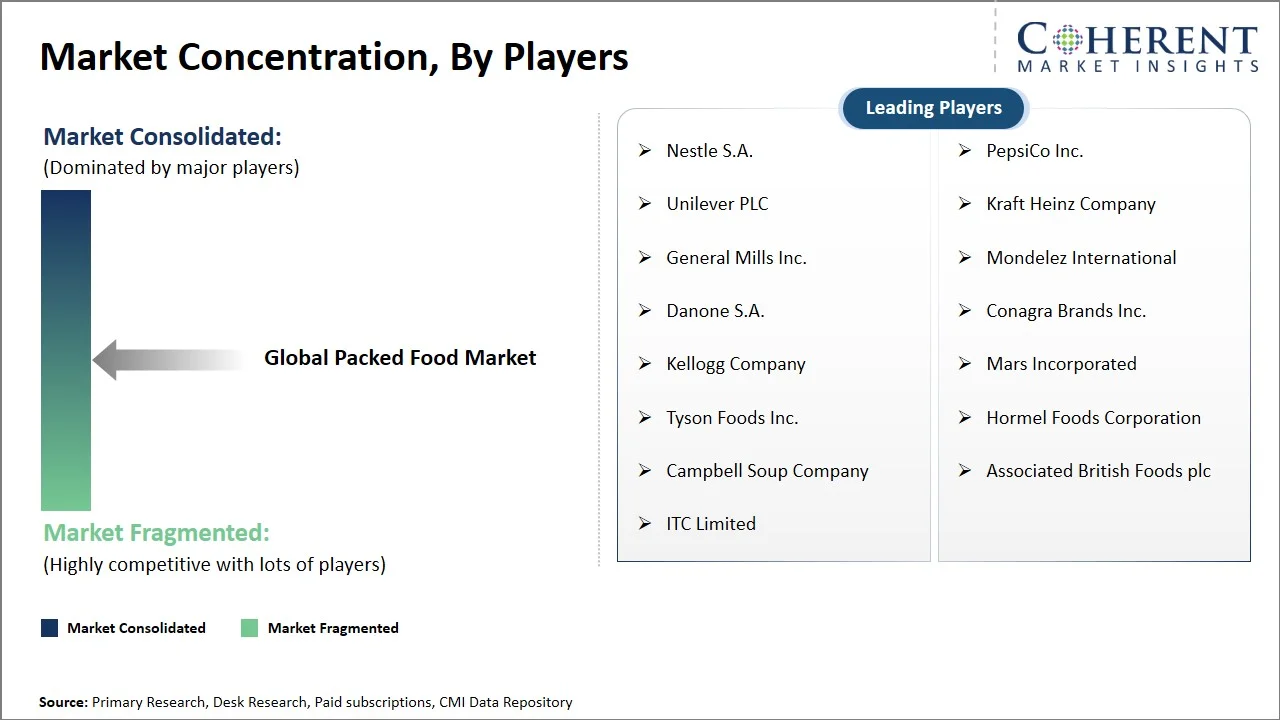
The global packed food market is highly competitive and fragmented, with large multinational food companies, regional manufacturers, private-label brands, and emerging health-focused food startups competing across bakery products, dairy products, ready-to-eat meals, snacks, processed meat and seafood, and other packaged categories. Competition is mainly based on product innovation, pricing, brand strength, distribution reach, packaging formats, taste differentiation, nutrition claims, and supply chain efficiency. Leading players are focusing on expanding healthier product lines, improving shelf life, adopting sustainable packaging, and strengthening omnichannel retail presence. Companies are also investing in automation, digital traceability, and localized product portfolios to meet changing consumer preferences across developed and emerging markets.
Key focus areas include
- Development of clean-label, high-protein, low-sugar, low-sodium, and fortified packed food products
- Expansion of ready-to-eat meals, frozen foods, snacks, bakery, and breakfast product portfolios
- Adoption of recyclable, lightweight, flexible, and portion-controlled packaging formats
- Strengthening of supermarket, hypermarket, convenience store, and online retail distribution networks
- Investment in automated manufacturing, cold-chain logistics, quality control, and digital traceability systems
- Regional expansion through new manufacturing facilities, acquisitions, partnerships, and localized flavor innovation
- Increasing focus on private-label competition, value packs, and premium packed food offerings
Market Report Scope
Packed Food Market Report Coverage
| Report Coverage | Details | ||
|---|---|---|---|
| Base Year: | 2025 | Market Size in 2026: | USD 2,845.2 Mn |
| Historical Data for: | 2020 To 2024 | Forecast Period: | 2026 To 2033 |
| Forecast Period 2026 to 2033 CAGR: | 6.4% | 2033 Value Projection: | USD 4,392.4 Mn |
| Geographies covered: |
| ||
| Segments covered: |
| ||
| Companies covered: | Nestle S.A., PepsiCo Inc., Unilever PLC, Kraft Heinz Company, General Mills Inc., Mondelez International, Danone S.A., Conagra Brands Inc., Kellogg Company, Mars Incorporated, Tyson Foods Inc., Hormel Foods Corporation, Campbell Soup Company, Associated British Foods plc, and ITC Limited | ||
| Growth Drivers: |
| ||
| Restraints & Challenges: |
| ||
Analyst Opinion (Expert Opinion)
- The global packed food market is expected to witness steady long-term growth due to rising demand for convenient, ready-to-consume, shelf-stable, and portion-controlled food products across households, foodservice operators, and institutional buyers. Changing lifestyles, higher urban working populations, and growing preference for time-saving food formats are expected to support wider adoption of packaged bakery products, dairy products, snacks, ready-to-eat meals, and processed meat and seafood products.
- The strongest opportunities are likely to emerge in bakery products, flexible packaging, and supermarket or hypermarket distribution channels. Bakery products are expected to remain the leading product category due to frequent consumption and broad household penetration, while flexible packaging will gain traction due to lightweight structure, longer shelf-life support, and cost-efficient handling. Asia Pacific is expected to remain the leading region due to high population density, rising disposable income, and strong food processing capacity, while North America is expected to grow faster with demand for premium, clean-label, frozen, and health-focused packaged foods.
- To gain a competitive advantage, market players should focus on clean-label formulations, healthier product lines, recyclable packaging, cold-chain efficiency, digital traceability, and omnichannel retail expansion. Companies that can offer strong taste, affordable pricing, convenient pack sizes, longer shelf life, transparent labeling, and localized flavors will be better positioned to capture demand from modern retail, online grocery platforms, quick-commerce channels, and foodservice customers.
Speak to the analyst
Want personalized insights?
Take the findings above to one of our principal consultants, or have the report rebuilt around the segments, geographies and competitors you actually track.
Market Segmentation
- Product Type Insights (Revenue, USD Mn, 2021 - 2033)
- Bakery Products
- Dairy Products
- Ready to Eat Meals
- Snacks
- Processed Meat & Seafood
- Others
- Packaging Type Insights (Revenue, USD Mn, 2021 - 2033)
- Flexible Packaging
- Rigid Packaging
- Cans
- Cartons
- Others
- End-use Industry Insights (Revenue, USD Mn, 2021 - 2033)
- Household Consumption
- Food Service
- Institutional
- Distribution Channel Insights (Revenue, USD Mn, 2021 - 2033)
- Supermarkets or Hypermarkets
- Convenience Stores
- Online Retail
- Specialty Stores
- Others
- Regional Insights (Revenue, USD Mn, 2021 - 2033)
- North America
- U.S.
- Canada
- Latin America
- Brazil
- Argentina
- Mexico
- Rest of Latin America
- Europe
- Germany
- U.K.
- Spain
- France
- Italy
- Russia
- Rest of Europe
- Asia Pacific
- China
- India
- Japan
- Australia
- South Korea
- ASEAN
- Rest of Asia Pacific
- Middle East
- GCC Countries
- Israel
- Rest of Middle East
- Africa
- South Africa
- North Africa
- Central Africa
- North America
- Key Players Insights
- Nestle S.A.
- PepsiCo Inc.
- Unilever PLC
- Kraft Heinz Company
- General Mills Inc.
- Mondelez International
- Danone S.A.
- Conagra Brands Inc.
- Kellogg Company
- Mars Incorporated
- Tyson Foods Inc.
- Hormel Foods Corporation
- Campbell Soup Company
- Associated British Foods plc
- ITC Limited
Sources
Primary Research Interviews
- Packed food manufacturers and brand owners
- Bakery, dairy, snacks, ready-to-eat meals, and processed food producers
- Food packaging manufacturers and flexible packaging suppliers
- Supermarket, hypermarket, convenience store, and online grocery retail executives
- Food processing plant managers and production heads
- Food safety, quality assurance, and regulatory compliance professionals
- Distributors, wholesalers, and cold-chain logistics providers
- Foodservice procurement managers and institutional buyers
Stakeholders
- Packed food manufacturers
- Food processing companies
- Flexible packaging and rigid packaging suppliers
- Ingredient suppliers and food additive companies
- Cold-chain and warehousing service providers
- Retail chains and e-commerce grocery platforms
- Private-label food companies
- Foodservice and institutional catering operators
End-use Sectors
- Household Consumption
- Food Service
- Institutional Buyers
- Supermarkets and Hypermarkets
- Convenience Stores
- Online Retail / E-commerce Grocery Platforms
- Specialty Food Stores
- Hotels, Restaurants, and Catering Services
Regulatory & Food Safety Bodies
- U.S. Food and Drug Administration (FDA)
- Food Safety and Standards Authority of India (FSSAI)
- European Food Safety Authority (EFSA)
- European Commission – Food Safety and Packaging Regulations
- Codex Alimentarius Commission
- Food Standards Australia New Zealand (FSANZ)
- National Health Commission, China
- Brazilian Health Regulatory Agency (ANVISA)
- U.K. Food Standards Agency (FSA)
Databases
- FAOSTAT
- World Bank Open Data
- OECD Data
- UN Comtrade Database
- Eurostat
- USDA Economic Research Service
- USDA Foreign Agricultural Service
- U.S. Census Bureau – Retail and Food Manufacturing Data
- India Ministry of Food Processing Industries Database
- China National Bureau of Statistics
- ITC Trade Map
Magazines
- Food Business News
- Food Engineering Magazine
- Food Processing Magazine
- Packaging World
- Dairy Foods Magazine
- Baking Business
- Snack Food & Wholesale Bakery
- The Grocer
- Food Manufacture
- FoodBev Media
Journals
- Food Control
- Food Packaging and Shelf Life
- Journal of Food Science
- Trends in Food Science & Technology
- International Journal of Food Science & Technology
- Journal of Food Processing and Preservation
- Comprehensive Reviews in Food Science and Food Safety
- Foods Journal
- Packaging Technology and Science
Newspapers
- Financial Times
- The Wall Street Journal
Associations
- Food and Agriculture Organization of the United Nations (FAO)
- International Food Information Council (IFIC)
- Consumer Brands Association
- Grocery Manufacturers Association
- Institute of Food Technologists (IFT)
- FoodDrinkEurope
- Specialty Food Association
- International Dairy Federation (IDF)
- American Bakers Association
- SNAC International
- International Fresh Produce Association
Public Domain Sources
- World Health Organization (WHO) – Nutrition and Food Safety Data
- FAO – Food Security, Food Production, and Food Systems Data
- U.S. FDA – Food Labeling and Nutrition Regulations
- USDA – Food Consumption, Food Processing, and Retail Data
- European Commission – Food Safety and Packaging Waste Regulations
- FSSAI – Food Labeling, Safety, and Standards Guidelines
- World Bank – Population, Urbanization, and Income Indicators
- United Nations – Urbanization and Demographic Data
- Ministry of Food Processing Industries, India
- National Bureau of Statistics of China
Proprietary Elements
- CMI Data Analytics Tool, Proprietary CMI Existing Repository of information for last 10 years.
Get access to 250+ pages report
Every segment, forecast, competitor profile and data table behind the analysis above — available for instant download.
- ESOMAR Member
- ISO 9001:2015 Certified
- D-U-N-S Registered
- GDPR & CCPA Compliant
Missing comfort of reading report in your local language? Find your preferred language:
Transform your Strategy with Exclusive Trending Reports
Frequently Asked Questions
The CAGR of the global packed food market is projected to be 6.4% from 2026 to 2033.
The global packed food market is valued at USD 2,845.2 Mn in 2026 and is expected to reach USD 4,392.4 Mn by 2033
Supermarkets or hypermarkets are estimated to dominate the market in 2026.
Clean-label reformulation and healthy convenience foods offer major growth opportunities.
Quick-commerce and omnichannel grocery expansion and product innovation and price-pack renovation are the major factors driving the growth of the global packed food market.
Rising health concerns over processed foods and volatility in raw material and packaging costs are the major factors hampering the growth of the global packed food market.
In terms of product type, bakery products are estimated to dominate the market revenue share in 2026.