

Global Semiconductor Solvent Market Size and Forecast – 2026-2033
Coherent Market Insights estimates that the global semiconductor solvent market is expected to reach USD 3.30 Bn in 2026 and will expand to USD 5 Bn by 2033, registering a CAGR of 5% between 2026 and 2033.
Key Takeaways of the Semiconductor Solvent Market
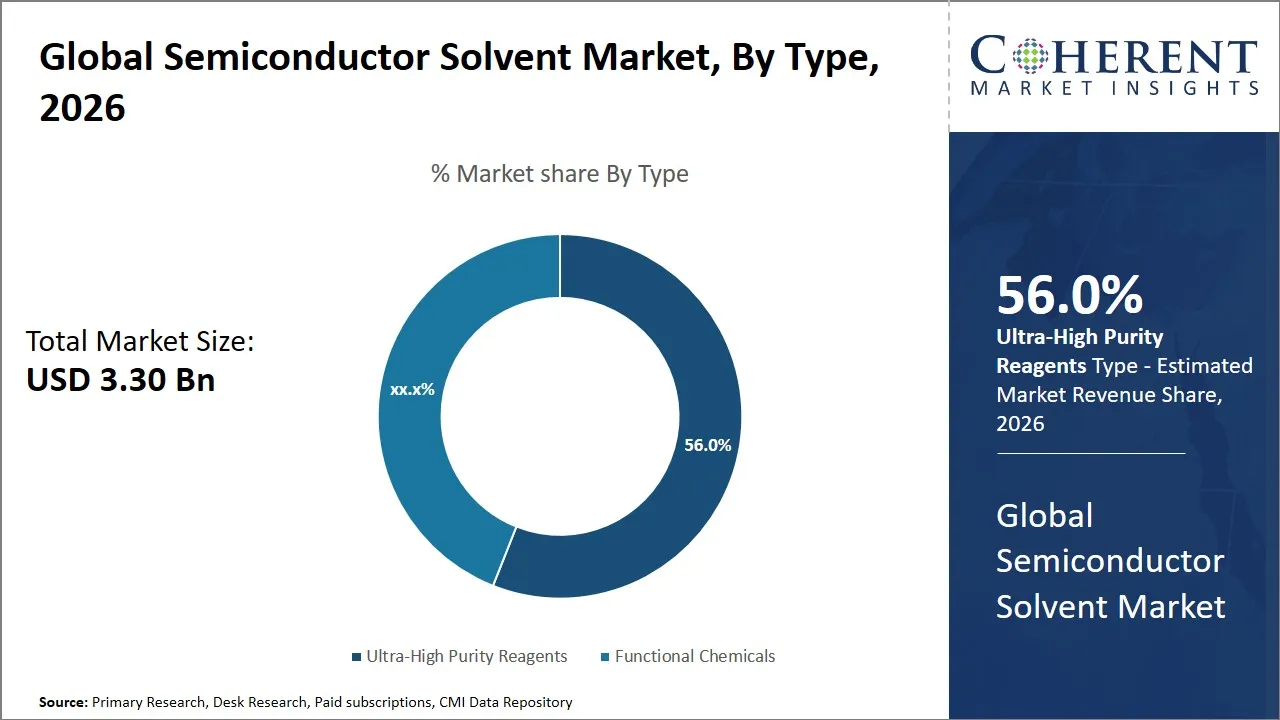
- The ultra-high purity reagents segment is expected to account for 56% of the semiconductor solvent market share in 2026.
- The acetone segment is estimated to capture 43% of the market share in 2026.
- The cleaning segment is projected to hold 47% of the global semiconductor solvent market share in 2026.
- Asia Pacific will dominate the semiconductor solvent market in 2026 with a 39% market share.
- North America will hold 24% share in 2026 and is expected to record the fastest growth over the forecast period.
Current Events and Its Impact
Current Events | Description and its Impact |
BASF Expansion Plans |
|
Segmental Insights
- Current Industry Events of 2026
- Market Size Estimation
- Regional Breakdown
- Competitive Landscape
- Customer Intelligence
- Segmental Analysis
- Pricing Analysis
- Key Market Drivers, Challenges & Future Trends
- Customized Insights Section
Why Does the Ultra-High Purity Reagents Segment Dominate the Global Semiconductor Solvent Market in 2026?
The ultra-high purity reagents segment is expected to account for 56.0% of the global semiconductor solvent market share in 2026. The growth is primarily due to the ever-increasing demand for impeccable cleanliness and precision in semiconductor manufacturing processes. As semiconductors react strongly to impurities, their cleaning requires extreme purity. Yet these solvents eliminate traces that most agents fail to clear. What makes them different lies in how few metals, organic compounds, or particles they contain. Function depends upon molecular-level sanitation. Any slight leftover interferes with operation. Precision of that kind sets the benchmark. Only after contaminants drop beneath measurable levels does trust take shape.
For instance, on March 26, 2025, ExxonMobil announced that it is expanding production of 99.999% ultra‑high purity isopropyl alcohol (IPA), a critical semiconductor cleaning solvent, at its Baton Rouge plant, with the aim of supplying the advanced chip industry by 2027, underscoring how node scaling and contamination control requirements make ultra‑high purity reagents indispensable.
(Source: corporate.exxonmobil.com)
Acetone Segment Dominates the Global Semiconductor Solvent Market
The acetone segment is expected to hold 43.0% of the global semiconductor solvent market share in 2026. Owing to powerful dissolving traits, acetone appears often in many phases of chip making. Fast drying follows its ability to break down substances, aiding function where materials are sensitive. Stability when meeting different surfaces leads to common use; this happens especially before wafers undergo processing. Important tasks rely on it even though alternatives exist. Preference grows where precision cleaning meets reliable interaction with sensitive surfaces.
Why is Cleaning the Most Widespread Application in the Global Semiconductor Solvent Market?
The cleaning segment is expected to account for 47.0% of the semiconductor solvent market share in 2026. Growth shows how essential solvent-based cleaning remains within semiconductor production. As impurities emerge during wafer fabrication - particles, organic layers, ions, leftover residues, thorough cleansing becomes necessary. When these substances stay behind, flaws may appear. Yield rates often decline under such conditions. Electrical functionality of chips might weaken as a result. Cleaning gaps lead to measurable setbacks in output quality.
Global Semiconductor Solvent Market - Regional Supply Concentration & Import Dependency
Region | Supply Concentration | Import Dependency |
Asia Pacific | Highest concentration of semiconductor fabs and solvent demand (China, Taiwan, South Korea, Japan dominate) | Varies by country; China historically depends on imports for >60% of ultra-high-purity solvents due to technology limitations |
North America | Strong base for specialized solvent innovation and advanced purity supply | Import dependency reduced by reshoring incentives (e.g., CHIPS Act), but advanced process inputs still partly sourced abroad |
Europe | Established specialty chemical producers (Germany, France) for certain solvent types | Some reliance on imports for highest-purity solvents; domestic production strong in niche segments |
Latin America | Limited local production capacity | Import dependence >80% on high-purity solvents due to lack of indigenous manufacturing |
Middle East & Africa | Small market with nascent semiconductor chemical demand | High import dependency for almost all advanced solvent grades |
Regional Insights
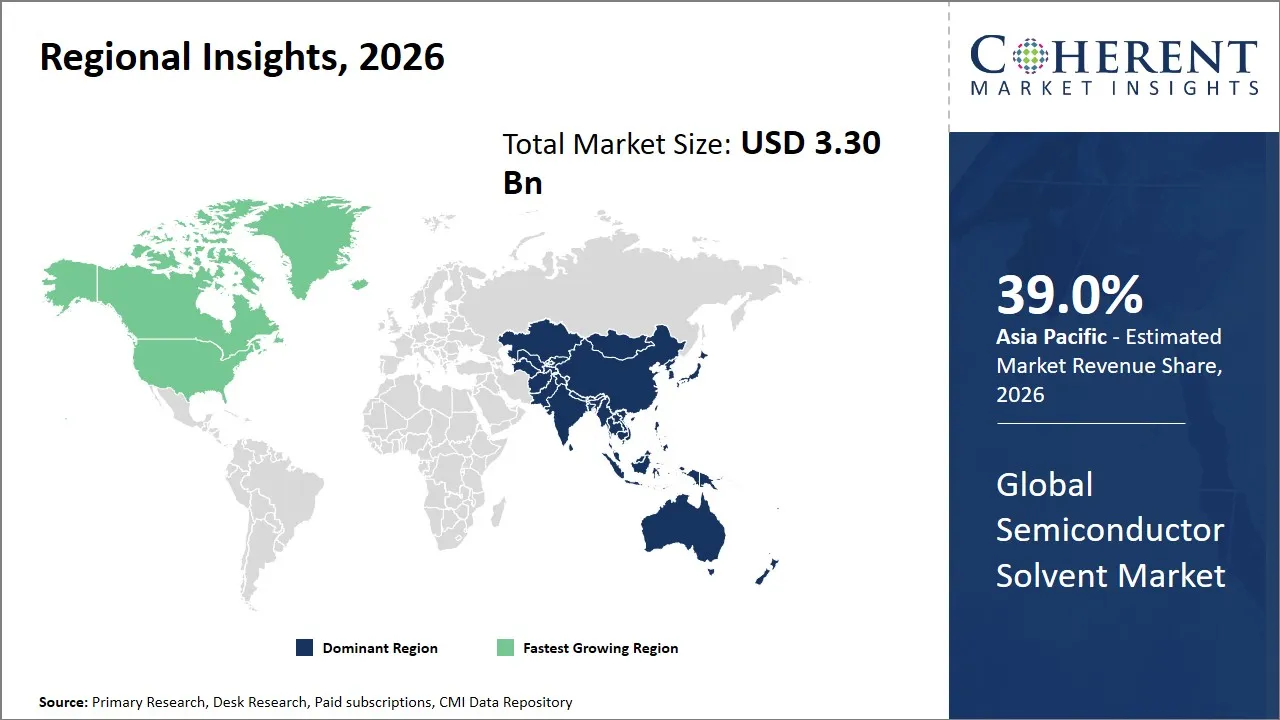
Asia Pacific Semiconductor Solvent Market Analysis and Trends
The Asia Pacific region is projected to lead the market with a 39% share in 2026. Growth takes shape where strong industrial frameworks exist - nations such as Japan, Taiwan, South Korea, and China form its core. Within this zone, clusters of wafer plants, packaging hubs, and test centers operate, dependent on specialized fluids to enable accurate production stages. Instead of relying on external support, regional authorities push autonomy via funding, research expansion, and upgraded physical systems, especially visible across Chinese and Korean initiatives.
Flow patterns in commerce reveal tightly linked networks, supplied by nearby resource streams, high-level synthesis methods, and output-focused factory setups. Among those shaping the regional market are LG Chem and SK Innovation from South Korea, alongside Japan's JSR Corporation, together with China’s Wanhua Chemical Group. Innovation in solvents tailored for advanced semiconductor fabrication and eco-conscious production is primarily driven by these firms.
For instance, on October 24, 2024, FUJIFILM Corporation announced the commercial rollout of EUV resist and EUV developer products that use high‑purity organic solvents tailored for advanced lithography processes in Japan and South Korea, these solvents support fine pattern formation and contamination control crucial for EUV node fabrication.
(Source: fujifilm.com)
North America Semiconductor Solvent Market Analysis and Trends
The North America region is expected to exhibit the fastest growth in the market contributing 24% share in 2026. Driven by semiconductor advances and efforts to bring production back home, growth takes shape. New U.S. policies focus on rebuilding semiconductor production, creating demand for refined chemicals used in high-grade solvent supply. Not only do companies like Intel, Micron Technology, yet Texas Instruments need flawless solvents, they also enforce demanding standards around purity and environmental impact.
While companies like Dow Chemical alongside DuPont develop new chemical blends, precision in production improves at the same time emissions drop. With rules growing stricter throughout the region, milder solvents gradually enter factories instead of previous versions. Expansion follows from rising capital flows into modern fabrication plants, reinforcing momentum within the sector.
Global Semiconductor Solvent Market Outlook for Key Countries
Why is China Emerging as a Major Hub in the Semiconductor Solvent Market?
Growth in China’s market for semiconductor solvents stems from nationwide efforts including the “Made in China 2025” strategy, which supports major expansions in chip manufacturing. Firms like Wanhua Chemical play a key role by producing high-purity solutions at competitive prices, meeting needs within China and abroad. With policies aimed at strengthening self-reliance in chip materials, reliance on imports declines steadily. Progress unfolds as upgraded facilities emerge across regions, while partnerships form between Chinese producers and overseas specialists in chemical engineering.
Is the U.S. the Next Growth Engine for the Semiconductor Solvent Market?
With momentum building across sectors, national initiatives including the CHIPS Act lay groundwork for chip production within the country. Since techniques in fabrication shift quickly, firms such as Intel and Micron shape demand via exacting tech specifications. Instead of aligning with general norms, chemical producers like Dow and DuPont steer progress into tailored fluids - improving performance while reducing environmental impact. When regulations grow stricter on pollution and waste handling, adherence quietly fuels changes in product design. Geopolitical positioning, combined with access to skilled networks, brings external capital into regional ecosystems where collaboration occurs more naturally.
South Korea Semiconductor Solvent Market Analysis and Trends
South Korea hosts major firms such as Samsung Electronics and SK Hynix, where cutting-edge memory fabrication requires precision-grade solvents. Advancement in tools and cooperation among fields shapes national standing on world stages. Beyond firms such as LG Chem, connections linking chip producers with material providers hold weight. Owing to these links, new liquid blends reach production swiftly, tuned carefully to meet uniform output needs. With alignment like this, workflow stays uninterrupted, ensuring steady results through intricate build sequences.
Japan Semiconductor Solvent Market Analysis and Trends
Even with maturity defining its path, Japan’s semiconductor solvent market grows by precision, not speed. Anchored by companies like JSR Corporation and Mitsui Chemicals, the industry leans on narrow but deep scientific capability. While speed drives many fields, precision guides each step here. Over time, concern for nature slowly shapes choices in materials. From wafer cleaning to photoresist removal, key uses shape the direction of formula design. Local chip production maintains consistent need, supporting ongoing demand for high-performance fluids.
Taiwan Semiconductor Solvent Market Analysis and Trends
Still central in global tech supply chains, Taiwan hosts leading chipmakers such as TSMC and UMC, where intricate production relies heavily on refined chemical agents. Because precision demands extreme cleanliness, only select liquids meet standards for silicon surface treatment. Supporting long-term industry strength, public policies push material developers toward cleaner compositions. Taiwanese solvents market growth is also supported by close collaboration between fabs and chemical manufacturers, ensuring rapid alignment with emerging process requirements, particularly as the country advances toward smaller nanometer-scale technologies.
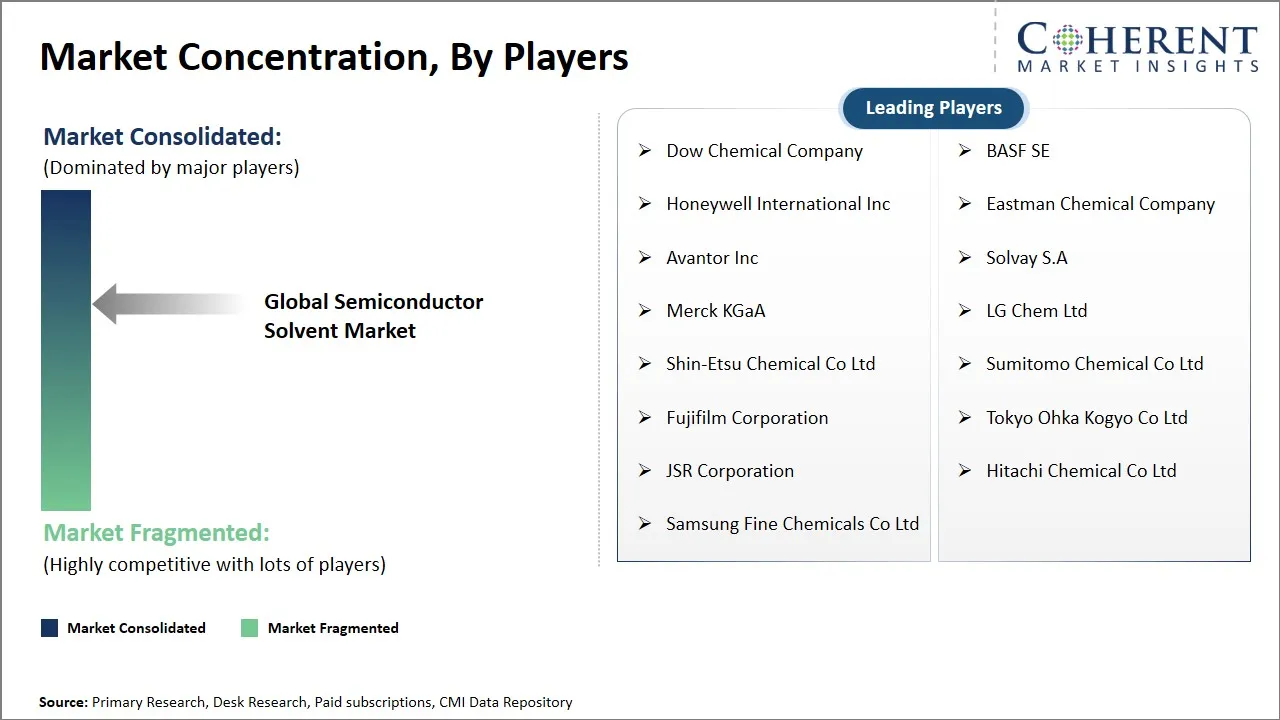
Market Players, Key Development, and Competitive Intelligence
Key Developments
- On September 15, 2025, Solvay officially opened a significant expansion at its Zhenjiang, China, facility, doubling its production capacity for electronic grade hydrogen peroxide (H2O2) annually. This investment underscores Solvay's commitment to supporting the semiconductor industry, which relies on this ultra-pure chemical for integrated circuit manufacturing.
- On September 16, 2024, Eastman introduced EastaPure IPA, a new electronic‑grade high‑purity isopropyl alcohol product positioned for wafer fabrication wet cleaning and drying applications throughout semiconductor front, middle, and back ends.
Top Strategies Followed by Global Semiconductor Solvent Market Players
Player Type | Strategic Focus | Example |
Established Market Leaders | Merck Expansion | On December 1, 2025, Merck inaugurated its Semiconductor Solutions megasite in Kaohsiung, Taiwan. With this investment, the company is strengthening its global supply chain resilience while deepening its leading role in the semiconductor ecosystem. |
Mid-Level Players | LCY Chemical Launches LCY Advanced Formulations | On September 10, 2025, LCY Chemical announced the launch of LCY Advanced Formulations, a next‑generation portfolio of wet processing chemicals, including electronic‑grade isopropyl alcohol (EIPA) for semiconductor advanced packaging and cleaning processes |
Small-Scale Players | Business Collaboration | On January 23, 2025, Evonik and Fuhua Tongda Chemicals Company established a joint venture in Leshan, Sichuan Province, to produce and market hydrogen peroxide (H2O2) in China. |
Market Report Scope
Semiconductor Solvent Market Report Coverage
| Report Coverage | Details | ||
|---|---|---|---|
| Base Year: | 2025 | Market Size in 2026: | USD 3.30 Bn |
| Historical Data for: | 2020 To 2024 | Forecast Period: | 2026 To 2033 |
| Forecast Period 2026 to 2033 CAGR: | 5% | 2033 Value Projection: | USD 5 Bn |
| Geographies covered: |
| ||
| Segments covered: |
| ||
| Companies covered: | Dow Chemical Company, BASF SE, Honeywell International Inc, Eastman Chemical Company, Avantor Inc, Solvay S.A, Merck KGaA, LG Chem Ltd, Shin-Etsu Chemical Co Ltd, Sumitomo Chemical Co Ltd, Fujifilm Corporation, Tokyo Ohka Kogyo Co Ltd, JSR Corporation, Hitachi Chemical Co Ltd, and Samsung Fine Chemicals Co Ltd | ||
| Growth Drivers: |
| ||
| Restraints & Challenges: |
| ||
Global Semiconductor Solvent Market Dynamics
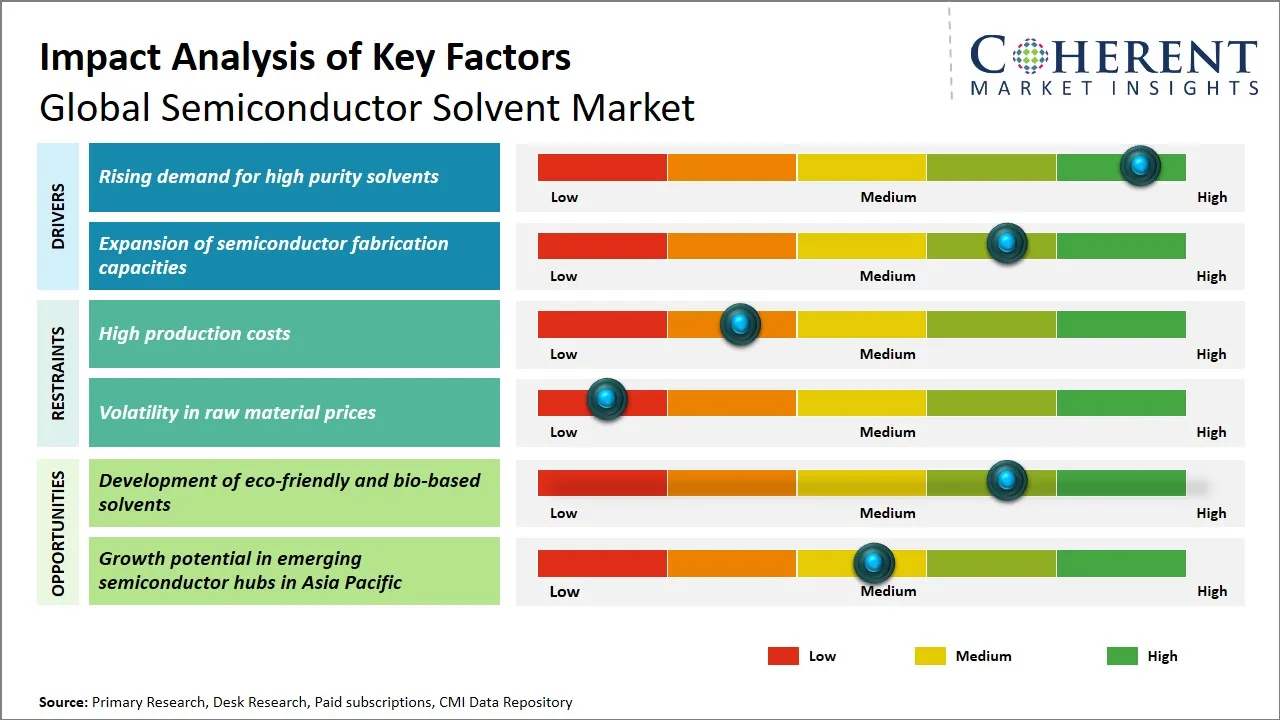
Global Semiconductor Solvent Market Driver - Rising Demand for High Purity Solvents
The semiconductor industry's ongoing advancements in microelectronics and nanotechnology rely heavily on the use of high purity solvents, which play a critical role in cleaning, etching, and wafer processing. Smaller sizes, greater complexity - this shift pushes solvent needs toward flawless consistency. Purity becomes non-negotiable when even tiny contaminants risk disrupting performance. Precision matters more as components pack tighter. Requirements evolve where stability under pressure defines suitability. Impurity-free operation is expected, not optional. Through precise elimination of microscopic debris and leftover matter, top-grade solvents help preserve fragile structures throughout production stages.
For instance, on October 2, 2025, FUJIFILM Corporation announced that its U.S.-based subsidiary for semiconductor materials, FUJIFILM Electronic Materials U.S.A., Inc. (Fujifilm), will participate in SEMICON West 2025, an international exhibition of semiconductor manufacturing equipment and materials, where it will highlight its broad portfolio of advanced high-purity chemicals & semiconductor materials.
(Source: fujifilm.com)
Global Semiconductor Solvent Market Opportunity - Development of Eco-Friendly and Bio-Based Solvents
Movement within the worldwide semiconductor solvent market connects strongly to changes favoring environmentally friendlier chemical practices, driven by tighter environmental rules alongside industry reductions in toxic substance usage. Rather than depend on traditional formulations, producers investigate alternatives preventing emission of hazardous fumes throughout fabrication processes. Pressure rises when governments enforce tighter control over chemical output, nudging firms to seek safer fluid choices without sacrificing performance. From crops rather than fossil fuels, certain liquids emerge, breaking down more easily, harming living tissue less, leaving behind smaller climate traces.
For instance, on August 8, 2024, BASF gave a clear sign towards biotransformation of its (Meth)Acrylate portfolio and switching its production to bio-based Ethyl Acrylate (EA) starting Q4 2024.
(Source: basf.com)
Analyst Opinion (Expert Opinion)
- Steady expansion marks the worldwide market for semiconductor solvents, shaped largely by technological advances rather than broad economic shifts. Mainly because of massive production facilities, East Asia dominates consumption figures - Japan, South Korea, Taiwan, and mainland China setting the pace. Output here exceeds most regions, shaping global supply flows along with standards for purity. With advancing techniques, expectations for uniform composition increase; thus tighter controls over contaminants become necessary. Higher precision becomes necessary where refinement processes advance. Growth follows innovation cycles within integrated circuits, progressing without dramatic surges but with consistent upward pressure.
- Structural changes now shape the market, influenced by localized supply chains alongside tightening ecological rules. Geopolitical tensions growing have shifted focus in the U.S. and Europe toward locally produced high-purity chemicals, particularly solvents. Despite this, environmental priorities are accelerating progress in fluids that emit less, can be reused, and pose fewer ecological risks. Despite fluctuations in base component costs coupled with demanding cleanliness thresholds creating hurdles, those able to deliver stable extreme-grade quality, adherence to legal norms, along with engineering support to fabrication plants may gain lasting positioning strength.
Speak to the analyst
Want personalized insights?
Take the findings above to one of our principal consultants, or have the report rebuilt around the segments, geographies and competitors you actually track.
Market Segmentation
- Type Insights (Revenue, USD Billion, 2021 - 2033)
- Ultra-High Purity Reagents
- Functional Chemicals
- Solvent Type Insights (Revenue, USD Billion, 2021 - 2033)
- Acetone
- Isopropyl Alcohol
- Ethanol
- Methanol
- Others
- Application Insights (Revenue, USD Billion, 2021 - 2033)
- Cleaning
- Etching
- Deposition
- Photolithography
- Chemical Mechanical Planarization
- Regional Insights (Revenue, USD Billion, 2021 - 2033)
- North America
- U.S.
- Canada
- Latin America
- Brazil
- Argentina
- Mexico
- Rest of Latin America
- Europe
- Germany
- U.K.
- Spain
- France
- Italy
- Russia
- Rest of Europe
- Asia Pacific
- China
- India
- Japan
- Australia
- South Korea
- ASEAN
- Rest of Asia Pacific
- Middle East
- GCC Countries
- Israel
- Rest of Middle East
- Africa
- South Africa
- North Africa
- Central Africa
- North America
- Key Players Insights
- Dow Chemical Company
- BASF SE
- Honeywell International Inc
- Eastman Chemical Company
- Avantor Inc
- Solvay S.A
- Merck KGaA
- LG Chem Ltd
- Shin-Etsu Chemical Co Ltd
- Sumitomo Chemical Co Ltd
- Fujifilm Corporation
- Tokyo Ohka Kogyo Co Ltd
- JSR Corporation
- Hitachi Chemical Co Ltd
- Samsung Fine Chemicals Co Ltd
Sources
Primary Research Interviews
- Semiconductor solvent manufacturers and suppliers
- Chemical processing equipment vendors
- Electronics industry procurement managers
- Semiconductor fabrication facility operators
Magazines
- Semiconductor International Magazine
- Chemical Processing Magazine
- Electronics Manufacturing Magazine
- Cleanroom Technology Magazine
Journals
- Journal of Electronic Materials
- IEEE Transactions on Semiconductor Manufacturing
- Journal of Chemical Technology & Biotechnology
Newspapers
- Chemical & Engineering News
- Electronics Weekly
- Semiconductor Today
- EE Times
Associations
- Semiconductor Industry Association (SIA)
- International Association of Electronics Recyclers (IAER)
- Chemical Manufacturers Association (CMA)
- Global Semiconductor Alliance (GSA)
Public Domain Sources
- U.S. Environmental Protection Agency (EPA) reports
- International Trade Administration databases
- World Health Organization chemical safety publications
- European Chemicals Agency (ECHA) databases
Proprietary Elements
- CMI Data Analytics Tool
- Proprietary CMI Existing Repository of information for last 8 years
Get access to 250+ pages report
Every segment, forecast, competitor profile and data table behind the analysis above — available for instant download.
- ESOMAR Member
- ISO 9001:2015 Certified
- D-U-N-S Registered
- GDPR & CCPA Compliant
Missing comfort of reading report in your local language? Find your preferred language:
Transform your Strategy with Exclusive Trending Reports
Frequently Asked Questions
The global semiconductor solvent market is expected to stand at USD 3.30 Bn in 2026 and is expected to reach USD 5 Bn by 2033.
The CAGR of global semiconductor solvent market is projected to be 5% from 2026 to 2033.
Rising demand for high purity solvents and expansion of semiconductor fabrication capacities are the major factors driving the growth of the global semiconductor solvent market.
High production costs and volatility in raw material prices are the major factors hampering the growth of the global semiconductor solvent market.
In terms of type, ultra-high purity reagents are estimated to dominate the market revenue share in 2026.
EUV processes require specialized cleaning and photoresist removal solvents with extremely low contamination levels.
Regulations encourage the development of low-VOC and environmentally friendly solvent alternatives.