

Global Specialty Malt Market Size and Forecast – 2026 To 2033
The Global Specialty Malt Market is estimated to be valued at USD 3.63 Bn in 2026 and is expected to reach USD 4.87 Bn by 2033, exhibiting a compound annual growth rate (CAGR) of 4.3% from 2026 to 2033. Market expansion will be supported by craft brewing, premium beer and whisky production, alcohol-free beer formulation, and wider use of roasted and kilned malt in bakery, cereals, confectionery, and beverage products.
Maltsters are developing portfolios and technical assistance based on recipes to meet critical color, sweetness, aroma, body and fermentation requirements. Better access to bagged products and smaller order sizes are helping independent breweries and regional distilleries. In February 2024, Rahr Corporation merged Rahr Malting Co. and BSG into RahrBSG and streamlined their operations to serve the brewing and distilling markets in the same way as distributing malt. The alignment will help customers gain better access to specialty malt varieties, application know-how and more integrated supply services.
Key Takeaways of the Global Specialty Malt Market
- The caramel and crystal malt segment is expected to hold 37.2 % of the global specialty malt market in 2026 because controlled stewing and roasting provide brewers with precise color, sweetness, body, and flavor adjustment across multiple beer styles. Their recipe versatility supports recurring procurement by large and craft breweries. In September 2023, Weyermann commissioned its Caramel Malt Cathedral with modern malting technologies.
- Dry specialty malt is expected to account for 79.4 % of the market share in 2026 because it is easier to store, transport, meter, and blend than liquid alternatives. Its shelf stability and compatibility with existing milling and mashing systems support use across brewing, distilling, and food production. In July 2024, Muntons promoted Maltichoc Dried Regular as a malt-based cocoa alternative for food formulations.
- Barley is expected to represent 76.8 % of the global specialty malt market in 2026 because it offers dependable extract yield, enzymatic performance, husk-assisted filtration, and established malting infrastructure. Its processing flexibility supports caramel, roasted, kilned, and smoked malt varieties. In April 2026, Boortmalt and Asahi UK launched a collaboration advancing regenerative practices across British barley farms.
- Europe is expected to dominate the market, holding 34.6 % of the market share in 2026, supported by established malting clusters, technically advanced breweries, whisky production, and demand for distinctive color and flavor profiles. European maltsters also possess extensive roasting, kilning, and peating expertise. In September 2024, U.K.-based Simpsons Malt completed projects to expand base and peated malt production at its Tweed Valley Maltings in Berwick-upon-Tweed, England. The development is directly relevant to the European market, as it strengthens regional malt-processing capacity and supports growing demand from breweries and whisky distilleries, particularly across the U.K. and Scotland.
- North America is expected to hold 27.4 % of the market share in 2026 and remain the fastest-growing region as craft breweries, regional distilleries, and experimental beverage producers seek differentiated malt profiles. Strong ingredient distribution networks also help smaller customers access specialty grades. In January 2025, Gambrinus Malting introduced Mars Malt, a North American red malt developed for richly colored beer styles.
- Customized Flavor Architecture: Specialty malt buyers are moving toward more precise flavor, color, aroma, and mouthfeel specifications rather than selecting products only by broad malt category. This encourages maltsters to develop application-led portfolios, pilot-scale testing, sensory support, and recipe guidance. Suppliers that translate production parameters into consistent brewing outcomes can strengthen customer retention and command greater value from technical service.
- Low-Carbon Malt Procurement: Breweries and distilleries are starting to consider the footprint of specialty malt, both in terms of agriculture and processing. This changes the focus of investment to regenerative grain sourcing, kilning using energy efficient technology, heat recovery, renewable energy and auditable chain-of-custody systems. But those maltsters with built-in farmer connections and legitimate emissions claims could benefit from preferred-supplier status, while those using opaque farmer sourcing may be under procurement pressure.
Segmental Insights
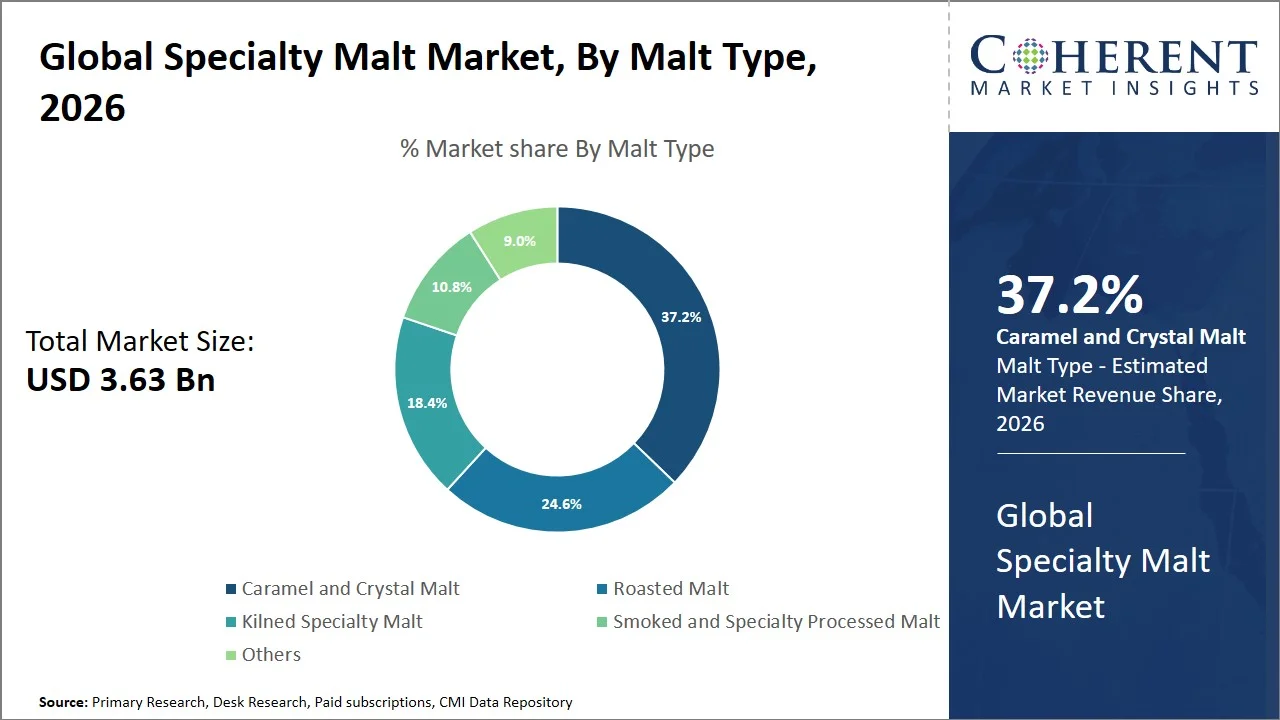
Why Does Caramel and Crystal Malt Dominate the Global Specialty Malt Market?
The caramel and crystal malt segment is expected to hold 37.2% of the global specialty malt market in 2026 because they offer brewers precise control over color, residual sweetness, foam stability, body, and caramelized flavor without requiring major recipe changes. Their use spans amber lagers, ales, bitters, bocks, porters, and specialty releases, supporting repeat procurement across industrial and craft breweries. Maltsters benefit from differentiated pricing, while brewers gain a flexible tool for premiumization and flavor consistency. In December 2025, Castle Malting introduced CHÂTEAU CARA ULTRA, a caramel malt range produced through steam-saccharification technology to improve uniform caramelization, aromatic clarity, smoothness, and foam performance. This development demonstrates continued product innovation within the leading specialty malt category.
- Current Industry Events of 2026
- Market Size Estimation
- Regional Breakdown
- Competitive Landscape
- Customer Intelligence
- Segmental Analysis
- Pricing Analysis
- Key Market Drivers, Challenges & Future Trends
- Customized Insights Section
Why Does Dry Specialty Malt Represent the Largest Form Segment in the Global Specialty Malt Market?
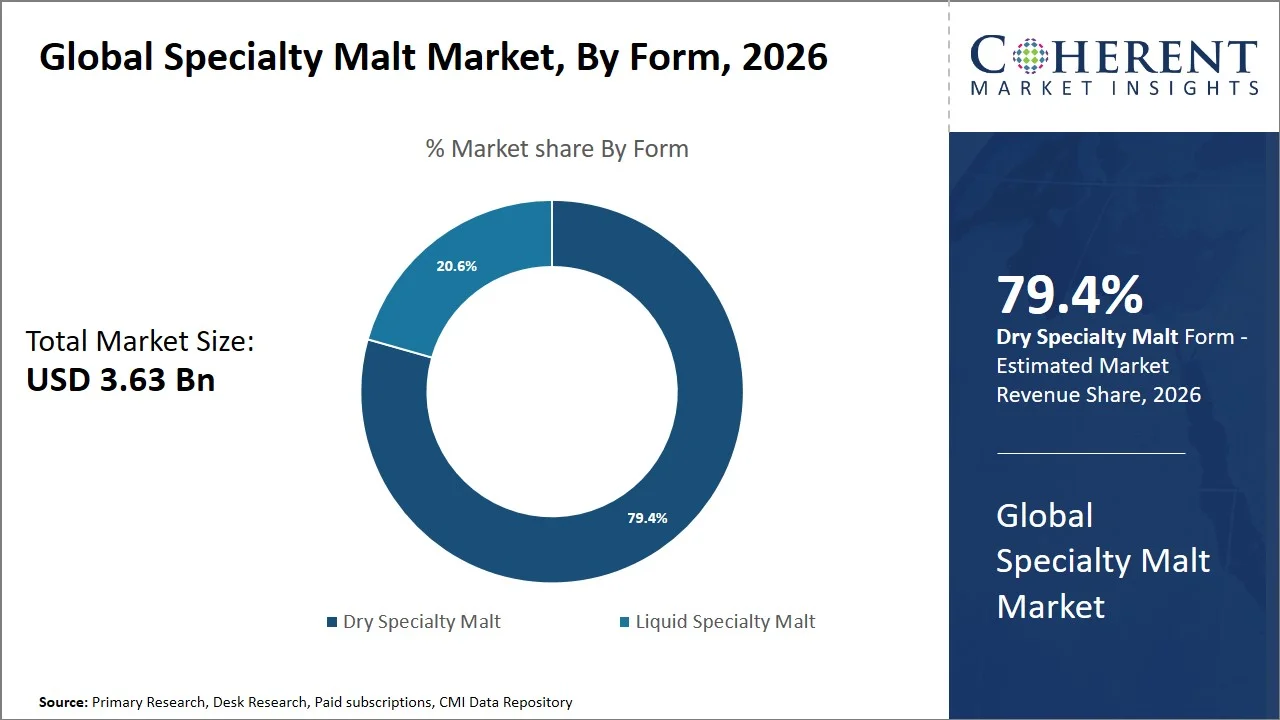
Dry specialty malt is expected to account for 79.4% of the global specialty malt market in 2026 because its low moisture content supports longer storage, simpler handling, lower transportation complexity, and accurate dosing in brewing and food formulations. Dry formats integrate easily with grain milling, bakery premixes, confectionery, cereals, and powdered beverage systems, giving suppliers access to several end-use markets. Manufacturers also gain greater packaging flexibility and reduced leakage or spoilage risk compared with liquid formats. In December 2025, Döhler launched an all-in-one powdered cocoa-replacement solution using barley malt, carob powder, and coloring concentrates for bakery applications. The launch demonstrates how dry malt-based ingredients can move beyond brewing into clean-label color, flavor, and texture systems for food manufacturers.
Why Does Barley Dominate the Grain Type Segment of the Global Specialty Malt Market?
Barley is expected to represent 76.8% of the global specialty malt market in 2026 because its enzyme profile, starch availability, husk structure, and processing familiarity make it the preferred grain for brewing and distilling malt. Barley supports efficient lautering, predictable extract performance, and broad modification through roasting, stewing, kilning, smoking, and peating. Established breeding programs, grain contracts, storage systems, and malting infrastructure further strengthen supply reliability. This benefits maltsters seeking scale and brewers requiring consistent recipe performance. In October 2025, Cornell University’s Small Grains Breeding Program released LakeEffect, its first winter malting barley variety, combining higher yield, disease resistance, and a brewing-suitable malting profile. The release illustrates continued investment in grain quality and agronomic resilience for malt supply chains.
Current Events and their Impact
Current Event | Description and Its Impact |
March 2024 – Canada Introduces Craft Brewery Excise Relief |
|
May 2024 – EU Geographical Indication Regulation Takes Effect |
|
February 2025 – U.K. Expands Draught and Small-Producer Relief |
|
Global Specialty Malt Market Dynamics
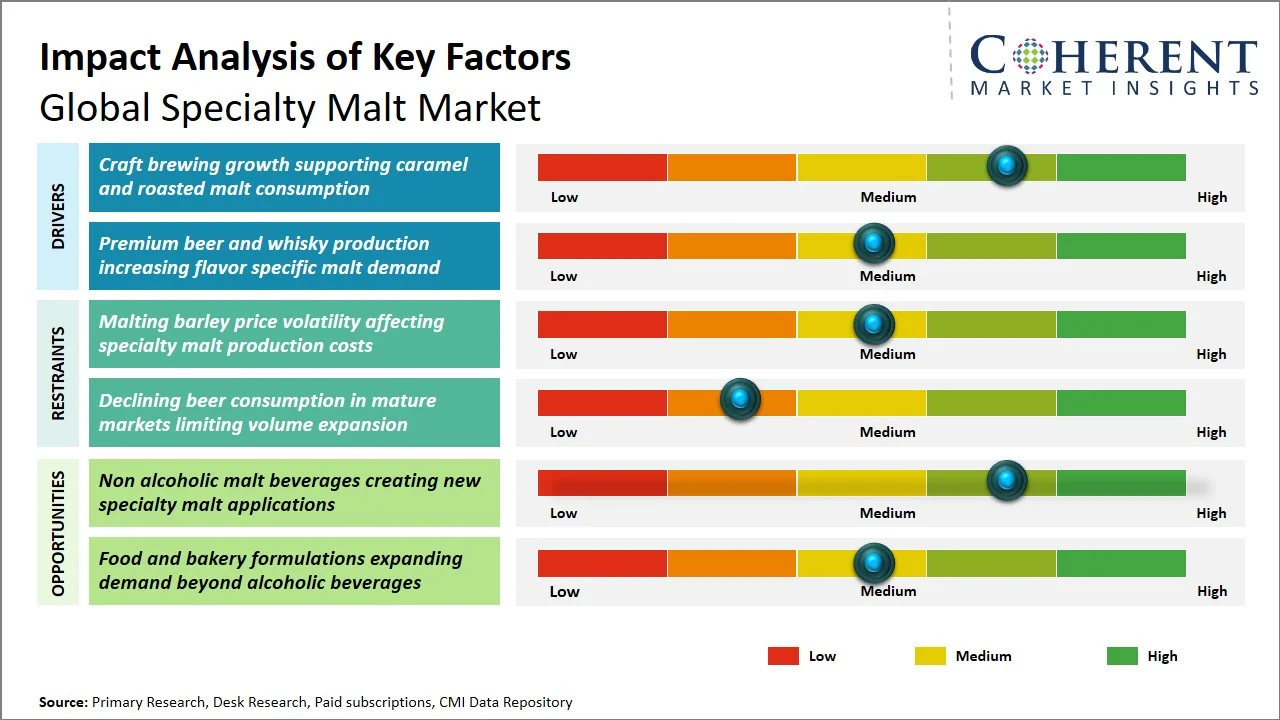
Key Market Drivers
- Craft Brewing Expands Recipe-Specific Malt Procurement: Craft brewing growth supports specialty malt consumption because independent breweries compete through differentiated recipes rather than production scale. Caramel, crystal, roasted, smoked, wheat, rye, and highly kilned malts allow brewers to create seasonal releases, taproom exclusives, darker styles, and locally distinctive products without installing additional processing equipment. Frequent recipe rotation increases the number of malt specifications purchased in smaller lots, benefiting specialist maltsters, distributors, technical-service teams, and flexible packaging operations. Direct brewery sales also improve margins, giving producers greater room to use premium ingredients. In April 2026, the Society of Independent Brewers and Associates reported that many British independent breweries were expanding direct-to-consumer activity through brewery shops, taprooms, market stalls, and events. This channel shift supports faster product experimentation and strengthens commercial demand for specialty malts capable of delivering recognizable color, aroma, and mouthfeel.
- Premium Whisky Capacity Increases Demand for Flavor-Specific Malt: Premium beer and malt whisky production increases the demand for flavor-specific malts because producers use grain selection and thermal processing to build product identity. Distillers can combine standard pot-still malt with roasted, peated, smoked, or specialty-kilned grades to influence new-make spirit character, while premium brewers use targeted malt bills to support richer sensory positioning. These applications require tighter control of color, extract, protein, fermentability, glycosidic nitrile content, and batch consistency, creating higher-value opportunities for maltsters with pilot facilities and application expertise. In November 2024, Diageo opened its YunTuo single malt whisky distillery in Yunnan, China, as part of a long-term investment in locally produced premium whisky. The facility illustrates how new regional single-malt capacity can create recurring demand for distilling-grade barley malt and encourage suppliers to develop locally adapted specifications, traceability systems, and technical support.
Emerging Market Trends
- Specialty Malt for Alcohol-Free Beer: Alcohol-free beer producers are using caramel, dextrin, Munich, wheat and lightly roasted malts to bring back the body, color, sweetness and roasted attributes that they lost through limited fermentation or de-alcoholization. This drives the demand for process-specific malt grades and technical formulation support, with the advantage for maltsters who are able to support the brewers in balancing the intensity of flavor, fermentability and drinkability. Innovation with malt will likely ramp up as there is increasing demand for premium alcohol-free products among consumers.
- Specialty Malt in Food Formulations: Roasted and kilned malts are gaining use in bakery, cereals, snacks, confectionery, and beverage powders as natural sources of brown color, toasted flavor, and mild sweetness. This creates higher-value opportunities for suppliers with fine milling, blending, food-grade quality control, and application-testing capabilities, while reducing dependence on beer and whisky demand. Additionally, clean-label trends are encouraging manufacturers to replace artificial additives with malt-based ingredients.
Regional Insights
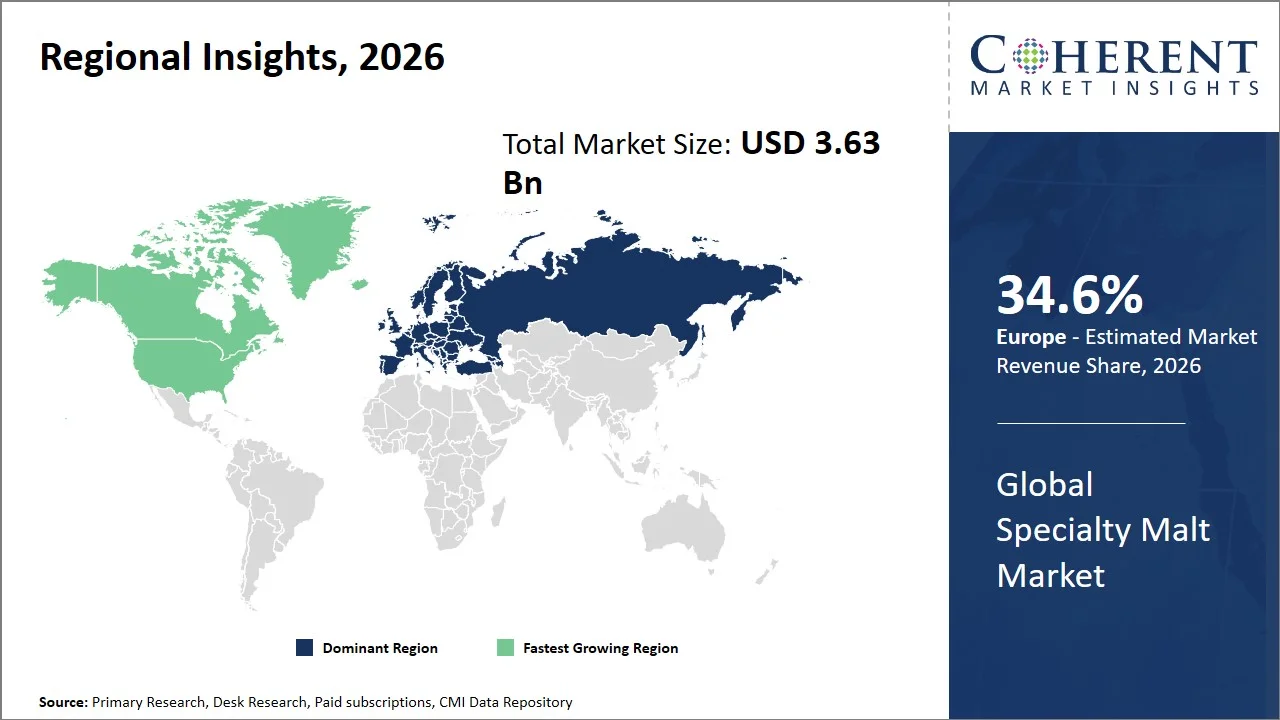
Why Does Europe Dominate the Global Specialty Malt Market?
Europe is expected to dominate the global specialty malt market with a 34.6% share in 2026. The region combines established malting-barley cultivation, technically advanced malt houses, extensive brewery networks, and major whisky and craft-spirit clusters. Brewers use caramel, crystal, roasted, kilned, wheat, and smoked malts to differentiate lagers, ales, stouts, wheat beers, and alcohol-free products. Maltsters also benefit from close links to barley cooperatives, ports, laboratories, and brewing-equipment suppliers, supporting consistent specifications and export flexibility. Demand is increasingly shaped by premium recipes and fuller flavor delivery rather than beer volume alone. In July 2025, The Brewers of Europe published its European Beer Trends edition, documenting 9,553 breweries and beer production of 335.6 million hectoliters across the European Union, demonstrating the large downstream customer base supporting specialty malt procurement.
Why is North America Emerging as the Fastest-Growing Region in the Global Specialty Malt Market?
North America is expected to be the fastest-growing region in the global specialty malt market, accounting for 27.4% in 2026. Expansion is supported by craft breweries, regional distilleries, brewpubs, and product developers seeking locally differentiated color, aroma, and flavor profiles. Small and mid-sized buyers frequently use roasted, caramel, smoked, rye, wheat, and other specialty malts to produce limited releases and premium beverages, creating higher-value opportunities for flexible maltsters and ingredient distributors. Growth in malt whisky also broadens demand beyond beer and encourages closer alignment between barley varieties, malting specifications, and distillation performance. In January 2025, the U.S. Alcohol and Tobacco Tax and Trade Bureau’s American single malt whisky standard became effective, requiring production from 100% malted barley in the U.S. The rule strengthens a clearly defined end market for malt suppliers serving North American distillers.
Global Specialty Malt Market Outlook for Key Countries
Why is the U.S. a Key Market for the Specialty Malt Market?
The U.S. is a key country in the global specialty malt market because its diversified brewing sector supports demand for standardized and highly customized malt profiles. Independent breweries use crystal and caramel malts for body and sweetness, roasted grades for stout and porter character, and wheat, rye, or smoked malts for seasonal and experimental recipes. Regional maltsters and nationwide ingredient distributors make smaller orders, technical advice, and recipe-specific sourcing accessible to breweries unable to procure full bulk loads. Distilling, baking, and malted-food applications add further demand diversity. In April 2025, the Brewers Association reported that 9,796 U.S. craft breweries operated during 2024 and produced 23.1 million barrels of beer. Although industry volumes moderated, the extensive brewery base continues to sustain the demand for differentiated malt ingredients, pilot batches, and frequent recipe renovation.
Why Does China Support Growth in the Global Specialty Malt Market?
China supports growth in the global specialty malt market through its large brewing base and gradual shift from standardized mass-market lager toward premium, craft-style, all-malt, wheat, dark, and flavored beer offerings. Large breweries can generate substantial volumes for consistent specialty grades, while smaller urban brewers create demand for wider malt portfolios and technical support. Domestic barley production, imported malting barley, established malt plants, and expanding brewing capacity provide a scalable supply structure. Product premiumization increases the importance of color control, extract performance, foam stability, and distinctive roasted or caramel notes. In December 2025, the Zhongshan government announced that Zhujiang Brewery’s capacity-expansion and upgrade project had entered operation, adding 300,000 tons of annual brewing capacity and modernized production lines. The investment expands the downstream processing base capable of consuming differentiated brewing malts.
Why is Japan Important in the Global Specialty Malt Market?
Japan is important in the global specialty malt market because brewers compete through precise sensory profiles, premium positioning, seasonal products, and carefully controlled manufacturing quality. Domestic consumers are receptive to differentiated lagers, wheat beers, craft products, and alcohol-free beer-style beverages, encouraging the use of specialty malts for softer mouthfeel, deeper color, foam stability, and distinctive grain character. Malt suppliers must meet strict requirements for consistency, traceability, extract yield, and flavor repeatability across national production sites. Product renovation by major brewers can translate quickly into meaningful malt requirements because launches receive broad retail coverage. In January 2025, Kirin announced Ichiban Shibori White Beer for nationwide launch, using wheat malt and an unfiltered brewing method to create a softer, lighter taste. The introduction illustrates how grain and malt selection can recruit consumers seeking alternatives to conventional lager profiles.
Why is India an Important Growth Market for the Specialty Malt Market?
India is becoming an important country in the global specialty malt market as brewery investment, premium beer consumption, whisky production, and organized hospitality increase the demand for reliable malt supplies. Domestic barley cultivation offers a foundation for local sourcing, but processors must manage varietal suitability, protein content, germination quality, and climate-related variation to meet brewing specifications. Growing interest in wheat beers, stronger flavor profiles, craft products, and premium spirits creates opportunities beyond standard base malt. Local malting and distribution can reduce freight exposure and improve responsiveness for breweries operating under state-specific supply systems. In February 2025, Carlsberg India signed an agreement with the Government of Karnataka to invest USD 3.62 Mn in expanding its Mysuru brewery through new can, glass, and keg lines. Higher brewing capability will increase requirements for consistent base and specialty malt inputs across an enlarged product mix.
Why is Germany a Strategic Country in the Specialty Malt Market?
Germany is a strategic country in the global specialty malt market because it combines high-quality malting barley, experienced maltsters, advanced kilning and roasting expertise, and a brewing culture that values process discipline. German suppliers produce caramel, roasted, Munich, Vienna, wheat, rye, and organic malts for domestic customers and export markets. Their competitiveness rests on crop contracting, laboratory control, sensory guidance, recipe support, and the ability to deliver consistent color and flavor specifications. Demand from traditional breweries is complemented by craft brewing, alcohol-free beer, bakery, and distilling applications. In January 2025, BESTMALZ selected oatmeal stout for its international BestBrewChallenge and specified oat, chocolate, and roasted malt options for participants. The program demonstrates Germany’s role in connecting specialty malt development with brewer education, recipe experimentation, and international technical engagement.
Technology Adoption Landscape in the Global Specialty Malt Market
Technology | Adoption Level | Key Application Area | Business Impact |
Controlled drum roasting | High | Production of chocolate, black, brown, coffee, and deeply roasted malts | Enables precise development of color and roasted flavor while limiting scorching and batch inconsistency. |
Steam stewing and crystallization | High | Manufacturing caramel and crystal malt | Converts internal starches into sugars before kilning, supporting sweetness, body, color, and flavor differentiation. |
Automated steeping, germination, and kilning controls | High | Large-scale specialty and base malt production | Improves batch repeatability, process timing, water use, energy efficiency, and specification compliance. |
Near-infrared spectroscopy | Medium | Rapid assessment of moisture, protein, extract potential, and grain quality | Reduces laboratory turnaround time and supports faster barley segregation and process adjustment. |
Pilot malting and micro-roasting systems | Medium | Customer trials, recipe development, and new specialty-grade testing | Allows maltsters to validate flavor, color, and processing outcomes before committing to commercial production. |
Digital grain traceability platforms | Medium | Tracking barley from contracted farms through storage, malting, and delivery | Strengthens origin verification, sustainability reporting, quality investigations, and customer confidence. |
How are Malt-Based Cocoa Reduction and Natural Coloring Systems Creating New Growth Opportunities in the Global Specialty Malt Market?
Malt-based cocoa reduction and natural browning systems represent an underdeveloped opportunity for specialty malt suppliers serving bakery, biscuits, cereals, snacks, desserts, and beverage powders. Roasted barley and specialty malt flours can contribute dark color, toasted flavor, and body while helping manufacturers manage cocoa-cost volatility and simplify ingredient labels. The opportunity is not a complete cocoa replacement strategy; commercial success depends on application-specific blends that preserve bitterness, aroma, texture, and consumer familiarity. Maltsters can capture value by offering standardized color ranges, fine particle sizes, low-flavor and high-flavor options, technical prototypes, and documented dosage guidance. Food manufacturers, private-label producers, and ingredient distributors are the most relevant customers. Participation requires food-grade segregation, microbiological controls, allergen management, milling and blending capability, and sensory laboratories. Vertically integrated maltsters and food-ingredient specialists are best positioned, although smaller roasting companies can compete through customized batches. Suppliers should prioritize products where malt functionality adds value beyond color alone.
Market Players, Key Development, and Competitive Landscape
Key Developments
- In February 2026, Soufflet Malt announced a USD 114.08 million investments to construct a new technology-led malthouse in Rajasthan, India. The planned facility will use digital grain handling, traceability systems, advanced water management, and the company’s MALTimize platform. This is important for the global specialty malt market because it expands localized production capacity while introducing data-led process optimization for brewing, distilling, food, and beverage customers.
- In September 2024, Viking Malt introduced its malted faba bean ingredient, Sprau, into the Polish brewing market through beers developed with ReCraft Brewery. This is important for the market because it extends malting technology beyond conventional cereal grains and demonstrates how specialty ingredients can modify mouthfeel, foam quality, and flavor while supporting crop rotation and differentiated brewing strategies.
- In June 2024, Malteurop, VIVESCIA, and HEINEKEN completed the first barley harvest from HEINEKEN’s large-scale regenerative agriculture program in Europe. This is important for the global specialty malt market because it links farm-level cultivation practices with commercial malt procurement and gives breweries a route to reduce upstream environmental impacts while maintaining barley quality and supply-chain traceability.
Competitive Landscape
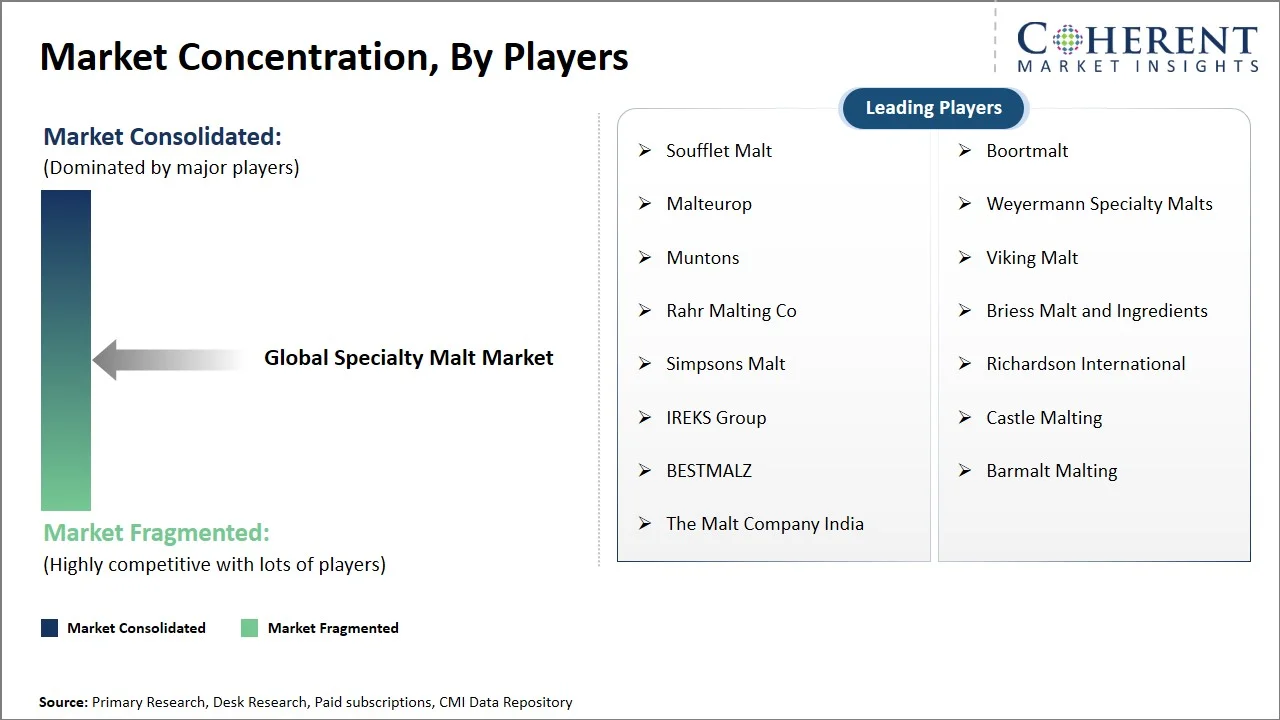
The global specialty malt market is moderately consolidated at the industrial malting level but fragmented within regional craft and highly specialized grades. Large multinational maltsters possess integrated barley sourcing, international plants, bulk logistics, and major brewery contracts. Independent and regional malt companies compete through heritage grains, small-batch roasting, local sourcing, technical service, and customized products. Competitive advantage depends increasingly on sensory consistency, supply reliability, production flexibility, sustainability verification, and application-specific expertise.
Key focus areas include
- Barley sourcing security: Contracted grower networks and diversified crop origins reduce exposure to harvest variability.
- Flavor consistency: Customers expect repeatable caramel, toasted, biscuit, chocolate, coffee, and smoked profiles across batches.
- Flexible order sizes: Bagged, palletized, bulk, and mixed-load options improve access to craft breweries and regional distilleries.
- Technical collaboration: Pilot malting, recipe advice, sensory assessment, and troubleshooting strengthen long-term customer retention.
- Cost and energy efficiency: Kilning and roasting economics influence margins because specialty grades require additional thermal processing.
- Food-grade capability: Milling, powder handling, microbiological controls, and documentation support expansion beyond alcoholic beverages.
- Local and heritage positioning: Regional barley varieties and traditional processing methods help smaller maltsters differentiate from standardized global suppliers.
- Sustainability verification: Farm-level traceability, regenerative agriculture, renewable heat, and emissions reporting increasingly influence supplier selection.
Market Report Scope
Specialty Malt Market Report Coverage
| Report Coverage | Details | ||
|---|---|---|---|
| Base Year: | 2025 | Market Size in 2026: | USD 3.63 Bn |
| Historical Data for: | 2020 To 2024 | Forecast Period: | 2026 To 2033 |
| Forecast Period 2026 to 2033 CAGR: | 4.3% | 2033 Value Projection: | USD 4.87 Bn |
| Geographies covered: |
| ||
| Segments covered: |
| ||
| Companies covered: | Soufflet Malt, Boortmalt, Malteurop, Weyermann Specialty Malts, Muntons, Viking Malt, Rahr Malting Co, Briess Malt and Ingredients, Simpsons Malt, Richardson International, IREKS Group, Castle Malting, BESTMALZ, Barmalt Malting, and The Malt Company India | ||
| Growth Drivers: |
| ||
| Restraints & Challenges: |
| ||
Analyst Opinion (Expert Opinion)
- Competitive leadership will gradually move from selling standardized malt grades toward managing complete flavor and performance solutions. Maltsters that combine grain selection, controlled processing, pilot brewing, sensory evaluation, recipe support, and reliable logistics will gain stronger customer relationships. Basic product portfolios will remain necessary, but technical collaboration will increasingly determine supplier preference and margin quality.
- Precision fermentation and advanced flavor systems could pressure some traditional specialty malt applications by offering brewers alternative methods for adjusting color, aroma, body, and sweetness. Malt will retain its core role, but suppliers may need to prove the natural, sensory, process, and labeling advantages of malt-derived functionality. Companies with detailed application data and distinctive grain-origin stories will be better protected.
- Maltsters should prioritize energy-efficient roasting, flexible small-batch equipment, food-grade processing, barley-variety development, and digital quality records. Investment decisions should reflect contracted demand because specialized kilning and roasting assets can be underutilized when beer styles change. Suppliers should diversify across brewing, distilling, alcohol-free beverages, and food applications while avoiding excessive dependence on one crop region or large customer.
Speak to the analyst
Want personalized insights?
Take the findings above to one of our principal consultants, or have the report rebuilt around the segments, geographies and competitors you actually track.
Market Segmentation
- Malt Type Insights (Revenue, USD Bn, 2021 - 2033)
- Caramel and Crystal Malt
- Roasted Malt
- Kilned Specialty Malt
- Smoked and Specialty Processed Malt
- Others
- Form Insights (Revenue, USD Bn, 2021 - 2033)
- Dry Specialty Malt
- Liquid Specialty Malt
- Grain Type Insights (Revenue, USD Bn, 2021 - 2033)
- Barley
- Wheat
- Rye
- Oats
- Others
- Application Insights (Revenue, USD Bn, 2021 - 2033)
- Brewing
- Distilling
- Food and Bakery Products
- Non Alcoholic Malt Beverages
- Others
- Regional Insights (Revenue, USD Bn, 2021 - 2033)
- North America
- U.S.
- Canada
- Latin America
- Brazil
- Argentina
- Mexico
- Rest of Latin America
- Europe
- Germany
- U.K.
- Spain
- France
- Italy
- Russia
- Rest of Europe
- Asia Pacific
- China
- India
- Japan
- Australia
- South Korea
- ASEAN
- Rest of Asia Pacific
- Middle East
- GCC Countries
- Israel
- Rest of Middle East
- Africa
- South Africa
- North Africa
- Central Africa
- North America
- Key Players Insights
- Soufflet Malt
- Boortmalt
- Malteurop
- Weyermann Specialty Malts
- Muntons
- Viking Malt
- Rahr Malting Co
- Briess Malt and Ingredients
- Simpsons Malt
- Richardson International
- IREKS Group
- Castle Malting
- BESTMALZ
- Barmalt Malting
- The Malt Company India
Sources
Primary Research Interviews
- Specialty malt manufacturers, malted grain suppliers, breweries, distilleries, food processors, distributors, traders, and contract maltsters
- R&D, grain procurement, malting operations, quality, regulatory, sustainability, marketing, and sales executives
Stakeholders
- Caramel, crystal, roasted, kilned, smoked, and specialty-processed malt manufacturers
- Barley, wheat, rye, oat, enzyme, packaging, storage, roasting, kilning, and malting-equipment suppliers
- Breweries, distilleries, bakery companies, malt beverage producers, importers, exporters, distributors, and ingredient traders
End-use Sectors
- Brewing, craft beer, premium beer, whisky, spirits, and alcohol-free malt beverages
- Bakery, confectionery, cereals, snacks, malt extracts, natural coloring, flavoring, and food ingredients
Regulatory & Government Bodies
- U.S. FDA, USDA, Alcohol and Tobacco Tax and Trade Bureau, and U.S. Customs
- European Commission, EFSA, and national food and alcohol regulators
- UK Food Standards Agency, HM Revenue & Customs, and Department for Environment, Food & Rural Affairs
- FSSAI, China SAMR and NHC, Japan MHLW, Brazil ANVISA, FSANZ, and customs authorities
Databases
- UN Comtrade, ITC Trade Map, WTO Statistics, Eurostat, and USITC DataWeb
- FAOSTAT, World Bank, OECD, USDA, China Customs, India DGCI&S, and Brazil Comex Stat
- Barley production, malt trade, brewery output, distillery capacity, company filings, pricing, and product databases
Magazines and Journals
- Brewing & Beverage Industry International, Brewer and Distiller International, The Brewer & Distiller, and Craft Brewing Business
- Journal of the Institute of Brewing, Journal of Cereal Science, Cereal Chemistry, Food Chemistry, and LWT
Associations
- Maltsters Association of Great Britain
- European Maltsters Association
- American Malting Barley Association
- Master Brewers Association of the Americas
- Brewers Association
- The Brewers of Europe
- Institute of Brewing & Distilling
Public Domain Sources
- Agriculture, food-safety, alcohol, trade, customs, and environmental authorities
- Brewery and distillery statistics, barley crop reports, customs data, company reports, product catalogues, technical specifications, and press releases
- Maltster, brewery, distillery, bakery, ingredient-distributor, and trade-platform listings
Key Standards and Regulations
- Codex food hygiene, additives, contaminants, allergens, and labeling standards
- EU General Food Law, Food Information to Consumers Regulation, and spirit-drink requirements
- U.S. FD&C Act, FSMA, FDA labeling rules, and TTB beer and distilled-spirit regulations
- UK food labeling, alcohol duty, excise, and geographical indication requirements
- India FSSAI, China GB 2760 and GB 7718, and applicable malt and beverage standards
- Barley grading, malt quality, moisture, extract, color, enzyme activity, food-contact packaging, traceability, and organic certification requirements
Proprietary Elements
- CMI Data Analytics Tool, Proprietary CMI Existing Repository of information for last 10 years.
Get access to 250+ pages report
Every segment, forecast, competitor profile and data table behind the analysis above — available for instant download.
- ESOMAR Member
- ISO 9001:2015 Certified
- D-U-N-S Registered
- GDPR & CCPA Compliant
Missing comfort of reading report in your local language? Find your preferred language:
Transform your Strategy with Exclusive Trending Reports
Frequently Asked Questions
The CAGR of the global specialty malt market is projected to be 4.3% from 2026 to 2033.
The global specialty malt market is estimated to be valued at USD 3.63 billion in 2026 and is expected to reach USD 4.87 billion by 2033.
Brewing generates the highest demand because specialty malt provides beer with specific color, aroma, sweetness, body, foam stability, and roasted flavor characteristics.
Barley is the most widely used grain because of its enzyme activity, extract potential, husk structure, processing flexibility, and suitability for brewing and distilling.
Maltsters are developing application-specific products for craft beer, premium whisky, alcohol-free beverages, bakery products, natural coloring, and clean-label food formulations.
Craft brewing growth supporting caramel and roasted malt consumption and premium beer and whisky production increasing flavor specific malt demand are the major factors driving the growth of the global specialty malt market.
Malting barley price volatility affecting specialty malt production costs and declining beer consumption in mature markets limiting volume expansion are the major factors hampering the growth of the global specialty malt market.