

Global Trail Mix Market Size and Forecast: 2026-2033
The global trail mix market is estimated to be valued at USD 4.91 Bn in 2026 and is expected to reach USD 7.83 Bn by 2033, exhibiting a compound annual growth rate (CAGR) of 6.9% from 2026 to 2033.
Key Takeaways of the Trail Mix Market
- The nuts & seed segment is projected to account for 49.7% share in 2026.
- The conventional segment is expected to capture 68.9% share in 2026.
- The supermarkets & hypermarkets segment is projected to hold 35.7% share in 2026.
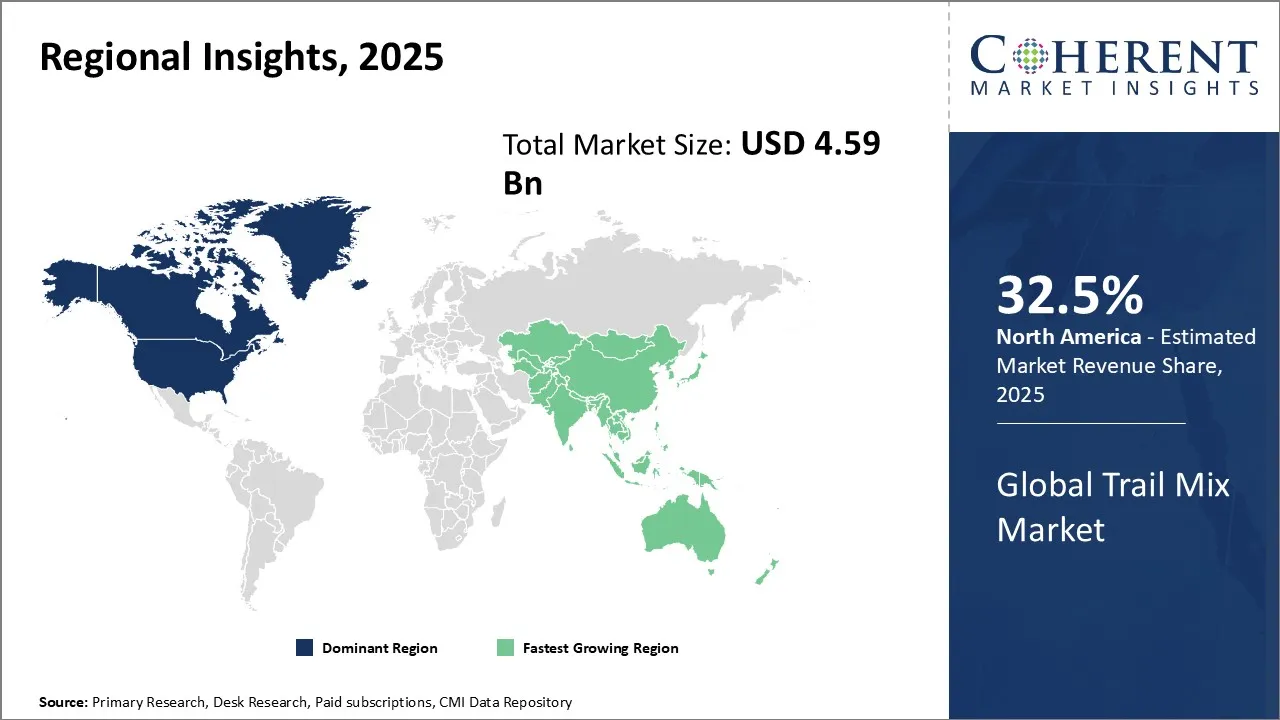
- North America is projected to dominate the global trail mix market in 2026 with a 32.5% share. Asia Pacific, holding an estimated share of 21.5% in 2026, is expected to be the fastest-growing region.
Market Overview
Current market trends highlight a strong shift toward organic and clean-label trail mix products as consumers become more health-conscious and seek transparency in ingredient sourcing. Additionally, the demand for on-the-go snacking is pushing manufacturers to offer diverse, portion-controlled packaging. Sustainable sourcing and eco-friendly packaging are also gaining traction, driven by increasing environmental awareness. Furthermore, the incorporation of superfoods and fortified ingredients is shaping product development to cater to the wellness-driven consumer base.
Currents Events and their Impact
Current Events | Description and its impact |
Supply Chain Disruptions |
|
Regulatory Changes for Food Safety |
|
Segmental Insights
- Current Industry Events of 2026
- Market Size Estimation
- Regional Breakdown
- Competitive Landscape
- Customer Intelligence
- Segmental Analysis
- Pricing Analysis
- Key Market Drivers, Challenges & Future Trends
- Customized Insights Section
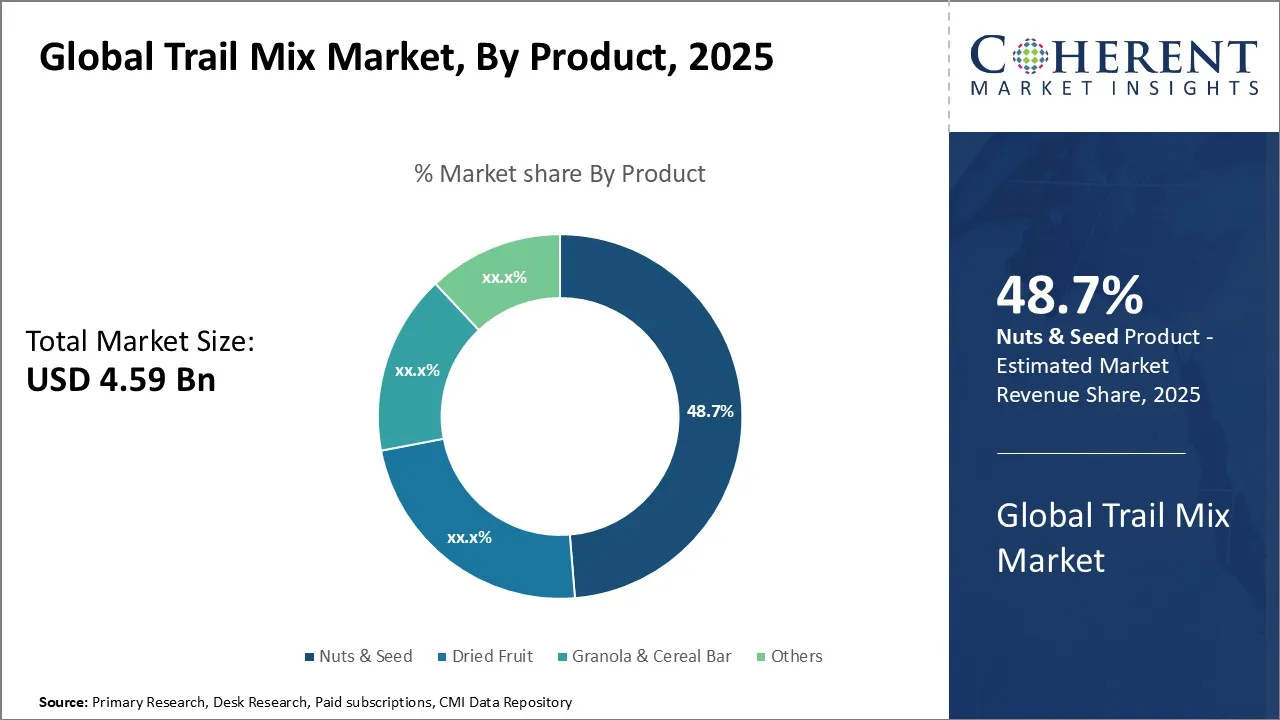
Trail Mix Market Insights, By Product - Nuts & Seed Contributes the Highest Share of the Market Owing to their Nutritional Richness and Versatility
The nuts & seed segment holds an estimated share of 49.7% in 2026, because these ingredients serve as a powerhouse of nutrition, appealing strongly to health-conscious consumers worldwide. Nuts like almonds, cashews, walnuts, and seeds such as pumpkin seeds and sunflower seeds are densely packed with proteins, healthy fats, vitamins, and minerals, which position them as an ideal energy-boosting snack for a variety of demographics, including athletes, busy professionals, and health enthusiasts. This nutritional profile aligns well with the increasing global emphasis on functional foods that support overall wellness.
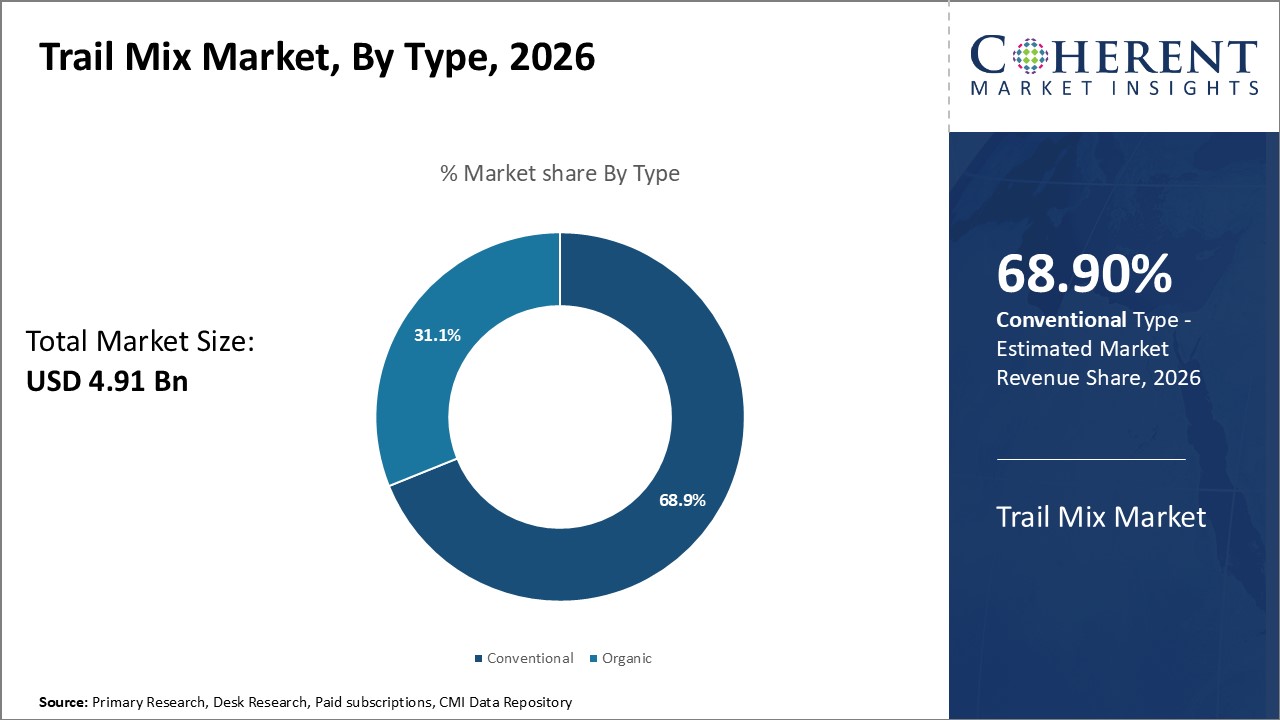
Trail Mix Market Insights, By Type - Conventional Segment Dominate the Market Driven by Cost Accessibility and Widespread Consumer Familiarity
The conventional segment is expected to capture 68.9% share in 2026, due to its widespread availability, price competitiveness, and consumer familiarity. Conventional trail mix products, which are typically produced using standard agricultural practices, present an accessible option for a broad demographic, accommodating varying income levels and market demands globally. The cost advantage compared to organically certified products makes conventional trail mixes a preferred choice for mass-market consumption, especially in emerging economies where price sensitivity plays a critical role in purchase decisions.
Consumer behavior also leans toward conventional products because they often represent the “default” or mainstream option in retail environments. These products benefit from well-established supply chains, enabling consistent availability and variety that cater to diverse tastes. Many consumers associate conventional trail mix with reliable quality and flavor profiles, reinforced by decades of presence and marketing efforts by leading brands. This familiarity reduces the barrier to trial and repeat purchase, creating steady consumption patterns.
Trail Mix Market Insights, By Distribution Channel - Supermarkets & Hypermarkets Segment Lead Driven by Shopping Convenience and Extensive Product Variety
The supermarkets & hypermarkets segment is projected to hold 35.7% share in 2026, due to their ability to combine broad product assortments with consumer shopping convenience. These large-format retail outlets offer trail mix products in various formats and brands, creating a one-stop shop environment that appeals especially to busy consumers seeking quick and easy access to favorite snacks. The availability of multiple product options under one roof enables shoppers to compare choices on quality, price, type, and packaging sizes, fostering informed purchase decisions.
Regional Insights
North America Trail Mix Market Analysis and Trends
The North America region is projected to lead the market with a 32.5% share in 2026, driven by a mature health-conscious consumer base and well-established retail and distribution channels. The region benefits from a robust the market ecosystem characterized by a strong presence of key industry players such as Clif Bar & Company, General Mills, and Planters (a Kraft Heinz brand). Government initiatives promoting healthy eating habits, coupled with increasing the demand for convenient and nutritious snack options, have firmly positioned trail mix as a staple in the region’s snacking culture.
Additionally, North America’s developed supply chain infrastructure, including large-scale procurement of nuts, dried fruits, and seeds, enables efficient production and distribution. The trade environment favors easy import and export operations, sustaining a steady influx of raw materials from Latin America and Asia Pacific. This synergy between consumer trends, policy support, and strong industry presence cements North America’s leading stance in the trail mix market.
Asia Pacific Trail Mix Market Analysis and Trends
The Asia Pacific region is expected to exhibit the fastest growth in the market contributing 21.5% share in 2026, attributed to escalating urbanization, rising disposable incomes, and a shifting preference towards healthier lifestyles among millennials and working professionals. Countries like India, China, and Australia are seeing increasing penetration of western-style snack products, supported by expanding modern retail formats such as supermarkets, hypermarkets, and e-commerce platforms. Government programs in countries like India promoting nutrition awareness and healthy living provide a conducive environment for category expansion.
Local players alongside global brands like Mars and Nestlé are actively engaging consumers with innovative flavors and healthier formulations catering to regional taste preferences. Trade dynamics favor the import of premium nuts and dried fruits, while local agricultural output supports cost-effective ingredient sourcing. The developing food processing industry and rising consumer awareness enable Asia Pacific’s rapid ascent as the fastest-growing market for trail mix.
Global Trail Mix Market Outlook for Key Countries
U.S. Trail Mix Market Analysis and Trends
The U.S. continues to lead the trail mix market globally due to its extensive network of health-conscious consumers and diverse product availability. Established companies such as Clif Bar & Company, Planters, and KIND Snacks play a pivotal role by continuously innovating with organic and plant-based varieties. The country’s regulatory framework around labeling and food safety ensures high product standards, reinforcing consumer trust. Additionally, strong e-commerce growth and widespread availability in convenience stores contribute to broad market reach and sustained the demand.
Germany Trail Mix Market Analysis and Trends
Germany trail mix market benefits from its position as a health and wellness hub within Europe. Consumers exhibit strong preferences for natural, additive-free, and sustainably sourced products, prompting local companies like Seeberger to emphasize organic trail mix options. Government policies supporting organic farming and environmental sustainability further encourage the availability of eco-friendly ingredients. Germany’s well-established distribution networks across Europe facilitate cross-border trade, enabling it to act as a gateway for trail mix products across the continent.
India Trail Mix Market Analysis and Trends
India trail mix market is gaining momentum propelled by increasing urbanization and a growing middle-class population seeking nutritious snacking options. Domestic brands such as Nutty Yogi and Snackible have emerged, offering trail mixes infused with traditional Indian ingredients and spices to appeal to local palates. Government awareness campaigns on nutrition and wellness complement the expanding health-conscious demographic. The country also benefits from abundant local raw materials, including a variety of nuts and dried fruits, ensuring competitive pricing and fresh ingredient availability.
China Trail Mix Market Analysis and Trends
China trail mix market development is closely tied to its burgeoning middle class and rising health awareness, leading to growing consumption of convenient diet supplements like trail mix. Multinational companies such as Mars and Nestlé are investing in tailored product portfolios, integrating local flavors like goji berries and lotus seeds. Government policies that promote food safety and innovative food technologies support industry growth. The expansion of online grocery platforms and increasing modern retail outlets ensure broader consumer access.
Australia Trail Mix Market Analysis and Trends
Australia trail mix market thrives on a strong consumer focus on outdoor active lifestyles and wellness. Brands like Carman’s and Macro have carved out the significant market shares by offering organic, gluten-free, and non-GMO trail mix variants, aligning with local health trends. The country's supportive government regulations and certifications related to organic and health foods promote market confidence. Additionally, Australia’s proximity to key raw material exporters in Asia Pacific and favorable trade agreements facilitate efficient sourcing and supply chain logistics.
Macro and Micro Economic Factors Impacting on Global Trail Mix Market Growth
Macroeconomic Factors
- Economic Conditions: Inflation, unemployment rates, and interest rates affect consumer spending on non-essential goods such as trail mix. Economic growth in key regions boosts disposable income, which in turn supports market expansion.
- Global Supply Chains: International disruptions (such as geopolitical instability, tariff changes, and transport issues) can increase raw material prices and affect supply reliability, influencing the market’s profitability and stability.
- Regulatory Environment: Stringent food safety and labeling regulations, along with compliance requirements, impact production costs and trade. Political decisions (e.g., taxes, subsidies) also influence market conditions.
- Demographic Shifts: Growing populations and urbanization, especially in Asia-Pacific, increase the consumer base for healthy snacks, driving market growth.
Microeconomic Factors
- Consumer Preferences: Changing diets, rising health consciousness, and demand for organic, vegan, and clean-label products drive innovation and differentiation in trail mix offerings.
- Raw Material Costs: Fluctuating prices for nuts, seeds, dried fruits, and other ingredients impact production margins and pricing strategies, directly affecting manufacturer profitability.
- Competition and Market Structure: High competition among established and new brands pushes innovation and product differentiation but can also lead to price wars and squeezed margins.
- Distribution Channels: The growth of online shopping and retail changes how consumers buy trail mix, reshaping engagement and sales strategies.
Market Players, Key Development, and Competitive Intelligence

Key Development
- In April 2025, Kar's Nuts, a leading U.S. trail mix brand, announced a high-profile collaboration with Dunkin', North America’s largest coffee and donut chain, to launch two new snack innovations—Kar's X Dunkin' Caramel Cold Brew Trail Mix and Kar's X Dunkin' Frosted Donut with Sprinkles Trail Mix. Inspired by Dunkin’s most popular flavors, these sweet-savory blends are now available across select retailers nationwide, as well as online through Amazon and KarsNuts.com. This partnership marks a strategic expansion of Kar’s product portfolio while reinforcing Dunkin’s brand presence in the snacking aisle.
- In April 2025, Kar's Nuts, in partnership with Dunkin', introduced two new trail mix varieties inspired by Dunkin's signature beverages and donuts. The Kar's X Dunkin' Caramel Cold Brew Mix combines roasted salted peanuts, butter toffee peanuts, cocoa candies, and caramel cold brew-flavored almonds, while the Kar's X Dunkin' Frosted Donut with Sprinkles Mix features roasted peanuts, butter toffee peanuts, cocoa candies, and frosted donut-flavored almonds. This collaboration highlights both brands’ efforts to bring indulgent, coffeehouse-inspired flavors into the snacking category.
Top Strategies Followed by the Global Trail Mix Market Players
- Established companies invest heavily in research and development to continuously innovate high-performance products that meet evolving consumer preferences for health, taste, and convenience. These innovations often include introducing novel ingredient combinations, enhancing nutritional profiles, and developing eco-friendly packaging solutions.
- For instance, General Mills, experimented with sustainable packaging under its Nature Valley brand, aiming to meet consumer preferences for health, taste, and environmental responsibility.
- Mid-level players in the trail mix market adopt a different but complementary approach, primarily focusing on offering cost-effective solutions that appeal to price-sensitive consumers without compromising on quality. Their strategic emphasis lies in balancing affordability with nutritional value and taste, thereby capturing a significant segment of budget-conscious buyers.
- For example, Kar’s Nuts frequently launches family-sized packs and collaborates with larger retailers to improve distribution reach at competitive price points. To overcome resource constraints, these companies sometimes partner with technology providers for improved roasting or packaging machinery and collaborate with larger manufacturers for distribution leverage.
- Small-scale players, while limited in scale and reach, carve out valuable niches by focusing on specialized features or innovative product offerings designed to attract discerning consumers. They often target specific dietary needs such as organic, vegan, allergen-free, or superfood-enriched trail mixes, differentiating themselves through unique formulations and artisan-style production. To remain competitive, these smaller entities adopt cutting-edge technologies such as small-batch processing, bespoke packaging, and online direct-to-consumer sales platforms.
- For instance, Graze, successfully built a reputation by selling portion-controlled, health-focused trail mixes directly to consumers through online subscription models, while other boutique brands highlight artisan-style small-batch processing with premium ingredients such as goji berries, cacao nibs, or chia seeds.
Market Report Scope
Trail Mix Market Report Coverage
| Report Coverage | Details | ||
|---|---|---|---|
| Base Year: | 2025 | Market Size in 2026: | USD 4.91 Bn |
| Historical Data for: | 2020 To 2024 | Forecast Period: | 2026 To 2033 |
| Forecast Period 2026 to 2033 CAGR: | 6.9% | 2033 Value Projection: | USD 7.83 Bn |
| Geographies covered: |
| ||
| Segments covered: |
| ||
| Companies covered: | The J.M. Smucker Company, PepsiCo, Inc., General Mills, Inc., Kellogg Company, Mars, Incorporated, Hormel Foods Corporation, Second Nature Brands, Texas Star Nut & Food Co, National Raisin Company, Mouth Foods, Whitworths, Oberto Snacks Inc., Creative Snacks Co., Kind LLC, and Clif Bar & Company | ||
| Growth Drivers: |
| ||
| Restraints & Challenges: |
| ||
Trail Mix Market Dynamics
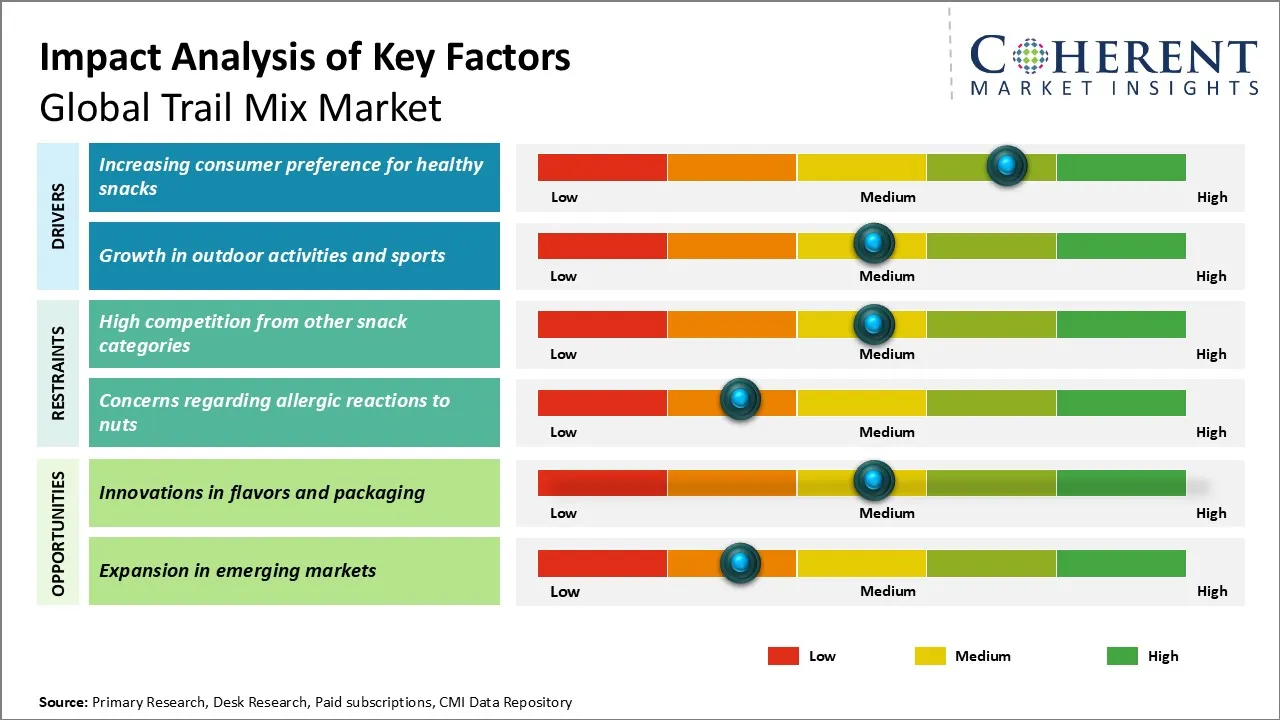
Trail Mix Market Driver - Increasing Consumer Preference for Healthy Snacks
The rising consumer inclination towards healthier eating habits is a significant driver propelling the demand for trail mix products globally. As awareness about nutrition and wellness grows, individuals are increasingly seeking convenient snack options that offer both taste and nutritional benefits. Trail mix, typically composed of nuts, dried fruits, seeds, and sometimes whole grains, aligns perfectly with this trend by providing a balanced mix of protein, fiber, and essential vitamins. Consumers are moving away from traditional high-sugar or high-fat snacks in favor of products perceived as natural and minimally processed, which trail mixes often represent.
For instance, brands such as KIND Snacks have launched nut- and fruit-based trail mixes positioned as “clean label” alternatives to candy or fried snacks, gaining traction among health-conscious millennials and working professionals. Similarly, retail chains like Whole Foods Market highlight trail mix under their “better-for-you snacks” section, reflecting its strong alignment with consumer demand for portable yet nutritious options.
Trail Mix Market Opportunity - Innovations in Flavors and Packaging
The global trail mix market is witnessing significant growth driven by consumer demand for novel and convenient snacking options, presenting a substantial opportunity through innovations in flavors and packaging. As health-conscious consumers increasingly seek diversified taste experiences, manufacturers are capitalizing on the potential to offer unique flavor blends that combine traditional nuts and dried fruits with exotic spices, superfoods, and functional ingredients such as antioxidants and probiotics.
For instance, PepsiCo’s Frito-Lay brand has been experimenting with functional trail mixes that include dark chocolate, chia seeds, and probiotics, positioning them as snacks that go beyond satiety to support gut health and immunity. This illustrates how global players are tapping into the functional foods trend by infusing traditional trail mix with superfoods and wellness-oriented ingredients, appealing to consumers who want snacks that deliver both flavor variety and tangible health benefits.
Analyst Opinion (Expert Opinion)
- The global trail mix market is poised for significant growth, driven by the increasing consumer preference for healthy, convenient snacking options. Insights from the Snack Food Association Conference (2023) and the Global Health and Wellness Summit (2022) highlighted innovative trends, with companies like Nature Valley and KIND Snacks leading the way in diversifying their product offerings.
- Nature Valley’s recent launch of a protein-packed trail mix tailored for fitness enthusiasts exemplifies the market's shift towards targeting specific consumer needs. Discussions at these events emphasized the importance of clean ingredients and sustainable sourcing, reflecting a growing awareness among consumers about nutritional quality and environmental impact. However, challenges such as fluctuating nut prices and competition from other snack categories were identified as potential obstacles.
- Companies that prioritize R&D to create unique flavor combinations and enhance product packaging will likely secure a competitive advantage. Additionally, forging partnerships with health and wellness influencers can boost brand visibility. Ultimately, the trail mix market's trajectory will depend on its ability to innovate while effectively addressing consumer demands for health, taste, and sustainability.
Speak to the analyst
Want personalized insights?
Take the findings above to one of our principal consultants, or have the report rebuilt around the segments, geographies and competitors you actually track.
Market Segmentation
- Product Insights (Revenue, USD Bn, 2021 - 2033)
- Nuts & Seed
- Dried Fruit
- Granola & Cereal Bar
- Others
- Type Insights (Revenue, USD Bn, 2021 - 2033)
- Conventional
- Organic
- Distribution Channel Insights (Revenue, USD Bn, 2021 - 2033)
- Supermarkets & Hypermarkets
- Convenience Stores
- Specialty Stores
- Online
- Regional Insights (Revenue, USD Bn, 2021 - 2033)
- North America
- U.S.
- Canada
- Latin America
- Brazil
- Argentina
- Mexico
- Rest of Latin America
- Europe
- Germany
- U.K.
- Spain
- France
- Italy
- Russia
- Rest of Europe
- Asia Pacific
- China
- India
- Japan
- Australia
- South Korea
- ASEAN
- Rest of Asia Pacific
- Middle East
- GCC Countries
- Israel
- Rest of Middle East
- Africa
- South Africa
- North Africa
- Central Africa
- North America
- Key Players Insights
- The J.M. Smucker Company
- PepsiCo, Inc.
- General Mills, Inc.
- Kellogg Company
- Mars, Incorporated
- Hormel Foods Corporation
- Second Nature Brands
- Texas Star Nut & Food Co.
- National Raisin Company
- Mouth Foods
- Whitworths
- Oberto Snacks Inc.
- Creative Snacks Co.
- Kind LLC
- Clif Bar & Company
Sources
Primary Research Interviews
- Procurement Head – Leading Global Snack Foods Retailer
- R&D Manager – International Nut & Dried Fruits Processor
- Marketing Director – Major Trail Mix Brand
- Sustainability Lead – Packaging and Ingredient Certification Organization
Stakeholders
- Manufacturers (Trail Mix Brands, Nut & Dried Fruit Processors, Seed & Snack Producers)
- End Use Sectors
- Retail Chains & Supermarkets
- Online Food & Grocery Delivery Platforms
- Fitness & Wellness Brands (healthy snacking solutions)
- Regulatory & Certification Bodies (food safety and labeling authorities)
- E-commerce Platforms and Retailers
- Packaging & Innovation Technology Players (resealable pouches, portion packs)
Databases
- UN Comtrade Database (trade data on nuts, dried fruits, seeds)
- USDA Foreign Agricultural Service (FAS) Global Agricultural Trade System (GATS)
- India Import Export (EXIM) Database
Magazines
- Snack Food & Wholesale Bakery – Innovations in trail mix and snack categories
- Food Business News – Healthy snacking and product development trends
- Nutrition Industry Executive – Functional and health-oriented snack trends
- Global Snacks & Confectionery Journal – Market updates and growth drivers
- Packaging World – Advances in packaging for trail mix and on-the-go snacks
Journals
- Journal of Food Products Marketing – Consumer preferences in healthy snacks
- International Journal of Gastronomy and Food Science – Snack formulation insights
- Journal of Agricultural and Food Chemistry – Nutritional aspects of nuts, fruits, and seeds
- Journal of Food Distribution Research – Retail and distribution trends in snacks
Newspapers
- The Wall Street Journal – Market growth and investments in healthy snacking
- The New York Times – Consumer demand shifts toward healthy, natural snacks
- Financial Times – M&A and global expansion strategies in the snack food sector
- The Guardian – Health trends influencing snacking choices
Associations
- International Nut & Dried Fruit Council (INC)
- Snack Food Association (SFA)
- National Confectioners Association (NCA)
- European Snacks Association (ESA)
- Specialty Food Association (SFA)
- Sustainable Food Trade Association (SFTA)
Public Domain Sources
- U.S. Food and Drug Administration (FDA) – Labeling & food safety regulations
- European Commission – Food labeling and additives in snack products
- Codex Alimentarius – International food standards for processed snacks
- World Health Organization (WHO) – Health implications of processed food consumption
Proprietary Elements
- CMI Data Analytics Tool, Proprietary CMI Existing Repository of information for last 8 years.
Get access to 250+ pages report
Every segment, forecast, competitor profile and data table behind the analysis above — available for instant download.
- ESOMAR Member
- ISO 9001:2015 Certified
- D-U-N-S Registered
- GDPR & CCPA Compliant
Missing comfort of reading report in your local language? Find your preferred language:
Transform your Strategy with Exclusive Trending Reports
Frequently Asked Questions
The global trail mix market is estimated to be valued at USD 4.91 Bn in 2026 and is expected to reach USD 7.83 Bn by 2033.
The CAGR of the global trail mix market is projected to be 6.9% from 2026 to 2033.
Increasing consumer preference for healthy snacks and growth in outdoor activities and sports are the major factors driving the growth of the global trail mix market.
The purpose of a trail mix is to provide a convenient, energy-dense snack that combines protein, healthy fats, and carbohydrates for sustained energy.
Trail mix usually contains a blend of nuts, dried fruits, seeds, chocolate or candy pieces, and sometimes grains like granola or pretzels for a balance of taste and quick energy.
High competition from other snack categories and concerns regarding allergic reactions to nuts are the major factors hampering the growth of the global trail mix market.
In terms of product, the nuts & seed segment is estimated to dominate the market revenue share in 2026.