

U.S. One Wheel Electric Scooter Market Size and Forecast – 2026-2033
The U.S. One Wheel Electric Scooter Market is estimated to be valued at USD 208.9 Mn in 2026 and is expected to reach USD 367.4 Mn by 2033, exhibiting a compound annual growth rate (CAGR) of 8.4% from 2026 to 2033.
Key Takeaways of the U.S. One Wheel Electric Scooter Market
- The electric unicycles segment is expected to lead the market holding a share of 56. 1% in 2026.
Market Overview
The market sees a rise in adoption of one wheel electric scooters because of advancements in battery technology, enhanced safety features, and integration with smart devices. Also, key players are focusing on product differentiation through design innovation and durability improvements. The market is also seeing a rise in shared scooter services and government initiatives promoting sustainable transportation, further stimulating demand and expanding the customer base in both urban and suburban areas.
Current Events and Its Impact
Current Events | Description and its impact |
Geopolitical and Trade Developments |
|
Economic and Infrastructure Trends |
|
Segmental Insights
- Current Industry Events of 2026
- Market Size Estimation
- Regional Breakdown
- Competitive Landscape
- Customer Intelligence
- Segmental Analysis
- Pricing Analysis
- Key Market Drivers, Challenges & Future Trends
- Customized Insights Section
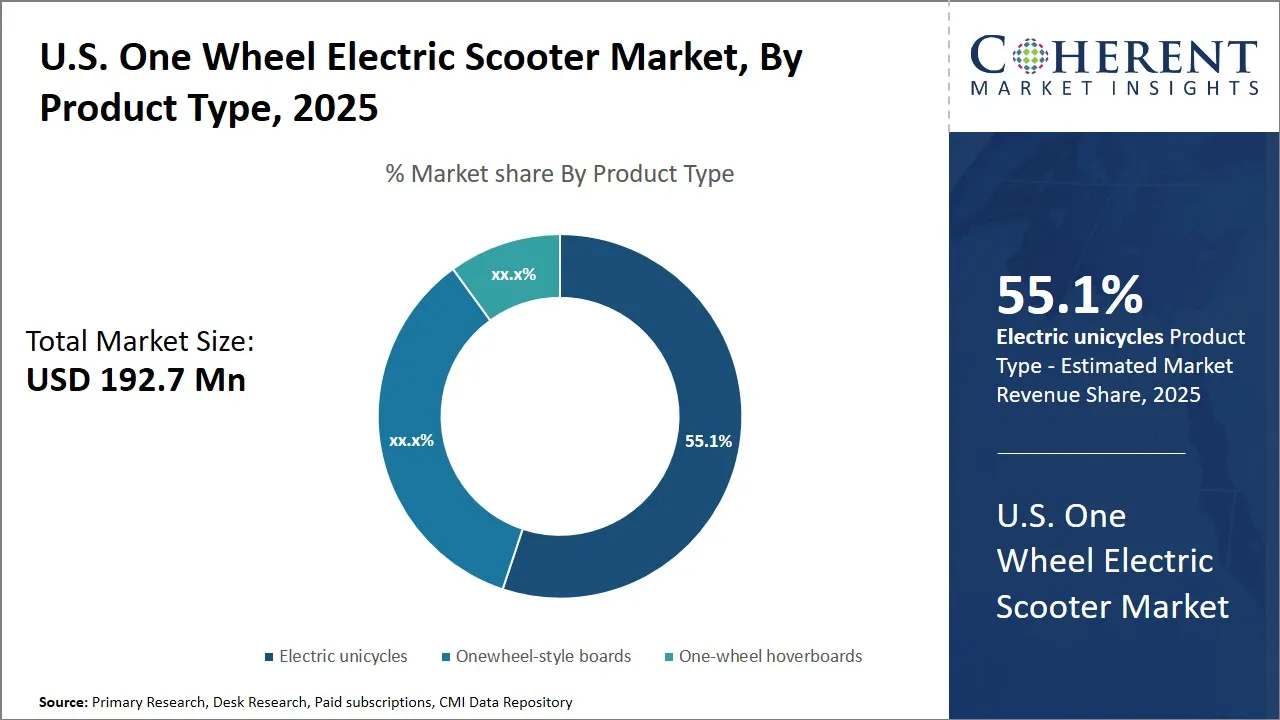
U.S. One Wheel Electric Scooter Market Insights, By Product Type – Rising Demand for Convenience and Portability Fuels Growth For Electric Unicycles
Electric unicycles are expected to dominate the U.S. one wheel electric scooter market with an estimated 56.1% share in 2026 because of their convenience, portability, and technological sophistication. Urban commuters and recreational riders choose these compact devices for effortless navigation in congested areas and seamless last-mile travel.
Growing environmental awareness and the shift toward sustainable mobility further add to adoption, as electric unicycles offer zero-emission transportation with minimal energy use. Technological advances—particularly in battery life, motor efficiency, and self-balancing stabilization—have improved both safety and accessibility, attracting new users beyond the enthusiast niche.
The segment’s growth is added to by the rising culture of urban adventure and outdoor recreation among younger consumers seeking both utility and excitement. For example, InMotion’s “V14 Adventure” (launched in 2024) come with a 3,000 W motor and advanced suspension system, showing the trend toward powerful yet portable electric unicycles designed for mixed urban and off-road use. As compact city living and micro-commuting lifestyles expand, electric unicycles are positioned as the most versatile and space-efficient option in the U.S. micromobility landscape.
Pricing Analysis of the U.S. One Wheel Electric Scooter Market
Segment | Representative Model & Retail Price |
Entry-level electric unicycle (~< USD 1,000) | KingSong S16 PRO: ~USD 1,799 listed sale |
Mid-tier electric unicycle (~USD 1,000-2,000) | KingSong S22 PRO: listed ~USD 3,499 (high end) but mid-range models (e.g., InMotion V12S at USD 2,399) |
Premium/high-performance electric unicycle (~USD 2,000-4,000+) | Begode EX30 from USD 2,799 sale price |
One-wheel board (single-tire board) – mainstream board market | Onewheel Pint X: USD 1,100 “from” price as listed. |
One-wheel board – premium model | Onewheel Pint S: Starting at USD 1,400 as listed. |
Distribution Channel Insights – U.S. One Wheel Electric Scooter Market
Distribution Channel | Key Characteristics & Notes | Estimated Value Share (U.S., Approx.) |
Online Retailers (including brand direct + third-party e-commerce) | • High convenience: purchase from home, wide selection, frequent discounts. | ~ 61.0% |
Specialty Stores/Offline Retail (dealers, test-ride facilities, skate/mobility shops) | • Permits test-rides, hands-on experience, expert advice. | ~ 30.00 % |
Direct Sales (manufacturer to consumer, brand flagship stores, demo events) | • Brands sell through their own website or flagship store; may run demo/test-ride events. | ~ 10.00 % |
Regional Adoption Trends – U.S. One Wheel Electric Scooter Market
State/Region | Adoption trend (short) | Adoption level | Estimated % share of U.S. one wheel electric scooter market (value) |
California | Mature & leading — highest concentration of riders, demo centers and brand activity; strong boardsports culture drives both recreational & commuter use. | High | ~ 30–36% (dominant single-state contributor). |
Texas | Rapid growth — expanding enthusiast communities and local repair/retail support; increasing visibility in mid-sized cities (San Antonio, U.S.). | High/Fastest-growing | ~ 18–26% (fastest growth rate among large states). |
Florida | Strong recreational adoption and active local owner groups; warm weather enables year-round riding and tourist/demo opportunities. | Medium-High | ~ 8–12% |
New York (NYC/state) | Urban & regulated — noticeable rider base but tighter urban rules and complex permitting slow adoption in dense cores; strong niche communities in suburbs. | Medium | 8-12% |
Consumer Demographics & Psychographics – U.S. One Wheel Electric Scooter Market
Attribute | Description/Estimated % (where applicable) | Implication for marketing/product |
Age distribution | 18–24: 20%; 25–34: 35%; 35–44: 25%; 45–54: 10%; 55+: 10%. Majority are young adults and early-mid career riders. | Focus digital ads on 18–34 demo (social, video), but keep messaging for 35–44 (family/commuter buyers). Offer different product tiers for younger thrill-seekers vs. older safety-oriented buyers. |
Gender split | Male skew: ~70–75% male, 25–30% female. (Enthusiast hobby skews male but female adoption rising.) | Use inclusive visuals and female rider testimonials to increase appeal; consider female-focused outreach/events to reduce perception of "male hobby". |
Income/purchasing power | ~15%; USD 50–100k: ~45%; >USD 100k: ~40% — buyers skew middle to upper income because of premium prices. | Offer financing/subscription, entry models, and clear ROI for commuters to convert cost-sensitive prospects. |
Education & profession | Higher education skew: ~60–70% college graduates; many in tech, creative, trades, or outdoor-industry jobs. | Tech and lifestyle messaging (product specs, performance) resonates; partner with tech & outdoor lifestyle channels. |
Urbanicity/residence | Suburban: ~40–50%; Urban: ~30–35%; Rural: ~15–20%. Urban riders use for short trips, suburban for recreation and trails. | Tailor offerings: portable/compact models for urban commuters; rugged/off-road models for suburban/outdoor riders. |
Primary use cases/commuting patterns | Recreation/Leisure: ~50–60%; Commuting/Last-mile: ~25–35%; Mixed (both): ~10–15%. | Create messaging that highlights both fun (recreation) and practical benefits (commuting range, storage). |
Usage frequency | Daily users: ~15–25%; Weekly users: ~35–45%; Occasional users: ~30–40%. Enthusiast subset rides very frequently. | Promote accessories (spare batteries, service plans) to high-frequency users; trial/demo programs to convert occasional users. |
Tech savviness & buying drivers | Strong tech affinity (app integration, firmware updates, sensors). Top purchase drivers: range, reliability, safety, and brand reputation. | Focus on tech features (app, firmware, diagnostics) and publish real-world range/testimonials. Offer easy firmware updates and visible safety certifications. |
Lifestyle/psychographic archetypes | 1) Thrill seekers/sports enthusiasts (boardsports crossover) | Targeted creative per archetype: action videos for thrill seekers; spec deep dives for techies; commuter case studies for utilitarians; local events/community programs for social riders. |
Attitudes toward sustainability | Moderately eco-positive — many value low-carbon personal mobility but purchase decisions are made as per fun/performance as much as sustainability. | Include sustainability messaging (long battery life, recyclability, repairability) but don’t make it the sole selling point. |
Risk tolerance & safety perception | Moderate–high risk tolerance among enthusiasts; safety concerns (falls, battery fires) are important for mainstream buyers. | Highlight safety features (UL batteries, stability control), mitigation (training videos), and warranty/insurance options. |
Learning curve & adoption barriers | Perceived learning difficulty is a big barrier for new riders; learning resources and demo/test rides add to conversion. | Provide beginner content, in-store demos, step-by-step onboarding, and community rides to lower barrier. |
Preferred purchase channels | Online/brand direct: ~60–70%; Specialty retailers/demo stores: ~20–30%; Events/demos: ~10%. | Invest in DTC e-commerce experience while growing local demo/test-ride partnerships and specialty retail presence. |
Average basket/willingness to spend | Typical full-spec purchase range: USD 900–USD 3,500+; sweet spot around USD 1,000–2,000 for mainstream buyers. | Offer clear product tiering (entry/mid/premium), bundles (accessories + warranty), and flexible payment to capture more buyers. |
Post-purchase behavior & community | High engagement in owner forums, social groups, modding, local group rides; strong word-of-mouth and influencer effects. | Use user-generated content, ambassador programs, and local meetups to drive organic growth. |
Key barriers to purchase | Price sensitivity, safety/regulatory concerns, charging logistics, and perceived difficulty to learn. | Address via financing, robust safety messaging/certificates, accessible charging guides, and starter training content. |
Regulatory Landscape & Safety Standards – U.S. One Wheel Electric Scooter Market
Regulation/Standard | Description | Impact on Market/Operations |
UL Certification (UL 2272 / UL 2271) | UL 2272 covers electrical system safety for personal e-mobility devices (including hoverboards, e-scooters, and one-wheels); UL 2271 covers lithium-ion battery packs. Certification ensures compliance with fire and electrical safety standards. | UL certification is increasingly required by U.S. insurers and retailers; uncertified devices see sales restrictions and liability exposure. Increases production costs but adds to consumer confidence and brand credibility. |
Consumer Product Safety Commission (CPSC) Oversight | CPSC monitors e-mobility device safety and recalls related to battery fires, fall risks, or design defects. In 2024–25, several enforcement actions targeted non-certified imports. | Manufacturers must ensure compliance or face recalls and bans. Increased enforcement has improved product quality but added to compliance costs. |
State Road Laws (General) | Electric unicycles and one-wheel devices are regulated differently across states. Typically classified under “Personal Electric Vehicles (PEVs)” or “Electric Mobility Devices.” | Inconsistent laws create market fragmentation — manufacturers must customize labeling and marketing per state; riders face confusion about legality in public spaces. |
California (CA Vehicle Code §313.5) | Treats electric unicycles similarly to e-scooters; allowed on bike lanes, not sidewalks; speed limit ~15 mph; helmet required for riders under 18. | One of the most permissive yet structured frameworks; boosts adoption through clarity but imposes speed caps. Encourages sales of safety-compliant and app-limited speed devices. |
Texas (Local Ordinance Variations) | No specific state law; regulation varies by city (e.g., Austin allows use in bike lanes and low-speed streets; Dallas enforces sidewalk restrictions). | Urban areas see higher adoption; lack of uniformity makes uncertainty for distributors and riders. |
Florida (Statute §316.20655) | Defines micro-mobility devices broadly; electric unicycles often treated like bicycles; allowed on streets with ≤35 mph limits. Helmets required under age 16. | Supportive environment for commuters and leisure riders; clear rules support sales growth in major metros like Miami and Tampa. |
New York (NYS Vehicle and Traffic Law) | One-wheel and EUCs are not explicitly listed as legal vehicles. NYC prohibits use on public roads and sidewalks; enforcement varies by borough. | Restrictive legal status limits adoption and sales; however, strong underground community persists, pushing for legalization. |
Helmet Mandates (State/City Level) | Many states require helmets for riders under 18; cities like Los Angeles, Seattle, and Portland extend mandates to all powered micro-mobility users. | Safety compliance adds to helmet accessory sales; retailers bundle certified helmets to promote legal readiness. |
Lighting and Reflector Requirements | Several states (e.g., CA, OR, WA) require front/rear lighting or reflectors for night riding. | Adds minor manufacturing and aftermarket cost; enhances safety and reduces accidents. |
Insurance and Liability Rules | Some jurisdictions (e.g., NY, CA municipalities) require commercial or shared fleet operators to carry liability insurance. | Makes entry barriers for shared micro-mobility startups; promotes professionalization of fleet operations. |
Local Registration/Permit Requirements | Cities like San Francisco and Chicago require permits for commercial e-ride fleets and event-based demos. | Adds bureaucracy for new entrants; incentivizes formal partnerships and local compliance frameworks. |
Battery Transport & Recycling (U.S. DOT & EPA) | Lithium-ion batteries fall under hazardous material transport regulations; recycling covered under EPA e-waste rules. | Requires certified shipping and disposal partners; adds logistical cost but aligns with sustainability goals. |
Import & Customs Compliance (CBP/ DOE) | Imported devices must meet U.S. customs safety declarations, tariff classifications, and occasionally DOE energy efficiency reporting. | Noncompliance can result in seizure or fines; making preference for domestic assembly or certified OEM partnerships. |
Pending Federal Standardization (NHTSA/CPSC discussions) | Federal agencies exploring unified PEV framework covering one-wheels, EUCs, and e-skateboards — addressing speed limits, lighting, and labeling. | Future federal framework could make compliance and interstate sales simpler, but near-term uncertainty affects product launches. |
Recall & Enforcement Trends (2023–2025) | Multiple high-profile recalls (e.g., battery overheating incidents) have added to consumer awareness and insurance scrutiny. | Brands that proactively ensure certification and transparent safety communication gain trust and brand advantage. |
Market Players, Key Development, and Competitive Intelligence
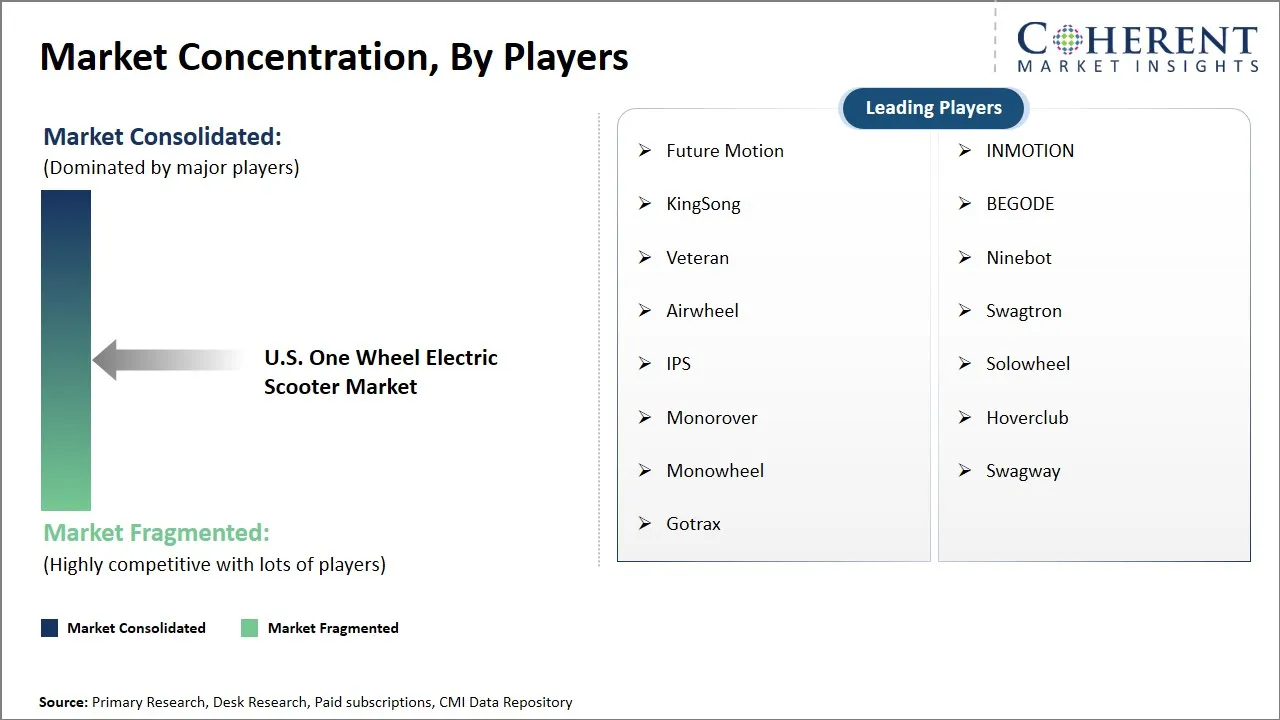
Key Developments
- In October 2025, INMOTION, the world's best electric unicycle brand, launched its new performance flagship electric unicycle — the P6. Powered by a 235V high-voltage system and a peak output of 20 kW, the P6 delivers a real riding top speed of 150 km/h.
- In September 2025, Future Motion Inc., the maker of Onewheel, announced the launch of the latest addition to its popular Pint lineup: the Onewheel Pint S.
- In August 2025, Future Motion Inc., the maker of Onewheel, the iconic, self-balancing single-wheel electric board that uses sensors to maintain rider balance and stability, is thrilled to announce the launch of its most ambitious board to date: the Onewheel Rally XL.
Top Strategies Followed by U.S. One Wheel Electric Scooter Market Players
- Established companies dominate the market through a lot of investments in research and development, aiming to push the boundaries of innovation and deliver high-performance products that appeal to discerning consumers.
- Begode offers Begode MTen4 and Tesla V4 models with balanced price-performance ratio, competing with premium brands at ~30% lower cost.
- Mid-level players in the U.S. one wheel electric scooter market use a different strategic focus compared to their more established counterparts.
- InMotion Technologies (through U.S. distributors) launched InMotion V14 Adventure (2024) with modular battery architecture and AI-based self-balancing systems.
- Small-scale players in the U.S. one wheel electric scooter market make their niche by targeting specialized consumer needs or introducing innovative features that distinguish their products from mainstream options.
- Floatwheel develops custom one-wheel components (battery packs, controller upgrades, and tire kits) catering to DIY and enthusiast communities.
Market Report Scope
U.S. One Wheel Electric Scooter Market Report Coverage
| Report Coverage | Details | ||
|---|---|---|---|
| Base Year: | 2025 | Market Size in 2026: | USD 208.9 Mn |
| Historical Data for: | 2020 To 2024 | Forecast Period: | 2026 To 2033 |
| Forecast Period 2026 to 2033 CAGR: | 8.4% | 2033 Value Projection: | USD 367.4 Mn |
| Segments covered: |
| ||
| Companies covered: | Future Motion, INMOTION, KingSong, BEGODE, Veteran, Ninebot, Airwheel, Swagtron, IPS, Solowheel, Monorover, Hoverclub, Monowheel, Swagway, and Gotrax | ||
| Growth Drivers: |
| ||
| Restraints & Challenges: |
| ||
Market Dynamics
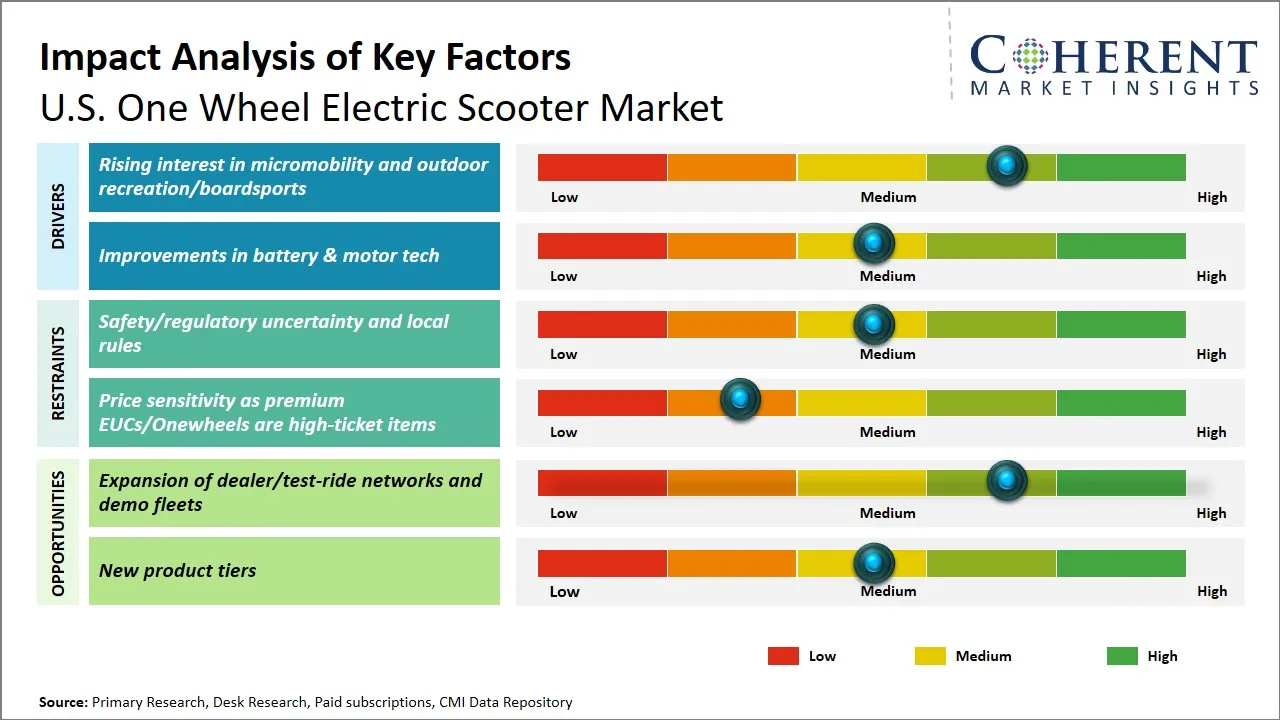
U.S. One Wheel Electric Scooter Market Driver – Rising Interest In Micromobility And Outdoor Recreation/Boardsports
The growth in demand for eco-friendly, recreational transport is adding to the adoption of one-wheel electric scooters in the U.S. Consumers look for fun, sustainable alternatives that combine commuting and outdoor adventure. For example, Future Motion’s Onewheel GT and GT S-Series became popular among younger riders and boardsport enthusiasts in states like California and Colorado, aligning with the growing micromobility and adventure-lifestyle movement.
U.S. One Wheel Electric Scooter Market Opportunity – Expansion of Dealer/Test-Ride Networks and Demo Fleets
Increasing hands-on demo access through local dealers and pop-up test-ride events makes trust and adds to adoption. For example, Onewheel’s official “Demo Days” program and retail partnerships with shops in California and Texas allow potential buyers to experience products before purchase, adding to sales and brand engagement.
Analyst Opinion (Expert Opinion)
- Despite growing consumer enthusiasm, the lack of uniform state and federal standards continues to affect mainstream adoption. Cities like New York and Chicago treat one-wheels as undefined vehicles, creating a patchwork of restrictions that discourage both investors and retailers.
- High-profile recalls and injury reports have made risk-averse consumers wary, especially without standardized safety benchmarks other than the UL 2272 certification. Until brands show long-term reliability and rider protection, the category will find it difficult to gain the trust enjoyed by e-bikes or e-scooters.
- The premium cost keeps one-wheels limited to a niche of affluent hobbyists and tech-savvy commuters. Unless manufacturers offer scalable, cost-efficient models, the market risks plateauing before it reaches true mass mobility adoption.
Speak to the analyst
Want personalized insights?
Take the findings above to one of our principal consultants, or have the report rebuilt around the segments, geographies and competitors you actually track.
Market Segmentation
- Product Type Insights (Revenue, USD Mn, 2021 - 2033)
- Electric unicycles
- Onewheel-style boards
- One-wheel hoverboards
- Key Players Insights
- Future Motion
- INMOTION
- KingSong
- BEGODE
- Veteran
- Ninebot
- Airwheel
- Swagtron
- IPS
- Solowheel
- Monorover
- Hoverclub
- Monowheel
- Swagway
- Gotrax
Sources
Primary Research Interviews
Stakeholders
- One-Wheel and Electric Unicycle Manufacturers (e.g., Future Motion, InMotion, King Song, Begode)
- Component Suppliers (Battery Manufacturers, Motor & Sensor OEMs)
- Retail Distributors and Micromobility Dealers (Online and Specialty Stores)
- Urban Mobility Startups and Rental Fleet Operators
- Regulatory Experts and Safety Certification Consultants (UL, CPSC advisors)
- Micromobility Associations and Rider Communities (e.g., Onewheel Owners Group, Electric Unicycle Forum)
- Transportation Policy Analysts and Local Mobility Planners
Databases
- U.S. Department of Transportation (DOT) – Personal Mobility Data Archive
- U.S. Energy Information Administration (EIA) – Electric Vehicle Statistics
- National Renewable Energy Laboratory (NREL) Mobility Insights Database
- OECD Urban Mobility Statistics
- U.S. Census Bureau – Urban Commuting Trends
- Micromobility Growth Observatory (made-up internal industry data)
Magazines
- Micromobility World Magazine
- Urban Transport Review
- E-Mobility Insider
- Smart City Journal
- GreenTech Mobility Digest
Journals
- Journal of Electric Vehicle Technology and Mobility
- Transportation Research Interdisciplinary Perspectives (TRIP)
- IEEE Access – Smart Transportation Systems
- International Journal of Sustainable Transport
- Urban Mobility and Infrastructure Engineering Journal
Newspapers
- The Verge (Tech & Mobility Section)
- Wired Magazine (Innovation Desk)
- The Guardian (Environment and Mobility Section)
- Los Angeles Times – Transportation & Tech
- San Francisco Chronicle – Startups & Mobility
- Business Standard (Global Tech Edition)
Associations
- Micromobility Industries Association (MIA)
- Electric Mobility Manufacturers Association (EMMA, U.S.)
- Personal Electric Vehicle Alliance (PEVA)
- American Public Transportation Association (APTA)
- Urban Transportation Research Association (UTRA)
- Smart Cities Council North America
Public Domain Sources
- U.S. Department of Transportation (DOT)
- National Highway Traffic Safety Administration (NHTSA)
- U.S. Census Bureau
- OECD Transport Statistics
- World Bank Open Mobility Data
- United Nations Economic Commission for Europe (UNECE)
- ResearchGate (academic papers on electric mobility)
Proprietary Elements
- CMI Data Analytics Tool, Proprietary CMI Existing Repository of Information for Last 8 Years
Get access to 250+ pages report
Every segment, forecast, competitor profile and data table behind the analysis above — available for instant download.
- ESOMAR Member
- ISO 9001:2015 Certified
- D-U-N-S Registered
- GDPR & CCPA Compliant
Missing comfort of reading report in your local language? Find your preferred language:
Transform your Strategy with Exclusive Trending Reports
Frequently Asked Questions
The U.S. one wheel electric scooter market is estimated to be valued at USD 208.9 million in 2026 and is expected to reach USD 367.4 million by 2033.
The CAGR of U.S. one wheel electric scooter market is projected to be 8.4% from 2026 to 2033.
Rising interest in micromobility and outdoor recreation/boardsports and Improvements in battery & motor tech are the major factors driving the growth of the U.S. one wheel electric scooter market.
Safety/regulatory uncertainty and local rules and price sensitivity as premium EUCs/Onewheels are high-ticket items are the major factors hampering the growth of the U.S. one wheel electric scooter market.
In terms of product type, electric unicycles are estimated to dominate the market revenue share in 2026.
It is a self-balancing personal electric vehicle with a single wheel, powered by gyroscopic technology for balance and motion control.
Yes, UL 2272 certification for electrical safety is strongly recommended and often required by U.S. insurers and retailers.