

Calcium Channel Blocker Drugs Market Size and Share Analysis: 2026 - 2033
The calcium channel blocker drugs market is estimated to be valued at USD 17,460.6 Mn in 2026 and expected to reach USD 24,857.4 Mn by 2033, witnessing a CAGR of 5.2% over the forecast period (2026-2033). The Calcium Channel Blocker (CCB) drugs market is growing steadily in 2026, as cardiovascular disease is becoming prevalent and hospitals and clinics have increased their adoption rate.
Key Takeaways
- Based on Drug Class, the dihydropyridine segment is expected to lead the market with 57% share in 2026, driven by hypertension treatment effectiveness.
- Based on Disease Indication, the hypertension segment is expected to hold 48% share of the market in 2026, fueled by rising global prevalence and lifestyle factors.
- Based on Distribution Channel, the hospital pharmacies segment is projected to account for 42% share in 2026, supported by bulk procurement and institutional cardiovascular care demand,
- Based on Region, North America is set to lead the calcium channel blocker drugs market with 37.20% share in 2026. While, Asia Pacific is anticipated to be the fastest growing region.
Market Overview
Calcium channel blocker is available in short acting and long-acting form. The response of short acting medication is quick as compare to long-acting calcium channel blocker drugs. Amlodipine (Norvasc), Diltiazem (Cardizem, Tiazac, others), Felodipine, Isradipine, Nicardipine are the type of calcium channel blocker drug used for the treatment of coronary artery disease, chest pain (angina), irregular heartbeats (arrhythmia) and blood vessel conditions, such as Raynaud's disease.
Current Events and their Impacts on the Calcium Channel Blocker Drugs Market
Current Event | Description and its Impact |
Aging Global Population Demographics and Healthcare Infrastructure Development |
|
Regulatory Environment Changes and Patent Expirations |
|
Can Calcium Channel Blockers Unlock New Frontiers in Personalized Medicine and Disease Repurposing?
Area | Key Point | Data | Implication |
Genetic Variation (CYP3A5) | CYP3A5*3 allele alters amlodipine metabolism | Carriers show ~25% higher plasma levels; prevalence: 70–80% Europe, 40–50% Africa | May require dose adjustments; supports personalized therapy |
Neurological Research | CCB derivatives studied for Alzheimer’s | Preclinical: 30–40% less amyloid-beta; pilot trial (n=60) showed cognitive improvement | Potential repurposing for neurodegenerative diseases |
Diabetes Repurposing (Verapamil) | Preserves pancreatic beta-cell function | Trial (n=206) showed 40% slower decline in C-peptide; animal studies confirm improved insulin secretion | Could delay type 1 diabetes progression |
- Current Industry Events of 2026
- Market Size Estimation
- Regional Breakdown
- Competitive Landscape
- Customer Intelligence
- Segmental Analysis
- Pricing Analysis
- Key Market Drivers, Challenges & Future Trends
- Customized Insights Section
Segmental Insights
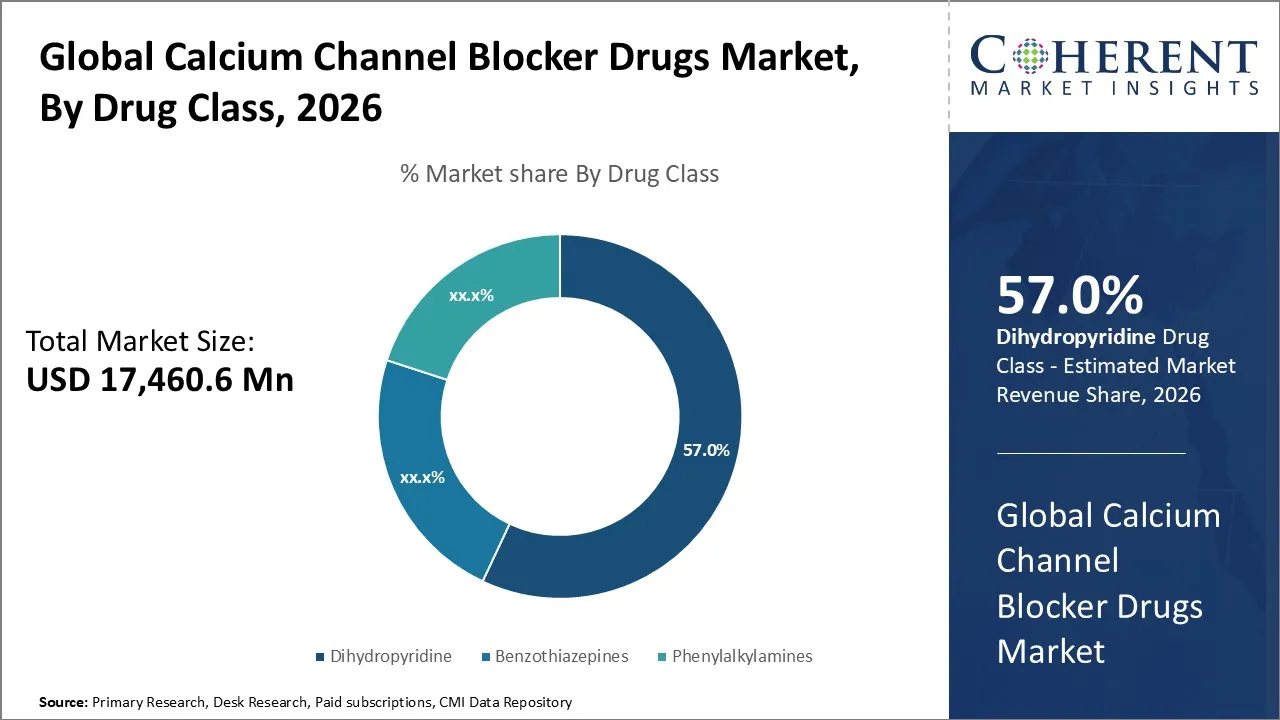
Why Do Dihydropyridines Lead the Calcium Channel Blocker Market in Hypertension?
In terms of drug class, the dihydropyridine segment is expected to lead the market with 57% share in 2026, due to their widespread used to treat high blood pressure. Amlodipine and nifedipine are two drugs that work effectively, well-tolerated, and are recommended in treatment guidelines around the world. Their ability to lower blood pressure without having a big effect on heart conduction makes sure that they will be used all over the world.
For instance, in June 2025, George Medicines claimed that the FDA has approved WIDAPLIK, a single-pill combination of telmisartan, amlodipine, and indapamide for treating high blood pressure in adults. The addition of amlodipine, a dihydropyridine calcium channel blocker, shows the significance for controlling high blood pressure and makes the segment even more dominant in cardiovascular therapy around the world.
Is Hypertension Driving Calcium Channel Blocker Market Growth Through Lifestyle and Prevalence?
In terms of disease indication, the hypertension segment is expected to hold 48% share of the market in 2026. The demand for high blood pressure medications is growing owing to high prevalence in aging population, sedentary lifestyle, and eating unhealthy foods. In many areas, CCBs are the first line of treatment, which makes hypertension the most common type of treatment.
For instance, in December 2025, the American Heart Association stated that combination pills for high blood pressure, like calcium channel blockers, can make treatment easier and lead to better long-term results. These treatments make it easier for people to take their medications and reduce the number of pills they have to take. This makes dihydropyridines like amlodipine even more important in controlling high blood pressure and solidifies their position as the best treatment for heart problems.
Hospital Pharmacies Boost Calcium Channel Blocker Market via Bulk Procurement and Cardiovascular Demand
In terms of distribution channel, the hospital pharmacies segment is projected to account for 42% share in 2026, because they purchase in bulk and have institutional supply chains. They take care of patients with serious illnesses and make sure that cardiovascular drugs are always available. Their dominance shows that people depend on hospitals for important cardiovascular care, especially in areas with strong healthcare systems and centralized buying.
For instance, in June 2025, the first triple-combination pill for high blood pressure, which has telmisartan, amlodipine, and indapamide in it, was approved by the FDA. Amlodipine, a dihydropyridine calcium channel blocker, holds the therapy to the CCB part.
Regional Insights
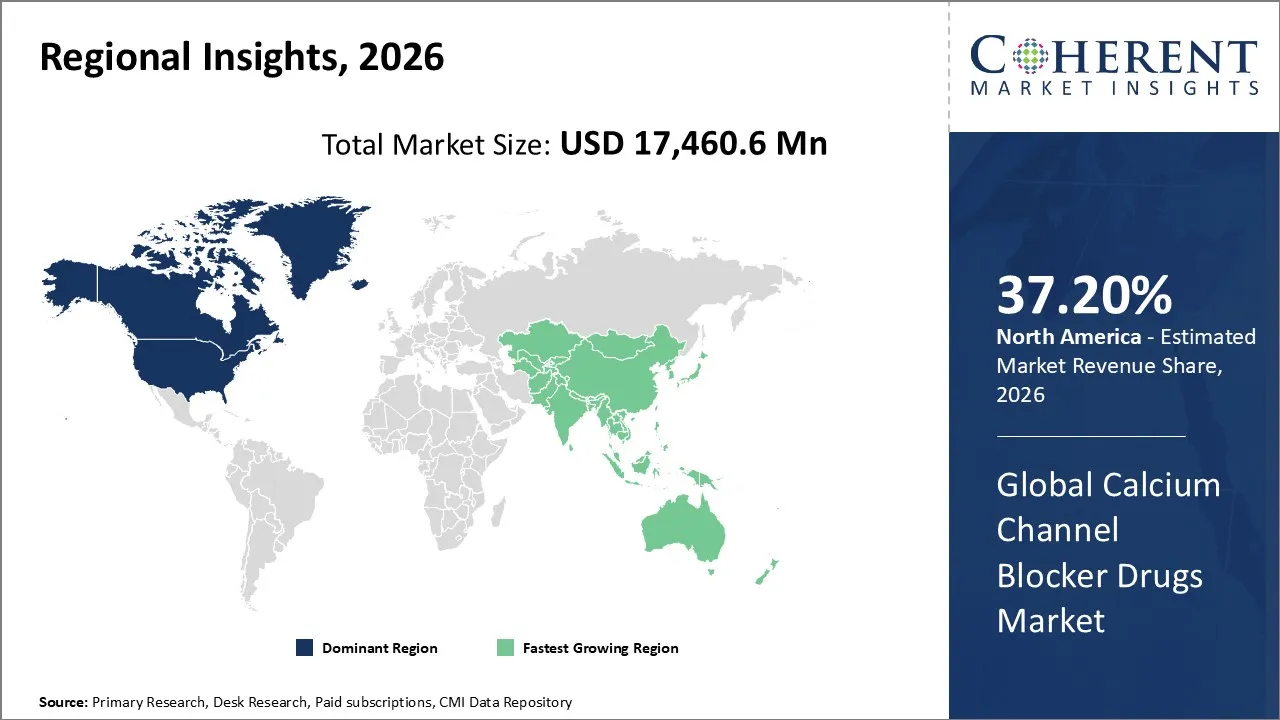
North America Calcium Channel Blocker Drugs Market Analysis & Trends
North America is expected to lead the calcium channel blocker drugs market with 37.20% share in 2026, because there is a high prevalence of high blood pressure and heart disease, the healthcare system is highly advanced, and there are a majority of large pharmaceutical businesses. Regulatory approvals and patient awareness help keep it at the top of the market.
For instance, in December 2025, The FDA has given its approval to etripamil nasal spray (Cardamyst) for the quick treatment of paroxysmal supraventricular tachycardia (PSVT). It is a fast-acting phenylalkylamine calcium channel blocker that patients can take on their own outside of the hospital. This is a big step forward in managing arrhythmias and opens up new uses for calcium channel blockers.
Asia Pacific Calcium Channel Blocker Drugs Market Analysis & Trends
Asia Pacific is expected to exhibit the fastest growth, due to cities are growing quickly, people are changing their lifestyles, and high blood pressure is becoming more common. Strong market growth across the region is also driven by more healthcare infrastructure, easier access to cheap generics, and more middle-class people being aware of heart health.
For instance, in February 2026, to market GMRx2 in Southeast Asia, George Medicines and Orient EuroPharma signed an exclusive licensing deal. Telmisartan, amlodipine, and indapamide are all part of the triple-combination therapy that treats high blood pressure. Amlodipine is a calcium channel blocker, and this deal makes it easier for people in the area to get it and makes CCBs an increased role of heart disease treatment plans.
Calcium Channel Blocker Drugs Market Outlook Country-Wise
The U.S. Calcium Channel Blocker Drugs Market Trends
In 2026, the Calcium Channel Blocker Drugs Market is extremely popular in the US because the country has a high volume of hypertension and heart disease, a well-developed healthcare system, and a lot of large pharmaceutical companies. Regulatory approvals and patient awareness help it stay on top of the market.
For instance, in February 2026, The FDA's 2026 pulmonology alert focused on approvals, recalls, and new information. Cardamyst (etripamil) nasal spray, a calcium channel blocker for PSVT, was one of the drugs that got approved. It gives patients a way to give themselves the drug. Other updates included treatments for pulmonary fibrosis, obesity, and opioid overdose. This shows that there is a strong regulatory activity in respiratory and cardiovascular care.
China Calcium Channel Blocker Drugs Market Trends
The Calcium Channel Blocker Drugs Market is exceptionally active in China in 2026 due to rapid urbanization, changes in lifestyle, and a sharp rise in cases of high blood pressure. Strong market growth across the country is also being driven by more healthcare infrastructure, government programs to improve heart health, and easier access to affordable generics.
For instance, in June 2025, Researchers in Hong Kong found that schisandrin A, a natural substance from Schisandra chinensis, stops spasms in the coronary arteries by blocking L-type calcium channels. When tested in pig arteries, it prevented spasms from occurring. This finding shows that traditional medicine may have benefits for heart health that are similar to those of calcium channel blockers.
Market Report Scope
Calcium Channel Blocker Drugs Market Report Coverage
| Report Coverage | Details | ||
|---|---|---|---|
| Base Year: | 2025 | Market Size in 2026: | USD 17,460.6 Mn |
| Historical Data for: | 2020 To 2024 | Forecast Period: | 2026 To 2033 |
| Forecast Period 2026 to 2033 CAGR: | 5.2% | 2033 Value Projection: | USD 24,857.4 Mn |
| Geographies covered: |
| ||
| Segments covered: |
| ||
| Companies covered: | Bausch Health, Mylan N.V., Teva Pharmaceutical Industries Ltd, Lupin, Arbor Pharmaceuticals, GlaxoSmithKline Plc, Biopharma, Sofgen Pharmaceuticals, Glenmark Pharmaceuticals Inc., Amneal Pharmaceuticals, Sun Pharmaceutical Industries Ltd, Novartis AG, Zydus Cadila and Pfizer Inc | ||
| Growth Drivers: |
| ||
| Restraints & Challenges: |
| ||
Calcium Channel Blocker Drugs Market Driver
Rising Incidence of Hypertension
The Calcium Channel Blocker Drugs Market growth is because there are a growing number of individuals with high blood pressure around the world. According to WHO, its second global hypertension report estimate 1.4 billion people lived with hypertension in 2024, yet only 1:5 are under control through medication and addressing modifiable health risk factors. High blood pressure is much more common around the world because of sedentary lifestyle, unhealthy diet, and are under a lot of stress. Hypertension is a major risk factor for heart disease, so the need for effective treatments is growing. Due to they work well to lower blood pressure, calcium channel blockers are often prescribed. This has led to market growth and new opportunities for drug companies.
Launches and Approval of Calcium Channel Blocker Drug
The Calcium Channel Blocker Drugs Market demand continues to expand due to new calcium channel blocker drugs are launching frequently and getting approved by regulators. Pharmaceutical companies are investing into research and development to develop new formulations that are safer and more effective. When regulatory bodies give its approval for these drugs, they become easier to get and the market gets stronger. This trend not only meets the growing medical needs of patients, but it also makes competition between key players stronger, which will drive demand and shape the future of the cardiovascular drug market.
Calcium Channel Blocker Drugs Market Opportunity
Strategic Opportunities for Companies
The Calcium Channel Blocker Drugs Market forecast shows pharmaceutical companies a number of ways to improve their position and boost growth. New formulations, like extended-release and combination therapies, can make it much easier for patients to stick to their treatment and get better results. Faster approvals from regulators help companies penetrate into markets and give them an edge over their competitors. More digital distribution channels, especially through online pharmacies, make it easier for people in areas with poor infrastructure to access. Also, working together and forming partnerships with local businesses helps companies get into new markets faster and meet unmet demand.
Analyst Opinion (Expert Opinion)
- Clinical Efficacy and Outcomes: Data from pooled analyses of 31 randomized controlled trials indicated that CCBs diminished the risk of stroke more effectively than placebo and β-blockers, while exhibiting similar efficacy to ACE inhibitors and diuretics. In the treatment of high blood pressure, CCBs consistently lower systolic blood pressure by an average of 8 to 10 mmHg. This means that there are fewer heart problems. Their role is especially important in older people, where they are better than other types of drugs at lowering isolated systolic hypertension and the risks that come with it.
- Therapeutic Uses and Safety Profile: CCBs are often prescribed for angina and some arrhythmias, in addition to high blood pressure. Clinical reviews emphasize their efficacy in enhancing coronary blood flow and diminishing myocardial oxygen demand. Statistically, they account for a large part of all antihypertensive prescriptions around the world, with amlodipine and diltiazem being two of the most commonly used drugs. About 10–15% of patients experience side effects like peripheral edema, but serious problems are still rare, which shows that they can be used for a lengthy period of time. Comparative studies indicate that dihydropyridine calcium channel blockers (CCBs) are especially efficacious in stroke prevention, whereas non-dihydropyridines offer supplementary advantages in arrhythmia management.
Speak to the analyst
Want personalized insights?
Take the findings above to one of our principal consultants, or have the report rebuilt around the segments, geographies and competitors you actually track.
Recent Developments
- In October 2025, The European Lacidipine Study on Atherosclerosis (ELSA) demonstrated that the calcium channel blocker lacidipine was more effective than atenolol in decelerating carotid artery thickening in hypertensive patients. The trial, which took place in Europe and involved more than 2,300 people, shows that calcium channel blockers can protect the heart and blood vessels in addition to lowering blood pressure.
Market Segmentation
- Global Calcium Channel Blocker Drugs Market, By Drug Class
- Benzothizepine
- Dihydropyridine
- Phenylalkylamine
- Global Calcium channel blocker drugs market, By Disease Indication
- Hypertension
- Chest Pain
- Arrhythmias
- Others (Blood vessel conditions, Coronary Artery Disease etc.)
- Global Calcium Channel Blocker Drugs Market, By Distribution Channel
- Hospital Pharmacy
- Retail Pharmacy
- Online Pharmacy
- Global Calcium Channel Blocker Drugs Market, By Region
- North America
- U.S.
- Canada
- Latin America
- Brazil
- Argentina
- Mexico
- Rest of Latin America
- Europe
- Germany
- U.K.
- Spain
- France
- Italy
- Russia
- Rest of Europe
- Asia Pacific
- China
- India
- Japan
- Australia
- South Korea
- ASEAN
- Rest of Asia Pacific
- Middle East & Africa
- GCC Countries
- Israel
- Rest of Middle East & Africa
- North America
- Key Players
- Bausch Health
- Mylan N.V.
- Teva Pharmaceutical Industries Ltd
- Lupin
- Arbor Pharmaceuticals
- GlaxoSmithKline Plc
- Biopharma
- Sofgen Pharmaceuticals
- Glenmark Pharmaceuticals Inc.
- Amneal Pharmaceuticals
- Sun Pharmaceutical Industries Ltd
- Novartis AG
- Zydus Cadila
- Pfizer Inc
Sources
Primary Research Interviews
- Cardiologists
- Interventional Cardiologists
- Internal Medicine Physicians
- Hospital Pharmacists
- Retail & Clinical Pharmacists
- Pharmaceutical Manufacturers of Calcium Channel Blockers
- Generic Drug Manufacturers
- API Suppliers for Cardiovascular Drugs
- Contract Development & Manufacturing Organizations (CDMOs)
- Drug Distributors & Wholesalers
- Regulatory Affairs Specialists
- Cardiovascular Therapy Consultants
- Others
Databases
- Bloomberg Terminal
- Thomson Reuters Eikon
- Evaluate Pharma
- Pharmaprojects
- Others
Magazines
- Pharmaceutical Executive
- BioPharma Dive
- Drug Store News
- Pharma Manufacturing
- American Journal of Managed Care (AJMC)
- Cardiovascular Business
- Managed Healthcare Executive
- Others
Journals
- Journal of the American College of Cardiology (JACC)
- Circulation
- European Heart Journal
- Journal of Clinical Hypertension
- American Journal of Hypertension
- Hypertension
- Drugs
- The American Journal of Cardiology
- Others
Newspapers
- Financial Times
- The Wall Street Journal
- Reuters
- Bloomberg News
- The Economic Times
- Business Standard
- Others
Associations
- American Heart Association (AHA)
- American College of Cardiology (ACC)
- European Society of Cardiology (ESC)
- Heart Failure Society of America (HFSA)
- International Society of Hypertension (ISH)
- World Heart Federation
- Others
Public Domain Sources
- U.S. Food and Drug Administration (FDA)
- National Institutes of Health (NIH)
- MedlinePlus
- National Center for Biotechnology Information (NCBI)
- Centers for Disease Control and Prevention (CDC)
- European Medicines Agency (EMA)
- World Health Organization (WHO)
- U.S. National Library of Medicine
- Others
Proprietary Elements
- CMI Data Analytics Tool
- Proprietary CMI Existing Repository of Information for the Last 8 Years
Get access to 250+ pages report
Every segment, forecast, competitor profile and data table behind the analysis above — available for instant download.
- ESOMAR Member
- ISO 9001:2015 Certified
- D-U-N-S Registered
- GDPR & CCPA Compliant
Missing comfort of reading report in your local language? Find your preferred language:
Transform your Strategy with Exclusive Trending Reports
Frequently Asked Questions
The global Calcium Channel Blocker Drugs Market size was valued at USD 17,460.6 Mn in 2026 and is expected to reach USD 24,857.4 Mn in 2033.
The global calcium channel blocker drugs Market size is estimated to be valued at USD 17,460.6 Mn in 2026 and expected to exhibit a CAGR of 5.2% between 2026 and 2033.
Rising incidence of hypertension and increasing launches and approval of drug is expected to drive the market growth over the forecast period.
Dihydropyridines drug class segment is expected to hold the major market share in the market
North America holds the largest market share in the market.
Major factors hampering the calcium channel blocker drugs market growth include side effect associated with calcium channel blocker drug.
Major players operating in the market include Bausch Health, Mylan N.V., Teva Pharmaceutical Industries Ltd, Lupin, Arbor Pharmaceuticals, GlaxoSmithKline Plc, Biopharma, Sofgen Pharmaceuticals, Glenmark Pharmaceuticals Inc., Amneal Pharmaceuticals, Sun Pharmaceutical Industries Ltd, Novartis AG, Zydus Cadila and Pfizer Inc.