

Cosmetic Isoparaffins Market Size and Share Analysis - 2026 To 2033
The Cosmetic Isoparaffins Market is anticipated to grow at a CAGR of 6.1% with USD 1.35 Bn in 2026 and projected to reach USD 2.05 Bn in 2033. The market is growing owing to the rising global cosmetic usage, with over 90% of consumers using personal care products regularly. Growing demand for lighter and durable products along with substantial growth in Asia Pacific region, are factors driving market growth, while sustainability preferences and regulations factors drive market trends.
Key Takeaways
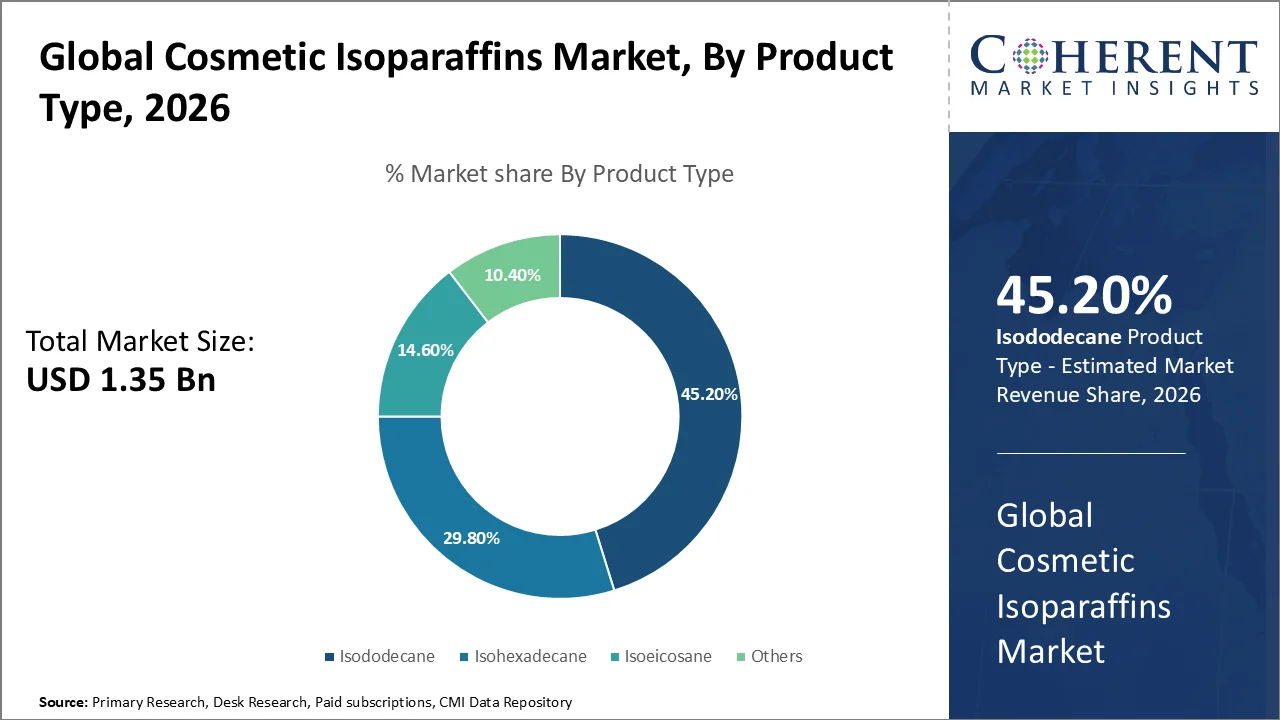
- Isododecane is projected to constitute the largest market share of 45.20% in 2026 due to its extensive application in long-wear and no-transferrable cosmetic products because of its volatile nature and lightweight texture, especially in foundations and lip products. The Cosmetic Ingredient Review (CIR) Expert Panel has declared that isododecane is safe for use and concentration as a cosmetic ingredient.
- On the basis of End Use, Hair Care is likely to hold the largest market share of 27.90% in 2026 due to growing preference for hair conditioning, anti-frizz, as well as hair styling purposes. The EU cosmetic ingredient regulatory documentation, specifically the COSMILE Europe database, classifies isododecane as an approved ingredient. It is used in the production of various hair care products like conditioners as well as hairsprays.
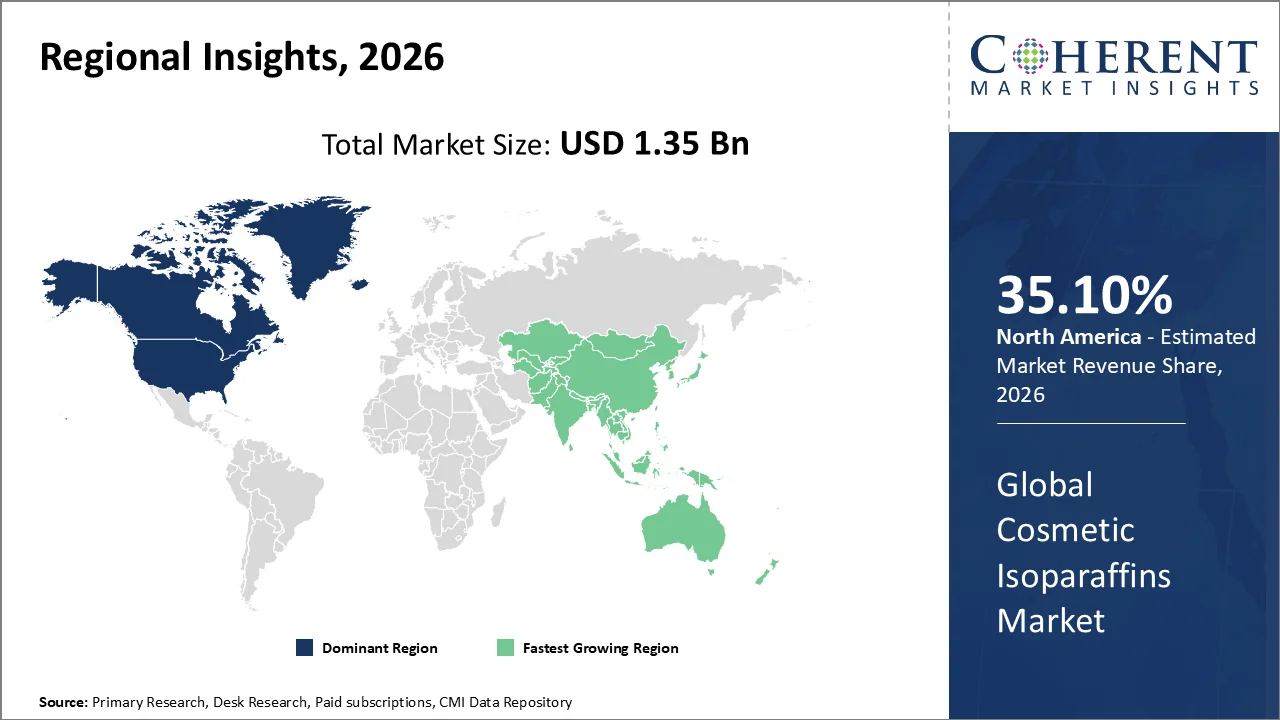
- Geographically, the North America region is expected to secure leading share of 35.10% in the year 2026. The growth is attributable to the developed beauty and personal care sector, demand for premium cosmetics, as well as high consumption of sophisticated ingredients like isoparaffins. The U.S. is among major regions where significant amounts of isododecane is consumed in skincare and color cosmetics.
Segmental Insights
Why Is Isododecane Acquiring the Largest Market Share in the Cosmetic Isoparaffins Market?
Isododecane stands as the primary driver of the cosmetic isoparaffins market growth and holds a projected 45.20% share in 2026. This leadership is due to its unique physical profile. It is exceptionally lightweight, evaporates at an ideal rate, and blends seamlessly into diverse product bases. Because it provides a smooth, weightless finish without leaving a heavy or oily residue excellent it has become the global standard for high performance beauty products. The surge in demand is largely fueled by the popularity of long wear and waterproof categories. In products like lipsticks and foundations, isododecane allows for easy application before drying down into comfortable transfer resistant layer.
In addition, the fast growth of the global cosmetics industry, particularly in Asia Pacific and North America, along with increasing consumer preference for high-performance and lightweight formulations, has also strengthened its market position. The increasing product innovation by major cosmetic manufacturers and rising demand for clean-label, sensory-enhancing ingredients have also contributed to its leading share in the isoparaffin segment. For example, in recent years, leading cosmetic brands like L’Oréal and Estée Lauder have incorporated isododecane-based systems in their long-wear product lines to improve performance and user experience.
- Current Industry Events of 2026
- Market Size Estimation
- Regional Breakdown
- Competitive Landscape
- Customer Intelligence
- Segmental Analysis
- Pricing Analysis
- Key Market Drivers, Challenges & Future Trends
- Customized Insights Section
Why Is Hair Care Dominating the End-Use Segment in the Market?
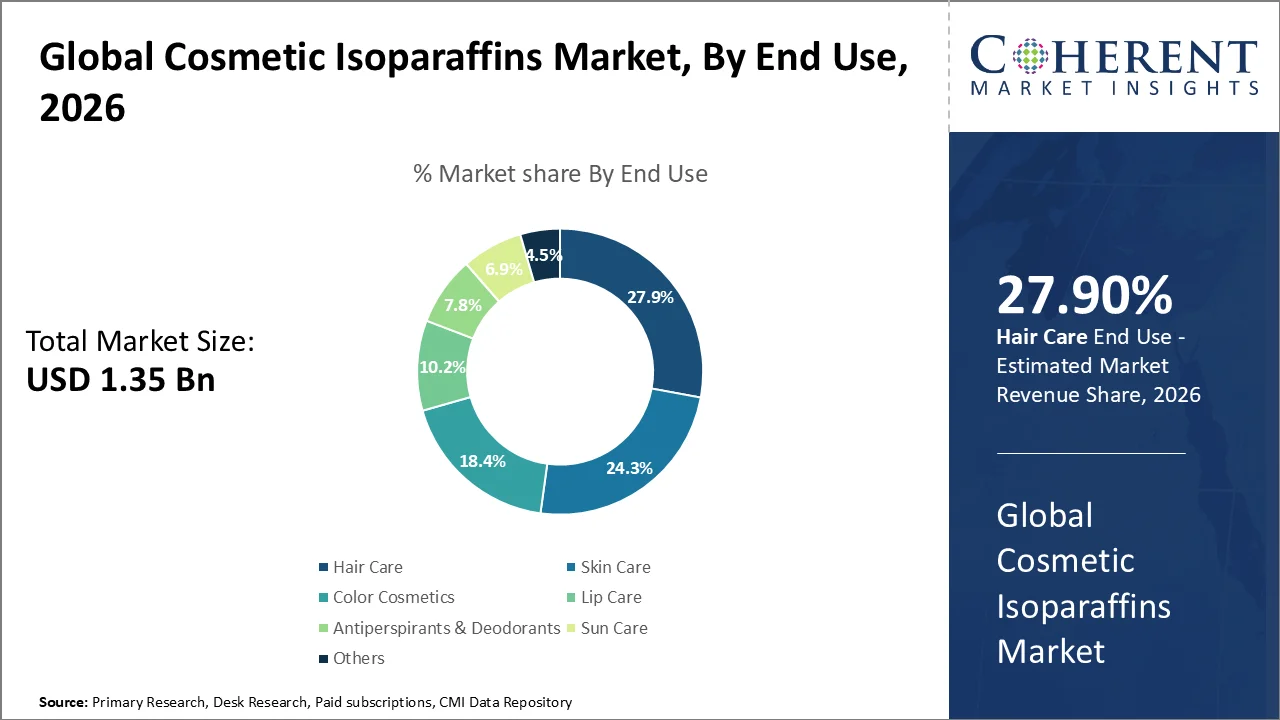
Based on end use, the Hair Care segment is projected to dominate the Cosmetic Isoparaffins Market with a share of approximately 27.90% in 2026. It can be attributed primarily to the increasing applications of isoparaffins in hair styling, conditioning, and treatment formulations. This is owing to their exceptional spreading qualities, lightweight characteristics, and good performance in terms of enhancing the product texture without making it greasy. In the case of hair care products like serums, leave-on conditioners, hair sprays, and styling creams isoparaffins are utilized for improving the ease of applying products along with providing frizz resistance and shine to the hair strands.
Moreover, owing to the rise in hair damage due to pollution, heat styling and chemical treatments the requirement for effective hair repair and protection products has led to more adoption of isoparaffin. The expansion of premium and salon-grade hair care products, especially in emerging markets, has also contributed to segment’s growth. The top personal care firms like L'Oréal, Procter & Gamble, and Unilever have integrated isoparaffin-based ingredients in their hair care portfolios to enhance product performance, sensory experience, and overall consumer appeal. Thus reinforcing the segment’s dominant position in the market.
Rising Innovations in Cosmetic Formulation Technology is Transforming the Cosmetic Isoparaffins Market in the United States
Technical breakthroughs within cosmetic chemistry and formulation science are significantly impacting the Cosmetic Isoparaffins Market share in the US. The personal care firms are incorporating new innovations in hydrocarbon engineering to formulate extremely light weight and quick evaporating ingredients like isododecane and isohexadecane. These innovations help in enhancing sensory feel, delivering superior film formation, as well as extending wear properties in makeup and skincare products. Improved purification and molecular refinement technologies also assist in minimizing odor, residue formation, and volatility inconsistencies. This makes isoparaffins more suitable for high end cosmetic applications.
Bio-compatible formulation innovations are also expanding their usage in sensitive-skin products by improving skin compatibility as well as reducing irritation potential. The enhanced delivery systems in cosmetics, like controlled evaporation matrices, also contribute to better dispersion and longer product wear especially in foundations, lipsticks, and sunscreens.
Top industry participants like ExxonMobil are actively working on new developments innovation with the Isopar™ series (Isopar L, Isopar H, Isopar M, Isopar V). They are being extensively used as light weight hydrocarbon emollients, viscosity reducers, and solvent carriers in skin care products, sunscreens, and color cosmetics due to their lack of odor, high purity level, and excellent spreadability in premium formulations. Such innovations are accelerating the cosmetic isoparaffins market size.
Current Events and Their Impact on the Cosmetic Isoparaffins Market (regulatory shifts, government policies)
Current Event | Description and its Impact |
EU REACH Regulatory Tightening on Hydrocarbon Solvents (2025–2026) |
|
U.S. FDA and MoCRA Implementation Strengthening (2025–2026) |
|
Cosmetic Isoparaffins Market Trends
- Rising demand for lightweight, non-greasy cosmetic formulations drives increased use of cosmetic isoparaffins as emollients in skincare, sunscreens, and makeup products. U.S. Health and Personal Care Stores recorded 8.0% year-on-year sales growth in July 2024, indicating sustained demand for premium, fast-absorbing, sensorially elegant formulations where isoparaffins are well suited as low-tack emollients and carriers.
- Growing shift toward silicone-alternative ingredients in personal care products boosts adoption of isoparaffins owing to its smooth texture, spreadability, and affordability.
- Expansion of clean beauty and sensitive-skin formulations is driving the demand for low-odor, non-comedogenic, and chemically inert cosmetic-grade isoparaffins.
- Increasing use in long-wear and high-performance cosmetics such as waterproof sunscreens, foundations, and lip products enhances product stability and film-forming properties.
- Rapid growth of the personal care and cosmetics industry in Asia-Pacific, particularly in India, China, and South Korea, strengthens demand for formulation solvents and emollients. In China, retail sales of cosmetics reached 52.3 billion yuan in October 2025, up 9.6% year on year.
- Rising focus on regulatory compliance and high-purity cosmetic grades (REACH, FDA-aligned standards) encourages manufacturers to invest in advanced refining technologies.
- Sustainability and ESG pressures drive innovation in energy-efficient production processes and low-VOC formulations within the isoparaffin value chain.
- Increasing use of multifunctional ingredients in cosmetics supports demand for isoparaffins as emollients, pigment carriers, and texture enhancers in simplified formulations.
Regional Insights
North America dominates owing to strong demand for premium skincare formulations
North America region is likely to account for share in 2026. The region leads the Cosmetic Isoparaffins Market owing to strong demand from the personal care, skincare, and cosmetics industries. The region continues to demonstrate strong performance in the beauty industry, showing a growth rate of +7.8%. This is mainly due to high consumer products and cutting edge formulation technologies. According to the Bureau of Labor Statistics, spending on personal care products and services rose by 9.7% in 2023, increasing from USD 866 to USD 950 per consumer unit. The growth is also backed by the strong footprint of leading cosmetic manufacturers and chemical suppliers in the countries of the U.S. and Canada.
The need for lightweight, non-greasy skincare formulations as well as silicone-alternative ingredients is fueling increased usage of cosmetic isoparaffins in moisturizers, sunscreens, and makeup products. The US continues to be a leader in developing new high-performance cosmetics. This progress is backed by the increasing adoption of multifunctional emollients that enhance texture, spreadability, and product stability.
Technological advancements in cosmetic formulation science are driving regional growth as well. For example, the firms are producing ultra-high purity isoparaffin grades optimized for sensitive-skin and “clean beauty” products, thus aligning with evolving consumer safety expectations.
In addition, strong regulatory frameworks under the U.S. FDA and Health Canada encourage the use of low-irritation, stable, and compliant cosmetic ingredients, thus fostering market confidence. The increasing demand for premium skincare and anti-aging products, along with the expansion of e-commerce beauty channels, continues to support steady growth of the Cosmetic Isoparaffins Market across North America.
Asia Pacific Cosmetic Isoparaffins Market Trends
The Asia Pacific region is poised to be the fastest-growing market throughout the forecast period. The region is growing at a CAGR of approximately 5.74%. This growth is due to fast expansion of the personal care and cosmetics industry, , as well as increasing demand for premium skincare and makeup products across emerging economies. For instance, China’s per capita disposable income reached 43,377 yuan in 2025, India’s per capita GNDI rose to ₹2,54,849 in FY 2025–26, and in Japan, workers’ households in their 40s recorded 571,000 yen average monthly disposable income in 2024, supporting higher spending on beauty and personal care products.
Countries like China, India, and Japan are witnessing robust growth in cosmetic manufacturing and formulation activities. India, in particular, is emerging as a major production hub for skincare and haircare products. China tops the list as the largest cosmetic importing country, with an impressive USD 13.02 billion in cosmetic imports for the year 2024 and 2025. Japan as well as South Korea are promoting innovation in advanced skincare formulations, thus contributing to the demand for high-performance cosmetic ingredients like isoparaffins.
In addition to this, increasing consumer preference for lightweight, non-greasy, and silicone-alternative formulations is boosting the incorporation of cosmetic isoparaffins in moisturizers, sunscreens, foundations, and other personal care products. Technological advancements in cosmetic formulation and specialty chemicals are also assisting in strengthening market’s growth. Manufacturers are concentrating on producing high-purity, low-odor isoparaffin grades suitable for clean beauty and sensitive-skin applications, thus improving product safety and performance.
Growing Demand for Premium Cosmetic Formulations is Accelerating the Cosmetic Isoparaffins Market in the United States
The United States Market is poised to witness steady growth owing to substantial demand from the personal care and cosmetics sector. products. The U.S. Census Bureau reported that retail sales at Health and Personal Care Stores in the country were up 8.0% year over year in July 2024, indicating sustained consumer demand for premium beauty products.
With regards to the highly competitive environment in the United States, some of the leading cosmetic and chemical producers have shifted their attention towards high-efficiency formulation technologies like silicone-alternative emollients, multifunctional carriers, and high-purity cosmetic-grade hydrocarbons like isoparaffins. The overall aim is to improve product texture, stability, and skin compatibility.
Alongside this, rising innovations in the realm of clean beauty and dermatologist-recommended skincare has resulted in a growing trend towards the incorporation of low-odor, non-comedogenic, and inert ingredients within moisturizers, sunscreens, and makeup products. In August 2025, cosmetic ingredient companies expanded their portfolios with next-generation formulation ingredients such as Ashland’s X-Tend 226 ester and Vantage’s DISTINCTIVE SUNBOOSTER, alongside innovations like Antaron™ opt natural glyceride and Sensiva SC 50 Natural, highlighting the industry’s shift toward advanced cosmetic solutions in a highly competitive market.
Japan Cosmetic Isoparaffins Market Trends
The Japan Market is projected to grow steadily during the upcoming years. The growth is supported by strong demand for advanced skincare and personal care formulations. Japan’s highly developed cosmetics industry (representing the largest share of the overall cosmetics industry with 49%), combined with a strong consumer focus on high-quality, safe, and effective products, is driving the adoption of specialty ingredients like cosmetic-grade isoparaffins.
As one of the world’s most “super-aged” societies, the country has a that substantially influences demand for skincare products focused on hydration, skin barrier protection, and anti-aging benefits. This demographic trend is promoting the use of lightweight, non-greasy emollients and stable formulation bases in creams, lotions, and sunscreens.
Who are the Major Companies in Cosmetic Isoparaffins Industry
Some of the major key players in Cosmetic Isoparaffins are Croda International plc., INEOS Group Limited, Elementis PLC, The Innovation Company, Rita Corporation, Lanxess AG, Presperse Corporation, and Nihon Koken Kogyo Co., Ltd.
Key News
- In September 2025, Croda International Plc launched Zenakine, a biotech-based neuroactive ingredient developed by SkinBiotherapeutics plc, an AIM-listed company specializing in skin health. Zenakine is designed to counteract the effects of stress on the skin.
- In April 2023, Momentive Performance Materials came up with Harmonie. It is a range of natural plant- and mineral-derived ingredients for the beauty and personal care industry. One of the products includes Harmonie Silken Gum (INCI: C13-16 Isoparaffin (and) Dimethicone / C13-16 Isoparaffin (and) Dimethiconol). It is a naturalized silicone gum that delivers spreadability and a soft after-feel. This makes it ideal for use in foundations, lipsticks, and conditioners.
Market Report Scope
Cosmetic Isoparaffins Market Report Coverage
| Report Coverage | Details | ||
|---|---|---|---|
| Base Year: | 2025 | Market Size in 2026: | USD 1.35 Bn |
| Historical Data for: | 2020 To 2024 | Forecast Period: | 2026 To 2033 |
| Forecast Period 2026 to 2033 CAGR: | 6.1% | 2033 Value Projection: | USD 2.05 Bn |
| Geographies covered: |
| ||
| Segments covered: |
| ||
| Companies covered: | Croda International plc., INEOS Group Limited, Elementis PLC, The Innovation Company, Rita Corporation, Lanxess AG, Presperse Corporation, and Nihon Koken Kogyo Co., Ltd | ||
| Growth Drivers: |
| ||
| Restraints & Challenges: |
| ||
Analyst Opinion
- The market is expanding steadily, driven by rising demand for lightweight emollients in cosmetics. Over 60% of new skincare formulations globally now focus on non-greasy textures, where isoparaffins are widely used for smooth application and stability. Going forward, this trend is likely to strengthen the role of isoparaffins in premium skincare, hybrid beauty, and daily-use formulations, particularly where sensory performance and formulation elegance remain critical purchasing factors.
- Increasing consumption of long-wear cosmetics is supporting growth. In 2025, nearly 48% of consumers preferred water-resistant makeup products, thus fostering the use of isoparaffins in foundations, sunscreens, and lip products. In the coming years, this may accelerate market differentiation, with compliant and high-purity suppliers likely to gain stronger preference from multinational cosmetic brands.
- Regulatory pressure is shaping innovation. The EU and U.S. are continually tightening ingredient transparency rules, which is pushing more than 35% of manufacturers to upgrade refining processes and ensure high purity grades.
- Asia Pacific dominates demand, accounting for around 42% of global cosmetic consumption in 2025. This is owing to urbanization and rising disposable incomes.
- However, nearly 30% of consumers show preference for bio-based ingredients, which may slightly restrain long-term adoption of petroleum-derived isoparaffins.
Speak to the analyst
Want personalized insights?
Take the findings above to one of our principal consultants, or have the report rebuilt around the segments, geographies and competitors you actually track.
Market Segmentation
- By Product Type
- Isododecane
- Isohexadecane
- Isoeicosane
- Others
- By End Use
- Hair Care
- Skin Care
- Lip Care
- Antiperspirants & Deodorants
- Sun Care
- Color Cosmetics
- Others
- By Region
- North America
- U.S.
- Canada
- Latin America
- Brazil
- Mexico
- Argentina
- Rest of Latin America
- Europe
- Germany
- U.K.
- France
- Italy
- Spain
- Russia
- Rest of Europe
- Asia Pacific
- China
- India
- Japan
- Australia
- South Korea
- ASEAN
- Rest of Asia Pacific
- Middle East
- GCC
- Israel
- Rest of Middle East
- Africa
- South Africa
- Central Africa
- North Africa
- North America
Sources
Primary Research Interviews
- Cosmetic Ingredient Manufacturers (Isoparaffin Producers)
- Personal Care Product Manufacturers (Skincare, Haircare, Makeup Brands)
- Specialty Chemical Suppliers & Distributors
- Formulation Scientists & Cosmetic Chemists
- Regulatory & Compliance Experts (Cosmetics & Chemicals)
- Dermatologists & Skincare Professionals
- Others
Databases
- Bloomberg Terminal
- Thomson Reuters Eikon
- IHS Markit
- Euromonitor International
- Others
Magazines
- Cosmetics & Toiletries Magazine
- Personal Care Magazine
- Happi (Household & Personal Products Industry Magazine)
- Chemical Week
- ICIS Chemical Business
- Others
Journals
- International Journal of Cosmetic Science
- Journal of Cosmetic Dermatology
- Cosmetics (MDPI Journal)
- Journal of Surfactants and Detergents
- Colloids and Surfaces B: Biointerfaces
- Others
Newspapers
- Financial Times
- The Wall Street Journal
- Reuters
- Bloomberg News
- Business Standard
- Others
Associations
- Personal Care Products Council (PCPC)
- Cosmetics Europe – The Personal Care Association
- Independent Beauty Association (IBA)
- Society of Cosmetic Chemists (SCC)
- International Federation of Societies of Cosmetic Chemists (IFSCC)
- Others
Public Domain Sources
- U.S. Food & Drug Administration (FDA) – Cosmetics Division
- European Commission – Cosmetics Regulation (EC No 1223/2009)
- Environment Canada – Chemical Substances Database
- World Health Organization (WHO)
- OECD Chemicals Programme
- Others
Proprietary Elements
- CMI Data Analytics Tool
- Proprietary CMI Existing Repository of Information for the Last 8 Years
Get access to 250+ pages report
Every segment, forecast, competitor profile and data table behind the analysis above — available for instant download.
- ESOMAR Member
- ISO 9001:2015 Certified
- D-U-N-S Registered
- GDPR & CCPA Compliant
Missing comfort of reading report in your local language? Find your preferred language:
Transform your Strategy with Exclusive Trending Reports
Frequently Asked Questions
The Cosmetic Isoparaffins Market is expected to reach USD 2.05 Bn in 2033.
Major players operating in the global Cosmetic Isoparaffins Market include Croda International plc., INEOS Group Limited, Elementis PLC, The Innovation Company, Rita Corporation, Lanxess AG, Presperse Corporation, and Nihon Koken Kogyo Co., Ltd
The high production costs, volatility in petroleum-based raw material prices, and stiff competition from cheaper, alternative solvents are the key factors hampering growth of the Market.
Increasing consumer awareness of personal grooming, rising disposable incomes for premium products, and the demand for high-performance, skin-friendly ingredients in skincare, haircare, and makeup boost demand for cosmetic isoparaffins.
The Cosmetic Isoparaffins Market is anticipated to grow at a CAGR of 6.1% between 2026 and 2033.
Among regions, North America is expected to account for a largest market share in the global Cosmetic Isoparaffins Market over the forecast period.
Isoparaffins are synthetic, petroleum-derived hydrocarbon liquids used in cosmetics as emollients, solvents, and texture enhancers.