

Dermatophytic Onychomycosis Treatment Market Analysis & Forecast: 2026-2033
Dermatophytic onychomycosis treatment market is estimated to be valued at USD 7,296.6 Mn in 2026 and is expected to reach USD 12,219.7 Mn in 2033, exhibiting a compound annual growth rate (CAGR) of 7.6% from 2026 to 2033.
Key Takeaways
- Based on Product Type, the Tablets segment is expected to hold 57.3% share of the market in 2026.
- Based on Treatment, the Oral segment is expected to lead with 60% share of the market in 2026.
- Based on End User, the Independent Pharmacies segment is projected to capture 42.7% share in 2026.
- Based on Region, North America is set to lead the dermatophytic onychomycosis treatment market with 37.6% share in 2026. While, Asia Pacific is anticipated to be the fastest growing region.
Market Overview
The dermatophytic onychomycosis treatment market is expanding steadily, driven by the rising prevalence of fungal nail infections and growing awareness of advanced therapies. Increasing demand for effective oral and topical antifungals, coupled with innovations in laser and combination treatments, is fueling adoption. Greater emphasis on early diagnosis and cosmetic outcomes is also boosting patient preference for modern solutions. With supportive healthcare infrastructure and ongoing R&D, the market is positioned for sustained growth and wider accessibility worldwide.
Current Events and Its Impacts on the Dermatophytic Onychomycosis Treatment Market
Current Events | Description and its Impact |
Rising Antifungal Drug Resistance and Regulatory Response |
|
Technological Advances in Nail Drug Delivery Systems |
|
How do treatments for dermatophytic onychomycosis differ in cure rates, duration, recurrence, and limitations?
Treatment Type | Cure Rate (%) | Duration | Recurrence (%) | Key Limitation |
Oral Terbinafine | 38–55 | 12–16 weeks | 20–25 | Liver toxicity risk |
Oral Itraconazole | 35–50 | 12–24 weeks | 25–30 | Drug interactions |
Topical Amorolfine | 15–30 | 6–12 months | 30+ | Poor nail penetration |
Topical Ciclopirox | 20–30 | 6–12 months | 30+ | Requires daily use |
Laser/Photodynamic | 40–50 | Multiple sessions | Unknown | High cost, limited data |
Novel H₂S-based agents | Preclinical | TBD | TBD | Still experimental |
- Current Industry Events of 2026
- Market Size Estimation
- Regional Breakdown
- Competitive Landscape
- Customer Intelligence
- Segmental Analysis
- Pricing Analysis
- Key Market Drivers, Challenges & Future Trends
- Customized Insights Section
Segmental Insights
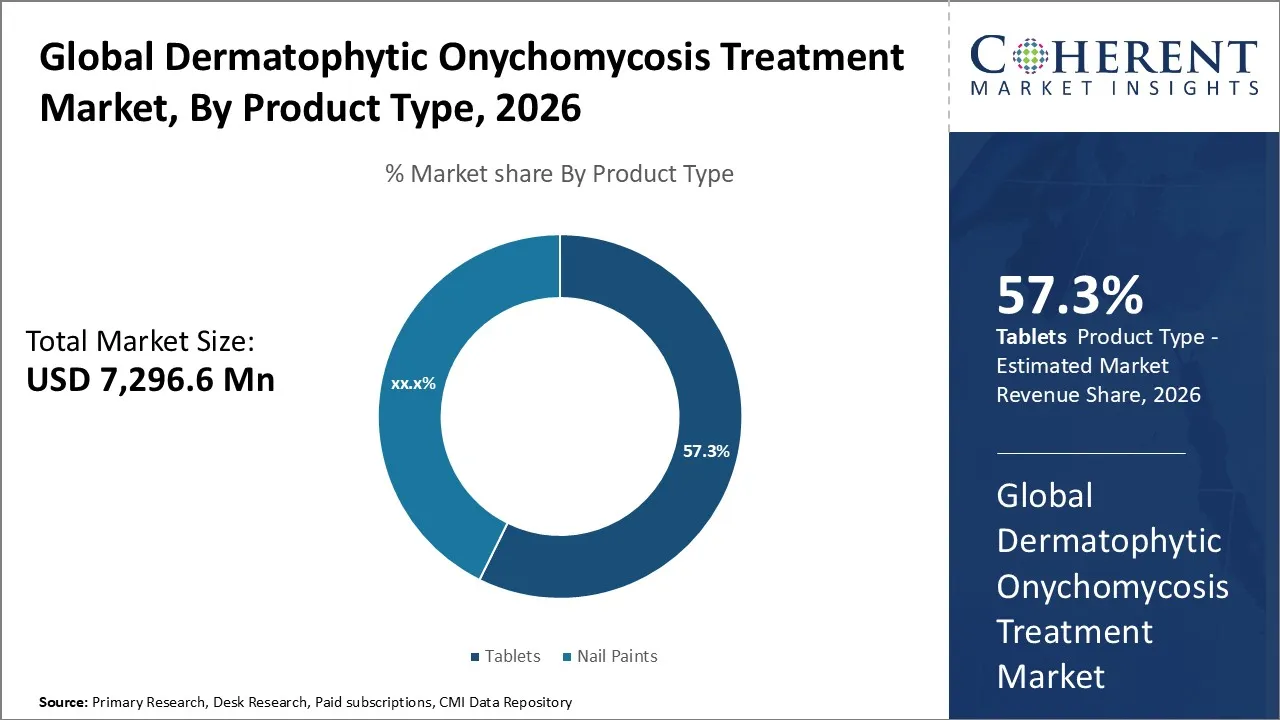
Dermatophytic Onychomycosis Treatment Market Insights, By Product Type - Tablets lead the market with superior efficacy and faster cure rates over nail paints
In terms of product type, the tablets segment is expected to hold 57.3% share of the market in 2026. Their systemic action ensures higher cure rates compared to topical nail paints, making them the preferred choice for moderate to severe infections. Physicians prescribe oral antifungals widely due to proven efficacy, shorter treatment cycles, and strong clinical evidence.
For instance, in December 2025, The Steris Pharma update highlights terbinafine and itraconazole, oral antifungal tablets used to treat dermatophytic onychomycosis. These systemic therapies dominate the market in 2026 due to superior efficacy, faster cure rates, and physician preference. Their availability through pharmacies strengthens demand, especially in regions with rising awareness of nail fungal infections.
Dermatophytic Onychomycosis Treatment Market Insights, By Treatment - Oral antifungals dominate due to systemic action and higher patient compliance
In terms of treatment, the oral segment is expected to lead with 60% share of the market in 2026. They remain the gold standard because of superior penetration and effectiveness against stubborn fungal infections. Despite concerns about liver toxicity, oral antifungals like terbinafine and itraconazole are favored for their faster results, higher patient compliance, and strong physician preference over topical alternatives.
Dermatophytic Onychomycosis Treatment Market Insights, By End User - independent pharmacies outlets prevail as the most accessible and preferred distribution channels
In terms of end user, the independent pharmacies segment is projected to capture 42.7% share in 2026. Their accessibility, convenience, and widespread presence make them the primary channel for both prescriptions and over-the-counter antifungal products. Patients prefer these outlets for affordability and immediate availability, reinforcing their leadership over hospitals, clinics, and mail-order pharmacies.
For instance, in December 2025, A new topical terbinafine 10% nail solution (MOB‑015) shows promise in treating onychomycosis, achieving nearly 70% cure rates in phase 3 trials. Licensed to Karo Healthcare for European distribution, it could soon join UK pharmacies, expanding safer alternatives to oral antifungals for dermatophytic nail infections pending MHRA approval.
Regional Insights
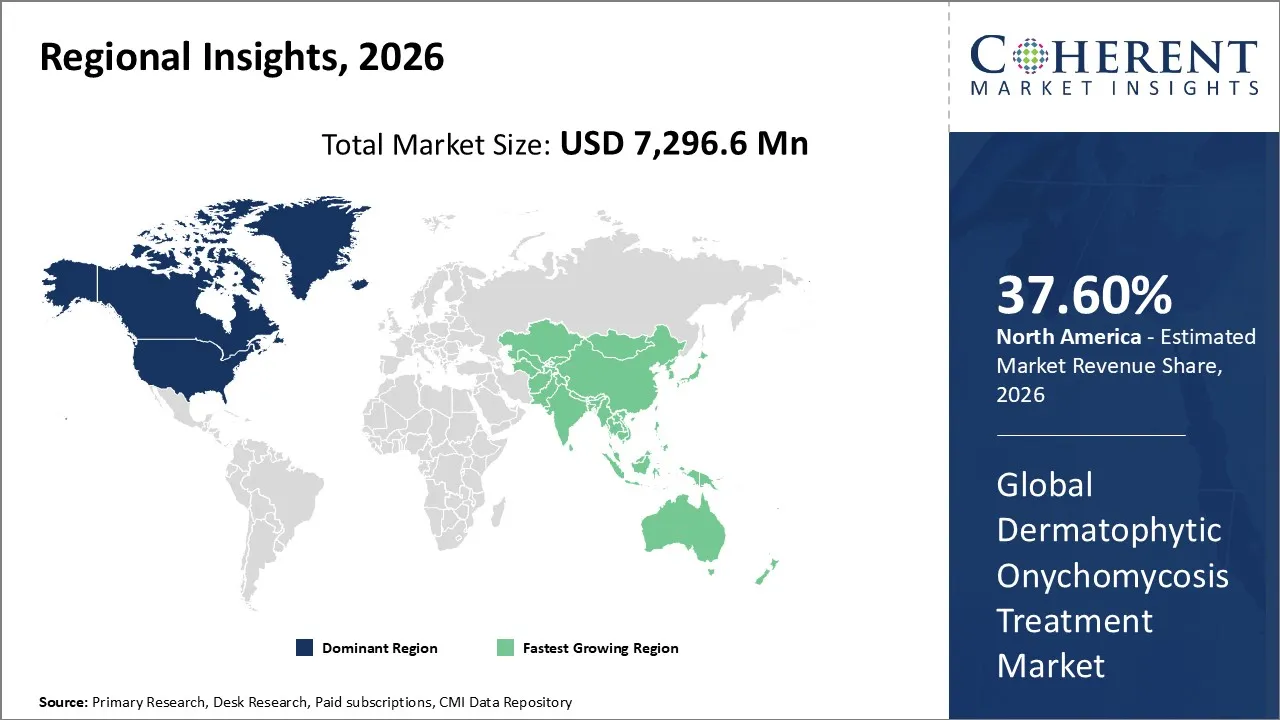
North America Dermatophytic Onychomycosis Treatment Market Analysis & Trends
North America is expected to dominate the dermatophytic onychomycosis treatment market with 37.60% share in 2026, driven by high infection prevalence among aging populations, advanced healthcare infrastructure, and strong physician preference for oral antifungal tablets. Rising cosmetic concerns, insurance coverage, and availability of treatments through pharmacies and drug stores further reinforce the region’s dominant market position.
For instance, in January 2026, The FDA approved an Investigational New Drug application for Hallux Subungual Gel 42, a topical antifungal candidate targeting onychomycosis. This milestone allows clinical trials in the United States, aiming to provide a safer, more effective alternative to oral antifungal tablets and existing topical lacquers for fungal nail infections.
Asia Pacific Dermatophytic Onychomycosis Treatment Market Analysis & Trends
Asia Pacific is expected to exhibit the fastest growth, due to rising awareness of fungal nail infections, growing middle-class populations, and expanding healthcare access. Increasing cosmetic concerns, humid climates fostering infection prevalence, and rapid growth of retail and online pharmacies further drive adoption of affordable oral and topical antifungal therapies.
For instance, in February 2025, Fosravuconazole, an oral antifungal prodrug of ravuconazole, is approved in Japan as NAILIN® Capsules for onychomycosis. DNDi highlights its potential against neglected fungal diseases like eumycetoma. Sato Pharmaceutical holds commercialization rights across ASEAN, Australia, New Zealand, South Korea, and Taiwan, expanding regional access to dermatophytic nail infection treatment.
Dermatophytic Onychomycosis Treatment Market Outlook Country-Wise
The U.S. Dermatophytic Onychomycosis Treatment Market Trends
In 2026, U.S. demand for dermatophytic onychomycosis treatments is rising due to increasing fungal infection prevalence, heightened patient awareness, and technological advances in antifungal therapies. Market growth is driven by localized supply-chain resilience, expanding drug options, and preference for effective oral and topical treatments.
For instance, in January 2024, Vanda Pharmaceuticals received FDA approval to advance VTR-297, a topical antifungal candidate for onychomycosis treatment. Since dermatophytes are the primary cause of nail fungus, this investigational therapy directly addresses dermatophytic infections. The development strengthens the topical treatment segment, offering safer alternatives to oral antifungals and expanding future market opportunities.
Japan Dermatophytic Onychomycosis Treatment Market Trends
In 2026, Japan’s dermatophytic onychomycosis treatment market is driven by rising fungal infection prevalence, aging population, and growing awareness of nail health. AI-driven diagnostics and personalized antifungal therapies enhance precision and accessibility, while expanding retail and hospital pharmacy channels boost demand for effective oral and topical treatment options.
For instance, in March 2025, Eisai announced it will end co‑promotion of NAILIN® Capsules (fosravuconazole) for onychomycosis in Japan. From April 2026, Sato Pharmaceutical will solely manage promotion.
Market Report Scope
Dermatophytic Onychomycosis Treatment Market Report Coverage
| Report Coverage | Details | ||
|---|---|---|---|
| Base Year: | 2025 | Market Size in 2026: | USD 7,296.6 Mn |
| Historical Data for: | 2020 To 2024 | Forecast Period: | 2026 To 2033 |
| Forecast Period 2026 to 2033 CAGR: | 7.6% | 2033 Value Projection: | USD 12,219.7 Mn |
| Geographies covered: |
| ||
| Segments covered: |
| ||
| Companies covered: | Valeant Pharmaceuticals International Inc., Galderma S.A., Novartis AG, Pfizer Inc., Moberg Pharma AB, Janssen Global Services, LLC (Johnson & Johnson Services, Inc.), Anacor Pharmaceuticals, Inc., NovaQuest Capital Management, L.L.C., and Novan, Inc. | ||
| Growth Drivers: |
| ||
| Restraints & Challenges: |
| ||
Dermatophytic Onychomycosis Treatment Market Driver
Rising Prevalence of Fungal Nail Infections
Dermatophytic onychomycosis is among the most widespread nail disorders globally, affecting millions of individuals each year. Its incidence continues to rise due to factors such as aging populations, diabetes, and weakened immunity, which make patients more susceptible to fungal infections. This expanding patient base is creating strong momentum for effective therapies, ranging from oral antifungals to topical solutions. As a result, the growing prevalence is significantly boosting dermatophytic onychomycosis treatment market demand, positioning it as a critical healthcare priority worldwide. According to National Institute of Health, Onychomycosis, a fungal infection of the nails, represents the most common nail disorder, affecting approximately 10% of adults worldwide. In children, prevalence varies by region, ranging from 0% to 7.7% globally. Among nail dystrophies, onychomycosis accounts for about 15% in children compared to 50% in adults.
Advancements in Treatment Options
The dermatophytic onychomycosis treatment landscape is evolving rapidly with innovations in oral antifungals, topical formulations, and advanced laser therapies. These modern approaches are improving cure rates, reducing recurrence, and enhancing patient satisfaction. Combination therapies, which integrate multiple treatment modalities, are gaining popularity for their superior efficacy. Such advancements not only improve accessibility but also strengthen the competitive positioning of pharmaceutical companies. Consequently, these innovations are expanding dermatophytic onychomycosis treatment market share, ensuring sustained growth and broader adoption across diverse patient populations.
Dermatophytic Onychomycosis Treatment Market Opportunity
AI-Driven Diagnostics
Artificial intelligence is revolutionizing fungal nail infection detection by enabling faster, more accurate diagnostics. Machine learning algorithms analyze nail images and patient data to identify dermatophytic infections with high precision, reducing misdiagnosis and unnecessary treatments. This innovation enhances early intervention, improves patient outcomes, and supports personalized therapy selection. As awareness grows, AI integration into clinical practice is expected to significantly boost adoption rates, strengthening the dermatophytic onychomycosis treatment market forecast with improved efficiency and accessibility.
Analyst Opinion (Expert Opinion)
- The dermatophytic onychomycosis treatment market value is expanding significantly due to rising prevalence of fungal nail infections and greater clinical awareness of effective therapies. Dermatophytic onychomycosis, which represents the majority of nail fungal infections worldwide, accounts for a substantial portion of treatment demand as diagnostic capabilities and patient education improve. Prevalence data indicate that dermatophytes are responsible for the vast majority of toenail onychomycosis cases and a substantial proportion of fingernail infections, reinforcing clinical focus on targeted antifungal interventions.
- Treatment modalities are broadly segmented into topical and oral antifungals. Therapeutic preferences are increasingly leaning toward topical therapies such as specialized nail lacquers and solutions, which benefit from ease of use and fewer systemic side effects compared with traditional systemic antifungal drugs. The topical segment has maintained a dominant position in treatment use, supported by formulations designed for deeper nail penetration and improved patient compliance.
- Regionally, North America remains the largest market, underpinned by strong healthcare infrastructure, high prescription volumes, and robust uptake of advanced treatment options. The Asia-Pacific region is emerging as a key growth area, driven by expanding healthcare access, rising awareness of fungal nail conditions, and increasing dermatological care utilization.
Speak to the analyst
Want personalized insights?
Take the findings above to one of our principal consultants, or have the report rebuilt around the segments, geographies and competitors you actually track.
Recent Developments
- In December 2025, Researchers discovered hydrogen sulfide as a promising antifungal for onychomycosis. Unlike current oral or topical drugs, it penetrates nails effectively and kills resistant fungi. This breakthrough could lead to faster, safer treatments, reducing side effects and improving outcomes, especially for older adults and diabetics, within five years.
- In November 2025, Karo Healthcare signed an exclusive license agreement with Moberg Pharma to commercialize MOB‑015 in Europe. MOB‑015 is a topical terbinafine solution developed for onychomycosis, offering improved nail penetration compared to existing lacquers. This partnership strengthens Karo’s dermatology portfolio and expands access to innovative antifungal nail infection treatments across Europe.
Market Segmentation
- By Product Type
- Tablets
- Nail Paints
- By Treatment
- Oral
- Topical
- By End User
- Hospitals
- Clinics
- Independent Pharmacies
- Mail Order Pharmacies
- Drug Stores
- By Region
- North America
- U.S.
- Canada
- Latin America
- Brazil
- Argentina
- Mexico
- Rest of Latin America
- Europe
- Germany
- U.K.
- Spain
- France
- Italy
- Russia
- Rest of Europe
- Asia Pacific
- China
- India
- Japan
- Australia
- South Korea
- ASEAN
- Rest of Asia Pacific
- Middle East & Africa
- GCC Countries
- Israel
- Rest of Middle East & Africa
- North America
- Global Dermatophytic Onychomycosis Treatment Market: Competitive Landscape
- Valeant Pharmaceuticals International Inc.
- Galderma S.A.
- Novartis AG
- Pfizer Inc.
- Moberg Pharma AB
- Janssen Global Services, LLC (Johnson & Johnson Services, Inc.)
- Anacor Pharmaceuticals, Inc.
- NovaQuest Capital Management, L.L.C.
- Novan, Inc.
Sources
Primary Research Interviews
- Dermatologists & Mycologists
- Podiatrists & Foot Care Specialists
- Infectious Disease Specialists
- Hospital Pharmacists & Clinical Pharmacologists
- Antifungal Drug Manufacturers
- Topical & Oral Antimycotic Formulation Experts
- Medical Laser Therapy Providers (Onychomycosis Treatment Devices)
- Healthcare Distributors & Specialty Pharmacy Managers
- Others
Databases
- Bloomberg Terminal
- Thomson Reuters Eikon
- IQVIA MIDAS & Pharmetrics
- GlobalData Healthcare
- S&P Global Market Intelligence
- EvaluatePharma
- Euromonitor International
- Others
Magazines
- Dermatology Times
- Podiatry Today
- Pharmaceutical Technology
- Drug Discovery & Development
- Medical Device Network
- Others
Journals
- Journal of the American Academy of Dermatology (JAAD)
- Mycoses Journal
- Journal of Dermatological Treatment
- International Journal of Dermatology
- Clinical Infectious Diseases
- Journal of Fungi
- Others
Newspapers
- Financial Times
- The Wall Street Journal
- Reuters
- Bloomberg News
- The Guardian – Health Section
- Others
Associations
- American Academy of Dermatology (AAD)
- European Academy of Dermatology and Venereology (EADV)
- International Society for Human and Animal Mycology (ISHAM)
- British Association of Dermatologists (BAD)
- Infectious Diseases Society of America (IDSA)
- Others
Public Domain Sources
- U.S. Food & Drug Administration (FDA) – Drug Approvals & Safety Labels
- Centers for Disease Control and Prevention (CDC) – Fungal Disease Branch
- World Health Organization (WHO)
- National Institutes of Health (NIH)
- European Medicines Agency (EMA)
- ClinicalTrials.gov
- National Center for Biotechnology Information (NCBI)
- Others
Proprietary Elements
- CMI Data Analytics Tool
- Proprietary CMI Existing Repository of Information for the Last 8 Years
Get access to 250+ pages report
Every segment, forecast, competitor profile and data table behind the analysis above — available for instant download.
- ESOMAR Member
- ISO 9001:2015 Certified
- D-U-N-S Registered
- GDPR & CCPA Compliant
Missing comfort of reading report in your local language? Find your preferred language:
Transform your Strategy with Exclusive Trending Reports
Frequently Asked Questions
The dermatophytic onychomycosis treatment market is estimated to be valued at USD 7,296.6 Mn in 2026, and is expected to reach USD 12,219.7 Mn by 2033.
Major players operating in the global dermatophytic onychomycosis treatment market include Valeant Pharmaceuticals International Inc., Galderma S.A., Novartis AG, Pfizer Inc., Moberg Pharma AB, Janssen Global Services, LLC (Johnson & Johnson Services, Inc.), Anacor Pharmaceuticals, Inc., NovaQuest Capital Management, L.L.C., and Novan, Inc.
High cost of treatment is expected to hamper growth of the market over the forecast period.
Rising prevalence of fungal nail infections and advancements in treatment options are expected to propel growth of the market over the forecast period.
The global dermatophytic onychomycosis treatment market is estimated to exhibit a CAGR of 7.6% over the forecast period.
Among regions, Europe is expected to hold dominant position in the market over the forecast period.