

Enteric Disease Testing Market Size and Forecast: 2026-2033
The Enteric Disease Testing Market is estimated to be valued at USD 5.1 Bn in 2026 and is expected to reach USD 7.8 Bn by 2033, exhibiting a compound annual growth rate (CAGR) of 4.2% from 2026 to 2033.
Key Takeaways
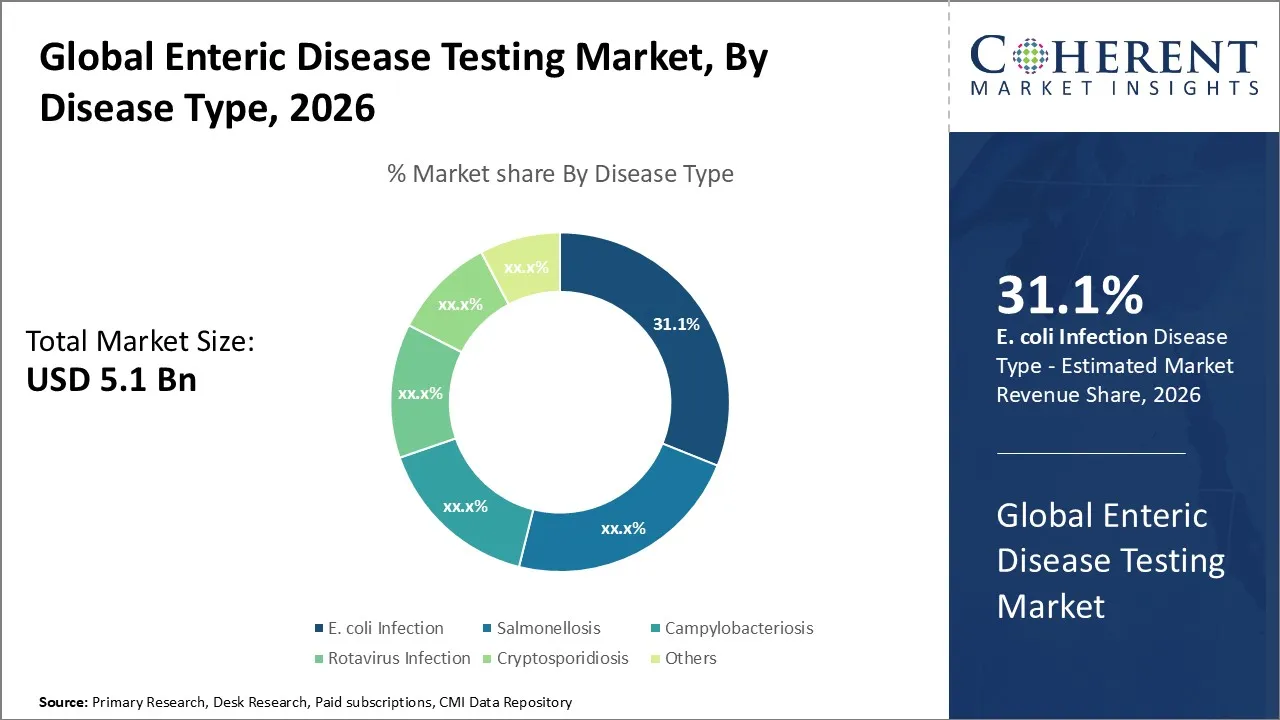
- By Disease Type, E. coli Infection hold the largest market share of 31.1% in 2026 owing to the rising prevalence of e. coli and other enteric infections.
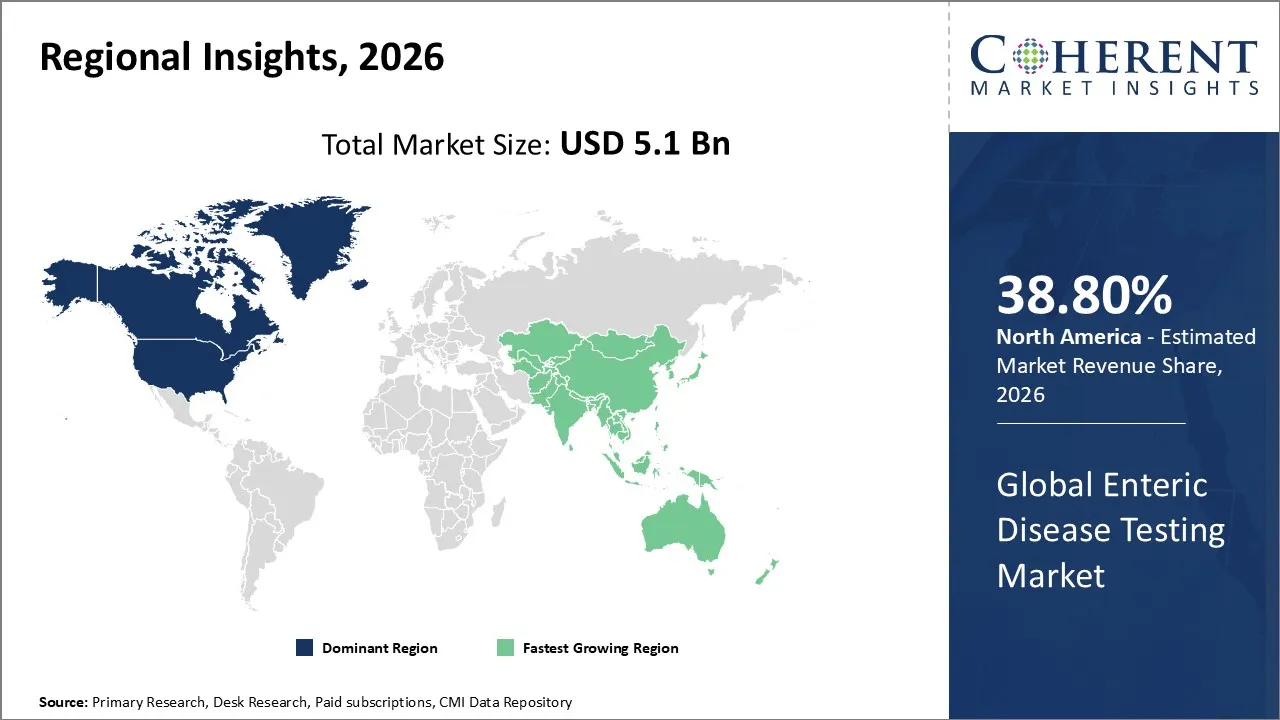
- By Region, North America dominates the overall market with an estimated share of 38.80% in 2026 owing to the high incidence of foodborne & enteric illnesses.
Market Overview
The enteric disease testing market delivers diagnostic solutions for gastrointestinal illnesses caused by bacterial, viral, and parasitic pathogens spread through contaminated food, water, or person‑to‑person contact. Rising awareness of early detection, the push for rapid and accurate diagnostics, innovations in molecular testing technologies, and the expansion of public health surveillance programs drive demand. Stringent food safety regulations and the increasing occurrence of enteric infections worldwide further boost the adoption of advanced testing methods in clinical and public health settings.
Current Events and their Impact on the Enteric Disease Testing Market
Current Events | Description and its impact |
Global Public Health Initiatives on Enteric Diseases |
|
Technological Advancements in Molecular and Point-of-Care Testing |
|
Regional Outbreaks and Epidemiological Shifts |
|
Segmental Insights
- Current Industry Events of 2026
- Market Size Estimation
- Regional Breakdown
- Competitive Landscape
- Customer Intelligence
- Segmental Analysis
- Pricing Analysis
- Key Market Drivers, Challenges & Future Trends
- Customized Insights Section
Enteric Disease Testing Market Insights, By Disease Type - E.coli Infection contribute the highest share of the market owing to its food & water safety regulations
E.coli Infection hold the largest market share of 31.1% in 2026. Increasing E. coli infections are driving growth in the enteric disease testing market, as contaminated food, water, and poor hygiene practices spread outbreaks. Public health authorities and food safety regulators prioritize early detection, while healthcare providers adopt rapid, reliable diagnostics to manage cases effectively. Advances in molecular assays and multiplex panels improve detection speed and accuracy. Heightened awareness of antimicrobial resistance and the demand for precise pathogen identification motivate wider use of advanced testing methods across clinical, food, and environmental monitoring sectors. For instance, in August 2025, CARB-X awarded USD 3 million to Swiss biotech startup Baxiva AG to advance its multivalent glycoconjugate vaccine targeting major serotypes of invasive extraintestinal pathogenic Escherichia coli.
Regional Insights
North America Enteric Disease Testing Market Trends
North America dominates the overall market with an estimated share of 38.80% in 2026. In North America, advanced molecular and multiplex diagnostics are transforming the enteric disease testing market by enabling faster and more accurate pathogen detection. Hospitals and laboratories increasingly adopt rapid and point‑of‑care tests to support wider disease surveillance and manage outbreaks effectively. Strong healthcare infrastructure, proactive public health programs, and strict food and water safety regulations drive routine testing. Leading diagnostic manufacturers innovate continuously, and growing investments in new technologies further accelerate the market’s growth and adoption of sophisticated testing solutions. For instance, NIAID, part of the NIH, launched an early-stage trial of CRS3123, an oral antibiotic that targets C. difficile while preserving healthy gut bacteria.
Asia Pacific Enteric Disease Testing Market Trends
In the Asia Pacific, high rates of food‑ and water‑borne infections from poor sanitation and hygiene are driving demand for enteric disease diagnostics. Governments are enhancing disease surveillance and raising public awareness, while healthcare systems expand infrastructure to support wider testing. Highly populated countries are upgrading laboratory capabilities and adopting advanced molecular and rapid testing technologies to improve detection. Heightened focus on food safety and increased access to healthcare further encourage the use of enteric disease testing throughout the region.
United States Enteric Disease Testing Market Trends
In the United States, healthcare facilities are driving the enteric disease testing market by adopting advanced molecular and rapid testing technologies for faster, more accurate detection of gastrointestinal pathogens. Hospitals and laboratories increasingly implement PCR and multiplex platforms to guide clinical decisions and respond to outbreaks. Public health agencies, including the CDC and FDA, actively promote routine testing and early detection through robust surveillance programs. Rising awareness of foodborne illnesses and continuous investment in diagnostic innovations further propel market growth. For instance, in January 2025, Eli Lilly announced FDA approval of Omvoh for adults with moderate to severe Crohn’s disease, adding to its existing U.S. approval for ulcerative colitis.
Japan Enteric Disease Testing Market Trends
In Japan, healthcare providers are driving the enteric disease testing market by adopting rapid and accurate diagnostics to detect food‑ and water‑borne infections such as norovirus and gastroenteritis. They increasingly use molecular techniques, including PCR and DNA‑based testing, to improve pathogen identification and accelerate response times. Expansion of point‑of‑care testing, along with collaborations between government agencies and private diagnostic firms, enhances access and innovation. Public health investments and digital health integration further promote widespread adoption of enteric disease testing across the country.
End-user Feedback and Unmet Needs in the Enteric Disease Testing Market
End-user Feedback and Unmet Needs
- Demand for Faster and More Accurate Diagnostics: End-users consistently highlight the need for rapid, reliable tests that reduce turnaround time without compromising accuracy. Clinicians and laboratories seek solutions that enable immediate patient management, early outbreak detection, and improved treatment outcomes. Delays or false results can compromise clinical decisions and public health responses.
- Accessibility and Point-of-Care Testing: Healthcare providers emphasize the need for tests that are easy to use at the point of care, particularly in outpatient clinics, rural hospitals, and resource-limited regions. Current diagnostic tools often require centralized labs, trained personnel, and complex equipment, limiting timely testing and patient reach.
- Integration with Multiplex and Syndromic Panels: End-users express a preference for multiplex panels capable of detecting multiple enteric pathogens simultaneously. This reduces repeated sample collection, saves time, and enables more comprehensive diagnostics. Many current solutions still require separate tests for different pathogens, increasing cost and operational burden.
Enteric Disease Testing Market Trend
Shift Toward Advanced Molecular Diagnostics
The market increasingly favors molecular techniques, such as PCR and next-generation sequencing, for detecting enteric pathogens. These methods provide faster, more accurate results than traditional culture-based tests, enabling healthcare providers to manage patients more effectively. Laboratories adopt these technologies to enhance sensitivity, reduce false negatives, and support outbreak tracking. Continuous innovation in molecular platforms also allows simultaneous identification of multiple pathogens, meeting the growing demand for comprehensive diagnostic solutions in clinical and public health settings.
Rising Adoption of Multiplex and Syndromic Panels
Multiplex and syndromic testing panels are gaining prominence as they allow simultaneous detection of several gastrointestinal pathogens from a single sample. This trend reduces the need for multiple tests, shortens diagnosis time, and lowers operational burdens for laboratories. Healthcare providers appreciate these panels for improving workflow efficiency, enabling rapid decision-making, and supporting epidemiological monitoring. The shift toward integrated testing solutions reflects the need for more efficient and cost-effective approaches to managing enteric disease outbreaks
Market Report Scope
Enteric Disease Testing Market Report Coverage
| Report Coverage | Details | ||
|---|---|---|---|
| Base Year: | 2025 | Market Size in 2026: | USD 5.1 Bn |
| Historical Data for: | 2020 To 2024 | Forecast Period: | 2026 To 2033 |
| Forecast Period 2026 to 2033 CAGR: | 4.2% | 2033 Value Projection: | USD 7.8 Bn |
| Geographies covered: |
| ||
| Segments covered: |
| ||
| Companies covered: | Alere, Inc, Becton Dickinson & Company, Biomerica, Inc., bioMerieux, Bio-Rad, Cepheid, Coris BioConcept, DiaSorin, Meridian Bioscience, Inc, Quest Diagnostics, and Trinity Biotech | ||
| Growth Drivers: |
| ||
| Restraints & Challenges: |
| ||
Enteric Disease Testing Market News
- In March 2026, University College London launched the Human Organ Atlas, a 3D web platform that lets users explore organs from whole structures down to single cells for research, education, and public learning.
Analyst Opinion (Expert Opinion)
- The enteric disease testing landscape is at a critical inflection point where diagnostic technology is outpacing public health infrastructure preparedness in many regions. Molecular and multiplex platforms are increasingly standard in advanced laboratories, but adoption is uneven. Although molecular diagnostics now account for a significant proportion of testing due to their speed and sensitivity with multiple pathogens identifiable in a single assay their cost and complexity continue to limit penetration in emerging markets. This dichotomy is starkly illustrated by reported increases in molecular testing utilization in the U.S., contrasting sharply with reliance on basic immunoassays and traditional methods in low‑resource settings.
- Bacterial enteric pathogens such as Salmonella, Shigella, E. coli and Campylobacter—remain the dominant drivers of testing demand globally. Bacterial agents are responsible for hundreds of millions of illnesses annually and are disproportionately prioritized by clinical and food‑safety testing protocols. Even as viral and parasitic enteric agents remain epidemiologically significant, resource allocation heavily favours bacterial diagnostics due to the acute public health and economic impacts of outbreaks.
- Investment patterns reflect this prioritization yet underscore a broader strategic misalignment. Capital continues to flow predominantly toward incremental improvements in PCR panels and immunoassay systems rather than the development of truly scalable, low‑cost point‑of‑care (POC) solutions capable of transforming diagnostics in high‑burden, low‑income regions. While syndromic panels and next‑generation sequencing tools expand capabilities in tertiary centres, the promise of rapid, field‑deployable diagnostics remains under‑realized, particularly in parts of Asia, Africa and Latin America where disease incidence is highest.
- Regulatory and payer environments further complicate adoption. In mature markets, stringent regulatory frameworks , while essential for quality control extend time to market and inflate costs, disproportionately benefiting entrenched players with the financial heft to absorb these barriers. Conversely, in many developing nations, regulatory incoherence and underfunded oversight fail to enforce basic testing standards, undermining both surveillance and clinical decision‑making. This regulatory asymmetry not only restricts market growth but also entrenches inequities in disease detection and response capabilities.
Speak to the analyst
Want personalized insights?
Take the findings above to one of our principal consultants, or have the report rebuilt around the segments, geographies and competitors you actually track.
Market Segmentation
- By Disease Type
- E. coli Infection
- Salmonellosis
- Campylobacteriosis
- Rotavirus Infection
- Cryptosporidiosis
- Norovirus Infection
- Cholera
- C. difficile
- H. pylori
- Amebiasis
- Shigellosis
- By Regional Insights
- North America
- U.S.
- Canada
- Latin America
- Brazil
- Argentina
- Mexico
- Rest of Latin America
- Europe
- Germany
- U.K.
- Spain
- France
- Italy
- Russia
- Rest of Europe
- Asia Pacific
- China
- India
- Japan
- Australia
- South Korea
- ASEAN
- Rest of Asia Pacific
- Middle East
- GCC Countries
- Israel
- Rest of Middle East
- Africa
- South Africa
- North Africa
- Central Africa
- North America
- Key Players Insights
- Alere, Inc
- Becton Dickinson & Company
- Biomerica, Inc
- bioMerieux
- Bio-Rad, Cepheid
- Coris BioConcept
- DiaSorin
- Meridian Bioscience, Inc.
- Quest Diagnostics
- Trinity Biotech
Sources
Primary Research interviews
- Interviews with laboratory directors and clinical microbiologists in diagnostic testing facilities
- Conversations with infectious disease specialists
- Interviews with public health officials involved in enteric disease surveillance
- Discussions with hospital laboratory managers
- Interviews with technicians using enteric pathogen testing platforms
Databases
- World Health Organization (WHO) Global Health Observatory
- CDC WONDER and CDC surveillance databases
- National health ministry disease surveillance portals (e.g., India’s NCDC)
- PubChem and NCBI pathogen databases
- Country-level disease reporting platforms
Magazines
- Clinical Laboratory News
- Diagnostic World Magazine
- Medical Lab Management Magazine
- Infection Control Today
- Global Health Magazine
Journals
- Journal of Clinical Microbiology
- Journal of Medical Virology
- Journal of Infectious Diseases
- Clinical Infectious Diseases
- Emerging Infectious Diseases
- International Journal of Infectious Diseases
Newspapers
- The Times of India (health and science sections)
- The Hindu (health updates)
- The Guardian (global health reporting)
- New York Times (health & science coverage)
- South China Morning Post (public health related reporting)
Associations
- World Health Organization (WHO)
- Centers for Disease Control and Prevention (CDC)
- Infectious Diseases Society of America (IDSA)
- Indian Council of Medical Research (ICMR)
- Association of Public Health Laboratories (APHL)
- European Centre for Disease Prevention and Control (ECDC)
Public Domain sources
- National health ministry policy documents
- WHO enteric disease and diarrheal disease fact sheets
- CDC enteric pathogen surveillance reports
- Open access scientific articles and datasets
- Government health statistics portals
Proprietary Elements
- CMI Data Analytics Tool
- Proprietary CMI Existing Repository of information for last 8 years
Get access to 250+ pages report
Every segment, forecast, competitor profile and data table behind the analysis above — available for instant download.
- ESOMAR Member
- ISO 9001:2015 Certified
- D-U-N-S Registered
- GDPR & CCPA Compliant
Missing comfort of reading report in your local language? Find your preferred language:
Transform your Strategy with Exclusive Trending Reports
Frequently Asked Questions
The Enteric Disease Testing Market is estimated to be valued at USD 5.1 Bn in 2026 and is expected to reach USD 7.8 Bn by 2033.
E. coli Infection segment held the major market share owing to an increasing prevalence of E. coli infection in developing economies is expected to propel growth of the market
Major factor driving the growth of Global Enteric Disease Testing market during the forecast period increasing prevalence enteric dieseases, increasing research & development , and adoption of expansion strategies from major companies.
Major factors hampering the growth of the Global Enteric Disease Testing market during the forecast period constitutes of low awareness in lower income economies.
North America market is expected to generate the highest revenue during the forecast period.
Some of the key players operating in the market are Alere, Inc., Becton Dickinson & Company, Biomerica, Inc., bioMerieux, Bio-Rad, Cepheid, Coris BioConcept, DiaSorin, Meridian Bioscience, Inc., Quest Diagnostics, and Trinity Biotech.