

Ingestible Smart Pills Market size and share Analysis (2026-2033)
The Global Ingestible Smart Pills Market is anticipated to grow at a CAGR of 5.6%, with a USD 1.6 Bn in 2026 and is expected to reach approximately USD 2.3 Bn in 2033. This growth in the market is driven by the rising burden of chronic diseases noncommunicable diseases account for about 75% of global deaths, with 18 million premature deaths before age 70 worldwide (WHO) and increasing demand for digital health and remote patient monitoring solutions, supported by global health strategies to promote digital health adoption. (Source: WHO)
Key Takeaways
- In 2026, Smart Pills captured approximately 84.8% of the total market share by Component. This notable market position can be primarily attributed to increased demand for gastrointestinal (GI) diagnostics and ongoing product advancements.
- Imaging is projected to hold the largest share by application at 69.6% in 2026, reflecting significant interest in early detection measures for gastrointestinal lesions and chronic diseases, including cancer. The American Cancer Society estimates that there will be around 158,850 new colorectal cancer cases in the U.S. in 2026. Additionally, the FDA's approval of the Deep Capsule is expected to facilitate faster turnaround times for reviewing capsule images. (Source: Cancer)
- Hospitals accounted for 53.4% of all smart pill procedures by end users in 2026. They serve as the primary site for service delivery due to the availability of specialists, a high volume of referred patients, and the presence of appropriate diagnostic equipment. According to the American Hospital Association, there were 6,100 hospitals in the U.S. as of 2026, with a total of 907,216 staffed beds and 35,658,583 total admissions.(Source: AHA)
- A total of nearly 40% of the smart pill market is projected to be in North America by 2026, due to the advanced state of its healthcare system and the substantial investment in diagnostic testing. In 2024, the Centers for Medicare and Medicaid Services estimated that total national spending will reach USD 5.3 trillion, with an anticipated increase of 7.1% from 2024 to 2025. Furthermore, the American Hospital Association (AHA) has reported that approximately 6,100 hospitals are expected to be operational in 2026, indicating that North America will continue to be the leading region for the use of digestible smart pills.
Segmental Insights
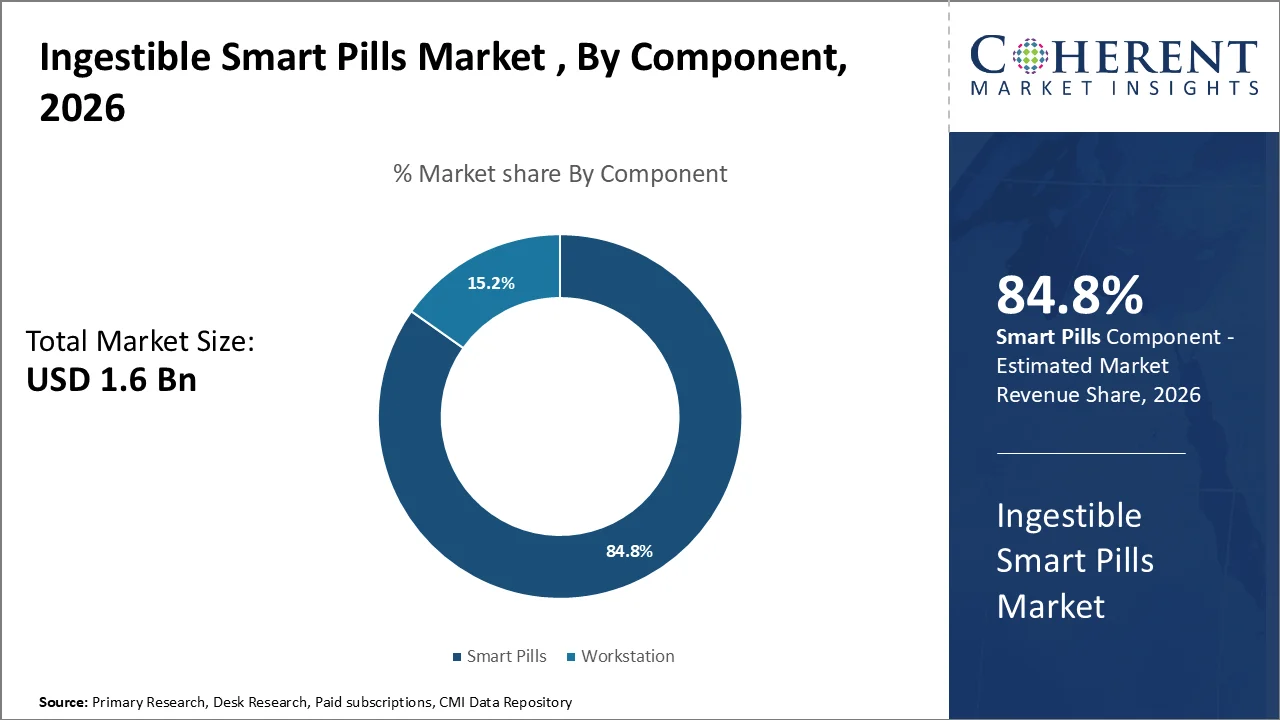
By Component, the Smart Pills dominates with 84.8% of market share in 2026
In 2026, the smart pills segment dominates the ingestible smart pills market due to increasing demand for minimally invasive and patient-friendly diagnostic solutions. Technologies such as capsule endoscopy enable detailed visualization of the gastrointestinal tract without the need for sedation or invasive procedures, improving patient comfort and compliance. According to the National Institutes of Health, capsule endoscopy has a diagnostic yield of over 60–70% for small bowel disorders, significantly higher than many traditional methods. Additionally, rising prevalence of gastrointestinal diseases, including Crohn’s disease, is further driving adoption, as smart pills allow continuous, real-time monitoring and more accurate disease management across clinical settings.
Two key factors are expected to drive continued growth in this segment. First, the healthcare industry is increasingly favoring minimally invasive gastrointestinal diagnostic procedures that offer visual evidence of hard-to-reach areas of the bowel without resorting to traditional invasive methods. Second, AI-assisted analysis of capsule data and improvements in workflow efficiencies have enhanced the detection of bleeding, Crohn's disease, polyps, and other abnormalities related to iron deficiency. This progress has led to greater confidence among clinicians in the use of smart pills.
The most significant development in this segment occurred on September 23, 2025, when Medtronic announced that its PillCam capsule for endoscopy had been used by over 4 million patients worldwide. This announcement was followed by the FDA's clearance on March 12, 2026, of the Deep Capsule, an AI-assisted analysis tool for small-bowel capsule endoscopy, designed to enhance the speed at which clinicians can review and interpret capsule data.
- Current Industry Events of 2026
- Market Size Estimation
- Regional Breakdown
- Competitive Landscape
- Customer Intelligence
- Segmental Analysis
- Pricing Analysis
- Key Market Drivers, Challenges & Future Trends
- Customized Insights Section
By Application, the imaging segment dominates with 69.6% of market share in 2026
The imaging sector is expected to dominate in 2026, driven by the widespread adoption and commercial availability of capsule-based visualization for assessing small bowel and colon issues. This prominent status in imaging is supported by a strong demand for cancer diagnostics; the American Cancer Society projects 158,850 new cases of colorectal cancer in the U.S. for that year. Additionally, the FDA's approval of Deep Capsule® AI-assisted capsule endoscopy image analysis software on March 12, 2026, will further position imaging at the forefront of clinical workflows.
A growing population within the digestive disease sector is influenced by two key factors: many patients stand to benefit significantly from the development of non-invasive gastrointestinal assessment tools, and the high incidence of gastrointestinal bleeding is driving demand for increased access to swallowable imaging technologies for bowel evaluation. This condition results in over 1.5 million healthcare visits and approximately 500,000 hospital admissions annually in the U.S.
By End User, the Hospitals segment dominates with 53.4% of market share in 2026
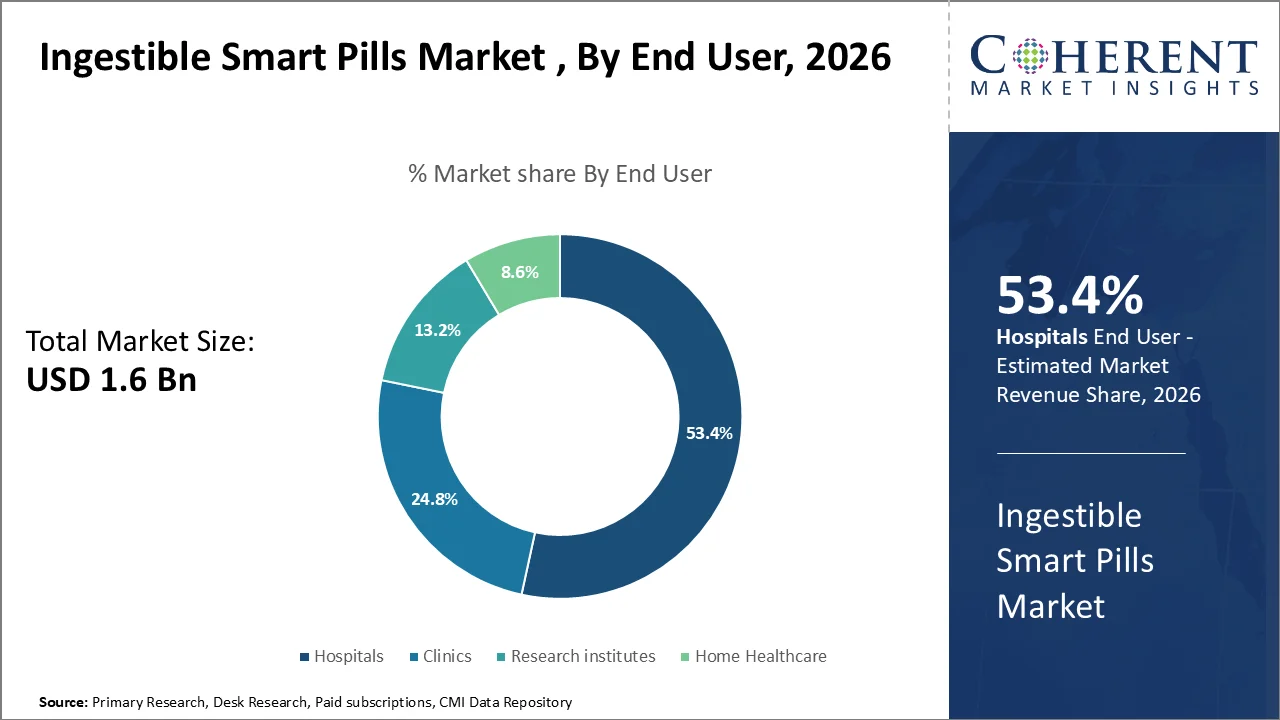
In 2026, hospitals will be the largest segment of end users, primarily due to their concentration of gastroenterologists, robust diagnostic infrastructure, and high patient volume necessary for ingestible smart pill procedures. The American Hospital Association’s 2026 hospital statistics indicate that there are 5,121 community hospitals in the U.S., with 3,567 of these being affiliated with hospital systems. This underscores the importance of hospitals as the most suitable environments for capsule-based diagnostics and follow-up care.
Hospital demand continues to rise, with the AHA reporting a 5.3% increase in inpatient volumes and a 9.8% increase in outpatient visits for 2025, which strengthens the case for hospital-based GI diagnostics. Reimbursement remains favorable, CMS indicates that capsule endoscopy interpretation is reimbursable in both inpatient and outpatient hospital settings, while hospital operating payment rates for FY 2026 are projected to increase by 2.6% for qualifying acute care hospitals.
The York and Scarborough Teaching Hospitals NHS Foundation Trust issued a protocol on February 3, 2025, for patients at risk of colorectal disease, comparing colon capsule endoscopy (CCE) to standard colonoscopy. Additionally, on April 17, 2026, CapsoVision announced that its AI-based pathology tools significantly reduce the time clinicians need to review images from CCE, making it a more financially attractive option for physicians.
Ingestible Smart Pills Market Trends
- The growing popularity of AI-enhanced capsule endoscopy is expected to spur significant activity in the expanding market for ingestible "smart pills." This trend is underscored by Medtronic's announcement that its PillCam platform has assisted 4 million patients globally as of September 2025. Subsequently, on March 12, 2026, the FDA approved the "Deep Capsule," indicating an increasing acceptance of AI-related ingestible imaging devices by regulatory authorities.
- The clinical necessity for these devices is closely tied to the detection of cancers in the gastrointestinal tract and the visualization of the small intestine. The American Cancer Society says that in 2026, there will be 158,850 new cases of colorectal cancer and 52,900 deaths from the disease in the U.S. This rising need for patient diagnoses is likely to drive a significant demand for imaging smart pills as a non-invasive method for screening and follow-up.
Rising Innovations in the Ingestible Smart Pills Market
The year 2026 represents a major change in the field of ingestible smart pills, as we transition from traditional imaging techniques to functional sensing capabilities and AI-based data interpretations. On June 27, 2025, Atmo Biosciences received U.S. FDA 510(k) clearance for its ingestible capsule, which can detect gas. This approval was supported by a multi-site pivotal study that successfully met all endpoints and will assist in diagnosing gut motility disorders. Additionally, Mass General Brigham reported that their ingestible biosensor pill was able to identify cases of acute mesenteric ischemia in preclinical models with 90% accuracy. Furthermore, the use of AI assistance in analyzing small bowel images obtained through capsule endoscopy reduced the review time from 120.9 minutes to 77.9 minutes, enhancing the clinical scalability of this technique. (Atmo Biosciences)
Current Events and Their Impact
Current Events | Description and its Impact |
FDA Approval of AI-Assisted Capsule Endoscopy Tool |
|
European Commission’s Clarification on AI Regulations in Medical Devices |
|
Regional Insights
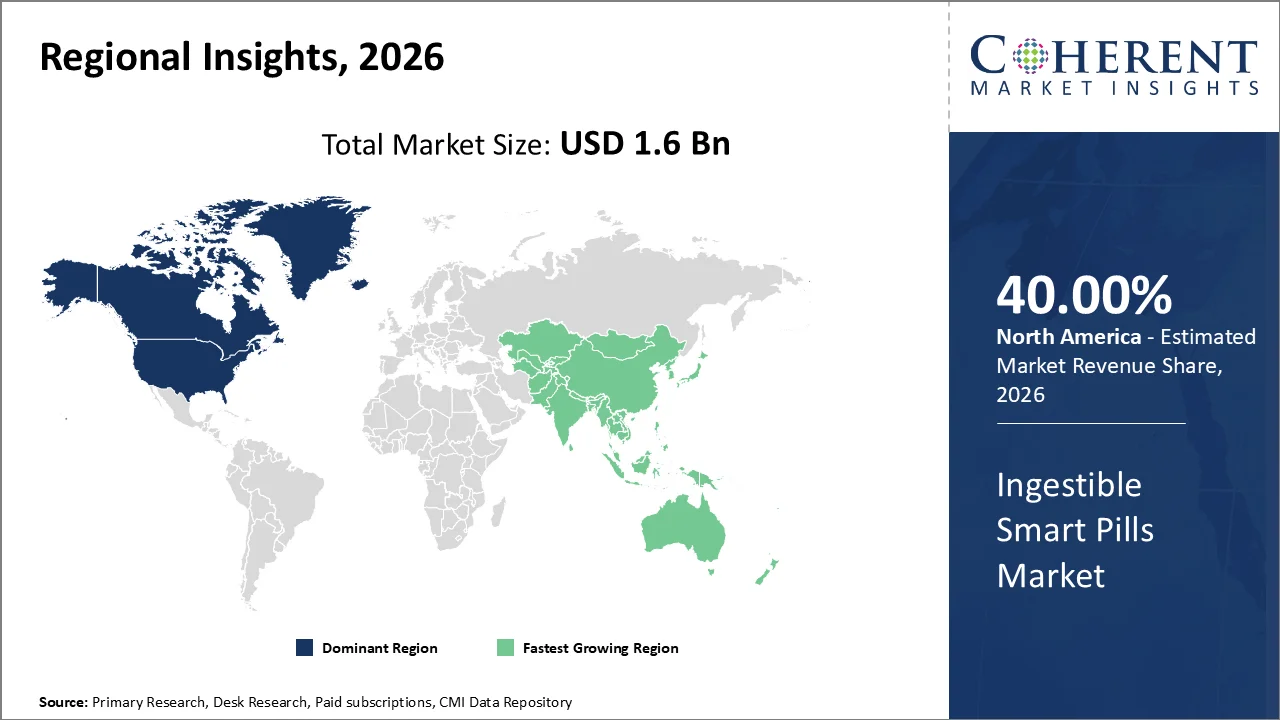
North America Ingestible Smart Pills Market Trends and Outlook
In 2026, North America is projected to hold the largest share of the global ingestible smart pill market, accounting for 40%. The U.S. healthcare system provides significant scale and depth in reimbursement options and has been an early adopter of AI-enabled diagnostic platforms. This trend facilitates the integration of innovative technologies, such as ingestible smart pills, into patient care and drives the expected growth of the market. According to the American Society of Gastrointestinal Endoscopy, over 20 million GI endoscopic procedures are performed each year in the United States, highlighting a significant need for advanced bowel visualization tools. Additionally, the U.S. Office of the National Coordinator reports that by 2025, 76% of hospitals will be using all four measured interoperability domains. As a result, there will be an increasing integration of image-rich capsule diagnostics into standard workflows, driven by the growing acceptance of routine capsule diagnostics.
Asia Pacific Ingestible Smart Pills Market Growth Outlook
The Asia Pacific region is projected to have the highest growth rate in 2026, with a market share of 24.3%. This growth is attributed to a rapidly increasing aging population, which is enhancing both the number of individuals and the capacity of health systems, along with a growing awareness of minimally invasive gastrointestinal (GI) diagnostics. The World Health Organization (WHO) reports that the Western Pacific Region currently has over 245 million people aged 65 and older. According to the United Nations Economic and Social Commission for Asia and the Pacific (ESCAP), 60% of the world's older population resides in the Asia and Pacific Regions. Furthermore, by 2025, individuals aged 65 and over are expected to account for 10.8% of the total population in that region. This demographic trend continues to expand the potential patient population for imaging technologies within smart pills.
Country Analysis
U.S. Ingestible Smart Pills Market Size, Trends, and Innovation Outlook
The United States is the leading market in North America thanks to very high levels of healthcare expenditure combined with a large number of hospitals and a lot of activity related to commercializing various products in the hospital sector.The CMS referenced a next-generation multitarget stool DNA test with a specificity of 93.4% in the proposed 2026 final rule, highlighting the ongoing federal emphasis on promoting non-invasive methods for detecting colorectal cancer. Additionally, the ONC has indicated that certified EHR users must provide standardized APIs for FHIR, thereby facilitating better data exchange for image-rich and advanced diagnostic tools.
China Ingestible Smart Pills Market Growth and Healthcare Demand Outlook
China has the potential to serve as a major growth engine for the Asia-Pacific region due to its large, aging population and improving health-related engagement from the population through the development of health literacy. A report from the National Bureau of Statistics stated that there were 223 million individuals age 65 and older by the end of 2025 and they represent about 15.9% of the overall population of China. According to the National Health Commission, the level of health literacy in China has grown to 33.69% by 2025 and that increase has helped develop greater awareness of the need for screening and have increased acceptance of new noninvasive diagnostic technologies.
Market Report Scope
Ingestible Smart Pills Market Report Coverage
| Report Coverage | Details | ||
|---|---|---|---|
| Base Year: | 2025 | Market Size in 2026: | USD 1.6 Bn |
| Historical Data for: | 2020 To 2024 | Forecast Period: | 2026 To 2033 |
| Forecast Period 2026 to 2033 CAGR: | 5.6% | 2033 Value Projection: | USD 2.3 Bn |
| Geographies covered: |
| ||
| Segments covered: |
| ||
| Companies covered: | BodyCap Medical, Given Imaging Ltd., Olympus Corporation, Proteus Digital Health, Inc., CapsoVision, Inc., Chongqing Jinshan Science and Component (Group) Co., Ltd., Medimetrics, IntroMedic Co., Ltd., Check-Cap Ltd., Boston Scientific Corporation, HQ Inc., Smart Pill Inc., Medtronic plc, Philips Healthcare, etectRx, Inc., Novartis, Siemens Healthcare, Pentax Medical Company (HOYA Corporation), GE Healthcare, and Stryker Corporation. | ||
Who are the Major Companies in Ingestible Smart Pills Market?
Major companies are BodyCap Medical, Given Imaging Ltd., Olympus Corporation, Proteus Digital Health, Inc., CapsoVision, Inc., Chongqing Jinshan Science and Component (Group) Co., Ltd., Medimetrics, IntroMedic Co., Ltd., Check-Cap Ltd., Boston Scientific Corporation, HQ Inc., Smart Pill Inc., Medtronic plc, Philips Healthcare, etectRx, Inc., Novartis, Siemens Healthcare, Pentax Medical Company (HOYA Corporation), GE Healthcare, and Stryker Corporation.
Key News
On June 26, 2025, the University of Maryland announced a significant advancement in ingestible capsule research: a 3D-printed capsule featuring integrated microneedles and a tunable drug reservoir capable of regulating drug release from seconds to months within the gastrointestinal (GI) tract.
Analysts Opinion
- The market for ingestible smart pills is evolving from a niche diagnostic tool into a potentially capacity-relieving solution within a healthcare system that is constrained by limited resources. In England, as of January 31, 2026, there were 1,810,900 patients waiting for essential diagnostic tests. Meanwhile, 2,527,900 tests were conducted in the same month, leading to significant strain on traditional testing pathways. Therefore, it is reasonable to suggest that there will be a preference for capsule-based platforms, as they can reduce unnecessary procedures and facilitate quicker patient triage.
Speak to the analyst
Want personalized insights?
Take the findings above to one of our principal consultants, or have the report rebuilt around the segments, geographies and competitors you actually track.
Market Segmentation
- Global Ingestible Smart Pills Market, By Component (Revenue, USD Bn, 2021-2033)
- Smart Pills
- Patient Monitoring
- Capsule Endoscopy
- Small Bowel Endoscopy
- Esophagus Endoscopy
- Colon Endoscopy
- Workstation
- Smart Pills
- Global Ingestible Smart Pills Market, By Application (Revenue, USD Bn, 2021-2033)
- Imaging
- Monitoring
- Global Ingestible Smart Pills Market, By End User (Revenue, USD Bn, 2021-2033)
- Hospitals
- Clinics
- Research Institutes
- Home Healthcare
- Global Ingestible Smart Pills Market, By Regions (Revenue, USD Bn, 2021-2033)
- North America
- U.S.
- Canada
- Europe
- U.K.
- Germany
- Italy
- France
- Spain
- Russia
- Rest of Europe
- Asia Pacific
- China
- India
- Japan
- ASEAN
- Australia
- South Korea
- Rest of Asia Pacific
- Latin America
- Brazil
- Mexico
- Argentina
- Rest of Latin America
- Middle East
- GCC
- Israel
- Rest of Middle East
- Africa
- North Africa
- Central Africa
- South Africa
- North America
- Key Players:
- BodyCap Medical
- Given Imaging Ltd.
- Olympus Corporation
- Proteus Digital Health, Inc.
- CapsoVision, Inc.
- Chongqing Jinshan Science and Component (Group) Co., Ltd.
- Medimetrics
- IntroMedic Co., Ltd.
- Check-Cap Ltd.
- Boston Scientific Corporation
- HQ Inc.
- Smart Pill Inc.
- Medtronic plc
- Philips Healthcare
- etectRx, Inc.
- Novartis
- Siemens Healthcare
- Pentax Medical Company (HOYA Corporation)
- GE Healthcare
- Stryker Corporation
Sources
Primary Research interviews
- Interviews with gastroenterologists
- Interviews with endoscopy specialists
- Interviews with GI surgeons
- Interviews with hospital procurement managers
- Interviews with capsule endoscopy technology providers
- Interviews with digital health software developers
- Interviews with medical device distributors
- Interviews with regulatory experts
- Interviews with healthcare administrators to assess adoption trends, diagnostic preferences, reimbursement challenges, technology innovation, and competitive positioning
Databases
- U.S. FDA 510(k), De Novo, and PMA Databases
- ClinicalTrials.gov
- PubMed / MEDLINE
- NIH / NLM Databases
- CMS Database
- CDC Data and Statistics
- WHO Global Health Observatory
- World Bank Data
- Eurostat
- SEC Filings Database
Magazines
- Medical Design & Outsourcing
- MD+DI (Medical Design & Development)
- MedTech Dive
- Fierce Biotech
- Healthcare Innovation
Journals’
- Gastrointestinal Endoscopy
- Endoscopy
- Clinical Gastroenterology and Hepatology
- World Journal of Gastroenterology
- United European Gastroenterology Journal
- Diagnostics
Newspapers
- Reuters
- Financial Times
- The Wall Street Journal
- Business Standard
- The Economic Times
Associations
- American Society for Gastrointestinal Endoscopy (ASGE)
- American College of Gastroenterology (ACG)
- American Gastroenterological Association (AGA)
- World Gastroenterology Organisation (WGO)
- United European Gastroenterology (UEG)
- Crohn’s & Colitis Foundation
Public Domain sources
- U.S. Food and Drug Administration (FDA)
- Centers for Disease Control and Prevention (CDC)
- National Institutes of Health (NIH)
- National Institute of Diabetes and Digestive and Kidney Diseases (NIDDK)
- Centers for Medicare & Medicaid Services (CMS)
- World Health Organization (WHO)
- NHS England
- European Commission
- ClinicalTrials.gov
- Company annual reports
- Investor presentations
- Regulatory filings
Proprietary Elements
- CMI Data Analytics Tool
- Proprietary CMI Existing Repository of information for last 8 years
Get access to 250+ pages report
Every segment, forecast, competitor profile and data table behind the analysis above — available for instant download.
- ESOMAR Member
- ISO 9001:2015 Certified
- D-U-N-S Registered
- GDPR & CCPA Compliant
Missing comfort of reading report in your local language? Find your preferred language:
Transform your Strategy with Exclusive Trending Reports
Frequently Asked Questions
The global ingestible smart pills market is valued at US$ 1.6 billion in 2026.
The market is expected to reach approximately US$ 2.3 billion by 2033.
The market is anticipated to grow at a CAGR of 5.6% during the forecast period.
Market growth is being driven by the rising burden of chronic diseases, increasing demand for digital health and remote patient monitoring, and growing adoption of minimally invasive gastrointestinal diagnostic technologies.
The Smart Pills segment dominates the market by component, accounting for 84.8% of the total market share in 2026.
The Imaging segment leads by application with 69.6% market share in 2026, supported by strong demand for non-invasive GI visualization and lesion detection.
The Hospitals segment dominates by end user, accounting for 53.4% of the total market share in 2026.