

Behenyl Alcohol Market Size and Share Analysis: 2026 - 2033
The global behenyl alcohol market size is estimated to reach approximately USD 191 Mn in 2026 and is expected to grow at a CAGR of 3.7% during the forecast period (2026-2033), totaling USD 246.3 Mn by 2033.
Key Takeaways from the Behenyl Alcohol Market Report
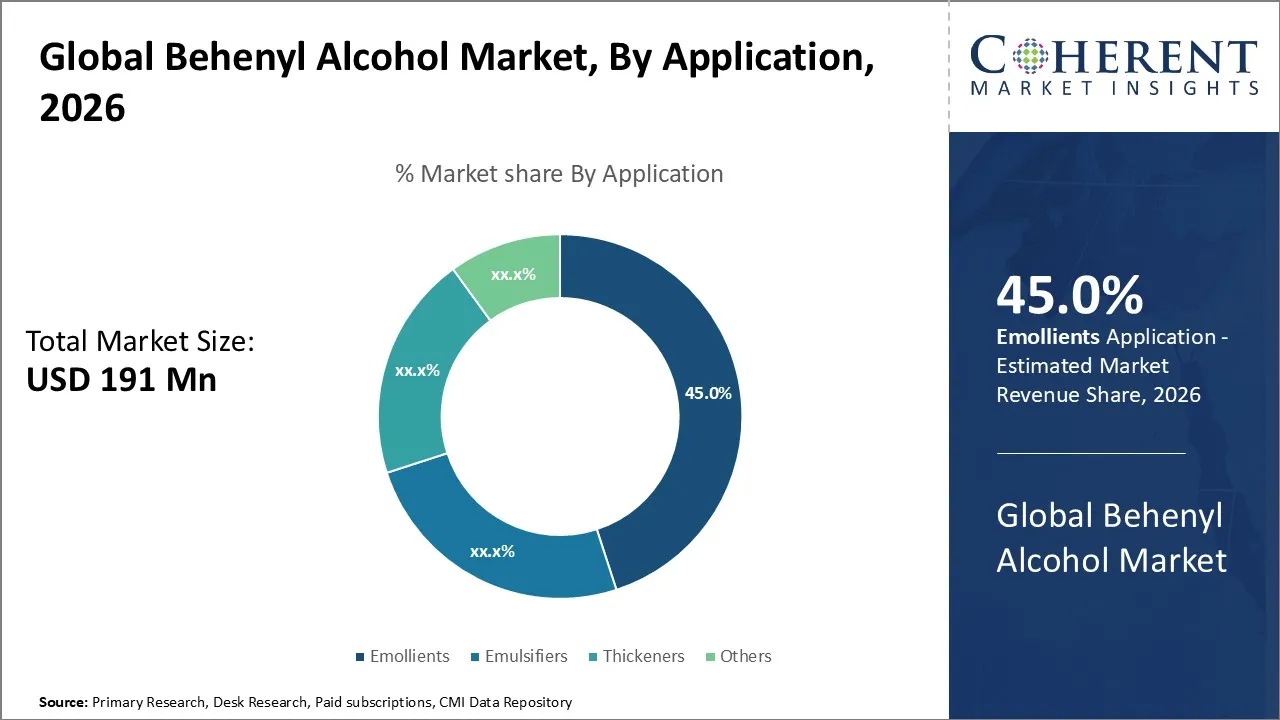
- Based on application, emollients segment is expected to lead the behenyl alcohol industry, accounting for a market share of 45% in 2026, supported by rising cosmetic and personal care product formulations that rely on behenyl alcohol’s skin-softening properties.
- Cosmetics segment is likely to remain the leading end user of behenyl alcohol, accounting for over 51% of the market share in 2026, followed by the pharmaceuticals segment.
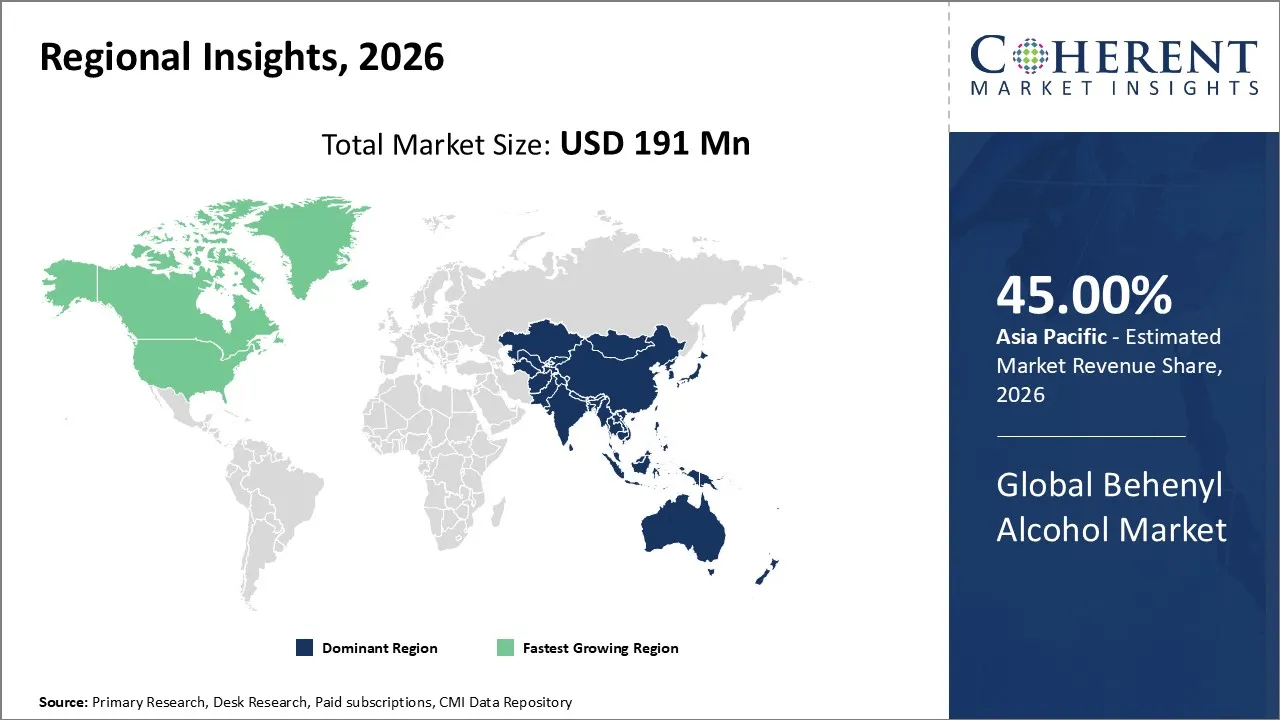
- Asia Pacific is expected to dominate the global market, capturing a share of about 45% in 2026, owing to rising demand in cosmetics and personal care products.
- North America, with an estimated share of 30% in 2026, is poised to emerge as a highly lucrative market for behenyl alcohol manufacturers during the forecast period. This is mostly due to strong demand in premium personal care.
Behenyl Alcohol Market Overview
The global behenyl alcohol market is expected to grow steadily during the forecast period. This is primarily due to rising demand for behenyl alcohol from cosmetics, pharmaceuticals, and other industries. Similarly, growing preference for natural and skin-friendly ingredients in personal care products is fueling adoption of behenyl alcohol as an emollient, thickener, and stabilizer in creams, lotions, and hair care formulations.
Behenyl alcohol, also referred to as 1-docosanol, is a long-chain fatty alcohol (C22) commonly used in cosmetics and personal care products. It functions as a thickener, emulsifier, and opacifying agent. Behenyl alcohol has the tendency to improve the texture and stability of personal care formulations.
According to a review in the International Journal of Cosmetic Science, behenyl alcohol is considered safe for topical applications and is well-tolerated across different skin types. This combination of efficacy, safety, and compatibility with natural product trends is encouraging its widespread use in cosmetic and pharmaceutical products, which drives behenyl alcohol market growth.
Rising investment by major players in research and development of new cosmetics and cosmeceutical products is projected to foster market growth over the forecast period. Players are investing heavily in innovations such as hypoallergenic creams, which have minimal impact on health. Hence, rising investment in the innovation of cosmetic products is projected to boost the market growth of behenyl alcohol over the forecast period.
Current Events and Their Impact on the Behenyl Alcohol Market
Current Event | Description and its Impact |
Cosmetics and Personal Care Industry Evolution |
|
Technological Advancements and Innovation |
|
Segmental Insights
- Current Industry Events of 2026
- Market Size Estimation
- Regional Breakdown
- Competitive Landscape
- Customer Intelligence
- Segmental Analysis
- Pricing Analysis
- Key Market Drivers, Challenges & Future Trends
- Customized Insights Section
Behenyl Alcohol Market Insights, By Application- Emollients Segment Dominates Behenyl Alcohol Applications
Based on application, emollients segment is slated to dominate the global behenyl alcohol industry, with a revenue share of over 45% in 2026. This is mostly due to increasing adoption of behenyl alcohol as an emollient across various industries. Growing demand for natural and effective skin care products is also propelling the use of behenyl alcohol in emollient applications.
Behenyl alcohol is widely used as an emollient in skincare and cosmetic products. Manufacturers increasingly add it to creams, lotions, and hair care formulations due to its ability to improve texture, enhance moisture retention, and provide a smooth, non-greasy feel. This trend is expected to sustain the segment’s leading position in the global behenyl alcohol industry.
Behenyl Alcohol Market Insights, By End User - Behenyl Alcohol Consumption to Remain High in Cosmetics
By end user, cosmetics segment is expected to account for 51% of the global behenyl alcohol market share in 2026. This is mainly due to rising use of behenyl alcohol in a wide variety of cosmetic products.
Behenyl alcohol is commonly used in lotions, creams, conditioners, and other personal care and cosmetics products for its emollient, thickening and stabilizing properties. Its rising importance in cosmetics formulations is boosting segment growth. Furthermore, rising consumer demand for natural and multifunctional ingredients in skin care and beauty products makes cosmetics a dominant segment
Regional Insights
Asia Pacific Remains at the Epicenter of Behenyl Alcohol Market Growth
Asia Pacific is expected to lead the global behenyl alcohol market during the forecast period, accounting for a share of around 45% in 2026. Rapid expansion of the personal care and cosmetics sector and rising demand for emollients and thickening agents in skincare, haircare, and cosmetic formulations are driving this growth.
Nations like China, India, and Japan are witnessing strong growth in beauty and personal care consumption. This is driving higher demand for Behenyl Alcohol as a multifunctional ingredient. In addition, increasing investments by major manufacturers to strengthen production capacity as well as meet regulatory standards are supporting market expansion in the region.
Premium Skincare Trends Propel Behenyl Alcohol Use in North America
North America, led by the U.S., is poised to offer lucrative growth opportunities to behenyl alcohol manufacturers, owing to rising popularity of premium skincare, haircare, and cosmetic products that require high-quality fatty alcohols like Behenyl Alcohol. The region is likely to account for approximately 27% of the global share in 2026.
Consumers in the U.S. and Canada are increasingly seeking products with superior texture, moisturizing properties, and stability. This is boosting use of Behenyl Alcohol in formulations. Moreover, the trend toward clean-label, paraben-free, and natural products encourages manufacturers to adopt Behenyl Alcohol as a safe and effective emulsifier and thickening agent, supporting sustained market growth.
Behenyl Alcohol Market Outlook – Country-wise
China Behenyl Alcohol Market Trends
China remains the most lucrative pocket for manufacturers of behenyl alcohol, driven by the expanding personal care and cosmetics sector. Rising consumer preference for multifunctional emollients and natural-based ingredients is pushing formulators to incorporate Behenyl Alcohol in creams, lotions, and hair care products.
Domestic manufacturers are investing in high-purity Behenyl Alcohol production to meet both quality standards as well as increasing demand for stable, high-viscosity cosmetic formulations. Growth of e-commerce platforms is also allowing niche and premium skincare brands to reach urban and semi-urban consumers more efficiently.
United States Behenyl Alcohol Market Forecast
The U.S. behenyl alcohol market is projected to grow steadily during the forecast period. This is mostly due to innovations in advanced cosmetic and pharmaceutical formulations. Behenyl Alcohol is increasingly used as a thickener, stabilizer, and skin-conditioning agent in luxury creams, sunscreens, and anti-aging products.
Increasing export of cosmetic products is uplifting demand for behenyl alcohol in the U.S. The United States is a major exporter of personal care and cosmetics products. For example, according to the Personal Care Products Council, United States cosmetics and personal care product exports reached around $17 billion in 2024. This is creating a conducive environment for the expansion of behenyl alcohol industry.
Shift towards sustainability is driving interest in natural behenyl alcohol across the U.S. There is a growing preference for bio-based and plant-derived behenyl alcohol. This is expected to play a key role in boosting the United States behenyl alcohol market growth during the forecast period. In addition, rising demand for high-performance drug formulations, including topical and transdermal products, is supporting market expansion in the nation.
Behenyl Alcohol Industry News
- In January 2025, Nikko Chemicals announced the NIKKOL NIKKOSOLVE series of natural solubilizers. These solubilizers are made from 100% natural ingredients and are designed for essential oils and fragrances.
- In August 2025, BASF SE updated its Lanette 22 product line, a behenyl alcohol‑based ingredient used in stable oil‑in‑water emulsions for personal care products. The update improves the performance of the ingredient for global personal care applications.
- In November 2024, BASF and Acies Bio partnered to drive sustainable production of personal and home care ingredients. These companies will look to develop and scale a fermentation technology platform using renewable methanol for the production of fatty alcohols.
Market Report Scope
Behenyl Alcohol Market Report Coverage
| Report Coverage | Details | ||
|---|---|---|---|
| Base Year: | 2025 | Market Size in 2026: | USD 191 Mn |
| Historical Data for: | 2020 To 2024 | Forecast Period: | 2026 To 2033 |
| Forecast Period 2026 to 2033 CAGR: | 3.7% | 2033 Value Projection: | USD 246.3 Mn |
| Geographies covered: |
| ||
| Segments covered: |
| ||
| Companies covered: | BASF SE, Kao Corporation, Godrej Industries, VVF Chemicals, Sasol Ltd, and Nikko Chemicals, Co. Ltd. | ||
| Growth Drivers: |
| ||
| Restraints & Challenges: |
| ||
Behenyl Alcohol Market Drivers
Rising Behenyl Alcohol Demand from Personal Care & Cosmetics
Behenyl alcohol is being increaisngly used as an emollient, thickener, and texture enhancer in skincare, haircare, and cosmetic products. Its ability to improve product feel and stability makes it highly desirable for lotions, creams, conditioners, and premium beauty formulations. Thus, expansion of the personal care and cosmetics industry is expected to boost growth of the behenyl alcohol market during the forecast period.
Shift Towards Natural, Sustainable and Clean-Label Ingredients
There is a rising consumer preference for natural and sustainable ingredients as part of the global clean beauty trend. Behenyl alcohol, often derived from plant oils like rapeseed or coconut, fits this profile as a bio based, ecosystem friendly ingredient. Regulatory emphasis on safer and eco-friendly components in cosmetics and personal care formulations also supports this trend.
Behenyl Alcohol Market Opportunity
Rising Behenyl Alcohol Use in Pharmaceutical and Topical Applications
Behenyl alcohol is widely used in pharmaceutical formulations as a stabilizer, excipient, and thickener in creams, ointments, and topical drug delivery systems. Its compatibility and non-irritating properties are especially valuable in dermatological products.. Thus, expansion of the global pharmaceutical industry is increasing demand for behenyl alcohol and other quality excipients and APIs.
Advances in Behenyl Alcohol Production
Manufacturers in the contemporary world are using advanced manufacturing technologies such as improved hydrogenation and distillation techniques to improve purity, yield, and efficiency. These advancements enable more competitive and consistent product quality. They help expand behenyl alcohol use into premium segments like luxury cosmetics and pharmaceutical grade products.
Analyst Opinion (Expert Opinion)
- The Behenyl Alcohol market is picking up speed, with formulation chemists recognizing how effectively it can be used in both cosmetics and medicine. Behenyl Alcohol is a long-chain fatty alcohol that maintains emulsion stability, providing a velvety texture to the finished product, outperforming even shorter-chain alcohols like cetyl or stearyl in blind sensory tests. In reality, formulation with Behenyl Alcohol at a level of 1-2% can deliver up to 30% greater stability in oil-in-water emulsions compared to traditional thickening agents.
- The increased demand for sensitive-skin, low-irritation, and clean-label products is one of the main factors behind the growth in Behenyl Alcohol usage in cosmetics. In Europe, greater than 65% of new sensitive-skin moisturizers launched in 2024 utilized Behenyl Alcohol as a primary emollient in their formulation, thanks to its non-comedogenic properties and gentle nature on sensitive skin. High-end skincare brands like Shiseido and Kiehl’s are now reformulating their high-end moisturizers and barrier creams to contain Behenyl Alcohol, indicating a significant shift in formulation strategy beyond cost alone.
- In the pharma industry, Behenyl Alcohol is gaining recognition as an excipient that can add stabilization benefits to a formulation. With its high melting point and ability to blend well with both water-based and oil-based systems, it is an excellent candidate for topical ointments or controlled-release products. For example, over 180 million units of dermatologically tested antiviral ointments used in Japan and South Korea now use Behenyl Alcohol as a booster.
- Innovation in the development of multifunctional formulations is also helping Behenyl Alcohol gain traction as a performance booster that can add value to a formulation beyond its use as a thickener. For example, the latest range of serums developed by Estée Lauder in Asia now use Behenyl Alcohol as a booster that can add long-term emulsion stability to complex oil-water emulsion formulations.
- The use of sustainable sources is also an important differentiating factor for Behenyl Alcohol. About 78% of the world’s Behenyl Alcohol is derived from plant oils such as rapeseed or coconut oil, giving it the ability to make “clean label” claims. This trend is especially prominent in the Asia-Pacific region, where premium skincare launches are now using “plant-derived” fatty alcohol as a key differentiating factor.
Speak to the analyst
Want personalized insights?
Take the findings above to one of our principal consultants, or have the report rebuilt around the segments, geographies and competitors you actually track.
Market Segmentation
- By Application Insights ( Revenue, USD Mn, 2020 - 2033)
- Emollients
- Emulsifiers
- Thickeners
- Others
- By End User Insights ( Revenue, USD Mn, 2020 - 2033)
- Cosmetics
- Pharmaceuticals
- Nutritional Supplements
- By Region Insights ( Revenue, USD Mn, 2020 - 2033)
- North America
- U.S.
- Canada
- Latin America
- Brazil
- Argentina
- Mexico
- Rest of Latin America
- Europe
- Germany
- U.K.
- Spain
- France
- Italy
- Russia
- Rest of Europe
- Asia Pacific
- China
- India
- Japan
- Australia
- South Korea
- ASEAN
- Rest of Asia Pacific
- Middle East & Africa
- GCC Countries
- Israel
- Rest of Middle East & Africa
- North America
- Key Players
- BASF SE
- Kao Corporation
- Godrej Industries
- VVF Chemicals
- Sasol Ltd
- Nikko Chemicals, Co. Ltd.
Sources
Primary Research interviews
- Industry experts
- Chemical manufacturers
- Distributors and suppliers involved in fatty alcohols and specialty chemicals.
Databases
- PubChem
- ChemSpider
- UN Comtrade (for trade and export-import data)
- FAOSTAT (for agricultural feedstock data relevant to fatty alcohols)
Magazines
- Chemical & Engineering News
- ICIS Chemical Business
- European Chemical News
- Specialty Chemicals Magazine
Journals
- Journal of Surfactants and Detergents
- Journal of Industrial and Engineering Chemistry
- International Journal of Cosmetic Science
- Journal of the American Oil Chemists’ Society
Newspapers
- The Chemical Daily
- The Financial Times (Chemicals Section)
- The Hindu Business Line (Industry Section)
- The Economic Times (Commodities & Chemicals)
Associations
- American Chemical Society (ACS)
- European Chemical Industry Council (Cefic)
- The Soap and Detergent Association
- International Fatty Alcohol & Derivatives Association
Public Domain sources
- World Health Organization (WHO) publications
- United Nations Industrial Development Organization (UNIDO) reports
- Government trade and industrial statistics portals
- Patent databases (e.g., WIPO, USPTO)
Proprietary Elements
- CMI Data Analytics Tool
- Proprietary CMI Existing Repository of information for last 8 years
Get access to 250+ pages report
Every segment, forecast, competitor profile and data table behind the analysis above — available for instant download.
- ESOMAR Member
- ISO 9001:2015 Certified
- D-U-N-S Registered
- GDPR & CCPA Compliant
Missing comfort of reading report in your local language? Find your preferred language:
Transform your Strategy with Exclusive Trending Reports
Frequently Asked Questions
The global market is estimated to be valued at USD 191 Mn in 2026.
The global Behenyl Alcohol Market value is expected to surpass USD 246.3 Mn by 2033.
The global market is poised to exhibit a CAGR of 3.7% from 2026 to 2033.
Major growth factors include growing market of personal care products and increasing demand for organic cosmetic products.
High cost of behenyl alcohol products.
BASF SE, Kao Corporation, Godrej Industries, VVF Chemicals, Sasol Ltd, and Nikko Chemicals, Co. Ltd. are the major players
Asia Pacific is expected to lead the global market during the forecast period.