

Stairlifts Market Size and Share Analysis - Growth Trends and Forecast (2026 - 2033)
The global stairlifts market size is estimated to total approximately USD 1,160.0 Mn in 2026 and is projected to grow at a compound annual growth rate (CAGR) of 6.2% during the forecast period (2026-2033), reaching USD 1,770 Mn by 2033. This is attributable to increasing aging population worldwide and rising demand for mobility solutions.
Key Takeaways from the Stairlifts Market Report
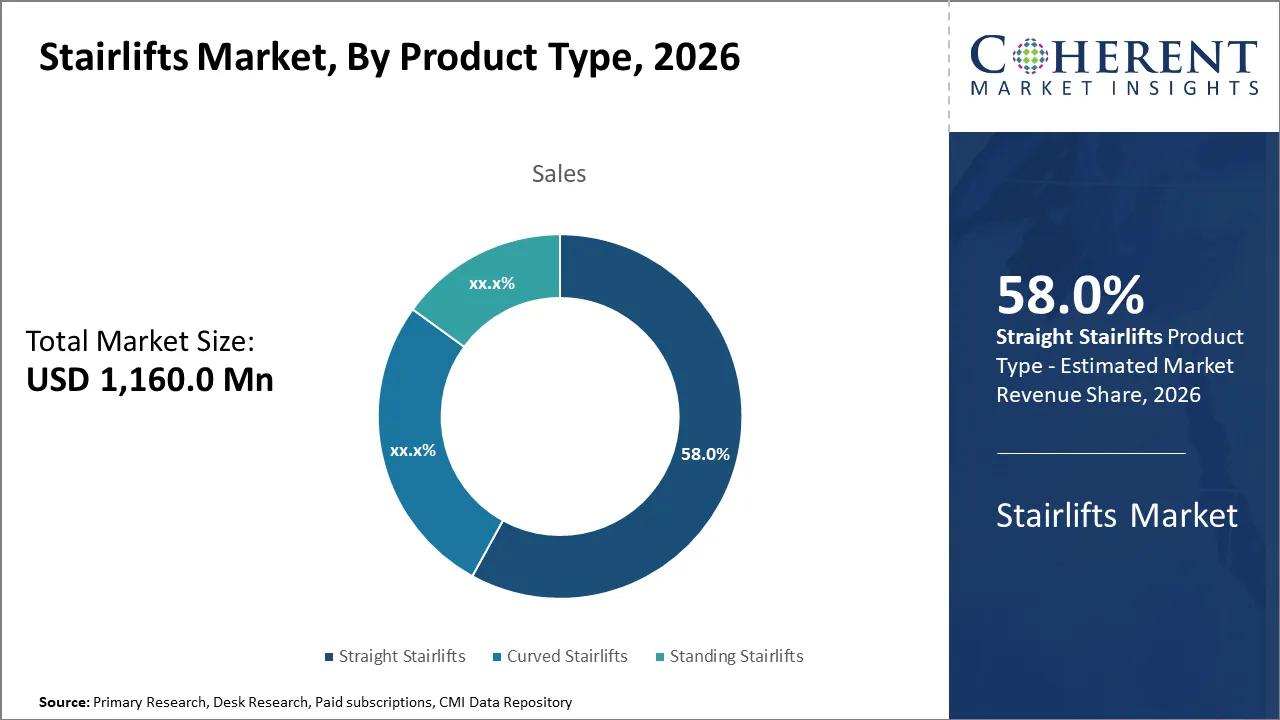
- Straight stairlifts are expected to remain the most sought-after product type, accounting for a revenue share of 58% in 2026, thanks to their cost-effectiveness and standardized installation needs.
- Based on modality type, indoor segment is slated to dominate the market with a share of over 75% in 2026, as a result of growing demand for home accessibility solutions, increasing aging population, and preference for convenient and safe indoor mobility aids.
- By end user, home care settings segment is likely to account for 65% of the global stairlifts market share in 2026, owing to rising awareness about aging-in-place growing preference for independent living solutions.
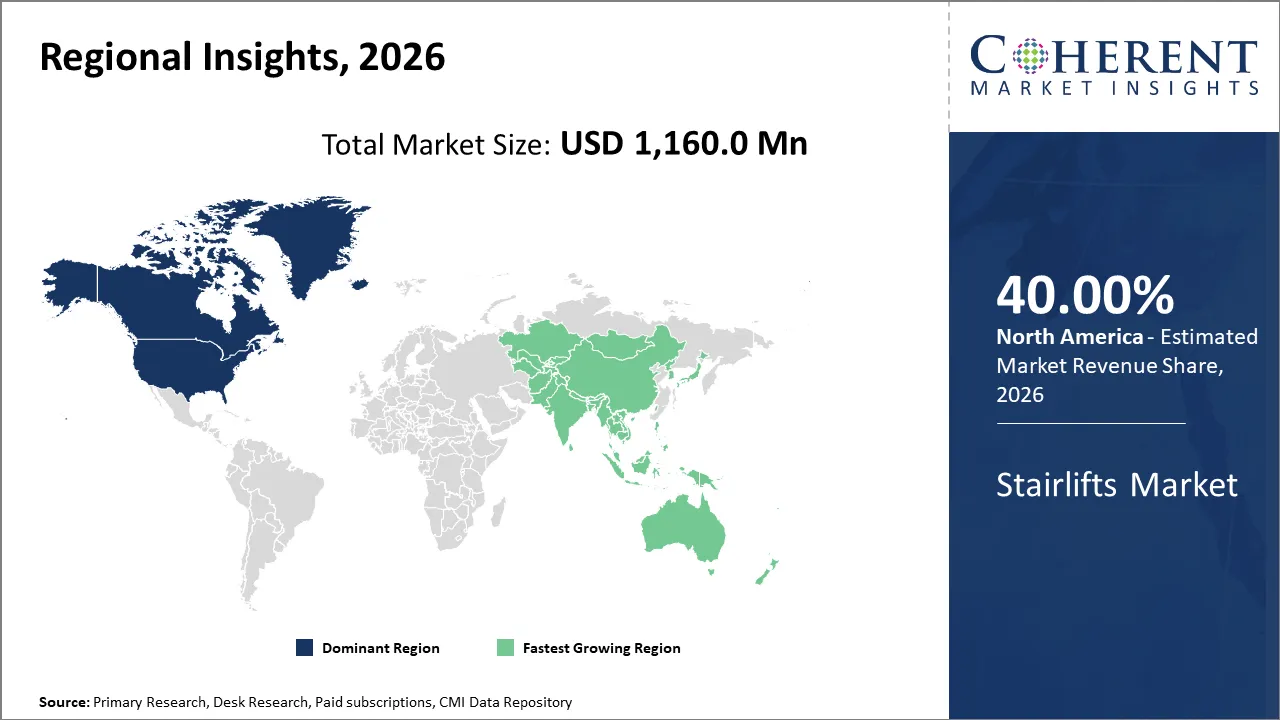
- North America is likely to retain its dominance over the global stairlifts industry, capturing a share of 40% in 2026, mostly due to increasing adoption of advanced mobility aids like smart stairlifts wih remote control, well-established healthcare infrastructure, and favorable reimbursement policies for accessibility devices.
- Asia pacific, with a share of 20% in 2026, is poised to emerge as the most lucrative market for stairlift manufacturers during the forecast period because of rising elderly population, accessibility investments, and increasing popularity of electric stairlifts.
Stairlifts Market Overview
The global stairlifts market is expected to grow steadily during the forecast period. This is mostly due to increasing geriatric population, rising prevalence of mobility impairments, growing awareness about home accessibility solutions, and advancements in stairlift technology that enhance safety, convenience, and comfort for users. In addition, rising interest in eco-friendly stairlifts is supporting market expansion.
Stairlifts, also called chair lifts or stair gliders, are mechanical devices that help people with mobility impairments move up and down stairs. A stairlift has an electrically powered seat and is available for both straight and curved staircases. They can also be customized to meet individual needs. They can also be customized according to specific requirements. In particular, stairlifts are installed for individuals with physical disabilities or those suffering from musculoskeletal disorders related to aging.
Rising prevalence of musculoskeletal disorders is expected to boost stairlifts market growth over the forecast period. According to the World Health Organization (WHO), about 1.71 billion people suffer from musculoskeletal conditions, such as fractures, back pain, osteoarthritis, rheumatoid arthritis, neck pain, and more. This large number of cases is likely to increase the demand for stairlifts during the forecast period.
Current Events and Their Impact on the Stairlifts Market
Current Event | Description and its Impact |
Global Demographic Shift and Aging Population Trends |
|
Technological Innovation and Smart Home Integration |
|
Segmental Insights
- Current Industry Events of 2026
- Market Size Estimation
- Regional Breakdown
- Competitive Landscape
- Customer Intelligence
- Segmental Analysis
- Pricing Analysis
- Key Market Drivers, Challenges & Future Trends
- Customized Insights Section
Which is The Top-Selling Product Type in the Stairlifts Market?
Straight Stairlifts Retain Top Spot in Global Market
According to Coherent Market Insights, straight stairlifts continue to dominate the market, accounting for 58% of the total revenue share in 2026. Straight stairlifts are being increasingly adopted in health care facilities and home care settings because of their cost-effectiveness and standardized install needs.
Straight stairlifts are being preferred because they offer a simpler, more cost‑effective solution with standardized designs that can be installed quickly and easily for most straight staircases. They require less customization and maintenance than curved models and appeal to a broad residential base due to their affordability and straightforward operation. On the other hand, the curved stairlifts segment is expected to grow at a higher CAGR due to rising demand for customized solutions that fit complex staircase designs, multi-level homes, and other architectural constraints.
Who is the Leading End User for Stairlifts?
Stairlift Adoption to Remain High in Home Care Settings
Based on end user, stairlift demand is anticipated to remain high in home care settings, accounting for a market share of 65% in 2026. This is mostly due to growing preference for aging in place, where seniors and individuals with mobility challenges choose to remain in their own homes rather than relocate to assisted living facilities.
The convenience, customization, and cost‑effectiveness of stairlift installations make them a great choice for homeowners looking to improve safety and independence. Healthcare providers, occupational therapists, and home care agencies are also recommending stairlifts more often as part of complete mobility support plans. This is helping to boost stairlift sales.
Regional Insights
North America Leads in Stairlift Adoption Globally
North America is expected to retain its dominance over the global stairlifts market during the forecast period. This growth is mostly because of its growing elderly population and high demand for home accessibility solutions. The region is projected to hold around 40% share of the global market in 2026.
Many seniors in the United States and Canada prefer to age in place rather than move to assisted living. This, in turn, is boosting stairlift adoption in residential homes and assisted care facilities. Well-established distribution networks and professional installation services also make it easier for buyers to choose customized stairlift systems that fit their home layouts.
Asia Pacific Becoming a Central Hub for Industry Players
Asia Pacific is anticipated to emerge as the most lucrative market for manufacturers of stairlifts during the forecast period. This can be attributed to rapid urbanization, rising disposable incomes, and increasing awareness of mobility aids among consumers in countries like Japan, China, and Australia. The region is set hold a global market share of 20% in 2026.
As more older adults live in multi-generational homes and urban apartments, there is a growing need for stair accessibility solutions that help them move safely between floors. Governments and healthcare providers in the region are also increasing their focus on elder care and home modification support. This, in turn, is driving stairlift installations not just in private houses but also in healthcare facilities.
Stairlifts Market Outlook – Country-wise
U.S. Stairlifts Market Trends
Sales of stairlifts in the U.S. are expected to grow steadily during the assessment period, thanks to rising geriatric population and increasing prevalence of mobility impairments such as arthritis and osteoporosis. In addition, more consumers are choosing home-based care solutions, helping elderly individuals stay independent. Advancements in stairlift technology, such as compact designs, automated safety features, and smart connectivity, are also increasing their use.
China Stairlifts Market Forecast
The stairlifts industry in China is poised to witness fastest growth during the forecast period as a result of rising awareness about elderly care and rapidly expanding aging population. Increasing demand for home healthcare solutions and residential accessibility improvements is fueling sales of stairlifts in the nation. Moreover, technological advancements, such as energy-efficient stairlifts with safety automation, are gaining traction. Government initiatives promoting accessibility in public and private spaces, along with financial support programs for senior citizens, are also supporting market expansion.
Stairlifts Industry News
- In September 2025, Stannah announced the launch of its new stairlift model, the 158. The 158 features a redesigned forward‑facing seat and enhanced comfort and safety features for everyday use.
- In May 2025, TK Elevator launched Innovative Light Assist, a new lighting feature for its stairlifts. This feature automatically lights up the seat and footrest when the stairlift is in use to help users see clearly and safely.
- In June 2023, Harmar Mobility launched the new UP Stairlift in the U.S. The UP Stairlift is designed for curved staircases and allows faster installation using modular components.
Market Report Scope
Stairlifts Market Report Coverage
| Report Coverage | Details | ||
|---|---|---|---|
| Base Year: | 2025 | Market Size in 2026: | USD 1,160.0 Mn |
| Historical Data for: | 2020 To 2024 | Forecast Period: | 2026 To 2033 |
| Forecast Period 2026 to 2033 CAGR: | 6.2% | 2033 Value Projection: | USD 1,770 Mn |
| Geographies covered: |
| ||
| Segments covered: |
| ||
| Companies covered: | Acorn Stairlifts, Bruno Independent Living Aids, Stannah Stairlifts Ltd., Inc., Handicare Group AB, Otolift Stairlifts Ltd., Prism U.K. Medical Limited, Platinum Stair Lifts Ltd., Kumalift Co., Ltd., Symax Lift (China) Co, Ltd, Taamal Seed Electra Group, Savaria Corp, Lehner Lifttechnik GmbH, Thyssenkrupp AG. | ||
| Growth Drivers: |
| ||
| Restraints & Challenges: |
| ||
Stairlifts Market Drivers
Rising Geriatric Population Globally
Increasing aging population is providing a strong impetus for the growth of the stairlifts market. According to the World Health Organization, the global population aged 80 years and above is projected to reach 426 million by 2050. This is expected to drive demand for mobility solutions like stairlifts. As people age, mobility challenges, especially with stair navigation, become more common, thereby boosting demand for stairlifts that enable safer movement within multistory homes and facilities.
Increasing Prevalence of Mobility Impairments and Chronic Conditions
Cases of mobility related conditions like osteoarthritis, osteoporosis, obesity, stroke, and other physical disabilities are increasing significantly. This, in turn, is encouraging adoption of stairlifts. These conditions often make stair climbing difficult or risky, increasing reliance on stairlift solutions.
Stairlifts Market Trends
Technological Advancements in Stairlifts
There is a rising trend towards integrating smart technologies in stairlifts. Companies are incorporating smart sensors and obstacle detection systems, remote controls or smartphone connectivity, enhanced safety features, diagnostics, battery backup, and energy-efficient components into their solutions. These improvements enhance reliability, safety, and the overall user experience, attracting more customers. They are expected to drive growth in the stairlifts market during the forthcoming period.
Growing Popularity of Customized Stairlifts
The trend toward customization is gaining traction in the global stairlifts market. Demand is rising for tailored solutions, including curved stairlifts for non-standard staircases, outdoor models, and compact designs, as architectural styles and user needs become more diverse. This shift is expected to create new revenue opportunities for stairlift manufacturers in the coming years.
Stairlifts Market Opportunities
Rising Adoption of Home Care
The shift towards home-based healthcare is creating significant growth opportunities for the stairlifts market. Increasing adoption of home healthcare services and expansion of assisted-living environments are driving higher deployment of stairlifts in both residential and clinical settings, supporting mobility for patients and the elderly.
Government Initiatives and Accessibility Regulations
Government policies and accessibility regulations are creating new opportunities in the stairlifts market. Many nations are promoting more inclusive homes and products, which encourages people to install stairlifts and other mobility-supporting equipment. For example, India’s Department of Empowerment of Persons with Disabilities has proposed new accessibility standards for everyday products and home aids, including suggestions for subsidies and tax breaks to make them more affordable for people with disabilities.
Analyst Opinion (Expert Opinion)
- Hospital fall reports show that 30–40% of stair‑related injuries among seniors result in fractures or head trauma, and stair mobility devices are increasingly flagged in incident reviews for poor ergonomics or installation errors. In response, manufacturers who retrofitted rail stiffness and lowered entry thresholds saw warranty claims fall by ~25% within 12–18 months — a powerful metric no buyer can ignore when comparing legacy products with next‑generation designs.
- Independent living assessments indicate that perceived confidence gains correlate directly with long‑term device use: seniors with higher initial trust in their stairlift reported 2× fewer assistance requests from caregivers over six months. This matters because churn — i.e., getting the lift installed and then replacing/discontinuing it — is expensive. Vendors emphasizing secure seating, intuitive controls, and audible feedback are consistently outperforming competitors focused solely on cost or design novelty.
- Service reliability is now a competitive differentiator. Warranty repair logs from multiple service providers show that ~60% of after‑sales service calls are due to alignment and remote calibration issues. Companies that bundle annual preventive maintenance and remote diagnostics have seen service calls drop by 40–50% compared with those offering only reactive support. In practice, buyers are increasingly willing to pay for guaranteed uptime — because a non‑functional stairlift effectively eliminates mobility independence.
- Integration with smart‑home ecosystems is no longer aspirational — it’s expected. Early adopters in aging‑in‑place communities show that stairlift units with connectivity (e.g., app alerts for caregiver monitoring) have 30–35% higher daily engagement rates versus standalone models. For families managing elder care at a distance, the ability to track usage patterns and receive maintenance alerts isn’t a luxury; it’s becoming a baseline requirement — especially as insurers and care networks begin tying reimbursement or recommendations to measurable adherence and safety metrics.
Speak to the analyst
Want personalized insights?
Take the findings above to one of our principal consultants, or have the report rebuilt around the segments, geographies and competitors you actually track.
Market Segmentation
- By Product Type Insights (Revenue, USD Mn, 2020 - 2033)
- Straight Stairlifts
- Curved Stairlifts
- Standing Stairlifts
- By Modality Type Insights (Revenue, USD Mn, 2020 - 2033)
- Indoor
- Outdoor
- By Operation Mode (Revenue, USD Mn, 2020 - 2033)
- Alternating Current
- Direct Current
- By End User Insights (Revenue, USD Mn, 2020 - 2033)
- Health Care Facilities
- Home Care Settings
- Others
- By Region Insights (Revenue, USD Mn, 2020 - 2033)
- North America
- U.S.
- Canada
- Latin America
- Brazil
- Argentina
- Mexico
- Rest of Latin America
- Europe
- Germany
- U.K.
- Spain
- France
- Italy
- Russia
- Rest of Europe
- Asia Pacific
- China
- India
- Japan
- Australia
- South Korea
- ASEAN
- Rest of Asia Pacific
- Middle East & Africa
- GCC Countries
- Israel
- Rest of Middle East & Africa
- North America
- Key Players in the Stairlifts Market
- Acorn Stairlifts
- Bruno Independent Living Aids
- Stannah Stairlifts Ltd., Inc.
- Handicare Group AB
- Otolift Stairlifts Ltd.
- Prism U.K. Medical Limited
- Platinum Stair Lifts Ltd.
- Kumalift Co., Ltd.
- Symax Lift (China) Co, Ltd
- Taamal Seed Electra Group
- Savaria Corp
- Lehner Lifttechnik GmbH
- Thyssenkrupp AG
Sources
Primary Research interviews
- Manufacturers of stairlifts
- Distributors and dealers of mobility aids
- Healthcare professionals specializing in elderly care
- Occupational therapists and rehabilitation centers
- End-users/patients using stairlifts
Databases
- Statista
- World Bank Open Data
- UN Data
- OECD Data
- PubMed
Magazines
- Home Care Magazine
- Mobility Management
- Healthcare Design Magazine
Journals
- Journal of Rehabilitation Research and Development
- Disability and Rehabilitation: Assistive Technology
- Geriatrics & Gerontology International
Newspapers
- The Guardian
- The New York Times
- The Times of India
Associations
- American Society of Mechanical Engineers (ASME) – Accessibility Division
- European Platform for Rehabilitation (EPR)
- National Institute on Aging (NIA)
- Assistive Technology Industry Association (ATIA)
Public Domain sources
- World Health Organization (WHO) Reports
- US Centers for Disease Control and Prevention (CDC) – Aging & Mobility
- European Commission – Disability & Accessibility
- National Health Service (NHS) – Mobility & Accessibility Guidelines
Proprietary Elements
- CMI Data Analytics Tool
- Proprietary CMI Existing Repository of information for last 8 years
Get access to 250+ pages report
Every segment, forecast, competitor profile and data table behind the analysis above — available for instant download.
- ESOMAR Member
- ISO 9001:2015 Certified
- D-U-N-S Registered
- GDPR & CCPA Compliant
Missing comfort of reading report in your local language? Find your preferred language:
Transform your Strategy with Exclusive Trending Reports
Frequently Asked Questions
The global market is estimated to be valued at USD 1,160.0 Mn in 2026.
The global Stairlifts Market value is expected to reach USD 1,770 Mn by 2033.
The global market is poised to exhibit a CAGR of 6.2% from 2026 to 2033.
Major growth factors include increasing prevalence of musculoskeletal disorders and growing geriatric population.
High cost of advanced stairlifts is slowing down market growth.
Straight stairlifts, with about 58% market share in 2026, remain the top-selling product category.
Some major companies in the Stairlifts Market include Acorn Stairlifts, Bruno Independent Living Aids, Stannah Stairlifts Ltd., Inc., Handicare Group AB, Otolift Stairlifts Ltd., Prism U.K. Medical Limited, Platinum Stair Lifts Ltd., Kumalift Co., Ltd., Symax Lift (China) Co, Ltd, Taamal Seed Electra Group, Savaria Corp, Lehner Lifttechnik GmbH, Thyssenkrupp AG.