Burn Care Market Analysis & Forecast: 2026-2033
The Burn Care Market is estimated to be valued at USD 2,808.1 Mn in 2026 and is expected to reach USD 5,227.8 Mn by 2033, exhibiting a compound annual growth rate (CAGR) of 9.8% from 2026 to 2033.
The Burn Care Market is rapidly evolving within the global healthcare industry as the rising incidence of burn injuries drives demand for advanced wound management solutions. Companies offer a broad range of products, including specialized dressings, topical agents, bioengineered skin substitutes, and therapeutic devices, to enhance healing and reduce complications. Technological advancements, expanding healthcare infrastructure, and increased awareness actively fuel market growth, while hospitals and specialized burn centers play a central role in delivering effective burn care to patients.
|
Current Events |
Description and its impact |
|
Geopolitical and Conflict-Related Events |
|
|
Technological Advancements and Innovations |
|
|
Epidemiological and Environmental Factors |
|
Uncover macros and micros vetted on 75+ parameters: Get instant access to report
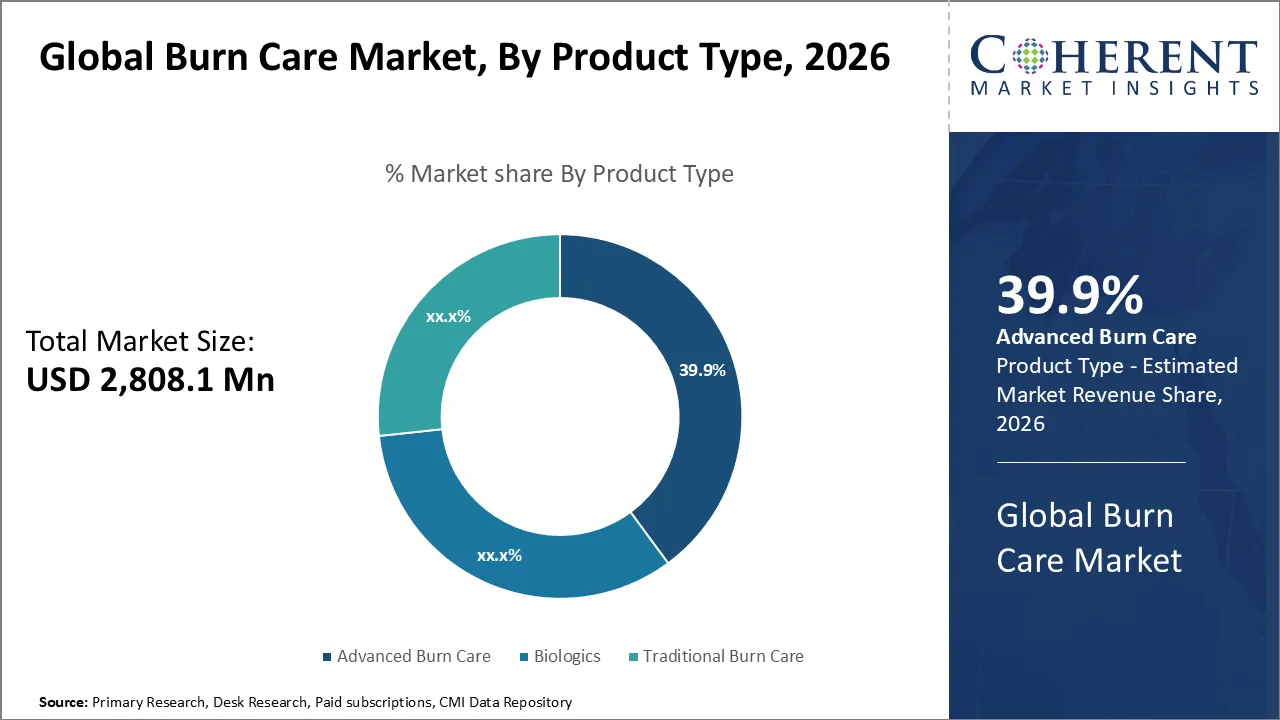
Advanced Burn Care hold the largest market share of 39.9% in 2026. The Burn Care Market is expanding as severe burn injuries become more prevalent, creating a strong demand for faster and more effective treatments. Healthcare providers increasingly adopt innovations like bioengineered skin substitutes, antimicrobial and hydrogel dressings, and regenerative therapies to enhance recovery and reduce complications. Growing awareness among medical professionals and patients, coupled with expanding hospital infrastructure and supportive healthcare policies, actively promotes the use of these solutions. A focus on improving both functional and cosmetic outcomes further stimulates demand for advanced burn care technologies. For instance, in February 2025, AIIMS-Bhubaneswar collaborated with Royal Adelaide Hospital, Australia, to enhance burn care through research, innovation, and new techniques, with RAH burn specialist Dr. Marcus Wagstaff visiting the institute to support the collaboration.
Second-Degree expected to hold largest market share of 45.5% in 2026. The Burn Care Market sees growing demand for second-degree burn treatments as partial-thickness burns occur frequently and require prompt, specialized medical attention. Healthcare providers increasingly use advanced wound dressings, topical therapies, and regenerative treatments to speed healing, prevent infections, and minimize scarring. Hospitals and specialized clinics actively follow structured treatment protocols, while rising awareness among medical professionals and patients encourages early intervention. The focus on effective, comfortable, and cosmetically favorable solutions drives wider adoption of products designed for second-degree burns. For instance, the FDA has cleared InnovaBurn, a placental extracellular matrix device by Convatec, as the first of its kind to treat second-degree burns.
Hospitals acquired the prominent market share of 42.2% in 2026. Hospitals actively propel the Burn Care Market by treating moderate to severe burn injuries that demand specialized care. With dedicated burn units, advanced surgical facilities, and multidisciplinary teams, they deliver comprehensive care from emergency treatment to rehabilitation. Medical centers increasingly implement advanced wound care products, bioengineered skin substitutes, and therapeutic technologies to enhance patient outcomes. By managing high patient volumes, following structured treatment protocols, and integrating innovative therapies, hospitals play a central role in driving growth and expanding the burn care market. For instance, in November 2025, Ahl Masr Burn Hospital launched the Middle East’s first international scientific conference focused on burn care, scheduled for 26–27 November in Cairo, establishing Egypt as a regional hub for advanced burn management and medical education.
To learn more about this report, Request Free Sample
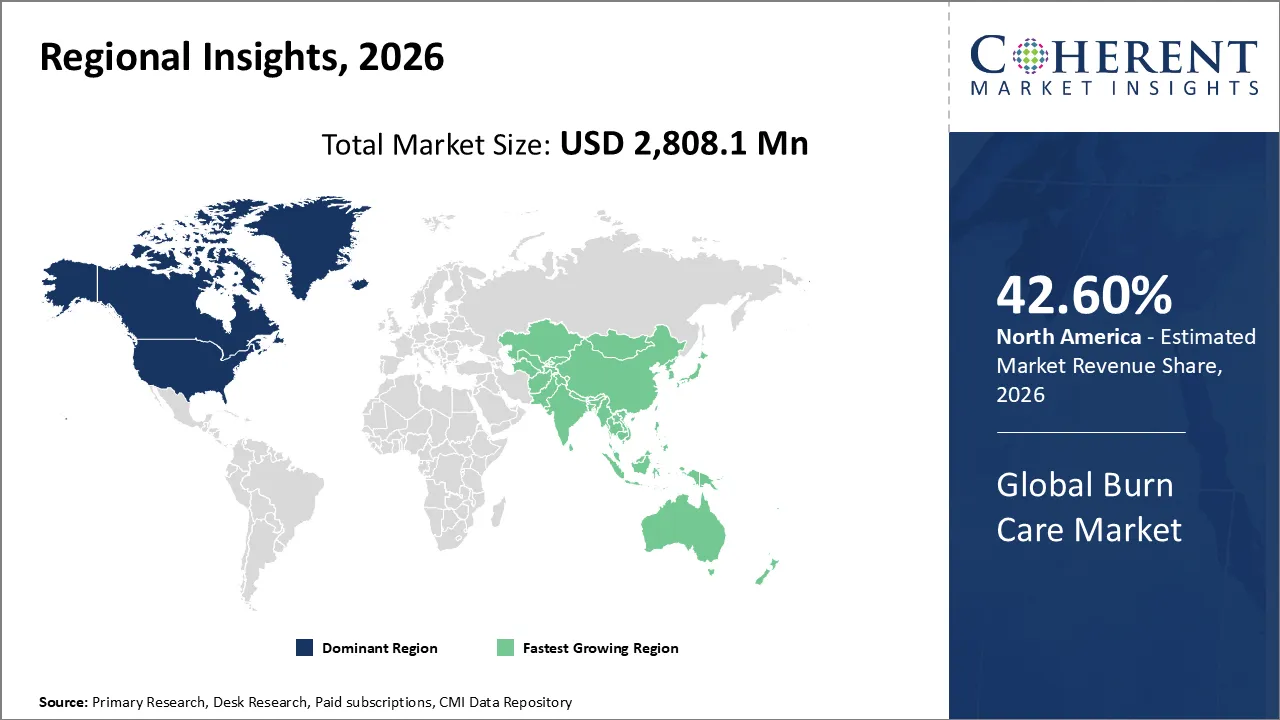
North America dominates the overall market with an estimated share of 48.4% in 2026. Technological innovations and the growing use of advanced wound care solutions are actively transforming the North America Burn Care Market. Hospitals and specialized burn centers increasingly adopt bioengineered skin substitutes, hydrogel and antimicrobial dressings, and regenerative therapies to speed recovery and minimize complications. Healthcare professionals and patients drive early intervention through rising awareness, while robust healthcare infrastructure and supportive policies ensure access to high-quality treatments. A strong focus on enhancing both functional and cosmetic outcomes continues to guide product development and stimulate market demand across the region. For instance, in October 2025, KK Women’s and Children’s Hospital (KKH), which treats around 400 new pediatric burn cases annually, has launched Singapore’s first dedicated paediatric Burn Centre to provide faster and more integrated care.
Rising burn incidences and increased investment in healthcare infrastructure are actively driving the growth of the Asia Pacific Burn Care Market. Hospitals and clinics are progressively adopting advanced wound care solutions, such as hydrogel dressings, antimicrobial therapies, and bioengineered skin substitutes, to improve treatment outcomes. Healthcare professionals and patients are promoting early intervention and effective burn management through growing awareness. Governments are supporting initiatives to enhance healthcare access, while the emphasis on functional recovery and cosmetic results continues to boost demand for innovative burn care products across the region. For instance, in June 2024, Army Hospital (Research & Referral), New Delhi, opened a state-of-the-art skin bank—the first within the Armed Forces Medical Services—to advance treatment of severe burns and other skin conditions for service members and their families.
Hospitals and specialized burn centers are actively shaping the evolution of the United States Burn Care Market by adopting advanced treatment solutions that enhance patient outcomes. Healthcare providers increasingly implement bioengineered skin substitutes, hydrogel and antimicrobial dressings, and regenerative therapies to speed healing and minimize complications. Growing awareness among medical professionals and patients promotes early intervention, while robust healthcare infrastructure and supportive insurance coverage ensure access to quality care. The emphasis on functional recovery and cosmetic improvement continues to drive innovation and market demand across the U.S.
Rising burn incidences and increased healthcare investments are actively driving the growth of the India Burn Care Market. Hospitals and clinics are increasingly adopting modern wound care products, such as hydrogel and antimicrobial dressings, bioengineered skin substitutes, and regenerative therapies, to accelerate healing and minimize complications. Healthcare providers and patients are promoting timely intervention through growing awareness, while government initiatives and expanding healthcare access support treatment adoption. The focus on functional recovery, scar reduction, and cosmetic improvement continues to boost demand for innovative burn care solutions across India. For instance, in December 2025, Kerala began skin processing at its first skin bank, established at the Government Medical College in Thiruvananthapuram, to improve treatment outcomes for patients with severe burns and extensive skin loss.
Healthcare providers are increasingly integrating advanced wound care solutions, such as hydrogel and foam dressings, antimicrobial treatments, and bioengineered skin substitutes, to improve healing outcomes. Innovations focus on accelerating recovery, reducing infections, and minimizing scarring. Hospitals and specialized burn centers actively implement these solutions, while research in regenerative therapies continues to expand product capabilities, reflecting a market trend toward technologically advanced, patient-centric burn care approaches.
Modern burn care emphasizes not only survival and healing but also restoring skin functionality and aesthetic appearance. Clinicians prioritize treatments that reduce scarring, enhance mobility, and support long-term quality of life. This trend drives the adoption of regenerative therapies, skin substitutes, and scar management solutions, reflecting a shift in the market from basic wound closure to comprehensive recovery that addresses both physical and psychological patient needs.
| Report Coverage | Details | ||
|---|---|---|---|
| Base Year: | 2025 | Market Size in 2026: | USD 2,808.1 Mn |
| Historical Data for: | 2020 To 2024 | Forecast Period: | 2026 To 2033 |
| Forecast Period 2026 to 2033 CAGR: | 9.8% | 2033 Value Projection: | USD 5,227.8 Mn |
| Geographies covered: |
|
||
| Segments covered: |
|
||
| Companies covered: |
Smith & Nephew Plc. Molnlycke, ConvaTec Inc., Integra LifeSciences Corporation, 3M, Coloplast A/S, Cardinal Health, Inc., DeRoyal Industries, Inc., Acelity LP, and Svenska Cellulosa Aktiebolaget (SCA) |
||
| Growth Drivers: |
|
||
| Restraints & Challenges: |
|
||
Uncover macros and micros vetted on 75+ parameters: Get instant access to report
Share
Share
Komal Dighe is a Management Consultant with over 8 years of experience in market research and consulting. She excels in managing and delivering high-quality insights and solutions in Health-tech Consulting reports. Her expertise encompasses conducting both primary and secondary research, effectively addressing client requirements, and excelling in market estimation and forecast. Her comprehensive approach ensures that clients receive thorough and accurate analyses, enabling them to make informed decisions and capitalize on market opportunities.
Joining thousands of companies around the world committed to making the Excellent Business Solutions.
View All Our Clients