Drug Screening Market Analysis & Forecast: 2026-2033
Drug Screening Market Size and Forecast – 2026 – 2033
The Global Drug Screening Market size is estimated to be valued at USD 7.45 billion in 2026 and is expected to reach USD 12.78 billion by 2033, exhibiting a compound annual growth rate (CAGR) of 8.5% from 2026 to 2033.
Global Drug Screening Market Overview
The drug screening market is primarily driven by rising regulatory enforcement, workplace safety mandates, and increasing substance abuse cases globally. Governments and employers are implementing stricter testing policies, particularly in transportation, construction, healthcare, and defense sectors, to ensure compliance and reduce accident risks. The growing opioid crisis and widespread use of illicit drugs have further intensified demand for routine and random drug testing programs. Technological advancements such as rapid testing kits, laboratory automation, and high-precision analytical techniques are improving accuracy and turnaround time, boosting adoption. Additionally, expanding pre-employment screening and rehabilitation programs across organizations continue to support steady market growth.
Key Takeaways
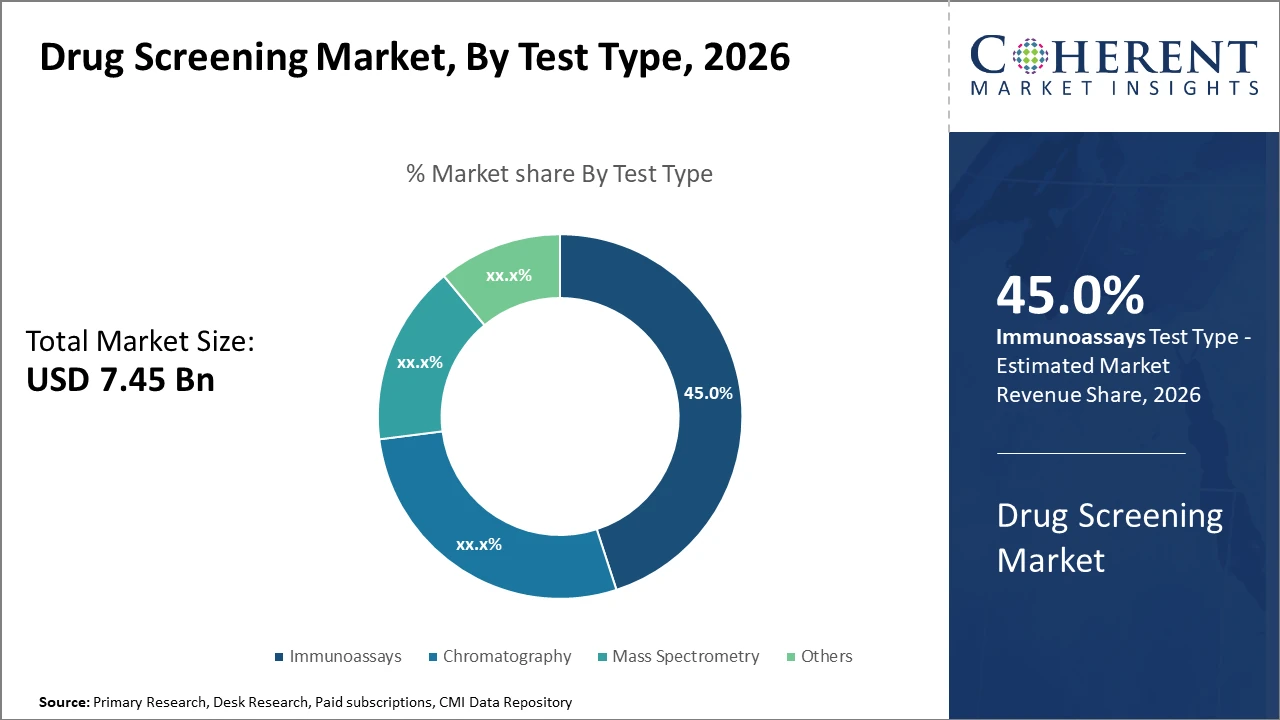
Immunoassay test type dominates the Drug Screening Market, accounting for nearly 45% of total revenue share due to rapid results and broad usage in workplace, clinical, and forensic applications.
Workplace testing represents the leading end-user segment, supported by strict regulatory policies, employee safety programs, and rising substance abuse monitoring initiatives across industries.
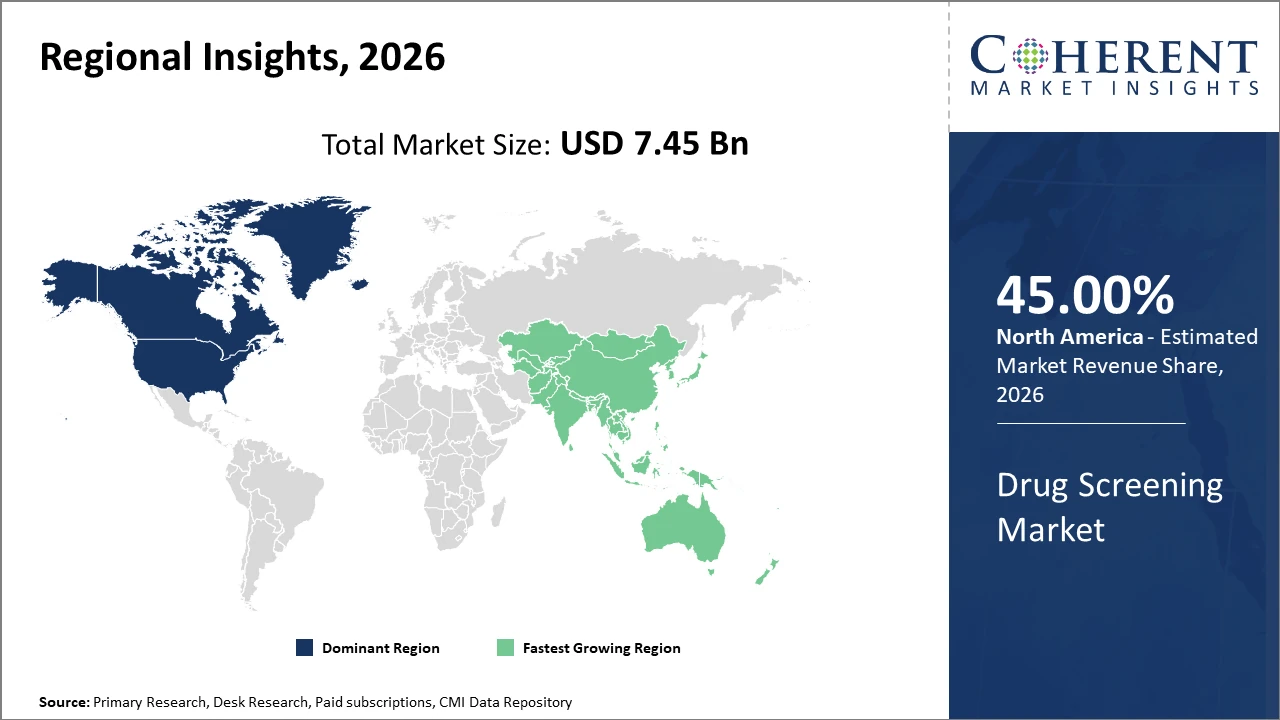
North America holds more than 40% of the global market share owing to strong regulatory compliance systems, widespread workplace screening practices, and advanced healthcare infrastructure.
Asia Pacific is projected to register the highest CAGR during the forecast period, driven by expanding healthcare access, rising awareness regarding substance abuse testing, and increasing adoption of advanced drug screening technologies.
Drug Screening Market Segmentation Analysis
To learn more about this report, Request Free Sample
Drug Screening Market Insights, By Test Type
Immunoassay holds the largest share of the Drug Screening Market, contributing nearly 45% of total revenue due to its rapid turnaround time, affordability, and extensive use in workplace drug testing programs. Its ability to process high sample volumes efficiently makes it the preferred testing method across healthcare, forensic, and corporate sectors. Chromatography remains the second-largest segment because of its superior accuracy in confirmatory testing and complex substance identification. Mass spectrometry is emerging as the fastest-growing segment, supported by rising demand for precise multi-drug detection in forensic and clinical toxicology. Emerging technologies such as biosensors and electrochemical assays are also gaining market attention.
Drug Screening Market Insights, By Sample Type
Urine samples account for nearly 60% of the Drug Screening Market share due to their cost-effectiveness, established regulatory acceptance, and widespread use in workplace and clinical testing. Oral fluid samples are the fastest-growing segment because they offer non-invasive collection, lower adulteration risk, and convenient use in roadside and workplace screening programs. Hair sampling remains important for forensic applications as it provides a longer drug detection window. Blood samples continue to play a critical role in clinical toxicology and emergency diagnostics despite invasive collection procedures. Sweat sampling is an emerging segment gaining attention for continuous and real-time drug monitoring in rehabilitation and controlled settings.
Drug Screening Market Insights, By End User
Workplace testing holds the largest share of the Drug Screening Market, supported by mandatory drug testing policies aimed at improving employee safety, productivity, and regulatory compliance across industries. Clinical and forensic laboratories represent a significant segment, relying on advanced screening technologies for diagnosis, therapeutic monitoring, and legal investigations. Law enforcement agencies are steadily increasing adoption of rapid field-testing devices for roadside drug detection and criminal investigations. Rehabilitation centers are emerging as the fastest-growing segment due to rising focus on substance abuse treatment and relapse monitoring through continuous and non-invasive testing methods. Other applications include military organizations and educational institutions implementing drug screening for safety and compliance purposes.
Drug Screening Market Trends
The Drug Screening Market is increasingly adopting automation and data analytics technologies to improve testing efficiency, accuracy, and result interpretation. In 2024, AI-powered screening systems helped reduce clinical diagnostic turnaround times by nearly 30% in several U.S. healthcare facilities.
Growing preference for non-invasive drug testing methods is accelerating the adoption of oral fluid screening, particularly in workplace, roadside, and clinical applications due to convenience and lower sample adulteration risks.
Multiplex testing platforms capable of identifying multiple substances in a single assay are gaining traction, helping laboratories and forensic centers streamline workflows, reduce operational costs, and improve testing productivity.
Drug Screening Market Insights, By Geography
To learn more about this report, Request Free Sample
North America Drug Screening Market Analysis and Trends
North America dominates the Drug Screening Market with a share of 45% due to stringent regulatory frameworks requiring comprehensive drug testing across industries including transportation, manufacturing, healthcare, and law enforcement. The United States contributes the largest share of the regional market, supported by advanced laboratory infrastructure, high healthcare spending, and strong investments in workplace safety and compliance programs. Increasing prevalence of substance abuse and strict federal testing guidelines further strengthen market demand. Major industry participants such as Thermo Fisher Scientific and Quest Diagnostics support regional leadership through advanced testing technologies, extensive service networks, and continuous innovation in drug screening solutions.
Asia Pacific Drug Screening Market Analysis and Trends
The Asia Pacific Drug Screening Market is projected to register the fastest growth, with a CAGR exceeding 10% from 2026 to 2033. Growth is driven by expanding healthcare infrastructure, increasing government initiatives to control substance abuse, and rising awareness regarding workplace safety standards. Countries such as India and China are witnessing rapid adoption of drug screening technologies due to growing industrialization and stricter regulatory monitoring. The market is also benefiting from increased imports of cost-effective rapid test kits and strategic collaborations between multinational manufacturers and local distributors. Improvements in healthcare accessibility and rising investments in diagnostic technologies further support strong regional market expansion.
Drug Screening Market Outlook for Key Countries
USA Drug Screening Market Analysis and Trends
The U.S. Drug Screening Market plays a critical role in driving global industry revenue and technological advancement. In 2025, more than 50 million workplace drug tests were conducted across the country, with rapid immunoassay devices accounting for a significant share because of their speed, affordability, and operational efficiency. Strict regulatory oversight from agencies such as the Department of Transportation continues to support widespread testing adoption across transportation, healthcare, and industrial sectors. Expanding use of drug screening in rehabilitation centers and clinical diagnostics further boosts market demand. Leading companies are increasingly investing in digital connectivity, automation, and multiplex testing technologies to strengthen their competitive market position.
Germany Drug Screening Market Analysis and Trends
The Germany Drug Screening Market is witnessing steady growth driven by stringent workplace safety regulations, rising substance abuse awareness, and increasing adoption of advanced diagnostic technologies. The country’s strong healthcare infrastructure and well-established laboratory networks support widespread implementation of drug screening across clinical, forensic, and occupational settings. Workplace testing remains a major application area, particularly in transportation, manufacturing, and healthcare industries. Demand for rapid and non-invasive testing methods such as oral fluid screening is increasing due to convenience and faster results. Technological advancements including automated analyzers and multiplex testing platforms are enhancing testing accuracy and efficiency, while government initiatives continue to strengthen regulatory compliance and market expansion.
Analyst Opinion
Rapid and point-of-care drug screening devices accounted for over 45% of testing volume in 2025 due to faster results and rising workplace testing demand.
Technological advancements in immunoassay devices reduced result turnaround time by nearly 50% across clinical and workplace settings.
Urine-based testing represented approximately 60% of all drug screening tests in 2024 because of regulatory acceptance and affordability.
Oral fluid testing is the fastest-growing sample segment, expanding at more than 12% annually due to non-invasive collection benefits.
North America held over 40% of the global market share in 2026, supported by strict workplace drug testing regulations.
More than 50 million workplace drug tests were conducted in the U.S. during 2025 under strong regulatory compliance requirements.
Competitive pricing strategies increased the availability of affordable rapid drug screening kits in emerging economies.
Asia Pacific recorded regional revenue growth exceeding 10% in 2024 due to rising imports of low-cost testing kits and healthcare expansion.
Market Scope
| Report Coverage | Details | ||
|---|---|---|---|
| Base Year: | 2025 | Market Size in 2026: | USD 7.45 billion |
| Historical Data for: | 2020 To 2024 | Forecast Period: | 2026 To 2033 |
| Forecast Period 2026 to 2033 CAGR: | 8.5% | 2033 Value Projection: | USD 12.78 billion |
| Geographies covered: |
|
||
| Segments covered: |
|
||
| Companies covered: | Abbott Laboratories, Danaher Corporation, Siemens Healthineers, Alere Inc., Bio-Rad Laboratories, NIPRO Diagnostics, Quest Diagnostics, Roche Diagnostics, Truvian Sciences, Premier Biotech | ||
| Growth Drivers: |
|
||
Uncover macros and micros vetted on 75+ parameters: Get instant access to report
Drug Screening Market Growth Factors
The Drug Screening Market is expanding due to increasing emphasis on workplace safety and regulatory compliance supported by laws such as the U.S. Drug-Free Workplace Act and Canada’s Controlled Drugs and Substances Act. Rising substance abuse cases worldwide are increasing demand for drug testing across workplaces, rehabilitation centers, and forensic applications. Technological advancements including AI and machine learning integration are improving testing sensitivity, accuracy, and operational efficiency in clinical settings. Additionally, the growing adoption of non-invasive testing methods such as oral fluid and sweat-based screening is supporting market growth by enabling faster sample collection, reducing discomfort, and improving user compliance and testing reliability across multiple applications.
Drug Screening Market Development
In May 2025, Tsinghua University and the National Supercomputing Center in Tianjin announced the launch of GalaxyVS, an AI-powered virtual drug screening platform set for release. Powered by the Tianhe supercomputer, it can rapidly analyze nearly 100 billion compounds and perform large-scale screening across millions of biological targets.
Key Players
Leading Companies of the Market
Abbott Laboratories
Danaher Corporation
Siemens Healthineers
Alere Inc.
Bio-Rad Laboratories
NIPRO Diagnostics
Quest Diagnostics
Roche Diagnostics
Truvian Sciences
Premier Biotech
Several companies in the Drug Screening Market are adopting strategic partnerships and acquisitions to strengthen their product offerings and expand regional presence. For instance, Thermo Fisher Scientific collaborated with multiple hospitals across North America to enhance point-of-care testing capabilities, contributing to a 15% increase in market penetration during 2025. Similarly, Eurofins Scientific expanded its integrated testing services through the acquisition of regional laboratories in Europe, which supported approximately 9% revenue growth in fiscal year 2024. Such strategies are helping companies improve service accessibility, strengthen technological capabilities, and enhance competitive positioning in the global market.
Drug Screening Market Future Outlook
The Drug Screening Market is expected to witness strong growth in the coming years due to increasing workplace safety regulations, rising substance abuse concerns, and expanding applications in healthcare and law enforcement. Advancements in rapid testing technologies, AI-enabled analytics, and multiplex screening platforms will improve testing accuracy and operational efficiency. Non-invasive sample collection methods such as oral fluid and sweat testing are anticipated to gain wider adoption because of convenience and faster processing. Emerging economies in Asia Pacific and Latin America are likely to create significant growth opportunities through healthcare expansion and regulatory reforms. Strategic partnerships and continuous product innovation will further intensify market competition and technological development.
Drug Screening Market Historical Analysis
The Drug Screening Market has experienced steady growth over the past decade due to rising awareness of substance abuse, increasing workplace safety concerns, and stricter regulatory requirements across industries. Early market expansion was primarily driven by urine-based testing methods widely adopted in workplaces, law enforcement, and clinical laboratories because of their affordability and regulatory acceptance. Over time, technological advancements introduced rapid immunoassay devices, chromatography systems, and mass spectrometry solutions that improved testing accuracy and efficiency. The market also witnessed growing adoption of non-invasive testing methods such as oral fluid and hair analysis. Increasing investments in healthcare infrastructure and forensic applications further supported long-term market development globally.
Sources
Primary Research Interviews:
Drug screening device manufacturers, toxicology laboratory managers, workplace testing service providers, hospital procurement managers, forensic experts, rehabilitation center administrators, and diagnostic distributors involved in substance detection and screening solutions.
Clinical toxicologists, pathologists, law enforcement officials, occupational health specialists, regulatory consultants, and R&D directors focusing on rapid testing technologies, analytical instrumentation, and non-invasive drug screening innovations.
Magazines:
Drug Testing and Analysis Magazine – Insights into drug detection technologies, forensic toxicology developments, and analytical testing trends.
Medical Laboratory Observer – Coverage of diagnostic laboratory technologies, toxicology testing advancements, and clinical screening solutions.
Forensic Magazine – Updates on forensic science innovations, roadside drug testing, and law enforcement screening technologies.
Journals:
Journal of Analytical Toxicology – Research on toxicology testing methods, drug detection technologies, and forensic analysis advancements.
Drug Testing and Analysis – Studies related to workplace testing, clinical toxicology, and advanced analytical screening techniques.
Clinical Chemistry – Research covering laboratory diagnostics, biomarker detection, and innovations in drug screening technologies.
Newspapers:
Financial Times – Coverage of diagnostic industry investments, healthcare technology expansion, and workplace safety initiatives.
Reuters – Reporting on drug screening product launches, regulatory developments, and healthcare policy updates.
Bloomberg – Insights into mergers, acquisitions, and strategic partnerships among diagnostic and drug screening companies.
Associations:
Substance Abuse and Mental Health Services Administration (SAMHSA) – Guidelines, workplace testing standards, and substance abuse prevention initiatives.
Drug and Alcohol Testing Industry Association (DATIA) – Industry standards, compliance updates, and professional training resources.
International Association of Forensic Toxicologists (TIAFT) – Global research collaboration, forensic toxicology advancements, and scientific developments in drug screening.
Share
Share
Ghanshyam Shrivastava - With over 20 years of experience in the management consulting and research, Ghanshyam Shrivastava serves as a Principal Consultant, bringing extensive expertise in biologics and biosimilars. His primary expertise lies in areas such as market entry and expansion strategy, competitive intelligence, and strategic transformation across diversified portfolio of various drugs used for different therapeutic category and APIs. He excels at identifying key challenges faced by clients and providing robust solutions to enhance their strategic decision-making capabilities. His comprehensive understanding of the market ensures valuable contributions to research reports and business decisions.
Ghanshyam is a sought-after speaker at industry conferences and contributes to various publications on pharma industry.

Credibility and Certifications
860519526

9001:2015
27001:2022

Need a Custom Report?
We can customize every report - free of charge - including purchasing stand-alone sections or country-level reports
Customize NowJoining thousands of companies around the world committed to making the Excellent Business Solutions.
View All Our Clients