

Global Automotive Electric Power Steering (EPS) Systems Market Size and Forecast
The Global Automotive Electric Power Steering (EPS) Systems Market is estimated to be valued at USD 34.41 Bn in 2026 and is expected to reach USD 50.06 Bn by 2033, exhibiting a compound annual growth rate (CAGR) of 5.5% from 2026 to 2033.
Key Takeaways for the Global Automotive Electric Power Steering (EPS) Systems Market
- The column assist type segment leads the market holding an estimated share of 47.7% in 2026.
- The gearbox segment is projected to dominate with a share of 39.6% in 2026.
- Asia Pacific is estimated to lead the market with a share of 33. 3% in 2026.
- North America, holding a share of 21. 4% in 2026, is projected to be the fastest growing region.
Market Overview
The market trend is characterized by the widespread adoption of electric power steering systems over traditional hydraulic systems due to their energy efficiency, reduced carbon emissions, and enhanced driving experience. Also, the integration of EPS with autonomous driving and smart vehicle technologies adds to the market growth. Innovation in sensor technology and software algorithms is further improving precision and reliability, making EPS systems a critical component in the evolution of next-generation vehicles, including electric and hybrid models.
Current Events and their Impact
Current Events | Description and its impact |
Technological Innovations in Automotive Steering Systems |
|
Market Dynamics and Competitive Movements |
|
Segmental Insights
- Current Industry Events of 2026
- Market Size Estimation
- Regional Breakdown
- Competitive Landscape
- Customer Intelligence
- Segmental Analysis
- Pricing Analysis
- Key Market Drivers, Challenges & Future Trends
- Customized Insights Section
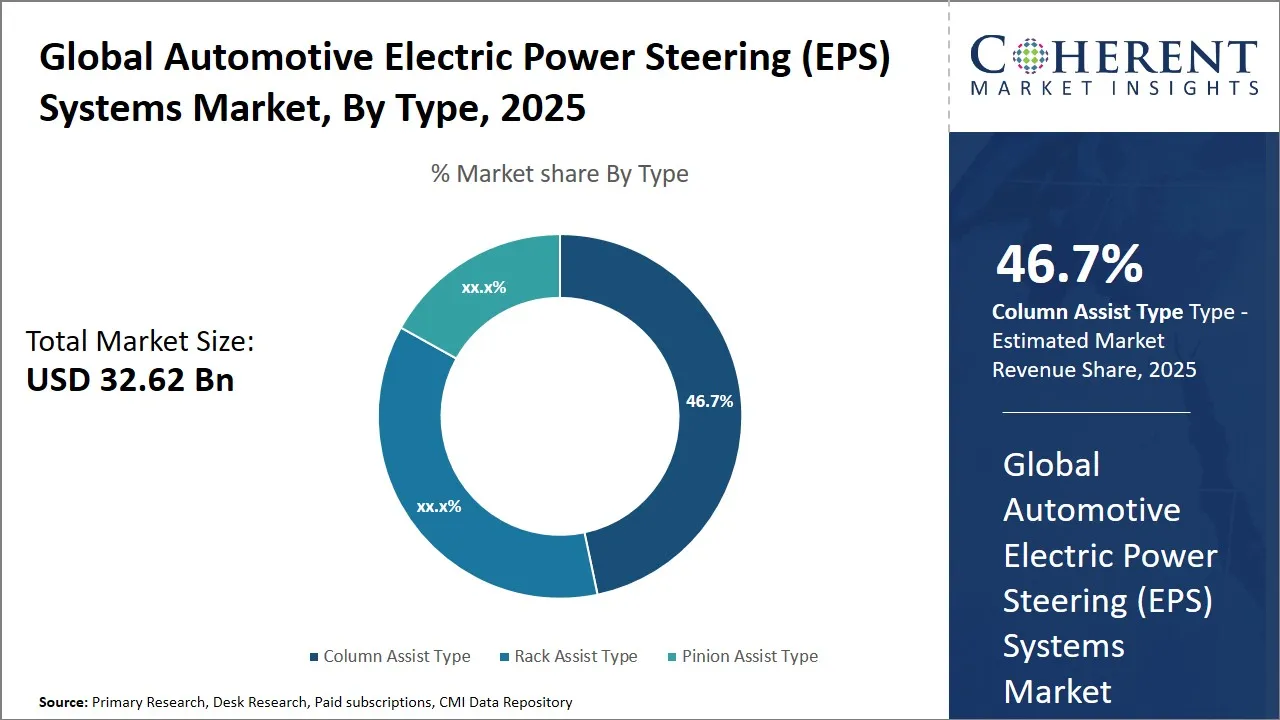
Global Automotive Electric Power Steering (EPS) Systems Market Insights, By Type - Column Assist Type Leads Due to its Compact Design and Cost-effectiveness
The column assist type segment is expected to dominate the global automotive electric power steering (EPS) systems market, holding a share of 47.7% in 2026. This type integrates the electric motor directly on the steering column, reducing the complexity and space requirements. Automakers facing space constraints, opt for this design as it uses the cabin space efficiently without compromising steering performance. Also, its simpler mechanical layout, coupled with fewer moving parts compared to Rack and Pinion Assist types, amounts to lower production and maintenance costs. To add, it is easier to integrate with existing steering columns, resulting in faster assembly lines and reduced manufacturing lead times.
From a performance point-of-view, the column assist type provides adequate steering assistance for a vast majority of vehicles, ensuring driver comfort and safety. The responsiveness and torque support of this system have improved a lot with advancements in electric motor technology and sensor accuracy.
-systems-market-by-component.webp "Automotive Electric Power Steering (EPS) Systems Market, By Component")
Global Automotive Electric Power Steering (EPS) Systems Market Insights, By Component - Gearbox Leads the Market Driven by its Critical Role in System Reliability and Steering Precision
The gearbox segment is expected to hold the largest share of 39.6% in 2026. The gearbox is the mechanical heart of the EPS system, responsible for ensuring smooth, reliable transfer of power while maintaining accurate feedback to the driver. The increasing emphasis on enhanced driving experience and safety has accentuated the demand for high-quality gearboxes.
Advancements in gearbox design have contributed significantly to the segment's growth. Modern EPS gearboxes are engineered with high-strength materials and precision manufacturing techniques that improve durability and reduce noise and vibration. These improvements are critical for passenger comfort as well as system longevity, especially in challenging road conditions or heavy use scenarios. The demand for quieter and smoother steering systems, particularly in electric and hybrid vehicles suited for urban environments, further underscores the need for superior gearbox components.
Given its position as a load-bearing and motion-transmitting unit, any malfunction can directly impair steering control, posing safety risks. Therefore, OEMs and suppliers invest heavily in robust gearbox solutions that can withstand continuous operational stresses while maintaining consistent performance over a vehicle’s lifetime. This focus on reliability encourages the preference for well-engineered gearboxes, thereby enlarging the component’s market share.
Furthermore, the gearbox segment benefits from rising complexity in EPS system designs. As electronic controls and sensors become more sophisticated, the mechanical components must keep pace to ensure seamless integration and optimal function. Gearboxes adapted for precise alignment with electronic control units (ECUs) enable better steering response and adaptive assistance levels — features increasingly demanded by consumers seeking advanced driver assistance systems (ADAS).
The Impact of Artificial Intelligence (AI) on the Automotive Electric Power Steering (EPS) Systems Market
The integration of Artificial Intelligence (AI) is revolutionizing the automotive Electric Power Steering (EPS) systems market by enabling predictive and adaptive steering capabilities. Traditional EPS systems rely on preset calibrations, but AI allows these systems to continuously learn from driver behavior, road conditions, and vehicle dynamics. This leads to more precise torque assistance, enhanced lane-keeping accuracy, and smoother transitions in advanced driver-assistance systems (ADAS). As OEMs move toward higher levels of vehicle autonomy, AI-augmented EPS becomes crucial for enabling steer-by-wire architectures that eliminate mechanical linkages and rely solely on software-driven control logic.
For instance, ZF has integrated its ProAI supercomputer with NVIDIA’s Drive Orin platform to support AI-enhanced steering for autonomous and electric vehicles. This setup enables real-time data processing from sensors and cameras to make intelligent steering decisions with minimal latency.
Regional Insights
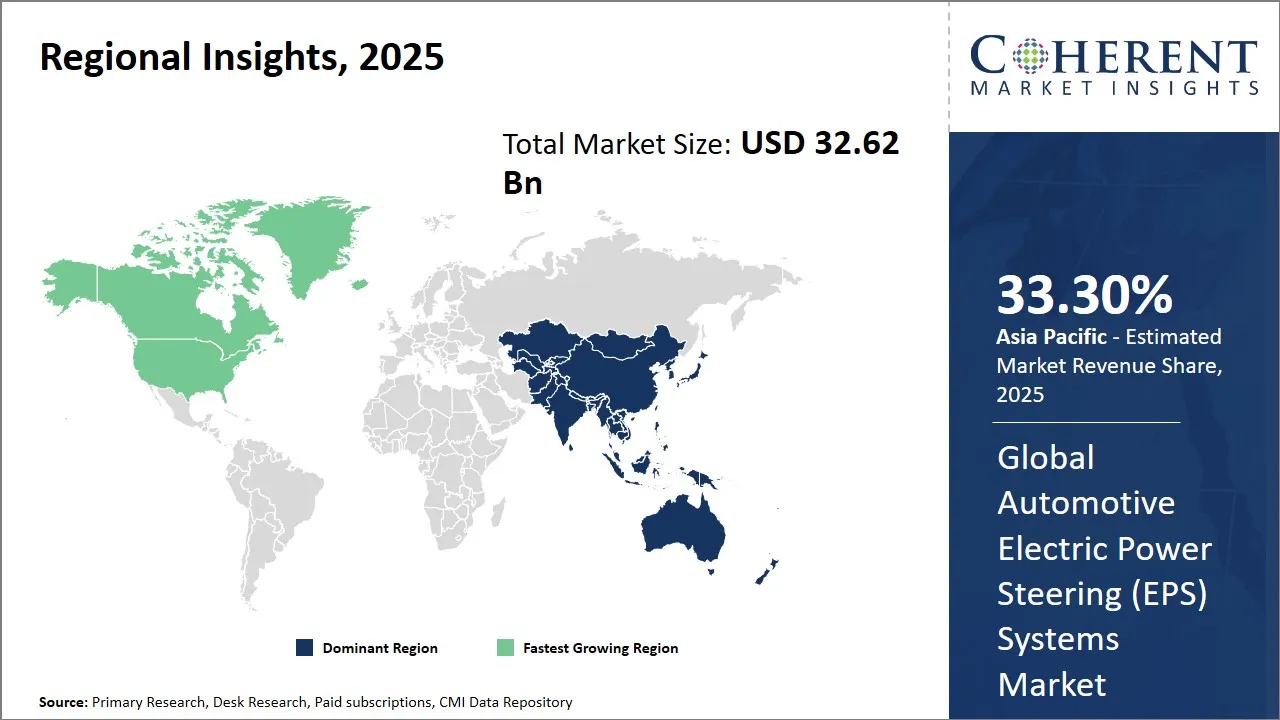
Asia Pacific Automotive Electric Power Steering (EPS) Systems Market Analysis and Trends
In the global automotive electric power steering (EPS) systems market, Asia Pacific is expected to hold the dominant position, holding a share of 33.30% in 2026, driven primarily by its expansive automotive manufacturing ecosystem. Countries like China, Japan, South Korea, and India host a significant base of OEMs and Tier 1 suppliers engaged in producing a wide range of vehicles from passenger cars to commercial vehicles. Government initiatives promoting electric and hybrid vehicle adoption, such as subsidies and stricter emission norms, have accelerated the integration of EPS systems, which are essential for improving fuel efficiency and vehicle control.
The region benefits from well-established supply chains and extensive R&D hubs focused on advanced steering systems. Key players such as NSK Ltd., Mitsubishi Electric Corporation (Japan), and JTEKT Corporation have been instrumental in pushing technological innovations and localizing production. Additionally, governments in the region support manufacturing competitiveness through trade policies and infrastructure development, further solidifying Asia Pacific’s dominance.
North America Automotive Electric Power Steering (EPS) Systems Market Analysis and Trends
North America, holding a share of 21.4% in 2026, is expected to exhibit the fastest growth in the market, driven by strong technological advancements and consumer demand for safer, more environment-friendly vehicles. The region boasts a highly advanced automotive ecosystem with a significant presence of global OEMs like General Motors, Ford, and Tesla, which are integrating EPS to enhance vehicle dynamics and support autonomous driving features. Strict government regulations regarding fuel economy and emission standards in the U.S. and Canada encourage manufacturers to adopt EPS solutions for weight reduction and energy efficiency. The rise of electric and hybrid vehicles in the region, paired with investments in intelligent steering technologies, accelerates market expansion. Major EPS system suppliers such as ZF Friedrichshafen AG, Nexteer Automotive, and Bosch have established manufacturing and innovation centers in North America, contributing significantly to the market’s fast-paced growth.
Global Automotive Electric Power Steering (EPS) Systems Market Outlook for Key Countries
China Automotive Electric Power Steering (EPS) Systems Market Analysis and Trends
China automotive electric power steering (EPS) systems market is underscored by its status as the largest automobile producer and consumer globally. The country’s focus on green mobility, supported by aggressive government policies aimed at electrification and emission reduction, has spurred the mass adoption of EPS systems, particularly in electric vehicles. Domestic companies like Zhongshan Broad-Ocean Motor Co., Ltd and international players such as NSK have partnered closely with Chinese automakers to supply high-quality EPS units. China’s well-developed automotive supply chain, coupled with consumer demand for advanced driver assistance systems (ADAS), bolsters the incorporation of EPS technologies.
Japan Automotive Electric Power Steering (EPS) Systems Market Analysis and Trends
Japan continues to be a forerunner in the market with its strong tradition of automotive innovation and manufacturing excellence. Leading companies like JTEKT Corporation and Mitsubishi Electric have played pivotal roles in pioneering EPS technologies and supplying some of the world’s top automotive OEMs such as Toyota, Honda, and Nissan. Japan’s robust R&D infrastructure enables continuous advancements in lightweight and energy-efficient steering systems to conform to global standards. Government incentives for hybrid and electric vehicle production further reinforce the adoption of EPS systems.
U.S. Automotive Electric Power Steering (EPS) Systems Market Analysis and Trends
The U.S. automotive electric power steering (EPS) systems market is characterized by rapid technological adoption fueled by a strong emphasis on vehicle safety and efficiency. American OEMs including Ford, General Motors, and Tesla rely heavily on EPS technology to meet stringent fuel economy rules and deliver responsive handling in electric and conventional vehicles alike. Suppliers like Nexteer Automotive (with roots in the U.S.) and Bosch play critical roles by providing cutting-edge electric steering solutions that integrate seamlessly with autonomous vehicle technologies. Government regulations and consumer preferences for cutting-edge features continue to drive EPS system deployment.
Germany Automotive Electric Power Steering (EPS) Systems Market Analysis and Trends
Germany, as Europe’s automotive powerhouse, has a well-established ecosystem for EPS manufacturing. The country hosts global automotive giants, such as Volkswagen, BMW, and Mercedes-Benz, all of which integrate sophisticated EPS systems to improve vehicle dynamics and energy efficiency. Companies like ZF Friedrichshafen and Bosch are dominant EPS suppliers headquartered here, investing heavily in R&D to enhance steering precision and reduce weight. Stringent European Union emission regulations and the push toward electrification have accelerated EPS adoption across German automotive production.
Market Players, Key Development, and Competitive Intelligence
Key Developments
- In May 2025, Bosch reported that it will begin the local production of the Electronic Control Unit (ECU) for the Electronic Stability Program (ESP) at its Campinas facility in São Paulo starting in 2026.
- In January 2025, Aptiv PLC, a global technology company, announced that its Board of Directors has unanimously approved a plan to separate its Electrical Distribution Systems business from Aptiv, creating two independent companies.
- In January 2025, Rane and ZF Group agreed to further strengthen their partnership by expanding the product portfolio within their joint venture, ZF Rane Automotive India Private Limited with plans to introduce Rack Drive Electric Power Steering System technologies to India.
- In August 2024, Nexteer Automotive announced its Modular Pinion-Assist Electric Power Steering (mPEPS) system, which expanded the company’s cost-effective, modular EPS offerings to now include Single-Pinion and Dual-Pinion systems.
Market Report Scope
Automotive Electric Power Steering (EPS) Systems Market Report Coverage
| Report Coverage | Details | ||
|---|---|---|---|
| Base Year: | 2025 | Market Size in 2026: | USD 34.41 Bn |
| Historical Data for: | 2020 To 2024 | Forecast Period: | 2026 To 2033 |
| Forecast Period 2026 to 2033 CAGR: | 5.5% | 2033 Value Projection: | USD 50.06 Bn |
| Geographies covered: |
| ||
| Segments covered: |
| ||
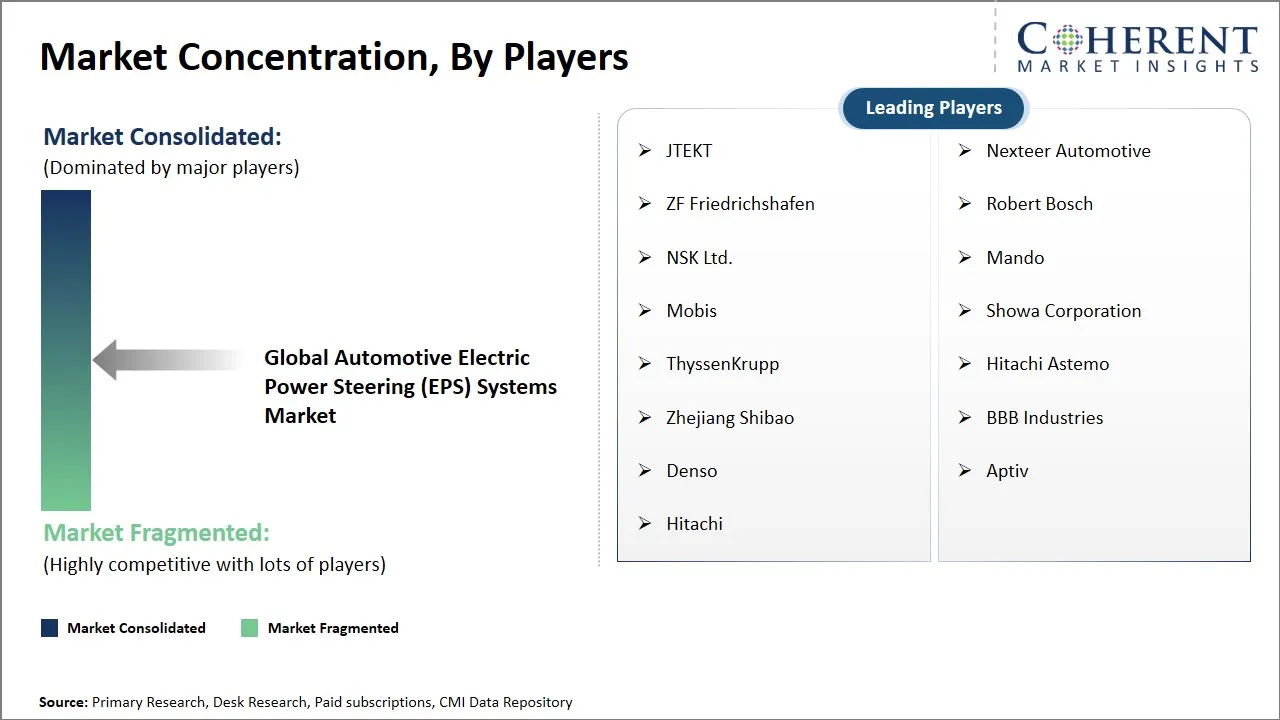
| Companies covered: | JTEKT, Nexteer Automotive, ZF Friedrichshafen, Robert Bosch, NSK Ltd., Mando, Mobis, Showa Corporation, ThyssenKrupp, Hitachi Astemo, Zhejiang Shibao, BBB Industries, Denso, Aptiv, and Hitachi | ||
| Growth Drivers: |
| ||
| Restraints & Challenges: |
| ||
Market Dynamics
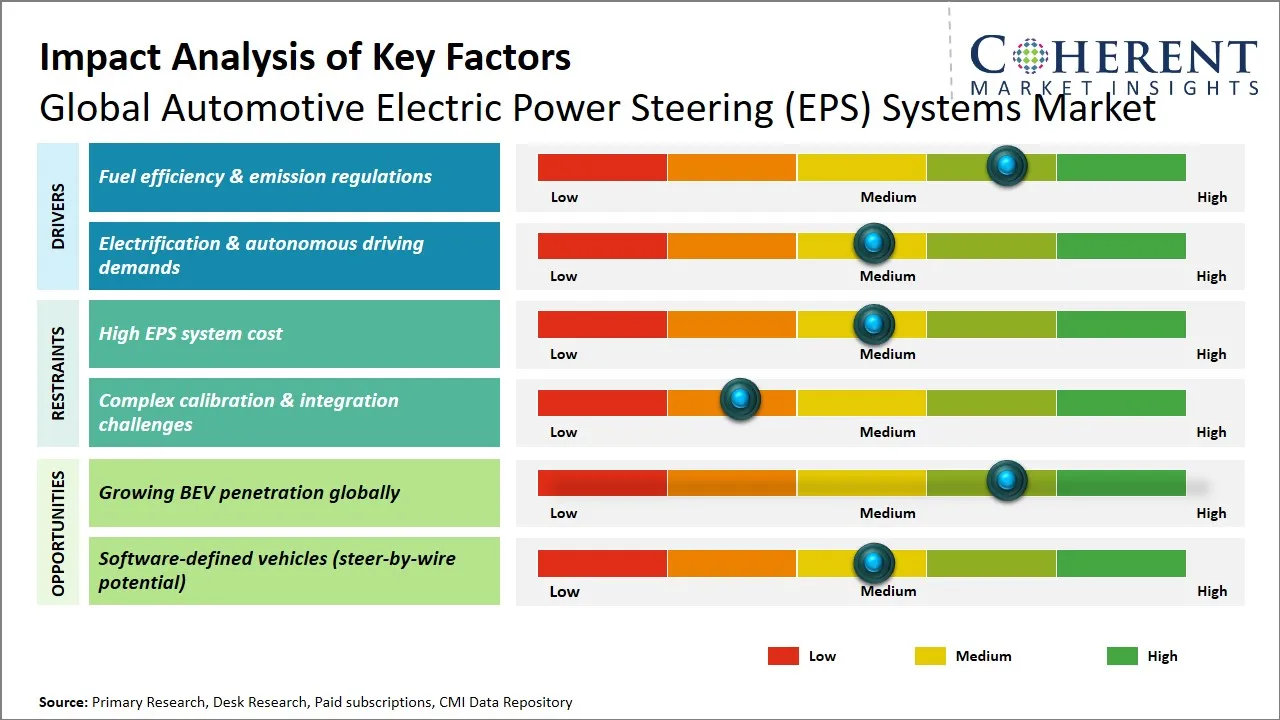
Global Automotive Electric Power Steering (EPS) Systems Market Driver - Fuel Efficiency & Emission Regulations
Unlike traditional hydraulic steering systems that rely on a continuously running engine-driven pump, EPS systems operate electrically, significantly reducing the mechanical load on the engine and thereby enhancing overall vehicle fuel economy. This reduction in energy consumption directly contributes to lower carbon emissions, helping manufacturers comply with government-mandated environmental guidelines aimed at curbing greenhouse gases.
Automakers are under mounting pressure to innovate and incorporate advanced, energy-saving technologies to meet regulatory targets without compromising vehicle performance or driver comfort. As a result, EPS technology, which offers both efficiency benefits and compatibility with hybrid and electric vehicle architectures, is increasingly favored for new vehicle models. The European Union’s 2020/2021 CO₂ fleet targets (95g CO₂/km for passenger cars) have pushed automakers to reduce parasitic engine loads. As a result, manufacturers like Volkswagen Group and Stellantis have rapidly transitioned from hydraulic to electric power steering systems, which consume energy only when needed.
Global Automotive Electric Power Steering (EPS) Systems Market Opportunity - Growing BEV Penetration Globally
As governments intensify efforts to reduce carbon emissions and promote sustainable transportation, stringent regulatory frameworks and incentives have accelerated the shift from internal combustion engine vehicles to BEVs. This transformation inherently increases the demand for advanced EPS systems, as electric vehicles require highly efficient, lightweight, and energy-saving steering solutions to optimize battery range and vehicle performance. EPS systems in BEVs not only contribute to enhanced drivability and maneuverability but also support integration with advanced driver-assistance systems (ADAS) and autonomous driving technologies, which are increasingly prevalent in electric vehicle designs.
Hyundai Mobis has developed advanced rack-assist EPS (R-EPS) units specifically optimized for Hyundai Motor Group’s E-GMP electric vehicle platform, used in models like the Ioniq 5 and Kia EV6. These systems are designed for low-noise, high-efficiency operation and integration with ADAS features. Additionally, the variable torque requirements and electronic integration capabilities of EPS systems align well with the electric architecture of BEVs, further propelling their adoption.
Analyst Opinion (Expert Opinion)
- As OEMs move toward full autonomy and software-defined vehicles, steer-by-wire systems—eliminating mechanical linkages—are becoming the future of EPS. Companies like Magna and Bosch are leading R&D in this area, focusing on fail-operational redundancy and cyber-secure architecture.
- EPS systems are increasingly integrating AI algorithms to adapt torque feedback in real-time based on driver behavior, road surface, and vehicle dynamics. This shift enables more personalized, responsive, and safer steering experiences, especially in high-end and autonomous vehicles.
- Emerging EPS platforms are being redesigned for compatibility with zonal and centralized electronic architectures, supporting over-the-air (OTA) updates and real-time diagnostics. Players like Nexteer and ZF are building modular EPS units to align with next-gen vehicle platforms.
Speak to the analyst
Want personalized insights?
Take the findings above to one of our principal consultants, or have the report rebuilt around the segments, geographies and competitors you actually track.
Market Segmentation
- Type Insights (Revenue, USD Bn, 2021 - 2033)
- Column Assist Type
- Rack Assist Type
- Pinion Assist Type
- Component Insights (Revenue, USD Bn, 2021 - 2033)
- Gearbox
- Electric Motor
- ECU
- Sensors
- Steering Column
- Others
- Regional Insights (Revenue, USD Bn, 2021 - 2033)
- North America
- U.S.
- Canada
- Latin America
- Brazil
- Argentina
- Mexico
- Rest of Latin America
- Europe
- Germany
- U.K.
- Spain
- France
- Italy
- Russia
- Rest of Europe
- Asia Pacific
- China
- India
- Japan
- Australia
- South Korea
- ASEAN
- Rest of Asia Pacific
- Middle East
- GCC Countries
- Israel
- Rest of Middle East
- Africa
- South Africa
- North Africa
- Central Africa
- North America
- Key Players Insights
- JTEKT
- Nexteer Automotive
- ZF Friedrichshafen
- Robert Bosch
- NSK Ltd.
- Mando
- Mobis
- Showa Corporation
- ThyssenKrupp
- Hitachi Astemo
- Zhejiang Shibao
- BBB Industries
- Denso
- Aptiv
- Hitachi
Sources
Primary Research Interviews
Stakeholders
- Automotive OEMs and Tier-1 Suppliers (e.g., Engineering Directors, Product Managers)
- EPS Component Manufacturers (e.g., Torque Sensor and ECU suppliers)
- Automotive Software and ADAS Integration Experts
- Vehicle Dynamics and Mechatronics Engineers
- EV Startups and Platform Architects
- Regulatory Advisors on Automotive Safety and Emissions
Databases
- AutoTech Insight (EU)
- U.S. National Transportation Data Hub
- Japan Vehicle Engineering Database (JVED)
- International EV & Steering Systems Repository (IEVSSR)
- China Automotive Industry Exchange Platform (CAIXP)
Magazines
- Automotive Manufacturing Today
- Motion & Control Engineering Review
- Electric & Hybrid Vehicle Technology International
- Steering Systems & Sensors Monthly
- Global Automotive Engineering Digest
Journals
- Journal of Automotive Engineering & Innovation
- International Journal of Vehicle Design & Dynamics
- Advanced Mobility & Electric Steering Systems Journal
- Journal of Automotive Safety & Electronics
- Mechatronics and Mobility Engineering Review
Newspapers
- The Automotive Herald
- AutoTech News Daily
- The EV Observer (North America)
- Asia Mobility Times
- The Mobility Tribune (Europe)
Associations
- International Automotive Steering Council (IASC)
- Society of Automotive Engineers (SAE International)
- Japan Automobile Manufacturers Association (JAMA)
- North American Steering Systems Consortium (NASSC)
- China Association of Automotive Manufacturers (CAAM)
Public Domain Sources
- U.S. Department of Transportation (DOT)
- EUROSTAT
- International Energy Agency (IEA)
- United Nations Economic Commission for Europe (UNECE)
- ResearchGate
- World Bank Mobility Indicators
Proprietary Elements
- CMI Data Analytics Tool, Proprietary CMI Existing Repository of information for last 8 years
Get access to 250+ pages report
Every segment, forecast, competitor profile and data table behind the analysis above — available for instant download.
- ESOMAR Member
- ISO 9001:2015 Certified
- D-U-N-S Registered
- GDPR & CCPA Compliant
Missing comfort of reading report in your local language? Find your preferred language:
Transform your Strategy with Exclusive Trending Reports
Frequently Asked Questions
The global automotive Electric Power Steering (EPS) systems market is estimated to be valued at USD 34.41 Bn in 2026 and is expected to reach USD 50.06 Bn by 2033.
The CAGR of the global automotive Electric Power Steering (EPS) systems market is projected to be 5.5% from 2026 to 2033.
Fuel efficiency & emission regulations and electrification & autonomous driving demands are the major factors driving the growth of the global automotive Electric Power Steering (EPS) systems market.
High EPS system cost and complex calibration & integration challenges are the major factors hampering the growth of the global automotive Electric Power Steering (EPS) systems market.
In terms of type, column assist type is estimated to dominate the market revenue share in 2026.
JTEKT, Nexteer Automotive, ZF Friedrichshafen, Robert Bosch, NSK Ltd., Mando, Mobis, Showa Corporation, ThyssenKrupp, Hitachi Astemo, Zhejiang Shibao, BBB Industries, Denso, Aptiv, and Hitachi are the major players.
Asia Pacific is expected to lead the global automotive Electric Power Steering (EPS) systems market in 2026.