

Global Carob Chocolate Market Size and Forecast – 2026 To 2033
Global carob chocolate market is expected to grow from USD 1.98 Bn in 2026 to USD 3.26 Bn by 2033, registering a compound annual growth rate (CAGR) of 7.4%. The rapid shift toward healthier confectionery alternatives and rising pressure on cocoa-based product economics are driving the market growth. Around 66% of consumers reported actively trying to limit sugar intake in 2024, reflecting rising demand for reduced-sugar and healthier snack alternatives, which directly supports the adoption of plant-based ingredients such as carob in confectionery applications, according to the International Food Information Council 2024 Food & Health Survey.
(Source: ific.org)
Key Takeaways of the Global Carob Chocolate Market
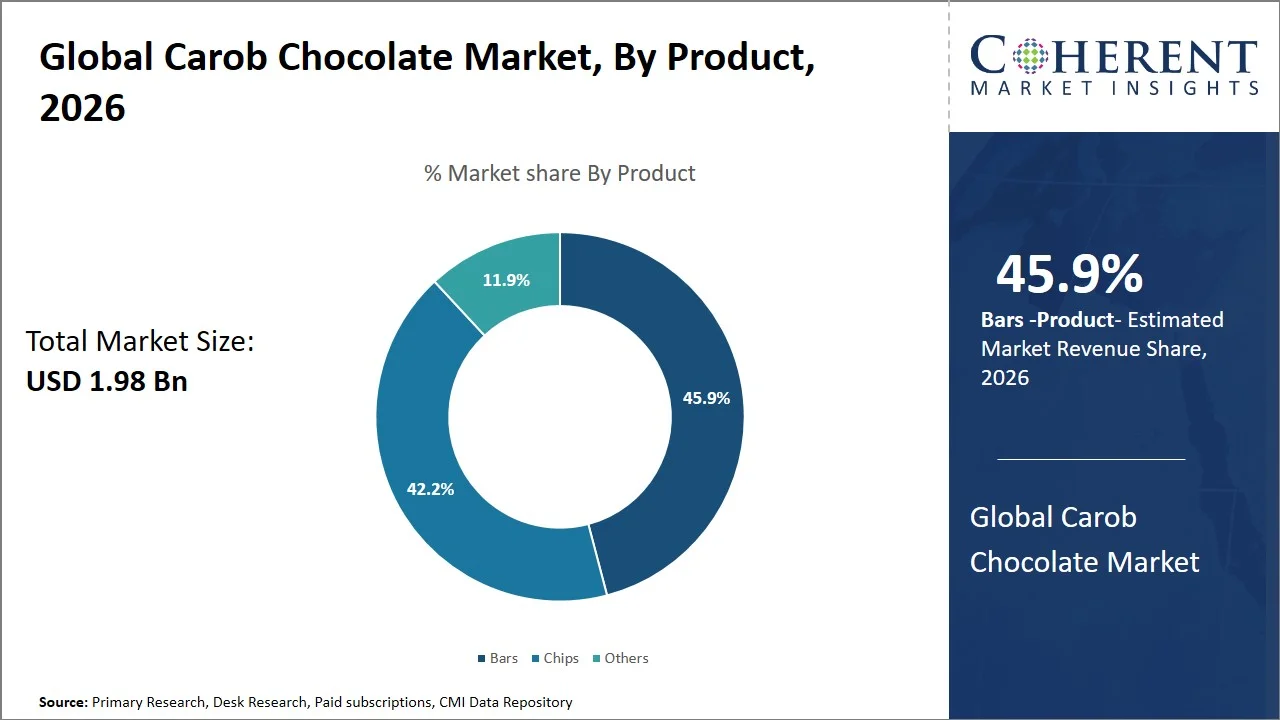
- Bars are expected to account for 45.9% of the global carob chocolate market share in 2026, making them the dominant product segment. The segment is benefiting from rising demand for convenient, portion-controlled, and healthier snack alternatives. Carob bars are increasingly positioned as caffeine-free, naturally sweet, and allergen-friendly alternatives to traditional chocolate bars. A major industry indicator supporting this trend is the rapid expansion of plant-based food consumption globally. According to the Good Food Institute, U.S. plant-based food retail sales crossed US$ 8.1 billion in 2024, indicating strong consumer acceptance of alternative food categories where carob bars fit naturally. Source: Food Institute)
- Supermarkets & hypermarkets segment is expected to account for 35.7% of the global carob chocolate market share in 2026, due to their strong shelf visibility, organized retail penetration, and consumer accessibility. Large retail chains are increasingly dedicating shelf space to plant-based snacks, sugar-free confectionery, and allergen-free products. According to the U.S. Department of Agriculture, organized food retail continues to dominate grocery sales in developed economies, with supermarkets remaining the primary purchase channel for packaged functional foods. (USDA.gov)
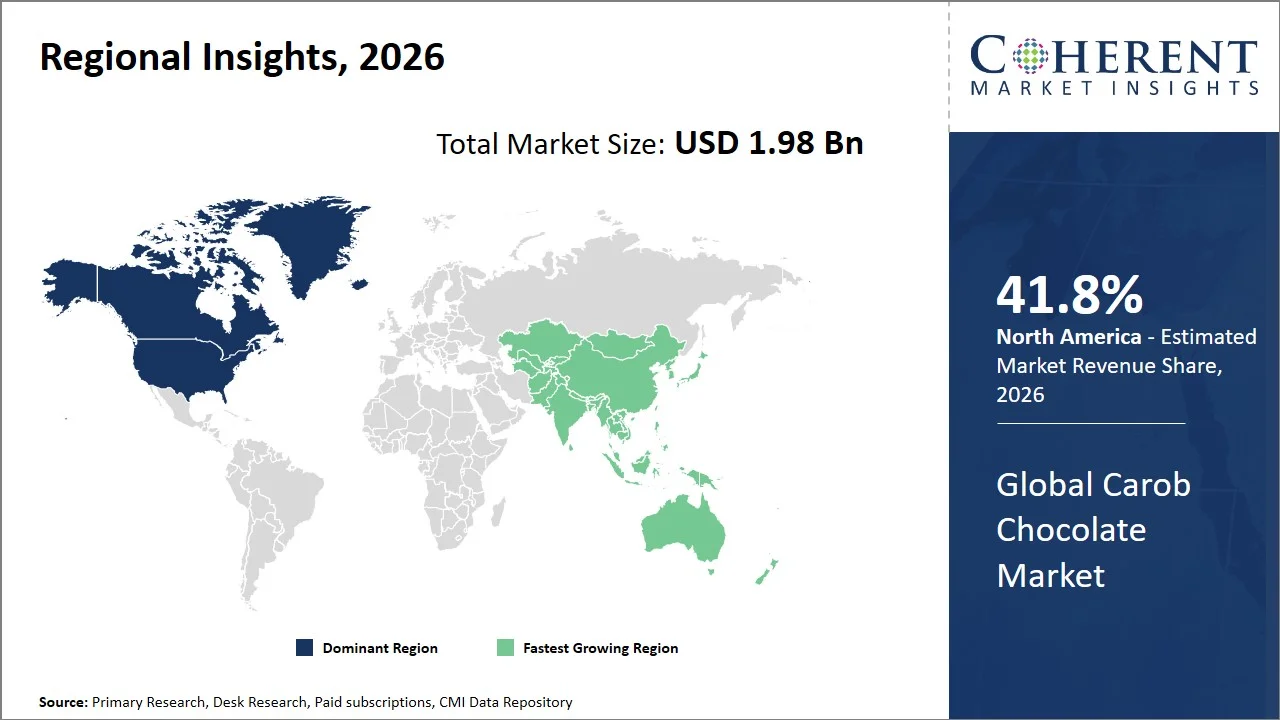
- North America is projected to dominate the global carob chocolate market with an estimated 41.8% market share in 2026, supported by strong consumer adoption of plant-based nutrition, sugar-reduction preferences, and growing demand for functional snacking products. The region—particularly the U.S. and Canada—has developed a mature health-food ecosystem where consumers actively seek clean-label, allergen-free, and naturally sweetened alternatives, directly benefiting carob-based chocolate products. The International Food Information Council reported in its 2024 Food & Health Survey that 66% of Americans are actively trying to limit sugar consumption, while 62% consider healthfulness a major factor in food purchase decisions. Carob chocolate aligns with this trend due to its naturally sweet profile and lower dependency on added sugars versus conventional chocolate formulations. (Source: ific.org)
- Asia Pacific is projected to be the fastest-growing region in the global carob chocolate market in 2026, accounting for 19.3% of the market share, driven by rapid urbanization, expanding middle-class consumption, and the rising awareness of healthier snack alternatives. According to the United Nations Department of Economic and Social Affairs, more than 55% of Asia’s population is expected to live in urban areas by 2030, accelerating demand for packaged, convenient, and premium functional food products across metropolitan markets. This urban consumption shift is directly benefiting carob chocolate, particularly among health-conscious consumers seeking plant-based and reduced-sugar confectionery alternatives. (Source: prb.org)
- Health & Clean Label Alignment: Carob chocolate is increasingly aligned with global clean-label, plant-based, and reduced-sugar food trends. Carob naturally contains dietary fibers, is caffeine-free, and requires lower added sugar compared to conventional cocoa formulations, making it attractive for wellness-focused consumers. Recent food science studies show carob-based formulations can reduce fat and calorie content while maintaining acceptable sensory performance, strengthening its positioning in functional confectionery.
- Market Expansion Catalysts: The rising adoption of plant-based diets, premium snacking behavior, and volatility in cocoa supply are accelerating market expansion. At the same time, cocoa supply constraints are pushing manufacturers to diversify ingredient sourcing toward cocoa alternatives.
Segmental Insights
Why Does the Bars Segment Dominate the Global Carob Chocolate Market?
Bars segment is expected to hold 45.9% of the market share in 2026. Bars are a popular snack among consumers as they provide them with a sense of portability and ease of consumption. In addition, the flexibility of carob chocolate bars means that they can be mixed in different flavors and different types of products can be offered, appealing to a broad spectrum of taste preferences.
For instance, in December 2024, Caroboo secured a new listing with Holland & Barrett, the U.K. health & wellbeing store. As the consumer movement towards low caffeine and healthier indulgences grows, Caroboo is positioning itself as the alternative to chocolate, made of naturally sweet Mediterranean carob plant. The bars are dairy-free, gluten-free and contain no artificial sweeteners, 45% less sugar than traditional chocolate. Caroboo serves the chocolate avoiders with mint, orange, and salted caramel nutty flavors.
- Current Industry Events of 2026
- Market Size Estimation
- Regional Breakdown
- Competitive Landscape
- Customer Intelligence
- Segmental Analysis
- Pricing Analysis
- Key Market Drivers, Challenges & Future Trends
- Customized Insights Section
Why are Supermarkets & Hypermarkets the Most Preferred Distribution Channel?
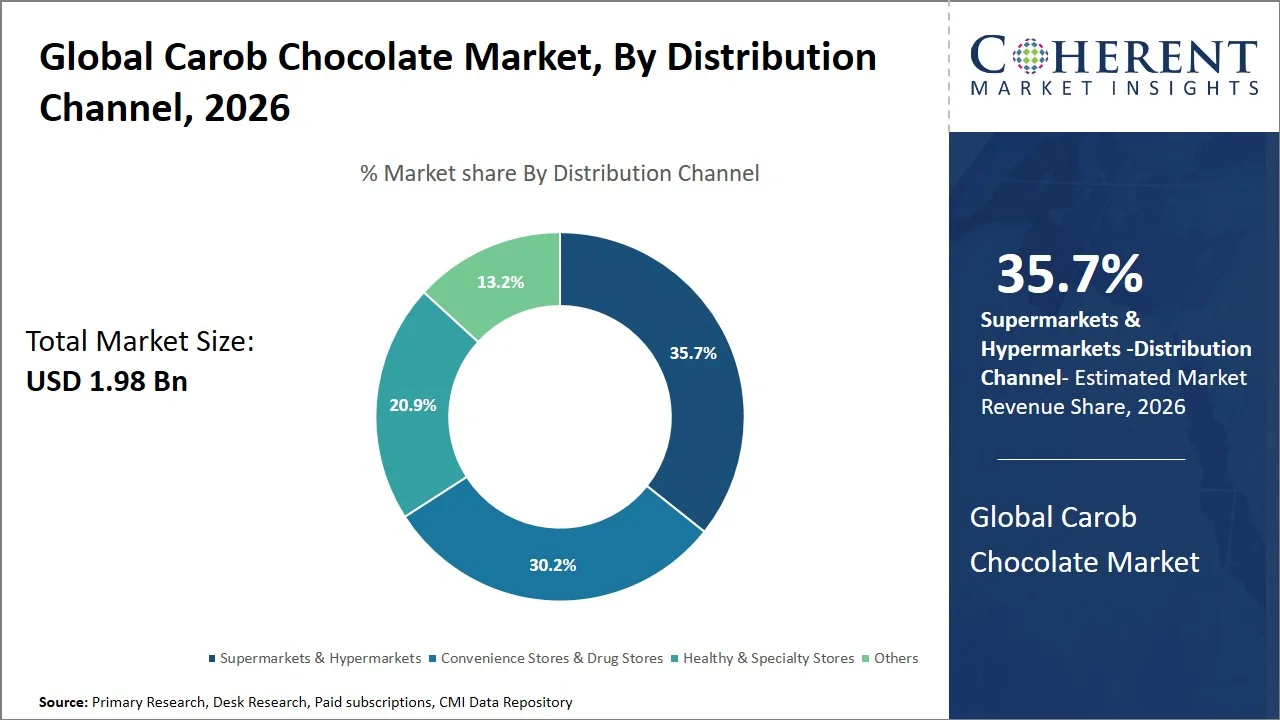
Supermarkets & hypermarkets are projected to dominate with 35.7% of the global carob chocolate market share in 2026. The segment growth can be explained by the fact that these retail stores provide consumers with a wide reach and convenience. The range of carob chocolate products available in supermarkets & hypermarkets is very broad, so that customers can easily experiment with the brands and varieties of carob chocolate available in these stores. They have a high market share because they are able to attract numerous shoppers and provide competitive prices. With consumers becoming more inclined towards convenience and access, supermarkets & hypermarkets would continue to be the key drivers of carob chocolate sales in the market.
As an example, most of the major retail chains including Whole Foods Market, Tesco, and Woolworths Group have increasingly added shelf space to the plant-based and better-for-you confectionery categories and created a greater visibility to the carob chocolate products. (Source: Tesco PLC)
Currents Events and their Impact
Current Events | Description and its Impact |
Macroeconomic Shift: Global Cocoa Price Volatility and Chocolate Inflation |
|
Regulatory Shift: Sustainability and Traceability Rules in Food Supply Chains |
|
Global Carob Chocolate Market Dynamics
Market Drivers
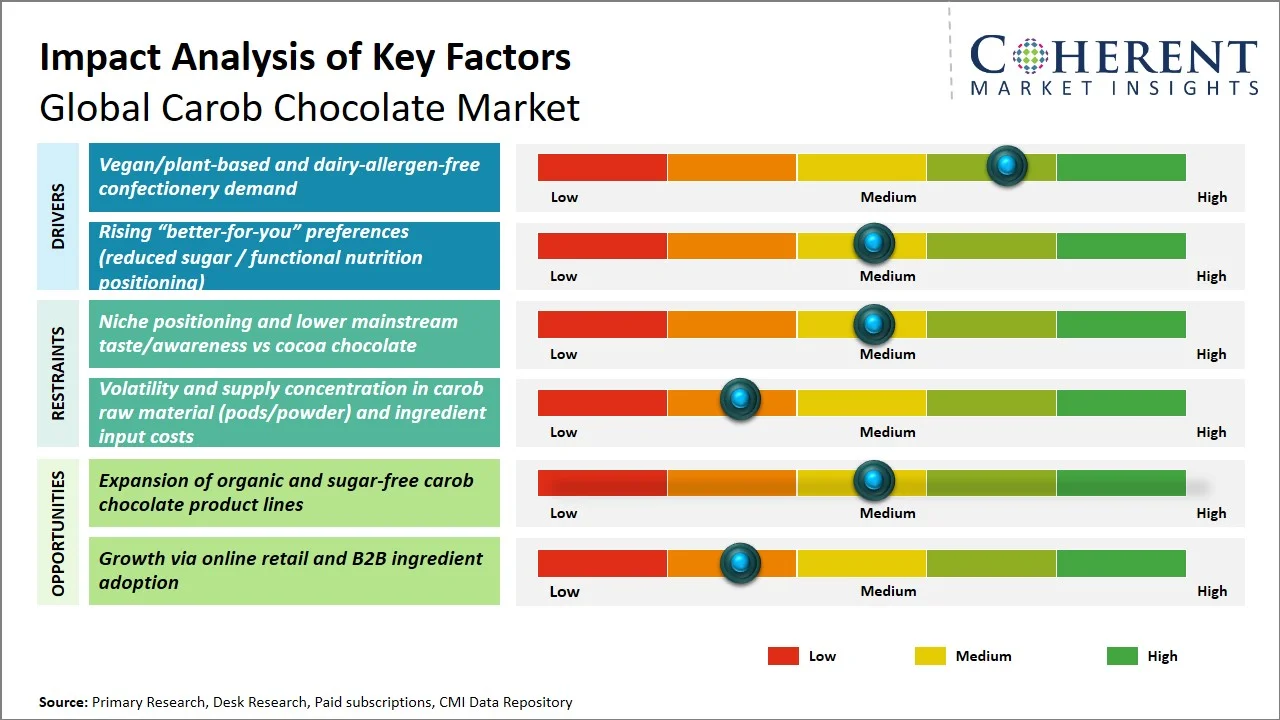
- Vegan/Plant-Based and Dairy-Allergen-Free Confectionery Demand: Carob chocolate has gained popularity as a plant-based alternative to traditional cocoa chocolate, particularly among consumers seeking dairy-free, lactose-free, and allergen-conscious confectionery products. Carob has a sweet flavor profile in its own right, meaning that less sugar needs to be added compared to traditional milk chocolate. It’s also naturally caffeine-free, making it attractive in vegan snacks, children’s nutrition products and wellness confectionery. Under Regulation (EU) 2018/848, products sold as organic in the European Union must comply with strict rules on sourcing, processing, labeling, certification, and advertising for agricultural products. Processed organic foods require that ingredients, additives and processing aids be strictly controlled, which creates higher entry barriers but also stronger consumer confidence for certified brands. (Source: European Union)
- Rising “better-for-you” preferences (reduced sugar / functional nutrition positioning): The behavior of consumers in the carob chocolate market is shifting from pure indulgence to permissible indulgence, where buyers still want to satisfy their taste buds but are more likely to judge products on sugar content, ingredient transparency and added health benefits. This shift is directly benefiting carob chocolate because carob naturally contains mild sweetness and does not need the same amount of added sugar as conventional cocoa-based chocolate in many formulations. Thus, manufacturers are developing sugar-free, low-sugar, fortified, and functional carob chocolate products, aimed at fitness-conscious consumers, diabetic consumers, parents looking for better snack options for children and consumers following clean-label lifestyles. Functional positioning now includes additions like dietary fiber, plant protein, probiotics, vitamins and mineral fortification. For instance, The Carob Kitchen launched naturally sweetened carob bars made with milk and plant-based formulations, positioned as caffeine-free and lower bitterness alternatives to conventional chocolate, targeting families and health-conscious consumers. Source: Carbo Kitchen
Emerging Trends
- Created High Value (Premium) & Functional (Indulged) Indulgences: Now carob chocolate is being made in artisanal formulations using organic ingredients with the added feature of providing functional benefits (such as protein, probiotics, & natural sweeteners). Premium packaging/clean label is allowing brands to improve consumer engagement & their ability to charge higher amounts due to brand loyalty.
- Movement Towards Plant Based/Low Sugar Products: Increasingly there is an interest in healthier types of candies, leading to new product innovations for vegan/dairy-free/sugar free/allergen-free carob chocolates. Consequently, the manufacturers are now able to market these products to consumers who are health-conscious, targeting the child’s nutrition segment, and consumers that are looking for cocoa-less alternatives, through various forms of marketing.
Regional Insights
Why is North America a Strong Market for Carob Chocolate ?
North America leads the global carob chocolate market, accounting for an estimated 41.8% share in 2026. This leadership is primarily driven by the region’s mature health-and-wellness ecosystem, strong consumer acceptance of plant-based snacking, and highly developed retail and e-commerce distribution networks. Consumers across the U.S. and Canada increasingly prefer caffeine-free, dairy-free, gluten-free, and reduced-sugar confectionery, directly supporting demand for carob-based chocolate alternatives. Around 36% of U.S. consumers actively look for low-sugar snacks and functional confectionery, creating a favorable demand base for naturally sweet carob formulations.
Why Does Asia Pacific Carob Chocolate Market Exhibit High Growth?
The Asia Pacific carob chocolate market is expected to exhibit the fastest growth with an estimated contribution of 19.3% share to the global market in 2026. A strong example is the Plant-Based Foods and Proteins Summit Asia 2023, which highlighted growing investment in alternative food products across Asia. Urban consumers, especially millennials and Gen Z, are driving online demand for imported and functional carob snacks. (Source: Bridge2Food)
Global Carob Chocolate Market Outlook for Key Countries
Why is the U.S. Leading Innovation and Adoption in the Carob Chocolate Market?
The U.S. leads innovation in the global carob chocolate market because of its advanced health-food ecosystem and strong product commercialization capabilities. U.S. consumers are early adopters of organic, vegan, keto, and allergen-free snacks, which makes the market ideal for carob-based innovation. The U.S. Department of Agriculture reports that over 55% of organic sales occur through mass-market retail channels, giving innovative products faster commercialization and national shelf penetration. (Source: USDA.gov)
Is Canada a Favorable Market for Carob Chocolate ?
Canada is a favorable market for carob chocolate, although smaller in size compared with the U.S. Canadian consumers show high preference for clean-label, organic, and functional foods, which supports premium carob products. Carob chocolate is increasingly positioned in organic grocery chains and natural health stores as a digestive-friendly and caffeine-free indulgence. The country’s strong vegan and sustainable consumption trends make it attractive for premium imported carob brands.
Why Does Germany Top the Europe Carob Chocolate Market?
Germany leads the Europe carob chocolate market due to its strong organic food culture, sustainable consumption behavior, and high adoption of plant-based products. German consumers actively pay premiums for bio-certified, dairy-free, and reduced-sugar snacks. Companies entering Europe often prioritize Germany because of its mature retail infrastructure and consumer acceptance of alternative ingredients. For example, Foreverland has been a prominent example of this trend, securing USD 7 million (€6 million) in funding in March 2026 to scale its cocoa-free, carob-based chocolate alternative, Choruba.
Is Carob Chocolate Market Developing in India?
India is still an emerging market for carob chocolate, but development is clearly underway. Rising urban health awareness, growing diabetic populations, and increased demand for plant-based nutrition are creating long-term opportunities. Carob products are currently more visible in premium e-commerce channels and imported food stores rather than mass retail. Cities like Mumbai, Bengaluru, and Delhi are showing early adoption through vegan bakeries, premium grocery stores, and health-focused online platforms. India is not yet a volume market, but it has strong future potential as awareness and local manufacturing increase.
Chocolate to Carob Switching Behavior (% of consumers replacing traditional chocolate with carob)
Region | Consumers Aware of Carob (%) | Consumers Trying Carob (%) | Consumers Replacing Traditional Chocolate (%) |
North America | 68% | 42% | 24% |
Europe | 72% | 47% | 29% |
Asia Pacific | 49% | 31% | 16% |
How is the expansion of organic and sugar-free carob chocolate product lines creating new growth opportunities in the global carob chocolate market?
The growing consumer shift toward healthier indulgence is creating a major commercial opportunity for organic and sugar-free carob chocolate products. Consumers are increasingly scrutinizing ingredient labels, sugar content, artificial additives, and allergen declarations before purchasing confectionery products. This is pushing manufacturers to expand product portfolios with organic-certified, low-sugar, sugar-free, vegan, and functional carob chocolate offerings.
Carob has a structural advantage in this trend because it is naturally sweet, caffeine-free, and lower in fat compared to cocoa-based chocolate, allowing manufacturers to formulate reduced-sugar products without significantly compromising taste. In addition, organic carob products appeal strongly to premium consumers seeking clean-label, non-GMO, and chemical-free confectionery options.
For instance, Health-focused brands such as The Carob Kitchen and PANOS Brands are actively expanding carob-based confectionery lines targeting vegan and clean-label consumers.
(Source: nlm)
Market Players, Key Development, and Competitive Intelligence
Key Developments
- In December 2025, NUS scientists enhanced the flavor of carob-based chocolate alternatives with novel methods. The team developed two flavor-boosting techniques to transform carob pulp into a delicious and sustainable alternative to cocoa. The NUS team, led by Associate Professor Liu Shao Quan from the Department of Food Science and Technology (FST) at the NUS Faculty of Science, developed the two innovative techniques.
- In November 2025, CSM Ingredients introduced Nuaré, a new range of carob-based cocoa alternatives designed for baking and ice cream formulations. The range has reportedly been developed to ensure excellent performance and versatility across multiple categories, both in industrial and artisanal settings. The formulations can easily be integrated into existing processes, and can be customized to provide bespoke solutions.
Competitive Landscape
The global carob chocolate market is becoming increasingly competitive as health-focused brands, specialty food manufacturers, and plant-based snack companies expand their presence. Key focus areas include
- Clean-label, functional, and taste-optimized product development
- Product portfolio expansion across confectionery and snacking formats
- Supply chain integration and Mediterranean sourcing control
Market Report Scope
Carob Chocolate Market Report Coverage
| Report Coverage | Details | ||
|---|---|---|---|
| Base Year: | 2025 | Market Size in 2026: | USD 1.98 Bn |
| Historical Data for: | 2020 To 2024 | Forecast Period: | 2026 To 2033 |
| Forecast Period 2026 to 2033 CAGR: | 7.4% | 2033 Value Projection: | USD 3.26 Bn |
| Geographies covered: |
| ||
| Segments covered: |
| ||
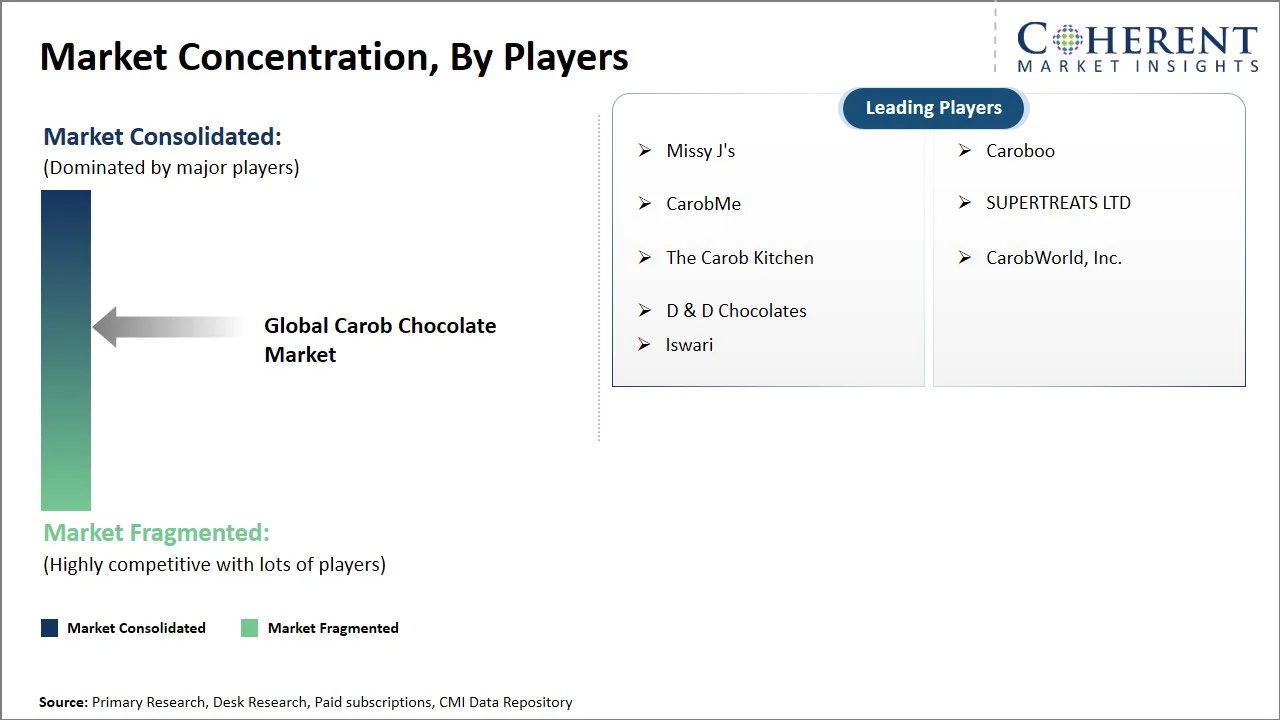
| Companies covered: | Missy J's, CarobMe, The Carob Kitchen, D & D Chocolates, Iswari, Caroboo, SUPERTREATS LTD, and CarobWorld, Inc. | ||
| Growth Drivers: | Vegan/plant-based and dairy-allergen-free confectionery demand Rising “better-for-you” preferences (reduced sugar / functional nutrition positioning) | ||
| Restraints & Challenges: |
| ||
Analyst Opinion (Expert Opinion)
- The global carob chocolate market is moving from being positioned as a niche “cocoa alternative” toward becoming a broader functional indulgence category. Over the next five to seven years, growth will not come from consumers simply replacing cocoa-based chocolate, but from brands repositioning carob as a naturally caffeine-free, lower-fat, allergen-friendly ingredient aligned with clean-label and plant-based lifestyles.
- As sugar reduction regulations tighten across developed markets and consumers become more ingredient-conscious, carob is likely to evolve from a specialty health-store product into a mainstream formulation ingredient across confectionery, bakery inclusions, snack bars, and dairy alternatives. The companies that treat carob as a wellness ingredient rather than a direct chocolate substitute will build stronger pricing power and long-term brand relevance.
- The highest near-term commercial opportunity sits in carob-based functional snack bars and premium confectionery applications in North America and Western Europe, particularly in the U.S., Germany, and the U.K. These markets already have high consumer adoption of vegan, sugar-conscious, and digestive wellness products. Protein bars, clean-label kids’ snacks, keto-friendly desserts, and dairy-free confectionery represent the strongest monetization channels.
Speak to the analyst
Want personalized insights?
Take the findings above to one of our principal consultants, or have the report rebuilt around the segments, geographies and competitors you actually track.
Market Segmentation
- Product Insights (Revenue, USD Bn, 2021 - 2033)
- Bars
- Chips
- Others
- Distribution Channel Insights (Revenue, USD Bn, 2021 - 2033)
- Supermarkets & Hypermarkets
- Convenience Stores & Drug Stores
- Healthy & Specialty Stores
- Others
- Regional Insights (Revenue, USD Bn, 2021 - 2033)
- North America
- U.S.
- Canada
- Latin America
- Brazil
- Argentina
- Mexico
- Rest of Latin America
- Europe
- Germany
- U.K.
- Spain
- France
- Italy
- Russia
- Rest of Europe
- Asia Pacific
- China
- India
- Japan
- Australia
- South Korea
- ASEAN
- Rest of Asia Pacific
- Middle East
- GCC Countries
- Israel
- Rest of Middle East
- Africa
- South Africa
- North Africa
- Central Africa
- North America
Sources
Primary Research Interviews
- Carob chocolate manufacturer.
- Supply chain director of a natural confectionery producer.
- Ingredient supplier specializing in carob powder and carob-based compounds.
- Sustainability officer of a plant-based and allergen-friendly food certification authority.
Stakeholders
- Manufacturers of carob chocolate and carob-based confectionery, such as PANOS Brands, D&D Chocolates, Missy J’s, and The Carob Kitchen.
- End-use sectors
- Health-conscious consumers seeking low-sugar and caffeine-free confectionery.
- Vegan and allergy-friendly snack buyers.
- Bakery and snack manufacturers using carob chips, bars, spreads, and related formats.
- Technology and product innovation players:
- Brands developing plant-based, organic, and functional confectionery formulations.
Databases
- Confectionery News
- Candy Industry
- Food Navigator
- Bake Magazine
- Specialty Food Magazine
Magazines
- Journal of Food Science
- Foods
- LWT - Food Science and Technology
- International Journal of Gastronomy and Food Science
- Journal of Food Processing and Preservation
Journals
- The Wall Street Journal – consumer demand and premium snack trends
- Business Standard – India food imports and health-food category growth
- Financial Times – plant-based and functional food market trends
- Reuters – confectionery and ingredient supply developments
Newspapers
- The Wall Street Journal – consumer demand and premium snack trends
- Business Standard – India food imports and health-food category growth
- Financial Times – plant-based and functional food market trends
- Reuters – confectionery and ingredient supply developments
Associations
- National Confectioners Association (NCA)
- Specialty Food Association (SFA)
- Vegan Society
- Gluten Intolerance Group (GIG)
- Organic Trade Association (OTA)
Public Domain Sources
- FDA – labeling and ingredient guidance for confectionery and alternative sweeteners
- USDA – food composition and specialty ingredient guidance
- European Commission – food labeling and novel food references
- EFSA – safety and ingredient assessment for food applications
- WHO/FAO – nutrition and reformulation guidance for reduced-sugar products
Proprietary Elements
- CMI Data Analytics Tool
- Proprietary CMI Existing Repository of information for last 10 years.
Get access to 250+ pages report
Every segment, forecast, competitor profile and data table behind the analysis above — available for instant download.
- ESOMAR Member
- ISO 9001:2015 Certified
- D-U-N-S Registered
- GDPR & CCPA Compliant
Missing comfort of reading report in your local language? Find your preferred language:
Transform your Strategy with Exclusive Trending Reports
Frequently Asked Questions
The global carob chocolate market is estimated to be valued at USD 1.98 Bn in 2026 and is expected to reach USD 3.26 Bn by 2033.
Supermarkets and hypermarkets dominate sales due to strong shelf visibility, consumer trust, and product accessibility.
The biggest opportunity lies in functional nutrition confectionery—especially products targeting vegan consumers, diabetic-friendly formulations, and cocoa-alternative ingredient sourcing for food manufacturers.
The CAGR of global carob chocolate market is projected to be 7.4% from 2026 to 2033.
Vegan/plant-based and dairy-allergen-free confectionery demand and rising “better-for-you” preferences (reduced sugar / functional nutrition positioning) are the major factors driving the growth of the global carob chocolate market.
Niche positioning and lower mainstream taste/awareness vs cocoa chocolate and volatility and supply concentration in carob raw material (pods/powder) and ingredient input costs are the major factors hampering the growth of the global carob chocolate market.
In terms of product, bars are estimated to dominate the market revenue share in 2026.