

Global Localization Strategies Market Size and Forecast – 2026-2033
The Global Localization Strategies Market is estimated to be valued at USD 70.2 Mn in 2026 and is expected to reach USD 155.2 Mn by 2033, exhibiting a compound annual growth rate (CAGR) of 12.0% from 2026 to 2033.
Key Takeaways of the Global Localization Strategies Market
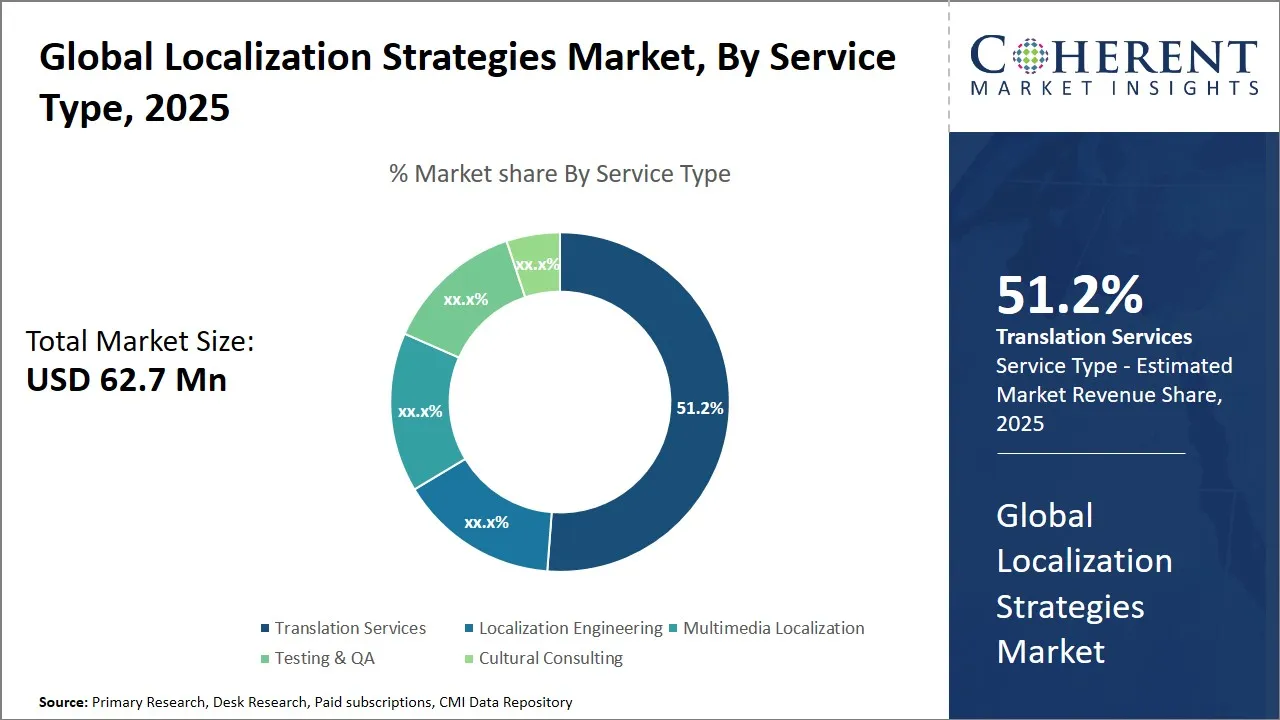
- The translation services segment is expected to lead the market holding a share of 52.2 % in 2026.
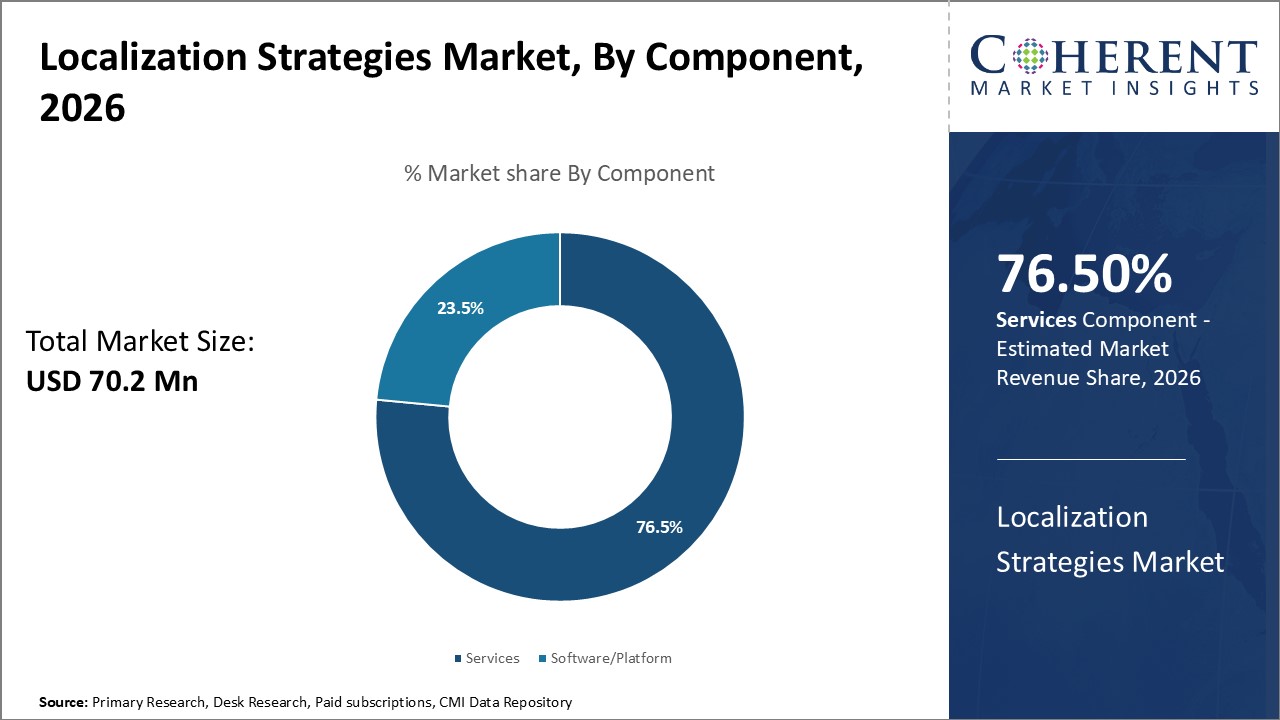
- The services segment dominates with an estimated share of 76.5 % in 2026.
- The large enterprises segment leads the market holding an estimated share of 63.3 % in 2026.
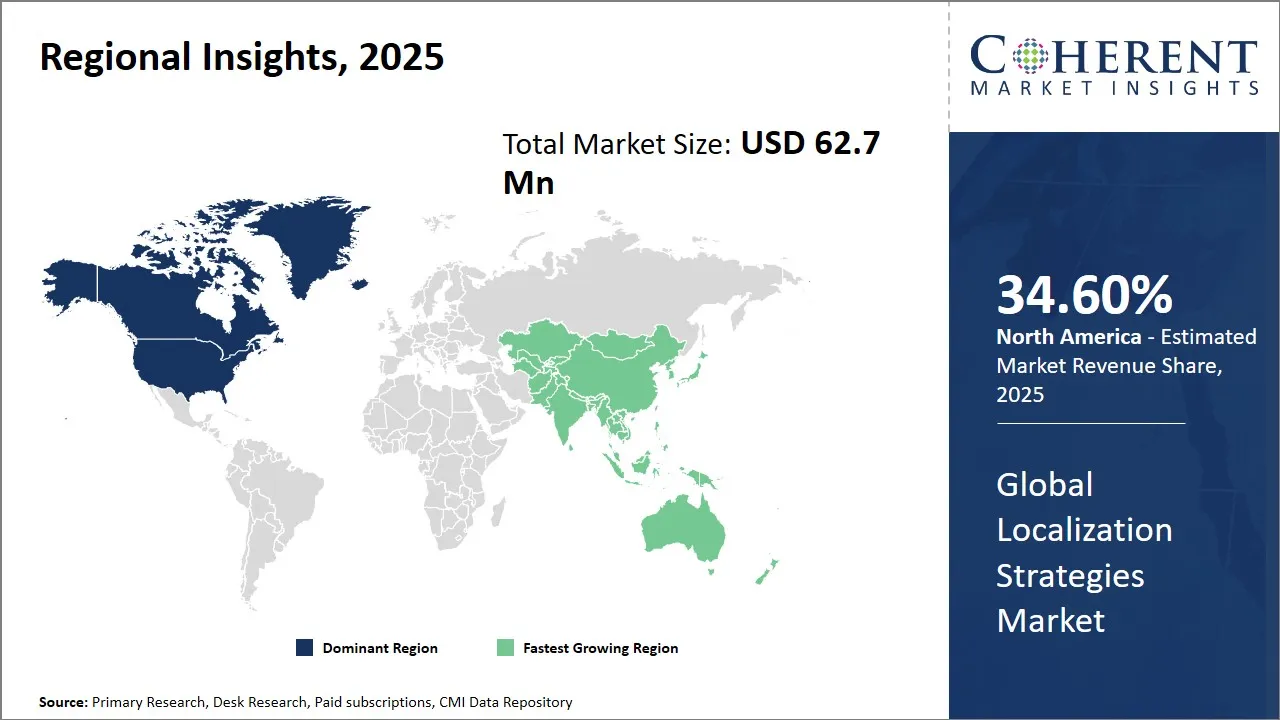
- North America, holding a projected share of 34.6 % in 2026, is expected to dominate the market.
- Asia Pacific, holding an estimated share of 25.3% in 2026, shows the fastest growth in the market.
Market Overview
A key trend in the localization strategies market is the rising integration of advanced technologies such as artificial intelligence and machine learning to enhance translation accuracy and speed. Also, there is a lot of emphasis on personalized content and user experience, enabling companies to engage local audiences more effectively. This shift is further supported by expanding digital transformation initiatives and the proliferation of e-commerce, creating immense opportunities for localization service providers to innovate and capture greater market share.
Current Events and Its Impact
Current Events | Description and its Impact |
Geopolitical and Trade Developments |
|
Segmental Insights
- Current Industry Events of 2026
- Market Size Estimation
- Regional Breakdown
- Competitive Landscape
- Customer Intelligence
- Segmental Analysis
- Pricing Analysis
- Key Market Drivers, Challenges & Future Trends
- Customized Insights Section
Global Localization Strategies Market Insights, By Service Type – Translation Services Lead with Increasing Cross-Border Communication Needs
Translation services are expected to hold the largest market share of 52.2% in 2026, due to surging cross-border communication needs. As global digital commerce expands, companies require culturally precise translations to connect with local audiences. AI and human post-editing improve speed and accuracy, particularly in regulated industries like healthcare and finance. For instance, TransPerfect’s partnership with Spotify in 2024 to deliver multilingual lyric translations and localized podcast metadata shows the growing use of AI-driven translation in cultural adaptation.
Global Localization Strategies Market Insights, By Component – Services Segment Dominates Because of End-to-End Localization Needs
The services segment is projected to capture 76.5% share in 2026, showing demand for full-spectrum localization that includes linguistic, cultural, and technical support. Businesses seek tailored workflows and consulting to ensure compliance and cultural relevance. For instance, RWS Group’s “End-to-End Global Experience Suite” offering translation, testing, and UX localization under one platform shows the trend of comprehensive service ecosystems.
Global Localization Strategies Market Insights, By Enterprise Size – Large Enterprises Drive Localization Using Comprehensive Strategies
Large enterprises are expected to account for 63.3% share in 2026, because of their global reach and need for brand consistency in different markets. They use advanced technologies and strategic vendor partnerships to ensure scalable localization. For instance, Microsoft invested in AI-assisted localization infrastructure in September 2026 to streamline multilingual software rollouts in 80+ regions.
Pricing Analysis of the Localization Strategies Market
Service/Product | Typical price (USD) | Unit/notes (concise) |
Human translation — common language pairs (e.g., EN–ES, EN–FR) | USD 0.10 – USD 0.20 | Per word (target or source depending on vendor). Typical for general/website content. |
Human translation — specialized (legal, medical, technical) | USD 0.18 – USD 0.35 | Per word (higher due to expertise, certification). |
Machine Translation — Google Cloud Translate (pay-as-you-go) | USD 20.00 | Per 1,000,000 characters (standard API rate; volume discounts may apply). |
Machine Translation — Microsoft/Azure Translator | USD 10.00 (typical public rate) | Per 1,000,000 characters (Azure often lists lower entry pricing/free tier up to limits). |
Machine Translation — DeepL (API Pro) | USD 25.00 | Per 1,000,000 characters (DeepL API Pro pay-as-you-go/flat + usage). |
MT Post-Editing (light/full) | USD 0.04 – USD 0.14 | Per word (Light PE ≈ 40–50% of human translation; Full PE ≈ 50–70% of human rate). Example: if human = USD 0.12/word → MTPE ≈ USD 0.05–USD 0.08. |
Linguistic QA (LQA)/Proofreading | USD 0.02 – USD 0.08 | Per word, or USD 30–USD 80 per hour (depends on depth and vendor). |
Subtitling/Captioning | USD 12.00 – USD 22.00 | Per minute of video (basic subtitling). More for complex timing/SDH/creative subtitles. |
Closed captions (automated + human QC) | USD 1.99 – USD 12.00 | Per minute (consumer services like Rev start ~USD 1.99/min for simple captions; premium workflows higher). |
Human dubbing/professional dubbing | USD 40.00 – USD 300.00 | Per minute finished audio (small-cast projects at low end; premium cast + studio + licensing at high end). |
AI Dubbing/synthetic voice dubbing | USD 1.00 – USD 30.00 | Per minute (low-cost automated services USD 1–USD 10; more advanced/custom voices or studio-grade output USD 20–USD 30+/min). |
TMS/Localization SaaS — entry/team tier (e.g., Lokalise) | USD 120 – USD 825 | Per month (starter → pro tiers; seat/hosted keys limits apply). Annual billing typically cheaper. |
TMS/Localization SaaS — enterprise (Smartling/custom) | USD Custom (typical enterprise engagements: USD 1,000 – USD 10,000+/month or custom annual contracts) | Enterprise plans are usually custom-priced (volume, connectors, SLA, onboarding, services). Smartling lists per-word service anchors too. |
Localization Project Management/PM | USD 40 – USD 85 | Per hour (in-house PM salary-equivalent or agency PM hourly rate; US PMs near USD 50–USD 80/hr). |
Enterprise MT/Customization & deployment (one-off) | USD 10,000 – USD 250,000+ | Project-based (custom MT model training, data cleaning, on-prem or private endpoint, enterprise SLAs) — price varies hugely with scope. |
Localization retainer/managed services (mid-market) | USD 3,000 – USD 25,000+ | Per month (managed localization programs covering recurring volumes, vendor management, engineering). |
Regional Insights
North America Localization Strategies Market Analysis and Trends
North America, holding an estimated share of 34.6% in 2026, dominates the global localization strategies market because of the region’s well-established technology infrastructure and the presence of a large number of multinational corporations requiring extensive localization efforts. The sophisticated market ecosystem, seeing advanced IT services, digital marketing firms, and translation technology providers, makes a lot of demand for localization solutions. U.S. government policies supporting innovation and digital transformation add to the market growth, especially through initiatives promoting technology adoption across industries.
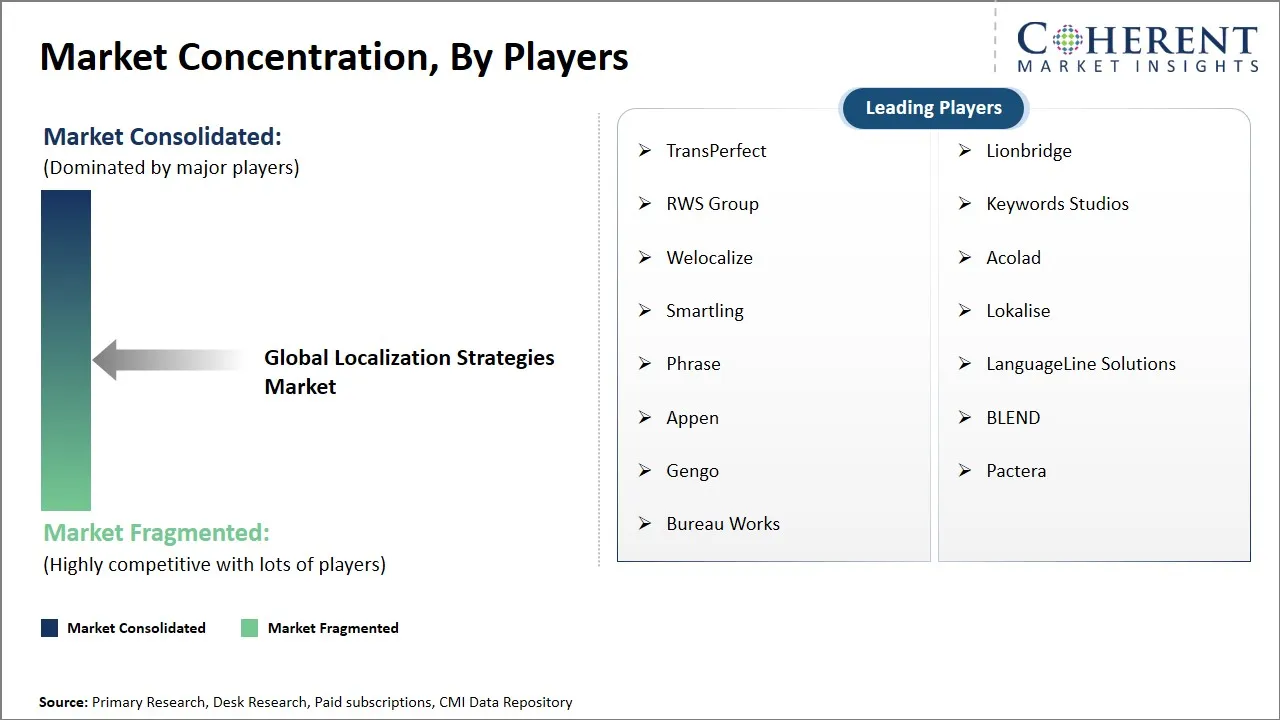
Trade dynamics, including robust international business ties and a huge volume of cross-border e-commerce, make continuous opportunities for localization. Big companies headquartered here such as Lionbridge, TransPerfect, and SDL (now part of RWS) have significantly contributed by pioneering advanced localization technologies and offering comprehensive language service platforms that cater to diverse industry verticals.
Asia Pacific Localization Strategies Market Analysis and Trends
The Asia Pacific region, holding a projected share of 25.3% in 2026, shows the fastest growth in the localization strategies market because of fast digital adoption, expanding internet penetration, and increasing globalization of businesses in emerging economies such as India, China, and Southeast Asian countries. The growing market ecosystem includes startups and established firms focusing on localization services paired with AI and machine learning capabilities, catering to a diverse linguistic and cultural landscape. Leading players like Pactera EDGE and Keywords Studios have made their positions stronger by offering region-specific solutions and using local talent pools.
Global Localization Strategies Market Outlook for Key Countries
U.S. Localization Strategies Market Analysis and Trends
The U.S. localization strategies market continues to lead with a huge presence of global language service providers and advanced technological capabilities. Big corporations in healthcare, IT, finance, and entertainment sectors invest in localization to reach diverse global audiences. Companies like TransPerfect and Lionbridge add to innovation with AI-driven translation tools and enterprise-level solutions, allowing seamless market entry for U.S. businesses abroad.
Germany Localization Strategies Market Analysis and Trends
Germany localization strategies market sees strong industrial and manufacturing sectors, including automotive and engineering, which need precise and culturally-appropriate localization strategies to stay competitive in global markets. The country’s focus on quality and compliance standards makes demand for specialized language services and localization expertise. Companies like RWS and SDL (RWS) have huge operations here, providing solutions that meet the demands of German enterprises. Also, supportive EU regulations on data privacy and cross-border trade make a supportive environment for localization investment.
China Localization Strategies Market Analysis and Trends
China localization strategies market is rapidly expanding, propelled by the country’s growing export-oriented economy and a booming digital entertainment sector focused on global outreach. The government’s digital transformation strategies and initiatives like “Made in China 2026” push enterprises to adopt robust localization frameworks to enter foreign markets effectively. The increasing number of international partnerships and e-commerce activities make demand for customized content and product adaptation. Leading firms like Pactera EDGE localize huge quantities of data and digital content, playing a big role in navigating the linguistic and cultural complexity of China’s vast market.
India Localization Strategies Market Analysis and Trends
India’s localization landscape sees a diverse linguistic profile and rising IT and software development industries. Government policies pushing digital literacy and startup ecosystems have made localization needs, particularly in sectors such as education, mobile applications, and e-commerce. The proliferation of regional languages online drives demand for nuanced localization rather than mere translation. Companies such as Infosys and Tata Consultancy Services utilize their in-house language technology divisions to offer scalable, AI-enabled localization services, fostering global expansion for Indian enterprises.
Brazil Localization Strategies Market Analysis and Trends
Brazil localization strategies market exhibits growing localization demand primarily due to its expanding e-commerce and media industries catering to the Latin American region. The multilingual composition and cultural diversity within Brazil emphasize the importance of customized localization strategies targeting Portuguese as well as other regional languages. Trade relations within South America and with global partners necessitate accurate market adaptations. Local and multinational companies like SDL and local firms collaborate to provide content adaptation and compliance-related localization services, which help businesses effectively engage the region’s dynamic consumer base.
Market Players, Key Development, and Competitive Intelligence
Key Developments
- In June 2025, RWS, a content solutions company powered by technology and human expertise, acquired the intellectual property behind Papercup’s breakthrough AI dubbing technology – known for its unique ability to reproduce a speaker’s tone, pace and emotion faithfully.
- In November 2024, Canada Pension Plan Investment Board (CPP Investments), alongside EQT and Temasek, completed the acquisition of Keywords Studios, the leading international video games service provider.
- In August 2024, Phrase, a world leader in AI-led translation technology, and Welocalize, a prominent provider of translation and global content solutions, announced the expansion of their partnership. This strategic alliance will enhance the integration between the two companies’ technology solutions.
- In August 2023, Smartling was named the best machine translation solution in the natural language processing category for the 2023 AI Breakthrough Awards.
Top Strategies Followed by Localization Strategies Market Players
- Established industry leaders invest a lot in research and development (R&D) to drive innovation and develop high-performance localization products that meet the evolving needs of global clients.
- RWS Group, invested a lot in AI-based translation and automation technologies.
- Mid-level players in the localization strategies market position themselves by offering cost-effective solutions that strike a balance between quality and affordability.
- Lokalise, a growing SaaS-based localization platform, offers flexible, tiered subscription pricing (USD 120–USD 825/month) and API-based automation tools aimed at startups and SMBs seeking affordable but efficient localization management.
- Small-scale players operate in a distinct niche within the global localization strategies market by concentrating on specialized features or introducing innovative products addressing very specific customer needs.
- Andovar, a smaller LSP, specializes in gaming and e-learning localization, focusing on culturally adaptive content and voiceover quality to serve a niche market.
Market Report Scope
Localization Strategies Market Report Coverage
| Report Coverage | Details | ||
|---|---|---|---|
| Base Year: | 2025 | Market Size in 2026: | USD 70.2 Mn |
| Historical Data for: | 2020 To 2024 | Forecast Period: | 2026 To 2033 |
| Forecast Period 2026 to 2033 CAGR: | 12.0% | 2033 Value Projection: | USD 155.2 Mn |
| Geographies covered: |
| ||
| Segments covered: |
| ||
| Companies covered: | TransPerfect, Lionbridge, RWS Group, Keywords Studios, Welocalize, Acolad, Smartling, Lokalise, Phrase, LanguageLine Solutions, Appen, BLEND, Gengo, Pactera, and Bureau Works | ||
| Growth Drivers: |
| ||
| Restraints & Challenges: |
| ||
Market Dynamics
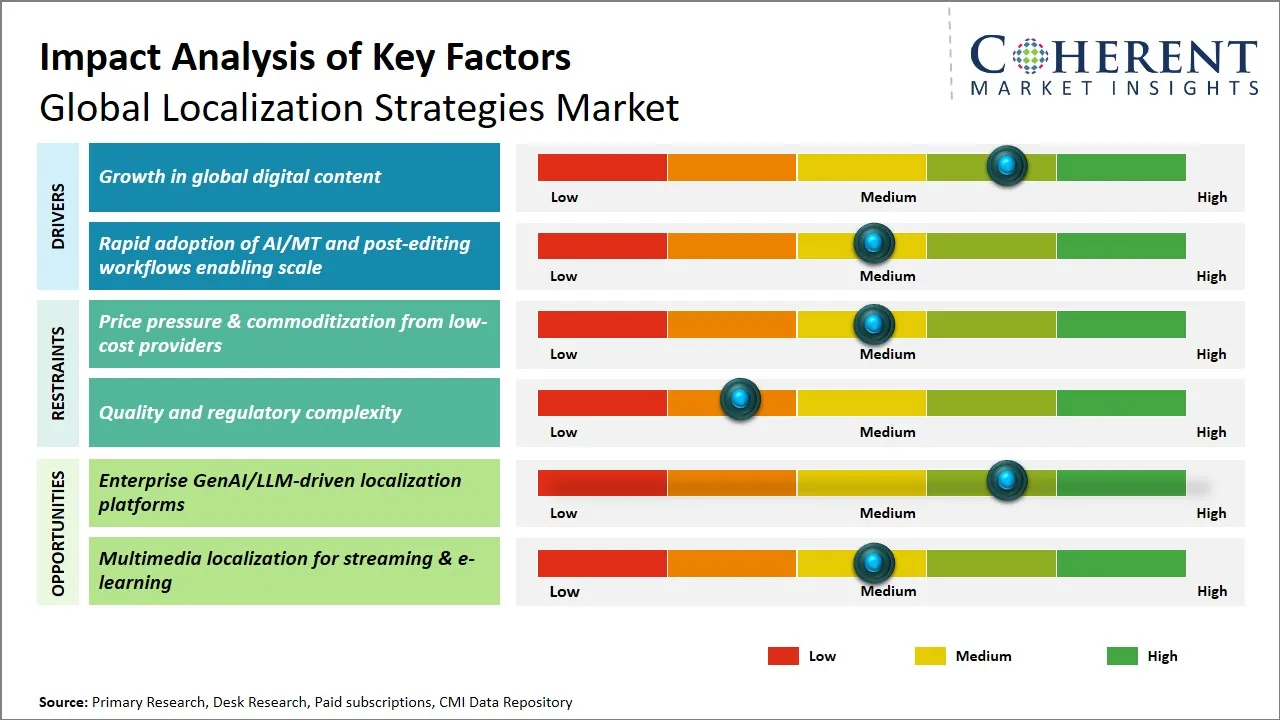
Global Localization Strategies Market Driver – Growth in Global Digital Content
The rapid proliferation of digital content across various platforms and regions is a major driver shaping the global localization strategies market. As businesses increasingly operate in diverse international markets, they generate vast volumes of digital assets, including websites, mobile applications, multimedia, social media posts, and e-commerce catalogs, all of which require adaptation to local languages, cultures, and regulatory environments. This surge in global digital content necessitates sophisticated localization strategies to ensure relevance and engagement with target audiences.
Moreover, the growing importance of personalized user experiences compels companies to tailor content precisely to regional preferences, idioms, and cultural nuances, which cannot be achieved through mere translation. Additionally, emerging digital formats, such as interactive videos, gaming content, and augmented reality, demand more intricate localization efforts, further amplifying the need for comprehensive strategies. Consequently, the exponential growth and diversification of digital content worldwide directly stimulate investments in advanced localization solutions to enhance global outreach and customer connection.
Global Localization Strategies Market Opportunity – Enterprise GenAI/LLM-Driven Localization Platforms
The emergence of enterprise-grade Generative AI (GenAI) and large language models (LLMs) represents a significant opportunity within the global localization strategies market. These advanced AI technologies enable companies to automate and enhance the localization process by providing highly accurate, context-aware translations and culturally relevant content adaptations at scale. With GenAI/LLM-driven platforms, enterprises can achieve faster turnaround times and cost efficiencies while maintaining or improving the quality and consistency of localized materials across multiple languages and regions. This capability is particularly beneficial for industries such as technology, e-commerce, gaming, and entertainment, where rapid market entry and continual content updates are imperative.
Moreover, these platforms offer adaptive learning features, meaning they improve over time by incorporating user feedback and domain-specific data, which further refines translation accuracy and localization nuance. The integration of AI-powered localization tools also facilitates seamless collaboration among global teams, enabling more agile responses to market demands and localized customer expectations. As organizations increasingly embrace digital transformation and omnichannel strategies, the reliance on sophisticated AI-driven localization platforms is set to grow, presenting a lucrative avenue for solution providers and service vendors aiming to capture market share in this evolving ecosystem.
Analyst Opinion (Expert Opinion)
- The global boom in streaming platforms, cross-border entertainment, and user-generated content is significantly increasing the need for high-quality subtitling, dubbing, and voice localization. As audiences seek regionally tailored experiences, media producers are investing more in linguistically and culturally accurate content. This trend is expanding opportunities for LSPs specializing in audiovisual localization, pushing companies to integrate AI dubbing and automated subtitle synchronization technologies to handle massive content volumes efficiently.
- International media consumption is reshaping localization from mere translation to cultural adaptation. Viewers now expect content that feels native to their culture—driving demand for services such as transcreation, cultural consulting, and regional storytelling adaptation. This shift favors providers that combine linguistic expertise with creative localization skills, prompting major players like TransPerfect, RWS, and Keywords Studios to expand creative teams and invest in AI-enhanced cultural modeling tools.
- The volume and pace of global media releases require faster turnaround times than traditional workflows allow. As a result, studios and LSPs are rapidly integrating machine translation, neural dubbing, and AI-assisted editing into production pipelines. This hybrid model—where AI handles initial drafts and human experts ensure contextual and emotional fidelity—is reducing costs and turnaround times by up to 40–60%, enabling broader language coverage and opening access to previously under-served markets in Asia Pacific, the Middle East, and Africa.
Speak to the analyst
Want personalized insights?
Take the findings above to one of our principal consultants, or have the report rebuilt around the segments, geographies and competitors you actually track.
Market Segmentation
- Service Type Insights (Revenue, USD Mn, 2021 - 2033)
- Translation Services
- Localization Engineering
- Multimedia Localization
- Testing & QA
- Cultural Consulting
- Component Insights (Revenue, USD Mn, 2021 - 2033)
- Services
- Software/Platform
- Enterprise Size Insights (Revenue, USD Mn, 2021 - 2033)
- Large Enterprises
- SMEs
- Startups/Digital-first
- Deployment Mode Insights (Revenue, USD Mn, 2021 - 2033)
- Cloud-based
- On-premise
- Hybrid
- Industry Vertical Insights (Revenue, USD Mn, 2021 - 2033)
- IT & Telecom
- Media & Entertainment
- E-commerce & Retail
- Healthcare & Life Sciences
- Education & E-learning
- Others
- Regional Insights (Revenue, USD Mn, 2021 - 2033)
- North America
- U.S.
- Canada
- Latin America
- Brazil
- Argentina
- Mexico
- Rest of Latin America
- Europe
- Germany
- U.K.
- Spain
- France
- Italy
- Russia
- Rest of Europe
- Asia Pacific
- China
- India
- Japan
- Australia
- South Korea
- ASEAN
- Rest of Asia Pacific
- Middle East
- GCC Countries
- Israel
- Rest of Middle East
- Africa
- South Africa
- North Africa
- Central Africa
- North America
- Key Players Insights
- TransPerfect
- Lionbridge
- RWS Group
- Keywords Studios
- Welocalize
- Acolad
- Smartling
- Lokalise
- Phrase
- LanguageLine Solutions
- Appen
- BLEND
- Gengo
- Pactera
- Bureau Works
Sources
Primary Research Interviews
Stakeholders
- Localization Service Providers
- Technology Vendors
- Multimedia Localization Specialists
- AI and Machine Translation Solution Developers
- Global Marketing and Content Managers from Multinational Corporations
- Cultural Adaptation and Transcreation Experts
- Media & Entertainment Localization Directors
- Regional SMEs utilizing SaaS-based localization platforms
Databases
- International Trade Administration (ITA)
- United Nations Educational, Scientific and Cultural Organization (UNESCO)
- World Intellectual Property Organization (WIPO)
- Global Digital Content Observatory (GDCO)
- OECD Digital Economy Database
- International Telecommunication Union (ITU)
- World Economic Forum – Digital Transformation Insights
Magazines
- Global Content Review
- Language Industry Today
- AI in Media & Localization
- The Globalization Insider
- Translation & Technology Digest
- Digital Content Business Weekly
Journals
- Journal of Language Technology and Localization
- International Journal of Translation Studies and Applied Linguistics
- AI & Society: Global Communication Edition
- Journal of Digital Media Localization
- Computational Linguistics and Cross-Cultural Communication Journal
- Global Media Studies Review
Newspapers
- The Business Standard (International Edition)
- The Global Tech Post
- The Economic Times (India)
- The Guardian (U.K.)
- Nikkei Asia
- The Wall Street Herald (Technology Section)
Associations
- Globalization and Localization Association (GALA)
- Translators Without Borders (TWB)
- European Language Industry Association (ELIA)
- American Translators Association (ATA)
- Localization Professionals Network (LPN)
- Asia-Pacific Translation and Localization Association (APTLA)
- Media Localization Council (MLC)
Public Domain Sources
- U.S. Census Bureau
- EUROSTAT
- UNESCO Institute for Statistics (UIS)
- World Bank – Digital Economy Indicators
- OECD – AI and Globalization Reports
- World Trade Organization (WTO)
- ResearchGate
- United Nations Conference on Trade and Development (UNCTAD)
Proprietary Elements
- CMI Data Analytics Tool, Proprietary CMI Existing Repository of Information for Last 8 Years
Get access to 250+ pages report
Every segment, forecast, competitor profile and data table behind the analysis above — available for instant download.
- ESOMAR Member
- ISO 9001:2015 Certified
- D-U-N-S Registered
- GDPR & CCPA Compliant
Missing comfort of reading report in your local language? Find your preferred language:
Transform your Strategy with Exclusive Trending Reports
Frequently Asked Questions
The global localization strategies market is estimated to be valued at USD 70.2 million in 2026 and is expected to reach USD 155.2 million by 2033.
The CAGR of the global localization strategies market is projected to be 12.0% from 2026 to 2033.
Growth in global digital content and rapid adoption of AI/MT and post-editing workflows enabling scale are the major factors driving the growth of the global localization strategies market.
Price pressure & commoditization from low-cost providers and quality and regulatory complexity are the major factors hampering the growth of the global localization strategies market.
In terms of service type, the translation services is estimated to dominate the market revenue share in 2026.
It encompasses services and technologies that adapt content, products, and media for different languages, regions, and cultures to enhance accessibility and engagement.
They are enabling faster, more cost-efficient multilingual content delivery through neural machine translation and automated QA tools.