

Global Ocean Drones Market Size and Forecast – 2026-2033
The global ocean drones market is estimated to be valued at USD 10.12 Bn in 2026 and is expected to reach USD 29.12 Bn by 2033, exhibiting a compound annual growth rate (CAGR) of 16.3% from 2026 to 2033.
Key Takeaways of the Global Ocean Drones Market
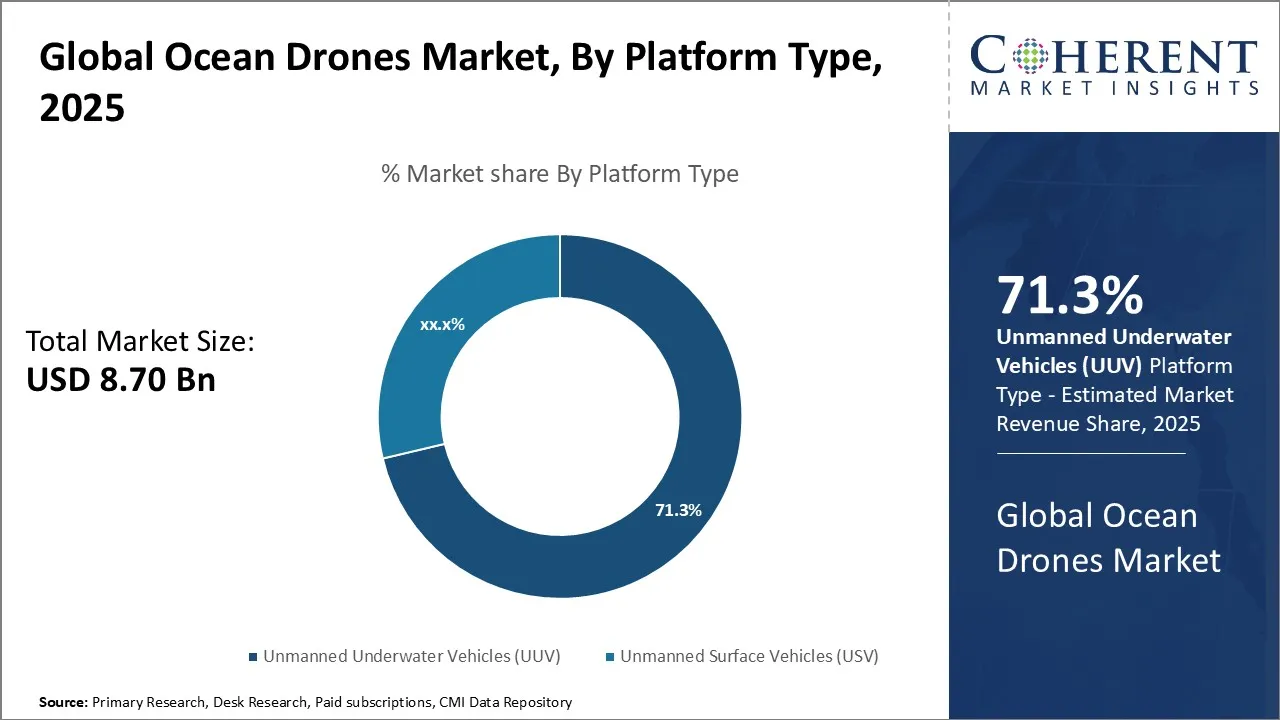
- The Unmanned Underwater Vehicles (UUV) segment leads the market holding an estimated share of 72.3% in 2026.
- The Remotely Operated Vehicles (ROV) segment is projected to dominate with a share of 65.1% in 2026.
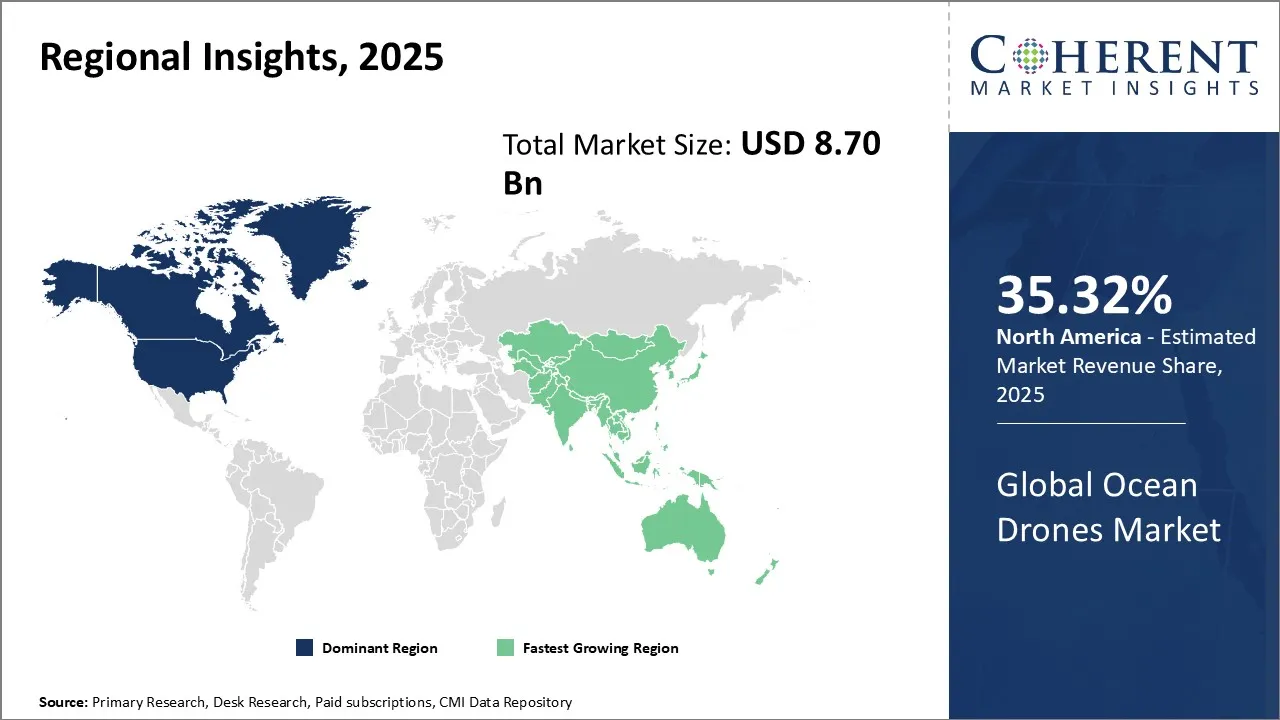
- North America is anticipated to lead the market, holding a share of 35.32% in 2026. Asia Pacific is expected to show the fastest growth, accounting for 30.21% of the market share in 2026.
Market Overview
The market is seeing the use of artificial intelligence and machine learning in ocean drones, making possible autonomous navigation and improved data analytics. Additionally, rising investments in ocean exploration and growing focus on sustainable marine practices are fueling innovation. The increasing need for real-time oceanographic data and the expansion of commercial opportunities in underwater inspection and resource mapping are further accelerating the market growth globally.
Current Events and their Impact
Current Events | Description and its impact |
Geopolitical and Trade Developments |
|
Economic and Industrial Trends |
|
Segmental Insights
- Current Industry Events of 2026
- Market Size Estimation
- Regional Breakdown
- Competitive Landscape
- Customer Intelligence
- Segmental Analysis
- Pricing Analysis
- Key Market Drivers, Challenges & Future Trends
- Customized Insights Section
Global Ocean Drones Market Insights, by Platform Type – Unmanned Underwater Vehicles (UUV) Lead Because of their Underwater Capabilities and Versatile Applications
Unmanned Underwater Vehicles (UUVs), holding a projected share of 72.3% in 2026, dominates the global ocean drones market because of their unparalleled ability to perform complex underwater tasks that are otherwise dangerous, time-consuming, or impossible for human divers. A big factor adding to the growth of UUVs is their high use in offshore industries like oil and gas exploration, underwater infrastructure inspection, and deep-sea mining. These vehicles give accurate data, including high-resolution sonar imaging, subsea mapping, and environmental monitoring.
Another big growth driver is the advancement in sensor technologies and battery life, which has improved UUV endurance and operational depth. Modern UUVs can now operate autonomously for extended periods, reaching deeper oceanic regions to get real-time data with high accuracy and reliability. This technological progression has expanded the scope of UUV applications beyond commercial uses to scientific research, defense and surveillance, and environmental conservation. The Kongsberg HUGIN AUV is used for deep-sea mapping, offshore oil & gas inspection, and military mine countermeasure operations.
The growing concerns about marine pollution and the ecological impact of underwater activities have also played a big role in the UUV segment growth. Governments and private entities are investing a lot in UUVs for underwater inspections and monitoring to ensure regulatory compliance and reduce environmental damage. Also, the military’s adoption of UUVs for surveillance, mine detection, and anti-submarine warfare also adds to segment growth. Cost-efficiency and operational safety are advantages adding to the preference for UUVs. These vehicles reduce the need for manned underwater missions, minimizing risks to human life and lowering operational costs of underwater exploration or inspections. UUVs can autonomously carry out repetitive tasks without fatigue, which adds to their value in industrial applications.
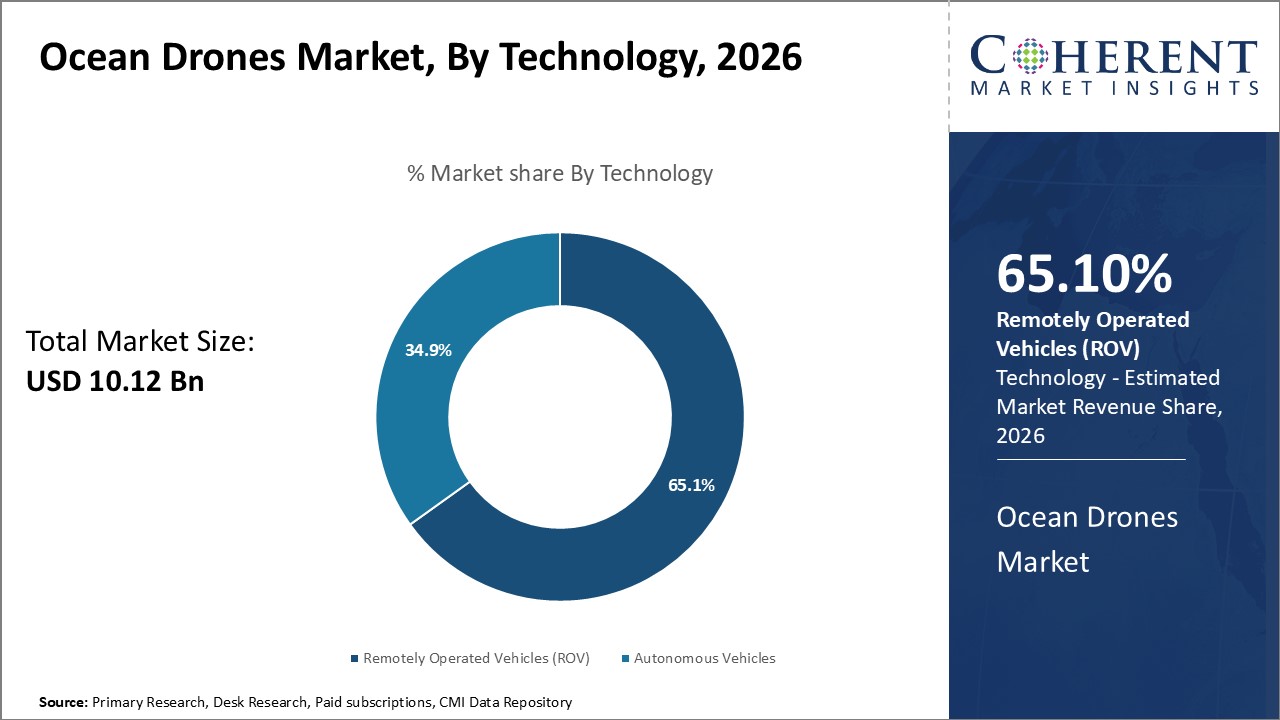
Global Ocean Drones Market Insights, by Technology – Remotely Operated Vehicles (ROV) Leads Because of their Control and Reliability in Complex Underwater Operations
Remotely Operated Vehicles (ROV) hold an estimated share of 65.1% of the global ocean drones market share in 2026 because they include real-time human control and supervision, which ensures accuracy and adaptability during complex underwater missions. The key factor driving the prominence of ROVs is their extensive acceptance in industries requiring meticulous and immediate intervention, particularly offshore oil & gas exploration, subsea construction, and underwater maintenance. ROVs are connected with a control station, allowing operators to navigate complex underwater environments and respond dynamically to different situations. This real-time interaction capability makes ROVs the preferred choice for tasks involving delicate equipment handling, deep-water repair, and installation activities where precision and responsiveness are critical.
The Saildrone Explorer USV/UUV hybrid is used for environmental monitoring, climate research, and fisheries assessment. By remotely piloting these vehicles, human operators can avoid hazardous underwater scenarios like high-pressure environments, malware-infested waters, or unstable seabeds. This removes unnecessary risk to human divers while allowing continuous, detailed surveillance and operational work. Technological improvements in imaging systems, manipulator arms, and communication links have added to the appeal of ROVs. High-definition cameras, sonar imaging, and real-time data transmission capabilities empower operators with unparalleled situational awareness. These improvements allow effective inspection, maintenance, and data acquisition in various underwater infrastructure projects, ensuring minimal downtime and better risk mitigation.
Also, the ROV segment grows owing to its established presence and proven reliability. Their adaptability also makes integration with other marine technologies easier, making a comprehensive ecosystem for efficient oceanic operations. ROVs’ ability to sustain prolonged missions, combined with the ease of operational control, positions them favorably, especially for government agencies and commercial enterprises invested in underwater exploration and resource management.
Pricing Analysis of the Ocean Drones Market
Drone Type | Price Range (USD) | Typical Applications |
Entry-Level AUVs | USD 50,000 – USD 250,000 | Academic research, shallow water surveys |
Mid-Range AUVs | USD 250,000 – USD 500,000 | Environmental monitoring, offshore inspections |
High-End AUVs | USD 500,000 – USD 1,000,000+ | Military defense, deep-sea exploration |
Light Work-Class ROVs | USD 50,000 – USD 150,000 | Shallow water inspections, aquaculture monitoring |
Heavy Work-Class ROVs | USD 150,000 – USD 500,000+ | Deep-sea oil & gas infrastructure, subsea construction |
Entry-Level USVs | USD 3,000 – USD 15,000 | Academic research, small-scale monitoring |
Mid-Range USVs | USD 15,000 – USD 50,000 | Environmental monitoring, coastal surveillance |
High-End USVs | USD 50,000 – USD 200,000+ | Military defense, large-scale oceanographic surveys |
Specialized USVs (e.g., Metal Shark HSMUSV) | Below USD 500,000 | Autonomous naval operations, rapid deployment |
Wave Gliders (Hybrid USV-AUV) | ~USD 200,000 | Oceanographic research, data collection |
Regional Insights
North America Ocean Drones Market Analysis and Trends
North America, holding a projected share of 35.32% in 2026, dominates the global ocean drones market because of the convergence of advanced technology infrastructure, substantial government support, and the presence of numerous leading marine technology companies. The U.S. and Canada have made a strong ecosystem for ocean drone innovation, supported by defense contracts, environmental monitoring initiatives, and private sector investments.
Government policies for maritime security, offshore resource exploration, and environmental conservation have added to the use of Autonomous Underwater Vehicles (AUVs) and surface drones. Also, North America has big industry players like Teledyne Marine, Boeing, and General Dynamics which adds a lot to innovation in ocean drone capabilities like long endurance, precision sensing, and data analytics. The integration of strong research institutions with industrial applications further secures North America’s leading position.
Asia Pacific Ocean Drones Market Analysis and Trends
The Asia Pacific region, holding a share of 30.21% is expected to exhibit the fastest growth in the ocean drones market due to ongoing maritime economic expansion, increasing offshore infrastructure projects, and strategic government initiatives promoting smart ocean technologies. Countries like China, Japan, South Korea, and India are investing a lot of in ocean drones to support fisheries management, offshore oil and gas exploration, maritime security, and scientific research.
The fast growing manufacturing capabilities and supportive trade policies in this region make possible cost-effective production and deployment of ocean drones, improving accessibility for commercial and governmental users. Prominent companies such as ECA Group (France-based but with strong APAC presence), Kongsberg Maritime (Norway-based with operations in Asia), and local firms like China’s QYSEA and Japan’s Mitsubishi Electric are actively contributing to market expansion by tailoring products to regional needs and collaborating with government research bodies.
Global Ocean Drones Market Outlook for Key Countries
U.S. Ocean Drones Market Analysis and Trends
The U.S. is characterized by strong government funding, especially in defense and oceanographic research. Agencies like the Navy, NOAA, and NASA collaborate closely with industry leaders such as Teledyne Marine and Bluefin Robotics to develop and deploy both autonomous underwater vehicles and surface drones for varied applications including surveillance, environmental monitoring, and scientific exploration. The advanced technological ecosystem and well-established supply chains in the U.S. enable rapid innovation. Also, partnerships between startups and established defense contractors are adding to the use of AI and advanced sensor technologies, securing the U.S. a competitive edge in ocean drone capabilities.
China Ocean Drones Market Analysis and Trends
China ocean drones market continues to grow fast because of focus on maritime domain awareness and offshore resource management. Big investments by government bodies like the China Maritime Safety Administration, combined with strong manufacturing bases, enable local companies such as QYSEA and EHang to develop ocean drones suited for both commercial and security purposes. China’s Belt and Road maritime initiatives also add to adoption of ocean drone technologies for infrastructure monitoring and oceanographic data collection, adding to market penetration. The country’s growing R&D infrastructure and exports to neighboring Southeast Asian markets makes its position in the Asia Pacific landscape stronger.
Japan Ocean Drones Market Analysis and Trends
Japan continues to lead in precise and reliable ocean drone technology, supported by its advanced electronics industry and maritime research institutions. Companies like Mitsubishi Electric and Japan Marine United contribute by using sophisticated robotics and sensor systems made for fisheries management, disaster prevention, and environmental conservation. Japan’s focus on high-quality manufacturing and collaboration with European and North American firms makes its innovative output stronger.
India Ocean Drones Market Analysis and Trends
India ocean drones market shows significant growth potential propelled by increasing government initiatives focused on coastal surveillance, disaster management, and offshore exploration. The Indian government’s ‘Blue Economy’ program focuses on technological improvement at sea, pushing partnerships between public research organizations and private players. Indian startups and defense manufacturers are working on making indigenous ocean drone technologies to support maritime security and resource mapping. Growing investments in port infrastructure and offshore energy sectors also make demand for autonomous ocean systems, making India a key emerging player in Asia Pacific.
U.K. Ocean Drones Market Analysis and Trends
The U.K. ocean drones market grows because of its rich maritime heritage, government R&D grants, and strong defense industry presence. Companies like Sonardyne and OceanScan contribute with innovative subsea sensor networks and autonomous solutions made for oil and gas, defense, and scientific sectors. The U.K.’s regulatory framework supporting unmanned maritime operations and its participation in international maritime research collaborations make a supportive environment for innovation and deployment. To add, the U.K.’s strategic location and trade relationships make possible testing and operational activities in the North Sea and beyond.
Market Players, Key Development, and Competitive Intelligence
Key Developments
- On October 2, 2025, a foundation created by Mr. Eric Schmidt, the former CEO of Google, will fund a project to send drone boats out into the rough ocean around Antarctica to collect data that could help solve a crucial climate puzzle.
- In July 2025, advanced technology and marine robotics company, Ocean Infinity successfully launched its innovative NeedleFish Uncrewed Surface Vessel (USV) at an official event with the Kuwaiti Coast Guard (KCG).
- In June 2025, Four Saildrone Voyager unmanned surface vehicles (USVs) were chosen for a three-month mission with the Danish Ministry of Defence Acquisition and Logistics Organisation (DALO). The deployment shows a big step forward in Denmark’s efforts to improve maritime domain awareness and operational readiness in the Baltic Sea region.
- In June 2025, Saildrone, in partnership with Meta, completed a deep-water cable route survey in the North Atlantic using the Saildrone Surveyor, a 20-meter uncrewed surface vehicle (USV). This project is a big milestone in the evolution of ocean survey technology, proving that autonomous platforms can deliver data quality and performance on par with traditional crewed survey vessels.
Top Strategies Followed by Ocean Drones Market Players
- Established players in the sector leverage substantial investments in research and development to drive continuous innovation, aiming to deliver high-performance ocean drones that meet the evolving demands of commercial, scientific, and defense applications.
- Kongsberg Maritime invested heavily in the HUGIN AUV line, incorporating advanced autonomy, sonar mapping, and deep-sea capabilities for defense and scientific applications.
- Mid-level players in the ocean drones market adopt a more cost-conscious strategy, targeting price-sensitive customer segments that require a balanced proposition between quality and affordability.
- Sea-Kit International offers mid-range USVs (~USD 50,000 – USD 200,000) that are affordable for commercial survey companies, while still providing robust capabilities for environmental and offshore monitoring.
- Small-scale players in the ocean drones market concentrate on specialized product features or breakthrough innovations that address unique operational challenges or niche segments within the broader marine ecosystem.
- Saildrone focuses on long-duration autonomous surface vehicles for oceanographic research and climate monitoring. Their niche emphasis on environmental data collection and research collaborations sets them apart from general-purpose drone manufacturers.
Market Report Scope
Global Ocean Drones Market Report Coverage
| Report Coverage | Details | ||
|---|---|---|---|
| Base Year: | 2025 | Market Size in 2026: | USD 10.12 Bn |
| Historical Data for: | 2020 To 2024 | Forecast Period: | 2026 To 2033 |
| Forecast Period 2026 to 2033 CAGR: | 16.3% | 2033 Value Projection: | USD 29.12 Bn |
| Geographies covered: |
| ||
| Segments covered: |
| ||
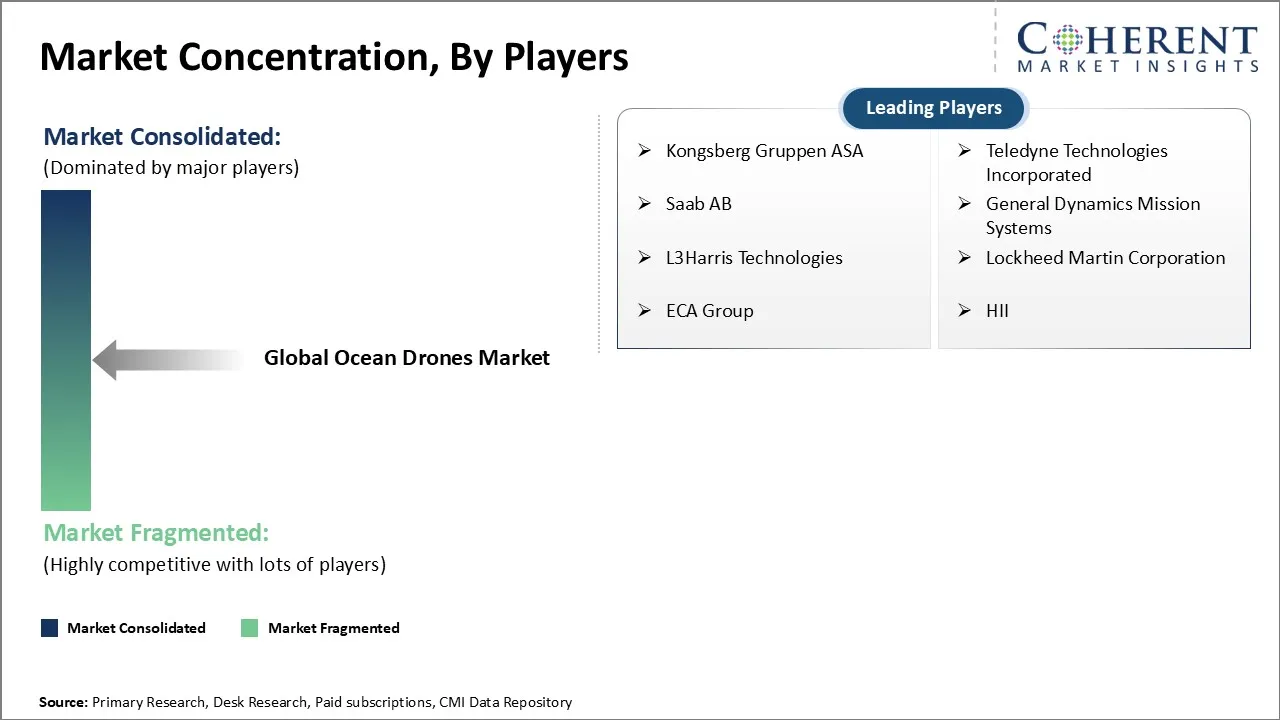
| Companies covered: | Kongsberg Gruppen ASA, Teledyne Technologies Incorporated, Saab AB, General Dynamics Mission Systems, L3Harris Technologies, Lockheed Martin Corporation, ECA Group, and HII | ||
| Growth Drivers: |
| ||
| Restraints & Challenges: |
| ||
Market Dynamics
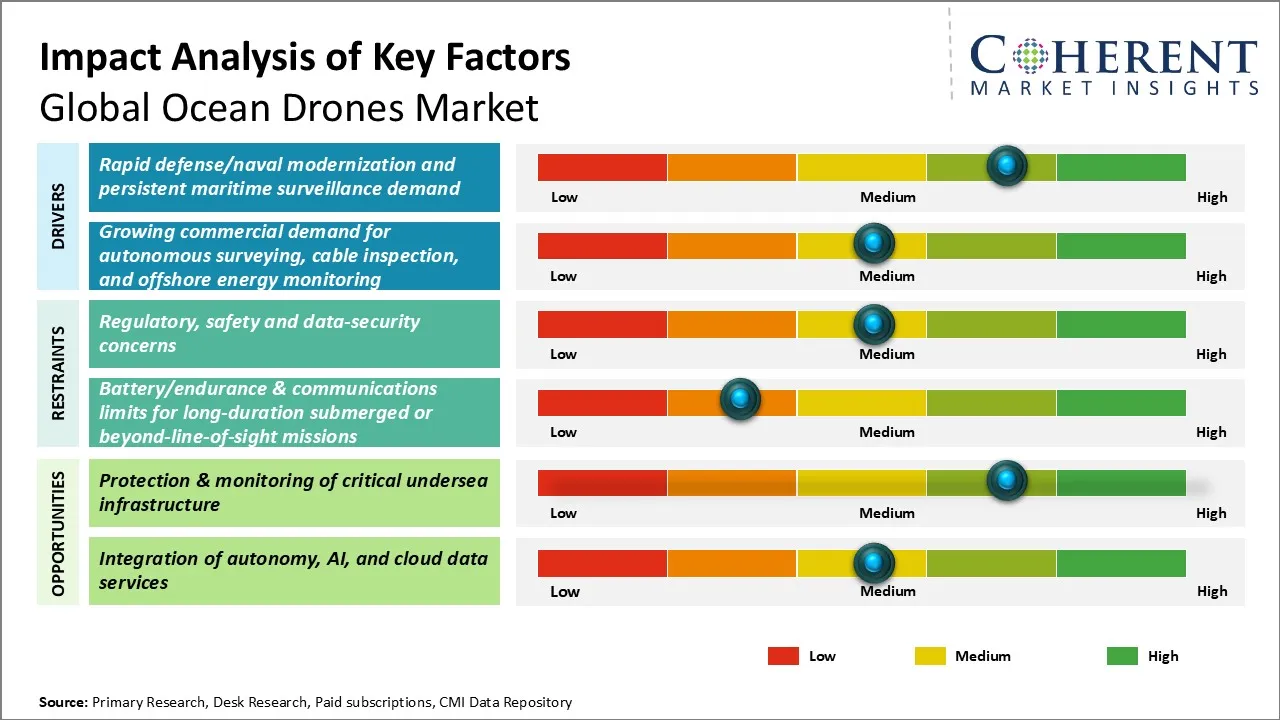
Global Ocean Drones Market Driver – Rapid Defense/Naval Modernization and Persistent Maritime Surveillance Demand
The accelerating pace of defense and naval modernization among global maritime powers is a significant driver propelling the adoption of ocean drones. As countries enhance their naval fleets with advanced vessels and integrate cutting-edge technologies, there is a corresponding emphasis on improving situational awareness and maritime domain awareness. Ocean drones, equipped with sophisticated sensors and autonomous capabilities, play a crucial role in persistent surveillance, enabling real-time monitoring of expansive oceanic territories without the limitations of manned missions.
These unmanned platforms support a variety of naval operations, including reconnaissance, anti-submarine warfare, mine detection, and coastal defense, thereby enhancing operational effectiveness while reducing risks to human personnel. Furthermore, geopolitical tensions and the need to secure territorial waters, crucial shipping lanes, and offshore assets drive continuous investment in ocean drone technology as a force multiplier. Consequently, the push for modernization in naval forces directly fuels increased demand for ocean drones to fulfill the critical requirement of persistent maritime surveillance.
Global Ocean Drones Market Opportunity – Protection & Monitoring of Critical Undersea Infrastructure
The global ocean drones market presents a significant opportunity in the protection and monitoring of critical undersea infrastructure, including subsea pipelines, communication cables, and offshore oil and gas facilities. As the volume of undersea assets continues to grow with expanding global energy needs and increasing data transmission demands, ensuring their integrity and security becomes paramount. Ocean drones equipped with advanced sensors and real-time data transmission capabilities can conduct regular inspections, detect anomalies such as leaks, corrosion, or physical damages, and monitor for potential security threats like unauthorized intrusions or sabotage. This capability allows for preventive maintenance, reducing the risk of costly downtime and environmental disasters.
Additionally, the increasing adoption of automation and remote monitoring systems in the marine and energy sectors enhances the appeal of ocean drones as a cost-effective and efficient solution compared to traditional manned underwater inspections, which are often time-consuming and hazardous. Governments and private enterprises are investing heavily in infrastructure resilience, further driving demand for innovative monitoring technologies. The incorporation of AI and machine learning in ocean drones enhances their ability to analyze complex underwater environments and provide predictive analytics, revolutionizing how critical undersea assets are managed and safeguarded. This evolving landscape creates a robust growth avenue for ocean drone manufacturers and service providers worldwide.
Analyst Opinion (Expert Opinion)
- Demand from naval forces and coast guards for surveillance, mine countermeasure, and strategic ISR missions is sustaining a strong market segment. High-end USVs and AUVs with advanced autonomy and sensor suites are prioritized, creating growth for established defense-focused vendors like Kongsberg, Thales, and BAE Systems.
- Offshore oil & gas, renewable energy (wind farms), and subsea cable inspection projects are increasingly relying on autonomous surface and underwater drones. This trend favors mid-level players offering reliable, cost-effective solutions for repetitive inspection tasks, enabling scalability in large commercial deployments.
- Academic institutions, environmental agencies, and aquaculture operators are driving demand for lightweight, specialized AUVs, gliders, and drifters. These segments value precision data collection and energy-efficient operations, giving small-scale, innovative players like Saildrone or Sofar Ocean an edge in specialized use cases.
Speak to the analyst
Want personalized insights?
Take the findings above to one of our principal consultants, or have the report rebuilt around the segments, geographies and competitors you actually track.
Market Segmentation
- Platform Type Insights (Revenue, USD Bn, 2021 - 2033)
- Unmanned Underwater Vehicles (UUV)
- Unmanned Surface Vehicles (USV)
- Technology Insights (Revenue, USD Bn, 2021 - 2033)
- Remotely Operated Vehicles (ROV)
- Autonomous Vehicles
- Regional Insights (Revenue, USD Bn, 2021 - 2033)
- North America
- U.S.
- Canada
- Latin America
- Brazil
- Argentina
- Mexico
- Rest of Latin America
- Europe
- Germany
- U.K.
- Spain
- France
- Italy
- Russia
- Rest of Europe
- Asia Pacific
- China
- India
- Japan
- Australia
- South Korea
- ASEAN
- Rest of Asia Pacific
- Middle East
- GCC Countries
- Israel
- Rest of Middle East
- Africa
- South Africa
- North Africa
- Central Africa
- North America
- Key Players Insights
- Kongsberg Gruppen ASA
- Teledyne Technologies Incorporated
- Saab AB
- General Dynamics Mission Systems
- L3Harris Technologies
- Lockheed Martin Corporation
- ECA Group
- HII
Sources
Primary Research Interviews
Stakeholders
- Defense & Naval Authorities
- Ocean Drone Manufacturers and Suppliers
- Offshore Energy Operators
- Academic & Research Institutions in Marine Science
- Ports and Harbor Authorities
- Environmental Monitoring Agencies and Ocean Conservation Experts
Databases
- Global Maritime Technology Database (GMTD)
- Oceanographic Data Network (ODN)
- International Drone Operations Registry (IDOR)
- World Marine Equipment Index (WMEI)
Magazines
- Marine Robotics Today
- Unmanned Maritime Vehicle Magazine
- Ocean Tech & Innovation
- Autonomous Marine Systems Monthly
Journals
- Journal of Ocean Engineering and Autonomous Vehicles
- International Journal of Marine Robotics
- Marine Technology Society Journal
- Journal of Underwater Systems and Exploration
Newspapers
- The Maritime Herald
- Oceanic Times
- Global Ports News
- Marine Industry Daily
Associations
- International Maritime Unmanned Systems Association (IMUSA)
- Association of Autonomous Marine Vehicles (AAMV)
- World Ocean Robotics Forum (WORF)
- Ocean Data & Exploration Consortium (ODEC)
- International Association of Oceanographic Drones (IAOD)
Public Domain Sources
- United Nations Division for Ocean Affairs and the Law of the Sea (DOALOS)
- Global Oceanographic Data Center (GODC)
- World Bank – Maritime Infrastructure Projects Database
- ResearchGate (Marine Robotics Sections)
Proprietary Elements
- CMI Data Analytics Tool
- Proprietary CMI Existing Repository of information for last 8 years
Get access to 250+ pages report
Every segment, forecast, competitor profile and data table behind the analysis above — available for instant download.
- ESOMAR Member
- ISO 9001:2015 Certified
- D-U-N-S Registered
- GDPR & CCPA Compliant
Missing comfort of reading report in your local language? Find your preferred language:
Transform your Strategy with Exclusive Trending Reports
Frequently Asked Questions
The global ocean drones market is estimated to be valued at USD 10.12 billion in 2026 and is expected to reach USD 29.12 billion by 2033.
The CAGR of the global ocean drones market is projected to be 16.3% from 2026 to 2033.
Rapid defense/naval modernization and persistent maritime surveillance demand and growing commercial demand for autonomous surveying, cable inspection, and offshore energy monitoring are the major factors driving the growth of the global ocean drones market.
Regulatory, safety and data-security concerns and battery/endurance & communications limits for long-duration submerged or beyond-line-of-sight missions are the major factors hampering the growth of the global ocean drones market.
In terms of platform type, the Unmanned Underwater Vehicles (UUV) segment is estimated to dominate the market revenue share in 2026.
Kongsberg Gruppen ASA, Teledyne Technologies Incorporated, Saab AB, General Dynamics Mission Systems, L3Harris Technologies, Lockheed Martin Corporation, ECA Group, and HII are the major players.
North America is expected to lead the global ocean drones market in 2026.