

Global Shooter Game Market Size and Forecast – 2026-2033
The Global Shooter Game Market is estimated to be valued at USD 85.2 Mn in 2026 and is expected to reach USD 200.5 Mn by 2033, exhibiting a compound annual growth rate (CAGR) of 13.0% from 2026 to 2033.
Key Takeaways of the Global Shooter Game Market
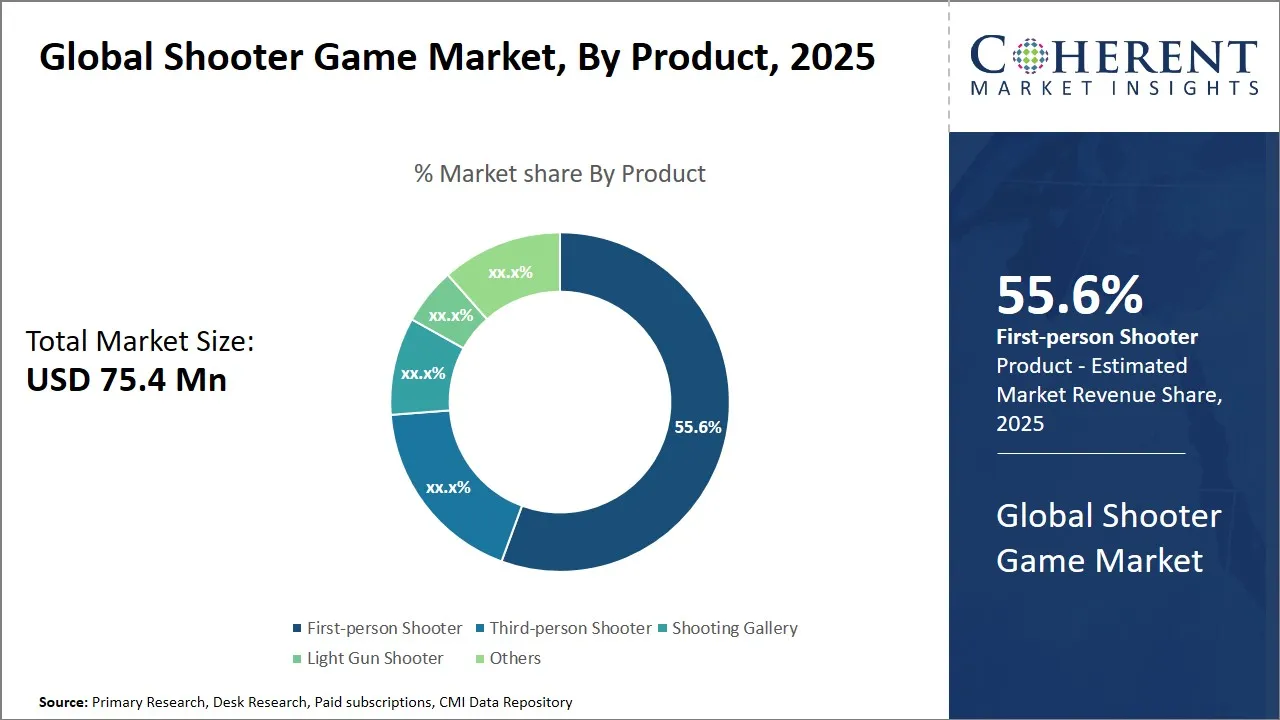
- The First-person shooter segment leads the market holding an estimated share of 56.6 % in 2026.
- The Mobile Phone segment is set to dominate with a share of 53% in 2026.
- The male segment leads the market holding an estimated share of 66% in 2026.
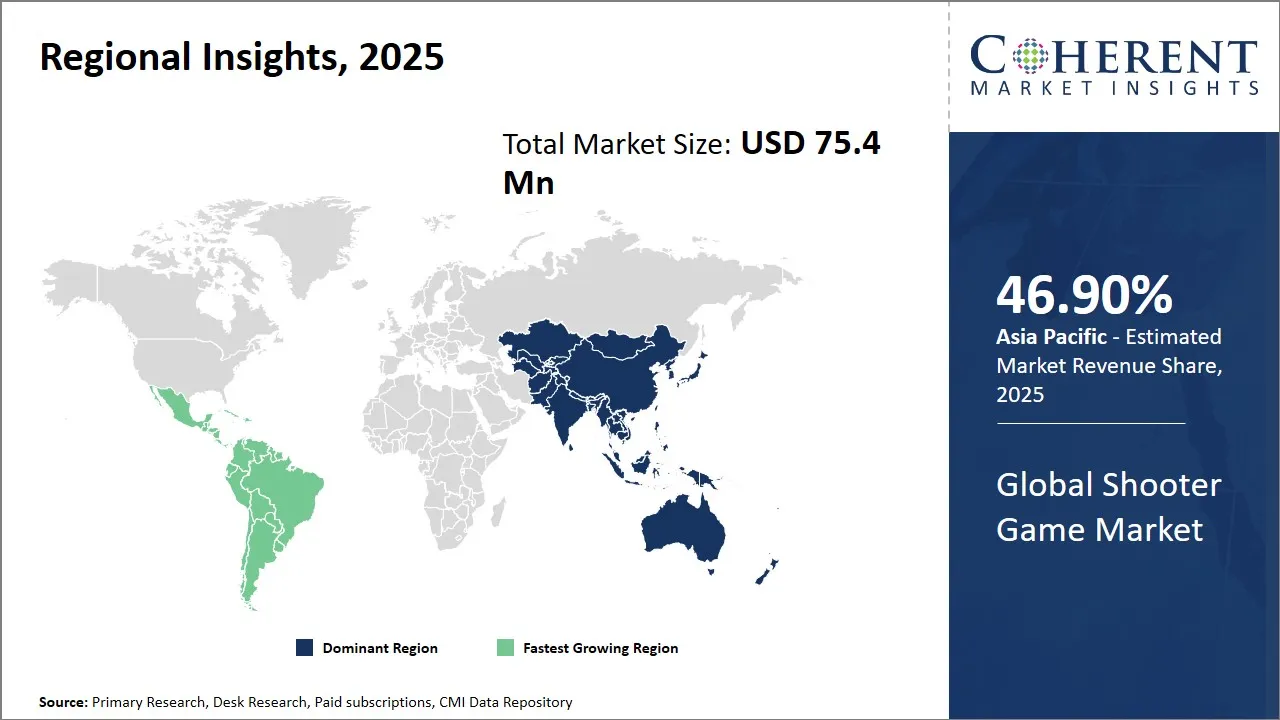
- Asia Pacific, holding a share of 46.9 % in 2026, is expected to dominate the market.
- Latin America, holding a projected share of 6.2 % in 2026, shows the fastest growth in the market.
Market Overview
The market is seeing the rise of cloud gaming and enhanced graphics capabilities, which are transforming player engagement and accessibility. Also, the use of virtual and augmented reality technologies is making more immersive shooter game environments, attracting diverse demographics. Furthermore, growing esports ecosystem and increasing mobile gaming adoption further stimulate the market expansion, emphasizing competitive gameplay and multiplayer experiences as pivotal growth drivers.
Current Events and Its Impact
Current Events | Description and its impact |
Geopolitical and Trade Developments |
|
Economic and Industrial Trends |
|
Segmental Insights
- Current Industry Events of 2026
- Market Size Estimation
- Regional Breakdown
- Competitive Landscape
- Customer Intelligence
- Segmental Analysis
- Pricing Analysis
- Key Market Drivers, Challenges & Future Trends
- Customized Insights Section
Global Shooter Game Market Insights, By Product – First-person Shooter Leads Because of Immersive Gameplay and Competitive Appeal
The First-person Shooter (FPS) segment is expected to hold 56.6% of the global shooter game market in 2026, driven by immersive gameplay and competitive appeal. FPS titles put players directly in the action through a first-person perspective, offering realism and adrenaline-fueled combat to keep the audiences engaged. Their strong multiplayer components and esports relevance add to their popularity and community interaction. Call of Duty: Warzone dominates the FPS genre because of its realistic graphics, regular updates, and huge online community, showing the genre’s sustained global appeal.
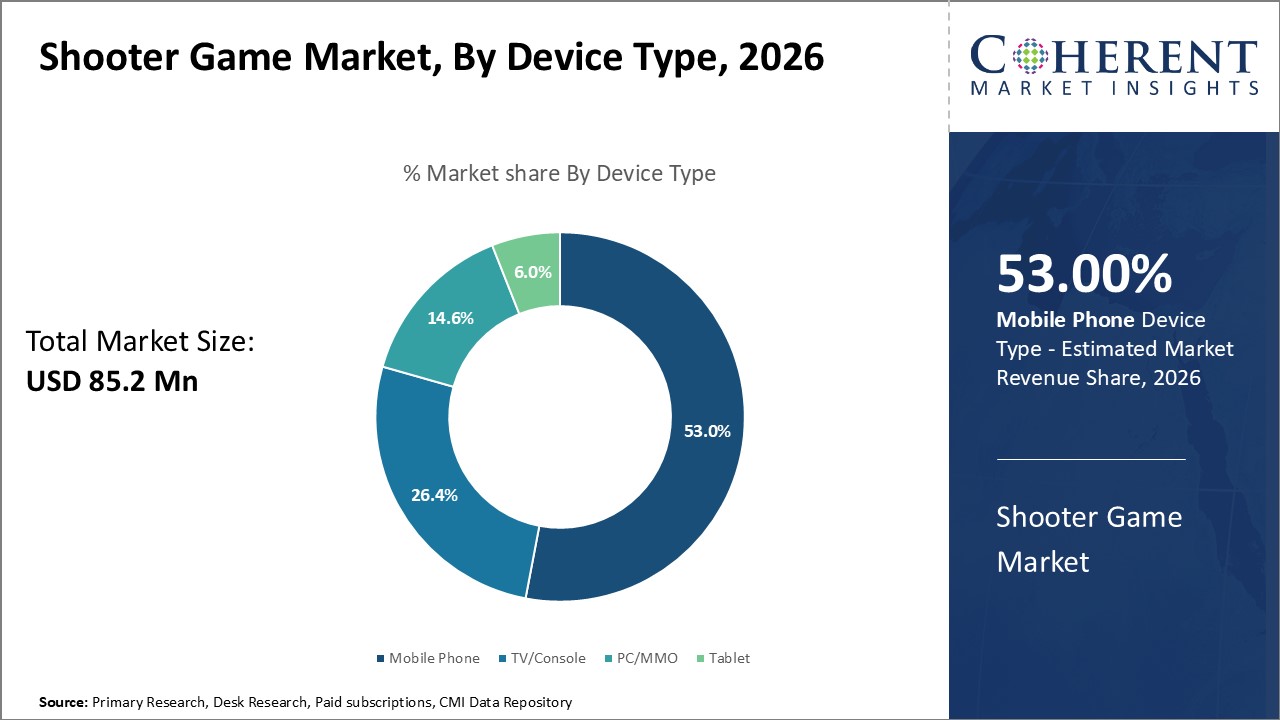
Global Shooter Game Market Insights, By Device Type – Mobile Phone Leads as Accessibility and Ubiquity Empower Segment Growth
Mobile Phones are projected to command 53% of the shooter game market in 2026, powered by accessibility, portability, and improved hardware performance. The rise of high-end smartphones allows console-like experiences on handheld devices, while free-to-play models make shooter games widely accessible. 5G technology improves online play with low latency and smoother performance. PUBG Mobile completely changed mobile shooter gaming by offering console-quality graphics and real-time multiplayer action, reaching over a billion downloads globally.
Global Shooter Game Market Insights, By End User – Male Gamers Dominate with Cultural Alignment and Behavioral Trends as Growth Catalysts
Male gamers are expected to account for 66% of shooter game players in 2026. The thrill of combat and achievement-based systems resonates a lot with male audiences, reinforced by targeted marketing and male-centric narratives. The Counter-Strike: Global Offensive (CS:GO) esports scene, dominated by male players and teams, illustrates how competitive shooter culture continues to thrive among male gamers.
Pricing Analysis of the Shooter Game Market
Item | Typical Price (USD) |
AAA new-release Standard Edition (PC/Console) | USD 69.99 |
AAA Deluxe/Special/Collector Edition | USD 99.99 |
Battle Pass (premium, single season) | USD 9.99 |
Season Pass/Major DLC (single major expansion) | USD 29.99 |
Single premium cosmetic skin (high-tier) | USD 9.99 |
Weapon/Bundle skin pack (3–5 items) | USD 14.99 |
In-game currency — Fortnite (store prices) | USD 8.99 — USD 89.99 |
In-game currency — PUBG Mobile (UC) | Representative benchmark: 3,850 UC ≈ USD 47.50 |
Typical mobile shooter IAP (single transaction) | USD 4.99 — USD 9.99 (typical) |
Average “paying user” spend (Mobile shooter ARPPU, yearly) | USD 25 — USD 60 per year (range) |
Subscription: Xbox Game Pass (post-Oct 2025 pricing tiers) | Essential USD 9.99/Premium USD 14.99/Ultimate USD 29.99 (monthly) |
Subscription: PlayStation Plus (typical US tiers) | Essential USD 9.99/Extra USD 14.99/Premium USD 17.99–USD 19.99 (varies) |
Typical DLC map/weapon pack (small paid add-on) | USD 4.99 — USD 14.99 |
Regional Insights
Asia Pacific Shooter Game Market Analysis and Trends
The Asia Pacific, holding an estimated share of 46.9% in 2026, dominates the global shooter game market because of a rapidly expanding user base, increasing smartphone penetration, and improving digital infrastructure across key countries such as China, India, South Korea, and Southeast Asian nations. The region benefits from a young demographic with increasing disposable incomes and a strong cultural inclination toward competitive gaming and esports. Government initiatives in countries like South Korea and China add to the development of gaming hubs and infrastructure, though regulatory policies, particularly in China, shape game content and market entry strategies.
The presence of influential companies like Tencent, NetEase, and Krafton has accelerated the market growth by introducing both PC and mobile shooter games tailored for local preferences. Cross-border investments and partnerships, alongside a growing esports scene, add to the market expansion. The Asia Pacific region’s trade environment makes possible the introduction of international titles and sees collaboration between domestic and global developers.
Latin America Shooter Game Market Analysis and Trends
Latin America, holding a projected share of 6.2% in 2026, is seeing the fastest growth in the global shooter game market because of increasing smartphone adoption, expanding internet penetration, and rising interest in competitive gaming across countries such as Brazil, Mexico, Argentina, and Chile. A young and digitally engaged population, coupled with growing disposable incomes, is making demand for mobile and free-to-play shooter titles. Local tournaments and a budding esports ecosystem are adding to player engagement and brand visibility, while international publishers are increasingly localizing content and introducing regional servers to improve gameplay experience.
Key players such as Tencent, Riot Games, and Activision have strengthened their presence through strategic partnerships and localized campaigns. Challenges remain, including varying regulatory frameworks, economic volatility, and infrastructure limitations in certain regions, but the growing community of online gamers and expanding digital payment adoption continue to support market expansion. Cross-border collaborations and investment in cloud gaming platforms are expected to accelerate penetration, making Latin America an important emerging market for shooter games.
Global Shooter Game Market Outlook for Key Countries
U.S. Shooter Game Market Analysis and Trends
The U.S. sees a strong presence of global shooter game players like Activision Blizzard and Epic Games, which lead innovation with flagship titles. The country’s comprehensive gaming ecosystem, from development studios to large-scale esports events, makes a self-reinforcing cycle of growth. Huge investments in virtual reality (VR) and cloud gaming technology also improve player experiences, keeping the U.S. market at the forefront of shooter game trends.
China Shooter Game Market Analysis and Trends
China is an important country in the Asia Pacific shooter game segment due to its vast gamer population and influential companies like Tencent and NetEase that dominate both domestic and international markets. Despite strict government regulations on game approvals and content restrictions, the market continues to grow with a focus on competitive mobile shooters and innovative monetization models. Strong infrastructure and rising esports investments make an engaged community. International partnerships help local companies navigate regulatory challenges while expanding their global footprint.
South Korea Shooter Game Market Analysis and Trends
South Korea continues to lead in esports culture and competitive gaming, which makes interest and revenues in the shooter game market. Companies like Krafton have got international acclaim with titles like PUBG, which have popularized the genre globally. South Korea’s government supports gaming as a big industry through infrastructure development and cultural promotion. The country’s highly connected digital environment and early adoption of technologies make it an important hub for testing new shooter game experiences and esports formats.
India Shooter Game Market Analysis and Trends
India shooter game market is seeing fast growth because of increasing internet penetration, affordability of smartphones, and a growing base of young gamers who favor mobile shooter games. Domestic companies and international publishers alike are targeting this audience with regionally tuned content and localized languages. The government’s push toward digital India initiatives benefits the gaming sector’s growth. While esports infrastructure is still developing, there is a lot of interest from investors and organizers, which is expected to add to the market growth.
Germany Shooter Game Market Analysis and Trends
Germany shooter game market sees a sizable gaming community and strong regulatory frameworks ensuring player security and digital rights. Companies based in or operating heavily in Europe, including Crytek and Ubisoft (with European studios), contribute to diverse game offerings featuring strong narrative elements alongside shooter mechanics. The country’s balanced approach to regulation encourages market innovation while maintaining content standards. Germany’s role in game development and its position as a distribution center for Europe make it a pivotal market in the region.
Market Players, Key Development, and Competitive Intelligence
Top Strategies Followed by Shooter Game Market Players
- Established companies in this sector tend to invest heavily in research and development (R&D) to continuously innovate and produce high-performance products that meet the evolving demands of gamers seeking superior graphics, fluid gameplay, and immersive experiences.
- Activision Blizzard invested heavily in advanced rendering and AI-driven matchmaking systems for Call of Duty: Black Ops 7 (2025), improving visual fidelity and player balance across PC and console ecosystems.
- Mid-level competitors in the global shooter game market tend to focus on striking a balance between quality and affordability, targeting a sizable segment of price-sensitive consumers who seek engaging gameplay without the premium price tag associated with top-tier products.
- KRAFTON localized PUBG: New State with lighter system requirements and region-specific monetization models to target emerging Asian markets.
- Small-scale players operating in the shooter game market carve out specialized niches by focusing on unique or innovative features that appeal to specific gamer segments.
- Indie developer VOID Interactive carved a strong following with Ready or Not (tactical realism FPS) by catering to a niche tactical community ignored by mainstream AAA shooters.
Key Developments
- On October 10, 2025, EA launched Battlefield 6, the ultimate all-out warfare experience. Battlefield 6 takes the fight to an unprecedented level, with brand new multiplayer modes, a thrilling blockbuster Single Player campaign, the return of Portal offering powerful creator tools, and a host of enhancements that have created a remarkable sandbox where every fight, vehicle, and strategy leads to victory.
- In September 2025, Treyarch took the stage at Call of Duty: NEXT to give an in-depth look at Multiplayer, Zombies, and Call of Duty: Warzone.
- In August 2025, Tencent Games, a leading global platform for game development, publishing and operations, shined in its biggest-ever presence at gamescom 2025, welcoming hundreds and thousands of visitors to its booths and capturing global attention with premieres at Opening Night Live.
Market Report Scope
Shooter Game Market Report Coverage
| Report Coverage | Details | ||
|---|---|---|---|
| Base Year: | 2025 | Market Size in 2026: | USD 85.2 Mn |
| Historical Data for: | 2020 To 2024 | Forecast Period: | 2026 To 2033 |
| Forecast Period 2026 to 2033 CAGR: | 13.0% | 2033 Value Projection: | USD 200.5 Mn |
| Geographies covered: |
| ||
| Segments covered: |
| ||
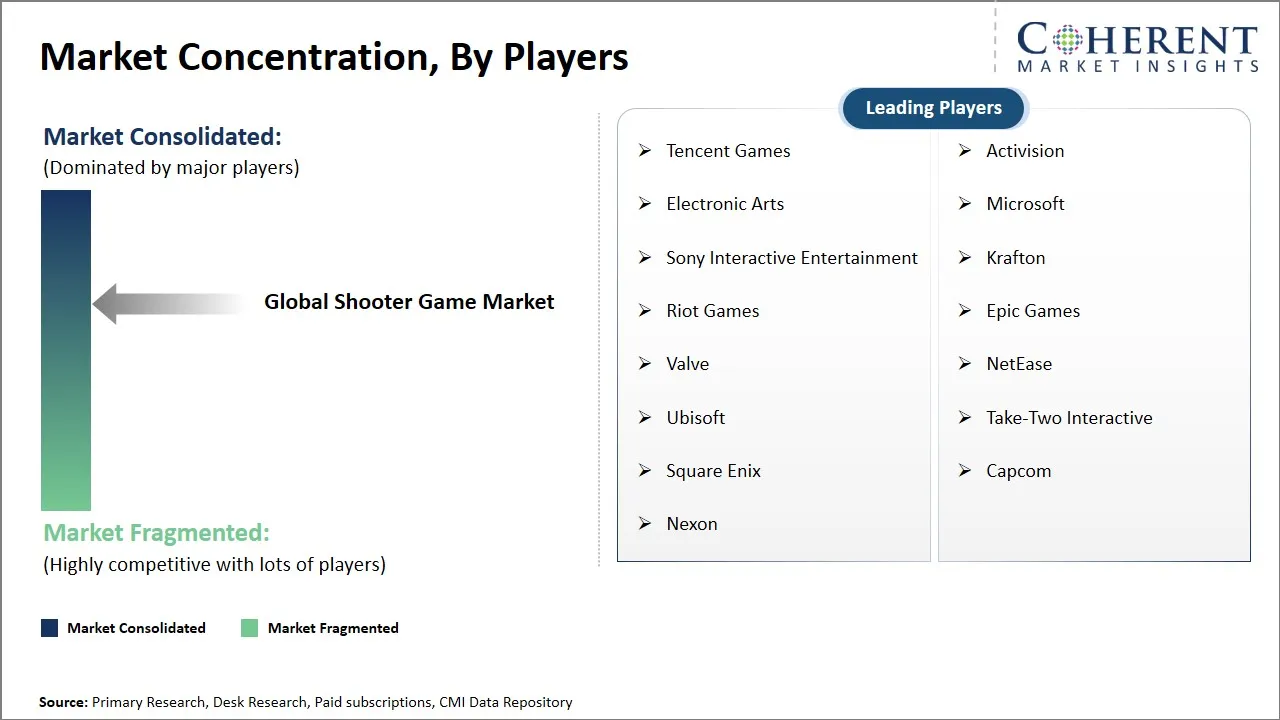
| Companies covered: | Tencent Games, Activision, Electronic Arts, Microsoft, Sony Interactive Entertainment, Krafton, Riot Games, Epic Games, Valve, NetEase, Ubisoft, Take-Two Interactive, Square Enix, Capcom, and Nexon | ||
| Growth Drivers: |
| ||
| Restraints & Challenges: |
| ||
Market Dynamics
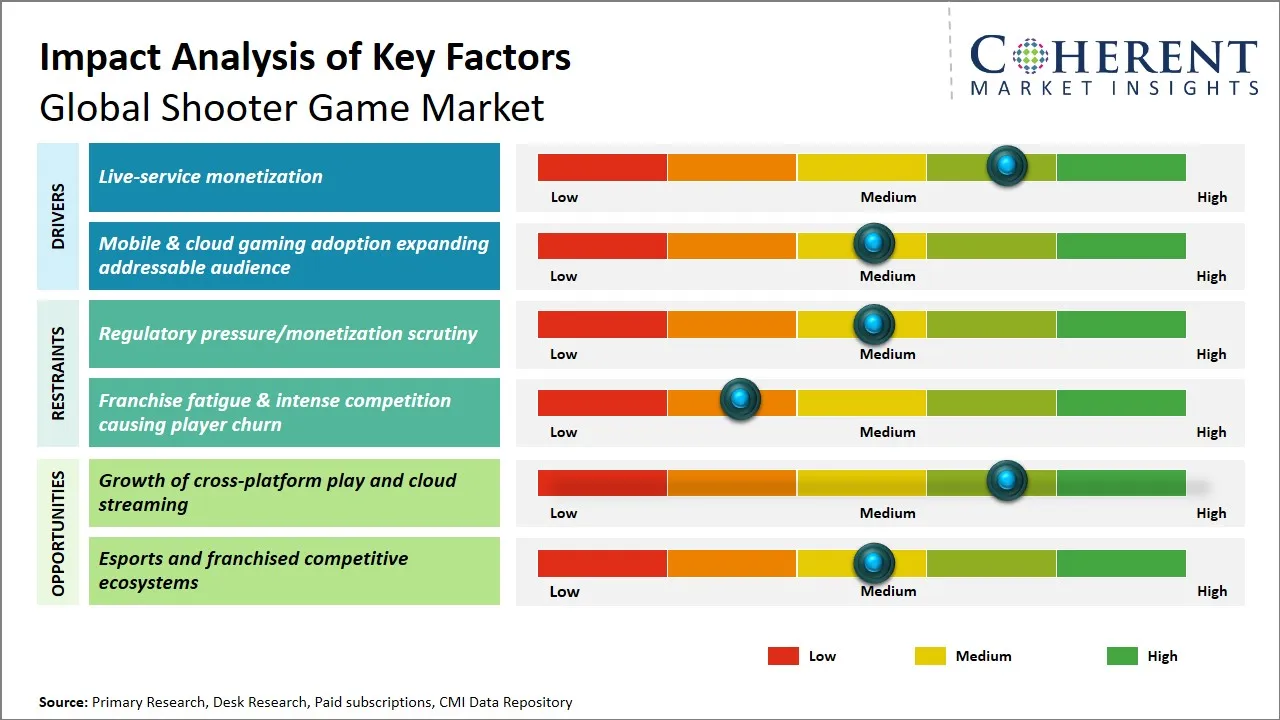
Global Shooter Game Market Driver - Live-Service Monetization
The increasing adoption of live-service monetization models in shooter games is significantly driving the market growth by transforming how developers generate ongoing revenue and sustain player interest. Unlike traditional one-time purchase games, live-service shooter titles employ in-game purchases, battle passes, and season-based content updates that offer continuous engagement opportunities. This approach not only encourages players to invest more time but also incentivizes spending on cosmetics, weapon skins, and other digital assets, creating a steady revenue stream for developers.
Additionally, the frequent introduction of new challenges, limited-time events, and content expansions through live-service frameworks keeps the gameplay fresh, fostering community interaction and competitive play. As a result, this model enhances player retention and lifetime value, compelling more developers and publishers to adopt live-service strategies for shooter games. The evolution towards live-service monetization thus acts as a crucial driver, reshaping the market landscape by balancing player satisfaction with sustained profitability.
Fortnite by Epic Games exemplifies this model through its regular seasons, themed events, and purchasable skins, enabling the game to generate billions in annual revenue while maintaining a vibrant global player community.
Global Shooter Game Market Opportunity – Growth of Cross-Platform Play and Cloud Streaming
The global shooter game market is poised to benefit significantly from the rapid expansion of cross-platform play and cloud streaming technologies, presenting a substantial growth opportunity. Cross-platform play allows gamers on different devices—such as consoles, PCs, and mobile phones—to compete or collaborate in real time, eliminating traditional barriers between hardware ecosystems. This inclusivity broadens the player base, enhances community engagement, and extends game longevity by fostering a more diverse and connected audience.
Simultaneously, cloud streaming services are revolutionizing game accessibility by enabling users to experience high-quality shooter games without the need for expensive, high-performance hardware. This democratization of access facilitates entry into emerging markets with lower device penetration and appeals to casual gamers who prefer instant gameplay without lengthy downloads or updates. Moreover, cloud streaming supports seamless updates and content delivery, enabling developers to maintain game freshness and player interest. The synergy of cross-platform compatibility and cloud-based gaming also encourages innovative multiplayer experiences and real-time social interactions, which are critical in shooter game genres.
Call of Duty: Warzone and Fortnite have both embraced full cross-platform play, while NVIDIA GeForce NOW and Xbox Cloud Gaming enable users to stream shooter games like Apex Legends directly to low-end devices.
Analyst Opinion (Expert Opinion)
- Younger gamers (ages 13–25) are increasingly driving demand for mobile shooters and cross-platform play. Their preference for on-the-go, social, and free-to-play experiences is prompting publishers to prioritize mobile optimization, cloud gaming, and cross-device progression. Titles like PUBG Mobile, Fortnite, and Valorant Mobile exemplify this trend.
- The younger demographic is highly receptive to cosmetic purchases, battle passes, and limited-time events. Analysts note that this cohort’s willingness to engage in microtransactions directly boosts ARPPU and recurring revenue, making F2P shooters with live-service ecosystems more profitable than traditional premium models.
- Younger players are the primary audience for competitive shooters and esports. Their engagement drives viewership, streaming content, and community growth, which, in turn, incentivizes publishers to invest in tournaments, online leagues, and interactive spectator experiences. Analysts highlight that sustained youth participation is critical for long-term franchise longevity and monetization.
Speak to the analyst
Want personalized insights?
Take the findings above to one of our principal consultants, or have the report rebuilt around the segments, geographies and competitors you actually track.
Market Segmentation
- Product Insights (Revenue, USD Mn, 2021 - 2033)
- First-person Shooter
- Third-person Shooter
- Shooting Gallery
- Light Gun Shooter
- Others
- Device Type Insights (Revenue, USD Mn, 2021 - 2033)
- Mobile Phone
- TV/Console
- PC/MMO
- Tablet
- End User Insights (Revenue, USD Mn, 2021 - 2033)
- Male
- Female
- Regional Insights (Revenue, USD Mn, 2021 - 2033)
- North America
- U.S.
- Canada
- Latin America
- Brazil
- Argentina
- Mexico
- Rest of Latin America
- Europe
- Germany
- U.K.
- Spain
- France
- Italy
- Russia
- Rest of Europe
- Asia Pacific
- China
- India
- Japan
- Australia
- South Korea
- ASEAN
- Rest of Asia Pacific
- Middle East
- GCC Countries
- Israel
- Rest of Middle East
- Africa
- South Africa
- North Africa
- Central Africa
- North America
- Key Players Insights
- Tencent Games
- Activision
- Electronic Arts
- Microsoft
- Sony Interactive Entertainment
- Krafton
- Riot Games
- Epic Games
- Valve
- NetEase
- Ubisoft
- Take-Two Interactive
- Square Enix
- Capcom
- Nexon
Sources
Primary Research Interviews
Stakeholders
- Game Development Studios and Publishers
- Mobile Game Developers and Platform Specialists
- Esports Organizers and Tournament Operators
- Gaming Hardware Manufacturers
- Cloud Gaming Service Providers
- Gaming Community Experts and Market Analysts
Databases
- Newzoo Global Gaming Database
- GameTrack Analytics
- App Annie Mobile Gaming Insights
- Global Esports Data Repository
Magazines
- Game Developer Magazine
- Esports Insider
- PC Gamer
- Console World
Journals
- Journal of Interactive Media and Gaming
- Entertainment Computing Journal
- Journal of Game Design and Development
- International Journal of Gaming and Virtual Worlds
Newspapers
- The Verge (Gaming Section)
- IGN News
- Polygon
- GamesIndustry.biz
Associations
- International Game Developers Association (IGDA)
- Esports Integrity Commission (ESIC)
- Entertainment Software Association (ESA)
- Mobile Gaming Association (MGA)
Public Domain Sources
- United Nations World Youth Report
- World Bank Digital Economy Reports
- U.S. Federal Communications Commission (FCC) Gaming & Broadband Data
- ResearchGate Gaming and Interactive Media Papers
Proprietary Elements
- CMI Data Analytics Tool, Proprietary CMI Existing Repository of information for last 8 years
Get access to 250+ pages report
Every segment, forecast, competitor profile and data table behind the analysis above — available for instant download.
- ESOMAR Member
- ISO 9001:2015 Certified
- D-U-N-S Registered
- GDPR & CCPA Compliant
Missing comfort of reading report in your local language? Find your preferred language:
Transform your Strategy with Exclusive Trending Reports
Frequently Asked Questions
The global shooter game market is estimated to be valued at USD 85.2 million in 2026 and is expected to reach USD 200.5 million by 2033.
The CAGR of global shooter game market is projected to be 13.0% from 2026 to 2033.
Live-service monetization and mobile & cloud gaming adoption expanding addressable audience are the major factors driving the growth of the global shooter game market.
Regulatory pressure/monetization scrutiny and franchise fatigue & intense competition causing player churn are the major factors hampering the growth of the global shooter game market.
Games where players engage in combat using firearms or ranged weapons, including FPS, TPS, and battle royale genres.
Free-to-play with battle passes and microtransactions, premium one-time purchases, and subscription models.
In terms of Product, First-person Shooter segment is estimated to dominate the market revenue share in 2026.