

Global Sugar Alternative Market Size and Forecast – 2026 To 2033
The Global Sugar Alternative Market is estimated to be valued at USD 22.64 Bn in 2026 and is expected to reach USD 36.83 Bn by 2033, exhibiting a compound annual growth rate (CAGR) of 7.2% from 2026 to 2033. Market growth is supported by rising health and wellness awareness, the increasing prevalence of diabetes and obesity, and the reformulation of beverages and processed foods with natural and low-calorie sweeteners.
Food and beverage companies are progressively expanding reduced-sugar portfolios to meet changing nutritional expectations without compromising taste or convenience. In August 2025, PepsiCo reported that 67% of its beverage portfolio volume contained fewer than 100 calories from added sugars per 12-ounce serving, achieving its 2025 sugar-reduction target one year ahead of schedule. This demonstrates the growing commercial importance of alternative sweetening systems in large-scale product reformulation.
Key Takeaways of the Global Sugar Alternative Market
- High-intensity sweeteners are expected to hold 38.6 % of the market share in 2026, supported by low dosage requirements, broad beverage compatibility, and improving sugar-like taste profiles. In February 2026, Tate & Lyle and Manus launched Yume M Stevia Sweetener, positioned as a scalable Reb M solution with an all-Americas supply chain.
- The natural segment is expected to dominate the source segmentation with 46.8 % of the market share in 2026 as manufacturers prioritize plant-origin claims, cleaner labels, and traceable agricultural inputs. In December 2025, Layn Natural Ingredients’ monk fruit supply chain achieved SAI Gold status under the Farm Sustainability Assessment, strengthening procurement confidence around responsible sourcing, supply continuity, and long-term contracting.
- The powder and crystal segment is expected to command 52.4 % of the market share in 2026 because it offers dosing precision, shelf stability, efficient logistics, and compatibility with dry blends and industrial processing. In March 2026, the U.S. Department of Commerce issued antidumping and countervailing duty orders on Chinese erythritol, increasing the strategic importance of diversified sourcing and landed-cost management.
- North America is expected to retain the leading regional position with a 32.8 % of the market share in 2026, supported by mature reformulation capabilities, broad retail availability, and rapid commercialization of zero-sugar extensions. In February 2026, Keurig Dr Pepper announced that all its 2026 carbonated soft drink innovations would include zero-sugar options and introduced Mott’s Zero Sugar Juice Drinks for nationwide rollout.
- Asia Pacific is expected to be the fastest-growing region with 28.9 % of the market share in 2026, reflecting expanding manufacturing capacity, ingredient innovation, and wider adoption of next-generation sweeteners. In September 2024, Samyang Corporation completed South Korea’s largest allulose facility in Ulsan, producing liquid and crystalline allulose and targeting expansion across Japan, Southeast Asia, and other export markets
- Blended Sweetening Architectures: Manufacturers are shifting from a single ingredient substitute approach to an integrated approach using a combination of high intensity sweeteners, bulk sweeteners, fibers and texture modifiers. This results in better sweetness onset, aftertaste, mouthfeel, browning, and processing performance; and offers formulation flexibility in all beverage, bakery, dairy and confectionery applications. The ability to apply the knowledge and expertise of the application, optimizing the senses and developing solutions specific to the customer will become an increasingly important element of the competitive advantage.
- Precision Fermentation and Supply Resilience: Bioconversion and fermentation are changing the sourcing landscape of sweetener as the reliance on climate-sensitive crops is diminishing, batch consistency is growing and production is being regionalized to produce rare sweetness molecules. Scale economics, regulatory acceptance and clear labelling will be important to commercial success. Strategic agreements with existing ingredient providers will help to speed up qualification, de-risk capacity increase and ensure supply security over the long-term.
Segmental Insights
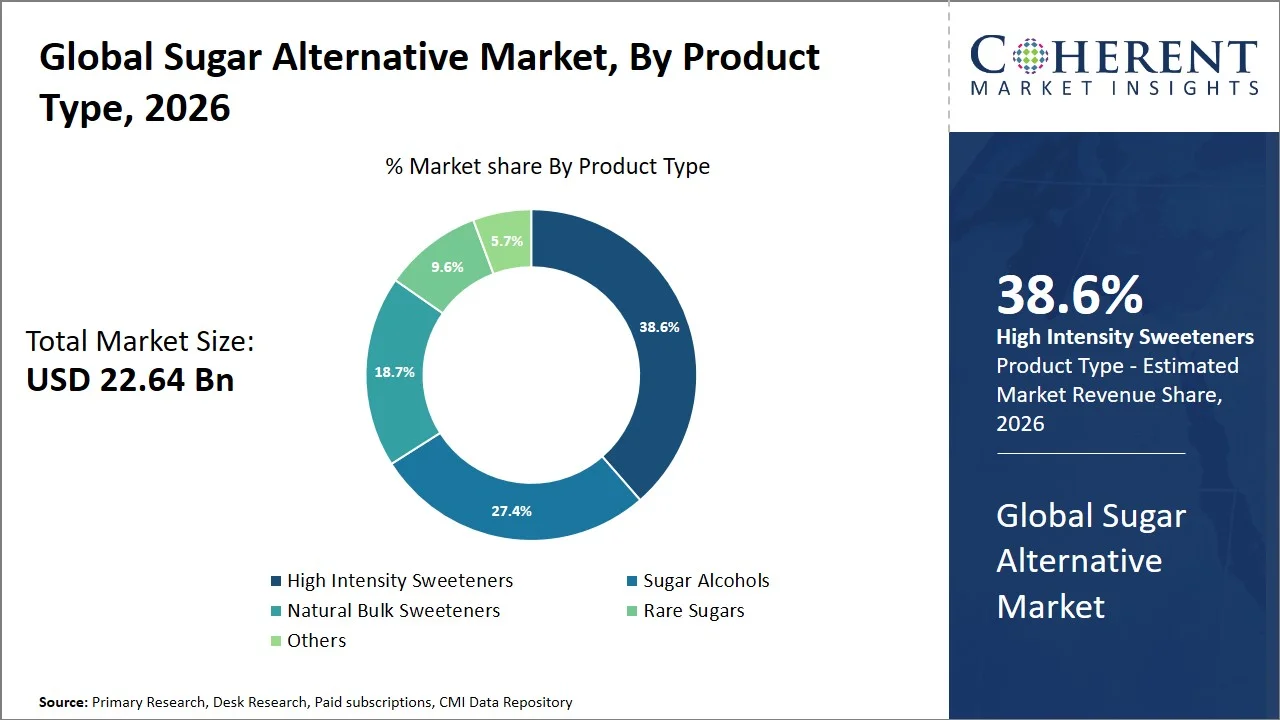
Why Do High Intensity Sweeteners Dominate the Global Sugar Alternative Market?
High intensity sweeteners are expected to account for 38.6% of the global sugar alternative market in 2026. Their leadership reflects the economics of large-scale reformulation, as small inclusion levels allow manufacturers to reduce sugar without materially increasing product weight, storage requirements, or freight exposure. The segment provides formulators with options such as stevia glycosides, sucralose, aspartame, monk fruit extracts, and fermentation-derived molecules, enabling sweetness systems to be tailored according to cost, regulatory status, sensory profile, and processing conditions. Adoption is particularly strong in carbonated drinks, flavored water, dairy beverages, chewing gum, oral-care products, and tabletop formulations where sweetness is required without substantial solids. In September 2025, Cargill reported that EverSweet, produced through precision fermentation, had secured approvals across multiple markets and was being adopted by major food and beverage brands, demonstrating continued commercial advancement in next-generation high intensity sweeteners.
- Current Industry Events of 2026
- Market Size Estimation
- Regional Breakdown
- Competitive Landscape
- Customer Intelligence
- Segmental Analysis
- Pricing Analysis
- Key Market Drivers, Challenges & Future Trends
- Customized Insights Section
Why Does the Natural Segment Represent the Largest Source Category in the Global Sugar Alternative Market?
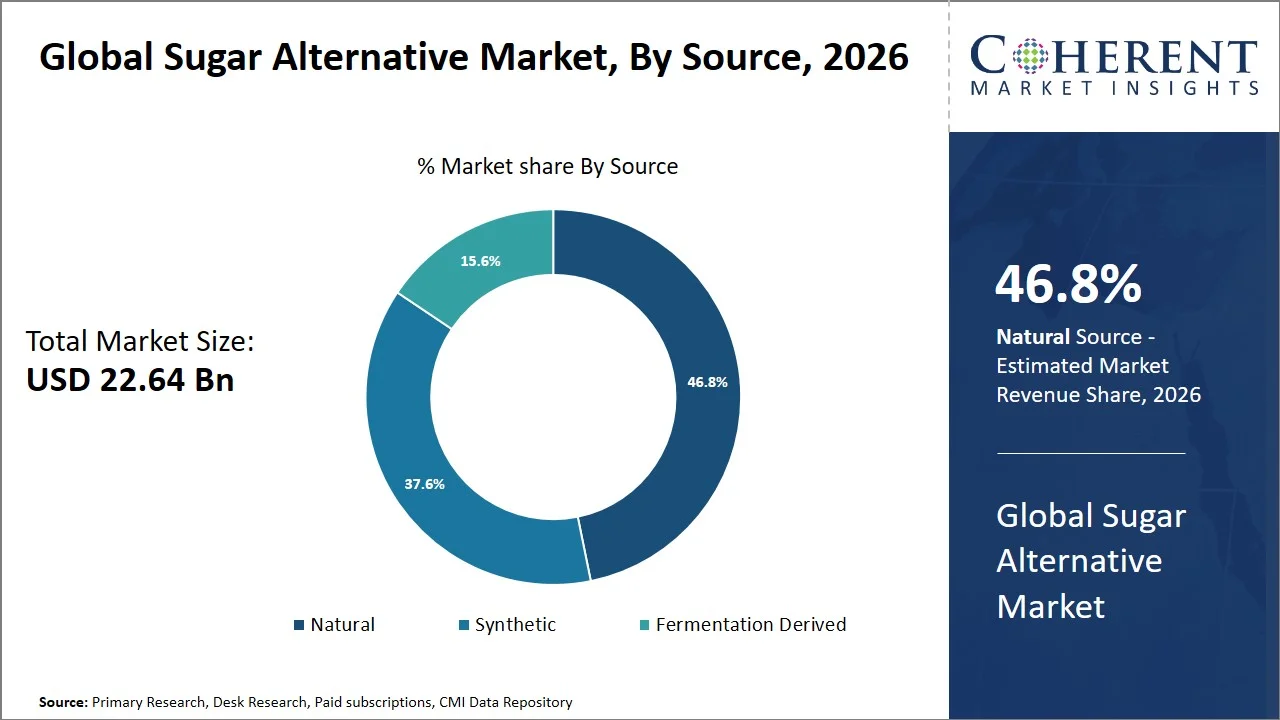
The natural segment is expected to hold 46.8% of the global sugar alternative market in 2026. Its leading position is supported by manufacturers’ efforts to develop premium, recognizable ingredient propositions while reducing dependence on portfolios based entirely on synthetic additives. Natural sweeteners provide flexibility across plant-based, organic-positioned, functional, and wellness-oriented products, allowing brands to differentiate through botanical origin and ingredient storytelling. On the supply side, advancements in plant breeding, glycoside selection, extraction, and bioconversion are improving crop productivity and ingredient consistency, addressing historical limitations related to taste variation and agricultural yield. Natural alternatives are strongly incorporated into dairy products, nutrition bars, flavored beverages, confectionery, and dietary supplements where ingredient perception influences purchasing decisions. In April 2024, Ingredion announced that PureCircle received Chinese plant breeders’ rights for its PCS-13 stevia variety, which delivers higher yields and greater quantities of sought-after steviol glycosides, strengthening scalable natural sweetener production.
Why Does the Powder and Crystal Segment Dominate the Global Sugar Alternative Market?
The powder and crystal segment is expected to represent 52.4% of the global sugar alternative market in 2026. Their dominance is closely linked to the requirement to replace the physical functions of sugar rather than sweetness alone. Crystalline and powdered alternatives can contribute bulk, structure, controlled dissolution, browning, moisture management, and freezing-point modification, making them commercially important in bakery, confectionery, frozen desserts, powdered beverages, meal replacements, and nutraceutical preparations. These formats also support blending with high-potency sweeteners, fibers, flavors, and texturizers, enabling manufacturers to develop application-specific premixes and simplify production-line integration. Their familiar processing characteristics further encourage adoption among industrial users and tabletop sweetener brands. In March 2024, ASR Group and Bonumose announced that tagatose became the first sweetener to earn NutraStrong Prebiotic Verified certification, expanding the value proposition of a crystalline sugar alternative offering sugar-like functionality alongside lower-calorie and functional-product positioning.
Global Sugar Alternative Market Dynamics
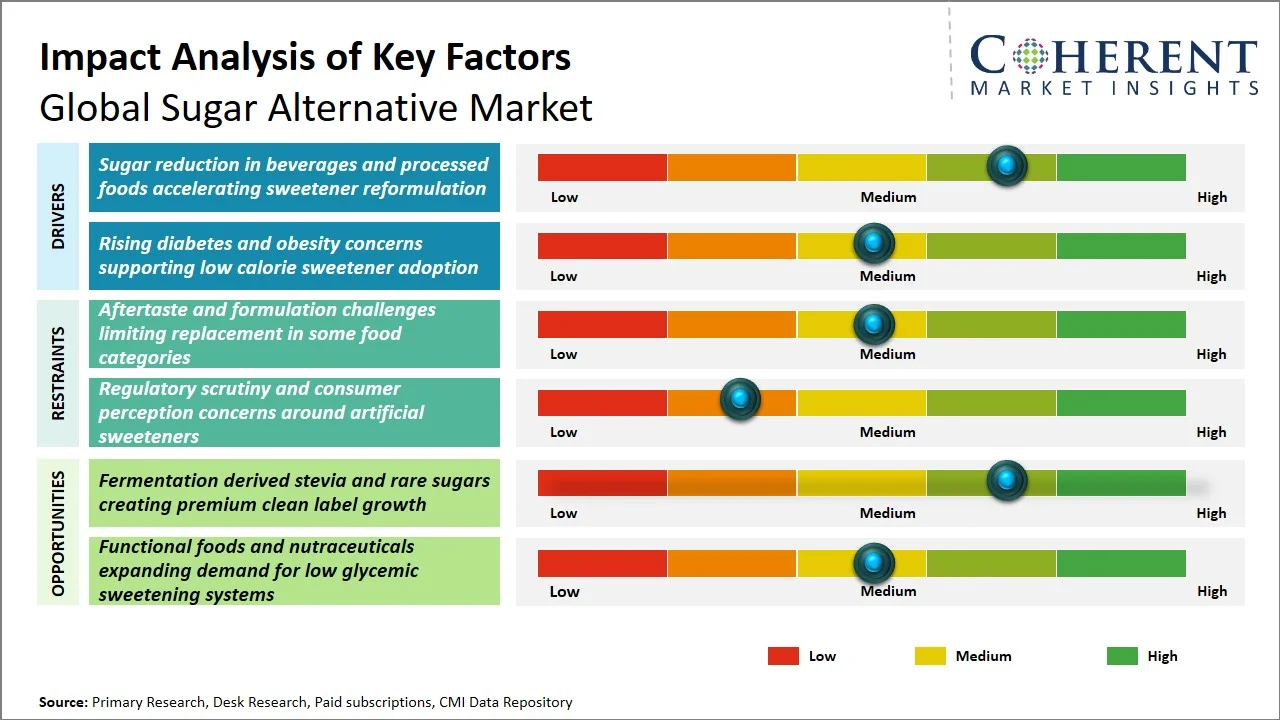
Key Market Drivers
- Sugar Reduction across Beverages and Processed Foods Accelerates Portfolio-Wide Reformulation: Sugar reduction in beverages and processed foods is shifting from a limited “diet” proposition to a portfolio-wide reformulation requirement. Beverage, dairy, bakery, cereal, sauce, and confectionery manufacturers increasingly need sweetening systems that lower added sugar while retaining sweetness onset, mouthfeel, browning, viscosity, and shelf stability. This expands demand beyond single high-intensity ingredients toward blends combining stevia, sucralose, monk fruit, polyols, fibers, and rare sugars. Suppliers that provide application testing and sensory optimization can capture greater value than commodity ingredient sellers because reformulation risk is concentrated in taste and processing performance. In April 2025, The Coca-Cola Company reported that Coca-Cola Zero Sugar volume grew 14% across all geographic operating segments, demonstrating that reduced-sugar beverage platforms can deliver broad commercial momentum and encourage further investment in alternative sweetener systems.
- Rising Metabolic Health Concerns Strengthen Low-Calorie Sweetener Adoption: The increasing burden of diabetes, obesity and related metabolic diseases is driving greater acceptance of products that provide sweetness without the same amount of sugar or calories. Food manufacturers, retailers, health/medical related brands, and foodservice operators are reacting with zero sugar drinks, low glycemic snacks, low sugar dairy products, and nutrition-specific food products. Allulose, tagatose, polyols and natural blends provide opportunities for high intensity sweeteners, but consideration must be given to metabolic positioning, digestive tolerance, labelling requirements, and consumer perception of artificial ingredients when choosing a formulation. In April 2025, the International Diabetes Federation released the 11th edition of its Diabetes Atlas, reporting that 589 million adults were living with diabetes and emphasizing prevention and early intervention. The findings reinforce the commercial importance of credible sugar-reduction solutions across mainstream and condition-specific food categories.
Emerging Market Trends
- Multi-Ingredient Sweetening Systems Replace Standalone Sugar Substitutes: One sweetener is no longer enough (one-for-one replacement). High-intensity sweeteners and bulk agents, soluble fibers, taste modulators, acids, flavors, and texturizers are being used in combination by manufacturers to recreate the sensory and functional properties of sucrose. In bakery and confectionery, dairy and frozen desserts, sugar has a role to play in structure, browning, moisture control, freezing behavior and shelf life. A new business model that moves away from the sale of ingredients to application specific solution platforms, with formulation laboratories and customer co-development, is taking the place. Suppliers who can achieve a balance of sweetness timing, masking the bitterness, controlling cooling effects and the stability of the process can persuade them to pay a premium and increase customer retention. Differentiated blends that are customized for specific product matrices and regional consumer tastes will continue to beat the standalone sweeteners, which will be primarily competing on price or sweetness level, in the forecast period.
- Precision Fermentation and Enzymatic Conversion Reshape Sweetener Production: Precision fermentation and enzymatic conversion are broadening the commercial pipeline for rare sugars, steviol glycosides, and sweet proteins that were previously constrained by crop availability, extraction yield, or high production cost. These technologies can deliver more consistent purity, support localized manufacturing, and enable molecules with improved sweetness quality or sugar-like functionality. Their adoption will encourage ingredient companies to build intellectual-property portfolios around production strains, enzymes, purification systems, and application know-how rather than relying solely on agricultural sourcing. However, commercialization will remain uneven because regulatory approval, scale-up economics, consumer labeling, and downstream formulation performance vary by molecule and jurisdiction. The most successful platforms will be those that combine efficient bioprocessing with clear safety dossiers, competitive unit economics, and technical support for beverages, nutrition products, bakery, and confectionery. This trend could materially reshape supplier concentration and margin structures.
Current Events and their Impact
Current Events | Description and its Impact |
November 2025 – U.K. Strengthens the Soft Drinks Industry Levy |
|
February 2026 – EFSA Completes Sucralose Safety Re-evaluation |
|
2026 – WHO Publishes Global Assessment of Sugar-Sweetened Beverage Taxes |
|
Regional Insights
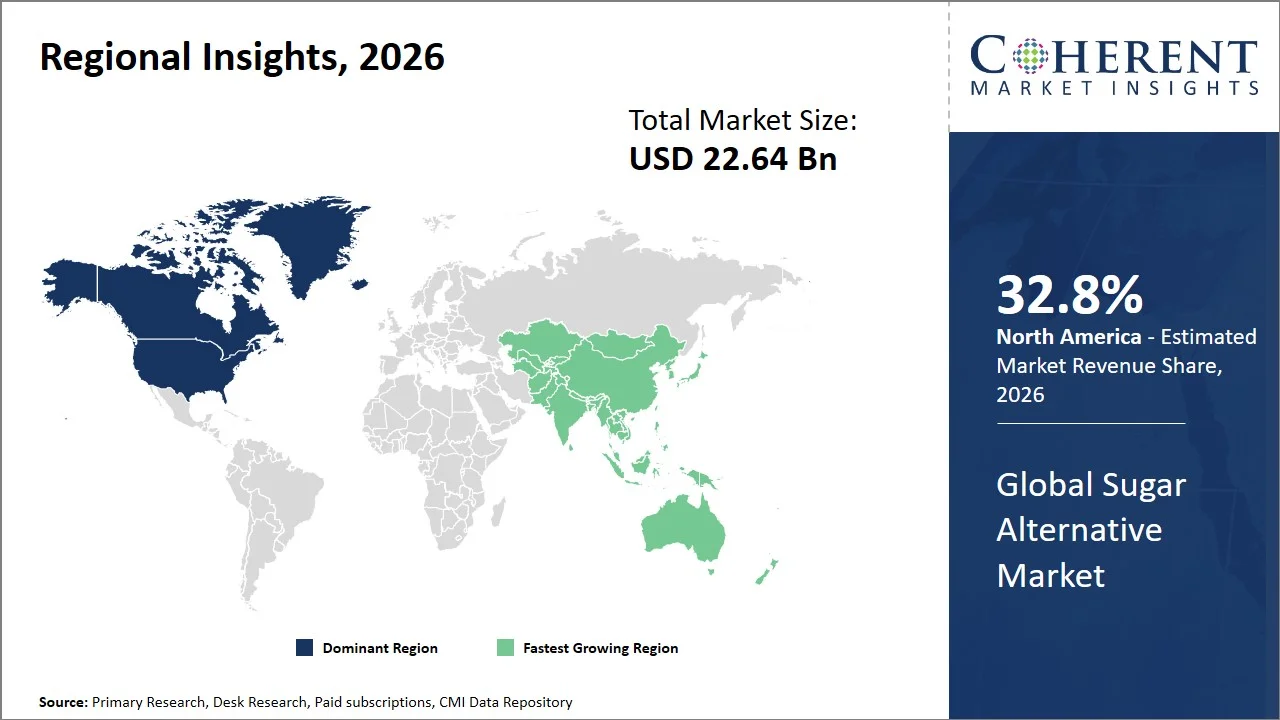
Why Does North America Dominate the Global Sugar Alternative Market?
North America is expected to lead the global sugar alternative market with a 32.8% share in 2026. Its position reflects a mature packaged-food industry, high penetration of reduced-sugar beverages, and strong formulation capabilities across dairy, bakery, nutrition, confectionery, and tabletop products. Ingredient suppliers benefit from established regulatory pathways, advanced sensory testing, and close collaboration with food manufacturers seeking sweetness, texture, and calorie reduction through integrated formulations. Regional demand also favors premium natural sweeteners and fermentation-derived molecules that can support differentiated labels without sacrificing consistency. In December 2024, Health Canada published an updated List of Permitted Sweeteners covering multiple steviol glycoside sources, including plant-derived and fermentation-based options, across numerous food categories. This broad regulatory framework improves commercialization flexibility and supports continued investment in next-generation sweetening solutions.
Why is Asia Pacific Emerging as the Fastest-Growing Region in the Sugar Alternative Market?
Asia Pacific is expected to be the fastest-growing region in the sugar alternative market, holding 28.9% share of the market share in 2026. Growth is supported by expanding beverage consumption, rising interest in lower-sugar packaged foods, and a large manufacturing base capable of producing polyols, stevia derivatives, rare sugars, and blended sweetening systems at commercial scale. Regional companies are adapting formulations to local taste preferences, including tea-based drinks, dairy beverages, confectionery, and functional nutrition products. Cost-efficient processing capacity and access to agricultural and fermentation feedstocks also strengthen export potential. In August 2024, Food Standards Australia New Zealand published approval for D-allulose manufactured through enzymatic conversion of fructose, permitting its use under specified food conditions. The decision expands the region’s ingredient toolkit and signals regulatory openness toward technically advanced, low-energy alternatives with sugar-like functionality.
Global Sugar Alternative Market Outlook for Key Countries
Why is the U.S. a Key Market for the Sugar Alternative Market?
The U.S. is a key market for sugar alternatives because food and beverage companies face sustained pressure to reduce added sugars while preserving taste, convenience, and familiar product formats. Demand spans carbonated beverages, sports nutrition, dairy, bakery, confectionery, cereals, and household tabletop products, creating opportunities for both high-intensity sweeteners and bulking ingredients. The country also has a strong commercialization ecosystem linking biotechnology developers, ingredient formulators, consumer brands, contract manufacturers, and national retailers. Regulatory labeling requirements make added-sugar content highly visible, increasing the commercial value of reformulation. In December 2024, the U.S. Food and Drug Administration finalized an updated definition for the “healthy” nutrient-content claim that, for the first time, establishes limits for added sugars. The rule creates a clearer incentive for manufacturers to redesign eligible products using alternative sweetening systems while maintaining nutritional and sensory performance.
Why is India Important in the Global Sugar Alternative Market?
India is important in the global sugar alternative market because its large packaged-food base is expanding alongside greater scrutiny of sugar content in everyday products. Manufacturers require affordable sweetening systems suited to dairy drinks, biscuits, confectionery, traditional sweets, nutraceutical powders, pharmaceuticals, and rapidly growing beverage categories. Price sensitivity encourages blended formulations combining small quantities of high-intensity sweeteners with polyols or functional bulking agents, allowing brands to manage cost and taste simultaneously. Domestic pharmaceutical and food-processing capabilities also support formulation, tableting, powder blending, and contract production. In July 2024, the Food Safety and Standards Authority of India approved a proposal to display total sugar, salt, and saturated fat in bold letters and a larger font on packaged-food labels. Greater label visibility is likely to intensify reformulation activity and improve the commercial case for lower-sugar product extensions.
Why Does China Support Growth in the Sugar Alternative Market?
China promotes market growth in sugar alternatives by virtue of its vast downstream demand, high sugar ingredient production and fermentation, enzymatic conversion, extraction and crystalline processing capabilities. The establishment of producers for domestic customers of beverage, dairy, tea, bakery, confectionery, pharmaceutical and export customers allows for the development of new sweetener technologies from the pilot scale up to industrial production. Consumers' demand for reduced sugar content without compromising on the familiar sweetness profile is also impacting the market, especially for ready to drink teas and milk-teas. In April 2024, Shanghai introduced China’s first beverage nutrition-grading system, rating products from A to D based on added sugar, fats, and non-sugar sweeteners. Major milk-tea chains began displaying the grades on menus. The initiative increases point-of-purchase transparency and encourages beverage companies to refine sweetener blends, portioning, and formulation strategies.
Why is Brazil a Strategic Country in the Sugar Alternative Market?
Brazil is a strategic market for sugar alternatives because it combines one of the world’s largest sugar production bases with a rapidly evolving consumer focus on health, nutrition, and reduced sugar intake. The country’s extensive beverage, dairy, confectionery, and bakery industries create significant reformulation opportunities, particularly as manufacturers seek to balance cost efficiency with improved nutritional profiles. Brazil also has a strong tradition of using natural sweeteners such as stevia, which supports the adoption of plant-based and clean-label alternatives. In addition, rising urbanization, expanding modern retail, and increasing awareness of obesity and diabetes are encouraging demand for reduced-sugar products. In October 2025, Brazil’s National Health Surveillance Agency (ANVISA) continued to advance front-of-pack labeling regulations requiring clear disclosure of high sugar content, reinforcing pressure on manufacturers to reformulate products. This regulatory environment strengthens demand for alternative sweeteners that can reduce sugar levels while maintaining taste and affordability.
Why is Germany an Important Growth Market for the Sugar Alternative Market?
Germany is an important growth market for sugar alternatives due to its strong regulatory framework, high consumer awareness of health and nutrition, and well-developed food and beverage industry. The country’s manufacturers are actively reformulating products to meet voluntary sugar reduction targets and align with broader European Union health initiatives. Demand is particularly strong for natural and clean-label sweeteners, including stevia, monk fruit, and emerging fermentation-derived ingredients, as German consumers show a preference for minimally processed and transparent products. In addition, Germany’s advanced retail infrastructure and private-label segment accelerate the adoption of reduced-sugar formulations across multiple price tiers. In June 2025, the German Federal Ministry of Food and Agriculture reported continued progress under its National Reduction and Innovation Strategy, which encourages manufacturers to lower sugar, fat, and salt levels in processed foods. This policy direction supports sustained demand for alternative sweeteners and application-specific blends that enable compliance without compromising product quality.
Technology Adoption Landscape in the Global Sugar Alternative Market
Technology | Adoption Level | Key Application Area | Business Impact |
Advanced plant extraction and glycoside purification | High | Stevia and monk fruit extracts | Improves purity, removes undesirable flavor compounds, and supports more consistent sweetness across commercial batches. |
Enzymatic bioconversion | Medium | Allulose, tagatose, modified steviol glycosides | Converts widely available feedstocks into higher-value sweeteners while improving yield and production scalability. |
Precision fermentation | Medium | Sweet proteins and fermentation-derived high-intensity sweeteners | Reduces dependence on limited agricultural sources and enables controlled production of high-value sweetness molecules. |
Digital sensory modeling and formulation optimization | Medium | Beverage, dairy, bakery, and confectionery blends | Shortens formulation cycles and identifies combinations that improve sweetness timing, mouthfeel, and aftertaste. |
Microencapsulation and controlled-release systems | Medium | Functional foods, nutraceuticals, bakery, and beverages | Protects sensitive sweeteners, masks off-notes, and controls sweetness release during processing and consumption. |
Crystallization, agglomeration, and particle engineering | High | Powdered sweeteners, tabletop products, premixes, and pharmaceuticals | Improves flowability, dissolution, blending accuracy, compression performance, and manufacturing consistency. |
How are Sugar-Like Functional Alternatives and Application-Specific Blends Creating New Growth Opportunities in the Global Sugar Alternative Market?
The most commercially attractive opportunity lies in alternatives that reproduce both the sweetness and physical functionality of sugar. High-intensity sweeteners can reduce calories efficiently, but many manufacturers still require solutions for bulk, browning, crystallization, viscosity, moisture control, and freezing-point management. This creates space for rare sugars, polyols, fibers, and engineered blends that deliver closer-to-sugar performance across bakery, confectionery, dairy, frozen desserts, and powdered nutrition. Suppliers can expand margins by offering matrix-specific systems rather than undifferentiated ingredients, supported by sensory validation, processing trials, and regulatory documentation. Opportunity is particularly strong in emerging markets, where multinational and local brands need cost-balanced formulations adapted to regional taste preferences and manufacturing conditions. Scalable enzymatic conversion, precision fermentation, and particle engineering can improve supply consistency and lower production costs. Companies that establish regional application centers, dual-source critical inputs, and develop clean-label positioning will be better placed to win long-term contracts and accelerate customer reformulation cycles.
Market Players, Key Development, and Competitive Landscape
Key Developments
- In January 2026, HOWTIAN launched SoPure DENTIVIA, a stevia-based sweetening and sensory system developed for toothpaste and mouthwash. The solution is designed to provide non-cariogenic sweetness, reduce bitterness from functional actives, and improve mouthfeel. This is important for the sugar alternative market because it expands stevia beyond food and beverages into specialized personal-care applications.
- In September 2025, Oobli received a third “no questions” letter for brazzein-54, confirming its Generally Recognized as Safe status for use as a sweetening ingredient in food and beverages. This is important for the sugar alternative market because it broadens the regulatory foundation for precision-fermented sweet proteins and supports their progression into commercial beverage, bakery, and nutrition applications.
- In June 2026, Roquette introduced a sugar-free wellness mint formulation using SweetPearl XTAB 160 maltitol syrup, designed to provide sweetness, stability, and compatibility with ginger inclusions. This development is important for the sugar alternative market because it demonstrates how bulk sweeteners can support technically demanding confectionery formulations while maintaining product structure, processing stability, and sugar-free positioning.
Competitive Landscape
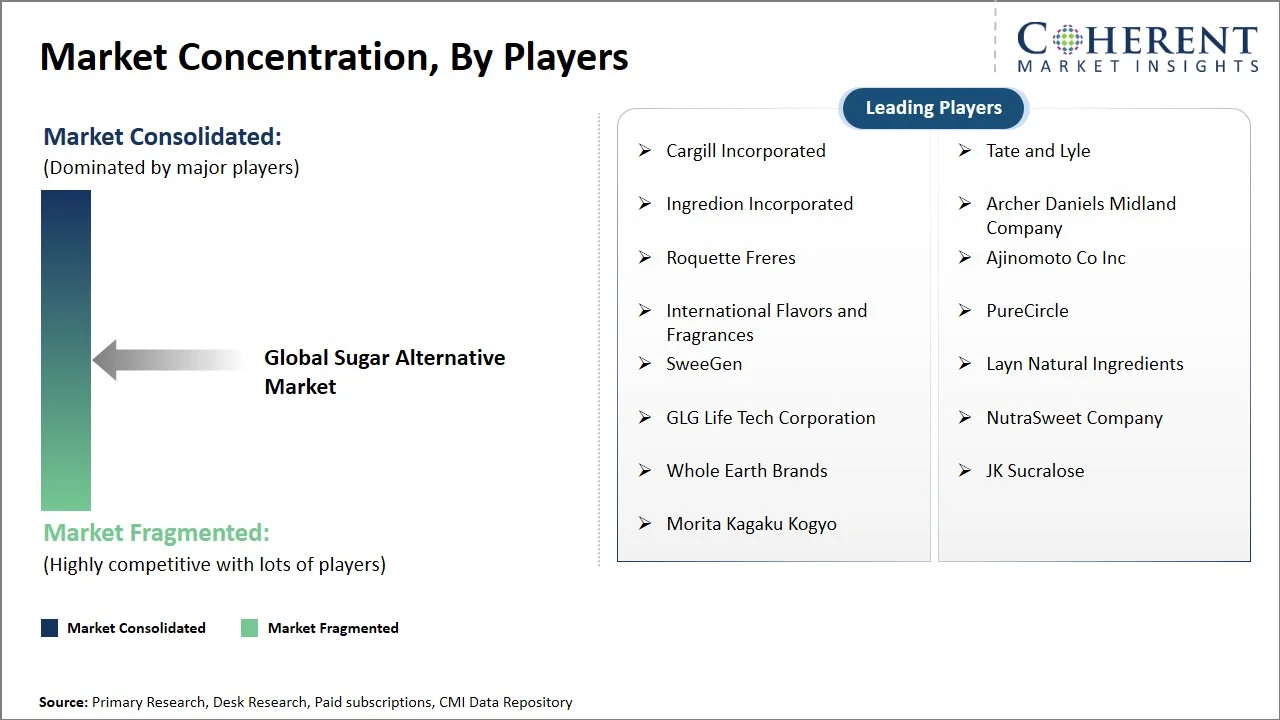
The global sugar alternative market includes multinational ingredient companies, specialized sweetener manufacturers, biotechnology platforms, agricultural extract suppliers, and consumer tabletop brands. Competition is moderately fragmented because no single ingredient can replace every sensory and functional property of sugar. Established companies compete through manufacturing scale and customer relationships, while emerging biotechnology companies focus on rare sugars, sweet proteins, fermentation, and proprietary conversion technologies.
Key focus areas include
- Product quality and sensory differentiation: Suppliers compete on sweetness profile, aftertaste reduction, mouthfeel, stability, and similarity to sugar.
- Application-specific formulation expertise: Companies are building technical capabilities for beverages, confectionery, dairy, bakery, pharmaceuticals, nutraceuticals, and oral care.
- Production efficiency and pricing: Process yield, feedstock costs, energy usage, purification requirements, and manufacturing scale directly influence competitiveness.
- Supply continuity: Dual sourcing, regional production, agricultural traceability, and inventory management are critical for maintaining consistent ingredient availability.
- Regulatory and quality compliance: Safety dossiers, purity specifications, permissible-use levels, labeling support, and international certifications influence customer qualification.
- Product format and specification differentiation: Competition extends across powders, crystals, syrups, granules, tablets, premixes, customized blends, and pharmaceutical grades.
- Clean-label and natural positioning: Plant-derived, minimally processed, non-genetically modified, organic-compatible, and traceable solutions attract premium product developers.
- Customer partnerships and distribution reach: Co-development agreements, application laboratories, contract manufacturing, distributor networks, and direct business-to-business sales improve market access.
Market Report Scope
Sugar Alternative Market Report Coverage
| Report Coverage | Details | ||
|---|---|---|---|
| Base Year: | 2025 | Market Size in 2026: | USD 22.64 Bn |
| Historical Data for: | 2020 To 2024 | Forecast Period: | 2026 To 2033 |
| Forecast Period 2026 to 2033 CAGR: | 7.2% | 2033 Value Projection: | USD 36.83 Bn |
| Geographies covered: |
| ||
| Segments covered: |
| ||
| Companies covered: | Cargill Incorporated, Tate and Lyle, Ingredion Incorporated, Archer Daniels Midland Company, Roquette Freres, Ajinomoto Co Inc, International Flavors and Fragrances, PureCircle, SweeGen, Layn Natural Ingredients, GLG Life Tech Corporation, NutraSweet Company, Whole Earth Brands, JK Sucralose, and Morita Kagaku Kogyo | ||
| Growth Drivers: |
| ||
| Restraints & Challenges: |
| ||
Analyst Opinion (Expert Opinion)
- The market will evolve from ingredient substitution toward integrated sweetness platforms. Future competitive advantage will come from supplying complete systems that manage sweetness, texture, browning, stability, and labeling rather than selling isolated high-intensity sweeteners. Application laboratories and customer co-development capabilities will become increasingly important sources of recurring revenue and customer retention.
- The convergence of precision fermentation, enzymatic conversion, and digital formulation tools could transform market economics. These technologies can expand access to rare molecules, improve batch consistency, shorten product-development cycles, and reduce dependence on climate-sensitive crops. Their greatest impact will emerge when production costs become competitive with established plant extracts and synthetic sweeteners.
- The strongest growth pockets are likely to emerge in natural high-intensity sweeteners, rare sugars, functional blends, and sugar-reduced beverages. Asia Pacific offers strong expansion potential, while North America will remain important for premium innovation, regulatory commercialization, and early adoption of biotechnology-derived ingredients.
- Regulatory divergence, digestive-tolerance concerns, taste limitations, and feedstock volatility remain material risks. Market participants should invest in jurisdiction-specific safety documentation, diversified sourcing, sensory validation, and transparent consumer communication. Companies that combine cost control with sugar-like functionality and credible clean-label positioning will be best placed to gain share.
Speak to the analyst
Want personalized insights?
Take the findings above to one of our principal consultants, or have the report rebuilt around the segments, geographies and competitors you actually track.
Market Segmentation
- Product Type Insights (Revenue, USD Bn, 2021 - 2033)
- High Intensity Sweeteners
- Sugar Alcohols
- Natural Bulk Sweeteners
- Rare Sugars
- Others
- Source Insights (Revenue, USD Bn, 2021 - 2033)
- Natural
- Synthetic
- Fermentation Derived
- Form Insights (Revenue, USD Bn, 2021 - 2033)
- Powder and Crystal
- Liquid and Syrup
- Granules
- Tablets and Sachets
- Application Insights (Revenue, USD Bn, 2021 - 2033)
- Beverages
- Bakery and Confectionery
- Dairy and Frozen Desserts
- Tabletop Sweeteners
- Pharmaceuticals and Nutraceuticals
- Others
- Regional Insights (Revenue, USD Bn, 2021 - 2033)
- North America
- U.S.
- Canada
- Latin America
- Brazil
- Argentina
- Mexico
- Rest of Latin America
- Europe
- Germany
- U.K.
- Spain
- France
- Italy
- Russia
- Rest of Europe
- Asia Pacific
- China
- India
- Japan
- Australia
- South Korea
- ASEAN
- Rest of Asia Pacific
- Middle East
- GCC Countries
- Israel
- Rest of Middle East
- Africa
- South Africa
- North Africa
- Central Africa
- North America
- Key Players Insights
- Cargill Incorporated
- Tate and Lyle
- Ingredion Incorporated
- Archer Daniels Midland Company
- Roquette Freres
- Ajinomoto Co Inc
- International Flavors and Fragrances
- PureCircle
- SweeGen
- Layn Natural Ingredients
- GLG Life Tech Corporation
- NutraSweet Company
- Whole Earth Brands
- JK Sucralose
- Morita Kagaku Kogyo
Sources
Primary Research Interviews
- Sugar alternative manufacturers, processors, formulators, and technology developers
- Stevia, monk fruit, polyol, rare sugar, and sweet protein producers
- Beverage, bakery, confectionery, dairy, pharmaceutical, and nutraceutical manufacturers
- Distributors, importers, procurement managers, food scientists, and regulatory experts
Stakeholders
- Key companies: Tate & Lyle, Cargill, Ingredion, ADM, Roquette, Tereos, Ajinomoto, SweeGen, Samyang Corporation, Bonumose, HOWTIAN, and GLG Life Tech
- Ingredient suppliers, fermentation companies, contract processors, retailers, distributors, and certification bodies
Databases:
- FAOSTAT, UN Comtrade, ITC Trade Map, Eurostat, and USITC DataWeb
- U.S. FDA GRAS Inventory, EFSA OpenFoodTox, WHO, USDA FAS, and OECD databases
- Company reports, trade records, patents, product brochures, and press releases
Industry Publications and Journals
- FoodNavigator, Food Ingredients First, BeverageDaily, Bakery and Snacks, NutraIngredients, and ConfectioneryNews
- Food Chemistry, Journal of Food Science, LWT, Appetite, and Nutrients
Associations
- International Sweeteners Association
- International Stevia Council
- Calorie Control Council
- FoodDrinkEurope
- International Council of Beverages Associations
Public Domain Sources
- WHO, FAO, JECFA, U.S. FDA, EFSA, European Commission, and Health Canada
- FSSAI, Food Standards Australia New Zealand, and national food safety authorities
Proprietary Elements
- CMI Data Analytics Tool
- Proprietary CMI Existing Repository of information for last 10 years
Get access to 250+ pages report
Every segment, forecast, competitor profile and data table behind the analysis above — available for instant download.
- ESOMAR Member
- ISO 9001:2015 Certified
- D-U-N-S Registered
- GDPR & CCPA Compliant
Missing comfort of reading report in your local language? Find your preferred language:
Transform your Strategy with Exclusive Trending Reports
Frequently Asked Questions
The CAGR of the global sugar alternative market is projected to be 7.2% from 2026 to 2033.
The global sugar alternative market is estimated to be valued at USD 22.64 billion in 2026 and is expected to reach USD 36.83 billion by 2033.
The beverages segment is expected to account for the largest share in 2026, supported by extensive reformulation of carbonated drinks, flavored water, and functional beverages.
The natural source segment is expected to dominate the market in 2026.
Sugar reduction in beverages and processed foods accelerating sweetener reformulation and rising diabetes and obesity concerns supporting low calorie sweetener adoption are the major factors driving the growth of the global sugar alternative market.
Aftertaste and formulation challenges limiting replacement in some food categories and regulatory scrutiny and consumer perception concerns around artificial sweeteners are the major factors hampering the growth of the global sugar alternative market.
In terms of product type, high intensity sweeteners are estimated to dominate the market revenue share in 2026.