

Global Tahini Market Size and Forecast – 2026-2033
The global tahini market is estimated to be valued at USD 1.74 Bn in 2026 and is expected to reach USD 2.69 Bn by 2033, exhibiting a compound annual growth rate (CAGR) of 6.5% from 2026 to 2033.
Key Takeaways of the Tahini Market
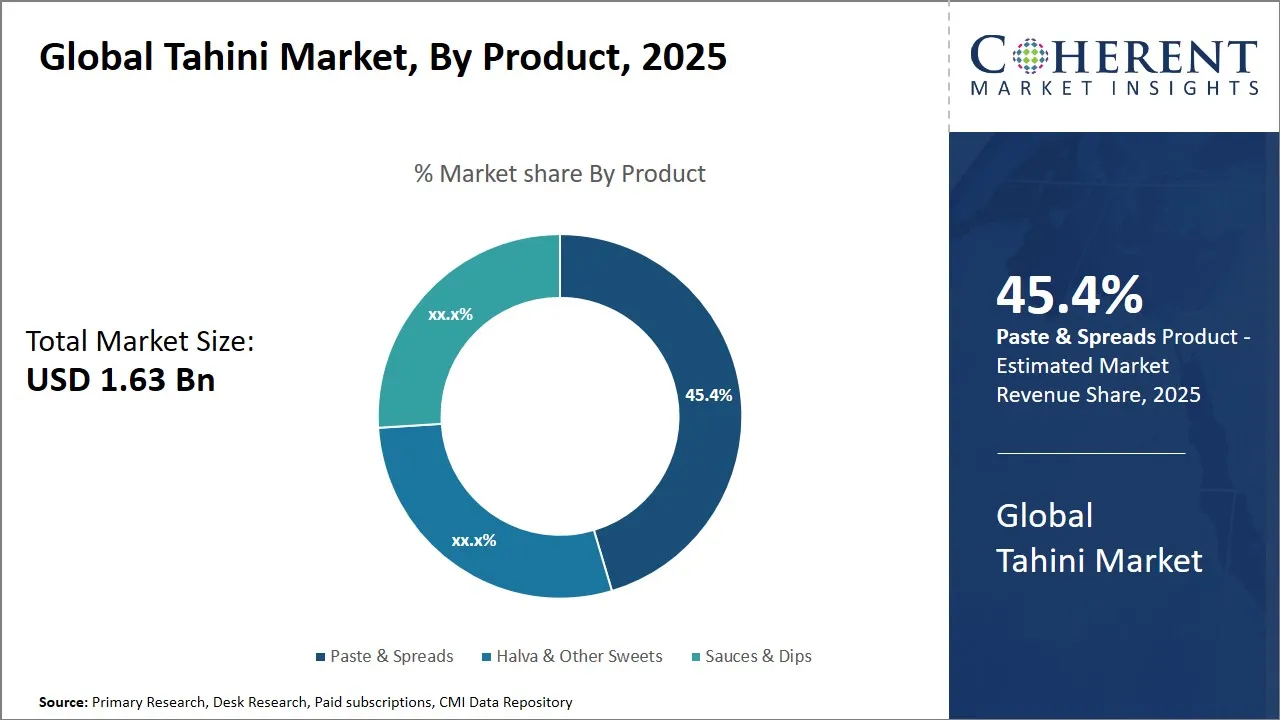
- The paste & spreads segment is expected to account for 46.4 % of the global tahini market share in 2026.
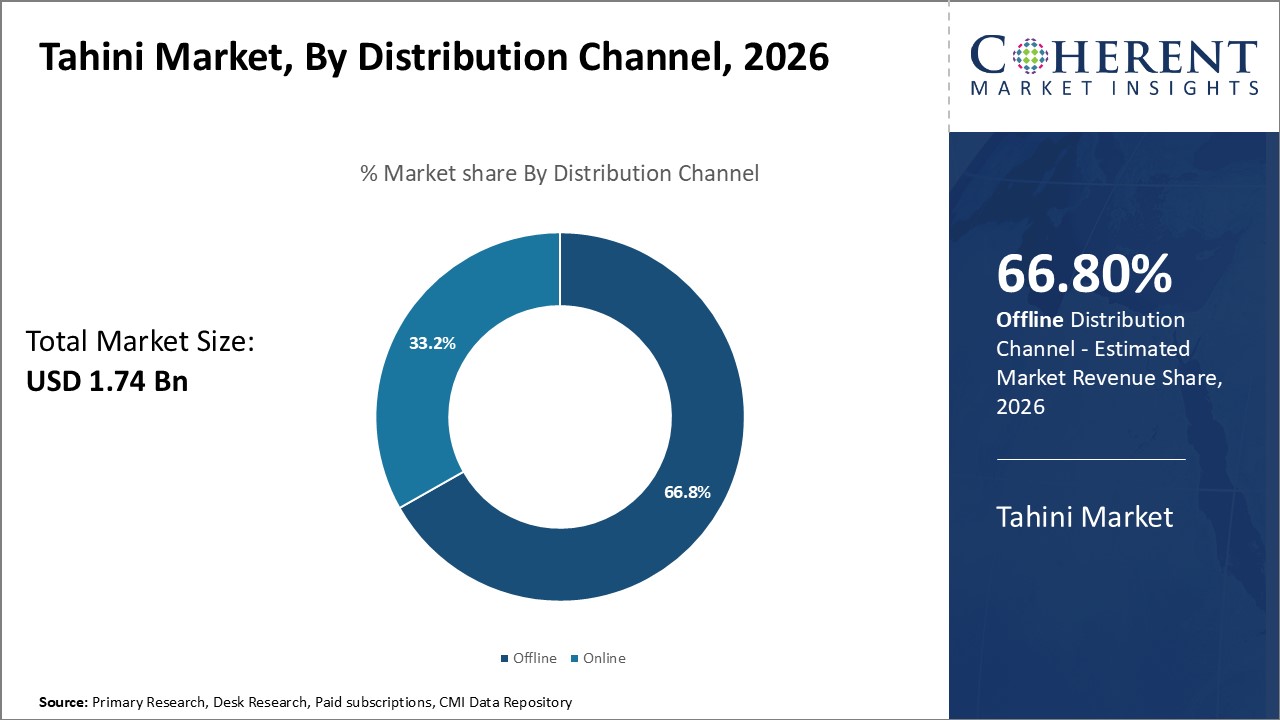
- The offline segment is projected to capture 66.8 % of the market share in 2026.
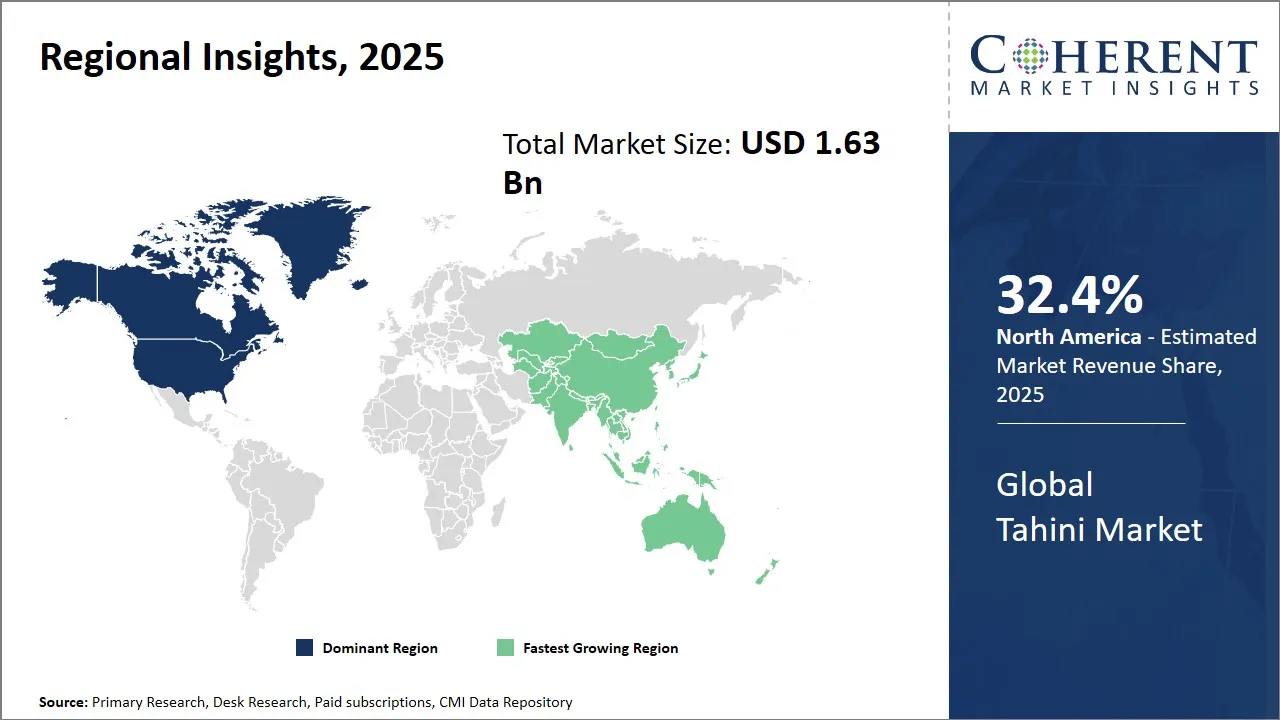
- North America is set to lead the global tahini market in 2026 with a 32.4 % share. Asia Pacific, with a 12.5% share, will be the fastest-growing region.
Market Overview
Market trends indicate a growing preference for organic and non-GMO tahini products, fueled by health-conscious consumers seeking clean-label and sustainable options. Additionally, innovations in packaging and product variants, such as flavored tahini and tahini-based snacks, are expanding the market reach. The influence of vegan and vegetarian diets, alongside rising popularity of Mediterranean cuisine worldwide, continues to propel tahini demand, making it an essential ingredient in diverse food categories from spreads to dressings and sauces.
Currents Events and their Impact
Current Events | Description and its Impact |
Expansion of Online Retail and E-commerce Penetration |
|
Supply Chain Disruptions in Sesame Seed Production |
|
Segmental Insights
- Current Industry Events of 2026
- Market Size Estimation
- Regional Breakdown
- Competitive Landscape
- Customer Intelligence
- Segmental Analysis
- Pricing Analysis
- Key Market Drivers, Challenges & Future Trends
- Customized Insights Section
Tahini Market Insights, by Product - Paste & Spreads Segment Dominates the Market Due to its Versatility and Rising Consumer Awareness About Health Benefits
The paste & spreads segment is projected to account for 46.4% of the global tahini market share in 2026, because of its wide-ranging applications and increasing consumer inclination towards nutritious food options. Tahini paste, known by its thick, creamy consistency and its nutty taste, is often utilized as a base ingredient in a variety of dishes, mostly of Mediterranean and Middle Eastern cuisines. It is versatile and can be used as a stand-alone spread or as a dip or as a baking and cooking ingredient. This multi-purpose feature makes it irreplaceable to the household consumer and foodservice industry.
The health awareness is the key driver of the paste and spreads segment. Tahini is a natural source of health nutrients, such as healthy fats, vitamins, minerals, and antioxidants. Tahini paste is a good alternative to traditional spreads and dips by consumers with the objective to use it as a healthier option. Its vegan and allergenic nature also increases its popularity with the vegan and diet-restricted communities. This has developed a niche but growing consumer base that is conscious of clean-label and nutrient-dense foods.
Tahini Market Insights, by Distribution Channel – Offline Segment Dominates Driven by Established Retail Networks and Consumer Preference for Tactile Shopping Experiences
The offline segment is expected to capture 66.8% share in 2026, supported by its entrenched presence in traditional retail outlets, supermarkets, specialty grocers, and ethnic food stores. These brick and mortar stores provide consumers with a variety of benefits that have kept them top despite the popularity of online stores.
One of the main drivers of offline sales is the availability and immediacy that physical stores can offer. People in most areas where tahini has been part of their household over the years will choose to buy the product as part of their daily shopping. The option to look at the packaging of the products and to verify the expiry dates and the quality is another benefit that leads to consumer confidence. This tactile involvement is particularly valuable in foodstuffs such as tahini, whose freshness and texture are the key quality factors.
Regional Insights
North America Tahini Market Analysis and Trends
The North America region is projected to lead the market with a 32.4% share in 2026, particularly among health-conscious consumers seeking plant-based, nutrient-rich ingredients. With the increasing consumer level of awareness of the health benefits of tahini, it is currently experiencing a boom as a universal ingredient in salads, dressing, creams and dips. Furthermore, the increasing popularity of clean-label and organic products is also increasing the popularity of tahini as a healthy, nutritious food product. The market in North America is also underpinned by the robust supply chain in terms of the supply of sesame seeds and the increasing demand in the ethnic food production as the multicultural urban population grows, alongside the increased popularity of plant-based diets.
The market is also being enhanced by government moderation in practicing sustainable food and organic certification. Some major food producers and distributors in the U.S and Canada are exploiting the demand of tahini and are diversifying their products to include organic and specialty tahini products. Firms like Once Again Nut Butter (U.S.) and Soom Foods (U.S.) are on the cutting edge of innovation in tahini, concentrating on high quality products and distribution networks across the retail and foodservice sectors.
Asia Pacific Tahini Market Analysis and Trends
The Asia Pacific region is expected to exhibit the fastest growth in the market contributing 12.5% share in 2026. The emerging middle class in such nations as China, Japan, South Korea, and India is shifting towards eating Mediterranean and Middle Eastern food, and as a healthy, versatile foodstuff, tahini is becoming popular among health-conscious consumers. The market ecosystem is advantaged in that the government gives incentives to encourage healthy foods and facilitate agricultural innovation particularly on the production of sesame seeds.
This is due to the growing entry of local startups and multinational companies into the tahini industry and the resultant diversification and expansion of distribution coverage. Other companies like SunSnack (China), The Tahini Co. (Australia) and Kawan Food (Malaysia) have played a leading role in product localization and product awareness campaigns that have made tahini more accessible and attractive throughout the region. Trade relations, particularly with Middle East suppliers, also relax the constraints of supply to enable the market to grow.
Global Tahini Market Outlook for Key Countries
Turkey Tahini Market Analysis and Trends
Turkey continues to lead as a significant producer and consumer of tahini, driven by a combination of rich sesame-growing regions and a well-developed food manufacturing sector. Turkish companies like Sesaco harness domestic sesame cultivation to maintain quality and supply. Robust government policies encouraging agro-industry exports and infrastructure development in logistics have bolstered Turkey’s competitive advantage. The vibrant local food culture integrates tahini not just in traditional recipes but also in contemporary food products, supporting steady domestic demand. Turkey’s strategic geographic location also facilitates trade between Europe, Asia, and the Middle East, reinforcing its role as a regional tahini hub.
U.S. Tahini Market Analysis and Analysis and Trends
The U.S. tahini market is characterized by growing consumer interest in ethnic and health foods, with tahini gaining popularity among the growing vegan and natural foods segments. The market ecosystem includes a mixture of large-scale food companies like B&G Foods (owning brands like Cedar’s Foods) and specialty organic brands expanding distribution nationwide through health food retailers and mainstream supermarkets. Government regulations around food safety and organic certification shape product standards, while trade dynamics involving imports from Middle Eastern and Asian suppliers help meet demand. Innovation in packaging and value-added tahini products is also notable in the U.S. market, catering to convenience-driven consumers.
China Tahini Market Analysis and Trends
China tahini market is emerging rapidly as consumer trends shift toward healthy eating and international cuisines gain footholds. Domestic companies such as SunSnack leverage local sesame production and government initiatives designed to improve food processing capabilities. The market is supported by expanding e-commerce platforms, allowing specialized and imported tahini brands to reach a broader audience efficiently. Trade enhancements between China and sesame-growing countries in the Middle East and Africa facilitate the import of raw materials and finished goods, reducing supply bottlenecks. Additionally, product innovation tailored to Chinese flavor profiles is increasing product acceptance and the market penetration.
Germany Tahini Market Trends
Germany is a key European player in the tahini market, benefiting from strong consumer demand for organic and plant-based foods. The country's robust food processing industry includes prominent companies like Alwadi Al Akhdar GmbH and Seeberger GmbH that distribute tahini across Europe tahini market. Regulatory frameworks supporting food safety, organic certification, and sustainability practices influence product offerings and quality assurance. Germany also serves as an important hub for the import and redistribution of tahini within Europe, supported by its advanced infrastructure and logistics network. Awareness campaigns and the rise of Mediterranean cuisine in German households further accelerate market adoption.
Macro and Micro Economic Factors Impacting Tahini Market Growth
Macroeconomic Factors
- Increasing disposable income globally leads to higher demand for tahini, especially in emerging markets where retail penetration is growing.
- Supportive government policies, including funding programs, tax incentives, and infrastructure development, enhance market growth by enabling better production and distribution.
- Globalization and rising popularity of Middle Eastern and Mediterranean cuisines worldwide drive demand internationally.
- The rise in plant-based and vegan diets fuels market expansion due to tahini being a popular dairy-free protein source.
- Economic disruptions like the COVID-19 pandemic initially reduced demand due to supply chain issues and lockdowns but later health trend awareness helped recover growth.
- E-commerce growth and online platforms increase accessibility and consumption of tahini globally.
Microeconomic Factors
- Health benefits of tahini, such as its richness in protein, fiber, vitamins B1, B2, B6, and minerals like selenium, drive consumer preference.
- Product innovation in flavors, consistency, ingredients, organic and clean-label variants increase consumer interest and market differentiation.
- Increasing consumer awareness of nutritional and heart health benefits influences buying behavior.
- Demand growth driven by product diversification into sauces, dips, spreads, and ready-to-eat options.
- Manufacturer focus on sustainably sourced and organic sesame seeds also appeals to ethically minded consumers.
- Competitive market strategies such as mergers, acquisitions, and R&D investments stimulate innovation and market expansion.
Market Players, Company Insights, and Competitive Intelligence
Company Insights
- Al Wadi Al Akhdar is a firm that focuses on various types of food products, and its products include Lebanese specialties, canned vegetables, halva and tahini, specialty pickles, organic frozen vegetables, jams, and condiments. Some of its tahini products include regular tahini, which is hulled and crushed sesame seeds paste, and organic tahini paste.
- Dipasa USA is a subsidiary of Dipasa Group involved with importation and production of diverse food ingredients as well as offering services. The company products consist of sesame seeds, tahini, oils, and sweeteners with a special mention made of the Black Sesame Tahini.
Top Strategies Followed by Global Tahini Market Players
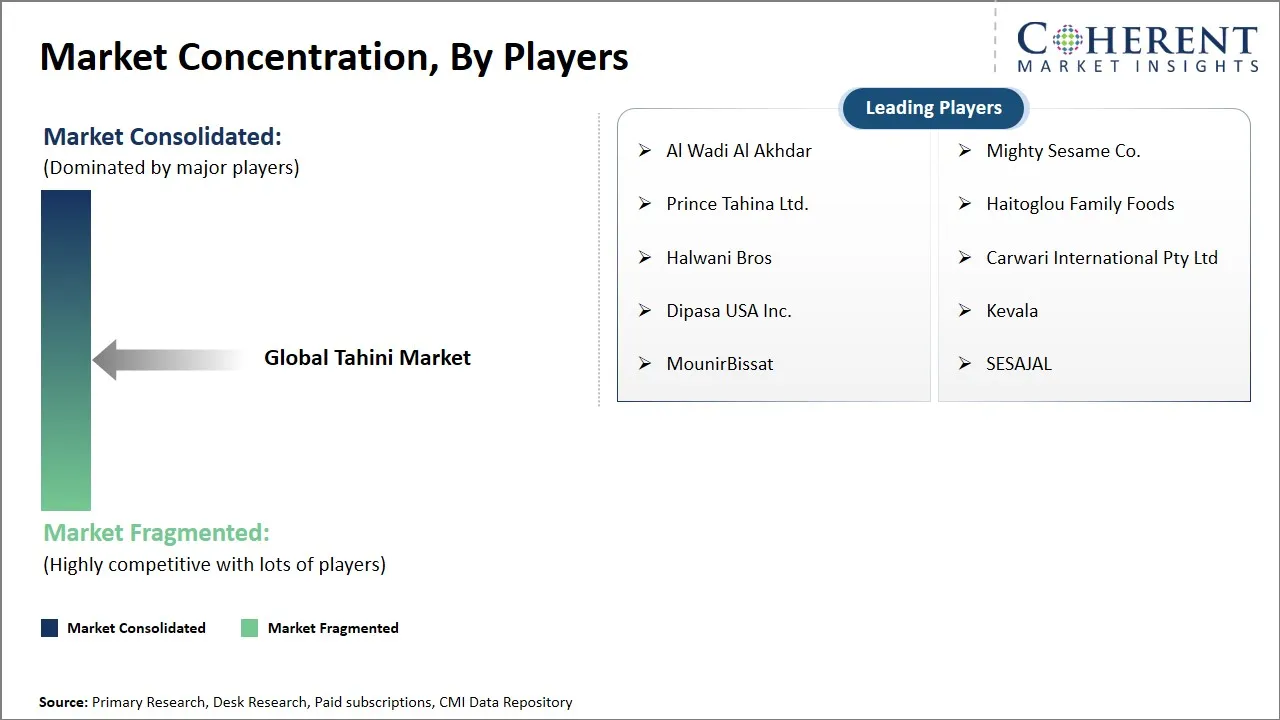
- The market is dominated by established players, who have made significant investments in research and development (R&D) and are involved in innovation of high-performance, high-end tahini products, that serve the changing consumer interest in quality and health-related benefits. In addition, they also engage in aggressive international growth through expansion of their distribution channels, especially to the emerging economies where the tahini demand is growing fast. This international strategy does not just cement their market position but also assists to spread the risk and access new consumer markets thus contributing to their competitive advantage.
- As an example, one may refer to Soom Foods, a major U.S. based tahini manufacturer, which specializes in manufacturing high-quality premium tahini produced using Ethiopian sesame seeds, which have become popular thanks to their better taste and smooth texture. It has also penetrated the international markets, such as Europe and Asia, to reach the health-conscious consumers through alliances with high-end grocery stores, such as Whole Foods.
- The tahini market middle players use a different strategy in which they focus more on providing affordable solutions, which balance between quality and affordability. The needs of these price-sensitive consumers are customized by these companies to develop product lines that they want at prices that do not compromises on the important product features. The middle players usually enter into joint venture deals with technology providers, co-packers or local distributors aiming at increasing the scale of their production and also bringing about technological improvements.
- Al Wadi Al Akhdar from Lebanon, offers a range of tahini products at competitive prices while maintaining acceptable quality standards. The company has expanded its distribution across the Middle East and North Africa (MENA) region by forming strategic alliances with local retailers and distributors.
- Small-scale players in the global tahini market differentiate themselves by targeting specialized niches and innovating with unique product features that appeal to particular consumer segments. These companies often embrace cutting-edge technologies such as advanced processing techniques, organic certification, or novel flavor infusions to stand out in a crowded marketplace. Since large-scale distribution channels may be beyond their immediate reach, they focus on building strong local alliances with startups, specialty food shops, or local manufacturers.
- Tahini Al Dar, producer based in Syria, which differentiates itself by producing organic tahini sourced from local, sustainable sesame farms. The brand has found success within niche markets, particularly among health-conscious consumers in the Middle East and parts of Europe.
Market Report Scope
Tahini Market Report Coverage
| Report Coverage | Details | ||
|---|---|---|---|
| Base Year: | 2025 | Market Size in 2026: | USD 1.74 Bn |
| Historical Data for: | 2020 To 2024 | Forecast Period: | 2026 To 2033 |
| Forecast Period 2026 to 2033 CAGR: | 6.5% | 2033 Value Projection: | USD 2.69 Bn |
| Geographies covered: |
| ||
| Segments covered: |
| ||
| Companies covered: | Al Wadi Al Akhdar, Mighty Sesame Co., Prince Tahina Ltd., Haitoglou Family Foods, Halwani Bros, Carwari International Pty Ltd, Dipasa USA Inc., Kevala, MounirBissat, and SESAJAL | ||
| Growth Drivers: |
| ||
| Restraints & Challenges: |
| ||
Tahini Market Dynamics
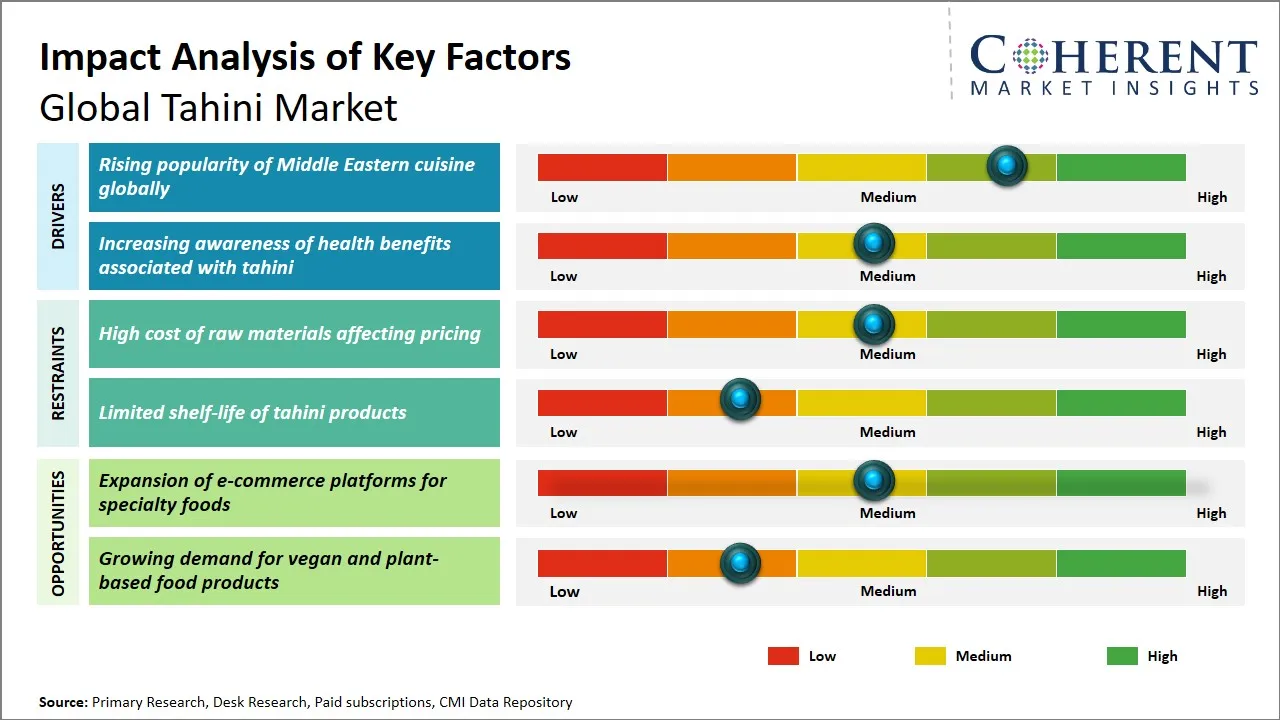
Tahini Market Driver - Rising Popularity of Middle Eastern Cuisine Globally
The growing popularity of Middle East cuisine in the world is an influential factor contributing to the rise in demand of tahini, which is a staple of most traditional foods, ethnic foods, including hummus, baba ganoush, and falafel. With consumers across the globe growing more adventurous in their food selections and an increased desire to find more authentic, flavorful, and healthy selections, the Middle Eastern flavors gained significant popularity in a wide range of markets. This food trend is also supported by the increased interest in plant-based and healthy eating tendencies, in which tahinis nutrient profile, which includes healthy fats and proteins, is quite consistent with consumer preferences.
Tahini Market Opportunity - Expansion of E-commerce Platforms for Specialty Foods
The swift growth of e-commerce sites is a great opportunity to the global tahini market, especially in the specialty foods section, specialty food ingredients. As consumer demand to access a variety of health-aware products that are conveniently available to them grows, online marketplaces have emerged to serve as instrumental mediums through which consumers can find and make purchases of niche food products including tahini. Online retailers allow specialty food brands to access a larger, more widely spread customer base outside of the retail setting. This is particularly relevant to tahini that is popular in the Middle East and Mediterranean diet but is gaining momentum across the globe owing to the increased popularity of plant- and nature-based food products.
Analyst Opinion (Expert Opinion)
- The market for tahini will experience an impressive growth due to the influx of health-conscious consumption and the rising incorporation of the Middle Eastern food into the global cuisine. The experience at the International Food Expo (2023) and the Plant-Based Food Innovation Conference (2022) revealed clearing trends, and such companies as Soom Foods and Tahinio were seen as the pioneers of product innovation.
- The introduction of organic tahini and ready to use sauces made on a tahini basis at Soom Foods is a strategic reaction to consumerism demand to save time without compromising health advantages. At these conferences, the idea of tahini in vegan and gluten-free diets was discussed, which further expanded its popularity. Nevertheless, cost issues like increasing the cost of sesame seeds and supply chain risks were often mentioned as an obstacle.
- Brands which have the potential to concentrate on sustainable sourcing and create clear supply chains will probably create stronger consumer loyalty. Moreover, the marketing campaigns to demonstrate how tahinis can be used in both the classical and contemporary dishes can also help increase market penetration considerably.
Speak to the analyst
Want personalized insights?
Take the findings above to one of our principal consultants, or have the report rebuilt around the segments, geographies and competitors you actually track.
Market Segmentation
- Product Insights (Revenue, USD Bn, 2021 - 2033)
- Paste & Spreads
- Halva & Other Sweets
- Sauces & Dips
- Distribution Channel Insights (Revenue, USD Bn, 2021 - 2033)
- Offline
- Online
- Regional Insights (Revenue, USD Bn, 2021 - 2033)
- North America
- U.S.
- Canada
- Latin America
- Brazil
- Argentina
- Mexico
- Rest of Latin America
- Europe
- Germany
- U.K.
- Spain
- France
- Italy
- Russia
- Rest of Europe
- Asia Pacific
- China
- India
- Japan
- Australia
- South Korea
- ASEAN
- Rest of Asia Pacific
- Middle East
- GCC Countries
- Israel
- Rest of Middle East
- Africa
- South Africa
- North Africa
- Central Africa
- North America
- Key Players Insights
- Al Wadi Al Akhdar
- Mighty Sesame Co.
- Prince Tahina Ltd.
- Haitoglou Family Foods
- Halwani Bros
- Carwari International Pty Ltd
- Dipasa USA Inc.
- Kevala
- MounirBissat
- SESAJAL
Sources
Primary Research Interviews
- R&D Director – Leading Tahini Manufacturer
- Procurement Manager – Major Tahini Retailer and Distributor
- Product Development Head – Well-Known Tahini Brand
- Sustainability Manager – Food Industry Certification Body focusing on sesame products
Stakeholders
- Tahini Manufacturers and Processors
- End-use Sectors:
- Foodservice (Restaurants, Middle Eastern and Mediterranean cuisine)
- Retail (Packaged tahini consumers)
- Food Ingredient Suppliers (Baking, sauces, dressings)
- Regulatory & Certification Bodies (Food safety and organic certifications)
- E-commerce Platforms and Specialty Food Retailers
- Technology Integration Providers: Quality control and traceability technologies (blockchain for sesame sourcing)
Databases
- UN Comtrade Database (Sesame seeds and tahini trade data)
- India Import Export (EXIM) Database (Sesame and Tahini trade statistics)
Magazines
- Food & Beverage News – Trends in sesame seed and tahini products
- Specialty Food Magazine – Innovations and new product launches in tahini market
- International Food Ingredients – Market developments in sesame-based ingredients
- Global Food Insights – Consumer trends in dip and spread consumption
Journals
- Journal of Food Science & Technology – Tahini production and quality research
- International Journal of Food Science – Nutritional benefits of sesame products
- Food Chemistry Journal – Analysis of tahini composition and functional properties
- Journal of Agricultural and Food Chemistry – Studies on sesame seed oil extraction and tahini
Newspapers
- The Financial Times – Global sesame seed and tahini market growth reports
- The Guardian – Consumer preferences and health trends in plant-based spreads
- Asia Health Journal – Tahini consumption growth in Asia-Pacific
- European Food News – Regulation and safety policies on tahini imports and exports
Associations
- International Sesame Association
- Global Food Safety Initiative (GFSI)
- Organic Trade Association (for organic tahini certification)
- Food and Agriculture Organization (FAO) – Sesame seed production and market reporting
- National Sesame Board (where applicable)
Public Domain Sources
- FDA – Guidelines for sesame and sesame-based products including tahini
- European Commission – Food safety regulation for tahini and sesame imports
- World Health Organization – Nutritional and safety assessments for sesame products
Proprietary Elements
- CMI Data Analytics Tool, Proprietary CMI Existing Repository of information for last 8 years.
Get access to 250+ pages report
Every segment, forecast, competitor profile and data table behind the analysis above — available for instant download.
- ESOMAR Member
- ISO 9001:2015 Certified
- D-U-N-S Registered
- GDPR & CCPA Compliant
Missing comfort of reading report in your local language? Find your preferred language:
Transform your Strategy with Exclusive Trending Reports
Frequently Asked Questions
The global tahini market is estimated to be valued at USD 1.74 Bn in 2026 and is expected to reach USD 2.69 Bn by 2033.
The CAGR of the global tahini market is projected to be 6.5% from 2026 to 2033.
Rising popularity of Middle Eastern cuisine globally and increasing awareness of health benefits associated with tahini are the major factors driving the growth of the global tahini market.
High cost of raw materials affecting pricing and limited shelf-life of tahini products are the major factors hampering the growth of the global tahini market.
In terms of product, the paste & spreads segment is estimated to dominate the market revenue share in 2026.
Al Wadi Al Akhdar, Mighty Sesame Co., Prince Tahina Ltd., Haitoglou Family Foods, Halwani Bros, Carwari International Pty Ltd, Dipasa USA Inc., Kevala, MounirBissat, and SESAJAL are the major players.
North America is expected to lead the global tahini market in 2026.