

Beta Glucan Market Size and Forecast – 2026 to 2033
Beta Glucan Market is estimated to be valued at USD 712.21 Mn in 2026 and is expected to reach USD 1,254.6 Mn in 2033, exhibiting a compound annual growth rate (CAGR) of 10.2% from 2026 to 2033.
Key Takeaways
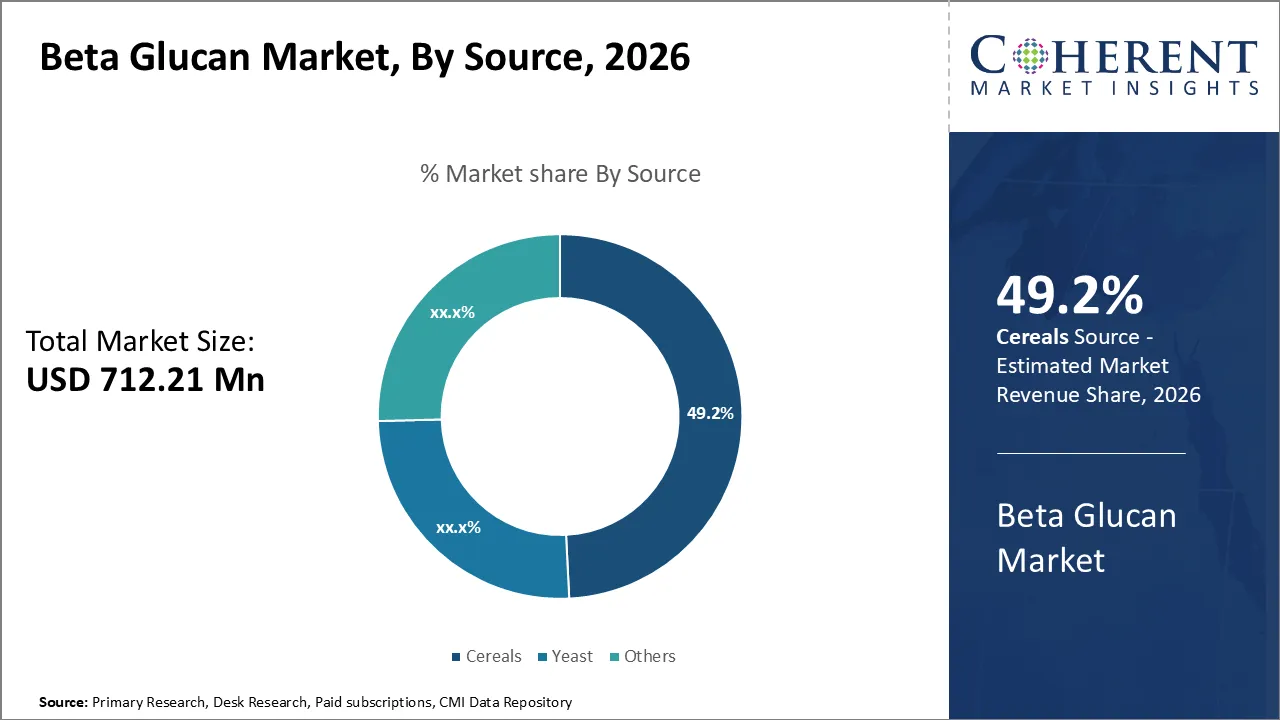
- By Source, Cereals hold the largest market share of 49.2% in 2026 owing to the rising consumer health awareness.
- By Application, Food & Beverages acquired the prominent market share of 41.1% in 2026 owing to its growing demand for functional foods & beverages.
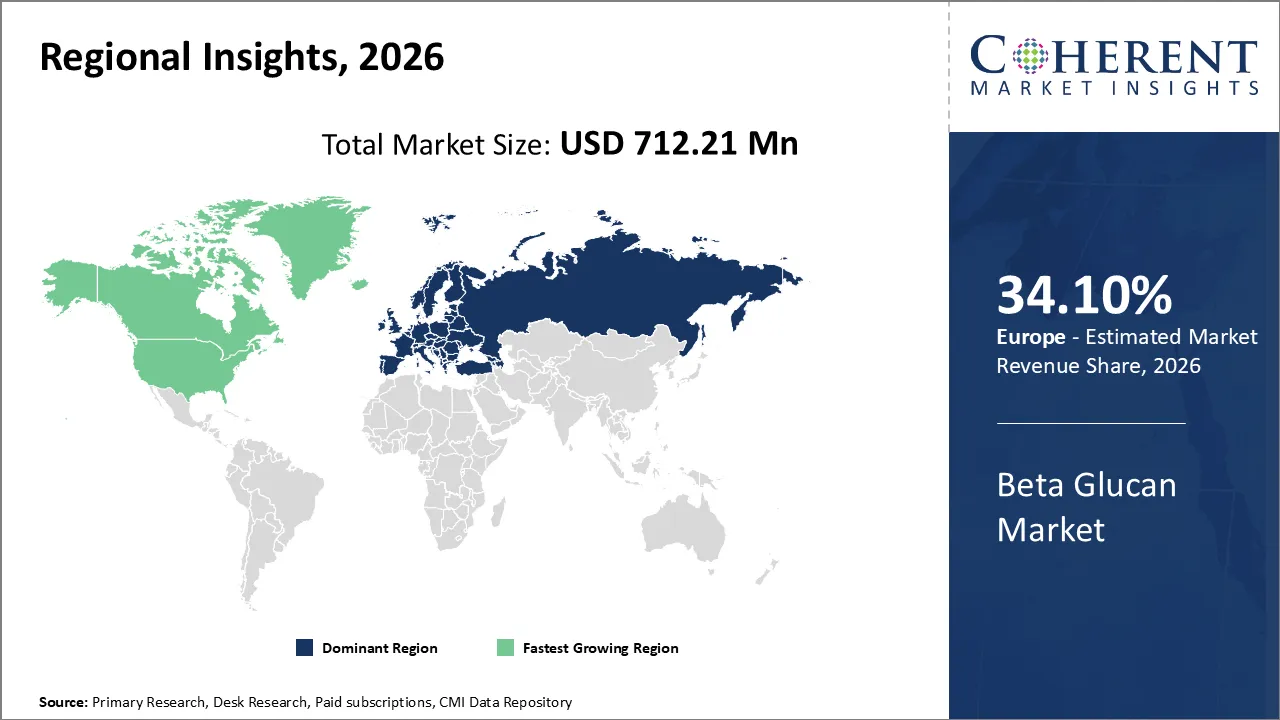
- By Region, Europe dominates the overall market with an estimated share of 34.1% in 2026 owing to the high health & wellness awareness.
Market Overview
The beta-glucan market is growing as consumers actively seek functional and health-oriented ingredients in food, beverages, dietary supplements, pharmaceuticals, and personal care products. Manufacturers source beta-glucan from oats, barley, yeast, and mushrooms to deliver benefits for heart health, immunity, and digestive wellness. Rising health awareness, strong preference for natural and clean-label ingredients, and continuous innovation in fortified and functional products are collectively driving global market growth.
Current Events and Its Impacts on the Beta Glucan Market
Current Events | Description and its impact |
Global Regulatory Changes in Nutraceuticals |
|
Advances in Beta Glucan Extraction and Nano-Delivery Technologies |
|
Shifts in Consumer Health Trends and Demand Patterns |
|
Segmental Insights
- Current Industry Events of 2026
- Market Size Estimation
- Regional Breakdown
- Competitive Landscape
- Customer Intelligence
- Segmental Analysis
- Pricing Analysis
- Key Market Drivers, Challenges & Future Trends
- Customized Insights Section
Beta Glucan Market Insights, By Source: Cereals contribute the highest share of the market owing to its preference for natural & clean-label ingredients.
Cereals hold the largest beta glucan market share of 49.2% in 2026. The cereal segment of the beta-glucan market is expanding as consumers increasingly prioritize heart health, digestive wellness, and balanced nutrition. Food manufacturers use cereals such as oats and barley, which naturally contain high levels of beta-glucan, in functional breakfast foods and snacks. Strong demand for fiber-rich, natural, and clean-label products, along with higher consumption of fortified cereals for preventive health, is actively driving the global adoption of beta-glucan in cereal-based applications.
Beta Glucan Market Insights, By Application: Food & Beverages contribute the highest share of the market owing to its innovation in food & beverage product development.
Food & Beverages acquired the prominent market share of 41.1% in 2026. The food and beverages segment of the beta-glucan market is growing as consumers actively seek functional products that promote heart health, immunity, and digestive wellness. Manufacturers are adding beta-glucan to bakery products, cereals, beverages, and dairy alternatives to improve nutritional value. Increasing awareness of preventive healthcare, strong preference for natural and clean-label ingredients, and ongoing innovation in fortified and functional food and beverage offerings are driving the global adoption of beta-glucan. For instance, in July 2025, Layn Natural Ingredients launched its plant-based sweetener SteviUp M2 (Reb M2), suitable for a wide range of food and beverage applications. The company also expanded its biotechnology facility and introduced its beta glucan ingredient, Galacan.
Regional Insights
Europe Beta Glucan Market Trends
Europe dominates the overall market with an estimated share of 34.10% in 2026. In Europe, consumers are actively driving the beta-glucan market by seeking products that enhance heart health, immunity, and digestive wellness. Manufacturers are adding beta-glucan to functional foods, beverages, and supplements to meet the growing demand for natural, clean-label ingredients. Strong regulatory support for health claims, along with advanced food and pharmaceutical industries, encourages ongoing innovation. Moreover, aging populations and a focus on preventive healthcare are boosting the use of beta-glucan-enriched products throughout the region. For instance, BENEO introduced its first barley beta-glucan ingredient, Orafti β-Fit. Several human intervention studies support its health benefits, but only cereal beta-glucans hold approved health claims in Europe.
North America Beta Glucan Market Trends
In North America, consumers are actively driving the beta‑glucan market by seeking functional foods and immune‑supporting ingredients. Manufacturers are incorporating beta‑glucan into cereals, beverages, snacks, and supplements to meet this demand. Health-conscious buyers are increasingly choosing natural, clean-label products that support heart and gut wellness, prompting continuous product innovation and new launches. The United States leads regional growth with strong health claims and advanced R&D, while Canada and Mexico are seeing increasing adoption of fortified and preventive health products. For instance, in December 2024, Witsbb, a leader in allergy-free nutrition, launched the Elderberry Yeast β-glucan drink. Designed for children aged 6 months to 12 years, the drink boosts immunity, follows Witsbb’s allergy-free formula, and features a new generation of high-standard immune-support ingredients.
United Kingdom Beta Glucan Market Trends
In the United Kingdom, consumers are actively driving the beta‑glucan market by seeking natural, plant-based ingredients that enhance immune health, heart wellness, and overall wellbeing. Manufacturers are introducing clean-label products and functional foods, including fortified cereals, snacks, and supplements, across mainstream retail and online channels. British shoppers are increasingly adopting yeast- and mushroom-based beta‑glucan for fitness and skincare applications, reflecting their focus on wellness and preventive health, and prompting ongoing innovation in product offerings. For instance, Swedish cooperative Lantmännen Functional Foods launched PromOat Instant, the first fully water-soluble oat beta-glucan, made from GMO-free wholegrain oats and supporting heart and diabetes health.
United States Beta Glucan Market Trends
In the United States, consumers are actively driving the beta‑glucan market by choosing products that support immune health, heart wellness, and digestive function. Manufacturers are incorporating beta‑glucan into cereals, beverages, snacks, and dietary supplements to meet the demand for clean-label, functional ingredients. Robust research, FDA-approved health claims, and well-established retail and e-commerce channels are enabling companies to launch new beta‑glucan-enriched products. Rising interest in natural wellness solutions and preventive health is continuously shaping market trends across the country. For instance, Kemin Industries, a global nutritional ingredient company, acquired unique beta-glucan manufacturing technology from Plymouth, Michigan–based Algal Scientific.
End-user Feedback and Unmet Needs in the Beta Glucan Market
- Taste and Palatability: Many end-users appreciate beta-glucan’s health benefits but report challenges with taste and texture in fortified foods and beverages. Consumers seek formulations that maintain nutritional value while improving flavor, mouthfeel, and versatility in everyday products like cereals, snacks, and drinks. Manufacturers are exploring masking techniques and natural flavor enhancements.
- Product Availability and Accessibility: Users indicate limited access to beta-glucan-enriched foods and supplements, especially in mainstream retail and smaller cities. They desire broader availability, affordable pricing, and convenient packaging formats. Expanding distribution through supermarkets, online platforms, and subscription models could better meet consumer needs for daily incorporation into their diet.
- Clear Health Communication: Consumers often struggle to understand beta-glucan’s benefits, dosage, and source differences. They seek transparent labeling, simplified health claims, and educational campaigns explaining heart, immunity, and gut benefits. Effective communication can enhance trust, adoption, and repeat purchases, addressing uncertainty about product efficacy.
Beta Glucan Market Trend
Rising Demand for Functional and Fortified Foods
Consumers are increasingly incorporating beta-glucan into their diets through functional and fortified foods, including cereals, snacks, bakery items, and beverages. Manufacturers are responding by developing innovative formulations that enhance heart, digestive, and immune health. The trend reflects a shift toward preventive nutrition, where people actively seek food products that deliver measurable health benefits while maintaining taste, texture, and convenience in everyday consumption.
Clean-Label and Natural Ingredient Preference
Modern consumers prioritize transparency, clean-label formulations, and plant-based ingredients. Beta-glucan, sourced from oats, barley, yeast, or mushrooms, aligns with these preferences. Brands are leveraging this trend by promoting natural sourcing, minimal processing, and clear labeling. This movement encourages innovation in food and supplement offerings, appealing to health-conscious buyers who want functional benefits without synthetic additives or artificial enhancers.
Beta Glucan Market Opportunity
Functional Food and Beverage Innovation
The growing consumer interest in preventive health creates opportunities for manufacturers to innovate with beta-glucan-enriched products. Companies can develop new cereals, bakery items, snacks, beverages, and dairy alternatives that provide heart, digestive, and immune benefits. Customizing formulations for taste, texture, and nutritional content allows brands to differentiate themselves, attract health-conscious consumers, and capture emerging niches within functional food and beverage markets.
Market Report Scope
Beta Glucan Market Report Coverage
| Report Coverage | Details | ||
|---|---|---|---|
| Base Year: | 2025 | Market Size in 2026: | USD 712.21 Mn |
| Historical Data for: | 2020 To 2024 | Forecast Period: | 2025 To 2032 |
| Forecast Period 2026 to 2033 CAGR: | 10.2% | 2033 Value Projection: | USD 1,254.6 Mn |
| Geographies covered: |
| ||
| Segments covered: |
| ||
| Companies covered: | Associated British Foods Plc, Biotec Pharmacon ASA (Biotec BetaGlucans AS), Biothera, the Immune Health Company, Ceapro Inc., Immuno Medic AS, Koninklijke DSM N.V., Super Beta Glucan (SBG) Inc., Groupe Soufflet S.A (AIT Ingredients), Tate & Lyle plc. (Tate & Lyle Oats Ingredients), and Zilor Inc. (Biorigin) | ||
| Growth Drivers: |
| ||
| Restraints & Challenges: |
| ||
Beta Glucan Market News
- In April 2025, Japanese dairy company Meiji launched a new RTD coffee drink in its Marugoto Oats series. Made with whole oats, it offers whole grain fiber and 0.5 g of beta-glucan per 200 ml, with a mellow oat taste and a hint of coffee.
- In December 2025, CERAGEM Co.’s health brand CERAMATE is launching CERAMATE NK Seven, a health functional food featuring beta-glucan powder as its main ingredient.
Analyst Opinion (Expert Opinion)
- The beta‑glucan market’s trajectory is increasingly defined by measurable uptake and strategic deployment within high‑growth product arenas rather than by generic wellness trends. Functional foods fortified with beta‑glucan now appear in over 42% of fortified cereals and bakery products in North America, suggesting that mainstream manufacturers are not experimenting but strategically embedding the ingredient to capture health‑oriented consumers. This is reflected in significant year‑on‑year increases in dietary supplements containing beta‑glucan, with some regions reporting double‑digit adoption growth among new SKUs.
- Industry investments affirm this momentum: leading producers such as Lesaffre and DSM have each allocated in excess of $100 million to R&D focused on novel extraction and application technologies, signaling confidence in long‑term commercial potential. Concurrently, over $1.2 billion has flowed into beta‑glucan ventures globally, with startups securing more than $350 million in funding across dozens of deals — underscoring investor belief in beta‑glucan’s expanding role beyond traditional supplements into functional foods and even pharmaceutical applications.
- Emerging evidence from pilot studies links beta‑glucan fortification with measurable consumer behavior shifts, including improved purchase intent and repeat buying in fortified beverages. However, production challenges such as raw material cost volatility — notably in oat and barley supplies — remain critical operational constraints, indicating that sustained growth will require both supply chain innovation and more efficient extraction methodologies.
- Collectively, these developments illustrate a market undergoing structural maturation, where clinical validation, targeted product innovation, and strategic capital allocation are progressively elevating beta‑glucan from a niche functional ingredient to a core component in next‑generation health‑oriented consumer products.
Speak to the analyst
Want personalized insights?
Take the findings above to one of our principal consultants, or have the report rebuilt around the segments, geographies and competitors you actually track.
Market Segmentation
- Global Beta Glucan Market, By Source
- Cereals
- Yeast
- Others
- Global Beta Glucan Market, By Application
- Food & Beverages
- Bakery Products
- Health & Dietary Supplements
- Dairy & Frozen Products
- Cosmetics & Personal Care
- Others
- Global Beta Glucan Market, By Region
- North America
- U.S.
- By Source
- Cereals
- Yeast
- Others
- By Application
- Food & Beverages
- Bakery Products
- Health & Dietary Supplements
- Dairy & Frozen Products
- Cosmetics & Personal Care
- Others
- By Source
- Canada
- By Source
- Cereals
- Yeast
- Others
- By Application
- Food & Beverages
- Bakery Products
- Health & Dietary Supplements
- Dairy & Frozen Products
- Cosmetics & Personal Care
- Others
- By Source
- U.S.
- Europe
- U.K.
- By Source
- Cereals
- Yeast
- Others
- By Application
- Food & Beverages
- Bakery Products
- Health & Dietary Supplements
- Dairy & Frozen Products
- Cosmetics & Personal Care
- Others
- By Source
- Germany
- By Source
- Cereals
- Yeast
- Others
- By Application
- Food & Beverages
- Bakery Products
- Health & Dietary Supplements
- Dairy & Frozen Products
- Cosmetics & Personal Care
- Others
- By Source
- France
- By Source
- Cereals
- Yeast
- Others
- By Application
- Food & Beverages
- Bakery Products
- Health & Dietary Supplements
- Dairy & Frozen Products
- Cosmetics & Personal Care
- Others
- By Source
- Italy
- By Source
- Cereals
- Yeast
- Others
- By Application
- Food & Beverages
- Bakery Products
- Health & Dietary Supplements
- Dairy & Frozen Products
- Cosmetics & Personal Care
- Others
- By Source
- Spain
- By Source
- Cereals
- Yeast
- Others
- By Application
- Food & Beverages
- Bakery Products
- Health & Dietary Supplements
- Dairy & Frozen Products
- Cosmetics & Personal Care
- Others
- By Source
- Russia
- By Source
- Cereals
- Yeast
- Others
- By Application
- Food & Beverages
- Bakery Products
- Health & Dietary Supplements
- Dairy & Frozen Products
- Cosmetics & Personal Care
- Others
- By Source
- Rest of Europe
- By Source
- Cereals
- Yeast
- Others
- By Application
- Food & Beverages
- Bakery Products
- Health & Dietary Supplements
- Dairy & Frozen Products
- Cosmetics & Personal Care
- Others
- By Source
- U.K.
- Asia Pacific
- China
- By Source
- Cereals
- Yeast
- Others
- By Application
- Food & Beverages
- Bakery Products
- Health & Dietary Supplements
- Dairy & Frozen Products
- Cosmetics & Personal Care
- Others
- By Source
- India
- By Source
- Cereals
- Yeast
- Others
- By Application
- Food & Beverages
- Bakery Products
- Health & Dietary Supplements
- Dairy & Frozen Products
- Cosmetics & Personal Care
- Others
- By Source
- Japan
- By Source
- Cereals
- Yeast
- Others
- By Application
- Food & Beverages
- Bakery Products
- Health & Dietary Supplements
- Dairy & Frozen Products
- Cosmetics & Personal Care
- Others
- By Source
- ASEAN
- By Source
- Cereals
- Yeast
- Others
- By Application
- Food & Beverages
- Bakery Products
- Health & Dietary Supplements
- Dairy & Frozen Products
- Cosmetics & Personal Care
- Others
- By Source
- Australia
- By Source
- Cereals
- Yeast
- Others
- By Application
- Food & Beverages
- Bakery Products
- Health & Dietary Supplements
- Dairy & Frozen Products
- Cosmetics & Personal Care
- Others
- By Source
- South Korea
- By Source
- Cereals
- Yeast
- Others
- By Application
- Food & Beverages
- Bakery Products
- Health & Dietary Supplements
- Dairy & Frozen Products
- Cosmetics & Personal Care
- Others
- By Source
- Rest of Asia Pacific
- By Source
- Cereals
- Yeast
- Others
- By Application
- Food & Beverages
- Bakery Products
- Health & Dietary Supplements
- Dairy & Frozen Products
- Cosmetics & Personal Care
- Others
- By Source
- China
- Latin America
- Brazil
- By Source
- Cereals
- Yeast
- Others
- By Application
- Food & Beverages
- Bakery Products
- Health & Dietary Supplements
- Dairy & Frozen Products
- Cosmetics & Personal Care
- Others
- By Source
- Mexico
- By Source
- Cereals
- Yeast
- Others
- By Application
- Food & Beverages
- Bakery Products
- Health & Dietary Supplements
- Dairy & Frozen Products
- Cosmetics & Personal Care
- Others
- By Source
- Rest of Latin America
- By Source
- Cereals
- Yeast
- Others
- By Application
- Food & Beverages
- Bakery Products
- Health & Dietary Supplements
- Dairy & Frozen Products
- Cosmetics & Personal Care
- Others
- By Source
- Brazil
- Middle East
- GCC
- By Source
- Cereals
- Yeast
- Others
- By Application
- Food & Beverages
- Bakery Products
- Health & Dietary Supplements
- Dairy & Frozen Products
- Cosmetics & Personal Care
- Others
- By Source
- Israel
- By Source
- Cereals
- Yeast
- Others
- By Application
- Food & Beverages
- Bakery Products
- Health & Dietary Supplements
- Dairy & Frozen Products
- Cosmetics & Personal Care
- Others
- By Source
- Rest of Middle East
- By Source
- Cereals
- Yeast
- Others
- By Application
- Food & Beverages
- Bakery Products
- Health & Dietary Supplements
- Dairy & Frozen Products
- Cosmetics & Personal Care
- Others
- By Source
- GCC
- Africa
- North Africa
- By Source
- Cereals
- Yeast
- Others
- By Application
- Food & Beverages
- Bakery Products
- Health & Dietary Supplements
- Dairy & Frozen Products
- Cosmetics & Personal Care
- Others
- By Source
- Central Africa
- By Source
- Cereals
- Yeast
- Others
- By Application
- Food & Beverages
- Bakery Products
- Health & Dietary Supplements
- Dairy & Frozen Products
- Cosmetics & Personal Care
- Others
- By Source
- South Africa
- By Source
- Cereals
- Yeast
- Others
- By Application
- Food & Beverages
- Bakery Products
- Health & Dietary Supplements
- Dairy & Frozen Products
- Cosmetics & Personal Care
- Others
- By Source
- North Africa
- North America
- Key Players Insights
- Associated British Foods Plc.
- Biotec Pharmacon ASA (Biotec BetaGlucans AS)
- Biothera
- the Immune Health Company
- Ceapro Inc.
- Immuno Medic AS
- Koninklijke DSM N.V.
- Super Beta Glucan (SBG) Inc.
- Groupe Soufflet S.A (AIT Ingredients)
- Tate & Lyle plc. (Tate & Lyle Oats Ingredients)
- Zilor Inc.
Sources
Primary Research interviews
- Discussions with nutraceutical product developers and formulators
- Interviews with pharmaceutical industry experts working on immune-support supplements
- Conversations with academic researchers studying beta glucan efficacy
Databases
- PubChem (chemical and compound information)
- FAO STAT (Food and Agriculture Organization statistics)
- USDA National Nutrient Database
- ClinicalTrials.gov (for clinical studies involving beta glucan)
Magazines
- Nutraceuticals World
- Food Technology Magazine
- HerbalGram
Journals
- Journal of Functional Foods
- International Journal of Biological Macromolecules
- Food & Function
- Carbohydrate Polymers
Newspapers
- The New York Times – Health Section
- The Guardian – Science & Health Section
- Financial Times – Food & Nutrition Section
Associations
- International Life Sciences Institute (ILSI)
- American Society for Nutrition (ASN)
- The Institute of Food Technologists (IFT)
- American Herbal Products Association (AHPA)
Public Domain sources
- World Health Organization (WHO) publications
- U.S. Food & Drug Administration (FDA) reports
- European Food Safety Authority (EFSA) opinions
- National Center for Biotechnology Information (NCBI)
Proprietary Elements
- CMI Data Analytics Tool
- Proprietary CMI Existing Repository of information for last 8 years
Get access to 250+ pages report
Every segment, forecast, competitor profile and data table behind the analysis above — available for instant download.
- ESOMAR Member
- ISO 9001:2015 Certified
- D-U-N-S Registered
- GDPR & CCPA Compliant
Missing comfort of reading report in your local language? Find your preferred language:
Transform your Strategy with Exclusive Trending Reports
Frequently Asked Questions
Beta Glucan Market is estimated to be valued at USD 712.21 Mn in 2026 and is expected to reach USD 1,254.6 Mn in 2033, exhibiting a compound annual growth rate (CAGR) of 10.2% from 2026 to 2033.
Rising health awareness is driving the market growth of beta glucan.
The CAGR of the Beta Glucan Market is projected to be 10.2% from 2026 to 2033.
Major players operating in the market include Associated British Foods Plc., Biotec Pharmacon ASA (Biotec BetaGlucans AS), Biothera, the Immune Health Company, Ceapro Inc., Immuno Medic AS, Koninklijke DSM N.V., Super Beta Glucan (SBG) Inc., Groupe Soufflet S.A (AIT Ingredients), Tate & Lyle plc. (Tate & Lyle Oats Ingredients), and Zilor Inc. (Biorigin)
Side effects associated with the beta glucan are factors hindering the market growth.