

Biodegradable Scaffold Market Size and Trends: (2026-2033)
The Biodegradable Scaffold Market is estimated to be valued at USD 520 Mn in 2026 and is expected to reach USD 1,165 Mn by 2033, growing at a compound annual growth rate (CAGR) of 12.2% from 2026 to 2033.
Key Takeaways
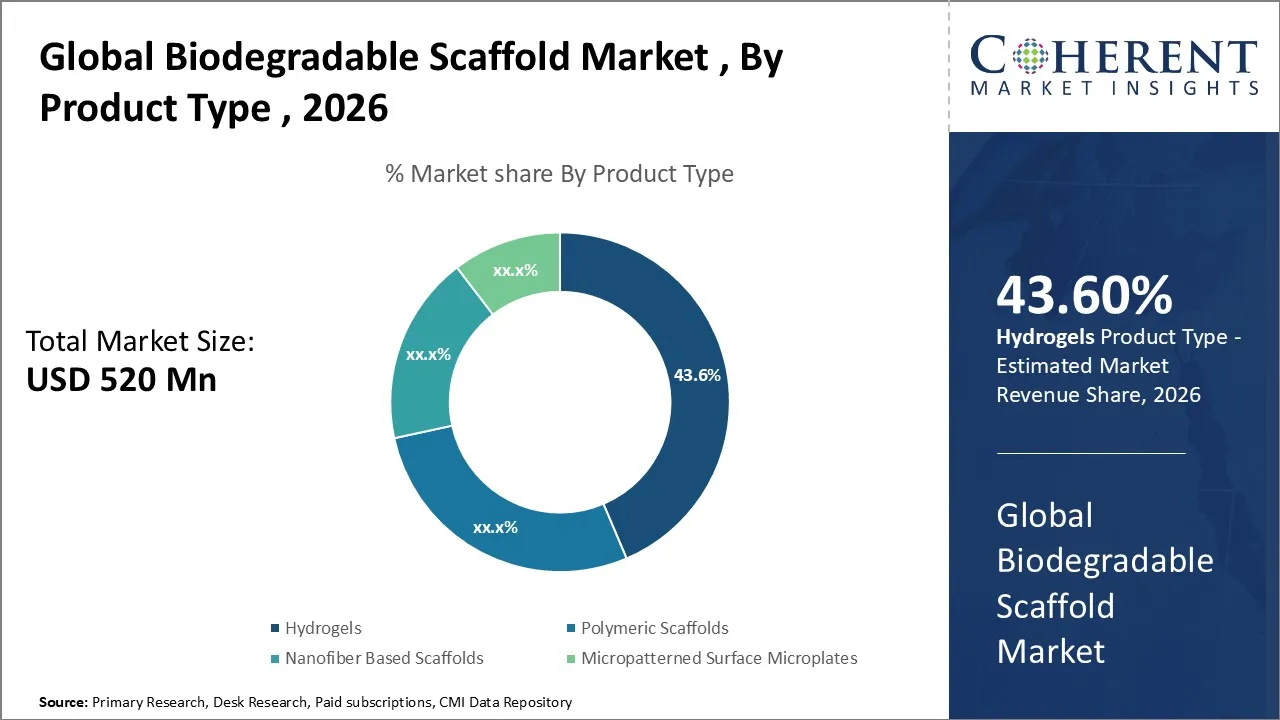
- Based on Product Type, the Hydrogels segment is expected to lead the market with 43.60 % share in 2026, owing to its high biocompatibility.
- Based on Technology, the 3D Printing segment is expected to hold 37.70 % share of the market in 2026, driven by their precise manufacturing capabilities.
- Based on Application, the Orthopedics segment is projected to account for 28.40 % share in 2026, due to rise in orthopedic procedures.
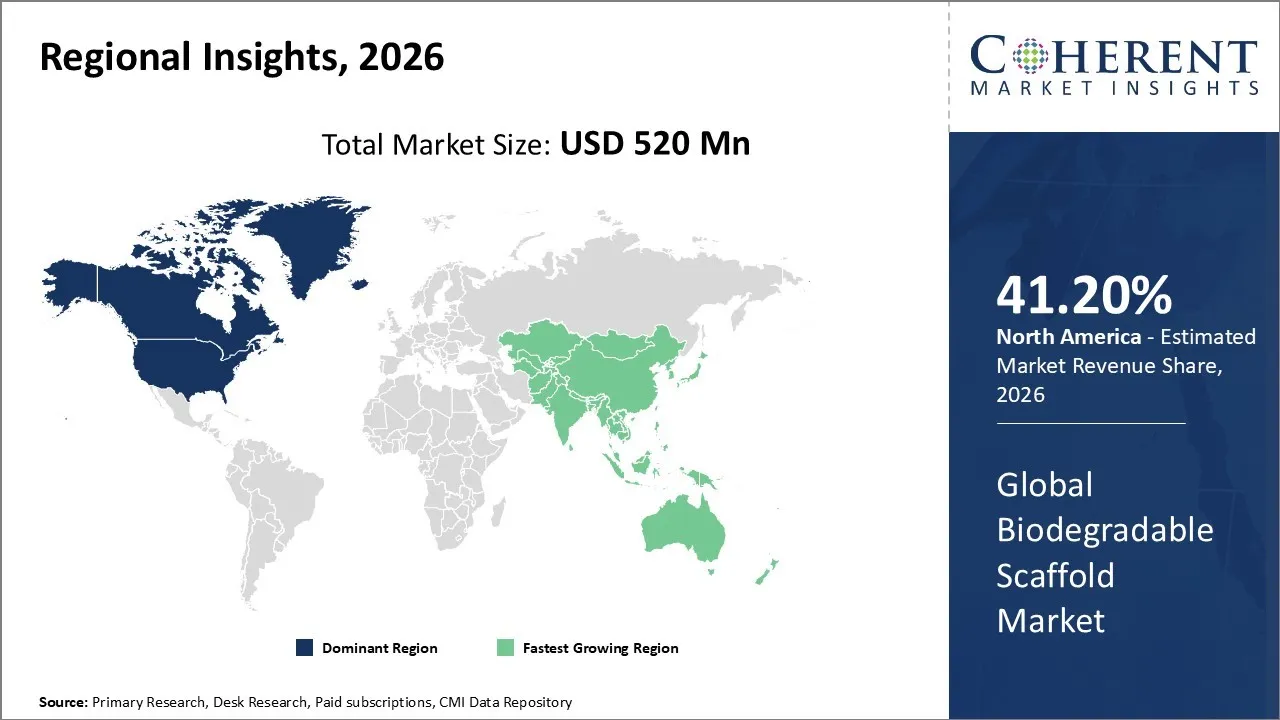
- Based on Region, North America is set to lead the market with 41.20 % share in 2026. While, Asia Pacific is anticipated to be the fastest growing region.
Market Overview
This biodegradable scaffold sector encompasses advanced biomaterial platforms provided to tissue engineering, regenerative medicine, and orthopedic companies throughout product development and clinical applications. The growing need for tissue regeneration solutions and increasing prevalence of chronic diseases requiring implantable devices are driving the market value for biodegradable scaffolds.
Healthcare companies are embracing specialized scaffold manufacturers and biomaterial suppliers that provide comprehensive scaffold design services integrated with biocompatibility testing for enhanced clinical outcomes. Specialized scaffolds for complex tissue engineering applications like bone, cartilage, and vascular regeneration are also growing in popularity over traditional permanent implants. This is because they provide controlled degradation rates, improved cellular integration, and enhanced tissue remodeling capabilities that eliminate the need for secondary removal surgeries. This shift toward temporary resorbable solutions will continue propelling market volumes higher over the forecast period.
Current Events and Its Impacts on the Biodegradable Scaffold Market
Current Event | Description and the Impact |
Technological Innovations and R&D Advancements |
|
Economic and Market Trends
|
|
Environmental and Sustainability Factors |
|
Segmental Insights
- Current Industry Events of 2026
- Market Size Estimation
- Regional Breakdown
- Competitive Landscape
- Customer Intelligence
- Segmental Analysis
- Pricing Analysis
- Key Market Drivers, Challenges & Future Trends
- Customized Insights Section
Biodegradable Scaffold Market Insights, By Product Type - Hydrogels Lead Owing to Their Tissue Regeneration Efficiency
In terms of product type, the hydrogels segment contributes the highest share of 43.60% in 2026 of the market. This is due to their excellent compatibility with human tissue. These gel-like materials are composed primarily of water, which gives them a soft and flexible texture similar to that of natural body tissue. Doctors can adjust how quickly they break down inside the body to match patient needs. Hydrogels help cells grow and attach easily, which speeds up the healing process. They also reduce swelling and irritation after surgery. Medical teams use hydrogels because they can add medicines directly into them for better treatment. The segment grows as more hospitals use these scaffolds for wound healing and repairing damaged organs. Patients recover faster as hydrogels blend naturally with their body.
Biodegradable Scaffold Market Insights, By Technology - Precise Manufacturing Capabilities Boosts 3D Printing Usage
In terms of technology, the 3D printing segment contributes the highest share of 37.70% in 2026 of the market as it creates custom scaffolds for each patient. This technology builds implants that fit perfectly into damaged areas, making surgeries more successful. Hospitals save money with the usage of 3D printing, as it wastes less material and produces scaffolds faster than old methods. Healthcare providers can design complex shapes that match exactly what patients need. The technology also controls tiny details like holes and strength in the scaffold structure. Medical centers are heavily investing in 3D printing equipment every year. Surgeons generally use this approach, as it gets better products to market faster.
For instance, in December 2025, Yonghui Ding and his colleagues at Northwestern Engineering have developed a rapid 3D-printing technique that employs light and biodegradable "ink" to fabricate tubular implantable scaffolds featuring channels and grooves. This research seeks not just to replace arteries but to rejuvenate them.
Biodegradable Scaffold Market Insights, By Application - Orthopedics Lead as They Utilize Increasing Orthopedic Procedures
In terms of application, the orthopedics segment contributes the highest share of 28.40% in 2026 of the market as bone injuries and degenerative diseases become increasingly common among populations worldwide. The older population experiences frequent broken bones and joint problems requiring medical intervention. Biodegradable scaffolds eliminate the need for extra surgeries to remove implants after healing completes. These scaffolds hold bones in place while natural regeneration occurs over time. Growing number of people learn about complications from metal implants that remain in the body forever. Orthopedic surgeons recommend biodegradable options for simpler and safer patient treatment.
Regional Insights
North America Biodegradable Scaffold Market Analysis & Trends
North America has remained the dominant region, with 41.20% in 2026 of the global Biodegradable Scaffold Market over the past decade. It retains advanced healthcare infrastructure that encourages the adoption of the latest technologies in regenerative medicine. Also, robust research funding by government agencies and private institutions drives continuous innovation in scaffold materials and their manufacturing processes. The regulatory bodies also establish a clear pathway for the approval of the products, encouraging heavy investments in development by manufacturers.
The increasing prevalence of cardiovascular diseases and orthopedic ailments occupies urgent demand for tissue engineering solutions. Major medical device players conduct massive operations in North America, which pushes innovation through competition and further expands the market. Universities and research institutions often collaborate with their industry counterparts for the translation of various laboratory discoveries into commercial applications.
For instance, in June 2023, 3DBioFibR, a leader in tissue engineering, has introduced two innovative collagen fiber solutions named μCollaFibR and CollaFibR 3D scaffold. They are now available for purchase by the scientific and medical communities. They are created using 3D BioFibR's proprietary dry-spinning technology, which enables the production of collagen fibers at commercial scales. These products provide substantial benefits for tissue engineering and tissue culture applications.
Asia Pacific Biodegradable Scaffold Market Analysis & Trends
The Asia Pacific region has become the fastest-growing market. The main factor for this is that a massive population in Asia, particularly in China, India, and SouthEast Asia, results in a substantial number of patients, thereby requiring prime medical treatments. Increased per capita income allows people from all classes to afford quality medical treatment, along with technological medical advancements. The region is presently overwhelmed by fast-moving industrialization, which enhances local capacity in the production of medical equipment. There is an increasing number of patients from around the globe seeking medical tourism in the region.
Pharmaceutical firms establish research offices in the Asia Pacific region to take advantage of a pool of professionals with low operational costs. There is an increasing number of lifestyle diseases, which increases the need for innovative medical solutions. The large number of trained professionals from the region’s academic institutions also fuels the expansion of the sector. The region adopts supportive government reforms that fast-track the approval process for medical technologies.
Biodegradable Scaffold Market Outlook Country-Wise
The U.S. Biodegradable Scaffold Market Trends
The U.S. leads in both robust research facilities and private industry investment. Venture capitalists invest in biotechnology startups working on innovative scaffold development tools. Top academic medical institutions conduct innovative clinical trials that confirm product effectiveness. Insurers gradually increase coverage for regenerative medicine procedures. The innovative spirit from Silicon Valley permeates the medical devices industry. The FDA’s strict standards enhance product acceptability in the international community. Established medical device industry leaders acquire startups with promising products in their portfolios.
China Biodegradable Scaffold Market Trends
China accounts for the significant growth of the biodegradable scaffold market due to the country’s aggressive government healthcare initiatives. Billions are invested in different biotechnology-related research and development programs within the country. Government-backed funding propels indigenous manufacturers to develop competitive products at lower costs. The aging rowing population fuels demand for cardiovascular and orthopedic applications in China. Leading cities establish dedicated medical centers, which focus on the use of pioneering techniques in regenerative medicines.
Market Report Scope
Biodegradable Scaffold Market Report Coverage
| Report Coverage | Details | ||
|---|---|---|---|
| Base Year: | 2025 | Market Size in 2026: | USD 520 Mn |
| Historical Data for: | 2020 To 2024 | Forecast Period: | 2026 To 2033 |
| Forecast Period 2026 to 2033 CAGR: | 12.2% | 2033 Value Projection: | USD 1,165 Mn |
| Geographies covered: |
| ||
| Segments covered: |
| ||
| Companies covered: | Merck KGaA, 3D Biotek LLC, Medtronic, Xanofi, Akron Biotech, Nanofiber Solutions, Vericel Corporation, NuVasive, Inc., Organogenesis, Inc., Biostage, Inc., In2Bones Global, Orthofix Medical Inc., Spine Smith, Invivo Therapeutics Holdings Corp., and Onkos Surgical | ||
| Growth Drivers: |
| ||
| Restraints & Challenges: |
| ||
Biodegradable Scaffold Market Drivers
Rising demand for regenerative medicine and tissue engineering
The ever-rising demand for regenerative medicine and tissue engineering applications drives the biodegradable scaffold industry to unprecedented levels. The goal of most patients today is seeking a cure rather than just treating any disease. Conventional surgical treatments result in lifelong implanted devices that result in lifelong complications, thus needing another surgical procedure for their removal. Biodegradable scaffolds can act as better substitutes that provide temporary support to gradually biodegrade when new tissue consolidates naturally.
Chronic diseases have affected numerous people around the world, leading to a high demand for solutions that can repair or replace tissues and organs. Conventional treatments often fail to provide effective solutions for treating complex injuries and related degenerative disorders. Medical practitioners regard regenerative treatments as more effective alternatives for complete restoration and recovery. Senior populations in developed countries continue to witness an increased likelihood of damaged tissues due to cardiovascular disease, diabetes, and arthritis.
Scientific findings have proved the enormous success of scaffold-based tissue engineering. Patients heal quickly with fewer complication-related problems. This benefits insurance companies, and they start covering the costs. Medical and technical events illustrate successful examples, and hesitant physicians begin incorporating regenerative technologies into their practice.
For instance, in August 2023, CD Bioparticles, a well-known manufacturer and supplier of a range of drug delivery products and services, has introduced its biodegradable and customizable Tissue Engineering Scaffolds. These include offerings such as the 3D Cell Culture Substrate and Engineered Tissue Scaffolds. These products are designed to assist scientists in regenerative medicine who require materials for their research and development efforts.
Analyst Opinion (Expert Opinion)
- The biodegradable scaffold market is gaining strong traction due to its expanding role in tissue engineering, regenerative medicine, wound care, and reconstructive therapies. Industry data indicates steady volume growth, supported by rising surgical procedures related to orthopedics, dental reconstruction, cardiovascular repair, and soft tissue regeneration. Increased clinical acceptance is driven by the ability of biodegradable scaffolds to support cell adhesion, proliferation, and tissue integration while eliminating the need for surgical removal
- Material innovation remains a core market driver. Polymers such as polylactic acid, polycaprolactone, collagen, gelatin, and chitosan are widely adopted due to their favorable biocompatibility, tunable degradation rates, and mechanical strength. Among applications, bone and cartilage tissue engineering account for a substantial share of scaffold usage, supported by the growing prevalence of musculoskeletal disorders and age-related degeneration. Research data also highlights increasing use in dental and wound healing applications, reflecting broader therapeutic versatility.
- Technological advancements, particularly in 3D printing and electrospinning, are enabling precise control over scaffold architecture, porosity, and mechanical properties. These capabilities are accelerating adoption in personalized and precision medicine. Regionally, North America leads in terms of research output and clinical adoption, while Europe and Asia Pacific continue to expand through rising healthcare investment and academic–industry collaboration.
- Overall, statistical indicators point to a structurally strong market supported by sustained clinical demand, material science innovation, and expanding end-use applications across healthcare and research environments.
Speak to the analyst
Want personalized insights?
Take the findings above to one of our principal consultants, or have the report rebuilt around the segments, geographies and competitors you actually track.
Biodegradable Scaffold Industry News
- In June 2025, PRN Pharmacal, a leading provider of specialized therapies, revealed the U.S. launch of ReGum™ Vet. This innovative scaffold can be placed into a dog's periodontal defect, filling and supporting the area while providing a framework for tissue restoration. ReGum™ Vet provides a more convenient option for periodontal tissue healing. It features a patented biodegradable 3D dry foam made from enzymatically cross-linked gelatin, utilizing BioChange's CellFoam™ technology.
- In May 2025, researchers from Nanjing University of Aeronautics and Astronautics and several other institutions are working together to use additive manufacturing (AM) to make zinc-based biomaterials for biodegradable medical implants. The team looked into selective laser melting (SLM) and binder jetting as ways to turn zinc and zinc oxide powders into scaffolds that are unique to each patient and help bone tissue grow back.
- In January 2025, BellaSeno GmbH, an ISO 13485-certified medtech company specializing in the production of resorbable scaffolds through additive manufacturing technologies, announced that all 19 women who received breast scaffolds during an Australian breast augmentation revision trial in 2022 have successfully completed a one-year follow-up. There were no major issues or removals of the scaffolds reported.
Market Segmentation
- Product Type Insights (Revenue, USD Mn, 2020 - 2033)
- Hydrogels
- Polymeric Scaffolds
- Nanofiber Based Scaffolds
- Micropatterned Surface Microplates
- Technology Insights (Revenue, USD Mn, 2020 - 2033)
- Decellularized Technology
- Synthetic Scaffold
- 3D Printing
- Others
- Application Insights (Revenue, USD Mn, 2020 - 2033)
- Neurology
- Urology
- Orthopedics
- Dental
- Cardiology & Vascular
- Cancer
- Skin & Integumentary
- Gastroenterology & Gynecology
- Others
- Regional Insights (Revenue, USD Mn, 2020 - 2032)
- North America
- U.S.
- Canada
- Latin America
- Brazil
- Argentina
- Mexico
- Rest of Latin America
- Europe
- Germany
- U.K.
- France
- Italy
- Russia
- Rest of Europe
- Asia Pacific
- China
- India
- Japan
- Australia
- South Korea
- ASEAN
- Rest of Asia Pacific
- Middle East & Africa
- GCC Countries
- South Africa
- Rest of Middle East & Africa
- North America
- Key Players Insights
- Merck KGaA
- 3D Biotek LLC
- Medtronic
- Xanofi
- Akron Biotech
- Nanofiber Solutions
- Vericel Corporation
- NuVasive, Inc.
- Organogenesis, Inc.
- Biostage, Inc.
- In2Bones Global
- Orthofix Medical Inc.
- Spine Smith
- Invivo Therapeutics Holdings Corp.
- Onkos Surgical
Sources
Primary Research Interviews
- Biodegradable Scaffold Manufacturers
- Biomaterials & Polymer Manufacturers
- Tissue Engineering & Regenerative Medicine Companies
- Medical Device OEMs
- Academic Researchers & Biomedical Scientists
- Orthopedic & Dental Implant Specialists
- Contract Research & Manufacturing Organizations (CROs/CMOs)
- Others
Databases
- Bloomberg Terminal
- Thomson Reuters Eikon
- Others
Magazines
- Medical Device and Diagnostic Industry (MDDI)
- Biomaterials Forum
- Drug Delivery & Translational Research Magazine
- Healthcare Packaging Magazine
- Medical Product Outsourcing
- Others
Journals
- Biomaterials
- Acta Biomaterialia
- Tissue Engineering (Part A, B & C)
- Journal of Biomedical Materials Research
- Materials Science & Engineering: C
- Regenerative Biomaterials
- Others
Newspapers
- Financial Times
- The Wall Street Journal
- Reuters
- Bloomberg News
- The Economic Times
- Others
Associations
- Tissue Engineering and Regenerative Medicine International Society (TERMIS)
- Society for Biomaterials (SFB)
- International Society for Stem Cell Research (ISSCR)
- American Institute for Medical and Biological Engineering (AIMBE)
- European Society for Biomaterials (ESB)
- Others
Public Domain Sources
- U.S. Food and Drug Administration (FDA) – Medical Device & Biomaterials Databases
- National Institutes of Health (NIH)
- National Institute of Biomedical Imaging and Bioengineering (NIBIB)
- European Commission – Medical Devices Regulation (MDR)
- World Health Organization (WHO)
- PubMed & ClinicalTrials.gov
- Others
Proprietary Elements
- CMI Data Analytics Tool
- Proprietary CMI Existing Repository of Information for the Last 8 Years
*Definition: The Biodegradable Scaffold Market encompasses the production, distribution, and application of temporary three-dimensional structures designed to support tissue regeneration and repair. These scaffolds are made from biocompatible materials that gradually break down and are absorbed by the body as new tissue forms. The market caters to healthcare providers, research institutions, and pharmaceutical companies in need of solutions for bone regeneration, cartilage repair, wound healing, and drug delivery applications. Important materials used in these processes are synthetic polymers like PLA and PLGA, natural biomaterials such as collagen and chitosan, and composite materials that combine both types.
Get access to 250+ pages report
Every segment, forecast, competitor profile and data table behind the analysis above — available for instant download.
- ESOMAR Member
- ISO 9001:2015 Certified
- D-U-N-S Registered
- GDPR & CCPA Compliant
Missing comfort of reading report in your local language? Find your preferred language:
Transform your Strategy with Exclusive Trending Reports
Frequently Asked Questions
The Biodegradable Scaffold Market is estimated to be valued at USD 520 Mn in 2026, and is expected to reach USD 1,165 Mn by 2033.
The CAGR of the Biodegradable Scaffold Market is projected to be 12.2% from 2026 to 2033.
The rising demand for regenerative medicine and tissue engineering and new product launches are the major factors driving the growth of the Biodegradable Scaffold Market.
The low stability and high cost of production are the major factors hampering the growth of the Biodegradable Scaffold Market.
In terms of product type, the hydrogels is estimated to dominate the market revenue share in 2026
Merck KGaA, 3D Biotek LLC, Medtronic, Xanofi, Akron Biotech, Nanofiber Solutions, Vericel Corporation, NuVasive, Inc., Organogenesis, Inc., Biostage, Inc., In2Bones Global, Orthofix Medical Inc., Spine Smith, Invivo Therapeutics Holdings Corp., and Onkos Surgical are the major players.
North America is expected to lead the Biodegradable Scaffold Market in 2026.