

Clostridium Difficile Diagnostics Market Size and Share Analysis: 2026 - 2033
The global clostridium difficile diagnostics market size is expected to reach approximately USD 1,118.8 Mn in 2026 and USD 1,852.1 Mn by 2033, growing at a CAGR of 7.5% throughout the forecast period (2026-2033).
Key Takeaways from the Clostridium Difficile Diagnostics Market Report
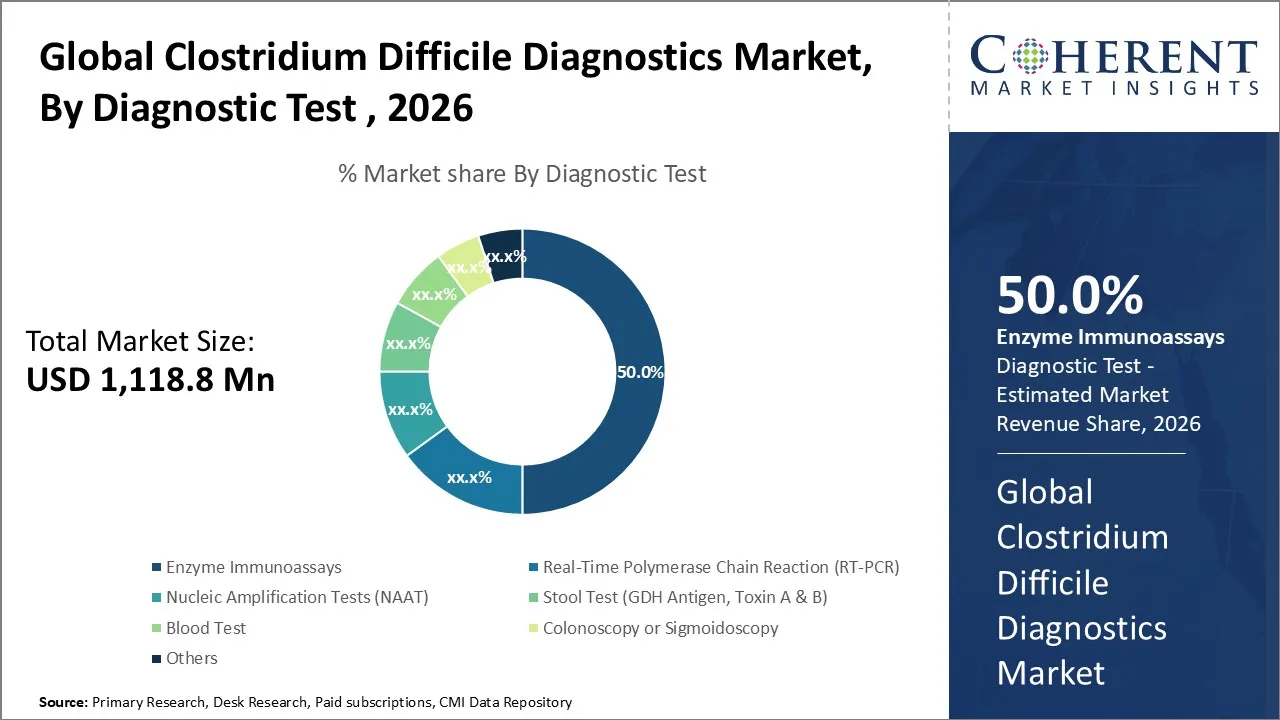
- Enzyme Immunoassays main a highly sought-after type, accounting for about 50% of the market share in 2026 as it is used extensively in routine hospital diagnostics and is cost-effective.
- The hospitals segment registered its dominance over the global clostridium difficile diagnostics market with share of 45% in 2026 as hospitals become the primary diagnostic and treatment hub.
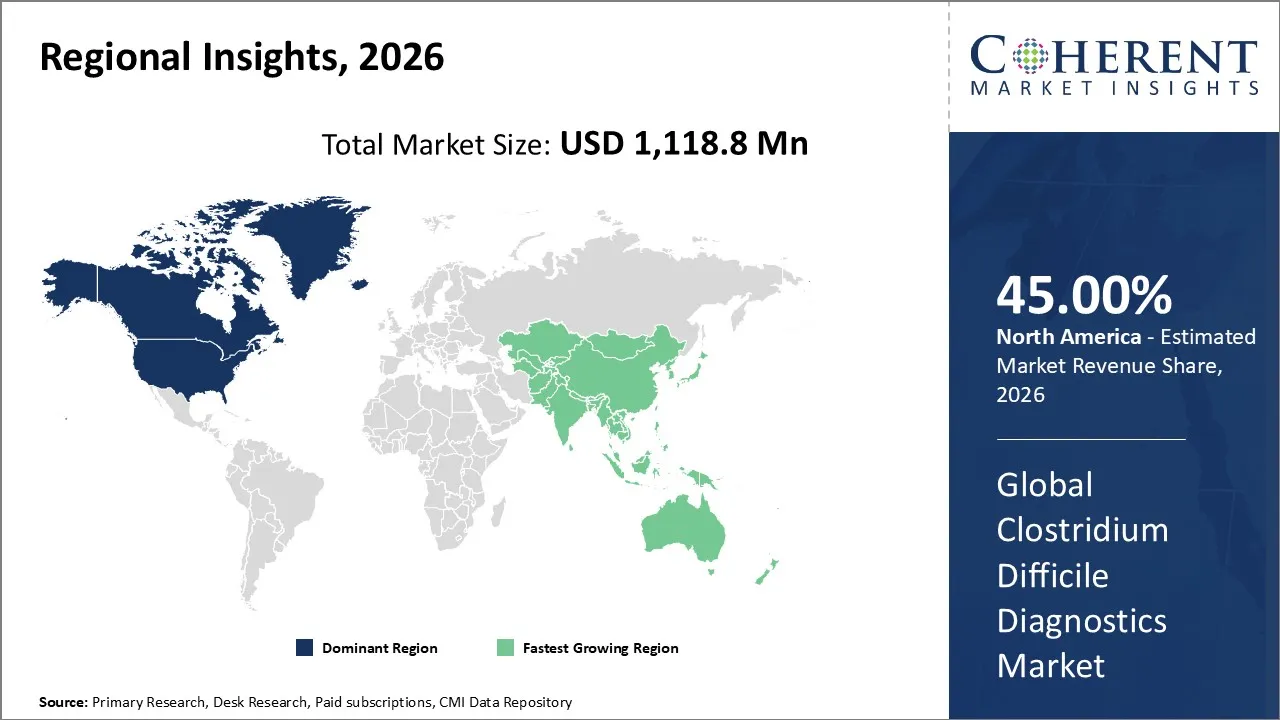
- North America is projected to dominate the global clostridium difficile diagnostics market in 2026, with a share of over 45% due to advanced healthcare facilities and strong presence of key pharmaceutical companies.
Clostridium Difficile Diagnostics Market Overview
The laboratory stool tests used to detect toxin-producing bacteria that cause colitis and diarrhea, typically following antibiotic use, are known as Clostridioides difficile (C. diff) diagnostics. In individuals whose normal gut microbiota has been altered by chemotherapeutic or antibiotic treatments, Clostridium difficile, an anaerobic, gram-positive bacterium, causes serious illness by generating two powerful toxins (dysbiosis). According to the guidelines released by the regulatory bodies a two-step procedure is recommended, starting with a glutamate dehydrogenase (GDH) test and ending with a toxin or nucleic acid test. Alternatively, a nucleic acid test by itself is appropriate in establishments where testing is guided by recognized clinical algorithms. The clostridium difficile diagnostic market is gaining strategic importance in the market due to increasing prevalence of clostridium difficile infection, launch and approval of new product and technology advancement.
Current Events and Their Impact on the Clostridium Difficile Diagnostics Market
Current Event | Description and its Impact |
Growing Adoption of Molecular Diagnostic Technologies |
|
Rising Prevalence of Hospital-acquired infections (HAIs) |
|
Segmental Insights
- Current Industry Events of 2026
- Market Size Estimation
- Regional Breakdown
- Competitive Landscape
- Customer Intelligence
- Segmental Analysis
- Pricing Analysis
- Key Market Drivers, Challenges & Future Trends
- Customized Insights Section
Clostridium Difficile Diagnostics Market Insights, By Diagnostic Test - Enzyme Immunoassays Holds Dominant Diagnostic Test in the Market
Based on diagnostic test, enzyme immunoassays are expected to lead the market, accounting for a revenue share of 50% in 2026. The enzyme immunoassays are cheaper than molecular tests and hence used extensively in routine hospital diagnostics. Enzyme immunoassays require less complex infrastructure and are easier to integrate into standard microbiology workflows. Enzyme immunoassays are not only utilized as standalone toxin tests; they are also embedded in commonly recommended clostridium difficile infection testing algorithms such as GDH + toxin EIA, GDH + toxin EIA arbitrated by Nucleic Amplification Tests (NAAT), or NAAT + toxin. That keeps enzyme immunoassays diagnostic test demand high even when labs do not rely on it alone.
Clostridium Difficile Diagnostics Market Insights, By End User - Hospitals to Remain Leading End User of Clostridium Difficile Diagnostics
By end user, the hospitals segment is slated to account for a prominent market share of 40% in 2026. Hospitals have strong in-house diagnostic infrastructure and well-trained staff for performing diagnosis tests. Hospitals lead the Clostridium difficile diagnostics market due to the presence of high-risk patient volume, availability of advanced diagnostic infrastructure, central role in diagnosis, treatment, and monitoring.
Regional Insights
North America Remains the Market Leader in 2026
North America is expected to dominate the global clostridium difficile diagnostics market, accounting for a share of 45% in 2026. Increasing prevalence of clostridium difficile infection in the North America region has driven the growth of the market. Due to high disease burden in the region, the demand for clostridium difficile diagnostics has also increased. For instance, in March 2026, according to the data published by the U.S. Centers for Disease Control and Prevention, it has been estimated that North America (NA) has the highest reported incidence of Clostridium difficile per 1000 admissions (4.85) and per 10,000 patient-days (6.23).
Another factor driving the growth of the clostridium difficile diagnostics market in North America is early adoption of molecular and guideline-based testing algorithms. North America also benefits from a strong regulatory and commercial ecosystem. The U.S. FDA has cleared or referenced multiple CDI-related diagnostic approaches in regulated clinical settings, and the region has a dense network of large hospital systems, CLIA-certified labs, and diagnostic manufacturers/distributors. So, the growth of the market in North America has been boosted by having advanced lab facilities, support for payments, and the widespread use of NAAT/PCR and multistep testing methods.
Asia Pacific Clostridium Difficile Diagnostics Market Trends
Asia Pacific is expected to grow at the fastest CAGR in the clostridium difficile diagnostics market during the forecast period. Counteries like China, India, and Japan are heavily investing in hospitals, laboratories, and diagnostic centers. Asia Pacific has a huge patient pool, especially elderly individuals who are more prone to infections like clostridium difficile. Rising hospitalization rates and antibiotic exposure are increasing clostridium difficile infection cases, which has estimated to drive the need for faster and accurate diagnostic testing in the region. Increasing government initiatives in Asia Pacific region and growing awareness campaigns has driven the market growth. Overall, Asia Pacific is growing at significant rate due to its large population, rising infection rates, improving healthcare systems, and increasing adoption of advanced diagnostics.
Clostridium Difficile Diagnostics Market Outlook – Country-wise
U.S. Clostridium Difficile Diagnostics Market Forecast
The U.S. country held majority revenue share in the North America clostridium difficile diagnostics market. The U.S. has one of the highest healthcare expenditures globally, which enables adoption of expensive but accurate diagnostic tools. For instance, in February 2026, according to the data published by the Institute for Health Metrics and Evaluation, when measured from birth, improvements in medical treatment extended health spans in the U.S. by 1.3 years and raised medical spending by USD 234,000 per person over their lifetime, or almost USD 182,000 every extra year of healthy life acquired. These are some of the main conclusions of a recent comprehensive nationwide study that was just released in Value in Health. A major reason is the high volume of hospital-based and healthcare-associated testing in the U.S. clostridium difficile diagnostics is closely tied to hospitalization, antibiotic exposure, and infection-control programs, and the U.S. has a very large hospital network and a mature surveillance ecosystem. Additionally, the U.S. leads due to the faster adoption of high-end diagnostic technology, particularly FDA-approved PCR/NAAT-based diagnostics.
China Clostridium Difficile Diagnostics Market Forecast
China leads the Asia Pacific clostridium difficile diagnostics market due to large patient pool and rapid expansion of healthcare infrastructure. The Chinese government is actively investing in infection control programs, hospital upgrades, and diagnostic technology adoption. China country is increasingly adopting molecular diagnostics (NAAT, PCR) and rapid diagnostic kits. Hospitals are integrating modern diagnostic platforms to improve accuracy and turnaround time.
Clostridium Difficile Diagnostics Market News
- In November 2025, LIV Process, biotechnology company based in Philadelphia, revealed that hospitals can visualize environmental contamination from diseases like Clostridium difficile on surfaces due to a patented microbial-visualization technique introduced by them. In addition to announcing a contract approval from the Veterans Health Administration (VA) for use across 170 VA hospitals nationally, the company demonstrated the tool at IDWeek 2025 in Atlanta.
Market Report Scope
Clostridium Difficile Diagnostics Market Report Coverage
| Report Coverage | Details | ||
|---|---|---|---|
| Base Year: | 2025 | Market Size in 2026: | USD 1,118.8 Mn |
| Historical Data for: | 2020 To 2024 | Forecast Period: | 2026 To 2033 |
| Forecast Period 2026 to 2033 CAGR: | 7.5% | 2033 Value Projection: | USD 1,852.1 Mn |
| Geographies covered: |
| ||
| Segments covered: |
| ||
| Companies covered: | F. Hoffmann-La Roche Ltd, Thermo Fisher Scientific, Merck & Co., Inc., Pfizer, Inc., Actelion Pharmaceuticals, Inc., Abbott Laboratories, Trinity Biotech Plc., Summit Therapeutics, Sanofi S.A., Novartis AG, and AstraZeneca Plc | ||
| Growth Drivers: |
| ||
| Restraints & Challenges: |
| ||
Clostridium Difficile Diagnostics Market Drivers
Increasing Prevalence Of Clostridium Difficile Infection (CDI)
Rising prevalence of clostridium difficile infection cases globally has directly increased the volume of diagnostic tests performed in labs and hospitals. Studies show that increasing prevalence of clostridium infections creates a strong demand for accurate and timely diagnostics. A large proportion of clostridium difficile diagnostics cases are hospital-acquired infections (HAIs). This leads hospitals to implement routine screening protocols and invest in advanced diagnostic systems. Due to overuse of antibiotics disrupts gut microbiota which causes clostridium difficile infection risk. Rising prevalence of clostridium difficile infection in elderly population, immunocompromised patients and long-term hospitalized individuals increases screening frequency and demand for routine diagnostic monitoring.
Increasing Approval of Diagnostics Tests/Assays by Regulatory Authorities
Rising approval of diagnostic tests/ assays by regulatory authority’s bodies like U.S. FDA, CE, CDSCO, etc.) has driven the growth of the clostridium difficile diagnostics market. Regulatory approvals allow faster commercialization & market entry which accelerates the growth of the market. Regulatory bodies ensure analytical and clinical validation of diagnostic tests before approval which guarantees sensitivity, reliability and accuracy, which is critical for infectious diseases like clostridium difficile. Strong regulatory frameworks ensure that only high-quality diagnostic tools reach the market, eliminating low-performance tests. Physicians are more confident in prescribing approved tests hence the increasing regulatory approval of diagnostics test/ assays is driving the growth of the market.
Clostridium Difficile Diagnostics Market Trends
Growing Use of Multiplex GI Panels
Multiplex GI panels can deliver broad results more quickly than conventional multi-step testing workflows; they help clinicians identify infectious causes sooner and act faster on clostridium difficile diagnostics related treatment and infection-control measures. Using multiplex GI panels give better antimicrobial stewardship and workflow efficiency. As the multiplex GI panels supports faster diagnosis by enabling simultaneous detection of clostridium difficile and other enteric pathogens from a single sample, reducing diagnostic turnaround time, improving clinical decision-making there is rise in the adoption of the multiplex GI panels for diagnosis.
Clostridium Difficile Diagnostics Market Opportunities
Increasing Demand Tied to Antimicrobial Stewardship
Strong demand for the tied to antimicrobial stewardship has created significant opportunity for the growth of the clostridium difficile diagnostics market in the near future. Clostridium difficile infection diagnostics become more crucial when healthcare systems prioritize cutting down on unnecessary antibiotic use because quicker and more accurate confirmation enables more focused therapy. This increases the clinical and financial value of clostridium difficile infection testing in hospital decision-making.
Analyst Opinion (Expert Opinion)
- The Clostridium difficile diagnostics market is expected to benefit from rising focus on infection prevention, diagnostic stewardship programs, and healthcare infrastructure development across emerging economies. Expansion of hospital networks, increasing healthcare expenditure, and improved access to advanced diagnostic technologies in regions such as Asia Pacific and Latin America are expected to accelerate market penetration. Moreover, growing awareness regarding hospital-acquired infections is further supporting adoption of advanced clostridium difficile infection diagnostic solutions.
- The clostridium difficile diagnostics market is anticipated to grow significantly due to the rising adoption of rapid molecular assays and multiplex gastrointestinal panels. Hospitals and diagnostic laboratories are increasingly utilizing these solutions to enable simultaneous detection of multiple pathogens, improve clinical decision-making, and optimize laboratory efficiency. The future outlook remains strong as healthcare providers continue shifting from conventional testing methods toward faster, syndromic, and high-throughput diagnostic platforms.
- According to experts’ opinion, baseline demand is being strengthened by the increasing need for rapid and accurate detection of clostridioides difficile infections across hospitals and long-term care settings. Advances in molecular diagnostics, automated immunoassays, and integrated testing platforms have improved turnaround time, diagnostic sensitivity, and workflow efficiency. These developments are helping clinicians initiate timely treatment, improve infection control measures, and reduce hospital transmission, thereby contributing to steady market expansion.
- Hence, rising adoption of rapid and multiplex diagnostic technologies, increasing burden of healthcare-associated infections, and continuous advancements in molecular testing platforms remain the primary growth catalysts. The growing demand for faster diagnosis, improved antimicrobial stewardship, and efficient patient management is expected to support the adoption of advanced clostridium difficile diagnostic solutions across hospitals, laboratories, and outpatient care settings, thereby driving sustained market growth.
Speak to the analyst
Want personalized insights?
Take the findings above to one of our principal consultants, or have the report rebuilt around the segments, geographies and competitors you actually track.
Clostridium Difficile Diagnostics Market Segmentation
- By Diagnostic Test ( Revenue, USD Mn, 2020 - 2033)
- Enzyme Immunoassays
- Real-Time Polymerase Chain Reaction (RT-PCR)
- Nucleic Amplification Tests (NAAT)
- Stool Test
- GDH Antigen Test
- Toxin A and B Test
- Blood Test
- Colonoscopy or Sigmoidoscopy
- Others
- By End User Insights (Revenue, USD Mn, 2020 - 2033)
- Hospitals
- Diagnostic Centers
- Specialty Clinics
- Others
- By Region Insights (Revenue, USD Mn, 2020 - 2033)
- North America
- U.S.
- Canada
- Latin America
- Brazil
- Argentina
- Mexico
- Rest of Latin America
- Europe
- Germany
- U.K.
- Spain
- France
- Italy
- Russia
- Rest of Europe
- Asia Pacific
- China
- India
- Japan
- Australia
- South Korea
- ASEAN
- Rest of Asia Pacific
- Middle East & Africa
- GCC Countries
- Israel
- Rest of Middle East & Africa
- North America
- Key Players
- Hoffmann-La Roche Ltd,
- Thermo Fisher Scientific
- Merck & Co., Inc.
- Pfizer, Inc.
- Actelion Pharmaceuticals, Inc.
- Abbott Laboratories
- Trinity Biotech Plc.
- Summit Therapeutics
- Sanofi S.A.
- Novartis AG
- AstraZeneca Plc
Sources
Primary Research Interviews
- Interviews with infectious disease specialists, clinical microbiologists, and gastroenterologists to understand diagnostic challenges, recurrence patterns, and testing preferences for Clostridium difficile infections in clinical settings.
- Insights from diagnostic kit manufacturers, assay developers, and R&D professionals on advancements in molecular diagnostics (PCR), immunoassays, and rapid testing technologies for improved sensitivity and turnaround time.
- Discussions with hospital laboratory directors, infection control teams, and procurement managers to assess testing protocols, cost considerations, reimbursement scenarios, and factors influencing the adoption of CDI diagnostic solutions.
- Conversations with public health experts, epidemiologists, and healthcare policymakers regarding infection surveillance programs, antimicrobial resistance trends, and the role of early CDI diagnosis in reducing hospital-acquired infections.
Databases
- PubMed - Biomedical and pathology research studies related to digital pathology, whole slide imaging, image analysis, and cancer diagnostics.
- Scopus - Multidisciplinary scientific literature covering pathology imaging, laboratory digitization, artificial intelligence in pathology, and whole slide imaging workflows.
- ClinicalTrials.gov - Clinical trial registry for studies involving digital pathology, image-based diagnostics, biomarker research, and AI-enabled pathology applications.
- Web of Science - Research publications on digital pathology validation, scanner technologies, image management systems, and computational pathology applications.
Magazines
- Genetic Engineering & Biotechnology News (GEN)
- 360Dx
- LabPulse
- The Dark Report / Dark Intelligence Group
- Pharmaceutical Technology Magazine
- GenomeWeb
Journals
- Archives of Pathology & Laboratory Medicine
- Laboratory Investigation
- Journal of Clinical Pathology
- American Journal of Pathology
- Modern Pathology
Newspapers
- The New York Times - Health and Science Section
- The Guardian -Science and Health
- Reuters - Healthcare, Medical Devices, and Diagnostics News
- The Wall Street Journal - Healthcare and Technology
- The Hindu - Science and Healthcare
- The Economic Times - Healthcare and Medical Technology
Associations
- Digital Pathology Association (DPA)
- College of American Pathologists (CAP)
- Association for Pathology Informatics (API)
- United States and Canadian Academy of Pathology (USCAP)
- National Society for Histotechnology (NSH)
Public Domain Sources
- U.S. Food and Drug Administration (FDA) - Device approvals, regulatory guidance, and validation considerations for digital pathology and whole slide imaging systems.
- National Institutes of Health (NIH) / PubMed Central - Public research papers on digital pathology, AI in pathology, and whole slide imaging applications.
- ClinicalTrials.gov - Publicly accessible clinical trial information related to pathology digitization, diagnostics, and AI-based image analysis.
- College of American Pathologists (CAP) Guidelines - Publicly available validation and implementation guidance for whole slide imaging in diagnostic pathology.
Proprietary Elements
- CMI Data Analytics Tool
- Proprietary CMI Existing Repository of Information for the Last 8 Years
Get access to 250+ pages report
Every segment, forecast, competitor profile and data table behind the analysis above — available for instant download.
- ESOMAR Member
- ISO 9001:2015 Certified
- D-U-N-S Registered
- GDPR & CCPA Compliant
Missing comfort of reading report in your local language? Find your preferred language:
Transform your Strategy with Exclusive Trending Reports
Frequently Asked Questions
The global market is estimated to be valued at USD 1,118.8 Mn in 2026.
The global Clostridium Difficile Diagnostics Market value is expected to reach USD 1,852.1 Mn by 2033.
The global market is poised to exhibit a CAGR of 7.5% from 2026 to 2033.
Major growth factors include increasing prevalence of clostridium difficile infection (CDI) and increasing approval of diagnostics tests/assays by regulatory authorities
Low awareness about clostridium difficile infection symptoms and associated effects
Some major companies in the F. Hoffmann-La Roche Ltd, Thermo Fisher Scientific, Merck & Co., Inc., Pfizer, Inc., Actelion Pharmaceuticals, Inc., Abbott Laboratories, Trinity Biotech Plc., Summit Therapeutics, Sanofi S.A., Novartis AG, and AstraZeneca Plc among others.
North America, with 45% share in 2026, is expected to lead the market during the forecast period.