

Compound Feed Market Analysis & Forecast: 2026-2033
Compound Feed Market is estimated to be valued at USD 571.15 Bn in 2026 and is expected to reach USD 864.48 Bn in 2033, exhibiting a compound annual growth rate (CAGR) of 6.1% from 2026 to 2033.
Key Takeaways
- Based on Ingredient Type, the Cereals segment is expected to capture 49% share of the market in 2026, due to their high energy value and cost-efficiency in feed formulations.
- Based on Animal Type, the Poultry segment is projected to account for the largest share of the market in 2026, driven by rising global demand for chicken meat and eggs.
- Based on Region, Asia Pacific is set to lead the compound feed market in 2026, with 48% While, North America is anticipated to be the fastest growing region.
Market Overview
As people learn more about animal nutrition and livestock productivity goes up, the demand for compound feed is steadily rising. Growth is being driven by improvements in feed formulation and the use of more efficient farming methods. Demand is particularly strong in the poultry, aquaculture, and swine markets. Environmental concerns and regulatory changes are also influencing feed composition trends, which promote sustainable and nutrient-dense solutions in global markets.
Current Events and their Impacts on the Compound Feed Market
Current Event | Description and its Impact |
Regulatory Changes in Feed Safety and Sustainability Standards |
|
Technological Innovations in Feed Production and Precision Nutrition |
|
Innovative Concepts in Food Formulation
Personalized Nutrition: Exact Feeding
- More than 60% of commercial poultry farms in North America use precision feeding systems. These systems let farmers make changes in real time based on the weight, age, and health of the animals.
- Depending on the species and the environment, these systems can cut down on feed waste by up to 15% and speed up growth by 8–12%.
Additives that work
- Enzyme-based additives are used a lot in chicken and pig feed, with more than 1.5 million metric tons used around the world each year.
- Probiotics and organic acids are replacing antibiotics in several regions. In Southeast Asia, more than 40% of commercial pig farms currently use acidifiers to improve gut health and minimize disease outbreaks.
- Probiotic-supplemented feed has been shown to improve feed conversion ratios by 5-10% and lower mortality rates by up to 20% in broiler chickens.
Alternative Proteins
- In 2025, the global output of insect meal for animal feed will reach 500,000 metric tons, with black soldier fly larvae being the most commonly utilized in poultry and aquaculture.
- Over 30% of commercial fish farms in Europe use algae-based feed components to boost omega-3 content and minimize reliance on fishmeal.
- Fermented biomass, including single-cell proteins, is being tested in dairy and poultry feed, with preliminary results indicating 10-15% cost savings and equivalent protein digestibility as soybean meal.
- Current Industry Events of 2026
- Market Size Estimation
- Regional Breakdown
- Competitive Landscape
- Customer Intelligence
- Segmental Analysis
- Pricing Analysis
- Key Market Drivers, Challenges & Future Trends
- Customized Insights Section
Segmental Insights
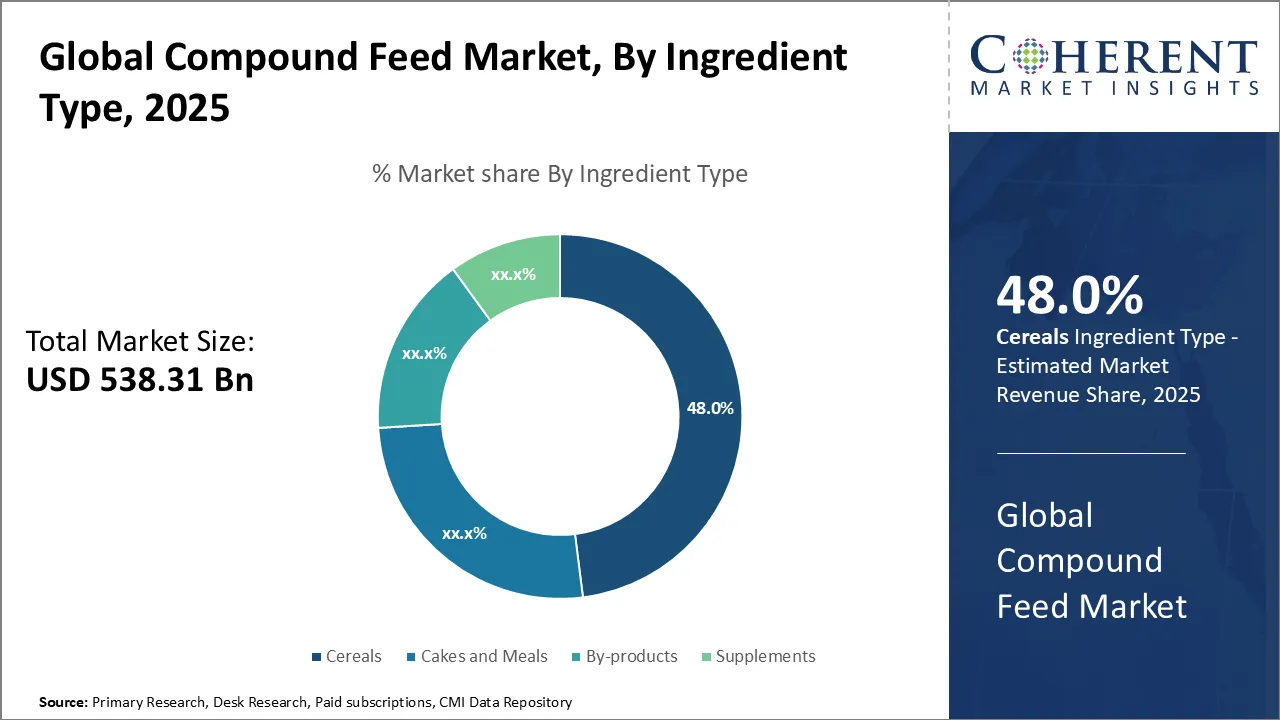
Compound Feed Market Insights, By Ingredient Type: Cereals leads due to their high energy value and cost-efficiency in feed formulations
In terms of ingredient type, the cereals segment is expected to lead with 49% share of the market in 2026, due to their high energy content, digestibility, and cost-effectiveness. They are the principal carbohydrate source in animals, ensuring growth and output. Cereals are the foundation of the compound feed industry, particularly for poultry and swine, due to their vast availability and compatibility with a variety of feed formulas.
For instance, in November 2026, a man from Jorhat, Assam, developed a sustainable method to convert discarded food into balanced animal feed. His initiative not only reduces food waste but also offers a cost-effective alternative for livestock nutrition. The innovation is gaining attention for its potential to support circular economy practices in rural farming communities.
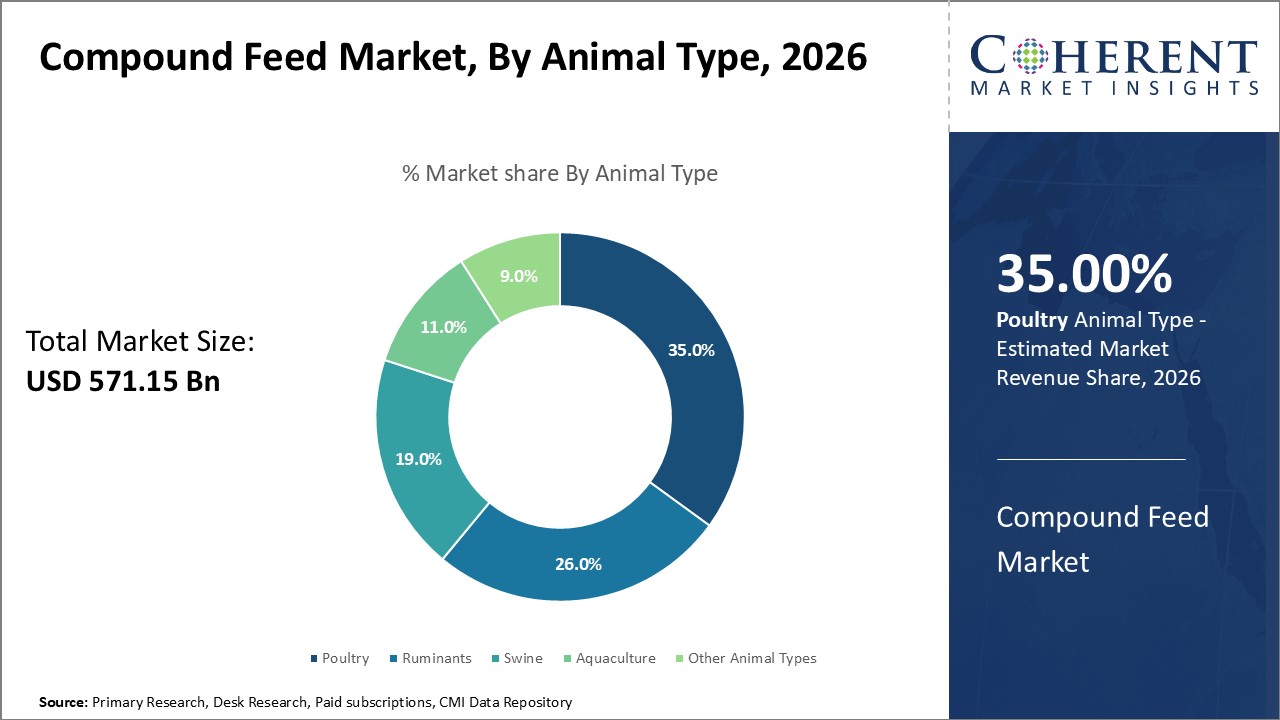
Compound Feed Market Insights, By Animal Type: Poultry dominance is driven by rising global demand for chicken meat and eggs
In terms of animal type, the poultry segment is projected to account for the largest share of the market in 2026, driven by increasing global consumption of chicken meat and eggs. Poultry farming is extremely profitable and feed-intensive due to rapid urbanization, increased incomes, and shorter production cycles. The demand for specific feed formulations geared toward broilers and layers strengthens the poultry segment's position in the compound feed market.
For example, in September 2026, De Heus India constructed a cutting-edge animal feed facility in Rajpura, Punjab, with different production lines for poultry, cattle, buffalo, and pig feed. Equipped with cutting-edge European technology, the facility aims to support India's thriving livestock sector by delivering high-quality, consistent, and efficient compound feed solutions.
Regional Insights
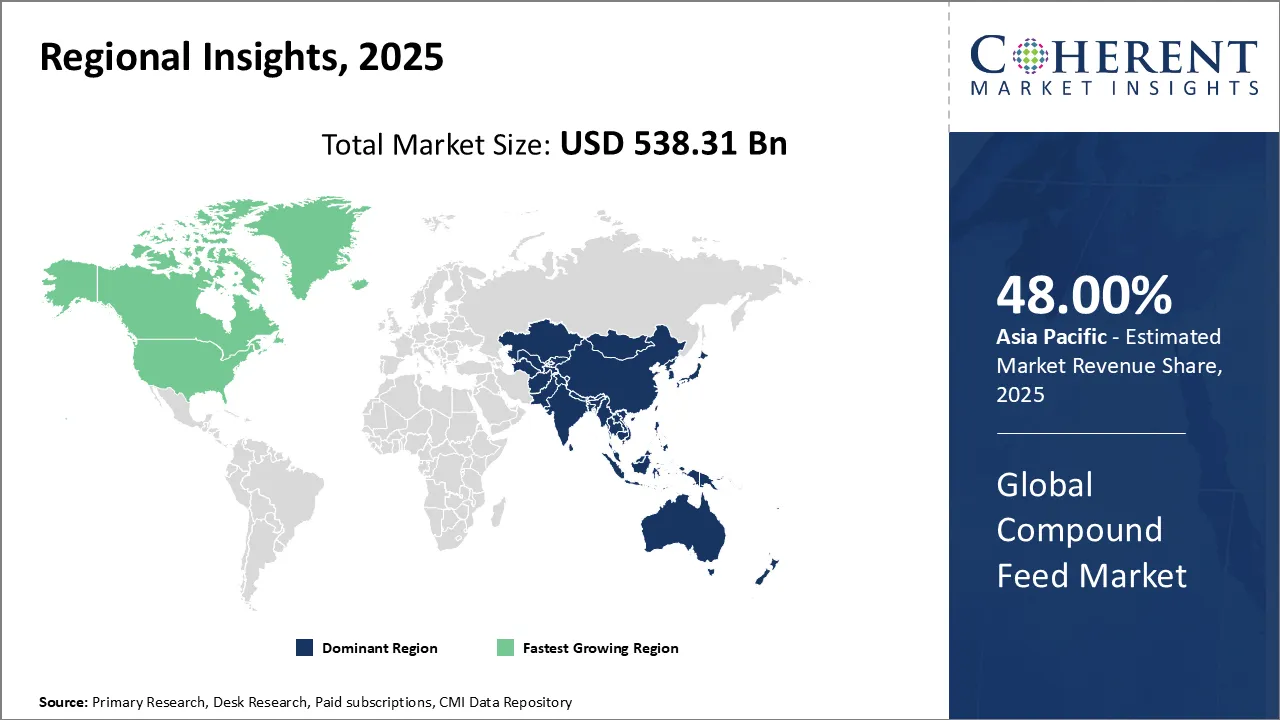
Asia Pacific Compound Feed Market Analysis & Trends
Asia-Pacific is predicted to dominate the compound feed market in 2026, with a 48% share, owing to rising meat consumption, expanding livestock and aquaculture sectors, and increased understanding of animal nutrition. Rapid urbanization, population growth, and government backing for advanced agricultural practices all contribute to increased demand. Countries such as China, India, and Vietnam have made significant contributions to the regional boom.
For instance, in March 2026, Kemin Industries introduced a revolutionary solution in India to make animal feed safer and protect the world's food system. The goal of the idea is to keep livestock food from getting contaminated and spreading disease, which will raise safety standards in the compound feed business and meet India's growing demand for high-quality animal protein.
North America Compound Feed Market Analysis & Trends
North America is anticipated to be the fastest growing region, driven by advanced livestock farming practices, high meat consumption, and growing demand for quality animal protein. The region benefits from solid regulatory frameworks, technological advances in feed production, and improved understanding of animal health and nutrition, particularly in the poultry and swine industries.
For example, in September 2026, ADM and Alltech launched a strategic joint venture to integrate their animal feeding expertise in North America. The alliance intends to provide novel compound feed solutions, improve production capacity, and promote sustainable animal husbandry. This initiative boosts their market position and responds to rising demand for high-quality animal feed.
Compound Feed Market Outlook Country-Wise
China Compound Feed Market Trends
China's compound feed market is expected to grow significantly by 2026 due to its large livestock population, particularly poultry and swine. Rising meat consumption, urbanization, and a shift toward commercial farming are driving demand. China is the best at feeding animals because the government helps with food security and new feed technologies are used.
For example, in May 2026, the Louis Dreyfus Company opened a new automated production line for specialty feed lecithin in Tianjin, China. The facility's goal is to improve the quality and efficiency of cattle feed. This planned growth shows that LDC is committed to improving the health and performance of animals while also helping China's growing market for compound feed. Trends in the U.S. Compound Feed Market
The U.S. Compound Feed Market Trends
In 2026, the US market for compound feed will grow because more people will want to feed cows, pigs, and chickens. More and more people want high-quality meat and dairy products, so the need for specialized feeds is growing. This is because farming methods are getting better and people are focusing on feed efficiency. The industry is growing thanks to help from regulators and new feed formulas.
In August 2026, for example, Cargill opened a new retail feed store in Granger, Washington, to help livestock farmers in the Pacific Northwest. The site will offer high-quality compound feed products, making it easier for people in the area to find solutions for feeding animals. This growth helps farming in the area and shows that Cargill is dedicated to sustainable livestock farming in North America.
Market Report Scope
Compound Feed Market Report Coverage
| Report Coverage | Details | ||
|---|---|---|---|
| Base Year: | 2025 | Market Size in 2026: | USD 571.15 Bn |
| Historical Data for: | 2020 To 2024 | Forecast Period: | 2026 To 2033 |
| Forecast Period 2026 to 2033 CAGR: | 6.1% | 2033 Value Projection: | USD 864.48 Bn |
| Geographies covered: |
| ||
| Segments covered: |
| ||
| Companies covered: | Charoen Pokphand Foods PCL, Cargill Inc., Land O’ Lakes Inc. (Purina Mills), Alltech Inc., Archer Daniels Midland Company, ForFarmers, United Animal Health (DeKalb Feeds), Kent Feeds, Weston Milling Animal Nutrition, and Nutreco NV | ||
| Growth Drivers: |
| ||
| Restraints & Challenges: |
| ||
Global Compound Feed Market Drivers
- Shift towards animal sourced food: Shifting consumer preferences towards animal sourced food is primarily fueling the growth of the Global Compound Feed Market. Moreover, the increasing consumption of meat, eggs, and milk due to growing awareness, regarding health benefits of animal sourced proteins is again contributing to the market growth. Additionally, growing disposable income especially in developing countries, such as India and Brazil, is also fostering the market growth.
- Increasing demand for sea food: Increasing consumption of seafood, such as fish, is projected to uplift the market growth over the forecast period. According to the Coherent Market Insights analysis, fish is sought out as a major source of protein worldwide, accounting for <10% of animal proteins in North America and Europe, and up to 26% of the animal protein source in Asia and Africa. Thus, processed products are being driven by high accessibility of fish protein internationally. The global market for meat and seafood is experiencing a surge due to the increasing global population. This has resulted in an increased demand for animal feed due to the longevity of the population and the limited land and water resources available for the production of animal feed, as well as the increased utilization of these resources for the production of food.
Global Compound Feed Market Opportunity
- Rapid increase in the demand for animal products and processed meat: The growing demand for animal products and processed meat is creating an opportunity for feed manufacturers to increase the animal productivity. A rise in the demand for various animal products, such as dairy products, milk, meat products, eggs, fish, and other non-food items, has led to the growth in the use of feed additives, thus propelling the growth of compound feed in the animal feed market.
- Growth of the domestic poultry sector: The Indian feed industry is projected to expand at a prosperous growth rate, particularly due to the growing demand for animal-based proteins and dairy products in the country. Despite the expanding supply-demand gap in the corn trade, the market is expected to be viewed as a potential investment hub, especially, due to the surging demand from the domestic poultry sector.
Global Compound Feed Market Trends
- Growing livestock industry: Animal nutrition is very important in the livestock industry because it helps make livestock that is good at getting nutrients. It also improves the health and well-being of farm animals and the quality of food that is meant for people to eat. Animal nutrition science has also helped cut down on greenhouse gas emissions, land use, and the number of units of product base that come from raising livestock. As a result, the demand for compound feed is expected to increase, due to the increasing emphasis on animal health.
Analyst Opinion (Expert Opinion)
The global market for compound feed is growing quickly because more people want animal-based proteins and farming animals is getting more competitive. Poultry is still the biggest user of compound feed, followed by pigs, cows, sheep, and fish farming. Grains make up most of animal feed, and more and more functional additives like enzymes, amino acids, and probiotics are being added to make animals healthier and more productive. Most of the physical form segment is made up of pellets, but in some places, liquid feed is becoming more popular.
Asia-Pacific has the highest demand because it has a lot of livestock and people are eating more chicken and pork. India's market is expected to grow quickly, and more people in the Middle East are using it because livestock is getting better. Some new technologies that make feed conversion more efficient and waste less are precision nutrition, AI-based feed formulation, and efficient feed mills. Because of worries about sustainability, the sources of raw materials are changing. For example, less soymeal is being used.
Challenges include raw material price volatility, regulatory changes that limit antibiotic use, and environmental efforts to reduce feed production's carbon footprint. Firms that invest in innovation, alternative proteins, and regional customization are better positioned to capitalize on market opportunities while reducing supply and regulatory concerns.
Speak to the analyst
Want personalized insights?
Take the findings above to one of our principal consultants, or have the report rebuilt around the segments, geographies and competitors you actually track.
Global Compound Feed Market: Key Developments
- In September 2025, DSM-Firmenich inaugurated its first feed additive manufacturing facility in Jadcherla, Telangana. The plant will produce essential additives that enhance the quality and efficiency of compound feed for livestock. This strategic investment supports India’s growing animal nutrition sector and reinforces the company’s commitment to sustainable food systems and agricultural innovation.
- In April 2025, Nectar Origin introduced Manka, a novel bovine feed product intended at transforming dairy nutrition and production in India. Manka offers dairy farmers a balanced compound feed solution that aims to boost animal health and milk production. Nectar Origin's commitment to sustainable cattle development and rural empowerment is shown by the event.
- In November 2024, Amit Shah, the Union Home Minister, opened a state-of-the-art animal feed factory in Gujarat that cost ₹210 crore. The plant's goal is to make high-quality compound feed that will improve the nutrition of cattle. This effort helps rural areas grow, makes dairy farms more productive, and fits in with India's larger goals of modernizing farming and becoming self-sufficient in animal husbandry.
Market Segmentation
- By Ingredient Type (Revenue, USD Bn, 2021 - 2033)
- Cereals
- Cakes and Meals
- By-products
- Supplements
- By Animal Type (Revenue, USD Bn, 2021 - 2033)
- Ruminants
- Poultry
- Swine
- Aquaculture
- Other Animal Types
- By Region (Revenue, USD Bn, 2021 - 2033)
- North America
- U.S.
- Canada
- Latin America
- Brazil
- Argentina
- Mexico
- Rest of Latin America
- Europe
- Germany
- U.K.
- Spain
- France
- Italy
- Russia
- Rest of Europe
- Asia Pacific
- China
- India
- Japan
- Australia
- South Korea
- ASEAN
- Rest of Asia Pacific
- Middle East
- GCC Countries
- Israel
- Rest of Middle East
- Africa
- South Africa
- North Africa
- Central Africa
- North America
- Global Compound Feed Market: Key Companies
- Charoen Pokphand Foods PCL
- Cargill Inc.
- Land O’ Lakes Inc. (Purina Mills)
- Alltech Inc.
- Archer Daniels Midland Company
- ForFarmers
- United Animal Health (DeKalb Feeds)
- Kent Feeds
- Weston Milling Animal Nutrition
- Nutreco NV
Sources
Primary Research Interviews
- Animal Feed Manufacturers
- Livestock and Poultry Farmers
- Aquaculture and Fish Feed Producers
- Feed Additive Suppliers
- Veterinary Nutritionists
- Others
Databases
- Bloomberg Terminal
- Thomson Reuters Eikon
- IHS Markit
- Euromonitor International
- FAO Statistics Database
- Others
Magazines
- Feed Strategy Magazine
- Poultry World
- Aquafeed International
- Farm Journal
- Feed & Grain
- Others
Journals
- Journal of Animal Science
- Animal Feed Science and Technology
- Livestock Science
- Aquaculture Reports
- Others
Newspapers
- Financial Times
- The Wall Street Journal
- Reuters
- Bloomberg News
- Agriculture Today
- Others
Associations
- International Feed Industry Federation (IFIF)
- American Feed Industry Association (AFIA)
- European Feed Manufacturers’ Federation (FEFAC)
- National Grain and Feed Association (NGFA)
- Others
Public Domain Sources
- Food and Agriculture Organization (FAO)
- United States Department of Agriculture (USDA)
- World Bank Open Data
- Government Agricultural Statistical Offices
- Others
Proprietary Elements
- CMI Data Analytics Tool
- Proprietary CMI Existing Repository of information for the last 8 years
Definition: Compounded feeds are a vital part of the animal nutrition industry, producing more than 1 billion tons of feed annually. Livestock converts compound feed into animal protein and milk, supplying about one third of the world's protein. This number of Feed production varies widely based on different regional consumption patterns and time periods. Animal proteins are a vital source of nutrients for the growing global population. Agricultural Producers and industrial processors generate raw materials for compound feed.
Get access to 250+ pages report
Every segment, forecast, competitor profile and data table behind the analysis above — available for instant download.
- ESOMAR Member
- ISO 9001:2015 Certified
- D-U-N-S Registered
- GDPR & CCPA Compliant
Missing comfort of reading report in your local language? Find your preferred language:
Transform your Strategy with Exclusive Trending Reports
Frequently Asked Questions
The Compound Feed Market is estimated to be valued at USD 571.15 Bn in 2026, and is expected to reach USD 864.48 Bn by 2033.
The global compound feed market is estimated to surpass US$ 719.5 Bn by 2033, exhibiting a CAGR of 6.1% between 2026 and 2033.
Shift towards animal forced food and increased demand for sea food are projected to drive the market growth.
The CAGR of the Compound Feed Market is projected to be 6.1% from 2026 to 2033.
The key companies operating in the market are Charoen Pokphand Foods PCL, Cargill Inc., Land O’ Lakes Inc. (Purina Mills), Alltech Inc., Archer Daniels Midland Company, ForFarmers, United Animal Health (DeKalb Feeds), Kent Feeds, Weston Milling Animal Nutrition, and Nutreco NV.
Fluctuating cost of raw materials may hinder the market growth.