

Hormonal Contraceptives Market Size and Forecast – 2026 to 2033
The Hormonal Contraceptives Market is anticipated to grow at a CAGR of 5.2% with USD 17.9 Bn in 2026 and is expected to reach USD 23.7 Bn in 2033. Rising awareness of family planning, improved women’s health education, and government reproductive health programs drive the hormonal contraceptives market. In June 2026, Union Health Minister Shri Jagat Prakash Nadda launched the SUMAN Roadmap 2030 to strengthen maternal and newborn healthcare and accelerate India's progress toward the Sustainable Development Goals by 2030.
Key Takeaways
- Oral Contraceptive Pills hold the largest market share of 38.8% in 2026 owing to the rising awareness of family planning and reproductive health. According to the United Nations, oral contraceptive pills are among the most widely used birth control methods, with usage rates of 17.8% in Europe and Northern America and 14.9% in Latin America and the Caribbean.
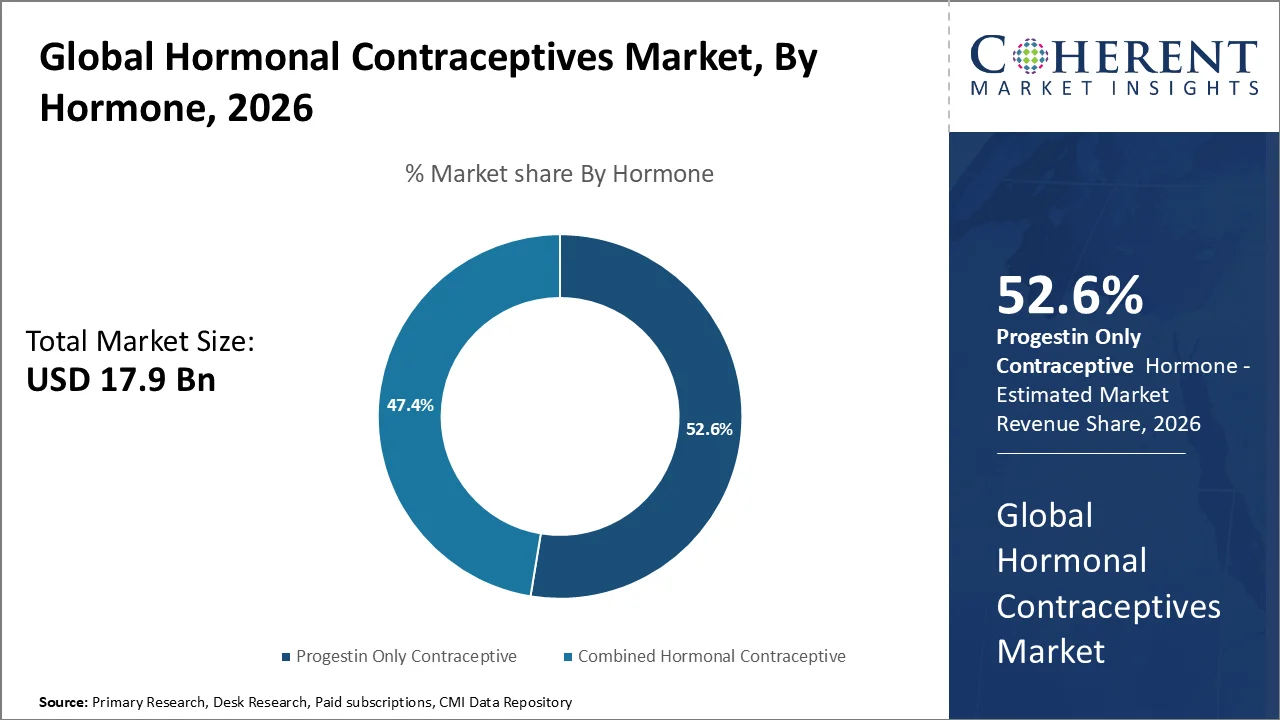
- Progestin Only Contraceptive expected to hold largest market share of 52.6% in 2026 owing to the suitability for women who cannot use estrogen. When taken as directed, progestin-only pills are highly effective in preventing pregnancy.
- 15–24 Years acquired the largest market share of 41.4% in 2026 owing to its rising focus on delaying pregnancy and life planning.
- Hospitals captures the largest market share of 37.8% in 2026 owing to the High volume of patient inflow for reproductive health services.
- North America is expected to acquire the dominant share of 43.2% in 2026 owing to the high awareness and widespread contraceptive use. Contraceptive use among sexually active women in the United States increased from 48% in 2017 to 82% in 2024.
Current Events and Their Impact on the Hormonal Contraceptives Market
Current Event | Description and its Impact |
National Pharmacare Coverage for Contraceptives in British Columbia, Canada (March 2026) |
|
WHO Updated Medical Eligibility Criteria for Contraceptive Use (2025) |
|
Segmental Insights
- Current Industry Events of 2026
- Market Size Estimation
- Regional Breakdown
- Competitive Landscape
- Customer Intelligence
- Segmental Analysis
- Pricing Analysis
- Key Market Drivers, Challenges & Future Trends
- Customized Insights Section
Why is Oral Contraceptive Pills Acquiring the Largest Market Share?
Oral Contraceptive Pills hold the largest market share of 38.8% in 2026. Rising awareness of family planning and the need to prevent unintended pregnancies drive the oral contraceptive pills segment in the hormonal contraceptives market. In 2022–2023, 54.3% of U.S. women aged 15–49 was using contraception. Increasing participation of women in education and the workforce further supports adoption. Manufacturers improve uptake by introducing lower-dose formulations with fewer side effects. Governments strengthen access through reproductive health programs and insurance coverage. Expanding online pharmacies and telehealth platforms enhance convenience and privacy. Additional benefits such as menstrual regulation and acne management also encourage higher use of oral contraceptive pills.
Progestin Only Contraceptive expected to hold largest market share
Progestin Only Contraceptive expected to hold largest market share of 52.6% in 2026 owing to the expanding range of progestin formulations. Rising demand from women who cannot use estrogen-based contraceptives due to health risks such as cardiovascular disorders and migraines drives growth in the progestin-only contraceptives segment of the hormonal contraceptives market. According to an article published by the Franciscan Health, estrogen-containing contraceptives are associated with an increased risk of high blood pressure, stroke, heart attack, and blood clots. Women increasingly choose these contraceptives during breastfeeding and postpartum periods, which further boosts adoption. Better safety profiles and a lower risk of side effects compared to combined options increase user preference. Expanding product availability, growing awareness of reproductive health, and improved access through telehealth and pharmacies also support global market growth.
15–24 Years acquired the largest market share
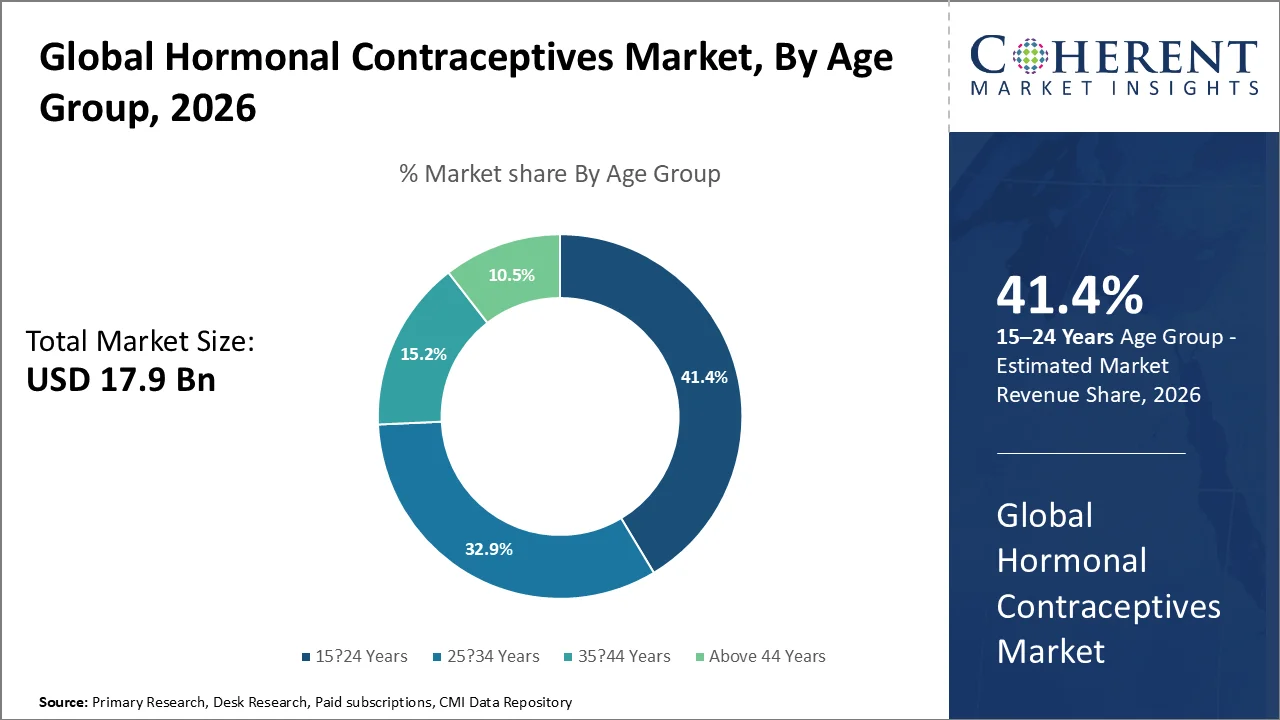
15–24 Years acquired the largest market share of 41.4% in 2026 owing to its rising concerns about unintended pregnancies. Increasing focus on delaying pregnancy for education and career goals drives the hormonal contraceptives market among the 15–24 years age group. Improved sexual awareness and better access to reproductive health education encourage contraceptive use in this segment. Young individuals prefer reversible and easy-to-use methods such as oral pills and injectables. Growing concerns about unintended pregnancies support adoption. Additional benefits like menstrual regulation and acne management further boost usage. Expanding digital health platforms also improve access and privacy for young users.
Which End User segment dominates the market?
Hospitals capture the largest market share of 37.8% in 2026. Hospitals drive the hormonal contraceptives market by acting as primary centers for reproductive and maternal healthcare services. High patient inflow for antenatal, postnatal, and family planning care supports consistent contraceptive prescriptions. Gynecologists and obstetricians recommend hormonal methods after clinical evaluation. Government-backed family planning programs and insurance coverage further strengthen hospital-based distribution. Hospitals manage complex and high-risk cases that require medical supervision. Integrated counseling services and access to multiple contraceptive options also increase adoption within institutional healthcare settings.
Hormonal Contraceptives Market Trends
- Growing adoption of implants and hormonal intrauterine systems is improving contraceptive compliance, reducing user dependency, and providing long-term pregnancy prevention. The U.S. Title X Family Planning Program reports that 19% of female clients used highly effective contraceptive methods, including implants and IUDs, highlighting increasing LARC utilization.
- Rising educational attainment, workforce participation, and delayed childbearing continue to increase demand for effective reversible contraceptives. According to the CDC, 54.3% of U.S. women aged 15–49 were using contraception during 2022–2023, reflecting sustained demand for contraceptive methods.
- Government-funded family planning initiatives continue to improve contraceptive accessibility. In 2023, the U.S. Title X Family Planning Program served 2.8 million clients, while Medicaid continues to cover family planning services and FDA-approved contraceptives for eligible beneficiaries, supporting market growth.
Regional Insights
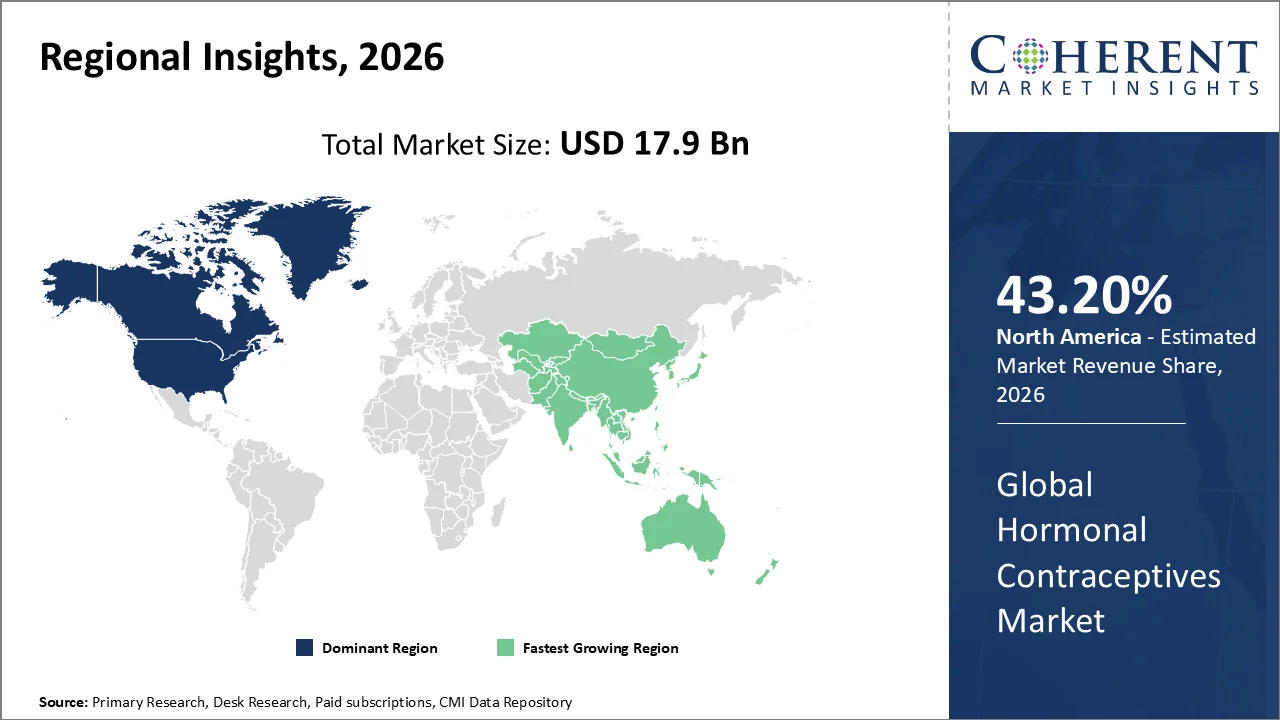
North America dominates owing to advanced healthcare infrastructure and clinical access
North America is expected to acquire the dominant share of 43.20% in 2026. High awareness of reproductive health and widespread use of modern contraceptive methods drive the hormonal contraceptives market in North America. Strong healthcare infrastructure and easy access to gynecological services support consistent adoption. As of 2025, the United States has 53,163 actively practicing OB/GYNs. Advanced pharmaceutical innovation, expanding telehealth services, and high acceptance of hormonal contraceptives for contraceptive and non-contraceptive uses such as acne and menstrual regulation also strengthen market growth. Perrigo Company plc announced that the U.S. Food and Drug Administration (FDA) has approved Opill, a progestin-only daily oral contraceptive, for over-the-counter use across all age groups. Opill becomes the first birth control pill available without a prescription in the United States.
Asia Pacific Hormonal Contraceptives Market Trends
Key drivers of the hormonal contraceptives market in Asia Pacific include rising awareness of reproductive health, increasing urbanization, and the growing participation of women in the workforce. Governments expand family planning initiatives, while healthcare systems improve access to services, which further drives market growth. Advances in contraceptive methods and wider distribution through pharmacies and clinics also enhance adoption across developed and emerging economies, sustaining strong regional demand in healthcare systems overall.
United States Hormonal Contraceptives Market Trends
Increasing awareness of reproductive health drives the hormonal contraceptives market in the United States, while strong focus on family planning encourages adoption of effective methods. Consumers increasingly choose long-acting reversible contraceptives for better convenience and reliability. Insurance coverage and public health programs expand access across population groups. Pharmaceutical innovations improve delivery options such as patches, implants, and intrauterine devices. Telehealth platforms and online prescriptions increase ease of access, and companies continuously introduce new products to broaden available contraceptive choices. For instance, in February 2025, Sebela Women’s Health Inc., part of Sebela Pharmaceuticals, announced that the U.S. FDA has approved MIUDELLA (a copper intrauterine system) for pregnancy prevention in females of reproductive age for up to three years. MIUDELLA is a next-generation, hormone-free, low-dose copper IUD and the first of its kind approved in the U.S. in over 40 years.
China Hormonal Contraceptives Market Trends
Rising urbanization and increasing participation of women in the workforce drive demand for hormonal contraceptives in China. Greater awareness of reproductive health encourages more individuals to adopt these methods. Government initiatives that support family planning and improve healthcare access also boost usage. Pharmaceutical companies expand distribution networks and online pharmacies to improve product availability. At the same time, people delay childbirth and adopt changing lifestyles, while preferring reliable, reversible contraceptive options, which together strengthen market growth across urban and rural regions.
Who are the Major Companies in Hormonal Contraceptives Industry
Some of the major key players in Hormonal Contraceptives are The Female Health Company, Teva Pharmaceutical Industries Limited, Bayer AG, Pfizer, Inc., Mylan N.V., Johnson & Johnson, Ansell Ltd., Mayer Laboratories, Merck & Co., Inc., Church & Dwight, Co., Inc., Afaxys, Inc., Allergan plc., Agile Therapeutics, Apothecus Pharmaceutical Corporation., Novartis AG, Sun Pharmaceutical Industries Ltd., and Cipla Limited.
Key News
- In August 2025, the Bill & Melinda Gates Foundation introduced an affordable long-acting hormonal IUD and contraceptive patch in Kenya to improve contraceptive access across Africa.
Market Report Scope
Hormonal Contraceptives Market Report Coverage
| Report Coverage | Details | ||
|---|---|---|---|
| Base Year: | 2025 | Market Size in 2026: | USD 17.9 Bn |
| Historical Data for: | 2020 To 2024 | Forecast Period: | 2026 To 2033 |
| Forecast Period 2026 to 2033 CAGR: | 5.2% | 2033 Value Projection: | USD 23.7 Bn |
| Geographies covered: |
| ||
| Segments covered: |
| ||
| Companies covered: | The Female Health Company, Teva Pharmaceutical Industries Limited, Bayer AG, Pfizer, Inc., Mylan N.V., Johnson & Johnson, Ansell Ltd., Mayer Laboratories, Merck & Co., Inc., Church & Dwight, Co., Inc., Afaxys, Inc., Allergan plc., Agile Therapeutics, Apothecus Pharmaceutical Corporation., Novartis AG, Sun Pharmaceutical Industries Ltd., and Cipla Limited. | ||
Analyst Opinion
- Hormonal contraceptives adoption is driven more by unmet reproductive health needs than lifestyle preference. Globally, around 164 million women of reproductive age still have an unmet need for modern contraception, highlighting a structural healthcare gap that continues to fuel demand rather than discretionary usage trends.
- Oral contraceptive pills remain one of the most widely used hormonal methods, with over 150 million users worldwide, reinforcing their position as a first-line option in both developed and emerging healthcare systems due to ease of access and clinical familiarity.
- Long-acting reversible contraceptives such as hormonal IUDs and implants are rapidly gaining clinical preference, with studies showing failure rates of less than 1% per year, making them significantly more effective than short-acting methods and driving strong physician-led adoption in public health programs.
- In markets like China, rising contraceptive counseling rates in urban hospitals and expanding insurance coverage for selected hormonal methods are shifting adoption patterns toward medically guided choices rather than over-the-counter self-selection, strengthening institutional demand across healthcare systems.
Speak to the analyst
Want personalized insights?
Take the findings above to one of our principal consultants, or have the report rebuilt around the segments, geographies and competitors you actually track.
Market Segmentation
- By Product (Revenue, USD Bn, 2021-2033)
- Oral Contraceptive Pills
- Injectable Birth Control
- Emergency Contraceptive Pills
- Vaginal Ring
- Transdermal Patches
- By Hormone (Revenue, USD Bn, 2021-2033)
- Progestin Only Contraceptive
- Combined Hormonal Contraceptive
- By Age Group (Revenue, USD Bn, 2021-2033)
- 15–24 Years
- 25–34 Years
- 35–44 Years
- Above 44 Years
- By End User (Revenue, USD Bn, 2021-2033)
- Hospitals
- Homecare
- Gynecology Centers
- Clinics
- Ambulatory Surgical Centers
- By Region (Revenue, USD Bn, 2021-2033)
- North America
- U.S.
- Canada
- Latin America
- Brazil
- Mexico
- Argentina
- Rest of Latin America
- Europe
- Germany
- U.K.
- France
- Italy
- Spain
- Russia
- Rest of Europe
- Asia Pacific
- China
- India
- Japan
- Australia
- South Korea
- ASEAN
- Rest of Asia Pacific
- Middle East
- GCC
- Israel
- Rest of Middle East
- Africa
- South Africa
- Central Africa
- North Africa
- North America
Sources
Primary Research interviews
- Gynecologists and obstetricians from tertiary care hospitals
- Endocrinologists and reproductive health specialists
- Pharmacists and hospital pharmacy managers
- Family planning program coordinators and public health officials
- Women using hormonal contraceptives across urban and rural regions
Databases
- National health statistics databases
- Government drug and pharmaceutical databases
- Clinical trial registries related to contraceptive drugs
- Hospital prescription and electronic medical record databases
- Academic biomedical and life sciences databases
Magazines
- Healthcare and life sciences trade magazines
- Pharmaceutical industry magazines
- Women’s health and wellness publications
- Medical practitioner-focused magazines
- Public health awareness magazines
Journals
- Peer-reviewed journals in reproductive health and endocrinology
- Pharmaceutical science and drug development journals
- Obstetrics and gynecology research journals
- Public health and epidemiology journals
- Clinical medicine journals focusing on hormonal therapies
Newspapers
- National and regional newspapers covering healthcare developments
- Financial newspapers reporting pharmaceutical product launches and approvals
- Public health and policy-related news sections
- Health and science feature articles in mainstream newspapers
Associations
- Medical associations in obstetrics and gynecology
- Reproductive health and family planning associations
- Pharmaceutical and life sciences industry associations
- Public health and women’s health advocacy groups
- Endocrine and hormonal research societies
Public Domain sources
- Government health ministry publications and reports
- World health organization publications and fact sheets
- Public policy documents on family planning programs
- Regulatory authority drug approval announcements
- National reproductive health survey reports
Proprietary Elements
- CMI Data Analytics Tool
- Proprietary CMI Existing Repository of information for last 10 years
Get access to 250+ pages report
Every segment, forecast, competitor profile and data table behind the analysis above — available for instant download.
- ESOMAR Member
- ISO 9001:2015 Certified
- D-U-N-S Registered
- GDPR & CCPA Compliant
Missing comfort of reading report in your local language? Find your preferred language:
Transform your Strategy with Exclusive Trending Reports
Frequently Asked Questions
The Hormonal Contraceptives Market is anticipated to grow at a CAGR of 5.2% with USD 17.9 Bn share in 2026 and is expected to reach USD 23.7 Bn in 2033.
Initiatives taken by the respective government to raise awareness about the use of contraceptives, rise in menstruating population worldwide, and increasing focus on family planning are fuelling the growth of the market.
The oral contraceptive pills segment is the leading product type segment in the market.
Side effects associated with hormonal contraceptives is the major factor restraining growth of the market.
Major players operating in the market include The Female Health Company, Teva Pharmaceutical Industries Limited, Bayer AG, Pfizer, Inc., Mylan N.V., Johnson & Johnson, Ansell Ltd., Mayer Laboratories, Merck & Co., Inc., Church & Dwight, Co., Inc., Afaxys, Inc., Allergan plc., Agile Therapeutics, Apothecus Pharmaceutical Corporation., Novartis AG, Sun Pharmaceutical Industries Ltd., and Cipla Limited.